
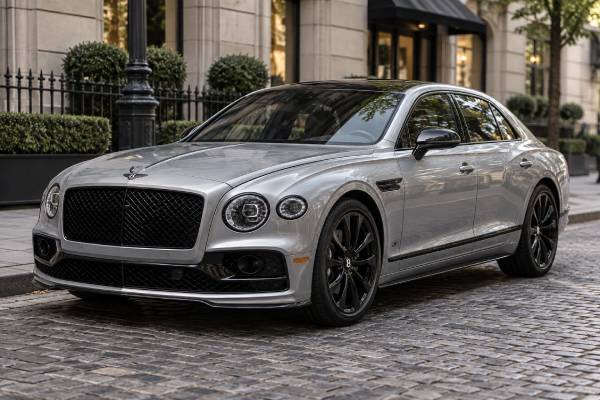
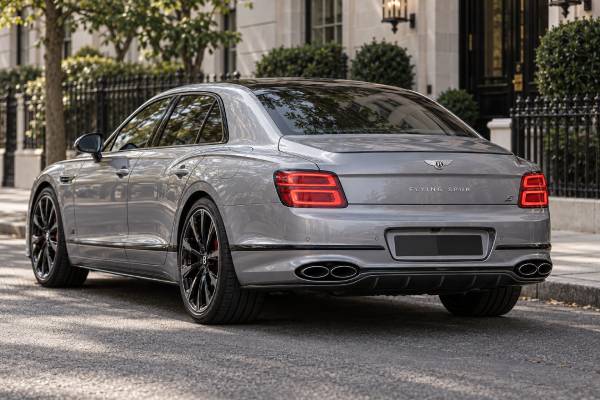
The 2022–2024 Bentley Flying Spur S V8 is the driver-focused middle ground in the third-generation range. It uses the familiar 542 hp 4.0-liter twin-turbo V8 rather than the Speed’s W12, but it combines that engine with standard Bentley Dynamic Ride, electronic all-wheel steering, a sports exhaust, dark exterior trim, and an S-specific cabin. The result is not the fastest Flying Spur of its era. It is the one designed to feel more responsive and more vocal at the speeds an owner can actually use.
That makes the S V8 appealing on the used market, where its specification can offer much of the Speed’s chassis sophistication with less weight over the front axle. It also means buyers must inspect more than the engine. The 48-volt active anti-roll system, rear steering, 22-inch wheels, large brakes, dual-clutch transmission, air suspension, and extensive electronics all contribute to the car’s character and cost. This article explains how those systems work together, how the S differs from the Azure and Hybrid, and which condition checks matter before buying a 198 mph luxury sports sedan.
Table of Contents
- What the S specification adds
- V8 S technical facts
- Active chassis in detail
- Engine, transmission, and sound
- S cabin and equipment
- Wear, maintenance, and cost control
- How to buy an S V8
What the S specification adds
The S turns the regular Flying Spur V8 into a more assertive driver’s car through chassis equipment, exhaust tuning, styling, and interface changes. It does not raise engine output, so the value rests on how the car responds and feels rather than a larger horsepower number.
Bentley positioned S between the comfort-focused Azure and the W12-powered Speed. The S V8 received Bentley Dynamic Ride and electronic all-wheel steering as standard at launch, along with a sports exhaust intended to reveal more of the cross-plane V8 note. Dark-tinted lamps, gloss-black grille and brightware, S badging, red brake calipers, and a 22-inch wheel created a visual identity that was sportier without copying the Speed exactly.
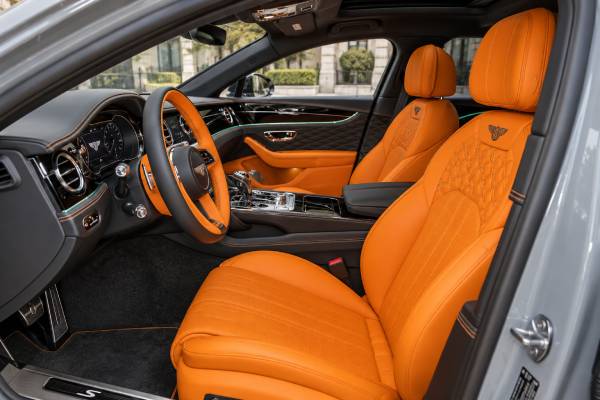
Inside, leather and Dinamica were combined on S-design seats and touch points. The instrument panel used performance graphics inspired by motorsport chronographs, and the treadplates, fascia, and embroidery carried S branding. These features matter to resale because retrofitted black trim or generic upholstery cannot recreate the factory package convincingly.
The car remains a Flying Spur first. It retains generous rear space, a long wheelbase, extensive sound insulation, powered comfort features, and the ability to be configured with four or five seats. The S brief does not make it harsh. Instead, active hardware broadens the difference between Comfort, Bentley, and Sport modes.
The V8 is central to the model’s balance. Compared with the W12, it removes about 100 kg and improves weight distribution. The engine still produces 770 Nm and can accelerate the sedan to 60 mph in 4.0 seconds. On public roads, the lighter nose and active chassis can be more noticeable than the Speed’s additional output.
The S Hybrid offered the same visual philosophy with a 2.9-liter PHEV, but its engineering priorities differed. The V8 has a larger trunk, lower mass, a continuous combustion soundtrack, and no charging requirement. The Hybrid can travel locally on electricity and posts lower official emissions. Buyers should decide which experience they value before shopping by color or price.
V8 S technical facts
The Flying Spur S V8 is an all-wheel-drive gasoline sedan with a twin-turbo 4.0-liter engine and an eight-speed dual-clutch transmission. The following data applies to the 550 PS version; regional emissions figures, tires, and unladen-weight conventions can differ.
| Specification | Value |
|---|---|
| Engine | 4.0-liter twin-turbocharged V8 |
| Displacement | 3,996 cc |
| Maximum output | 550 PS (542 bhp; 404 kW) |
| Maximum torque | 770 Nm (568 lb-ft) |
| Induction | Two twin-scroll turbochargers in hot-V layout |
| Efficiency feature | Four-cylinder deactivation at suitable light load |
| Gearbox | 8-speed dual-clutch automatic |
| Driven wheels | Active all-wheel drive |
| Specification | Value |
|---|---|
| 0–60 mph | 4.0 seconds |
| 0–100 km/h | 4.1 seconds |
| Maximum speed | 318 km/h (198 mph) |
| Fuel tank | 90 liters (23.8 US gal) |
| Luggage capacity | 420 liters (14.8 cu ft) |
| Seat layouts | Five-seat or optional four-seat cabin |
| Specification | Value |
|---|---|
| Overall length | 5,316 mm (209.3 in) |
| Width across mirrors | 2,220 mm (87.4 in) |
| Wheelbase | 3,194 mm (125.7 in) |
| Air suspension | Adaptive three-chamber system |
| Active anti-roll system | Bentley Dynamic Ride, 48-volt |
| Rear steering | Electronic all-wheel steering |
| Torque distribution | Rear-biased active AWD with brake-based vectoring |
| Standard wheel design | 22-inch S-specific alloy |
The official acceleration figure is only part of the story. Battery state does not affect peak output as it does in a PHEV, and the 90-liter tank plus 420-liter trunk make the V8 straightforward for touring. The tradeoff is fuel consumption, especially in traffic or repeated high-load use.
Active chassis in detail
The S V8’s main technical advantage is the way its chassis systems manage size and mass. Dynamic Ride reduces body roll, rear steering changes the car’s effective wheelbase, and active all-wheel drive provides traction without making the steering feel permanently front-driven.
Bentley Dynamic Ride uses electric motors powered by a 48-volt network to apply anti-roll torque. Bentley quoted up to 1,300 Nm in 0.3 seconds for the system. In a corner, it counters body movement; over a one-sided bump in a straight line, it can reduce the rigid coupling associated with a conventional anti-roll bar. This allows the car to be controlled in Sport mode without making Comfort needlessly busy.
The system should create a clear difference between drive modes. If the car rolls excessively, displays a chassis warning, or feels identical in every setting, scan the 48-volt subsystem and check actuators, sensors, wiring, battery health, and software. Replacement parts are expensive, so diagnosis must be precise.
Electronic all-wheel steering turns the rear wheels by up to about 4.2 degrees at low speed in the opposite direction to the fronts. The result is a tighter turning circle and easier parking. At higher speed, same-direction rear steering improves stability. Poor alignment, impact damage, a failing actuator, or incorrect calibration can show up as a crooked steering wheel, nervous lane changes, or unusual rear tire wear.
The air suspension supplies the base ride. Three chambers allow the effective spring rate to change, and adaptive dampers control wheel motion. Observe the car after it has stood overnight; all corners should remain even. During the test drive, listen for knocks and check that height or mode changes happen within a reasonable period without excessive compressor noise.
Active all-wheel drive can send torque forward as conditions require while preserving rear-led behavior. Torque Vectoring by Brake helps rotate the car by applying small braking forces to individual wheels. These systems are subtle. A buyer should not expect a dramatic display, but the car should put power down cleanly and remain neutral through a fast bend.
Tires are the common denominator. The chassis was tuned around high-quality, approved performance tires. A mixed set with different tread depths changes steering, braking, ride, and stability-control behavior. The S cannot compensate for a poor foundation.
Chassis condition is especially sensitive to tires. The S calibration assumes four closely matched tires with the correct construction, load capacity, pressure, and remaining tread. A mismatched pair can alter steering feel before it triggers an obvious fault, while inner-shoulder wear may remain invisible from a normal standing position. During inspection, turn the steering to view the front inner edges, examine the rear tires from underneath, and check each wheel for bends or previous straightening. Then drive on both smooth and broken pavement: a healthy car should change character between modes without knocking, repeated bouncing, or a steering-wheel tremor. Alignment should be measured after pothole impacts or tire replacement, not used merely to disguise worn suspension joints or damaged wheels.
The sports exhaust deserves the same practical test. Confirm that its valves operate consistently, that no warning is stored, and that the sound changes as intended rather than producing a metallic rattle. An aftermarket exhaust or software alteration may affect warranty coverage, emissions compliance, refinement, and resale, so originality should be documented rather than assumed.
Engine, transmission, and sound
The S V8’s engine is unchanged in headline output from the regular V8, but the sports exhaust and sharper overall presentation make it feel more expressive. Its strength is low- and midrange torque, not a need to chase the redline.
The hot-V turbo layout shortens the path from exhaust valves to turbines. Twin-scroll housings organize exhaust pulses for quicker response. Torque reaches 770 Nm below 2,000 rpm and remains broad, allowing the gearbox to accelerate the car strongly without repeated shifts.
Cylinder deactivation can turn off four cylinders under light load and suitable engine speed. Bentley engineered the transition to occur in milliseconds. The driver should not feel a persistent tremor. A vibration at cruise may instead come from wheel balance, tire flat-spotting, engine mounts, ignition, or driveline components.
The eight-speed dual-clutch transmission gives the S its rapid changes and direct connection. In Sport, it holds gears and responds quickly to paddles. At parking speed, clutch take-up can feel more mechanical than a torque-converter automatic. The line between character and fault is consistency: healthy operation is repeatable, while failing or poorly adapted behavior produces shudder, delayed selection, heavy engagement, or warnings.
The sports exhaust is a defining reason to choose this car. It deepens the V8 note and becomes more present in Sport mode without turning the rear cabin into an endurance test. Modified exhausts may be louder but can introduce drone, emissions faults, warranty questions, and a narrower resale audience. Verify that valves operate and that any changes are documented and reversible.
Acceleration remains immense for a luxury sedan. The 4.0-second run to 60 mph is only part of the appeal; the car’s ability to accelerate from medium speed with minimal preparation is more useful. The 198 mph maximum demonstrates cooling and stability capability, but tire age and specification must be treated seriously even when the car is driven far below that speed.
Fuel economy depends on discipline. Cylinder deactivation and tall gearing help during a steady cruise, but the S invites throttle use. Owners should budget for premium gasoline rather than using an optimistic highway figure as the total cost forecast.
S cabin and equipment
The S interior trades some of Azure’s visual softness for grip, contrast, and performance cues. Its condition reveals how the car was used, because Dinamica, bolsters, dark trim, and touch points show wear differently from conventional glossy leather.
Dinamica appears on seats and controls, combined with leather in the S-specific layout. Inspect the steering wheel rim, gear selector, seat centers, and side bolsters for flattening, oiliness, pilling, or color change. Incorrect cleaning can make the material hard or shiny. Factory replacement pieces are costly and color matching matters.
S embroidery, metal treadplates, fascia badging, and instrument graphics should all agree with the build. A car with aftermarket badges or blacked-out trim may be a standard V8 styled to resemble an S. The VIN and option codes settle the question.
The central touchscreen, digital instruments, head-up display, cameras, navigation, connectivity, and driver-assistance features should load promptly and retain settings. Some functions require active subscriptions or compatible mobile networks; separate a service-availability issue from a hardware fault.
The Bentley Rotating Display may be fitted. It rotates between touchscreen, analog gauges, and veneer. Test repeated cycles, inspect panel alignment, and listen for motor or gear noise. A decorative mechanism that works only occasionally should be valued as a defect.
Rear equipment can be extensive even in an S. Check massage, heating, ventilation, blinds, tables, the touchscreen remote, entertainment screens, climate controls, and power outlets. A four-seat car is visually dramatic, while five seats are more versatile. The correct choice depends on passengers and luggage, not perceived prestige.
Audio options include Bang & Olufsen and Naim. Play multiple sources and inspect all channels. Door rattles or bass distortion can come from trim clips as well as speakers. In a car with a sports exhaust, verify sound both with the system quiet and at normal listening levels.
Wear, maintenance, and cost control
The most reliable way to control S V8 costs is to buy a fully maintained car and correct small issues before they affect connected systems. Deferred tires, alignment, batteries, and leaks create secondary faults and make the chassis feel worse long before the car stops.
Annual servicing should use the exact oil approval and filter specified for the VIN. Review invoices for spark plugs, brake fluid, filters, coolant, belts, transmission and differential attention, software updates, and inspection of turbo and cooling circuits. Low mileage does not suspend time-based requirements.
The 12-volt battery deserves a test at every inspection. Modern Bentleys can log numerous faults during low voltage, and stored cars are vulnerable. Use an approved maintainer and replace the battery with the correct technology and registration procedure. Both keys should be present and functional.
Twenty-two-inch tires are expensive and easy to damage. Check tread at inner, center, and outer positions, age codes, sidewalls, repairs, and matching specification. Vibration can come from bent inner rims even when the outer face is perfect. Alignment must account for rear steering and correct ride height.
Brake assessment needs measurements. Iron discs can be worn, heat-checked, or corroded on the inner side. Carbon-ceramic brakes, if a particular car has them, require specialist evaluation for impact damage and remaining life. Caliper color is cosmetic; disc condition is financial.
Air suspension and Dynamic Ride should be checked after an overnight stand and a full warm drive. A single low corner points to leakage. Frequent compressor cycling accelerates wear. A 48-volt warning can involve power supply, control, or actuator faults; do not accept a vague assurance that it is a sensor without a report.
The V8’s hot-V area concentrates heat. Inspect coolant residue, oil seepage, turbo lines, hoses, undertrays, and fan operation. A clean engine bay may have been detailed before sale, so look beneath and review previous repairs.
Body and cabin preservation matter on an S. Gloss-black trim scratches easily, machine-finished wheels need correct refurbishment, and Dinamica requires gentle products. Poor cosmetic repairs lower value even when the car is mechanically strong.
How to buy an S V8
A good S V8 feels tight, consistent, and accurately specified. It should not rely on its exhaust note to distract from warning messages, tire vibration, brake wear, or disabled chassis systems.
Start with documentary proof. Obtain the VIN, build sheet, complete service record, recall status, warranty claims, body-repair invoices, and diagnostic history where available. Confirm that the car is a factory S and identify every expensive option before the physical inspection.
View the car cold. Check ride height, fluid marks, tire pressure, wheel damage, brake surfaces, and battery voltage before starting. Watch the instrument self-test, then listen to the engine with the hood open and closed. A healthy V8 settles quickly and produces no smoke or persistent ticking beyond normal direct-injection sounds.
The road test should include low-speed clutch operation, a tight turning maneuver to assess rear steering, rough surfaces, each drive mode, firm acceleration, highway-speed balance, and controlled braking. Dynamic Ride should make the car notably flatter in Sport, while Comfort should remain supple. No warning should appear after repeated mode changes.
Commission a specialist to perform:
- a full module scan with codes and freeze-frame data;
- 12-volt and 48-volt battery/system tests;
- underbody, coolant, and oil-leak inspection;
- tire and wheel measurement, including inner rims;
- brake thickness and condition report;
- air-suspension leak check and compressor review;
- rear-steering calibration and alignment assessment;
- paint-depth survey and sensor-calibration verification;
- recall completion check by VIN.
Price repairs before committing. A car due for tires, front brakes, annual service, battery replacement, and wheel refinishing may need a large immediate spend. A warranty can be valuable, but read exclusions for wear items, trim, electronics, and pre-existing faults.
Choose the S V8 over the Azure V8 when darker styling, sports exhaust, Dynamic Ride, rear steering, and a firmer driver emphasis are priorities. Choose the Azure when bright trim, comfort presentation, and wellness seating matter more. Choose the Speed W12 for maximum power, flagship significance, and 207 mph performance. The S occupies a useful center because it uses the lighter V8 while retaining serious chassis hardware.
The final decision should be based on coherence. An original car with matching tires, clean diagnostics, documented annual service, and fully working options is worth more than a lower-mileage example with unexplained gaps. Once sorted, the S V8 is one of the clearest expressions of the Flying Spur’s unusual ability to be both a rear-seat luxury car and a genuinely rewarding machine from the driver’s seat.
References
- Bentley News 2022 : NEW FLYING SPUR S – SPORTING STYLE TO DEBUT AT GOODWOOD FESTIVAL OF SPEED 2022 (Model Launch)
- Flying Spur Now Available with Renowned V8 Powertrain | Bentley Media 2020 (V8 Engineering)
- BENTLEY NEWSROOM : Flying Spur 2024 (Model Overview)
- Bentley News 2023 : BRINGING HARMONY TO AZURE, S AND SPEED 2023 (Design Update)
- Bentley Motors Website: Set Up Guide: Flying Spur Set Up Guide 2026 (Connected Features)
- Check for Recalls: Vehicle, Car Seat, Tire, Equipment | NHTSA 2026 (Recall Database)
Disclaimer
This article is for informational purposes only and does not replace professional diagnosis, repair, or a VIN-specific pre-purchase inspection. Specifications, torque values, service intervals, procedures, and equipment can differ by market, model year, and factory build. Verify all requirements with official Bentley service documentation. Please share this guide on Facebook, X/Twitter, or another platform if it helped you.