

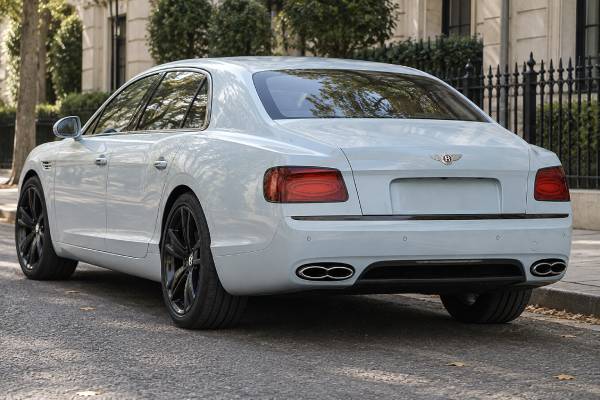
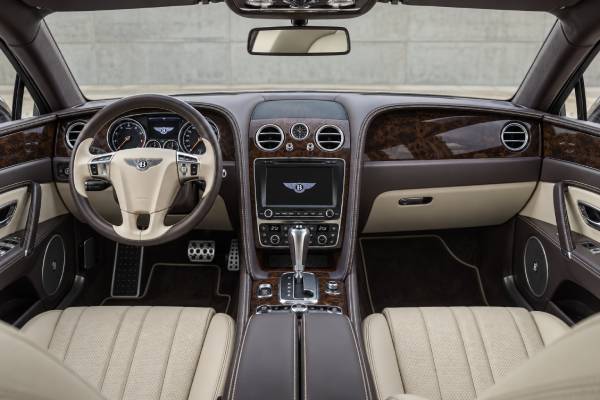
The 2014–2018 Flying Spur V8 is often described as the sensible version of an extravagant sedan, but that understates its character. Its 4.0-liter twin-turbo V8 produces 500 hp and 660 Nm, drives all four wheels through an eight-speed automatic, and reaches 60 mph in roughly five seconds. More important, the shorter, lighter engine reduces mass over the front axle, giving the car a more natural response while preserving the air-suspended comfort and hand-built cabin expected of a Bentley. It is still complex, expensive to repair, and vulnerable to neglected cooling, lubrication, ignition, suspension, brake, tire, and electrical systems. The V8 badge does not turn it into an ordinary executive car. This guide focuses on why the standard V8 can be the sweet spot of the 4W2 range, how its hot-V engine and cylinder-deactivation system work, what long-term care requires, and how to separate a properly maintained example from one whose lower purchase price merely postpones major bills.
Table of Contents
- Why the V8 Can Be the Range Sweet Spot
- Technical Specifications and Performance
- Hot-V Engine, Turbocharging, and Cylinder Deactivation
- Road Manners, Range, and Everyday Use
- Failure Prevention and Maintenance Logic
- Evidence to Demand Before Buying
- V8 Versus W12 and the Ownership Verdict
Why the V8 Can Be the Range Sweet Spot
The standard V8 gives up ultimate speed to the W12 but gains lighter front-end response, longer potential range, a distinctive exhaust note, and somewhat lower routine consumption. For many drivers, those changes make it the most usable second-generation Flying Spur.
Bentley introduced the V8 after launching the 4W2 with the W12. The 3,993 cc engine belongs to the Volkswagen Group’s twin-turbo V8 family, but Bentley applied its own intake, exhaust, software, cooling, driveline, acoustic, and chassis calibration. Output is 500 hp in the assignment’s rating, commonly expressed as 507 PS, with 660 Nm available across a broad band.
The V8 is physically shorter and lighter than the W12. The entire car remains heavy, yet the reduction ahead of the cabin improves turn-in and makes steering corrections feel less deliberate. The difference is clearest on a winding road or broken surface, not during a straight-line demonstration where both engines feel effortless.
Cylinder deactivation can shut down four cylinders at light load. The system is intended to operate without an obvious transition and contributes to improved cruising efficiency. It does not mean the car should be driven on cheap fuel, serviced like a small V8 sedan, or accepted with vibration because “it is changing modes.” Roughness requires diagnosis.
Visual distinctions from the W12 were restrained. V8 models typically used red Bentley badges, figure-eight exhaust outlets, specific wheel designs, and dark grille details, but individual options and later modifications blur these cues. Factory build information is the reliable method of identification.
The standard V8 should also be separated from the 2016–2018 V8 S. The S raises output to 521 hp, torque to 680 Nm, and adds a sportier calibration and appearance. A standard V8 fitted with black trim or S wheels does not become an S, while an authentic S missing cosmetic details remains identifiable through its VIN data.
Technical Specifications and Performance
This Flying Spur is a gasoline-only internal-combustion vehicle. It uses a twin-turbocharged V8, eight-speed torque-converter automatic, permanent rear-biased all-wheel drive, and self-leveling adaptive air suspension.
| Item | Value | Owner significance |
|---|---|---|
| Displacement | 3,993 cc | Aluminium twin-turbo V8 |
| Maximum power | 500 hp (about 507 PS / 373 kW) | Standard V8, not V8 S |
| Maximum torque | 660 Nm (487 lb-ft) | Broad plateau for low-rpm response |
| Turbo layout | Twin turbochargers inside the cylinder-bank V | Compact hot-V packaging |
| Efficiency feature | Four-cylinder deactivation at suitable light loads | Transition should be unobtrusive |
| Fuel | Premium unleaded gasoline | Follow market label and manual |
| System | Configuration |
|---|---|
| Transmission | ZF eight-speed torque-converter automatic |
| Drive | Permanent all-wheel drive, nominally 40:60 front to rear |
| Front suspension | Double wishbones with air spring and controlled damper |
| Rear suspension | Multi-link with self-leveling air spring |
| Steering | Speed-sensitive hydraulic power assistance |
| Brakes | Large ventilated discs; carbon-ceramic system optional in some markets |
| Measure | Approximate factory figure | Comparison |
|---|---|---|
| 0–60 mph | 4.9 seconds | Still exceptionally quick for its mass |
| 0–100 km/h | 5.2 seconds | About six-tenths behind the early W12 |
| Top speed | 295 km/h (183 mph) | More than sufficient for grand touring |
| Torque delivery | Strong from low engine speed | Fewer downshifts in normal use |
| Powertrain class | ICE | No high-voltage battery or electric drive |
| Item | Approximate value |
|---|---|
| Length | 5,299 mm (208.6 in) |
| Wheelbase | 3,066 mm (120.7 in) |
| Width across body | About 1,984 mm (78.1 in) |
| Kerb weight | Approximately 2,425 kg (5,346 lb), specification-dependent |
| Fuel tank | About 90 L (23.8 US gal) |
| Seating | Four or five, depending on rear-console configuration |
| Area | Evidence of good condition | Warning sign |
|---|---|---|
| Lubrication | Correct oil, stable level, dry upper engine | Burning smell, smoke, recurring low level |
| Cooling | No residue, stable temperature, clean radiators | Top-up history or fans running excessively |
| Turbo system | Linear boost and quiet operation | Whistle, surge, oil smoke, underboost codes |
| Cylinder deactivation | Imperceptible transition | Vibration or repeated mode-related faults |
| Air suspension | Even height and brief compressor cycles | Overnight sag or repeated level warnings |
Hot-V Engine, Turbocharging, and Cylinder Deactivation
The V8 places its exhaust manifolds and turbochargers inside the valley between the cylinder banks. This hot-V arrangement shortens the exhaust path to the turbines, improving response and making the package compact. It also concentrates heat, which raises the importance of correct oil, clean cooling surfaces, sound seals, and controlled shutdown after severe use.
A healthy engine should start quickly, settle without chain rattle or metallic tapping, and remain smooth with air-conditioning loads applied. Exhaust should be clean after the initial cold-start enrichment. Blue smoke after idling, persistent white vapor with coolant loss, or black smoke under moderate load requires investigation.
Turbo response is designed to feel progressive. The V8 should not pause, surge, or abruptly change tone as boost builds. Diagnostic testing should compare requested and actual boost, wastegate control, intake temperatures, fuel pressure, ignition timing, and misfire counts. Replacing a sensor because a generic code mentions boost can miss leaks or mechanical control problems.
Heat affects seals, hoses, wiring insulation, plastic connectors, oil separators, and coolant components. Inspect the upper engine and valley carefully, but remember that some areas cannot be evaluated fully without removing covers or other hardware. A recently cleaned engine needs a longer heat-soak inspection to reveal seepage.
The cylinder-deactivation system closes valves and cuts fuel on selected cylinders when load, speed, temperature, and other conditions are suitable. The driver may see an efficiency indication, but should not feel a pronounced shudder. Rough transitions can come from engine mounts, ignition faults, software, uneven combustion, or driveline issues rather than the deactivation hardware alone.
Direct injection and turbocharging make fuel and ignition quality important. Use the recommended octane, avoid running the tank repeatedly near empty, and replace spark plugs with the exact approved type. Coil failures may appear only under boost. A light-throttle test cannot certify the ignition system.
Oil level deserves regular checks. Turbochargers rely on clean oil for lubrication and cooling, while incorrect level can harm emissions equipment and create smoke. Follow the Bentley measurement procedure; do not add oil merely because the car has been parked at an angle or has not reached the required conditions.
Owners sometimes assume a shared engine family means any independent workshop can service it. Familiarity with related Volkswagen Group products is useful, but the Flying Spur’s packaging, software, air suspension, interior systems, and Bentley-specific parts still require appropriate information and diagnostics.
Road Manners, Range, and Everyday Use
The V8’s advantage is balance rather than scarcity of power. It feels eager enough to make the W12 unnecessary on ordinary roads, while the lighter nose gives the steering and front suspension less work during direction changes.
In Comfort mode, the car should absorb broad undulations and isolate the cabin without continuing to oscillate. Bentley mode provides a useful default, while Sport tightens response and damping. A large wheel-and-tire package can make impacts sharper, but severe crashing, knocking, or steering kickback is not simply “sportiness.”
The eight-speed automatic usually keeps the V8 within its torque band. It should select drive promptly, creep smoothly, and shift without flare. A hard downshift during slowing, vibration at steady speed, or delay after a hot restart needs diagnostic data and fluid-level assessment rather than a blind adaptation reset.
Permanent all-wheel drive makes the car reassuring in rain and cold weather, provided the tires are correct. Check that all four tires match in manufacturer, model, size, load and speed rating, and similar tread depth. The system cannot compensate for summer tires in snow or for old rubber whose grip has hardened away.
The V8 may travel farther between fuel stops than the W12, especially during steady cruising when cylinder deactivation operates. Real consumption still depends heavily on speed, short trips, traffic, temperature, and use of climate systems. The large tank and relaxed gearing matter more to touring range than a single laboratory figure.
Urban use exposes other concerns. The body is wide, wheels are vulnerable to curbs, brake wear rises in stop-and-go driving, and short trips may not fully charge the batteries. Cameras, parking sensors, powered mirrors, and keyless access should all function because they are practical necessities on a car of this size.
Rear-seat comfort can be exceptional, but test it as a passenger. Listen for trim noise over diagonal bumps, confirm climate airflow, operate blinds and tables, and check that powered seats move without twisting or clicking. A car used for professional transport may have greater rear-cabin wear than its odometer suggests.
Long journeys are the Flying Spur’s natural environment. Stable temperature, low wind noise, accurate alignment, and vibration-free wheels become more important than a brief acceleration run. A specialist road test should therefore include a sustained cruise, not only city streets around a showroom.
Failure Prevention and Maintenance Logic
Preventive maintenance should target heat, fluids, voltage, air leakage, and mass-related wear. Waiting for a dashboard warning often means a small weakness has already affected another component.
Begin with a documented baseline if history is incomplete. Scan every control unit, test batteries and alternator, measure parasitic draw, pressure-test cooling, inspect oil leakage, assess transmission behavior, record suspension heights, measure brake discs, and list tire dates and tread depths.
Change engine oil by time as well as mileage with the exact approved specification. Cars driven infrequently still accumulate moisture and fuel dilution. Inspect filters and intake paths for debris or rodent damage if the car has been stored.
Keep the cooling stack clean. Leaves and road debris can become trapped between the air-conditioning condenser, charge-cooling components, and radiators. Verify fan operation at different demands and inspect auxiliary pumps and hose junctions. A stable gauge during a short drive does not prove full cooling capacity.
Brake fluid should be renewed on a time basis. The standard steel brakes need disc-thickness and runout measurements; carbon-ceramic systems, when fitted, require specialist condition assessment and careful handling. Wheel removals must use correct lifting points, bolt torque, and equipment that will not damage the finish.
Air-suspension diagnosis should distinguish between a leaking strut, line, valve block, reservoir issue, level sensor, compressor, and calibration. Replacing the compressor without correcting a leak merely restarts the failure cycle. Listen for repeated operation after parking and measure actual heights.
Transmission and differential fluids should be inspected for leaks and condition. Any service requires exact fluid and temperature procedures. A universal fluid or aggressive machine flush is not a maintenance shortcut.
Maintain batteries with an appropriate charger during storage, but investigate why a healthy car discharges. Exercise electrical equipment periodically and lock the car as instructed so modules enter sleep. Accessories plugged into power outlets or aftermarket tracking devices can create hidden draw.
Record part numbers, dates, software updates, and measured results. This history helps the next technician recognize trends and prevents expensive parts from being replaced twice because the original diagnosis was undocumented.
Evidence to Demand Before Buying
A good V8 should provide evidence in four categories: identity, maintenance continuity, current mechanical condition, and correct operation of its luxury equipment. A stamped book without invoices covers only part of that proof.
Confirm the VIN and factory specification. Verify that the car is the standard 500 hp V8 rather than a V8 S, and identify wheels, brakes, seating layout, driver-assistance systems, audio, rear entertainment, and special-order trim. This helps price missing or non-working equipment accurately.
Review invoices chronologically. Long gaps, repeated battery replacements, repeated coolant top-ups, recurring misfire work, or the same suspension complaint appearing several times indicate unresolved causes. Major repairs are not a reason to reject a car when they were completed competently and documented.
Inspect from cold. Look for oil around the upper engine, coolant residue, damaged undertrays, aged tires, cracked wheel barrels, brake lips, corrosion, paint mismatch, and damp carpets. Check every key and remote-control device.
Use factory-capable diagnostics before clearing codes. Note emissions-readiness status, misfire histories, boost and fuel faults, suspension events, transmission entries, low-voltage records, and failed interior modules. A generic code reader cannot assess the whole vehicle.
The road test should include low-speed steering lock, diagonal bumps, smooth-road cruise, progressive acceleration, steady-speed light load, firm braking, all drive modes, and a hot restart. Observe whether cylinder-deactivation operation is smooth and whether the transmission remains refined after heat builds.
After parking, recheck for smells, smoke, leakage, uneven wheel heat, and suspension settling. Allow enough time for electronic systems to sleep before measuring current draw. Re-scan to identify faults created during the drive.
Check recalls and service campaigns by VIN through an authorized source. Broad online year lists are screening tools, not proof that a specific vehicle is included or complete. Save the result with the inspection record.
Calculate a first-year budget using specialist parts and labor. Include tires approaching age limits, brakes near minimum thickness, cosmetic wheel repair, fluid baselining, battery replacement, and non-working options. Negotiate from documented needs rather than fear of the badge.
V8 Versus W12 and the Ownership Verdict
For most real-world driving, the standard V8 is fast enough to preserve the Flying Spur’s sense of excess. Its advantage over the W12 is not cheapness; it is a slightly lighter, more responsive, and potentially more efficient expression of the same luxury-sedan concept.
Choose the V8 when steering balance, exhaust character, touring range, and lower front-axle mass matter more than a 200 mph headline. Choose the W12 when effortless twelve-cylinder identity, maximum torque, and model prestige are central. Select the V8 S when the standard V8’s comfort bias feels too restrained and its firmer calibration is genuinely desired.
Condition remains decisive. A superb W12 can cost less to own than a neglected V8, and a late V8 with an impressive option list can still be a poor car. The engine choice changes the risk profile; it does not remove air suspension, complex electronics, expensive brakes, large tires, or handcrafted interior materials.
Avoid examples with oil smoke, unexplained coolant loss, turbo-control faults, rough cylinder-deactivation transitions, mixed tires, harsh transmission behavior, sinking suspension, damp modules, or recently erased codes. Multiple small faults often indicate that the owner stopped maintaining the car as a complete system.
Plan for annual specialist inspection, premium fuel, tires, brakes, fluids, secure storage, insurance, and a repair reserve. Driving the car regularly and fully warming it is generally better than preserving it through endless short starts and stationary idling.
The best V8s feel cohesive: the engine responds cleanly, the gearbox fades into the background, the chassis breathes with the road, the cabin remains silent, and every powered feature works. That cohesion is what the inspection is buying. When it is present and supported by records, the 2014–2018 Flying Spur V8 may be the most rational way to own an inherently irrational but deeply capable Bentley sedan.
Using oil and temperature trends intelligently
Owners can improve V8 reliability by tracking trends instead of reacting only to warnings. Record oil quantity added, distance traveled, trip pattern, ambient temperature, and any smoke or odor. A stable consumption pattern may be normal for the individual engine; a sudden increase after a service or turbo repair deserves immediate investigation. Do not compare two cars without considering oil specification, measurement procedure, and driving style.
Temperature trends are equally useful. The dashboard may display a stable normalized value while diagnostic data shows changes in coolant, oil, intake, or transmission temperature. A specialist can establish healthy reference values during a known-good drive, then compare them after radiator cleaning, pump replacement, or software work. This turns preventive maintenance into evidence rather than guesswork.
Avoid obsessive data collection without interpretation. One hot intake reading after idling or one low battery voltage during cranking does not define a fault. Trends become valuable when measured consistently and tied to symptoms. A concise log of oil additions, battery dates, coolant repairs, tire changes, and scan results gives a future technician a much stronger starting point than a stack of invoices with no operating context.
References
- BENTLEY NEWSROOM : Flying Spur 2026 (Manufacturer Model Archive)
- BENTLEY NEWSROOM : 2018 Flying Spur W12 S 2026 (Generation Dimensions and Chassis Context)
- BENTLEY NEWSROOM : Technical Specifications 2026 (Manufacturer Technical Archive)
- Vehicle Detail Search – 2014 BENTLEY FLYING SPUR | NHTSA 2026 (Recall Database)
- November 2, 2015 2015 (Recall Acknowledgment)
- Search Safety Issues | NHTSA 2026 (VIN Recall Search)
Disclaimer
This material is an educational overview rather than a diagnosis, valuation, or repair instruction for a particular Flying Spur. Confirm all specifications, procedures, fluids, campaign status, software, and part compatibility against the individual VIN and current Bentley service information.
Share this article on Facebook, X/Twitter, or a relevant owners’ forum if its inspection framework could help another V8 buyer.