
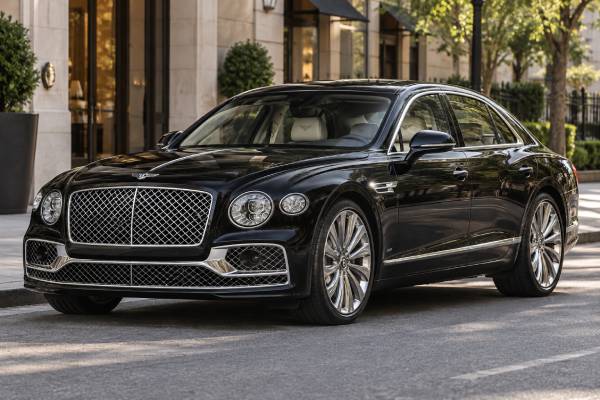
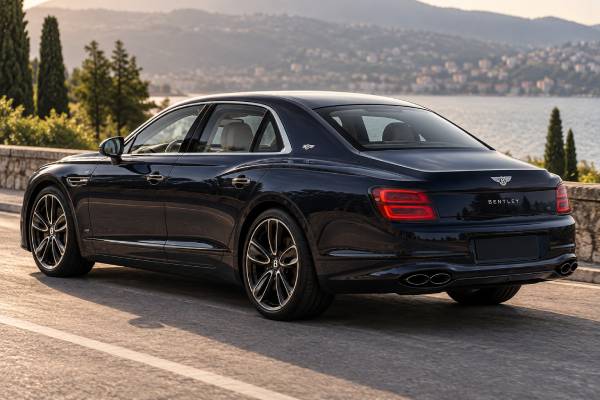
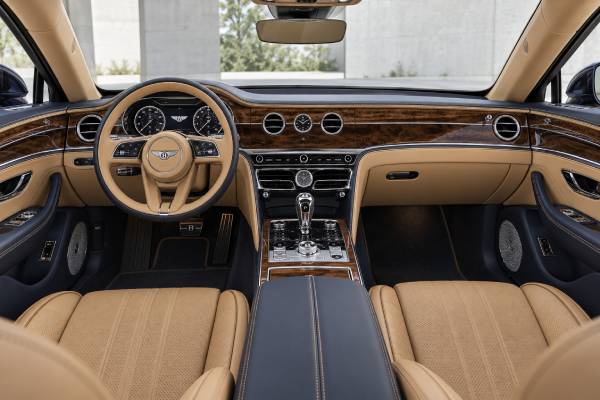
The 2020–2024 Flying Spur V8 is not simply the lower-output alternative to the ZG2 W12. Removing roughly 100 kg from the nose changes the sedan’s balance, while a 542 hp twin-turbo 4.0-liter engine, 770 Nm of torque, active all-wheel drive, rear-wheel steering, air suspension, and available 48-volt Bentley Dynamic Ride preserve most of the flagship’s ability. Bentley claimed 0–60 mph in 4.0 seconds and 198 mph, figures that make “entry-level” an absurd description. The V8 can also deactivate four cylinders during light-load cruising, extending range without adding a hybrid system. Used-car quality depends on much more than the engine. Tires, dual-clutch behavior, cooling, turbo plumbing, active chassis calibration, batteries, cameras, rotating displays, and luxury options must all function as one vehicle. This guide explains why the V8 may be the driver’s ZG2, documents its specifications, separates normal system behavior from developing faults, and provides a practical inspection and ownership strategy across the 2020–2024 production period.
Table of Contents
- Why the V8 Is the Driver’s ZG2
- V8 Specifications and Technical Data
- Balance, Steering, Braking, and Ride
- Hot-V Engine Health and Cylinder Deactivation
- DCT, Active Chassis, and Electrical Systems
- How to Inspect and Cost a Used ZG2 V8
- V8, W12, or Hybrid: Choosing and Owning
Why the V8 Is the Driver’s ZG2
The V8’s central advantage is reduced front-end mass. It gives away 84 hp and 130 Nm to the 626 hp W12, yet feels more willing to change direction and remains extraordinarily fast in ordinary use.
Bentley launched the third-generation Flying Spur with the W12, then added the 4.0-liter twin-turbo V8 for the 2020 model period. The engine produces 542 hp in the assignment’s rating, corresponding to Bentley’s 550 PS figure, and 770 Nm. It sends power through the same basic eight-speed dual-clutch transmission and active all-wheel-drive concept used in the W12.
The V8’s 90-degree, cross-plane architecture creates a distinct exhaust character. Turbochargers sit within the V between the cylinder banks, shortening gas paths for response. Under suitable load and engine-speed conditions, the management system can deactivate four cylinders in roughly milliseconds. The driver should gain efficiency without a coarse change in sound or vibration.
With less mass concentrated ahead of the cabin, steering response feels more natural. Rear-wheel steering makes the long wheelbase manageable in tight streets and stabilizes the car during faster direction changes. Air suspension preserves the grand-touring ride, while Bentley Dynamic Ride—standard or optional depending on derivative and market—uses 48-volt active anti-roll control.
The V8 was offered in several trim and specification combinations during 2020–2024. Azure, S, Mulliner, Blackline, Touring Specification, Mulliner Driving Specification, and market packages can alter appearance and equipment. This article addresses the standard 542 hp V8 powertrain rather than assuming every car has the same chassis options.
A build sheet is therefore necessary. Verify engine derivative, chassis equipment, wheel size, brakes, seating arrangement, driver-assistance package, rotating display, audio, and special-order finish. Option count can add desirability, but it also determines how long a complete inspection will take.
V8 Specifications and Technical Data
The ZG2 V8 is a gasoline internal-combustion vehicle with twin turbochargers and cylinder deactivation. It is not a mild hybrid or plug-in hybrid, although some cars use a 48-volt chassis system for active roll control.
| Specification | Value | Owner relevance |
|---|---|---|
| Engine | 3,993 cc twin-turbo V8 | Hot-V turbo layout, cross-plane crankshaft |
| Maximum power | 542 hp (550 PS / 404 kW) | Standard ZG2 V8 output |
| Maximum torque | 770 Nm (568 lb-ft) | Strong plateau from low rpm |
| Transmission | Eight-speed dual-clutch | Different low-speed feel from torque converter |
| Drive system | Active all-wheel drive | Rear-led with front torque added as needed |
| Efficiency feature | Four-cylinder deactivation | Operates during suitable light load |
| Measure | Factory claim | Context |
|---|---|---|
| 0–60 mph | 4.0 seconds | Bentley launch figure |
| 0–100 km/h | 4.1 seconds | Active AWD launch traction |
| Top speed | 318 km/h (198 mph) | Correct tires and controlled conditions |
| Weight difference | About 100 kg lighter than W12 | Most noticeable in front-axle response |
| Powertrain classification | ICE | No electric traction motor |
| Item | Approximate value |
|---|---|
| Length | 5,316 mm (209.3 in) |
| Width across body | 1,978 mm (77.9 in) |
| Width including mirrors | 2,220 mm (87.4 in) |
| Height | About 1,484 mm (58.4 in) |
| Wheelbase | 3,194 mm (125.7 in) |
| Kerb weight | Approximately 2,330 kg (5,137 lb), specification-dependent |
| System | Purpose | What to test |
|---|---|---|
| Rear-wheel steering | Agility at low speed, stability at high speed | No warnings, correct alignment, even wear |
| Air suspension | Self-leveling ride and selectable damping | Overnight height, mode changes, compressor time |
| 48-volt active roll control | Reduces lean while preserving straight-road comfort | Where fitted, scan voltage and actuator modules |
| Active AWD | Rear-led traction management | Matched tires and clean driveline behavior |
| Brake torque vectoring | Supports corner entry and stability | Brake balance, sensors, fluid, disc condition |
| Symptom | Possible categories | Next evidence |
|---|---|---|
| Smoke after idling | Oil control, turbo seals, crankcase ventilation | Oil level, intake inspection, pressure tests |
| Misfire under load | Plugs, coils, injectors, fuel pressure, boost leak | Live counters and freeze-frame data |
| Vibration at light cruise | Mounts, cylinder deactivation, tires, driveline | Repeatable mode and speed analysis |
| Hot odor | Oil seepage, coolant, exhaust shield, brake drag | Heat-soak inspection and temperature comparison |
| Soft response | Boost control, adaptation, fuel quality, air leak | Requested versus actual operating data |
Balance, Steering, Braking, and Ride
The V8’s lighter nose should be evident as precision rather than nervousness. A good car turns with less apparent inertia than the W12, tracks quietly on a motorway, and absorbs broken surfaces without allowing the body to float.
Rear-wheel steering is a major contributor. At parking speed, the rear wheels steer opposite the fronts to reduce the effective turning circle. At higher speed, they steer in phase for stability. There should be no rear-axle knock, tire hop, steering warning, or sense that the car changes direction in two stages.
Air suspension provides multiple calibrations. Comfort should allow wheel movement without repeated heave. Bentley mode should balance control and isolation. Sport should tighten response without turning every expansion joint into an impact. A car that is always harsh may have overlarge or damaged wheels, old tires, incorrect pressures, worn arms, failed dampers, or active-roll faults.
Where Bentley Dynamic Ride is installed, its 48-volt actuators resist roll in corners while decoupling more readily in a straight line. A disabled system may leave the car driveable but alter its intended balance. Scan the 48-volt network and compare actual road behavior across modes.
Wheel and tire condition can dominate the test. ZG2 wheels are large, heavy, and vulnerable to inner-barrel damage. Inspect for cracks, welds, bends, excessive refinishing, and missing approval markings. All four tires should match in brand, model, specification, dimensions, and close tread depth.
Rear steering means alignment must be done with correct procedures and equipment. Inner-shoulder wear, an off-center steering wheel, or a car that crabs under acceleration may indicate more than a simple front toe adjustment. Request a full geometry printout.
The V8’s brakes have less mass to manage than the W12’s but still face a heavy, very fast sedan. Pedal feel should be firm and stopping straight. Measure steel discs for thickness and runout. If carbon-ceramic brakes are fitted, use a specialist familiar with their inspection, handling, and replacement cost.
The reduced nose weight can make the V8 more sensitive to mismatched replacement parts. A single cheap control arm, different tire pair, or non-standard spring calibration can disrupt the carefully coordinated chassis. Judge the car as a system rather than approving each isolated component because it is new.
Hot-V Engine Health and Cylinder Deactivation
The 4.0-liter hot-V is powerful and compact, but its heat concentration makes lubrication, cooling, seals, wiring, and correct shutdown behavior central to longevity.
Turbochargers inside the V receive exhaust gas through short paths. This improves transient response but heats the valley and surrounding components. Look for oil residue beneath covers, hardened hoses, discolored connectors, coolant crust, and a burning odor after a long drive. A clean top surface does not prove the valley is dry.
Oil must meet the exact Bentley approval for the VIN and market. Change by time as well as mileage, especially on cars used for short journeys. Follow the specified level-check procedure. Overfill can increase smoke and catalyst stress; underfill threatens turbo and bearing lubrication.
The cooling package includes several circuits and layered heat exchangers. Pressure-test the system, inspect pumps and valves, verify fans, and clean debris between radiator and condenser surfaces. The displayed coolant gauge is damped and cannot reveal every loss of cooling margin.
Spark plugs, coils, direct injection, fuel pressure, and boost control must operate correctly together. A weak ignition component can pass an idle test and fail at high cylinder pressure. During a specialist road test, log misfire counts, requested and actual boost, fuel pressure, ignition correction, and intake temperature.
Crankcase ventilation faults may cause whistle, unstable idle, oil consumption, smoke, or mixture errors. Turbo-control and recirculation valves can create underboost or inconsistent response. Diagnose with smoke testing, pressure measurement, and live data instead of replacing popular “common-failure” parts without proof.
Cylinder deactivation closes valves and stops injection on four cylinders when torque demand and speed permit. Bentley described the change as effectively imperceptible. A repeatable vibration should be mapped against engine mode, rpm, gear, road speed, and temperature. Engine mounts, tires, propeller shafts, DCT clutch behavior, and ignition all can imitate a mode-transition complaint.
Avoid evaluating the engine only through full-throttle acceleration. Listen during cold start, hot idle, light cruise, overrun, parking maneuvers, and heat-soak restart. Different operating states expose different faults.
A shared engine family does not make Bentley labor ordinary. Access, software, cooling layout, active chassis interaction, and option equipment require a workshop with model-specific information and suitable diagnostic support.
DCT, Active Chassis, and Electrical Systems
The V8 may be mechanically lighter than the W12, but the systems surrounding it are equally sophisticated. Their condition often determines whether the car feels exceptional or merely complicated.
The eight-speed dual-clutch transmission uses friction clutches rather than a torque converter to move from rest. Mild clutch take-up is inherent, especially on an incline, but repeated shudder, lurching, overheating warnings, delayed reverse, or slipping under load is not. Test cold, during extended low-speed maneuvering, and fully warm.
Do not accept an adaptation reset as a complete repair. Capture clutch values, temperatures, fault histories, and software level first. Fluid and filter service must follow the exact Bentley procedure. Wrong fluid, fill temperature, or programming voltage can create new problems.
Active AWD normally permits a rear-driven character and engages the front axle as needed. Tire circumference and grip must be predictable. A noisy or binding system requires examination of clutches, differentials, shafts, bearings, mounts, and tires rather than a single generic fluid change.
The 12-volt electrical system supports numerous modules; the 48-volt network may support active roll control. Test battery health, charging strategy, DC conversion, and sleep current. Programming must use stable approved power support. A voltage collapse during software work can corrupt modules.
The Bentley Rotating Display, if fitted, should move quietly and align perfectly in screen, gauge, and veneer positions. Cameras, night vision, adaptive cruise, lane systems, head-up display, parking assistance, and cross-traffic functions need both operational testing and scan review.
Sensor calibration matters after windshield replacement, bumper repair, alignment, suspension work, or collision. Ask for calibration reports, not merely an invoice that says “body repair complete.” Driver-assistance systems that do not show a warning can still be misaligned.
Rear comfort systems are numerous: powered seats, massage, heating, ventilation, climate zones, blinds, screens, tables, audio, and touch controls. Test them from the rear seat. A low-mileage chauffeur car can have heavy rear-device use that is invisible from the driver’s position.
Water ingress can damage network connectors and modules. Inspect beneath carpet underlay, trunk side panels, door seals, drain paths, and areas around replacement glass. Moisture history should be resolved before buying, because intermittent faults are time-consuming to reproduce.
How to Inspect and Cost a Used ZG2 V8
A strong inspection produces a written condition model, not a vague impression. It should establish identity, verify current operation, detect stored evidence, and translate findings into first-year cost.
Before viewing, request the VIN, factory option record, service invoices, warranty repairs, recall status, tire details, battery date, and any collision or software history. Ask that the car remain cold and not have its codes cleared.
Inspect body and underside with the mixed-material construction in mind. Check paint depth, panel fasteners, glass dates, undertrays, wheel-arch liners, jacking points, sensor mounting, radiator openings, and corrosion prevention. A luxury repair can be cosmetically excellent while calibration records are missing.
At cold start, note cranking speed, warning-light sequence, exhaust smoke, ticking, idle, suspension leveling, and voltage. Cycle climate control and electrical loads. Check oil and coolant only through approved procedures.
Scan every control module. Save engine, DCT, AWD, rear-steering, suspension, 48-volt, brake, camera, radar, seat, climate, infotainment, airbag, and battery data. Incomplete emissions readiness after a recent clear is a reason to recheck later.
The road test should include parking maneuvers to load the clutches, diagonal bumps, smooth-road cruise, light-load cylinder deactivation, progressive boost, controlled braking, all chassis modes, and a hot restart. Test driver assistance only where safe and legal.
Afterward, inspect for fresh oil or coolant, hot smells, unequal wheel temperature, extended fan operation, and air-suspension settling. Re-scan. Compare new faults with the pre-drive record and require an explanation for any system that became unavailable.
Build a four-part estimate: immediate safety needs, reliability maintenance, non-working luxury equipment, and cosmetic or originality corrections. Use realistic specialist labor and OEM-quality parts. A small cluster of tires, brakes, camera calibration, and a display fault can change the economics of the purchase.
Verify recalls by VIN through official sources. Production years are too broad to establish applicability, and a seller’s verbal statement does not confirm completion. Retain the official result in the file.
V8, W12, or Hybrid: Choosing and Owning
The standard V8 is the best ZG2 for many owner-drivers because it combines nearly W12-level pace with lower nose weight and no high-voltage traction system. It is not the correct choice for everyone.
Choose the W12 when twelve-cylinder smoothness, 900 Nm, 207 mph capability, and end-of-era status matter more than weight and consumption. Choose the plug-in hybrid when regular charging and short urban trips can exploit electric operation. Choose the V8 when steering balance, exhaust character, long-distance simplicity, and strong conventional performance are priorities.
The V8’s economy advantage should not be exaggerated. Fuel use remains high in traffic or at speed, and savings do not offset poor maintenance. The car still requires premium fuel, expensive tires and brakes, specialist electronics, air-suspension care, and secure storage.
Model year alone is a weak selector. Later cars may have updated software and equipment, but an early car with complete dealer and specialist history can be superior to a later example with collision repair, long service gaps, or unresolved warnings. Evaluate the individual specification and market history.
Good ownership includes regular full-temperature driving, conservative oil service, battery support during storage, clean radiators, tire discipline, annual scans, and immediate investigation of coolant, DCT, steering, or 48-volt messages. Repeated short starts in a garage are not exercise.
Walk away from oil smoke, unexplained coolant loss, load misfire, DCT shudder, rear-steering faults, active-roll warnings, mixed tires, water ingress, disabled assistance systems, or undocumented tuning. A single diagnosed issue may be negotiable; an owner who normalizes multiple faults is the larger risk.
The best 2020–2024 V8 demonstrates that reduced mass can matter more than maximum output. It feels composed rather than cumbersome, fast rather than strained, and luxurious without insulating the driver completely. When its mechanical and digital systems are maintained to the same standard as its cabin, it is arguably the most rounded pure-combustion Flying Spur of the ZG2 generation.
Preserving the final pure-combustion V8 experience
The 2020–2024 V8 represents a specific point in Flying Spur development: modern active-chassis capability paired with a non-hybrid 4.0-liter engine. Owners who value that configuration should preserve its original calibration rather than chasing W12-level numbers through undocumented tuning.
The standard engine already operates near 200 mph capability and places substantial heat and torque through the DCT and driveline. Additional boost can change exhaust temperature, catalyst load, clutch demand, cooling margin, and warranty or emissions status. A tuned car needs evidence of fuel quality requirements, software origin, dyno data, supporting hardware, and the original file.
Originality does not prohibit thoughtful care. More frequent oil changes for short-trip use, radiator cleaning, careful wheel alignment, battery support, and early replacement of aging tires preserve performance without altering it. Keeping factory parts, software records, and removed components also strengthens future resale.
A standard V8 in excellent condition is already the driver-focused choice in the range. Its long-term appeal is likely to depend less on a peak-power claim than on whether it still steers, shifts, sounds, and rides with the integration Bentley engineered.
References
- Flying Spur Now Available with Renowned V8 Powertrain | Bentley Media 2020 (Manufacturer Launch Release)
- BENTLEY NEWSROOM : Flying Spur 2026 (Manufacturer Model Archive)
- BENTLEY NEWSROOM : 2019 Flying Spur DF69EUX 2026 (ZG2 Dimensions and Chassis Context)
- BENTLEY NEWSROOM : Technical Specifications 2026 (Manufacturer Technical Archive)
- Bentley Bulletin 2021 (Manufacturer Recall Communication)
- Search Safety Issues | NHTSA 2026 (VIN Recall Search)
Disclaimer
This guide is general information and does not replace a VIN-specific inspection, current workshop manual, or professional diagnosis. Confirm specifications, option content, fluids, software, service actions, recall applicability, and repair procedures through Bentley and qualified technicians.
Please share this article on Facebook, X/Twitter, or an owners’ community if it can help another ZG2 V8 buyer evaluate the complete car.