
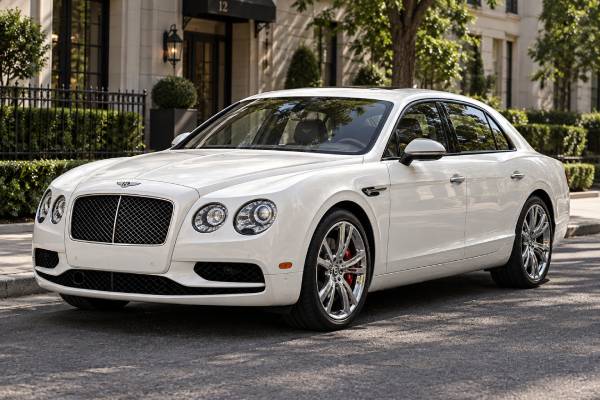
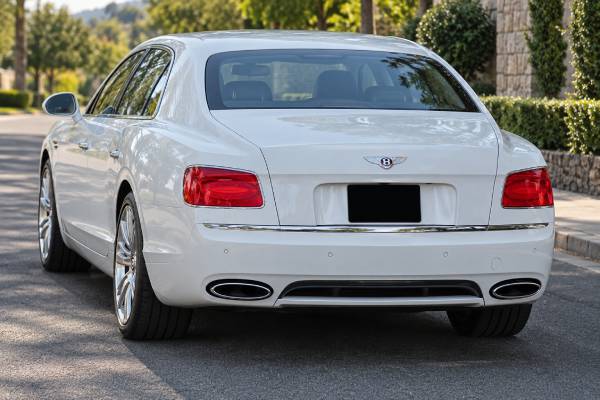
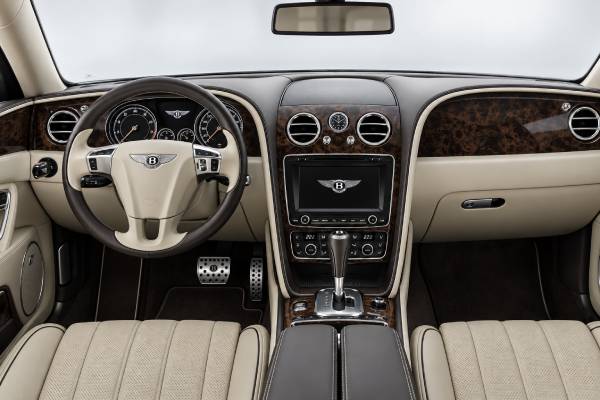
The second-generation Flying Spur arrived for 2013 with a clearer identity of its own, dropping “Continental” from the name while retaining the twin-turbo W12, all-wheel drive, air suspension, and hand-finished four-door format. Its 616 hp output, 800 Nm of torque, eight-speed automatic, and claimed 200 mph maximum made it faster and more efficient than the original standard car, yet its real advance was breadth: quieter cruising, more rear-seat technology, cleaner styling, and a chassis calibrated to disguise considerable mass. Used examples now span very different conditions. Some were chauffeur-maintained on schedule; others depreciated into ownership without the budget for tires, cooling work, batteries, suspension parts, or electronic diagnosis. This article covers the 2013–2018 standard W12, not the later 626 hp W12 S. It explains the generation’s engineering, how the car should operate, which systems deserve preventive care, and how to judge whether a beautifully presented example is genuinely ready for service.
Table of Contents
- The Second-Generation Reset
- W12 Specifications and Key Measurements
- Grand-Touring Performance and Road Behavior
- Cabin Technology, Batteries, and Hidden Complexity
- Mechanical Watchpoints and Preventive Service
- A Disciplined Pre-Purchase Inspection
- Model-Year Choice, Options, and Ownership Verdict
The Second-Generation Reset
The 4W2 Flying Spur was more than a facelift of the 3W2. Bentley redesigned the body, reduced visual bulk, revised the interior, introduced an eight-speed transmission, and recalibrated the chassis while keeping the proven basic W12 and fixed all-wheel-drive layout.
The new body used sharper feature lines, a lower roof impression, broader rear haunches, and cleaner lamp graphics. Despite its sleeker appearance, the sedan remained approximately 5.3 meters long and retained a 3,066 mm wheelbase. The cabin placed greater emphasis on rear passengers, with optional powered individual seats, entertainment screens, tables, climate controls, blinds, and extensive audio choices. A five-seat arrangement was also available.
Under the hood, the 5,998 cc twin-turbo W12 produced 616 hp in the assignment’s rating, equivalent to Bentley’s 625 PS figure, and 800 Nm. The ZF eight-speed torque-converter automatic widened the ratio spread compared with the previous six-speed unit. Permanent all-wheel drive used a rear-biased nominal torque distribution, giving the car secure traction without making it feel entirely front-led.
Bentley also reduced weight relative to the first-generation car through body and component changes, though the Flying Spur remained around 2.4 tonnes. Air suspension, continuously controlled damping, and several drive settings allowed the same vehicle to waft in traffic and remain stable at very high speed.
Do not confuse the standard W12 with the W12 S introduced later in the cycle. The S has 626 hp, 820 Nm, a 202 mph rating, darker exterior details, and sportier calibration. Wheels, grilles, exhaust finishers, and badges are easily changed, so factory build data—not appearance alone—must establish the derivative.
W12 Specifications and Key Measurements
The 2013–2018 W12 is a gasoline internal-combustion sedan with twin turbochargers, an eight-speed automatic, permanent all-wheel drive, and adaptive air suspension. Figures below describe the standard W12; equipment, market rules, and model-year revisions can alter weight and minor details.
| Specification | Value | Context |
|---|---|---|
| Engine type | 5,998 cc twin-turbocharged W12 | 48-valve gasoline ICE |
| Maximum power | 616 hp (about 625 PS / 460 kW) | Standard 4W2 W12 rating |
| Maximum torque | 800 Nm (590 lb-ft) | Available across a broad midrange |
| Transmission | ZF eight-speed torque-converter automatic | Manual selection through paddles or lever |
| Drive system | Permanent all-wheel drive | Nominal rear-biased 40:60 distribution |
| Fuel | Premium unleaded gasoline | Use exact market requirement |
| Measure | Factory figure | Practical meaning |
|---|---|---|
| 0–60 mph | Approximately 4.3 seconds | Traction-rich launch despite mass |
| 0–100 km/h | Approximately 4.6 seconds | Depends on conditions and test method |
| Top speed | 322 km/h (200 mph) | Closed-course figure with correct tires |
| Torque character | Strong from low engine speed | Few downshifts needed during cruising |
| Powertrain classification | ICE | No hybrid motor or traction battery |
| Item | Approximate value |
|---|---|
| Length | 5,299 mm (208.6 in) |
| Width across body | About 1,984 mm (78.1 in) |
| Height | About 1,488 mm (58.6 in) |
| Wheelbase | 3,066 mm (120.7 in) |
| Kerb weight | Approximately 2,475 kg (5,456 lb), specification-dependent |
| Fuel-tank capacity | About 90 L (23.8 US gal) |
| System | Configuration |
|---|---|
| Front suspension | Independent double wishbones |
| Rear suspension | Independent multi-link |
| Springing | Self-leveling air suspension |
| Damping | Electronically controlled, driver-selectable calibration |
| Brakes | Large ventilated discs with electronic stability and assistance systems |
| Steering | Speed-sensitive hydraulic power assistance |
| Record | What it proves |
|---|---|
| Annual or mileage-based service invoices | Correct oil, filters, inspections, and continuity |
| Battery replacement and coding details | Voltage faults were handled methodically |
| Cooling pressure-test or repair documentation | Leaks were diagnosed rather than topped up |
| Tire invoices listing all four sizes and dates | AWD-compatible tires were fitted as a set |
| Diagnostic and recall printouts | Module faults and VIN campaigns were checked |
Grand-Touring Performance and Road Behavior
A healthy 4W2 W12 feels calm first and fast second. It should start cleanly, idle almost imperceptibly, move away without driveline thump, and deliver a broad, uninterrupted surge when the accelerator is pressed.
The eight-speed transmission is central to that character. Its lower gears give the W12 immediate response; upper ratios reduce engine speed on long journeys. In Comfort or Bentley mode, shifts should be difficult to detect. Sport mode holds ratios longer and makes kickdown more decisive, but it should not introduce flare, harsh engagement, or shudder.
Test transmission behavior from cold and fully warm. Select reverse and drive several times with the brakes applied, noting delay or impact. At light throttle, watch for hunting between ratios. At steady motorway speed, feel for converter shudder. During progressive acceleration, the tachometer should rise consistently with road speed rather than jumping between shifts.
The air suspension allows substantial variation in ride. Comfort should absorb long-wave movement without floating; firmer modes should reduce body motion without making the car brittle. A crash over sharp edges often points to tires, wheel damage, control-arm wear, or damper problems rather than a normal characteristic.
Steering is deliberately measured. The car should track straight with a relaxed grip and return naturally after a corner. Tramlining, constant correction, steering-wheel vibration, or uneven self-centering justify a wheel, tire, alignment, arm, or bearing investigation.
The W12’s acceleration can hide weak ignition or boost-control components because the car remains quick even when imperfect. Use live data and a controlled load test. Misfire counters, fuel trims, requested versus actual boost, intake temperatures, and throttle behavior provide more evidence than a passenger’s impression.
Brakes should stop the car straight with a firm pedal. A small amount of surface corrosion after storage may clear, but persistent vibration, grinding, or unequal wheel temperatures indicates disc, pad, caliper, hose, or parking-brake trouble. The mass of the Flying Spur magnifies small brake defects.
Noise matters. A good car has little wind roar, no driveline hum, no booming exhaust, and only muted tire sound. A speed-dependent whine may come from tires, wheel bearings, or driveline components. Compare the sound on different road surfaces before assigning a cause.
Cabin Technology, Batteries, and Hidden Complexity
The second-generation cabin is one of the car’s strengths, but its electrical equipment is also a major inspection category. Low voltage, moisture, aging motors, software faults, and damaged wiring can create repairs that are difficult to price from a brief viewing.
Depending on specification, the car may have four-zone climate control, powered rear seats, heating, ventilation, massage, picnic tables, rear screens, headphones, blinds, adaptive cruise, cameras, keyless access, powered trunk operation, multiple audio systems, telephone interfaces, and a removable rear control device. Test every feature individually and in combination.
Do not accept “it only needs a battery” without evidence. Battery testing should include resting voltage, load capacity, charging performance, and parasitic draw after all modules sleep. Correct battery type, installation, venting, and registration or coding procedures matter. A recently fitted battery may already be damaged if the underlying draw remains.
A full scan may show many historical low-voltage codes. Their presence is not automatically disastrous; their recurrence, timestamp, frequency, and relationship to current symptoms determine significance. Save the scan before clearing anything. Recheck after the road test and heat soak.
Inspect the rear compartment particularly carefully. Chauffeur-operated cars may have heavy use of rear controls, blinds, tables, headphones, charging ports, and seat mechanisms even when driver-seat wear is modest. Conversely, an owner-driven car may have barely used rear equipment that has seized from inactivity.
Water ingress can follow blocked drains, window or door-seal faults, trunk leaks, or previous collision repair. Feel beneath mats, inspect spare-wheel and module areas, look for tide marks or green corrosion on connectors, and smell for damp. A polished cabin can conceal moisture below the carpet underlay.
Infotainment from this era is slower than current systems by design. Outdated maps or obsolete cellular services are not necessarily faults. Reboots, blank screens, lost audio channels, dead touch areas, failed cameras, or a unit that never enters sleep mode are faults and should be priced accordingly.
Interior craftsmanship is costly to restore. Inspect veneer for lifting or cracking, leather for dye transfer and bolster collapse, headlining for sagging, brightwork for scratches, and lambswool rugs for moisture. Correct repairs require material and color matching, not generic upholstery work.
Mechanical Watchpoints and Preventive Service
The most expensive failures usually begin as small leaks, heat-related deterioration, voltage instability, or deferred wear. Preventive inspection is therefore more valuable than waiting for a warning message.
The W12’s crowded packaging places hoses, seals, turbo plumbing, ignition components, pumps, and wiring in a high-temperature environment. Inspect for oil seepage, coolant residue, brittle connectors, vacuum leaks, abnormal crankcase pressure, and smoke after idling. A smooth idle does not exclude misfire under boost.
Cooling-system health is non-negotiable. Pressure-test when cold, confirm stable operating temperature in traffic and under load, inspect radiator and condenser faces, and verify fan operation. The heat-exchanger stack can collect debris between layers. Unexplained coolant loss or repeated top-ups should stop a purchase until the leak is identified.
Engine mounts and driveline mounts can soften, causing vibration at idle, thump during take-up, or excessive movement under load. Propeller shafts, flexible couplings, driveshaft boots, and wheel bearings should be inspected with undertrays removed where appropriate.
Air-suspension leakage can overwork the compressor. Measure heights at shut-down and after an overnight rest. Listen to compressor duration and frequency. A level-sensor or calibration problem can mimic a leaking strut, so replace parts only after diagnosis.
Bentley issued safety actions affecting some vehicles of this era, including a battery-cable connection campaign covering certain 2014 Flying Spurs. Applicability is determined by VIN, not by a broad year statement. Confirm completion through an official recall source and retain documentation.
Service intervals should be treated as maximums, not permission to ignore time. Oil, brake fluid, coolant condition, filters, spark plugs, transmission behavior, differential leaks, air-conditioning refrigerant performance, and suspension joints all age differently. A low-mileage car still needs time-based care.
Use correct approved fluids and procedures. The W12 oil level must be measured as specified. Transmission work requires the correct fluid, temperature, filter, seals, and adaptation process. Brake service may need diagnostic control of electronic functions. Guesswork is expensive on a tightly integrated car.
A Disciplined Pre-Purchase Inspection
The best inspection begins before arrival. Request the VIN, factory specification, service invoices, recall status, tire details, battery dates, and permission for a cold start and independent specialist examination.
When first seeing the car, confirm that it is genuinely cold. Check fluid levels, coolant staining, oil leaks, belt and hose condition, tire dates, wheel damage, panel gaps, paint depth, glass dates, and underside corrosion. Look for signs that the engine bay was washed immediately before sale.
Start without touching the accelerator. Observe cranking speed, warning lights, exhaust smoke, idle quality, pump noises, and the time required for the suspension to level. Cycle climate control and electrical consumers while monitoring voltage behavior.
A Bentley-capable scan should cover every module, not merely generic powertrain codes. Review misfire history, emissions readiness, suspension faults, battery-management events, transmission data, restraint systems, comfort modules, and infotainment. Recently cleared readiness monitors are a reason to postpone judgment.
Drive in stages. At low speed, listen for suspension knocks and feel for brake drag. On a smooth road, assess balance and tracking. Once fully warm, use moderate and then strong acceleration, watching for hesitation or warnings. Test all drive modes, adaptive cruise where safe, parking systems, and a hot restart.
After the drive, inspect for fresh drips, coolant odor, oil smoke, or unequal wheel heat. Leave the car parked long enough to see whether a corner settles. Repeat the diagnostic scan and compare new entries with the initial report.
Prepare a written estimate divided into immediate safety work, near-term reliability work, cosmetic work, and optional improvements. Use specialist retail labor and parts prices, not optimistic online component prices. The correct purchase price is the asking price plus this realistic first-year plan.
Reject a car when the seller blocks diagnosis, cannot explain coolant loss, has fitted mixed tires, presents unresolved transmission or suspension warnings, or offers no proof of major repairs. One defect can be negotiated; a pattern of avoidance cannot.
Model-Year Choice, Options, and Ownership Verdict
There is no universally best model year. Later cars may have updated software, equipment, and detail improvements, but condition and documentation outweigh a calendar advantage. A carefully maintained 2013 car is preferable to a neglected 2018 example.
Options affect both pleasure and risk. Mulliner Driving Specification trim, upgraded audio, rear entertainment, adaptive cruise, carbon-ceramic brakes where fitted, special paint, and individual rear seating can raise desirability. They also increase inspection time and replacement cost. Buy equipment you will use, not a long option list that cannot be demonstrated.
The standard W12 is the most relaxed second-generation powertrain. It offers immense torque without the firmer identity of the W12 S. Owners who prioritize lower front-axle mass and somewhat reduced fuel and service burden should also consider the V8. Buyers seeking the sharpest late 4W2 may prefer the V8 S or W12 S, but must accept their model-specific costs.
Running expenses remain those of a flagship Bentley. Budget for premium fuel, specialist annual inspection, quality tires, large brakes, battery care, insurance, secure storage, and an emergency reserve. Depreciation does not reduce the original engineering complexity.
The strongest purchase has consistent use, transparent invoices, stable coolant level, smooth hot and cold transmission behavior, matched recent tires, level suspension, clean electronics, and a seller who welcomes scrutiny. Very low mileage without records is not equivalent to preservation.
Pass on cars with repeated overheating, unexplained oil smoke, hard shifting, active air-suspension faults, water-damaged modules, structural repair of uncertain quality, or heavily modified engine software. These conditions can turn an appealing price into a long diagnostic project.
A sound 2013–2018 W12 still delivers a rare experience: near-silent twelve-cylinder thrust, secure all-weather traction, genuine rear-seat luxury, and effortless long-distance speed. Its complexity is manageable when maintained systematically. The buying decision should therefore be based less on whether you can purchase one and more on whether you are prepared to preserve the integrated machine Bentley built.
Chauffeur history versus owner-driver history
The way a 4W2 W12 accumulated its mileage can be as important as the number. A chauffeur car may have received disciplined scheduled servicing and long, fully warmed journeys, yet experienced prolonged idling, frequent door and trunk cycles, curb contact, and heavy use of rear seats, blinds, climate controls, and entertainment. An owner-driven car may show more front-seat wear but far less use of rear mechanisms. Neither pattern is automatically preferable.
Look for evidence that matches the claimed use. Rear door-handle wear, table hinges, seatbelt latches, carpet compression, wheel rash, and rear-control fault histories can reveal professional transport. Engine hours, when available through diagnostics, help put low average speed into context. Repeated battery replacements may reflect long periods waiting with accessories operating rather than an inherent electrical defect.
Service planning should respond to that history. A former chauffeur car deserves close inspection of cooling fans, engine mounts, brake wear, door modules, soft-close mechanisms, and rear HVAC. A lightly used private car deserves equal scrutiny of tire age, fluid time, air-suspension seals, battery sulfation, and systems that have rarely moved.
The ideal purchase is not defined by its previous role but by whether maintenance anticipated that role. A transparent high-mileage car can be easier to forecast than a low-mileage example whose use and storage remain unexplained.
When reviewing professional-use records, compare service mileage with inspection and licensing dates. Consistent intervals support the story; unexplained odometer gaps, replacement instrument clusters, or missing annual records require clarification before value is agreed.
A chauffeur history can also affect idle-hour service. Engine oil, cooling fans, air-conditioning, batteries, and mounts may have worked far longer than the odometer alone suggests.
Eight-speed adaptation and driveline refinement
The conventional eight-speed automatic is central to the 4W2 W12’s relaxed character. Evaluate it during the first cold pull-away, light-throttle urban shifts, a gradual incline, manual downshifts, and a fully warm restart. Harsh engagement is not automatically proof of internal failure; voltage problems, engine faults, old fluid, mounts, or adaptation issues can influence shift quality. Nevertheless, a seller’s claim that every jolt is “normal for a Bentley” should never replace scan data, fluid inspection, and a specialist road test.
References
- BENTLEY NEWSROOM : 2018 Flying Spur W12 S 2026 (Heritage Collection and Generation Data)
- BENTLEY NEWSROOM : Flying Spur 2026 (Manufacturer Model Archive)
- BENTLEY NEWSROOM : Technical Specifications 2026 (Manufacturer Technical Archive)
- Vehicle Detail Search – 2014 BENTLEY FLYING SPUR | NHTSA 2026 (Recall Database)
- November 2, 2015 2015 (Recall Acknowledgment)
- Search Safety Issues | NHTSA 2026 (VIN Recall Search)
Disclaimer
This article provides general educational guidance and cannot identify the condition of an individual vehicle. Verify specifications, service intervals, recall applicability, fluids, part numbers, software, and repair procedures by VIN through current Bentley documentation and a qualified specialist.
Please share this guide through Facebook, X/Twitter, or a Bentley community when it can help someone make a better-informed W12 purchase.