

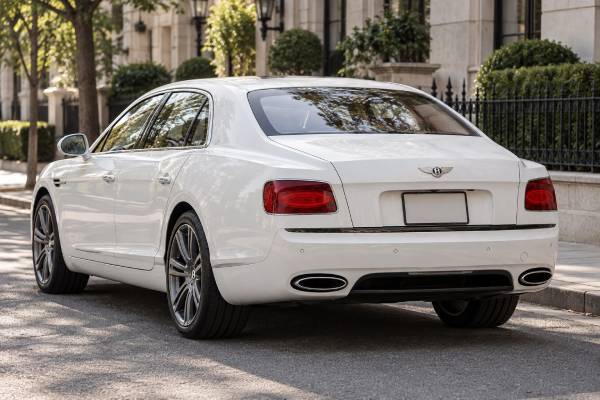
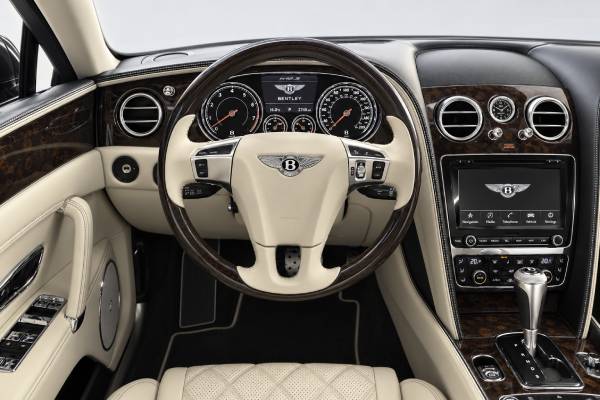
The 2016–2018 Flying Spur W12 S is the final and most forceful development of Bentley’s second-generation fixed-all-wheel-drive sedan. Its 6.0-liter twin-turbo W12 produces 626 hp and 820 Nm, propelling a richly trimmed four-door to a claimed 202 mph and making it the first production Bentley sedan advertised beyond the 200 mph threshold. Bentley also revised the suspension, steering, transmission, stability control, exhaust, and appearance, so the S is more than an engine tune. That distinction raises the standard for a used example. It must accelerate cleanly, remain thermally stable, ride with disciplined compliance, stop without vibration, and operate a dense network of rear-cabin and driver-assistance systems. Cosmetic S pieces can be copied; integrated behavior cannot. This guide treats the W12 S as the peak of the 4W2 generation, explains its engineering and exact role, identifies age and heat-related risks, and shows how to authenticate and inspect one before its exceptional depreciation becomes an exceptionally expensive repair plan.
Table of Contents
- The Peak of the 4W2 Generation
- W12 S Specifications and Performance Tables
- Engineering Beyond 200 mph
- Thermal, Ignition, and Driveline Health
- Chassis, Tires, Brakes, and Air Suspension
- Identity, Diagnostics, and Purchase Examination
- Collector Appeal, Driver Use, and Ownership Decision
The Peak of the 4W2 Generation
The W12 S combined the strongest factory engine tune of the second-generation Flying Spur with a more assertive chassis and visual treatment. It sits above the 616 hp standard W12 and should be verified as a complete factory derivative.
Bentley raised output to 626 hp, equivalent to 635 PS, and torque to 820 Nm. The eight-speed automatic received revised programming, while permanent all-wheel drive retained its nominal 40:60 front-to-rear distribution. Sportier suspension and stability-control settings, steering revisions, and a freer exhaust gave the car a more urgent response without abandoning rear-seat comfort.
The claimed 202 mph maximum was historically important: it moved Bentley’s four-door line beyond the symbolic 200 mph boundary. The acceleration difference from the standard W12 is less dramatic than the marketing headline. What the S adds is sharper calibration, stronger high-speed continuation, and a distinct top-of-range identity.
Exterior features commonly include gloss-black brightware or dark matrix grilles, smoked lamp details, W12 S badging, model-specific wheels, and black or polished exhaust treatments depending on specification. Interiors can feature S embroidery, contrast stitching, knurled controls, and extensive Mulliner options. Because Bentley personalization was broad, absence of one expected visual cue is not decisive.
VIN-linked build data should confirm derivative, market, original wheels, brakes, seating layout, audio, driver assistance, paint, veneers, and special-order equipment. A standard W12 with S grilles and software is not equivalent to a factory W12 S. Conversely, a genuine car may have lost original wheels or trim during previous ownership; those deviations affect value and restoration cost.
The 4W2 W12 S should not be confused with the 2019-on ZG2 W12. The later generation uses a different platform, longer wheelbase, dual-clutch transmission, active all-wheel drive, rear-wheel steering, and 48-volt chassis technology. Similar power figures do not make the cars mechanically interchangeable.
W12 S Specifications and Performance Tables
The W12 S is a gasoline-only internal-combustion sedan. It uses a 5,998 cc twin-turbocharged twelve-cylinder engine, eight-speed torque-converter automatic, permanent all-wheel drive, and adaptive air suspension.
| Specification | Value | Notes |
|---|---|---|
| Engine | 5,998 cc twin-turbo W12 | 48 valves, compact four-bank arrangement |
| Maximum power | 626 hp (635 PS / 467 kW) | W12 S factory output |
| Maximum torque | 820 Nm (605 lb-ft) | Broad plateau for overtaking |
| Transmission | ZF eight-speed torque-converter automatic | S-specific calibration |
| Drive | Permanent all-wheel drive | Nominal 40:60 front-rear split |
| Fuel | Premium unleaded gasoline | Use exact regional requirement |
| Measure | Published value | Context |
|---|---|---|
| 0–60 mph | Approximately 4.2 seconds | Regional test convention may vary |
| 0–100 km/h | 4.5 seconds | Bentley heritage specification |
| Top speed | 325 km/h (202 mph) | Correct tires and controlled conditions required |
| Power increase over standard W12 | About 10 hp | 616 hp assignment rating to 626 hp |
| Torque increase over standard W12 | 20 Nm | Calibration change is broader than peak numbers |
| Item | Value |
|---|---|
| Length | 5,299 mm (208.6 in) |
| Width across body | About 1,984 mm (78.1 in) |
| Height | About 1,488 mm (58.6 in) |
| Wheelbase | 3,066 mm (120.7 in) |
| Kerb weight | Approximately 2,475 kg (5,456 lb) |
| Body | Steel and aluminium four-door sedan structure |
| System | Configuration | Inspection emphasis |
|---|---|---|
| Suspension | Double-wishbone front, multi-link rear | Bushes, joints, geometry, wheel bearings |
| Springing | Self-leveling adaptive air suspension | Overnight height retention and compressor duty |
| Brakes | Large ventilated discs; carbon-ceramic optional | Thickness, runout, heat damage, caliper function |
| Electrical | Networked comfort, infotainment, and chassis modules | Battery condition and complete-module scan |
| Rear cabin | Four- or five-seat arrangements with extensive options | Test every powered feature |
| Evidence | Why it matters |
|---|---|
| Correct matching high-speed tires | Supports AWD, steering, braking, and 202 mph design envelope |
| Cooling-system pressure and repair records | Shows heat-related faults were traced |
| Ignition and plug history | Reduces risk of boost-load misfire |
| Transmission and driveline inspection | Confirms smooth torque delivery |
| Battery and diagnostic reports | Separates voltage events from persistent module faults |
Engineering Beyond 200 mph
A 202 mph sedan needs more than an engine powerful enough to overcome aerodynamic drag. It needs stable cooling, correct tires, predictable aero balance, controlled body movement, reliable braking, and a driveline that can sustain high torque without vibration.
The W12’s layout places twelve cylinders in a comparatively short block by using narrow bank angles. Twin turbochargers produce the dense midrange that defines the car. Under load, the engine should feel seamless: no pause, flutter, surging, or uneven exhaust note. Because 626 hp can mask partial performance loss, diagnostics should compare requested and actual boost, ignition correction, fuel delivery, intake temperatures, and misfire counters.
The eight-speed automatic provides both acceleration ratios and quiet overdrive cruising. Maximum-speed capability does not mean every ratio is used for acceleration to the limit; gearing is arranged to balance speed and economy. A healthy gearbox changes ratios quickly in Sport while remaining refined in Bentley and Comfort modes.
Permanent all-wheel drive provides strong traction and predictable behavior, but it imposes a strict tire discipline. Four tires should match in model, size, construction, rating, and close tread depth. Large rolling-circumference differences create continuous internal work even when no warning appears. A W12 S wearing a mixture of bargain tires contradicts the engineering premise of the car.
Aerodynamic stability depends on body condition. Missing undertrays, damaged liners, incorrect ride height, poorly fitted bumpers, and non-standard wheels can alter airflow or cooling. Inspect the underside rather than assuming cosmetic paint perfection means the body is complete.
At high road speed, small imbalances become large forces. Bent wheels, aged tires, incorrect hub seating, worn bearings, and propeller-shaft problems may produce vibration only above normal urban speeds. A road test should include a legal sustained cruise on smooth pavement, plus road-force wheel analysis if any tremor remains.
The brake system must absorb immense kinetic energy. The purchase inspection should measure rather than merely look at discs. Steel rotors need thickness and runout data; carbon-ceramic components require specialist assessment for surface, edge, impact, and heat damage. Old brake fluid undermines pedal consistency even when pads look thick.
No used-car test should attempt the published maximum. The relevant question is whether all systems retain the margin implied by that rating. Stable temperatures, smooth torque, balanced tires, straight braking, correct underbody parts, and clean diagnostics provide that evidence safely.
Thermal, Ignition, and Driveline Health
Heat is the central long-term issue in a tightly packaged twin-turbo W12. It ages seals, hoses, connectors, pumps, wiring, mounts, and surrounding components even when mileage is modest.
Begin with cooling-system integrity. Inspect the expansion tank, caps, hose connections, radiator seams, auxiliary pumps, turbo cooling lines, heater circuits, and evidence of dried coolant. Pressure-test cold and monitor temperature under traffic and load. Debris can accumulate between layered heat exchangers, reducing capacity while the visible front face appears clean.
Repeated coolant top-ups are not maintenance. Demand an explanation, pressure-test result, and repair invoice. Stop-leak products, incompatible coolant, or incomplete bleeding can create secondary restrictions and false confidence. An engine with a documented overheating event needs specialist evaluation beyond a normal pre-purchase check.
Ignition components must fire reliably under high boost. Worn plugs, weak coils, oil-contaminated wells, injector problems, or vacuum leaks can produce a misfire only during strong acceleration. Inspect freeze-frame data and misfire histories. A seller who has cleared codes before viewing has removed evidence, not repaired the cause.
Crankcase-ventilation and vacuum faults can alter fuel trim, oil consumption, idle, and boost response. Smoke testing and pressure measurements are more reliable than replacing generic valves based on forum lists. The W12 has limited access, so diagnosis should precede labor-intensive disassembly.
Engine and transmission mounts affect refinement. A worn mount may create idle vibration, a clunk between drive and reverse, or excessive engine movement that stresses hoses and exhaust joints. Driveline couplings, shafts, boots, and bearings should be inspected with the underside visible.
The automatic transmission should be evaluated at several temperatures. Delayed reverse engagement when hot, converter shudder at steady speed, flare during upshifts, or harsh coast-down behavior warrants investigation. Fluid work requires the exact specification, filter, filling temperature, and adaptation procedure. A universal flush is not an acceptable experiment.
Differentials and transfer components should be checked for leaks, noise, and tire-related stress. A whine that changes with throttle may differ from a wheel-bearing hum that follows road speed. A specialist road test and chassis microphones can prevent expensive guessing.
Oil service must use the approved grade and measurement method. An overfilled W12 can smoke and burden emissions components; an underfilled engine risks lubrication. Time-based changes are sensible for low-use cars because repeated cold starts and storage contaminate oil without adding much mileage.
Chassis, Tires, Brakes, and Air Suspension
The W12 S is meant to feel disciplined, not punishing. A harsh, noisy, or wandering car is usually telling the buyer that wheels, tires, alignment, joints, dampers, or air-suspension components need attention.
Air struts can leak, valve blocks can distribute pressure incorrectly, level sensors can fail, and compressors can wear from frequent operation. Measure all four corners on a level surface immediately after parking and again after an overnight rest. Note how long the compressor runs after start-up and whether one corner repeatedly corrects.
The W12’s mass places heavy loads on front control arms, bushes, ball joints, tie rods, bearings, and mounts. A knock over one-wheel bumps often points to joint wear. Steering shimmy under braking can arise from discs, bushes, wheel runout, or tire defects. Replacing brake rotors without checking the front axle may not cure it.
Alignment must be performed at correct ride height with proper equipment. Uneven inner-edge wear on wide tires can be hidden while the outer tread looks healthy. Record tread across the entire width and inspect sidewalls for age cracks, bulges, repairs, and curb damage.
Factory wheel sizes and optional designs affect ride and replacement cost. Check inner barrels for cracks and welds. A cosmetically perfect face may conceal structural repair. Wheel bolts, locking keys, center caps, and tire-pressure sensors should all be present and correct.
The S suspension has firmer calibration than the standard W12. In Sport, it should contain roll and pitch decisively; in Comfort, it should still isolate a luxury cabin. An inability to distinguish modes may indicate damper or control faults. Excessive differences could indicate non-standard parts or coding.
Brakes should release fully after parking. Compare wheel temperatures after a drive, using appropriate non-contact measurement. A hot corner can indicate a sticking caliper, hose, bearing, or parking-brake issue. Brake dust alone is not diagnosis, especially after different pad compounds have been fitted.
Because the W12 S has such high capability, use tires and brake parts from reputable manufacturers in correct specification. Saving money on the contact patches and stopping system defeats the reason for buying the model and can reduce resale confidence.
Identity, Diagnostics, and Purchase Examination
Authentication should precede valuation. Obtain the VIN before travel, request the factory build sheet, and compare it with engine output, model designation, wheels, brakes, colors, interior embroidery, grilles, exhaust, and software identifiers.
Look for tuning or conversion work. A standard W12 may have been remapped and fitted with S trim; an authentic W12 S may have been tuned further. Ask for invoices, original software files, emissions documentation, and insurer disclosure. Undocumented software creates uncertainty about boost targets, gearbox torque limits, and how the car was driven.
Inspect the car cold and dry. Fresh washing can hide leaks and fill brakes with water. Observe cranking, smoke, warning lights, idle, suspension leveling, pump sounds, and battery voltage. Open every door and trunk area to inspect seals, drains, carpets, module compartments, and evidence of dampness.
A complete scan should include engine, transmission, AWD, suspension, brakes, steering, battery management, climate, seats, infotainment, cameras, driver assistance, airbags, and rear controls. Save the original report. Readiness monitors that are incomplete after a recent code clear require a later retest.
Road testing should progress from low speed to load. Listen for joints over diagonal bumps, feel for driveline lash during take-up, assess steering on smooth pavement, warm the transmission, then use progressive acceleration. Test each chassis mode, firm braking, adaptive systems where safe, and a hot restart.
Afterward, leave the vehicle stationary during heat soak. Inspect for smoke, smells, fan behavior, leakage, and settling suspension. Recheck coolant only when safe and according to procedure. Scan again to identify load-dependent faults.
Review VIN-specific recalls and campaigns with an authorized source. Do not assume a database entry means repair completion, and do not assume absence of a public recall means no service campaign exists. Documentation should show date, mileage, and performing facility.
Commission a costed report. It should distinguish immediate safety faults, reliability risks, cosmetic deviations, missing original pieces, and optional upgrades. Price work using Bentley-specialist labor and quality parts. A cheaper W12 S with six simultaneous needs is rarely cheaper than the best available car.
Collector Appeal, Driver Use, and Ownership Decision
The W12 S has a credible historical claim: it is the ultimate factory performance version of the 4W2 and Bentley’s first production four-door rated above 200 mph. That does not make every surviving example collectible.
Collector value favors originality, unusual but desirable specification, complete documents, low but exercised mileage, unmodified software, correct wheels, intact trim, and evidence of climate-controlled storage. Long inactivity without fluid, battery, tire, and seal care is not preservation.
Driver value favors regular specialist maintenance, recent tires and brakes, corrected cooling weaknesses, smooth transmission behavior, and every comfort system functioning. Higher mileage can be acceptable when the car has been used on long journeys and serviced continuously.
Compared with the standard W12, the S is marginally quicker but meaningfully more distinctive. Compared with the V8 S, it offers greater torque and twelve-cylinder prestige but more front-end mass and potentially greater access cost. Compared with the ZG2 W12, it is mechanically older and lacks active rear steering, yet some owners prefer its traditional torque-converter smoothness and fixed-AWD character.
Budget beyond routine service. Premium fuel, high-speed tires, large brakes, battery care, suspension components, cosmetic finish, insurance, storage, and diagnostic labor are recurring realities. Establish a repair reserve before purchase rather than relying on resale equity.
Reject cars with undocumented overheating, persistent misfire, oil or coolant smoke, gearbox flare, sinking suspension, mixed tires, damp electronics, major structural repair, or concealed tuning. One resolved major repair can strengthen a car; several unresolved warning signs reveal deferred stewardship.
The right W12 S feels extraordinary without trying to prove it. It moves with silent force, remains stable over distance, responds more sharply than the standard car, and preserves a calm rear cabin. Buy one for that complete experience, not merely for the badge or a depreciated entry price, and the final 4W2 flagship can still justify its place in Bentley’s modern history.
Storage without turning preservation into deterioration
A W12 S that spends part of the year off the road needs an active storage plan. Clean and dry the car thoroughly, inflate tires appropriately, avoid applying the parking brake for a long humid lay-up when safe alternatives are specified, and connect an approved maintainer through the correct point. Stabilize fuel only with products and procedures suitable for the market, and keep the tank strategy consistent with Bentley guidance.
Do not start the engine periodically merely to idle for a few minutes. That adds moisture to oil and exhaust without fully warming the transmission, differentials, brakes, tires, and wheel bearings. Either leave the car prepared and undisturbed or drive it far enough under suitable conditions to reach full operating temperature and exercise every system.
Before recommissioning, inspect for rodent damage, fluid leaks, tire flat spotting, brake corrosion, stale fuel, low ride height, and blocked air inlets. Test batteries and scan modules before a hard drive. A cautious first journey with progressive braking and load is better than using maximum performance to “clear it out.” Proper storage protects the W12 S; casual storage simply allows expensive systems to age invisibly.
References
- BENTLEY NEWSROOM : 2018 Flying Spur W12 S 2026 (Heritage Collection)
- BENTLEY NEWSROOM : Flying Spur 2026 (Manufacturer Model Archive)
- BENTLEY NEWSROOM : Technical Specifications 2026 (Manufacturer Technical Archive)
- Vehicle Detail Search – 2018 BENTLEY FLYING SPUR | NHTSA 2026 (Recall Database)
- November 2, 2015 2015 (Generation Recall Documentation)
- Search Safety Issues | NHTSA 2026 (VIN Recall Search)
Disclaimer
This guide supplies general information and cannot certify a specific W12 S or replace professional inspection. Verify model identity, technical data, fluids, repair procedures, software, recall applicability, and part fitment by VIN using current Bentley sources.
Please share this article on Facebook, X/Twitter, or a Bentley forum when its inspection approach may help another W12 S buyer.