
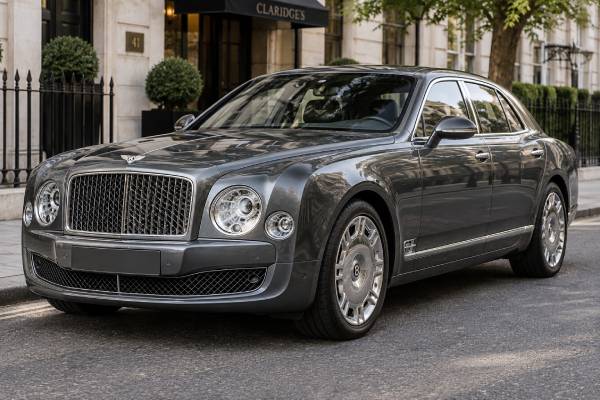
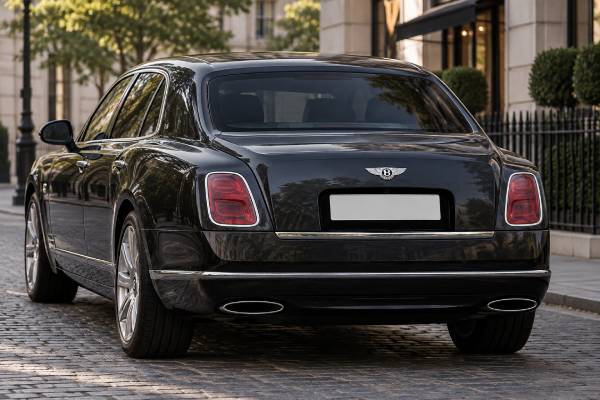
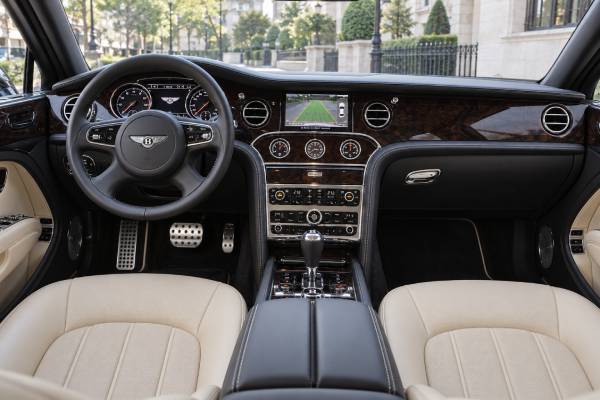
The 2010–2020 Bentley Mulsanne was the last clean-sheet Bentley flagship built around the company’s 6.75-litre L-series V8. It combined 505 hp, 1,020 Nm of low-speed torque, rear-wheel drive, an eight-speed automatic, adaptive air suspension, and a cabin that required hundreds of hours of handwork. Unlike the Continental Flying Spur of the same era, the Mulsanne used its own body, platform, engine development, and visual language. It was designed to be both an owner-driver’s grand saloon and a formal rear-seat car, with performance that could move more than 2.5 tonnes to nearly 184 mph. The decade-long production run also includes meaningful differences: the 2016 redesign brought a wider grille, new lighting, revised seats, updated infotainment, and substantial noise-isolation work. Used examples now offer extraordinary craftsmanship for a fraction of their original cost, but maintenance, tires, brakes, air suspension, electronics, cooling, and provenance must be evaluated at flagship-car scale.
Table of Contents
- A Flagship Developed From Scratch
- Mulsanne Specifications and Technical Data
- How Bentley Reengineered the L-Series V8
- Chassis, Cabin Craft, and the 2016 Redesign
- Maintenance Realities and Common Age-Related Needs
- Used-Mulsanne Inspection and Model Choice
- Running Costs, Best Uses, and Verdict
A Flagship Developed From Scratch
The modern Mulsanne was not a stretched Continental or a rebodied group-platform sedan. Bentley developed it as a separate flagship, revealed it in 2009, and began customer production for 2010. The name linked the car to Le Mans, while the engineering linked it to six decades of Crewe V8 development.
Its proportions communicate the brief. The front axle sits well forward, the bonnet is long, the passenger compartment is set back, and the rear body is shaped for formal presence rather than maximum packaging efficiency. Aluminium superforming was used for major exterior panels, while hand-brazed seams and labor-intensive finishing produced the solid, almost coachbuilt appearance.
The base Mulsanne remained the comfort-focused member of the family after the 530 hp Speed arrived. It shared the core 3Y body and V8 but used a more relaxed powertrain calibration and chassis personality. In 2016, Bentley introduced the Extended Wheelbase and updated the standard car and Speed with a redesigned front end, revised interior, new infotainment, and additional acoustic measures.
The production span is long enough that “a Mulsanne” is not one fixed specification. Early 2010–2014 cars have the original face and first infotainment generation. The 2015 model year brought an efficiency update and revised calibration. The 2016-on family introduced the broader visual and cabin changes, although market model-year labeling can differ. Options such as the Mulliner Driving Specification, 21-inch wheels, rear entertainment, sunroofs, refrigerated bottle storage, bespoke veneers, and audio systems also change value and replacement cost.
Bentley reported that each car took more than 400 hours to build, with the majority of that time devoted to its interior. That handcrafted content is a major attraction, but it also means trim condition cannot be treated like ordinary used-car cosmetics. Matched wood, plated switchgear, leather panels, rear tables, and bespoke colors may require specialist restoration rather than simple replacement.
Mulsanne Specifications and Technical Data
The standard 3Y Mulsanne is an internal-combustion, front-engine, rear-wheel-drive four-door saloon. Its 6,752 cc twin-turbocharged V8 produces 505 bhp and 1,020 Nm, driving through a ZF eight-speed automatic. Published weight and acceleration figures vary slightly by model year, market, and definition, so the tables use the most consistently documented values and identify variation where useful.
| Specification | Value | Notes |
|---|---|---|
| Engine family | L-series V8, assignment code L410HT | Modern twin-turbo development |
| Displacement | 6,752 cc (6.75 L; 412 cu in) | Often rounded to 6.8 L |
| Architecture | 90-degree OHV V8 | Two valves per cylinder |
| Induction | Twin turbochargers with intercooling | Calibrated for very high low-rpm torque |
| Fuel system | Electronic multipoint fuel injection | Premium unleaded gasoline |
| Maximum power | 505 bhp (377 kW; 512 PS) at about 4,000–4,200 rpm | Published rpm varies by source/model year |
| Maximum torque | 1,020 Nm (752 lb-ft) at 1,750 rpm | Broad low-speed delivery |
| Efficiency systems | Variable cam phasing and cylinder deactivation | Operate under suitable light-load conditions |
| Component | Configuration |
|---|---|
| Transmission | ZF 8HP eight-speed automatic |
| Drive type | Rear-wheel drive |
| Front suspension | Double wishbones with electronically controlled air springs and dampers |
| Rear suspension | Multi-link with toe and brake-reaction control, air springs, and adaptive damping |
| Drive modes | Bentley, Comfort, Sport, and Custom settings |
| Front brakes | Ventilated discs, approximately 400 × 38 mm |
| Rear brakes | Ventilated discs, approximately 370 × 30 mm |
| Steering | Speed-sensitive power-assisted rack and pinion |
| Measure | Value | Standard or condition |
|---|---|---|
| 0–60 mph | About 5.1 seconds | Manufacturer figure for early standard car |
| 0–100 km/h | About 5.3 seconds | Manufacturer figure |
| Top speed | 296 km/h (184 mph) | Manufacturer figure |
| Combined fuel use | Approximately 15.0–16.9 L/100 km | Depends on test cycle and model year |
| CO₂ emissions | Approximately 342–393 g/km | Test cycle and update dependent |
| Fuel tank | 96 L (25.4 US gal) | Published capacity |
| Luggage compartment | About 443 L (15.6 cu ft) | Published geometric volume |
| Measurement | Value | Notes |
|---|---|---|
| Length | 5,575 mm (219.5 in) | Standard wheelbase |
| Body width | 1,926 mm (75.8 in) | Excluding mirrors |
| Height | Approximately 1,521 mm (59.9 in) | Suspension setting affects measurement |
| Wheelbase | 3,266 mm (128.6 in) | Unchanged through the standard model run |
| Kerb weight | Approximately 2,585–2,650 kg (5,699–5,842 lb) | Definition and equipment dependent |
| Standard wheels | 20-inch alloy wheels | 21-inch options widely fitted |
| Common tire sizes | 265/45 ZR20 or 265/40 ZR21 | Use Bentley-approved load and speed specification |
| Phase | Key distinction |
|---|---|
| 2010–2014 | Original exterior design, first infotainment generation, 505 hp calibration |
| 2015 | Powertrain efficiency update and revised transmission calibration |
| 2016–2020 | Redesigned front end, revised seats and trim, updated infotainment and acoustic package |
When comparing listings, confirm whether figures describe the standard Mulsanne, Speed, or Extended Wheelbase. The three share much of their architecture, and advertisements frequently copy the Speed’s 530 hp or the EWB’s dimensions into a base-car listing.
How Bentley Reengineered the L-Series V8
The modern Mulsanne engine is historically related to the V8 introduced in 1959, but describing it as an unchanged old engine is inaccurate. Bentley revised combustion, control, turbocharging, emissions, cooling, lubrication, and internal components repeatedly to meet modern output and regulatory requirements.
The basic architecture remained distinctive: an aluminium 90-degree block, pushrod valve operation, two valves per cylinder, and enormous displacement. That layout supports a compact cylinder head and strong low-speed airflow rather than high-rpm breathing. Peak torque arrives at only 1,750 rpm, so the car rarely needs dramatic downshifts.
Twin turbochargers replace the single-turbo arrangement used on earlier performance Bentleys. Variable cam phasing helps manage breathing and emissions, while cylinder deactivation can close four cylinders under light load. The system is designed to be seamless. A noticeable shudder, warning light, or persistent change in exhaust note requires diagnosis rather than acceptance as normal four-cylinder operation.
The engine’s personality is defined by torque more than horsepower. From low speed, a modest throttle opening produces strong acceleration, and the eight-speed transmission keeps the engine in a narrow, quiet range. Full throttle delivers speed without the rising mechanical drama of a high-revving engine. That calm can hide the workload imposed on cooling, tires, brakes, and driveline components.
Maintenance must respect heat. Turbochargers, catalysts, exhaust manifolds, and a tightly packaged engine bay create high under-bonnet temperatures. Correct oil, clean cooling circuits, sound hoses, functioning fans, intact heat shielding, and healthy batteries are essential. Owners should warm the engine through gentle driving, avoid immediate shutdown after sustained high load, and investigate coolant odor or fan behavior promptly.
Oil leaks can appear around covers, turbo oil lines, seals, and ancillary connections. A light film is different from oil reaching hot exhaust components or producing a falling dipstick level. Because access is labor-intensive, a pre-purchase inspection should distinguish a minor seep from work that requires major disassembly.
The ZF eight-speed automatic is generally smooth and well matched. Harsh engagement, shudder, delayed selection, flare, or repeated hunting may involve fluid condition, adaptations, mounts, software, engine faults, or internal wear. “Sealed for life” should not be interpreted as immune to aging; service decisions should follow Bentley documentation, condition, and specialist advice.
Chassis, Cabin Craft, and the 2016 Redesign
The Mulsanne’s chassis succeeds by controlling mass without making the car feel busy. Air springs and Continuous Damping Control allow a soft primary ride, while selectable modes alter damping, steering effort, and powertrain behavior. A healthy car should feel settled after a bump, not float repeatedly or crash over sharp edges.
The standard Bentley mode is the best reference during a test drive. Comfort softens the response, Sport adds body control, and Custom allows combinations. If all modes feel identical, the adaptive system may not be working. Warning messages, a low corner after parking, compressor noise, or slow ride-height changes need investigation.
Twenty-inch wheels generally provide the most compliant ride. Twenty-one-inch wheels sharpen response and are visually popular, but they make tire specification, flat spotting, wheel damage, and alignment more important. Bentley issued technical guidance for vibration and flat-spot complaints on early 21-inch fitments, including tire identification and suspension-related production changes. Rebalancing alone does not cure a temporary or permanent flat spot.
Inside, the Mulsanne’s craftsmanship is its most obvious advantage over mass-produced luxury cars. The dashboard and doors form a continuous ring of veneer. Leather covers large surfaces, metal switchgear has substantial weight, and many visible pieces were hand-finished. Inspect the cabin in daylight because dyed repairs, veneer clouding, stretched leather, and scratched piano-black or metal trim can disappear in showroom lighting.
The original infotainment system now feels dated, but functionality matters more than speed. Test navigation, audio sources, Bluetooth where equipped, rear screens, remote controls, cameras, parking sensors, telephone functions, and the retractable display. Bespoke rear-seat systems can be expensive to restore because screens, control modules, wiring, and trim are integrated.
The 2016 redesign changed more than the grille. Bentley widened the vertical-vane radiator treatment, revised the bonnet, front wings, lights, bumpers, rear details, seats, door trims, armrests, navigation, and infotainment. Additional acoustic insulation and revised glass improved isolation. Buyers often prefer the later appearance and technology, but early cars can represent stronger value and retain the original design’s purity.
Options must be judged individually. The Mulliner Driving Specification adds distinctive wheels and quilting, but it does not turn the standard engine into a Speed. A glass sunroof brightens the cabin yet adds drains, seals, and mechanisms. Refrigerated bottle storage, rear picnic tables, and premium Naim audio enhance the experience but increase diagnostic and replacement costs.
Maintenance Realities and Common Age-Related Needs
The Mulsanne is maintainable, but no service should be priced as though it were an ordinary V8 sedan. Parts volume is low, access can be time-consuming, and many components require model-specific diagnostic equipment or trim skills.
Annual baseline
An annual inspection should cover fluid levels and condition, leaks, cooling-system pressure, battery health, fault memory, brakes, tire age and wear, suspension height, steering joints, underbody panels, air conditioning, and every electrical feature. Low mileage does not justify skipping checks because batteries, seals, refrigerant, tires, and air-suspension components age while parked.
The car uses substantial electrical power and can behave unpredictably with a weak battery. Multiple warning messages after storage may be voltage-related, but they should not be erased without testing both batteries, charging output, grounds, and parasitic draw. A correctly connected maintainer is helpful for cars used intermittently.
Brakes, tires, and suspension
Large discs and pads are consumable items, and replacement cost rises if calipers, electronic parking-brake components, or corroded hardware are involved. Pulsation may come from disc variation, pad deposits, wheel runout, or suspension wear. Diagnose before ordering parts.
Tires must carry the car’s mass and speed potential. Match all four by approved specification, check date codes, inspect inner shoulders, and measure pressure cold. Uneven wear can indicate alignment, bush, or ride-height issues. A car on bargain tires is a poor sign regardless of tread depth.
Air-suspension compressors, valves, height sensors, dampers, air lines, and control modules can age. One low corner may be a leak; a whole car that is slow to rise may involve the compressor or pressure supply. Do not repeatedly command height changes with an overheating compressor.
| Area | Evidence of good care | Warning signs |
|---|---|---|
| Cooling | Stable temperature, dry system, documented hose and coolant work | Odor, staining, fan faults, unexplained loss |
| Air suspension | Level stance, quiet operation, clear fault memory | Low corner, compressor running often, harsh mode |
| Brakes | Even discs, correct pads, straight stops | Vibration, lip, warning messages, parking-brake faults |
| Electrical system | Healthy batteries, complete function test | Clusters of warnings, slow modules, battery drain |
| Interior | Complete matched trim and working options | Missing remotes, water stains, damaged veneer |
| Tires and wheels | Matched approved tires, straight wheels, even wear | Flat spots, cracked rims, mixed brands, old dates |
Water ingress should be taken seriously. Check sunroof drains, windscreen and rear glass areas, door seals, boot seals, and under carpets. Moisture can damage modules and leave odors that are difficult to remove from thick insulation and leather.
Recalls and service campaigns are VIN-specific. In the United States, check the VIN through NHTSA and verify completion with a Bentley retailer. A 2018 compliance recall involved rear-view camera display behavior on a small population, illustrating why a general “all recalls done” statement is not enough without records.
Used-Mulsanne Inspection and Model Choice
A used Mulsanne should be inspected by a workshop with Bentley diagnostic access and experience with the 3Y platform. A generic scan and visual check will miss option-module faults, suspension data, battery history, and model-specific repair patterns.
Confirm identity, model year, original market, service history, accident records, paintwork, options, keys, remotes, books, and tool equipment. Decode the VIN and compare the car with its build specification. Because personalization was extensive, a rare color is not suspicious by itself, but unusual combinations should still be documented.
Begin the mechanical test cold. Listen for timing or valvetrain noise, observe exhaust smoke, check warning messages, and watch the air suspension reach its normal height. Let the car idle with climate control operating, then drive until engine, transmission, tires, and brakes are fully warm.
During the road test, use each drive mode. The transmission should be nearly imperceptible in gentle driving and decisive under load. The steering should remain centered without vibration. Brake from several speeds and listen for suspension movement. Test adaptive cruise, cameras, parking sensors, rear entertainment, seat ventilation and massage, shades, tables, sunroof, audio, and every rear control.
Choose the production phase based on priorities:
- 2010–2014: lowest entry prices and original styling, but oldest electronics and the greatest age-related exposure;
- 2015: useful efficiency and calibration updates without the later body redesign;
- 2016–2020: newer infotainment, revised cabin, updated exterior, and stronger buyer demand, usually at a higher price.
A Mulliner Driving Specification car can be desirable, but condition is more important than quilting and wheels. Likewise, a low odometer reading is valuable only when supported by annual servicing, battery management, fluid care, and regular exercise. A higher-mileage car used for long journeys may be healthier than a garage ornament with hardened tires and repeated voltage faults.
Paintwork should be measured because aluminium panels, hand-finished joints, and complex colors make accident repair expensive. Inspect panel gaps, headlamp mounting, grille alignment, undertrays, wheel arches, jacking points, and the boot floor. A high-quality repair is not necessarily a reason to reject the car, but it must be known and priced.
Running Costs, Best Uses, and Verdict
The Mulsanne’s depreciation makes the purchase price look approachable; its operating requirements remain those of a hand-built flagship. The correct budget includes routine service, a battery and tire plan, brake reserves, air-suspension risk, electronics diagnosis, secure storage, and specialist transport if the car cannot be driven.
Fuel use is high, especially in cities, but often predictable. Unexpected repair labor is the larger variable. Owners who delay a coolant leak, suspension warning, weak battery, or tire vibration can create secondary damage and much larger bills. Preventive work and rapid diagnosis are financially sensible, not obsessive.
The car is best used for long-distance touring, formal travel, and occasions where silence and cabin quality matter. It can serve as a daily driver if parking, fuel, and service support are practical, but its width, length, turning needs, and low production volume make careless urban use stressful. A secure dry garage and access to a Bentley-capable specialist are more important than proximity to a detailing shop.
The standard 505 hp model is arguably the balanced choice. It is fast enough to feel extraordinary, rides more gently than the Speed, and is available across the full production run. Buyers focused on rear legroom should consider the EWB, while collectors seeking the final expression may prefer a Speed-based special edition.
The best example will have complete annual records, matched approved tires, strong batteries, a dry cabin, quiet suspension, smooth transmission, stable coolant temperature, working options, and no unexplained diagnostic codes. Pay more for that evidence. A cheap Mulsanne with multiple small faults is rarely experiencing multiple cheap faults.
As the last Bentley to use the L-series V8 and the marque’s final stand-alone ultra-luxury saloon of its type, the 3Y Mulsanne has lasting significance. Its engineering is traditional in concept but modern in execution, and its interior remains exceptional. Bought carefully and maintained without shortcuts, it delivers a form of mechanical, material, and acoustic luxury that newer cars seldom reproduce in the same way.
References
- Bentley Mulsanne | History and Heritage | Bentley Motors 2026 (Manufacturer Heritage)
- Bentley Mulsanne 2026 (Model Reference)
- Technical Service Bulletin 2030349/3 2019 (TSB)
- Technical Service Bulletin 2053492/3 2019 (TSB)
- EC77 2070237/1 2023 (Field Campaign)
- Search Safety Issues | NHTSA 2026 (Recall Database)
Disclaimer
This article is for informational purposes and is not a substitute for professional diagnosis, repair, or official workshop instructions. Specifications, torque values, intervals, fluids, software, recalls, and procedures vary by VIN, market, model year, and equipment; verify the car against Bentley service documentation and current VIN-specific records. Please share this guide on Facebook, X/Twitter, or an owners’ group if it helps another reader evaluate a Mulsanne responsibly.