
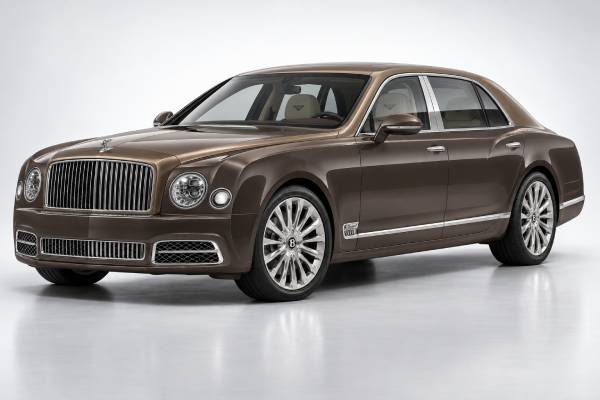
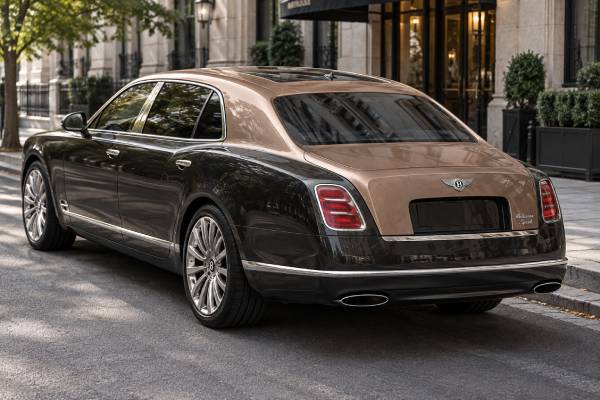
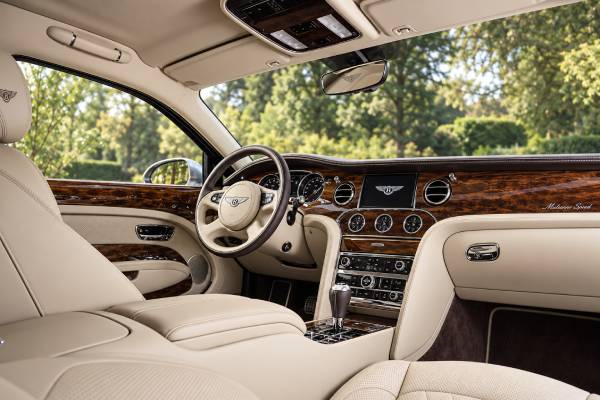
The 2016–2020 Bentley Mulsanne Extended Wheelbase is the rear-passenger specialist of the modern Mulsanne family. Bentley stretched the wheelbase by 250 mm, from 3,266 to 3,516 mm, and devoted the gain to the rear compartment. Airline-style powered leg rests, a rear sunroof, extended doors, and four-seat configurations turned the car into a factory-engineered limousine without losing the standard Mulsanne’s 505 hp twin-turbo V8, rear-wheel drive, and adaptive air suspension. At 5,825 mm long and roughly 2,730 kg, it demands more space and more planning than the standard car, but it avoids the structural and visual compromises of an aftermarket stretch. Used buyers should focus on rear-cabin completeness, door alignment, water management, air suspension, batteries, electronics, tires, brakes, and chauffeur-style wear. This guide treats the Extended Wheelbase as its own model rather than a standard Mulsanne with one extra dimension, because its value and maintenance exposure are concentrated in the hardware behind the B-pillars.
Table of Contents
- Why Bentley Built the Extended Wheelbase
- Extended Wheelbase Technical Specifications
- Rear-Passenger Engineering and Cabin Equipment
- Chauffeur Dynamics, Parking, and Practical Limits
- EWB-Specific Service and Preservation
- Inspection, Provenance, and Buying Strategy
- Who the EWB Suits and Ownership Verdict
Why Bentley Built the Extended Wheelbase
The Mulsanne EWB was created for owners who primarily travel in the rear, not for drivers seeking more luggage space or power. Its extra 250 mm sits within the wheelbase and expands rear legroom, while the boot, 505 hp engine, and 184 mph top speed remain broadly aligned with the standard Mulsanne.
Bentley introduced the model with the redesigned Mulsanne family in 2016. The new range included the standard car, the 530 hp Speed, and the Extended Wheelbase. All received the wider vertical-vane grille, revised lighting, new front bodywork, updated interior, and newer infotainment. The EWB then added its own long body, rear roof opening, powered leg-rest system, and rear-seat emphasis.
Factory engineering is the key distinction. The longer floor, roof, doors, wiring, climate-control arrangement, glazing, and trim were developed as one vehicle. This gives the car coherent proportions and predictable crash, sealing, and suspension behavior. It also creates expensive model-specific parts. A damaged rear door, scratched long trim piece, failed leg-rest mechanism, or water-damaged rear controller cannot always be replaced from a standard Mulsanne.
The EWB was offered with extensive personalization. Four-seat layouts with a full rear console are common, and some cars have refrigerated storage, deployable tables, rear entertainment, privacy curtains, special veneers, bespoke embroidery, or market-specific communication equipment. The final Mulsanne built was an EWB commissioned for Queen Elizabeth II, illustrating how readily the model served formal and bespoke roles.
The extra length does not make the EWB slow. Its 1,020 Nm of torque moves the car to 100 km/h in about 5.5 seconds, while top speed remains 296 km/h. The more important dynamic differences are wheelbase, mass, turning needs, rear body clearance, and the way the suspension must manage passengers seated farther from the car’s center.
Extended Wheelbase Technical Specifications
The EWB is a petrol-only, front-engine, rear-wheel-drive limousine. It uses the standard Mulsanne’s 6,752 cc twin-turbo V8 and ZF eight-speed automatic rather than the Speed’s 530 hp tune. Its defining technical values are the 3,516 mm wheelbase, 5,825 mm length, and approximately 2,730 kg kerb weight.
| Specification | Value | Notes |
|---|---|---|
| Engine family | L-series V8, assignment code L410HT | Standard 505 hp calibration |
| Displacement | 6,752 cc (6.75 L; 412 cu in) | Often rounded to 6.8 L |
| Valve layout | OHV, two valves per cylinder | Variable cam phasing |
| Induction | Twin turbochargers with intercooling | Electronic boost control |
| Maximum power | 505 bhp (377 kW; 512 PS) at 4,000 rpm | Manufacturer figure |
| Maximum torque | 1,020 Nm (752 lb-ft) at 1,750 rpm | Manufacturer figure |
| Transmission | ZF 8HP eight-speed automatic | Rear-wheel drive |
| Fuel tank | 96 L (25.4 US gal) | Published capacity |
| Measurement | Value | Comparison |
|---|---|---|
| Length | 5,825 mm (229.3 in) | 250 mm longer than standard Mulsanne |
| Wheelbase | 3,516 mm (138.4 in) | 250 mm longer than standard |
| Width across body | 1,926 mm (75.8 in) | Same basic body width |
| Height | Approximately 1,541 mm (60.7 in) | Published EWB figure |
| Front track | Approximately 1,605 mm (63.2 in) | Published figure |
| Rear track | Approximately 1,651 mm (65.0 in) | Published figure |
| Kerb weight | Approximately 2,730 kg (6,019 lb) | Equipment can change final mass |
| Measure | Value | Standard or condition |
|---|---|---|
| 0–60 mph | 5.3 seconds | Manufacturer figure |
| 0–100 km/h | 5.5 seconds | Manufacturer figure |
| Top speed | 296 km/h (184 mph) | Manufacturer figure |
| Urban fuel consumption | About 23.4 L/100 km | Published NEDC-era figure |
| Extra-urban fuel consumption | About 10.1 L/100 km | Published NEDC-era figure |
| Combined fuel consumption | About 15.0 L/100 km | Published NEDC-era figure |
| Combined CO₂ | About 344 g/km | Published NEDC-era figure |
| Component | Configuration |
|---|---|
| Front suspension | Double wishbones with electronically controlled air springs |
| Rear suspension | Multi-link with toe and brake-reaction control, air springs, and adaptive damping |
| Drive modes | Comfort, Bentley, Sport, and Custom |
| Brakes | Large ventilated discs with electronic stability and parking systems |
| Common wheels | 20- or 21-inch Bentley alloys |
| Common tire fitment | 265-section high-load performance tires |
| Feature | Function |
|---|---|
| Airline-style leg rests | Extend and pivot from the rear seat bases |
| Rear-compartment sunroof | Adds light above rear passengers |
| Extended rear doors | Improve access to the longer rear cabin |
| Four-seat layout | Allows two individual rear chairs and a full center console |
| Rear entertainment | Integrated screens, audio, and remote controls where specified |
| Privacy equipment | Powered shades or curtains depending on specification |
Do not substitute Speed figures into an EWB listing. The EWB normally has 505 bhp and 1,020 Nm, even when it wears 21-inch wheels, dark trim, or a Mulliner specification.
Rear-Passenger Engineering and Cabin Equipment
The EWB should be judged from the rear seat first. Its central value lies in how the longer floor, individual seating, leg rests, roof opening, tables, screens, shades, and climate functions work together during a journey.
The 250 mm wheelbase increase creates physical space, but the powered leg rests turn that space into usable comfort. Each rest extends from beneath the seat and pivots to support different seating positions. During inspection, operate every movement through its full travel with no passenger load first, then confirm normal support under controlled use. Grinding, asymmetry, hesitation, or a mechanism that stops after warming may involve motors, cables, sensors, control modules, dried lubrication, or low voltage.
Long rear doors improve access but place more load on hinges, latches, wiring looms, window mechanisms, and seals. Open each door to several positions and observe whether it drops or moves at the latch. The glass should rise smoothly, meet the seal evenly, and remain quiet at speed. Soft-close operation should pull the door in without repeated attempts.
The rear sunroof adds light and separation from the front cabin, but it creates additional drains and seals. Inspect headlining, grab handles, rear pillars, footwells, and seat electronics for water staining. Test the roof through its full cycle and listen for wind noise. A blocked drain can damage expensive trim and hidden controllers before moisture becomes obvious.
Four-seat cars often have a broad fixed console containing storage, controls, charging points, glassware or bottle equipment, and entertainment hardware. Confirm all lids, catches, veneers, cooling functions, remotes, and outlets. Missing bespoke pieces can be difficult to source and may reduce value more than a minor exterior scratch.
Rear climate performance should be tested with the car fully warm. Check temperature control on both sides, fan speeds, vent direction, heated and ventilated seats, massage, window shades, reading lights, and audio. A chauffeur-used car may show more wear on rear switches and seat edges than its odometer suggests.
Leather and veneer need careful daylight inspection. EWB buyers often focus on rear condition, but the front driver’s seat may have significant wear from professional use. Look for dyed bolsters, stretched perforated leather, damaged seat piping, cloudy veneer, scratches around table hinges, and sun damage under open shades.
Privacy modifications need documentation. Curtains, security lighting, communication equipment, flags, sirens, or armored additions may have been professionally installed for a formal customer. They can be historically interesting, but they add wiring, weight, and potential registration issues. Confirm what remains operational and legal in the intended market.
Chauffeur Dynamics, Parking, and Practical Limits
The EWB is surprisingly manageable once moving, but low-speed planning defines daily usability. Its 5.825 m length exceeds many parking spaces, the rear doors need wide clearance, and the turning path extends well behind the driver.
A chauffeur should use the cameras, parking sensors, mirrors, and visible bonnet as aids rather than substitutes for awareness. Confirm that the reverse camera appears promptly and is not obstructed by infotainment icons. Test front and rear sensors individually because a single failed sensor can disable or distort the whole system.
The long wheelbase improves straight-line calm and reduces some pitching over broad road waves. Rear passengers sit farther from the center of rotation, however, so abrupt steering and braking can feel more pronounced. Smoothness comes from early observation, progressive inputs, and maintaining space rather than driving unusually slowly.
Air suspension is essential to the experience. Bentley mode should feel composed, Comfort should relax body control without repeated floating, and Sport should tighten response. A low rear corner, slow levelling after passengers enter, compressor noise, or warning messages can indicate leaks, height-sensor problems, dampers, valves, or compressor wear.
The 505 hp engine has ample reserve. Normal acceleration rarely requires full throttle, and the eight-speed transmission should change almost invisibly. A chauffeur-driven example may have spent years idling and making short urban trips, so mileage alone does not describe engine use. Check operating hours where diagnostic data permits, inspect cooling fans and batteries, and look for soot or fuel dilution associated with repeated cold cycles.
Braking should be progressive and free of vibration. Heavy urban use can wear pads and discs even at low mileage, while long storage can create corrosion or pad deposits. The electronic parking brake should apply and release quietly on gradients.
Tires have a difficult job. The EWB’s weight, long stance, and often low annual mileage make age, flat spotting, sidewall condition, and inner-shoulder wear important. Match all four tires by approved specification and inspect the spare or mobility equipment. A limousine should not be sold on mixed or budget tires.
High-speed capability is academically impressive but not the EWB’s purpose. The practical performance target is effortless merging, stable cruising, and reserve for overtaking. Any use near the top-speed claim would require flawless tires, brakes, alignment, suspension, and legal conditions that rarely exist.
EWB-Specific Service and Preservation
The EWB needs all standard Mulsanne maintenance plus dedicated attention to its longer body and rear comfort systems. Neglect usually appears first as several small cabin faults, but those faults can share a battery, water-ingress, wiring, or controller cause.
Electrical supply
Strong batteries are foundational. Seat motors, leg rests, shades, entertainment, soft-close doors, sunroof, climate blowers, and control modules draw heavily. Low voltage can create cascading warnings and incomplete movements. Test both batteries, charging output, grounds, sleep current, and the suitability of any maintainer.
Do not repeatedly cycle a struggling mechanism. Measure voltage at the component and check mechanical binding first. Replacing a motor without correcting dried guides or a pinched loom can damage the new part.
Water and seals
Inspect roof drains, windscreen and rear glass, door seals, vapor barriers, boot seals, and air-conditioning drains. Thick carpet and insulation can hold water without feeling wet on the surface. Use moisture measurements and lift accessible trim during a pre-purchase inspection.
Long door seals should be cleaned and conditioned with compatible products. Misalignment needs hinge and latch correction, not simply harder slamming. Wind noise often provides the first clue that a seal or frame is no longer seated correctly.
Powertrain and chassis
Cooling, oil leaks, turbo lines, ignition, transmission behavior, air suspension, brakes, steering, wheels, and tires follow standard Mulsanne principles. The EWB’s additional weight increases the importance of wear measurement. A visually thick brake pad may still be paired with discs near their service limit.
| Area | Check | Why it matters |
|---|---|---|
| Rear doors | Hinges, soft-close, glass, looms, seals | Long assemblies are model-specific and heavy |
| Leg rests | Full movement, noise, synchronization | Central EWB feature with complex mechanisms |
| Rear sunroof | Drains, seals, motor, headlining | Water can reach trim and electronics |
| Batteries | Capacity, charging, parasitic draw | Low voltage creates multiple false symptoms |
| Air suspension | Overnight height, compressor, fault memory | Must manage added mass and rear passengers |
| Brakes | Disc measurement, pads, fluid, parking brake | Urban chauffeur use can be severe |
| Rear cabin | Climate, screens, shades, tables, remotes | Completeness strongly affects value |
Because EWB parts are scarce, preserve removed components and document repairs with photographs and part numbers. A professionally rebuilt mechanism may be more sensible than replacing an entire assembly if factory support is limited.
Inspection, Provenance, and Buying Strategy
A good EWB purchase begins with its original build specification and use history. Determine whether the car served a private owner, hotel, corporate fleet, government office, royal household, or chauffeur company. Each pattern creates different wear.
Private cars may have very low mileage but long storage periods. Commercial or formal cars may have excellent scheduled servicing yet high idle hours, frequent door cycles, and worn rear controls. Neither history is automatically superior. The condition evidence should match the story.
Authenticate the EWB through VIN and build records. Confirm the 3,516 mm wheelbase, correct long rear doors, rear sunroof, seat configuration, engine output, wheels, colors, and bespoke options. Watch for listings that use “long wheelbase” loosely for a standard car with reclining rear seats.
A cold inspection should include battery voltage, engine start, ride-height movement, warning lights, cameras, and every rear mechanism. After warm-up, test climate output, seat functions, leg rests, sunroof, screens, tables, shades, refrigerator, audio, and charging ports. Then complete a road test from both front and rear seats.
From the front, assess steering, transmission, braking, vibration, and visibility. From the rear, listen for door-seal wind noise, trim rattles, suspension harshness, driveline vibration, and climate imbalance. A fault that is subtle to the driver can be obvious in the passenger seat.
Inspect the body on a lift and with paint-depth measurement. Pay special attention to long sills, rear door apertures, floor extensions, jacking points, undertrays, wheel arches, and signs of curb or transporter damage. Check for water under rear carpets and within the boot side compartments.
Service records should show annual care, batteries, tires, brakes, cooling, suspension, software, and rear-cabin repairs. Confirm recall status by VIN in the intended market. Retain invoices for bespoke work because future technicians need to know how custom wiring and trim were assembled.
The purchase budget should include immediate replacement of aged tires or weak batteries even when the car drives well. Set aside a separate reserve for one major rear-cabin mechanism and one chassis repair. That approach is more realistic than assuming a low-mileage flagship needs only oil changes.
Who the EWB Suits and Ownership Verdict
The EWB makes sense when rear-seat use is central. A buyer who normally drives alone will carry extra length, mass, and complexity without using the model’s greatest strengths. The standard Mulsanne is easier to park, while the Speed offers more driver focus.
For chauffeured travel, the EWB is exceptional. Its individual rear chairs, leg support, quiet cabin, soft ride, and material quality create an environment closer to private aviation than an ordinary executive sedan. The car still feels coherent from the driver’s seat because the extension was engineered by Bentley rather than added later.
Ownership requires space. Measure the garage, door opening, ramp angle, parking bay, and turning area before buying. Confirm that lifts and transporters used by local workshops can accommodate the wheelbase and mass. Practical preparation prevents body damage and inconvenient storage.
Operating costs are determined by condition and equipment. Fuel and routine servicing are obvious, but door systems, sunroof drains, rear electronics, air suspension, brakes, tires, batteries, and bespoke trim create the larger surprises. A complete, dry, fully functioning car is worth a substantial premium.
The ideal EWB sits level after parking, rises promptly, tracks straight, shifts smoothly, stops without vibration, holds temperature, and operates every rear feature quietly. Its history explains its mileage and wear. Its tires are matched, its batteries are strong, and its cabin is dry.
The model’s significance extends beyond comfort. It was the final factory long-wheelbase form of the L-series-powered Mulsanne and the body style chosen for the last Mulsanne built. That gives it historical weight without making every example a museum piece.
Use it regularly, maintain the rear compartment as carefully as the engine, and preserve its bespoke parts. When those conditions are met, the Extended Wheelbase delivers something the standard car cannot: a true Bentley limousine designed from the start around the passenger behind the front seat.
For cars used with a chauffeur, create a written handover routine. Before each formal journey, check tire pressures, warning messages, fuel range, rear climate, seat positions, shades, leg rests, charging ports, water or glassware storage, and the cleanliness of door apertures. Confirm that rear passengers can exit if a powered feature or soft-close system fails. These checks take minutes and prevent a minor cabin fault from defining an important trip.
The driver should also know the manual-release and emergency procedures described in the official handbook, including safe battery support and towing limitations. Bespoke security or communication equipment may alter those procedures, so keep a supplementary diagram in the vehicle rather than relying on the memory of one installer.
A rear-seat road test after every major service is worthwhile. Workshop technicians naturally focus on the driver’s controls; a loose table, trim buzz, uneven rear temperature, or slow leg rest may only be obvious from the passenger position. The EWB is correctly repaired only when both halves of the car work as one system.
References
- Bentley Mulsanne | History and Heritage | Bentley Motors 2026 (Manufacturer Heritage)
- Bentley Mulsanne 2026 (Model Reference)
- Technical Service Bulletin 2030349/3 2019 (TSB)
- Technical Service Bulletin 2053492/3 2019 (TSB)
- EC77 2070237/1 2023 (Field Campaign)
- Search Safety Issues | NHTSA 2026 (Recall Database)
Disclaimer
This article is for informational purposes and does not replace professional diagnosis, repair, or official Bentley workshop procedures. Specifications, torque values, fluids, intervals, software, recalls, and equipment vary by VIN, market, and bespoke build; verify every car against its official service and build documentation. Please share this guide on Facebook, X/Twitter, or an owners’ community if it helps another reader evaluate an Extended Wheelbase responsibly.