
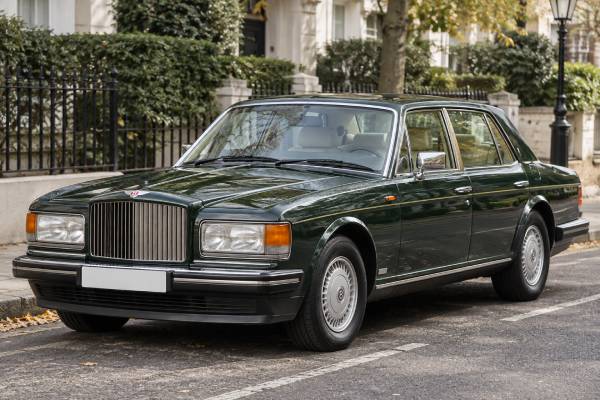
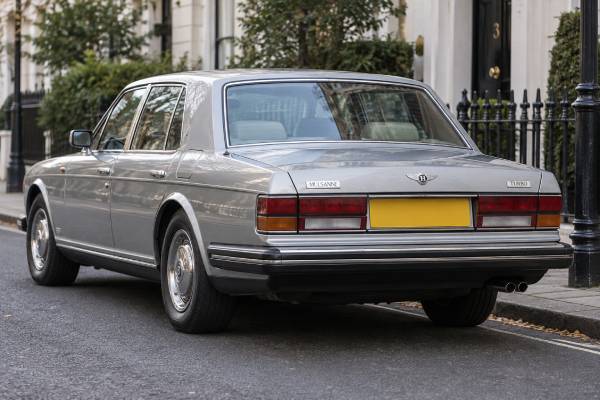
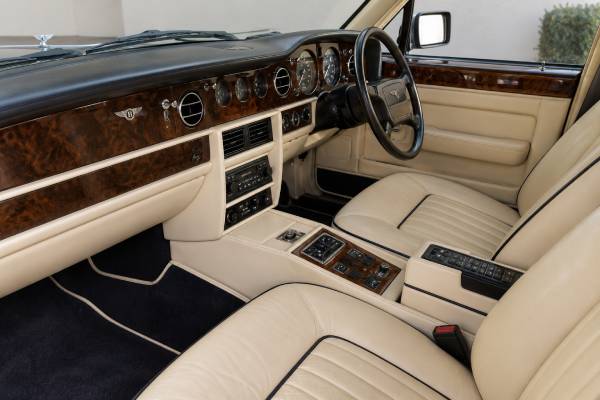
The Bentley Mulsanne Turbo transformed the early SZ saloon from a quiet badge-engineered relative of the Rolls-Royce Silver Spirit into a distinctly Bentley performance car. Introduced in 1982, it added a Garrett turbocharger to the 6.75-litre L-series V8 and raised output to roughly 298 hp, with a much larger increase in mid-range thrust than the number alone suggests. The result was a near two-and-a-half-ton luxury saloon capable of sports-car acceleration by early-1980s standards, yet it retained wool headlining, deep leather, polished walnut, hydraulic braking, and self-levelling suspension. Its importance is historical as well as mechanical: the Mulsanne Turbo established the formula that led directly to the Turbo R and Bentley’s modern identity. Buying one now requires more than checking boost. Heat management, carburetion, ignition, hydraulic condition, chassis wear, corrosion, and originality all determine whether the car feels like a “silent sports car” or an expensive unfinished project.
Table of Contents
- Why the Mulsanne Turbo Was a Turning Point
- Turbocharged V8 and Technical Data
- Boost Delivery, Performance, and Road Behavior
- The Chassis Before the Turbo R
- Heat, Fuel, Ignition, and Hydraulic Maintenance
- Authenticity and Pre-Purchase Inspection
- Collector Value and Driver’s Verdict
Why the Mulsanne Turbo Was a Turning Point
The Mulsanne Turbo matters because it restored a clear performance reason to buy a Bentley. The naturally aspirated Mulsanne was refined and handsome, but it differed only subtly in concept from its Rolls-Royce counterpart. Turbocharging gave Bentley a separate personality built around effortless speed, low-rev torque, and discreet aggression.
Bentley unveiled the model at the 1982 Geneva Motor Show. Contemporary commentary revived the “Blower Bentley” comparison, although the engineering link to the supercharged pre-war cars was symbolic rather than direct. The production car used an exhaust-driven Garrett AiResearch turbocharger feeding the long-established pushrod V8. A four-barrel Solex carburettor and modified induction arrangement supplied fuel, while internal and cooling changes allowed the engine to survive substantially higher cylinder pressure.
The effect was dramatic. Output rose by roughly half over the naturally aspirated car, and the 0–60 mph time fell to around seven seconds. More important, overtaking performance arrived without forcing the engine to rev hard. The car surged forward on boost while preserving a muted exhaust and relaxed cabin.
This first turbo installation was not yet the complete handling package. Bentley’s engineers learned that straight-line performance had outgrown the soft chassis calibration, leading to the firmer, better-controlled Turbo R in 1985. That history should shape expectations. A Mulsanne Turbo is an early high-speed luxury express, not simply a Turbo R with older trim.
Production was low. Specialist records commonly cite 498 standard-wheelbase cars and 18 long-wheelbase examples. Survival is lower, and many cars have been modified with later wheels, suspension parts, fuel injection, body kits, or Turbo R details. A correct early car therefore has value beyond its raw performance.
Turbocharged V8 and Technical Data
The 1982–1985 Mulsanne Turbo is a petrol-only, front-engine, rear-wheel-drive saloon. Its L410D-family 6,750 cc V8 uses one turbocharger, carburettor fuel metering in its original early form, and a three-speed GM automatic transmission. Because period factory output disclosure was sometimes guarded, figures vary among sources; the assignment’s 298 hp figure aligns with Bentley’s later heritage description of the engine carried into the early Turbo R.
| Specification | Value | Notes |
|---|---|---|
| Engine family | L-series V8, assignment code L410D | Crewe-developed turbo application |
| Displacement | 6,750 cc (6.75 L; 411.9 cu in) | Frequently rounded to 6.8 L |
| Architecture | 90-degree OHV V8 | Two valves per cylinder, hydraulic tappets |
| Bore × stroke | 104.1 × 99.1 mm (4.10 × 3.90 in) | Shared L-series geometry |
| Turbocharger | Garrett AiResearch T04-series single turbo | Period sources vary on suffix |
| Fuel system | Solex four-barrel carburettor | Special pressurized turbo installation |
| Compression ratio | Approximately 8.0:1 | Reduced for forced induction |
| Maximum power | Approximately 298 hp (222 kW) | Some period-derived sources quote higher estimates |
| Fuel | Premium petrol/gasoline | Octane quality and ignition control are critical |
| Component | Configuration | |
|---|---|---|
| Transmission | GM THM400 three-speed automatic | |
| Drive type | Rear-wheel drive | |
| Front suspension | Independent wishbones, coil springs, anti-roll bar | |
| Rear suspension | Independent semi-trailing arms, hydraulic self-levelling | |
| Steering | Power-assisted rack and pinion | |
| Brakes | Four-wheel discs with high-pressure hydraulic assistance | |
| Original tire size | 235/70 VR15 or period-correct equivalent | Confirm wheel and market specification |
| Measurement | Approximate value |
|---|---|
| Body | Four-door standard-wheelbase saloon |
| Wheelbase | 3,060 mm (120.5 in) |
| Length | 5,310 mm (209.1 in) |
| Width | 1,890 mm (74.4 in), excluding mirrors |
| Height | 1,490 mm (58.7 in) |
| Kerb weight | About 2,290 kg (5,050 lb) |
| Turning circle | About 11.9 m (39.0 ft) |
| Measure | Published figure | Condition |
|---|---|---|
| 0–60 mph | About 7.0 seconds | Healthy period-specification car |
| 0–100 km/h | Approximately 7.0–7.5 seconds | Test method and source dependent |
| Top speed | Approximately 217–222 km/h (135–138 mph) | Tire condition and road legality are critical |
| Observed fast-cruise consumption | About 17.3 L/100 km at 120 km/h | Period published test condition |
The tables should not be read as permission to pursue maximum speed in an unrestored car. Tires, brake hydraulics, dampers, wheel bearings, steering joints, cooling performance, and body stability must all be verified before using even a portion of the original capability.
Boost Delivery, Performance, and Road Behavior
A properly tuned Mulsanne Turbo should build power progressively, then deliver a strong mid-range surge without detonation, misfire, or black smoke. It will not respond like a modern small-turbo engine with electronic boost control. There is more delay, more driveline softness, and a greater sense that the whole car gathers momentum at once.
At light throttle, the car behaves much like the naturally aspirated Mulsanne: quiet, smooth, and reluctant to show effort. Press farther and exhaust flow wakes the large turbocharger. The torque increase then pushes through the three-speed automatic, often without an immediate downshift. This broad, gear-independent acceleration is central to the model’s appeal.
Several symptoms signal trouble rather than period character. A flat response may indicate ignition retard, carburettor problems, boost leakage, a sticking wastegate, fuel starvation, low compression, exhaust restriction, or transmission kickdown faults. Surging can come from unstable fuel delivery or induction leaks. Metallic pinging under load is dangerous because a high-compression event under boost can damage pistons quickly.
Blue smoke after idling or on boost can point to turbo seals, valve guides, breather problems, or engine wear. A small puff must be interpreted in context, but continuous smoke is not acceptable. Oil in the intake tract should be assessed by someone familiar with the system rather than dismissed as normal.
The THM400 is strong enough for the engine when healthy. Engagement should be prompt, shifts positive but not brutal, and kickdown repeatable. Modified engines can overwhelm old clutches or expose weak cooling. A transmission that flares between gears or delays Reverse is asking for attention.
The most rewarding way to drive the car is to preserve momentum. Use the engine’s middle range, leave room for braking, and make one smooth steering input rather than correcting repeatedly. On a clear fast road, the combination of quiet cabin and rapid speed accumulation can be deceptive. The speedometer needs more attention than the soundtrack.
The Chassis Before the Turbo R
The Mulsanne Turbo’s chassis is its defining limitation and one reason it feels historically interesting. Bentley added major power before the later Turbo R’s comprehensive increase in roll stiffness, damping, lateral location, tire specification, and aerodynamic stability.
That does not make the Mulsanne Turbo unsafe when correct. It means the car leans more, takes longer to settle, and communicates its mass differently from the 1985-on Turbo R. On smooth roads, the supple setup is luxurious. On a series of fast bends or abrupt lane changes, the body can move significantly, and old dampers or bushes amplify that motion.
The later Turbo R reportedly gained much stiffer anti-roll bars, firmer dampers, a rear Panhard rod, performance tires, and a deeper front air dam after high-speed development. Owners sometimes retrofit some of these parts to a Mulsanne Turbo. The result may drive better, but the buyer should know whether the goal is originality or a sympathetic restomod. A mixed setup with random springs, modern low-profile tires, and tired hydraulic levelling can be worse than either factory configuration.
A chassis assessment should include ride height, damper control, wheel alignment, tire age, tire load and speed ratings, subframe mounts, wishbone joints, rear semi-trailing-arm bushes, anti-roll-bar links, steering rack mounts, and wheel bearings. The car should not bounce repeatedly, steer from the rear under throttle changes, or pull during braking.
Aerodynamics are another period constraint. The body was designed before its turbocharged speed potential was fully explored. Missing undertrays, incorrect ride height, damaged spoilers, or raised front suspension can worsen stability. A car that feels light or nervous at legal motorway speed needs diagnosis; it should not be rationalized as an old-car trait.
Brakes use Crewe’s high-pressure hydraulic system. When operating correctly, they are powerful and consistent. The warning-light sequence, pump cycling, accumulator reserve, fluid condition, leaks, hoses, calipers, discs, and rear levelling operation need specialist testing. Performance increases the consequences of any weakness.
Heat, Fuel, Ignition, and Hydraulic Maintenance
Turbocharged ownership succeeds or fails on heat and mixture control. The engine bay packages a large turbo, exhaust plumbing, carburettor hardware, hydraulics, wiring, and air-conditioning components around an alloy V8. Old insulation, brittle hoses, weak fans, poor grounds, and incorrect tuning can combine into serious faults.
Cooling and turbo lubrication
Verify radiator condition, fan operation, water pump, thermostat, hoses, expansion tank, heater circuit, coolant concentration, and evidence of combustion gas. The temperature should remain stable after a hard pull followed by idling. A car that behaves only while moving may have inadequate airflow or a partially blocked radiator.
Fresh oil of the correct specification and regular change intervals protect both engine and turbocharger. After sustained load, allow a short period of gentle driving before shutdown rather than repeatedly stopping immediately from boost. This reduces localized heat soak. An owner does not need theatrical multi-minute idling after every trip; sensible warm-up and cool-down behavior is enough.
Carburettor and fuel supply
The pressurized Solex installation requires specialist knowledge. Fuel pumps, pressure regulation, float control, enrichment, throttle linkages, gaskets, and boost-referenced functions must work as a system. Converting parts without understanding pressure relationships can produce lean running exactly when the engine is under greatest load.
Replace aged fuel hoses proactively, inspect heat shields, and confirm that no lines touch hot exhaust or turbo components. Check the tank and filters for contamination after long storage. Premium fuel of adequate octane is essential, but high octane cannot compensate for excessive ignition advance, a lean mixture, or overheating.
Ignition and exhaust
Spark plugs, leads, distributor condition, advance mechanisms, coils, and grounds must deliver a strong consistent spark under boost. An engine may idle perfectly yet misfire at cylinder pressure. Use the correct plug heat range and gap from model-specific documentation.
Exhaust manifolds and turbo joints should be checked for cracks and leaks. A ticking noise when cold, soot marks, slow boost response, or fumes in the cabin may reveal leakage. Original exhaust parts are expensive; stainless replacements can be practical if routing, heat control, sound, and mounting remain appropriate.
| Symptom | Possible causes | Response |
|---|---|---|
| Detonation under load | Low octane, lean mixture, excess advance, overheating | Stop boost testing and diagnose immediately |
| Blue smoke on boost | Turbo seals, guides, rings, breather fault | Check intake, compression, and turbo condition |
| Weak acceleration | Boost leak, wastegate, fuel restriction, ignition, transmission | Measure rather than adjust blindly |
| Fuel smell | Hoses, carburettor leakage, tank venting | Treat as a fire risk |
| Rising temperature after boost | Radiator, fan, pump, mixture, head sealing | Pressure-test and inspect cooling system |
| Frequent hydraulic pump cycling | Weak accumulators or pressure loss | Specialist pressure test |
Routine servicing should also cover the high-pressure brake and levelling hydraulics, transmission fluid, differential oil, belts, engine mounts, steering joints, air conditioning, and electrical charging. A turbo engine cannot compensate for a neglected base car.
Authenticity and Pre-Purchase Inspection
A genuine Mulsanne Turbo should be authenticated before price discussions become serious. Badges and turbo body details can be transferred, while later engines and fuel systems may have been installed during decades of repair.
Compare VIN, chassis plate, registration documents, engine number, build records, and visible equipment. Look for the correct turbo plumbing, carburettor installation, air cleaner, heat shields, exhaust, instruments, wheels, grille, badges, and interior specification. A factory long-wheelbase Turbo is exceptionally rare and needs especially strong documentation.
Modification is common. Turbo R suspension components, later fuel injection, larger wheels, modern ignition, different turbochargers, and altered exhaust systems can improve or degrade the car. Ask who engineered the work, what parts were used, whether the original components remain, and whether the mixture and ignition were verified under load. A folder of receipts and test data is much more persuasive than an owner’s claim that the car has been “upgraded.”
Corrosion inspection follows the same broad pattern as other SZ cars: sills, floor edges, wheel arches, lower wings, door bottoms, boot floor, window surrounds, jacking areas, subframe mounting regions, and hidden seams. Turbo heat can also affect paint, wiring, seals, and insulation in the engine bay. Examine repaired accident damage carefully because the car’s speed and mass place high demands on alignment.
The road test should begin cold and last long enough to create heat soak. Confirm starting, idle, oil pressure, hydraulic warning behavior, transmission engagement, boost response, braking, steering, ride height, climate control, and hot restarting. A boost gauge added for diagnosis can be useful, but a dashboard full of aftermarket instruments is not proof of correct tuning.
A specialist pre-purchase inspection should include:
- cylinder health and crankcase-pressure assessment;
- turbo shaft, seal, wastegate, and oil-feed inspection;
- fuel pressure and mixture behavior under controlled load;
- cooling-system pressure and airflow checks;
- brake and levelling hydraulic pressure tests;
- suspension, steering, subframe, and tire inspection;
- body corrosion and repair evaluation;
- verification of identity and major modifications.
Do not skip the inspection because the car is inexpensive. The difference between a running car and a sorted car can exceed the purchase price.
Collector Value and Driver’s Verdict
The Mulsanne Turbo appeals to enthusiasts who want the moment Bentley rediscovered performance. It is rarer and more historically pivotal than the naturally aspirated Mulsanne, but less dynamically developed than the Turbo R. That combination gives it a distinctive niche rather than a simple place in a performance ranking.
Collectors generally favor original cars with early turbo hardware, complete interiors, known ownership, factory colors, and evidence of specialist maintenance. Driver-focused buyers may accept sympathetic Turbo R chassis improvements or modern ignition, provided the work is documented and reversible. Both groups should avoid incomplete projects unless rare parts and skilled labor are already secured.
Running costs are driven by condition, not mileage alone. Fuel use is high, but a turbocharger rebuild, hydraulic overhaul, radiator replacement, body restoration, or interior re-veneering can dominate the budget. Insurance, secure dry storage, specialist transport, and correct high-speed tires also belong in the ownership calculation.
Regular use is beneficial when the car is fully sorted. It keeps seals working, exposes small fuel and cooling faults, exercises hydraulic systems, and prevents electrical contacts from deteriorating unnoticed. Trips should be long enough to warm the drivetrain completely, and the driver should avoid heavy boost until oil and coolant are at operating temperature.
Compared with the Turbo R, the Mulsanne Turbo rides more softly and feels more dramatic because the engine’s performance exceeds the chassis’s visual and dynamic expectations. Compared with the standard Mulsanne, it is far quicker and more complex. That contrast is the essence of the car.
Buy one for its historical significance and unique road character, not because it is the cheapest route to 1980s Bentley speed. The ideal example starts cleanly, holds temperature, builds boost without detonation, shifts decisively, brakes with confidence, sits level, and retains its correct turbo-specific parts. When those conditions are met, the Mulsanne Turbo delivers the blend that revived Bentley: immense handcrafted luxury with a genuinely forceful engine beneath it.
Tuning discipline is especially important because a workshop can make an early turbo Bentley feel faster while moving it closer to detonation or thermal failure. Establish a factory-style baseline before changing boost, carburettor calibration, ignition advance, exhaust restriction, or wastegate control. The baseline should include compression consistency, fuel pressure under load, ignition timing through the operating range, cooling-system capacity, exhaust leaks, intake sealing, and a verified pressure gauge. Without those measurements, an adjustment that improves one road test may hide a lean condition or an overworked turbocharger.
If the car has a non-standard turbo, intercooler, ignition box, fuel pump, or exhaust, identify the manufacturer and part number rather than accepting a vague “uprated” description. Determine who selected the components and whether the carburettor and ignition were calibrated together. A large turbo can reduce low-speed response; a freer exhaust can alter boost control; a high-output pump can overwhelm an incorrect regulator. Modifications interact.
A cautious owner should also distinguish engine performance from transmission behavior. A delayed kickdown can make boost feel weak, while an early downshift can make an ordinary engine feel unusually strong. Road testing with a specialist who can observe throttle position, gear selection, boost, mixture behavior, and temperature prevents unnecessary engine work.
After purchase, avoid full-load demonstrations until tires, brakes, steering, hydraulics, and wheel bearings have passed inspection. Then build load in stages on a suitable road or controlled test environment. Recheck hose clamps, oil lines, coolant level, spark-plug appearance, and fluid leaks after the first meaningful heat cycles. Early discovery of a loose joint is far cheaper than assuming the restoration invoice guarantees every connection has settled.
Keep the original calibration parts even if a reversible upgrade is chosen. The Mulsanne Turbo’s significance lies partly in its first-generation solution to high-performance luxury; retaining the ability to return to that configuration protects both historical value and diagnostic clarity.
References
- Bentley Mulsanne Turbo 2026 (Model and Production Reference)
- Bentley Mulsanne 2026 (Naturally Aspirated Comparison)
- Bentley Mulsanne LWB 2026 (Body and Chassis Reference)
- 1980-1998 2022 (Official Technical Library)
- Coachwork Repair Manual 1985 (Official Coachwork Manual)
Disclaimer
This article is for informational purposes only and is not a substitute for professional diagnosis, tuning, repair, or model-specific workshop procedures. Specifications, boost settings, torque values, intervals, fluids, and components vary by VIN, market, production change, and modification history; verify every car against official service documentation. Please share this guide on Facebook, X/Twitter, or an enthusiast forum if it supports safer, better-informed preservation of the Mulsanne Turbo.