
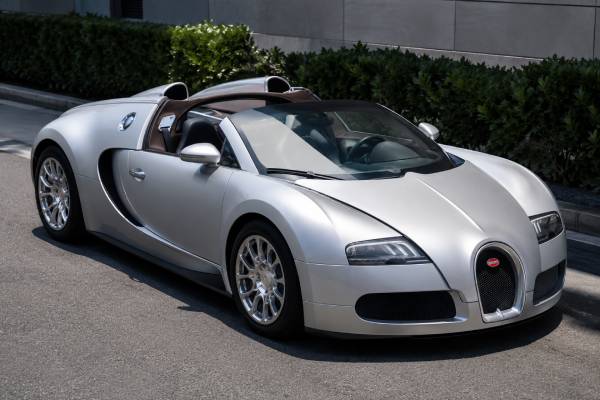
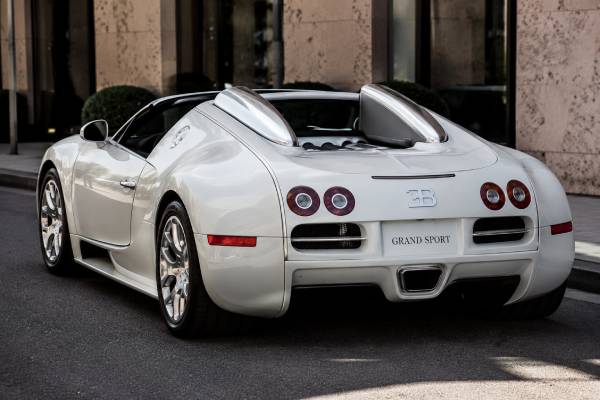
The Bugatti Veyron 16.4 Grand Sport is the open-top version of the car that turned the word “hypercar” into everyday language. It kept the standard Veyron’s quad-turbocharged 8.0-liter W16 engine, all-wheel drive, seven-speed dual-clutch gearbox, and extraordinary top-speed ability, but added a removable roof and a much more complex body structure. That made it more than a simple roadster. It had to deliver the same sense of speed, refinement, and stability while coping with the loss of a fixed roof at speeds few production cars could reach even with one.
For buyers and collectors, the Grand Sport matters because it sits between two worlds. It has the original 1,001 PS Veyron character, not the later 1,200 PS Vitesse tune, but it offers the open-air drama that makes the roadster body so desirable. It is rare, highly technical, expensive to maintain, and still one of the clearest examples of engineering ambition without compromise.
Table of Contents
- Why the Grand Sport Still Matters
- W16 Specs and Key Technical Data
- Production Versions and Collector Details
- Open-Top Engineering and Design Details
- How the Grand Sport Drives
- Maintenance Realities for a Veyron Roadster
- Buying a Grand Sport the Right Way
Why the Grand Sport Still Matters
The Veyron Grand Sport matters because it took the original Veyron formula and made it harder: the same immense speed, the same grand-touring comfort, and the same technical confidence, now with a removable roof. For Bugatti, that was not just a styling exercise. It meant protecting the Veyron’s reputation while changing one of the most important structural parts of the car.
The Veyron itself was born from Ferdinand K. Piëch’s idea of a road car that could exceed 400 km/h yet remain usable, luxurious, and stable. The production car arrived in 2005 with a new 8.0-liter W16 engine, four turbochargers, ten radiators, all-wheel drive, active aerodynamics, and a specially developed seven-speed dual-clutch gearbox. The Grand Sport extended that idea into a targa-style roadster, introduced publicly in 2008 before production began for customers in 2009.
Its place in Bugatti history is important for three reasons. First, it was the first open Veyron body style and proved that the platform could work without a fixed roof. Second, it kept the original 1,001 PS tune, making it the open-air counterpart to the early Veyron rather than a preview of the later, more aggressive Vitesse. Third, it became part of the final chapter of the Veyron story, which ended in 2015 after a total Veyron-family production run of 450 cars.
The Grand Sport also helped move collector attention away from simple top-speed numbers. The coupé was the original technical statement. The Super Sport was the record-focused evolution. The Grand Sport Vitesse became the 1,200 PS open-top flagship. The standard Grand Sport, however, has a different appeal. It is the Veyron in a more sensory form, where intake noise, wind, heat, and mechanical presence become a larger part of the experience.
Today, serious buyers see it as a rare, complicated, and historically meaningful Bugatti. It is not a casual exotic car. It is a hand-built hypercar from Molsheim, developed during a period when the Volkswagen Group gave Bugatti the resources to solve problems that most manufacturers would never attempt. That is why the Grand Sport still has a strong reputation: it represents engineering excess with a clear purpose.
W16 Specs and Key Technical Data
The Grand Sport uses the standard Veyron 16.4 powertrain: an 8.0-liter, quad-turbocharged W16 producing 1,001 PS and 1,250 Nm of torque. The important point is that the roof changed, not the core engine concept.
| Category | Specification |
|---|---|
| Production years covered | 2009–2015 |
| Body style | Two-seat open-top targa roadster with removable roof panel |
| Engine | 8.0-liter quad-turbocharged W16 |
| Displacement | 7,993 cc |
| Output | 1,001 PS at 6,000 rpm |
| Torque | 1,250 Nm from 2,200 to 5,000 rpm |
| Transmission | Seven-speed dual-clutch automatic |
| Drivetrain | All-wheel drive |
| Engine position | Longitudinal mid-rear |
| Chassis concept | Carbon-fiber monocoque with aluminum chassis structures |
The W16 is the center of the car’s identity. It is often described as two narrow-angle V8 layouts combined into a compact W arrangement, but the production engine was not a parts-bin curiosity. It was developed to make huge power while fitting into a road car that also needed air conditioning, luggage space, noise control, emissions compliance, and daily drivability. Four turbochargers provide the boost, while a large cooling system manages engine water, charge-air cooling, oil, transmission, differential, and cabin climate loads.
The gearbox is just as important as the engine. A conventional manual gearbox would not have matched the torque, speed, and usability targets. The seven-speed dual-clutch unit was designed to shift quickly while keeping the car smooth enough for luxury use. In normal driving, it can behave with surprising calm. Under full throttle, it keeps the W16 in its torque band and removes the drama that a traditional clutch would create at this power level.
| Measure | Grand Sport figure |
|---|---|
| 0–100 km/h | About 2.5–2.7 seconds, depending on test source and conditions |
| 0–200 km/h | About 7.3–7.5 seconds |
| 0–300 km/h | About 16.7–16.8 seconds |
| Top speed with roof fitted | Approximately the same top-speed class as the standard Veyron coupé |
| Top speed with roof removed | Limited below the roof-fitted maximum; published period figures vary around the high-300 km/h range |
| Temporary soft roof limit | Low-speed emergency-use range, commonly quoted around 130 km/h |
The performance figures need context. A Veyron is not fast only because it has a large power number. It is fast because the powertrain, tires, aerodynamic control, cooling, brakes, and suspension were developed as one system. At very high speed, the car changes ride height and aerodynamic attitude. Under heavy braking, the rear wing works as an air brake, adding stability and load to the rear axle.
Dimensions are also part of the story. The Veyron is compact in length compared with many luxury cars, but very wide and heavy for a two-seater. Its mass helps explain the stable, planted feel at speed, while its all-wheel-drive system helps convert torque into acceleration instead of tire smoke.
| Area | Useful detail |
|---|---|
| Wheelbase | 2,710 mm |
| Length | 4,462 mm |
| Width | 1,998 mm |
| Height | 1,204 mm |
| Brakes | Carbon-ceramic system with high-performance multi-piston calipers |
| Aerodynamic braking | Rear wing functions as an air brake during high-speed deceleration |
| Tires | Bugatti-specific Michelin high-speed tire system |
| Suspension behavior | Active ride-height and aerodynamic modes for normal driving, handling, and top-speed use |
The Grand Sport’s removable roof adds another performance variable. With the main roof panel fitted, it can operate much like the coupé. With the roof removed, airflow, buffeting, cooling behavior, and safety margins change. That is why the car uses speed limits tied to roof configuration rather than pretending the open-top version can be treated exactly like the fixed-roof coupé in every condition.
Production Versions and Collector Details
The Grand Sport is best understood as the first open Veyron, not as the later Grand Sport Vitesse. The standard Grand Sport kept the 1,001 PS engine, while the Vitesse used the stronger 1,200 PS Super Sport-based tune.
Bugatti planned the Veyron family around extreme rarity. Across all Veyron variants, total production reached 450 cars. The roadster allocation was smaller than the coupé allocation, and within that open-top group, the standard Grand Sport is especially interesting because it belongs to the original-output era. Published production breakdowns commonly separate the family into the standard coupé, Grand Sport, Super Sport, and Grand Sport Vitesse.
For identification, buyers should be careful with the name. “Veyron Grand Sport” can be used loosely in listings, but there are two very different open-top cars:
- The Veyron 16.4 Grand Sport uses the 1,001 PS W16 tune.
- The Veyron 16.4 Grand Sport Vitesse uses the 1,200 PS tune related to the Super Sport.
- Special editions may be based on either version, so the base variant must be confirmed by VIN, factory documentation, and Bugatti records.
Early Grand Sport production was tied closely to existing Bugatti clients. That makes provenance unusually important. Many cars were commissioned with highly personalized colors, exposed carbon fiber, polished aluminum details, special leather, contrast stitching, and one-off design themes. A plain-looking specification can be valuable if it is elegant and original, but a famous or one-off factory specification can add a different layer of desirability.
The Grand Sport also became a platform for several notable special versions. Examples include the Sang Bleu, L’Or Blanc, Dubai Motor Show special cars, and the Bernar Venet art car. L’Or Blanc is especially memorable because it used porcelain details through a collaboration with Königliche Porzellan-Manufaktur Berlin. These cars show how Bugatti treated the Grand Sport not only as an engineering product but also as a coachbuilt luxury object.
| Version or theme | Why collectors notice it |
|---|---|
| Standard Grand Sport | Original-output open Veyron with 1,001 PS character |
| Sang Bleu | One-off design focus with exposed materials and blue theme |
| L’Or Blanc | Porcelain-detail one-off collaboration with KPM Berlin |
| Dubai Motor Show cars | Highly visible Middle East-market special specifications |
| Bernar Venet | Art-focused one-off with technical-equation graphics |
| Grand Sport Vitesse | Later 1,200 PS open-top model; related but not the same buying proposition |
Factory options and personalization matter more here than they do on most cars. Paint, exposed carbon, interior color, leather type, stitching, wheel finish, roof equipment, luggage, books, chargers, tools, and factory correspondence all affect completeness. The best cars are not merely low-mileage examples. They are cars with clear history, complete accessories, correct service records, and documented originality.
Collectors should also be aware that a unique color combination is not automatically better. A tasteful original specification can be easier to resell than an extremely personal one. Conversely, a one-off car with known factory story, public history, or special-edition status can become far more desirable than a standard build. The documentation decides which is which.
Open-Top Engineering and Design Details
The Grand Sport’s key engineering achievement is structural: it had to remain stable, safe, and refined after losing the fixed roof. That required more than simply cutting the top off the coupé.
The Veyron coupé’s body structure was already dealing with rare loads. At more than 400 km/h, aerodynamic forces, tire loads, drivetrain torque, and heat management all become extreme. Removing the roof created new problems in torsional stiffness, rollover behavior, door aperture strength, sealing, wind management, and noise control. Bugatti responded by reinforcing the structure, strengthening areas such as the side sills and door surrounds, and using the roof-intake area as part of the safety and rigidity strategy.
Visually, the Grand Sport keeps the Veyron shape but changes its emotional character. The roofline is lower in the driver’s perception because the removable top separates the cockpit from the intake and rear deck visually. With the roof removed, the twin intake structures behind the seats become a defining feature. They are not just decoration. They help feed and package the W16’s cooling and intake needs while contributing to the car’s open-top identity.
The removable roof system is central to ownership. The main roof panel gives the car its high-speed capability and coupé-like comfort. The temporary soft roof is a practical emergency piece, not a full replacement for the main roof. Buyers should treat both as important factory equipment. Missing, damaged, poorly stored, or ill-fitting roof parts can affect usability, value, and inspection results.
Aerodynamics are another major part of the design. The Veyron’s active system uses front diffuser flaps and a rear wing/spoiler arrangement to balance drag, downforce, and braking stability. In handling conditions, the car produces meaningful aerodynamic load. In top-speed mode, it lowers and changes its aero attitude to reduce drag. That explains why the Veyron can feel secure at speeds where most cars would feel nervous or light.
Cooling defines much of the bodywork. The Veyron’s shape is smooth and elegant, but underneath that surface is a heat-management machine. The W16, four turbochargers, charge-air system, engine oil, gearbox, differentials, brakes, and cabin systems all need careful cooling. The Grand Sport keeps the drama hidden. It does not wear oversized racing vents as styling theater; instead, it integrates airflow into the car’s luxury shape.
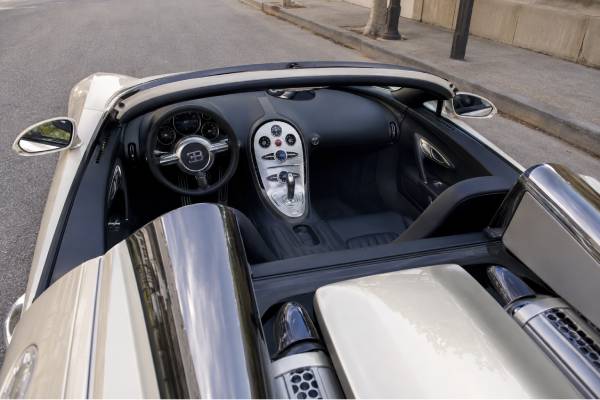
Inside, the Grand Sport is deliberately simple compared with many modern hypercars. The cabin uses rich materials, strong symmetry, clear analog-style controls, and a driving position designed for confidence rather than race-car intimidation. This is one of the Veyron’s lasting strengths. It feels special, but it does not bury the driver under screens and modes. The luxury is in the material quality, the sense of occasion, and the fact that such performance can be accessed without a competition-style cockpit.
The sound is also different from a typical exotic. The W16 does not scream like a naturally aspirated V12. It has a deep, dense, turbine-like character, supported by intake rush and turbocharged force. Roof-off driving adds more intake and airflow noise, which makes the Grand Sport feel more mechanical and more alive at road speeds than the coupé.
How the Grand Sport Drives
The Grand Sport drives with a mix of absurd acceleration and unexpected calm. The headline is speed, but the more impressive quality is how controlled the car feels while delivering it.
Full-throttle acceleration is not delicate. The W16’s torque arrives with enormous force, and the all-wheel-drive system gives the car the traction needed to use it. Unlike a rear-drive supercar that turns power into drama, the Veyron turns power into distance. It gathers speed so quickly that short straights disappear, yet the delivery is smooth enough that the driver may underestimate the pace.
The gearbox contributes to that character. In automatic mode, it can move the car through town with little theater. In manual mode, it responds quickly and keeps the engine in the strongest part of the torque curve. The shifts are not meant to feel raw or violent. The Veyron’s job is to make extreme speed repeatable and controlled, not to mimic a race car with harsh engagement.
Steering feel is heavy enough to match the car’s width and weight, but the Grand Sport is not a nervous, hyperactive machine. It was engineered to feel stable first. On a fast road, that gives the driver confidence. In tight mountain sections, the car’s mass and width are always present, so it rewards clean inputs more than aggression. It can cover ground at a huge rate, but it is not a small lightweight car that wants to be thrown around.
Ride quality is one of the reasons the Veyron became legendary. The Grand Sport can feel firm because of its tires, structure, and performance targets, but it is not crude. It was built as a Bugatti, not as a stripped track special. On highways and open roads, it has the grand-touring composure that made the original Veyron so unusual.
Braking performance is deeply tied to the aero system. The carbon-ceramic brakes provide the mechanical stopping power, while the rear wing helps stabilize the car during hard deceleration from very high speed. This gives the Veyron one of its most distinctive sensations: acceleration and braking both feel like managed engineering events, not just driver inputs.
Roof configuration changes the experience. With the roof fitted, the car feels closer to the coupé: quieter, more sealed, and better suited to very high speeds. With the roof removed, the Grand Sport becomes more theatrical. The driver hears more air, more intake sound, and more of the mechanical environment behind the seats. It is still a very refined car by open-top hypercar standards, but the open cockpit makes the performance feel more physical.
Visibility is better than many people expect, although the car’s width demands respect. The driving position is low, the front corners are not as easy to place as a smaller sports car, and urban driving requires patience. In normal use, however, the Grand Sport is far less intimidating than its numbers suggest. That was part of the Veyron mission from the beginning: the car had to be unimaginably fast, but still usable by an owner rather than a professional driver.
Track use is possible, but it is not the Grand Sport’s natural home. Heat, tire cost, brake wear, and vehicle mass make repeated track running expensive. The car is more convincing as a high-speed road and grand-touring machine than as a lap-time tool. Owners who want to preserve value should be careful with repeated launch-control use, aggressive heat cycles, and any driving that consumes rare components without adding meaningful enjoyment.
Maintenance Realities for a Veyron Roadster
Maintaining a Veyron Grand Sport is not like maintaining a normal exotic car. The car is rare, highly specialized, and dependent on factory-level knowledge, correct equipment, and parts that were never designed for mass-market availability.
The most important ownership rule is simple: buy the best-documented car you can afford, then maintain it through people who know the platform. A low-mileage car with weak records can be riskier than a properly used car with complete Bugatti service history. Age matters as much as mileage because seals, tires, fluids, batteries, hoses, and hydraulic components do not stop aging when the odometer is still low.
Key maintenance areas include:
- Tires: the Veyron uses a special high-speed tire system, and age matters even if tread depth looks healthy.
- Wheels and tire mounting: correct equipment and procedures are essential because the tire system is highly specialized.
- Brakes: carbon-ceramic discs and pads are durable in the right use but very expensive if damaged, worn, or heat-abused.
- Cooling system: the W16 depends on extensive cooling hardware, and any leak, blockage, fan issue, or weak pump deserves serious attention.
- Gearbox and driveline: the dual-clutch gearbox, all-wheel-drive hardware, differentials, and related fluids must be maintained correctly.
- Active aero and suspension: hydraulic and electronic systems should be checked for smooth function, warning lights, leaks, and calibration issues.
- Roof system: seals, latches, storage equipment, finish, and fitment are critical on the Grand Sport.
- Battery and electronics: weak batteries can create warning issues, and control modules need proper diagnostic support.
The Grand Sport’s roof adds inspection points that a coupé does not have. The main roof panel should fit cleanly and seal properly. The emergency soft roof should be present and complete. Weather seals should be soft, correctly seated, and free from obvious compression damage. Evidence of water entry, wind noise complaints, or roof-related trim damage should be investigated before purchase.
Carbon-ceramic brakes need a specialist inspection. A shiny disc surface is not enough. Buyers should check remaining material, surface condition, edge wear, chips, cracks, and service history. Replacement costs can be severe, so brake condition affects real purchase value.
Tire condition is equally important. A car may have very low mileage but old tires. For an ordinary collector car, that might be a small negotiation point. For a Veyron, it can become a major cost and safety issue because the tire system is part of the car’s top-speed capability.
The gearbox and clutch system should feel smooth, consistent, and free from strange engagement behavior. Hard launch use, poor maintenance, or long inactivity can all create concerns. A specialist diagnostic scan is essential because dashboard behavior alone is not enough.
The cooling system deserves special respect. The Veyron was engineered around heat control, and any shortcut here is dangerous. Coolant condition, radiator condition, fan operation, oil leaks, turbo-related heat shielding, and service records should be reviewed carefully.
Originality creates another maintenance tradeoff. Some owners may want modern infotainment upgrades, protective film, battery tender updates, or small usability improvements. Those can be sensible if reversible and documented, but permanent changes can hurt collector value. On a Grand Sport, originality is not just about paint color. It includes interior trim, roof pieces, luggage, books, tools, factory accessories, and service stamps.
Recalls and service campaigns should be checked by VIN through official channels. Because Veyron production was tiny, some updates may be handled through direct owner communication, dealer records, or factory service history rather than broad public awareness. A clean listing description is not enough. The car’s file should prove what has been done.
Buying a Grand Sport the Right Way
The right Grand Sport is the one with verified identity, complete history, healthy major systems, and a specification you will still want years from now. Price matters, but condition and documentation matter more.
Start with identity. Confirm whether the car is a standard Grand Sport or a Grand Sport Vitesse. Confirm the VIN, build number, original delivery market, original specification, current specification, and any special-edition status. A seller’s wording may be casual, but the paperwork must be precise.
Next, study the service history. You want dates, mileage, invoices, dealer or factory records, tire history, brake history, battery history, fluid services, roof-related work, and any campaign completion evidence. Gaps do not automatically ruin a car, but they should be explained. A Veyron with missing history should be priced with enough margin to correct unknowns.
A pre-purchase inspection should be performed by a Bugatti-authorized or deeply experienced Veyron specialist. A general exotic-car shop is not enough unless it has direct Veyron experience and proper diagnostic access. The inspection should cover mechanical, electronic, hydraulic, structural, cosmetic, and documentation points.
| Inspection area | What to confirm |
|---|---|
| Identity | VIN, model variant, original market, build documentation, special-edition status |
| Service history | Complete records, campaign evidence, fluid services, tire and brake history |
| Roof equipment | Main roof panel, emergency roof, storage parts, seals, latches, fitment |
| Tires and wheels | Age, condition, correct specification, mounting history, wheel damage |
| Brakes | Disc condition, pad life, chips, cracks, heat damage, replacement records |
| Cooling and fluids | Leaks, radiator condition, coolant state, oil condition, service intervals |
| Electronics | Diagnostic scan, warning history, battery health, control-module behavior |
| Body and carbon | Paint quality, exposed carbon condition, accident history, panel alignment |
| Accessories | Books, tools, charger, luggage, keys, roof storage items, factory correspondence |
Mileage should be judged intelligently. Ultra-low mileage helps collectability, but it can also hide aging issues. A car that has been stored correctly, serviced regularly, and exercised carefully may be better than a delivery-mileage car that sat unattended. On the other hand, high mileage without perfect records can make resale difficult because major component wear becomes harder to estimate.
Specification is personal, but resale patterns matter. Exposed carbon, tasteful two-tone paint, strong factory color stories, rare interiors, and complete factory provenance can help desirability. Extremely unusual colors may be exciting, but they narrow the buyer pool unless attached to a known special edition or factory story.
Budgeting should be conservative. The purchase price is only part of ownership. Tires, annual service, age-related recommissioning, brake work, roof parts, transport, insurance, storage, and specialist inspections can be significant. A buyer stretching to afford the car may struggle to maintain it correctly, and deferred maintenance is especially dangerous on this platform.
The best buying strategy is patient and documentation-led:
- Decide whether you want the original 1,001 PS Grand Sport or the later Vitesse.
- Build a shortlist from reputable dealers, known collections, or factory-connected sources.
- Request the complete history file before emotional negotiation begins.
- Pay for a specialist inspection before committing.
- Verify roof equipment, tires, brakes, campaigns, and electronics.
- Compare the car’s specification against long-term resale appeal.
- Keep enough budget aside for immediate service after purchase.
A strong Grand Sport is not merely a fast convertible. It is one of the most complex analog-era hypercars, built before hybrid assistance, giant screens, and software-defined performance became normal. That gives it a lasting appeal. It feels mechanical, monumental, and deeply engineered. For the right owner, that is the reward: a car that still feels almost impossible, yet can be driven with a level of polish that explains why the Veyron name remains so powerful.
References
- Veyron 2025 (Model Page) ([Bugatti Newsroom][1])
- The realization of an intractable dream: the engineering genius behind the Bugatti Veyron 2025 (Manufacturer Publication) ([Bugatti Newsroom][2])
- From vision to Veyron: the evolution of a Bugatti icon 2025 (Manufacturer Publication) ([Bugatti Newsroom][3])
- Bugatti Veyron: the legacy behind a legendary name 2025 (Manufacturer Publication) ([Bugatti Newsroom][4])
- The Bugatti “L’Or Blanc” 2011 (Manufacturer Publication) ([Bugatti Newsroom][5])
Disclaimer
This article is for informational purposes only and is not a substitute for professional diagnosis, repair, inspection, valuation, or legal advice. Specifications, torque values, service intervals, procedures, campaign status, and equipment can vary by VIN, market, model year, and individual factory configuration. Always verify details against official Bugatti service documentation and a qualified Bugatti specialist before buying, servicing, repairing, or operating a Veyron Grand Sport.
If this guide was helpful, please consider sharing it on Facebook, X/Twitter, or your preferred automotive community to support our work.