
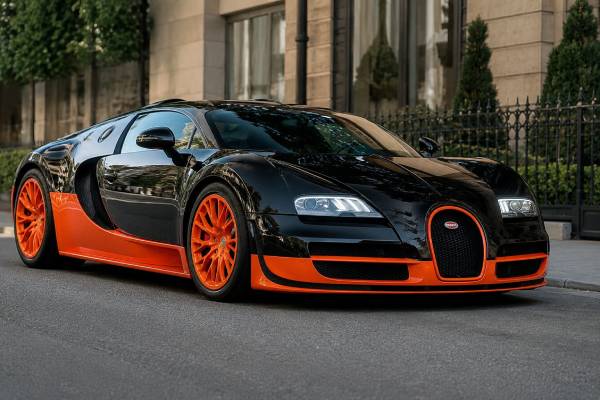
The Bugatti Veyron 16.4 Super Sport is the most focused fixed-roof Veyron: a 1,200 PS, quad-turbo W16 hypercar built to prove that extreme speed could still feel stable, luxurious, and usable. It took the original Veyron idea—1,000-plus horsepower, all-wheel drive, a dual-clutch gearbox, and grand-touring comfort—and pushed it further with larger turbochargers, improved cooling, revised aerodynamics, and a stiffer carbon structure. Its headline number is the 431.072 km/h record run, but the more important point is how complete the car was. It was not a stripped racing special. It remained leather-lined, carefully finished, and built around the idea that a road car could operate in a speed range normally reserved for prototypes. For collectors, the Super Sport is now one of the key modern Bugattis: rarer than the standard coupé, historically important, mechanically complex, and expensive to maintain correctly.
Table of Contents
- Why the Super Sport Still Matters
- W16 Specs and Super Sport Hardware
- Production Numbers, Editions, and Identification
- Carbon Body, Cooling, and Aero Details
- How the 1,200 PS Veyron Drives
- Service Reality for a Million-Dollar W16
- How to Buy the Right Super Sport
Why the Super Sport Still Matters
The Veyron Super Sport matters because it was the Veyron at its most serious: faster, rarer, and more technically resolved than the standard coupé. It was not just a power upgrade; it was Bugatti’s answer to the question of how far the original Veyron concept could be taken while remaining a finished road car.
The first Veyron already changed the modern supercar world. It arrived with a quad-turbocharged 8.0-liter W16, all-wheel drive, a seven-speed dual-clutch gearbox, and a level of refinement that did not match the usual “fast but fragile” image of exotic performance cars. The Super Sport added another layer. It raised output from 1,001 PS to 1,200 PS, increased torque to 1,500 Nm, and used a revised body to help the car stay calm at speeds beyond 400 km/h.
The result became one of the defining hypercars of the early 2010s. The Super Sport showed that top-speed engineering was not only about power. It also depended on tire limits, heat control, body stability, drivetrain durability, and the confidence of the driver. Many cars can feel dramatic at legal speeds. Far fewer can run deep into aircraft-takeoff speeds and still feel engineered rather than improvised.
For Bugatti, the Super Sport also bridged two eras. It closed the fixed-roof Veyron story and pointed toward the later Chiron. Many of the ideas that shaped the Chiron—huge thermal demand, high-speed stability, active aero logic, and the need to make impossible numbers feel repeatable—were already visible in the Super Sport.
For collectors, its appeal is simple: it combines historical significance with low production, a usable closed body, and the strongest version of the original Veyron coupé formula. The Grand Sport Vitesse later used similar output in an open-top package, but the Super Sport remains the purist’s high-speed Veyron coupé.
W16 Specs and Super Sport Hardware
The Super Sport’s core specification is built around a quad-turbo 8.0-liter W16 with 1,200 PS and 1,500 Nm of torque. In mechanical horsepower terms, 1,200 PS equals about 1,183 hp, although listings often round the car to “1,200 hp.”
| Category | Specification |
|---|---|
| Model | Bugatti Veyron 16.4 Super Sport |
| Production focus | Fixed-roof high-performance Veyron coupé |
| Engine | 8.0-liter quad-turbocharged W16 |
| Displacement | 7,993 cc |
| Valvetrain | 64 valves, dual overhead camshaft layout by cylinder-bank grouping |
| Output | 1,200 PS, approximately 1,183 hp |
| Torque | 1,500 Nm |
| Induction | Four turbochargers with uprated intake and intercooling for the Super Sport |
| Transmission | 7-speed dual-clutch automatic |
| Drivetrain | Permanent all-wheel drive |
| Body style | 2-door coupé |
| Construction | Carbon-fiber structure with revised Super Sport bodywork |
| Top speed | 431.072 km/h record speed; customer cars electronically limited to about 415 km/h |
| 0–100 km/h | About 2.5 seconds |
| 0–200 km/h | About 6.7 seconds |
| 0–300 km/h | About 14.6 seconds |
The W16 is the car’s centerpiece. It is effectively two narrow-angle V8-style cylinder groups arranged into a compact 16-cylinder package. The layout allowed Bugatti to package enormous output behind the cabin without creating the long, front-heavy proportions of a traditional large-displacement engine.
The Super Sport’s changes over the standard Veyron centered on airflow and strength. Larger turbochargers and improved intercooling helped the engine produce more power without relying only on higher boost stress. The gearbox and driveline also had to cope with 1,500 Nm, which is why service history matters so much on used examples.
Its seven-speed dual-clutch transmission is one of the most important parts of the car’s character. At low speed, it helps the Veyron behave like a luxury GT rather than a temperamental racing car. Under full acceleration, it shifts quickly enough to keep the W16 in its strongest range. The all-wheel-drive system then turns that power into clean launch traction instead of smoke and wheelspin.
The dimensions are compact by modern hypercar standards but dense in mass and hardware. The Veyron is not a lightweight. Its performance comes from power, traction, cooling capacity, and stability rather than from minimalist philosophy. That is part of its identity: it feels like a heavily engineered high-speed machine, not a bare carbon track toy.
Production Numbers, Editions, and Identification
The Super Sport is rare because it represents only a small part of total Veyron production. The overall Veyron family reached 450 cars, while the Super Sport coupé is generally listed at 48 units, with the World Record Edition forming the most famous subset.
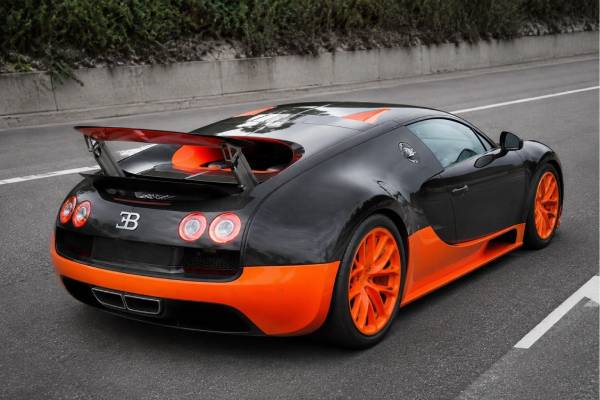
The five World Record Edition cars are the easiest to recognize. They used the now-famous black exposed-carbon and orange finish inspired by the record-setting car. These examples have special historical appeal because they visually connect the production model to Bugatti’s 431.072 km/h achievement.
Standard Super Sports could be specified in a wider range of exterior and interior combinations. Many cars feature visible carbon fiber, two-tone paint, special leather colors, contrast stitching, and bespoke trim. Because Bugatti buyers often personalized their cars heavily, originality is more than just paint color. A good inspection should compare the car with its original factory build record.
| Area | What to check | Why it matters |
|---|---|---|
| Factory build record | Original color, trim, carbon finish, options, and delivery market | Confirms authenticity and helps value the car correctly |
| World Record Edition details | Black exposed carbon, orange finish, numbered history, and documentation | These cars are the most historically recognizable Super Sports |
| VIN and market paperwork | Registration market, emissions compliance, import papers, and title chain | Veyrons move globally, so paperwork quality affects resale |
| Engine and model codes | Verify any SG or CBLA references against official Bugatti and VIN records | Database codes can vary by market and should not replace factory documentation |
| Service continuity | Annual records, tire changes, battery history, fluids, and specialist invoices | Maintenance quality is central to value and usability |
The “16.4” name is also worth understanding. The “16” points to the 16-cylinder engine. The “4” points to four turbochargers. That badge is not decoration; it describes the central engineering idea of the car.
Buyers should be careful with broad online descriptions. Some listings use “1,200 hp” as shorthand, while technical sources often state 1,200 PS. Some databases may also use internal codes such as SG or CBLA, but those should be treated as identification aids, not proof by themselves. For a car at this level, the factory file, VIN, service book, and Bugatti specialist inspection matter more than a listing description.
Carbon Body, Cooling, and Aero Details
The Super Sport’s body changes were made for stability, cooling, and high-speed confidence. The car looks similar to a Veyron at first glance, but the roof intakes, rear treatment, and carbon structure give it a different purpose.
The most visible change is the roof intake layout. Instead of the standard Veyron’s prominent polished roof scoops, the Super Sport uses flatter NACA-style roof ducts. This gives the car a lower, cleaner top surface and helps manage airflow at extreme speed. The engine cover is also more closed and purposeful, feeding the W16 while reducing unnecessary disturbance over the rear body.
Cooling is one of the Veyron’s defining engineering challenges. A 1,200 PS engine creates enormous heat, especially when asked to accelerate repeatedly or sustain very high speeds. The Veyron family is known for using multiple radiators and heat exchangers to manage engine coolant, charge-air temperature, transmission oil, differential oil, engine oil, and air conditioning. The Super Sport’s greater output made airflow management even more important.
The active rear wing is another key system. At lower and medium speeds, the car must generate stability and braking support. At top speed, drag becomes the enemy, so the car changes posture and aero configuration. This is why the Veyron’s maximum-speed procedure is not just “floor it.” The car needs the right mode, ride height, tire condition, road length, and system checks.
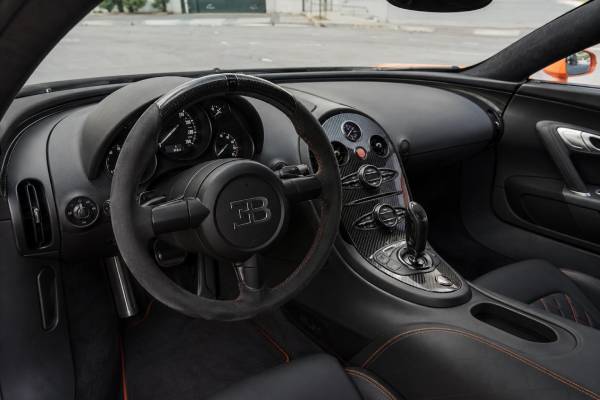
Inside, the Super Sport keeps the Veyron’s luxury-first layout. The cockpit is not overloaded with screens or racing gimmicks. It uses leather, metal, carbon, and simple major controls. That restraint is part of the charm. The car’s drama comes from the engineering beneath the skin, not from a stripped cabin or harsh race-car theater.
The sound is also distinct. A W16 does not sing like a naturally aspirated V12, and it does not bark like a flat-plane V8. It produces a deep, layered surge, with turbo sound, intake pressure, and exhaust force building as speed rises. The Super Sport feels less like a peaky exotic and more like a private jet accelerating on a runway.
How the 1,200 PS Veyron Drives
The Veyron Super Sport drives with a strange mix of calmness and violence. It can feel easy at normal speed, then compress distance with a force that few road cars can match.
The first surprise is traction. With permanent all-wheel drive and a fast dual-clutch gearbox, the Super Sport does not waste much of its output in wheelspin when conditions are right. Launches are brutally effective rather than messy. The car’s mass, tires, and driveline work together to make full-throttle acceleration feel like a system event, not just an engine event.
Power delivery is broad. The W16 does not need to be revved like a smaller racing engine. Instead, it delivers a deep wave of torque, then keeps pulling as the turbochargers and gearbox carry the car into higher speed ranges. The numbers are hard to process from the driver’s seat because the car remains composed while the speedometer climbs at an unreal rate.
Steering and handling are more grand-tourer than track special. The Veyron is secure, planted, and confidence-inspiring, but it is not a lightweight car that dances around the driver. It prefers clean inputs and open roads. On tight mountain routes, its width, weight, tire cost, and visibility make it feel valuable and serious. On fast, smooth roads, it starts to make sense.
The brakes are a major part of the experience. Huge speed requires huge stopping ability, and the Veyron’s braking system combines powerful carbon-ceramic brakes with aero assistance from the rear wing. Buyers should understand that braking performance depends heavily on disc condition, pad condition, fluid condition, tire age, and correct system operation.
Ride quality is better than many expect. The Veyron was engineered as a high-speed luxury car, not a track-only weapon. The cabin can feel quiet and mature at ordinary speeds, and the gearbox can operate smoothly in traffic. That usability is why owners often describe the car as more approachable than its numbers suggest.
Tire temperature and tire condition matter enormously. The Veyron’s top-speed capability depends on tires that are correct, fresh, inspected, and approved. The 415 km/h customer limiter was tied closely to tire protection. At this performance level, tires are not just consumables; they are structural safety components.
Service Reality for a Million-Dollar W16
The Super Sport is not unreliable in the ordinary sense, but it is extremely demanding to maintain correctly. The main ownership risk is not that the car is poorly built; it is that every system is specialized, expensive, and intolerant of neglect.
Routine service should be handled by Bugatti-authorized or deeply experienced Veyron specialists. General exotic-car experience is not enough. The W16, cooling system, dual-clutch transmission, active aero, all-wheel-drive hardware, carbon structure, and electronic systems require model-specific knowledge.
The biggest cost areas are usually tires, wheels, brakes, fluids, batteries, hydraulic systems, and age-related electronic or rubber deterioration. A low-mileage car is not automatically a low-risk car. Hypercars that sit for long periods can develop battery issues, seal problems, old tires, stale fluids, and control-module faults.
| System | Inspection focus | Buyer concern |
|---|---|---|
| Tires and wheels | Age, correct specification, mounting history, wheel condition | Critical for safety, value, and high-speed eligibility |
| Brakes | Carbon-ceramic disc condition, pads, fluid, calipers, parking brake function | Replacement costs can be very high |
| Cooling | Radiators, hoses, fans, coolant condition, leaks, heat-soak behavior | The W16 depends on excellent thermal control |
| Transmission | Shift quality, service records, clutch behavior, leaks, fault codes | Dual-clutch repair or replacement is a major event |
| Suspension and aero | Ride-height operation, wing function, dampers, hydraulic components | Faults affect drivability and high-speed safety |
| Electrical systems | Battery health, charging history, modules, sensors, stored codes | Low use and weak batteries can create expensive problems |
| Body and carbon | Panel fit, exposed carbon quality, repairs, paint meter readings where useful | Undisclosed carbon or paint repairs affect value |
Originality also matters. Some owners may upgrade audio, protection film, exhaust sections, wheels, or trim. Minor reversible changes may not hurt value, but undocumented modifications can create concern. A Veyron Super Sport is most valuable when its factory specification, maintenance history, and current condition all tell the same story.
Pre-purchase inspection should include a full diagnostic scan, road test by a qualified specialist, visual inspection on a lift, tire and brake assessment, battery and charging evaluation, service-document review, and confirmation of any open campaigns or market-specific requirements. The buyer should also confirm whether the car has a current service plan, extended support arrangement, or recent major service.
Parts availability is specialized rather than ordinary. Bugatti can support the cars, but timing and cost depend on the part, market, and service route. This is one reason deferred maintenance is dangerous. A missing small component, tired hydraulic part, or aging electronic module can delay use and affect resale confidence.
How to Buy the Right Super Sport
The best Super Sport to buy is the car with the strongest documents, cleanest history, best service continuity, and most desirable original specification. Mileage matters, but condition and provenance matter more.
A buyer should start with identity. Confirm the VIN, build specification, original selling market, ownership chain, and whether the car is a standard Super Sport or a World Record Edition. Then review the service history from delivery to today. A gap of several years is not automatically fatal, but it must be explained and priced into the deal.
Next, inspect the expensive consumables. Old tires, worn brakes, weak batteries, expired fluids, or noncurrent service can turn a “cheaper” Super Sport into the more expensive car. A fresh, documented service from a recognized Bugatti facility is worth real money because it lowers uncertainty.
The car’s cosmetic condition needs expert attention. Exposed carbon fiber is beautiful but unforgiving. Clouding, repair marks, mismatched weave, stone damage, and poor paint protection work can reduce value. Interior leather should be checked for shrinkage, dye wear, sticky controls, and signs of poor storage.
Strong examples usually share these traits:
- Complete factory documentation and build sheet
- Continuous specialist or Bugatti-authorized service records
- Correct tires with known age and mounting history
- Clean diagnostic report with no hidden system faults
- Original paint, carbon, trim, and options or fully documented repairs
- Clear title and import history
- No unexplained long-term storage issues
- Accessories, keys, books, chargers, and special equipment present
The market values rarity, specification, and confidence. A World Record Edition will generally attract special attention because of its direct link to the record story. A standard Super Sport in a rare or tasteful factory color combination can also be highly desirable, especially if it has low mileage and excellent records.
Buyers should avoid cars with vague descriptions, missing service files, unclear import status, unexplained warning lights, old tires, or “recent service” claims without invoices. At this level, the seller should be able to provide detailed evidence. If they cannot, the price should reflect the risk.
For an enthusiast collector, the Super Sport is one of the strongest modern Bugatti choices. It is more historically important than many later limited editions, more usable than a track-only hypercar, and rarer than the standard Veyron. It also has a clear identity: the closed-body Veyron built to go beyond 430 km/h.
The right purchase mindset is simple. Do not buy the cheapest car. Buy the best-documented, best-maintained, best-inspected car you can justify. With a Veyron Super Sport, the purchase price is only the entry point. Long-term satisfaction comes from buying a car whose history is as impressive as its performance.
References
- Veyron 16.4 Super Sport 2010 (Manufacturer Model Page)
- Bugatti Veyron 2026 (Technical Overview)
- King of All Cars Tops 267 MPH 2010 (Record Report)
- How a Texas Tuner and a Technicality Took Down the World’s Fastest Car 2013 (Record Review)
- List of production car speed records 2026 (Record Context)
Disclaimer
This article is for informational purposes only and is not a substitute for professional diagnosis, inspection, repair, valuation, or legal advice. Specifications, torque values, service intervals, diagnostic procedures, campaign status, and correct parts can vary by VIN, market, equipment, and factory update history. Always verify details against official Bugatti service documentation and consult a qualified Bugatti specialist before buying, servicing, or modifying a Veyron Super Sport.
If this guide helped you, please consider sharing it on Facebook, X/Twitter, or your favorite car community to support our work.