
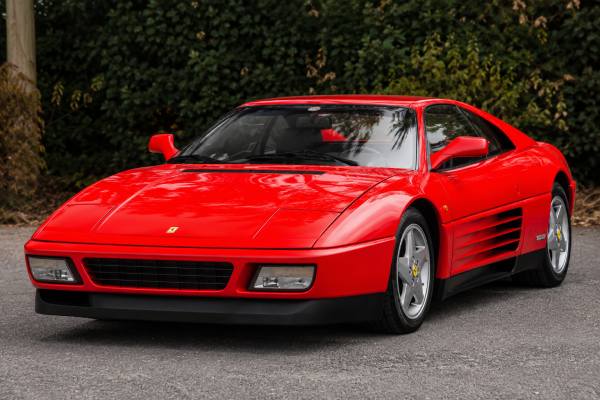
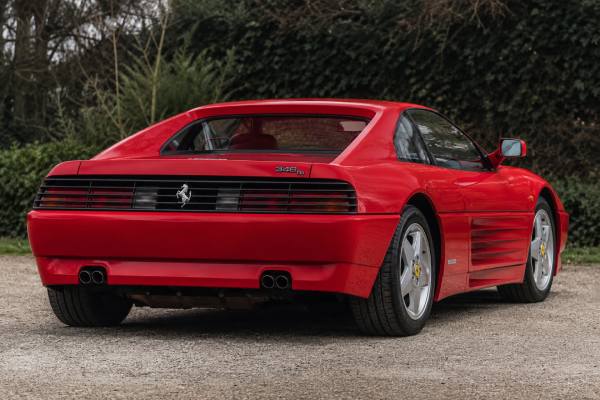
The Ferrari 348 tb is the fixed-roof Berlinetta version of Ferrari’s late-1980s mid-engine V8, built from 1989 to 1993 with the Tipo F119 3.4-liter V8 and a five-speed gated manual gearbox. It replaced the 328 GTB, moved Ferrari’s entry mid-engine line into a more modern mechanical layout, and brought visual cues from the Testarossa into a smaller, sharper two-seat package.
The 348 tb matters because it sits at an interesting turning point. It was the first clean-sheet Ferrari road car launched after Enzo Ferrari’s death, and it arrived before electronic driver aids, paddle-shift gearboxes, and highly assisted steering changed the feel of the brand’s V8 cars. It is quick rather than effortless, demanding rather than polished, and much more sensitive to condition than a casual buyer might expect. Good examples offer a raw, mechanical Ferrari experience; neglected ones can become expensive very quickly.
Quick Take
The Ferrari 348 tb is most appealing as a compact, gated-manual, mid-engine Ferrari with Testarossa-era styling and a high-revving naturally aspirated V8. Its identity comes from the longitudinal engine, transverse gearbox layout, unassisted steering, removable rear subframe, and early-1990s analog feel. The main caution is ownership sensitivity: timing-belt work, cooling, fuel lines, suspension wear, electrical age, and accident history matter more than mileage alone. The best buy is a documented, original, regularly serviced car inspected by a Ferrari specialist, not the cheapest example on the market.
Table of Contents
- History and Significance
- Engine, Chassis and Specifications
- Production, Variants and Options
- Design, Engineering and Features
- Driving Experience and Performance
- Maintenance, Reliability and Restoration
- Market Value, Buying Guide and Rivals
History and Significance
The 348 tb is important because it was not simply a facelifted 328. It introduced a new mid-engine V8 platform, a new drivetrain arrangement for Ferrari’s small Berlinetta line, and a design language that clearly linked the car to the Testarossa era.
Launched in 1989, the 348 replaced the 328 GTB and GTS at a time when Ferrari was under pressure from increasingly usable rivals. The Acura NSX would soon show that a mid-engine exotic could be refined and easy to live with. Porsche’s 911 Turbo remained a brutal, charismatic alternative. Lotus and Lamborghini also offered more extreme interpretations of the compact exotic-car formula. Ferrari answered with a car that was modern in layout but still deeply traditional in driver involvement.
The “tb” name stands for transversale berlinetta. The engine itself is mounted longitudinally behind the cabin, but the gearbox is mounted transversely at the rear. This layout had appeared in the Mondial t and became one of the defining mechanical features of the 348. It helped Ferrari lower the engine and gearbox package compared with the older transverse-engine V8 cars, while keeping the car compact.
The 348 tb also arrived during a sensitive historical moment. Enzo Ferrari died in 1988, and the 348 was among the first new road Ferraris to reach customers afterward. That gives it a symbolic place in the brand’s timeline: it belongs to the old analog Ferrari world, but it points toward the more modern F355 that followed.
Its reputation has shifted over time. In the 1990s, the 348 was often criticized for nervous handling, especially in early cars and poorly set-up examples. It was also compared harshly with the NSX and later with the F355, which brought more power, a sweeter chassis, power steering, and a more polished engine. Today, that same lack of polish has become part of the 348’s appeal. It feels mechanical, narrow by modern supercar standards, and honest about its limits.
Collectors now look at the 348 tb for several reasons:
- It is a gated-manual Ferrari from the pre-paddle-shift era.
- It is the closed Berlinetta body, which many collectors prefer for structure and purity.
- It has strong visual links to the Testarossa without the size or running costs of a 12-cylinder Ferrari.
- It sits below many other manual Ferraris in price, although the best examples are no longer cheap.
- It rewards careful ownership and correct set-up more than casual use.
The 348 tb is not the easiest classic Ferrari to buy, and it is not the most universally praised. That is exactly why it needs to be understood properly. Its value lies in character, originality, mechanical condition, and the way it bridges Ferrari’s older V8 cars and the more sophisticated F355 generation.
Engine, Chassis and Specifications
The 348 tb uses a 3.4-liter naturally aspirated V8 with four valves per cylinder, Bosch electronic fuel injection, and a five-speed gated manual transmission. The headline output is 300 PS, usually described as 300 hp in enthusiast shorthand, or about 296 bhp.
The engine is part of the F119 family and is one of the key reasons the car still feels special. It is not a torque-rich modern engine. It wants revs, temperature, and commitment. Below the mid-range it is tractable but not explosive; above roughly 4,000 rpm it becomes sharper, louder, and more urgent.
| Item | Ferrari 348 tb specification |
|---|---|
| Production years | 1989–1993 |
| Body style | Two-seat Berlinetta coupe |
| Engine family | Tipo F119 90-degree V8 |
| Displacement | 3,404.70 cc |
| Valvetrain | DOHC, 32 valves |
| Induction | Naturally aspirated |
| Fuel system | Bosch Motronic electronic fuel injection |
| Maximum power | 221 kW / 300 PS at 7,200 rpm |
| Maximum torque | About 324 Nm at 4,200 rpm |
| Transmission | Five-speed gated manual |
| Drivetrain | Rear-wheel drive |
| Layout | Longitudinal mid-mounted engine, transverse rear gearbox |
| Top speed | Over 275 km/h |
The chassis is a steel structure with a detachable rear subframe. That rear subframe is important for servicing because the engine and gearbox are removed as a unit for major belt work. For buyers, it is also important because crash repair, corrosion, poor welding, and incorrect assembly can affect alignment and value.
Suspension is independent all around, with unequal-length wishbones, coil springs, telescopic dampers, and anti-roll bars. Steering is unassisted rack and pinion, one of the reasons the 348 feels so direct once moving. Braking is by ventilated discs, with anti-lock braking fitted depending on market and model-year details.
| Area | Details |
|---|---|
| Construction | Steel chassis/body structure with detachable rear subframe |
| Front suspension | Independent wishbones, coil springs, dampers, anti-roll bar |
| Rear suspension | Independent wishbones, coil springs, dampers, anti-roll bar |
| Steering | Unassisted rack and pinion |
| Brakes | Ventilated discs front and rear |
| Wheelbase | 2,450 mm |
| Length | 4,230 mm |
| Width | 1,894 mm |
| Height | About 1,170 mm |
| Typical tire sizes | 215/50 ZR17 front, 255/45 ZR17 rear |
Published weight figures vary by market, measurement method, and equipment. A 348 tb is commonly quoted around the high-1,300 kg range, with real-world road weight higher once fluids and equipment are included. The most useful point is not the exact number; it is that the 348 is compact and relatively light compared with later V8 Ferraris.
Performance is strong but not modern-supercar fast. Period 0–100 km/h figures usually fall in the mid-to-high five-second range, depending on test conditions. The car’s real appeal is less about a single acceleration number and more about the way it delivers speed: revs, induction noise, gearshift effort, and steering feedback all matter.
Production, Variants and Options
The 348 tb was the fixed-roof coupe, built in smaller numbers than the targa-style 348 ts. For collectors, the coupe body, production number, documentation, and originality are central to desirability.
The 348 family is broader than the tb alone, and buyers often compare the tb against the ts, Spider, GTB, GTS, Serie Speciale, and Challenge cars. These versions are related, but they do not all carry the same collector identity.
| Version | Years | Key identity |
|---|---|---|
| 348 tb | 1989–1993 | Fixed-roof Berlinetta coupe, 3.4-liter V8, 300 PS |
| 348 ts | 1989–1993 | Targa-style removable-roof version with the same basic drivetrain |
| 348 Serie Speciale | Early 1990s | U.S.-market special series with detail changes and added collector interest |
| 348 GTB | 1993 onward | Updated Berlinetta with 235 kW output and chassis/body detail changes |
| 348 GTS | 1993 onward | Updated targa-style companion to the GTB |
| 348 Spider | 1993–1995 | Full open Spider body, later and generally more mature in feel |
| 348 Challenge | 1990s | Factory-supported competition version or Challenge-converted car |
The 348 tb itself is generally cited at 2,894 examples. That makes it less common than the 348 ts, but not so rare that buyers should accept a poor car out of fear of missing out. Condition and documentation still matter more than color alone.
Year and specification differences
Early 348s can feel different from later cars. Ferrari made running updates through production, and many cars have also been modified by owners or specialists. Some later cars received improvements in engine management, suspension set-up, and detail trim. Market-specific equipment also matters, especially for U.S., European, and right-hand-drive cars.
Important identification points include:
- VIN, chassis number, and market specification.
- Engine and gearbox identity.
- Original color and interior trim.
- Correct wheels, lights, instruments, and emissions equipment for the market.
- Service book, warranty book, pouch, manuals, tools, jack, and factory accessories.
- Evidence of Ferrari Classiche certification or other well-regarded provenance files.
Matching-numbers status matters, but for a 348 it is not the only issue. A car with original engine and gearbox but poor accident repair can be far less desirable than a properly documented car with honest, correct mechanical work. Buyers should avoid judging originality only by paint shine and mileage.
Factory options and personalization
The 348 tb was offered before modern personalization programs became as extensive as today’s Ferrari Tailor Made world. Still, specification matters. Rosso Corsa over tan leather is the familiar classic choice, but black, yellow, silver, white, blue, and other period colors can be more interesting when original and well documented.
Factory and dealer-fit details may include:
- Leather color and carpeting.
- Left-hand or right-hand drive.
- Wheel and tire specification by market.
- Air conditioning and audio equipment.
- Luggage, tools, owner’s books, and accessories.
- Market-specific emissions and lighting equipment.
Collectors usually prefer cars that have not been heavily altered. Aftermarket wheels, non-original steering wheels, repainted lower panels, modified exhausts, changed seats, and non-factory body parts can be acceptable for a driver but may reduce value if originality cannot be restored.
Design, Engineering and Features
The 348 tb is visually defined by Pininfarina styling, side intake strakes, pop-up headlights, and a wide black rear grille. Its shape is not delicate like a 328 and not as dramatic as a Testarossa, but it clearly belongs to Ferrari’s late-1980s design language.
The side strakes are more than decoration. They feed the side-mounted radiators, a packaging solution that helped Ferrari manage cooling in a compact mid-engine body. The same visual theme tied the car to the Testarossa, giving the smaller V8 model a strong family identity.
The front end is low and wedge-like, with pop-up headlights and a simple bumper form. The rear is broad and horizontal, with the tail lamps integrated into a dark grille treatment. The engine cover uses slatted openings, and the body has a low, planted stance when the suspension is correctly set.
Mechanical packaging
The most distinctive engineering feature is the drivetrain layout. The V8 sits longitudinally, but the gearbox is transverse. This means the 348 does not feel like the earlier 308 and 328 mechanically, even though all are mid-engine Ferrari V8s. The rear-mounted gearbox also influences weight distribution, service access, and shift feel.
The detachable rear subframe is another major feature. It makes engine-out service more logical for specialists, but it also means buyers should inspect rear-frame condition carefully. Incorrect repairs, damaged pick-up points, corrosion, or poor assembly can affect the car’s alignment and handling.
Cooling is central to the 348’s design. The side intakes, radiator layout, fans, hoses, and coolant pipes all need to work correctly. A tired cooling system can make the car unpleasant in traffic and can lead to expensive consequences if ignored.
Cabin and controls
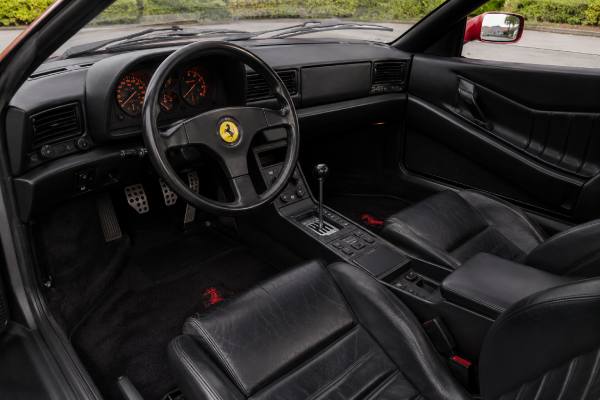
Inside, the 348 feels narrow and low compared with modern Ferraris. The driving position is classic Italian exotic: pedals slightly offset, steering wheel close, a gated shifter on the center tunnel, and simple analog instruments. Visibility is better than the styling suggests, although rear three-quarter vision is limited by the buttresses and rear structure.
The cabin materials need careful inspection today. Leather can shrink, dash panels can pull, seat bolsters can crack, switches can age, and older stereo installations can create wiring problems. A tidy, original interior is a strong value signal because many 348s have lived through decades of partial repairs and cosmetic shortcuts.
The sensory character is a large part of the car’s appeal. The V8 has a hard-edged sound as it climbs through the rev range, and the gearbox adds its own metal-on-metal rhythm through the open gate. It is not isolated, and it was never meant to be. Cabin heat, mechanical noise, and vibration are part of the experience, although excessive fumes, coolant smell, or harsh driveline vibration point to problems.
Driving Experience and Performance
A healthy 348 tb feels raw, direct, and more demanding than later V8 Ferraris. It rewards smooth inputs, warm fluids, correct tires, and a driver who understands that the car was developed before modern stability control.
The engine is flexible enough for normal road use, but it comes alive with revs. Throttle response is crisp when the fuel injection, ignition, intake, and exhaust systems are in good condition. A flat, hesitant, or uneven 348 is often telling you something is wrong: old sensors, air leaks, poor ignition components, clogged injectors, or neglected service can all dull the car.
The gated manual gearbox is one of the defining pleasures. When cold, second gear can be stiff, and forcing shifts is a bad habit. Once warm, the shift should become more cooperative, with a precise mechanical feel. A graunching second gear, vague linkage, clutch slip, or difficult selection deserves specialist attention before purchase.
Steering is heavy at parking speeds because there is no power assistance. On the move, that weight turns into feedback. The front end communicates road surface and load clearly, and the car feels compact once settled. The downside is that a poorly aligned 348 can feel nervous or unsettled, especially at speed. Tires, ride height, suspension bushings, dampers, and alignment are not small details on this car; they shape the entire driving experience.
Braking performance is period-correct rather than modern. The pedal should feel firm and progressive. A long pedal, vibration, pulling, warning lights, or uneven braking can point to old fluid, tired hoses, caliper issues, warped discs, or ABS faults depending on the car’s equipment.
Ride quality is firm but not unbearable. A good 348 has enough compliance for fast road driving, especially on proper tires. A bad one can crash, tramline, and feel skittish. Many negative opinions of the 348 come from cars with old rubber, incorrect geometry, worn suspension, or mixed-quality repairs.
The car is best on open, flowing roads where the engine can rev and the steering can breathe. In city traffic it is less relaxed. The clutch is heavier than modern cars, the gearbox wants temperature, the cabin can get warm, and the low nose needs care. On track, it can be rewarding, but only if cooling, brakes, tires, and suspension are fully prepared. A 348 is not a cheap track toy, and using one that way without preparation can turn routine wear into a major bill.
Maintenance, Reliability and Restoration
The 348 tb can be reliable when maintained correctly, but it is not tolerant of deferred maintenance. The biggest ownership mistake is buying a car because the purchase price looks attractive while ignoring the cost of overdue engine-out service, aged hoses, tired suspension, and electrical problems.
The timing-belt service is the central maintenance event. On a 348, major belt work is normally performed with the engine and gearbox assembly removed from the car. Owners and specialists often combine belts with tensioners, seals, water pump inspection or replacement, coolant hoses, fuel hoses, engine mounts, clutch inspection, and cleaning of hard-to-reach areas. Doing only the belts while ignoring everything around them can be false economy.
Common mechanical concerns
Important areas to inspect include:
- Timing belts and tensioners: Confirm age, mileage, parts used, and who performed the work.
- Fuel lines: Early cars and older rubber components need careful inspection because fuel leaks are a serious fire risk.
- Cooling system: Radiators, fans, hoses, thermostat, expansion tank, and coolant pipes must be healthy.
- Oil leaks: Cam seals, cam covers, gearbox seals, and engine gaskets can leak with age.
- Clutch: The clutch is serviceable from the rear, but parts and labor are still significant.
- Gearbox: Check second-gear synchro feel, linkage adjustment, fluid condition, and noise.
- Suspension: Bushings, ball joints, dampers, wheel bearings, and alignment affect both safety and value.
- Brakes: Inspect discs, pads, hoses, calipers, fluid age, and ABS function where fitted.
- Exhaust: Cracks, heat damage, failed cats, poor aftermarket installations, and leaks are common inspection points.
Electrical issues are also part of 348 ownership. Relay panels, connectors, grounds, window motors, cooling fans, HVAC controls, warning lights, alternators, and aging wiring can create intermittent faults. A specialist inspection should include more than a quick engine start and visual check.
Body and restoration risks
The 348 is not a simple body-on-frame classic, and accident repair quality matters. Inspect the front structure, rear subframe, suspension pick-up points, door gaps, sills, undertrays, floor edges, and radiator areas. Uneven panel gaps are not automatically proof of a serious crash, but they should prompt a closer look.
Corrosion is less famous on the 348 than on many older classics, but it should not be ignored. Check lower body areas, battery surroundings, windshield and window edges, door bottoms, floor sections, brackets, and hidden seams. Cars stored in damp conditions or repaired poorly can hide expensive problems.
Interior restoration can also be costly. Leather shrinkage, cracked bolsters, sticky or faded plastics, sagging trim, broken switches, and non-original stereo wiring all affect both enjoyment and value. A correct, original cabin is increasingly hard to recreate.
Originality versus upgrades
Some upgrades make sense for drivers: modern tires in correct sizes, improved cooling reliability, quality exhaust components, better brake pads, and carefully chosen suspension refreshes can improve usability. The problem is careless modification. Lowering springs, incorrect wheels, aggressive exhausts, removed emissions equipment, and non-reversible interior changes can hurt collectability.
The best approach is to preserve original parts wherever possible. A car with tasteful reversible upgrades and all original components retained is easier to justify than a car modified without documentation.
Service history should show a pattern, not a single large invoice. A major service from ten years ago is not current maintenance. A strong file includes annual fluid changes, belt history, cooling work, brake service, tire dates, clutch information, alignment records, and specialist notes.
Market Value, Buying Guide and Rivals
The 348 tb has moved from overlooked entry Ferrari to a recognized analog collector car, but values still depend heavily on condition, documentation, originality, and specification. As of 2026, ordinary driver-quality 348 tb examples often sit in the broad mid-five-figure to low-six-figure range in major markets, while exceptional low-mileage, rare-color, or special-series cars can go much higher.
The market is not uniform. A serviced, original Berlinetta with books, tools, clean history, correct paint, and recent specialist work is a different car from a tired example with old belts, patchy records, accident stories, and cosmetic shortcuts. The cheaper car may end up costing more within the first two years.
| Value factor | Why it matters |
|---|---|
| Service history | Major belt work, cooling service, clutch records, and annual maintenance reduce ownership risk. |
| Originality | Factory paint, interior, wheels, books, tools, and correct market equipment support collectability. |
| Accident history | Poor crash repair can damage alignment, structure, appearance, and long-term value. |
| Mileage | Low mileage helps only when condition and service history support it. |
| Color combination | Classic red/tan is easy to sell; rare original colors can attract collectors. |
| Interior condition | Original leather, dash, switches, and trim are expensive to restore correctly. |
| Special versions | Serie Speciale and Challenge-related cars occupy a different collector tier. |
Buyer inspection checklist
A serious pre-purchase inspection should cover:
- VIN, title, import status, and market specification.
- Engine number, gearbox number, and originality evidence.
- Timing-belt service age and invoice detail.
- Compression, leakdown, and running behavior when appropriate.
- Fuel-line, coolant-hose, and oil-leak condition.
- Clutch life, gearbox synchros, and shift linkage.
- Suspension bushings, dampers, ride height, and alignment.
- Brake system, tires, wheel condition, and tire date codes.
- Electrical operation, warning lights, windows, HVAC, fans, and instruments.
- Accident repair, paint thickness, panel gaps, underbody condition, and corrosion.
- Interior originality, books, tools, jack, pouch, and service records.
The right car should start cleanly, idle evenly, warm up without drama, hold temperature, shift properly once warm, track straight, brake evenly, and show no obvious fluid smells or warning lights. Any seller who refuses a specialist inspection is making the decision easier: walk away.
Cars to seek and cars to avoid
Seek a 348 tb that has been used regularly, serviced by known specialists, and kept close to factory specification. A slightly higher-mileage car with excellent records can be better than a low-mileage car that has sat for years. These cars do not improve by being ignored.
Avoid cars with missing history, overdue belts, unresolved overheating, fuel smells, poor cold and warm running, fresh paint with no explanation, mismatched tires, heavy modifications, or vague ownership stories. A neglected 348 can quickly demand the kind of spending that would have bought a better car in the first place.
Rivals and alternatives
The closest Ferrari alternatives are the 328 GTB/GTS and F355 Berlinetta/GTS. The 328 feels older, smaller, and more classic, with simpler styling and a different mechanical layout. The F355 is faster, more polished, and widely admired for its engine note and chassis, but it can bring its own expensive maintenance issues.
Outside Ferrari, the Acura NSX is the rational counterpoint: more usable, more refined, and easier to drive quickly. The Porsche 964 Turbo offers a different kind of old-school challenge, with rear-engine boost and rising collector demand. The Lotus Esprit SE and S4 provide turbocharged drama at a different price point. The Lamborghini Diablo is a much more extreme and expensive V12 alternative, not a true like-for-like rival in ownership cost.
The 348 tb makes the most sense for someone who wants the feel of a manual, analog Ferrari and accepts that condition is everything. It is not the default choice for effortless speed, daily usability, or low-risk ownership. It is the choice for a buyer who values steering feel, engine character, design honesty, and the satisfaction of owning a correctly maintained example from a transitional Ferrari era.
References
- Ferrari 348 TB (1989) – Ferrari.com 1989 (Manufacturer model page)
- Ferrari 348 GTB (1993) – Ferrari.com 1993 (Manufacturer model page)
- Ferrari 348 Challenge (1993) – Ferrari.com 1993 (Manufacturer model page)
- Check for Recalls: Vehicle, Car Seat, Tire, Equipment | NHTSA 2026 (Recall Database)
- Ferrari 348 tb Market – CLASSIC.COM 2026 (Market Data)
Disclaimer
This article is for informational purposes only and is not a substitute for professional diagnosis, repair, valuation, or inspection. Specifications, torque values, service intervals, recall status, and procedures can vary by VIN, market, equipment, production date, and later updates. Always verify details against official Ferrari service documentation and have any Ferrari 348 tb inspected by a qualified specialist before purchase or repair.
If this guide was useful, please share it on Facebook, X/Twitter, or your favorite car community to support our work.