
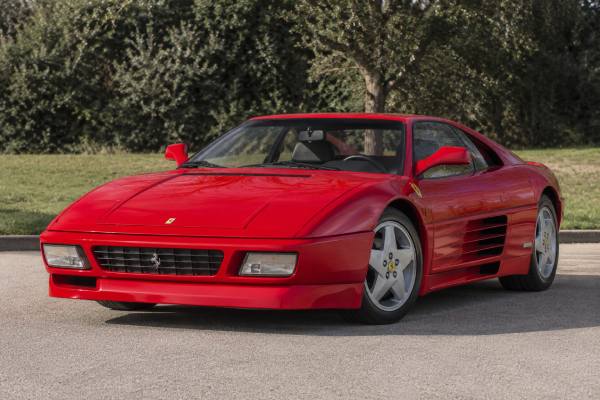
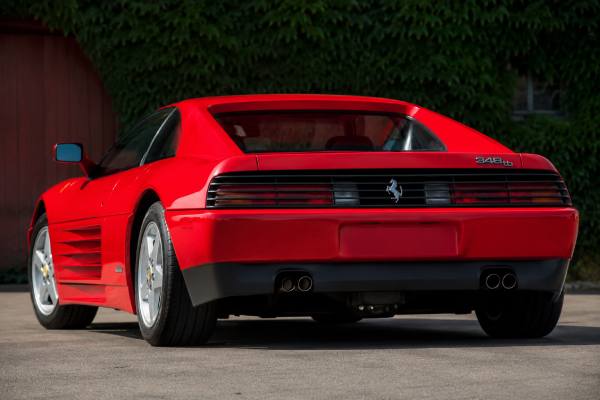
The Ferrari 348 tb Serie Speciale is the rare North American limited-edition version of the 348 berlinetta, built for 1992 and 1993 with the 3.4-liter Tipo F119D V8 tuned to 312 hp. It took the basic 348 tb formula—mid-mounted V8, gated 5-speed manual, rear-wheel drive, and dramatic Pininfarina styling—and gave it sharper gearing, a freer exhaust, a wider rear track, visual changes, numbered identification, and a much smaller production run.
This matters because the Serie Speciale sits in an interesting place in Ferrari history. It is not as famous as the later F355, not as extreme as a Challenge car, and not as universally admired as the final air-intake-era V8 Ferraris. Yet it is one of the most distinctive 348 variants, especially in tb coupe form. For buyers, the appeal is a mix of rarity, analog feel, manual transmission character, and a more focused setup than the standard early 348. The caution is equally clear: condition, documentation, originality, and major service history matter far more than the badge alone.
Quick Take
The Ferrari 348 tb Serie Speciale is the most collectible road-going 348 coupe for many North American buyers because it combines a numbered limited run, 312-hp V8, shorter final drive, wider rear track, and factory appearance changes without losing the raw gated-manual character of the standard car. Its main tradeoff is that the 348 is highly condition-sensitive: deferred belt service, old tires, tired suspension, electrical faults, accident history, or missing Serie Speciale parts can turn a rare Ferrari into an expensive project. The best examples are original, well-documented, freshly serviced, complete with books and tools, and verified by a Ferrari specialist before purchase.
Table of Contents
- History and Significance
- Engine, Chassis, and Specifications
- Production, Variants, and Options
- Design, Engineering, and Special Features
- Driving Experience and Performance
- Reliability, Maintenance, and Restoration
- Market Value, Buying Guide, and Rivals
History and Significance
The 348 tb Serie Speciale matters because it is the rarest and most focused North American road version of the early 348 coupe. It was built at a time when Ferrari was moving away from the compact 308 and 328 era and toward a more modern mid-engine V8 platform.
The standard Ferrari 348 arrived for the 1989 model year as the replacement for the 328. Its name followed Ferrari’s traditional logic: “34” for roughly 3.4 liters and “8” for eight cylinders. The “tb” meant trasversale berlinetta, referring to the transverse gearbox mounted behind the longitudinal V8. That layout was one of the car’s key engineering talking points and gave the 348 a different mechanical identity from the 328.
The car also carried strong visual links to the larger Testarossa. Its side strakes, rectangular rear lights, wide stance, and flat-deck rear treatment made it look far more aggressive than the rounded 328. Pininfarina shaped the design, and Leonardo Fioravanti’s influence is usually associated with the model’s styling language. The result was not subtle, but it was very much of its period.
The Serie Speciale appeared for North America in 1992. Ferrari used it to add excitement to the 348 range before the later GTB, GTS, Spider, and F355 would reshape the company’s V8 line. It was not a full motorsport homologation special, but it borrowed the spirit of a sharper factory variant. The changes were aimed at response, grip, visual identity, and exclusivity.
The 348 also carries an emotional footnote in Ferrari history. It was developed during the final period of Enzo Ferrari’s life, and it became part of the transition from the old Ferrari organization to the more structured, modern company of the 1990s. That transition matters to collectors because the 348 feels more analog and mechanical than the cars that followed, while still using electronics such as Bosch Motronic fuel injection and anti-lock brakes.
Today, the 348 tb Serie Speciale is valued for several reasons:
- It was built in very small numbers.
- It was offered only for North America.
- It used a stronger 312-hp version of the 3.4-liter V8.
- It retained a gated 5-speed manual gearbox.
- It had specific body and chassis details that separate it from a standard 348 tb.
- It is rarer as a tb coupe than as a ts targa.
Its reputation has also changed. For years, the 348 was treated as the awkward middle child between the elegant 328 and the excellent F355. That view is less common now. Enthusiasts have started to appreciate the 348 for what it is: a raw, compact, mid-engine Ferrari with heavy controls, real feedback, a naturally aspirated V8, and very few layers between driver and machine.
The Serie Speciale strengthens that case. It is still not a soft or easy car by modern standards, but it is more purposeful than the standard early 348. That is why buyers who know the model often look for originality, factory plaques, special trim, and records before they focus only on mileage.
Engine, Chassis, and Specifications
The 348 tb Serie Speciale uses Ferrari’s 3.4-liter Tipo F119D V8, tuned for 312 hp in this North American limited edition. The most important technical difference from the regular early 348 is not displacement, but the combination of engine calibration, freer exhaust flow, gearing, rear track, and tires.
The V8 sits longitudinally behind the cabin. The gearbox is mounted transversely, which is why the model name uses the “t” designation. This layout gives the 348 its distinctive mechanical feel: the engine is close, the shift linkage is mechanical, and the drivetrain feels more old-school than the smoother F355 that replaced it.
| Category | Specification |
|---|---|
| Model | Ferrari 348 tb Serie Speciale |
| Internal family | F119 |
| Engine code | Tipo F119D |
| Production years | 1992–1993 |
| Body style | 2-seat berlinetta coupe |
| Layout | Rear mid-engine, rear-wheel drive |
| Engine | 3.4-liter naturally aspirated 90-degree V8 |
| Displacement | 3,405 cc |
| Valvetrain | Dual overhead camshafts, 4 valves per cylinder |
| Fuel and ignition | Bosch Motronic electronic management |
| Power | 312 hp at 7,200 rpm |
| Torque | About 238 lb-ft at 4,200 rpm |
| Transmission | 5-speed gated manual transaxle |
| Brakes | Four-wheel ventilated discs with ABS |
| Steering | Manual rack-and-pinion |
| Wheelbase | 2,450 mm |
| Typical 0–60 mph estimate | About 5.3 seconds |
| Typical top speed estimate | About 171 mph |
The engine is all-aluminum and uses a flat-plane crankshaft, a defining feature of many Ferrari V8s. A flat-plane crank helps the engine rev quickly and gives the exhaust its sharp, metallic voice. It also creates more vibration than some cross-plane V8s, which is part of the car’s character.
The Serie Speciale’s 312-hp rating came from changes such as a freer exhaust and revised engine control settings. The standard early North American 348 was usually quoted at 296 hp, so the increase is meaningful but not transformational. The car feels quicker mainly because the gearing and throttle response make it more eager.
The shorter final drive improves acceleration. This matters in real-world driving because the 348 is not a huge-torque car at low rpm. It prefers revs, and the gearing helps keep the engine in its stronger range. On a back road, that makes the Serie Speciale feel more alert than a standard 348 tb.
The chassis uses steel construction with a rear subframe that carries the powertrain. The suspension is independent at all four corners, with unequal-length wishbones, coil springs, dampers, and anti-roll bars. It is a traditional exotic-car layout, but the setup is sensitive to tire condition, alignment, bushing wear, ride height, and previous accident repair.
One important detail is steering. The 348 uses manual steering, not modern power assistance. At parking speeds, that means effort. On the move, it gives the car a very direct front-end feel. A properly aligned 348 with fresh tires can feel far better than its old reputation suggests. A tired car on old rubber can feel nervous, heavy, and vague.
The brakes are ventilated discs with ABS. They are effective for road use when fresh, but they are not modern carbon-ceramic brakes and should not be judged that way. Brake pedal feel, rotor condition, caliper health, and fluid age all matter.
Production, Variants, and Options
The Serie Speciale was a North American limited edition of 100 cars built across the 348 tb coupe and 348 ts targa body styles. The tb coupe is the rarer body style, with many records identifying 35 coupes and 65 targas.
The model was introduced after the early 348 had already been on sale for several years. It was not a worldwide model and should not be confused with the later 348 GTB, 348 GTS, 348 Spider, 348 Challenge, or 348 GT Competizione. Each has a different place in the 348 family.
| Version | Role in the range | Key distinction |
|---|---|---|
| 348 tb | Standard early coupe | 3.4-liter V8, gated manual, fixed-roof berlinetta |
| 348 ts | Standard early targa | Removable roof panel, same basic drivetrain |
| 348 Serie Speciale | North American limited edition | 312 hp, numbered run, wider rear track, unique trim |
| 348 GTB/GTS | Later updated road cars | Revised engine and detail updates, not the same as Serie Speciale |
| 348 Challenge | Factory-supported race-series conversion | Track equipment and Challenge-series use |
| 348 GT Competizione | Very rare lightweight homologation model | More extreme, lighter, and much rarer than the Serie Speciale |
Each Serie Speciale was numbered, with a plaque on the passenger-side door jamb. That plaque is a major identity marker and should be checked carefully. Buyers should also verify the VIN, body style, engine type, factory records, and any Ferrari Classiche documentation if available.
Identification details that matter
A real 348 tb Serie Speciale should have more than just a story from a seller. Look for the specific numbered plaque, correct body details, proper seats or documented original-seat configuration, the correct wider-track setup, and records that connect the car’s VIN to the limited edition.
Important identifiers include:
- Serie Speciale numbered plaque.
- North American specification.
- Fixed-roof tb body if buying the coupe.
- 312-hp engine specification.
- Shorter final drive.
- Wider rear track.
- Body-color exterior treatment.
- Special front and rear detailing.
- Correct wheels and tire specification.
- Original books, manuals, tools, and service records.
The optional F40-style sport seats are especially desirable. They are often described as carbon/Kevlar-style seats and can have a major effect on collector appeal. Cars with the standard seats can still be authentic, but the seat history should be documented. Missing special seats, poorly retrimmed interiors, or incorrect replacements can affect value.
Colors also matter. Rosso Corsa is the most familiar Ferrari color and suits the 348’s shape, but rarer colors can make a car more interesting if the originality is proven. A rare color without documentation is just a claim. A rare color with factory records, original paint readings, and known ownership history can be a serious value driver.
Matching-numbers relevance is important but should be understood correctly. On a Ferrari of this age, the key is consistency between chassis, engine, gearbox, factory records, service history, and inspection findings. A replacement engine or gearbox is not automatically fatal to usability, but it can reduce collector value, especially on a numbered limited-production model.
Design, Engineering, and Special Features
The Serie Speciale is visually close to the regular 348, but its details make it sharper and more collectible. Its appeal is in the factory combination: Testarossa-like 348 design, fixed-roof coupe shape, special aero trim, body-color elements, wider rear stance, and numbered limited-edition identity.
The base 348 design is low, wide, and strongly horizontal. The side strakes feed the rear-mounted cooling system and link the car visually to the Testarossa. The rear has rectangular light units rather than the round lamps Ferrari would return to on the F355. The front is flat and wedge-shaped, giving the car a very early-1990s presence.
The Serie Speciale added a more aggressive front spoiler and body-color lower trim. These changes reduce the black-plastic look of the early 348 and make the body appear lower and cleaner. The rear treatment is also different, with details that help identify the car as a special version rather than a standard tb.
Aerodynamics are simple by modern standards. There is no active wing, no movable underbody system, and no computer-managed aero package. Instead, the car relies on shape, stance, cooling openings, and fixed body pieces. The front spoiler is not decoration only; it helps with high-speed stability and front-end confidence.
Cooling was a major packaging challenge. The engine is behind the occupants, and the side intakes help feed the radiators and engine bay. Proper airflow matters. Missing ducting, blocked radiators, damaged undertrays, or poor repairs can make a 348 run hotter than it should.
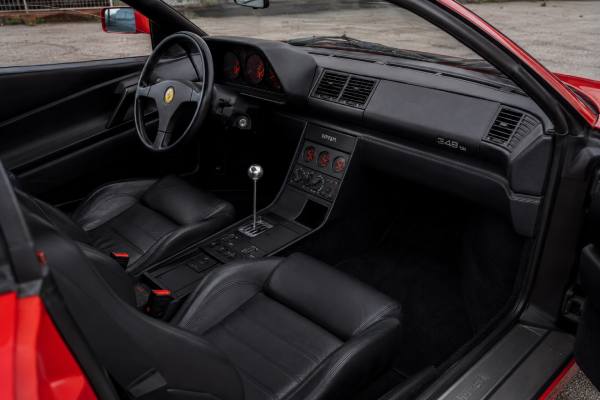
The cabin is also very period-correct. The driving position is low, the windshield is upright compared with many modern supercars, and the dashboard is simple. The gated shifter is central to the experience. The metal gate is not just nostalgic theater; it defines the rhythm of the car. You shift with your wrist and timing, not with a paddle.
The cockpit is narrow by modern standards. Visibility forward is good for an exotic, but rear visibility is limited. Cabin heat can be noticeable, especially in warm climates or in cars with tired insulation and aging air-conditioning systems. The 348 is usable, but it is not relaxed in the way a modern Ferrari can be.
What makes the Serie Speciale feel different
The most meaningful engineering changes are not isolated. They work together. The freer exhaust adds voice and breathing. The ECU changes support the 312-hp output. The shorter final drive makes the car feel more urgent. The wider rear track and Pirelli P Zero tire specification add grip and a more planted stance.
That combination gives the Serie Speciale a more focused identity than a regular early 348 tb. It is still not as polished as an F355, but it feels more alive than many later cars at ordinary road speeds.
The car’s sensory character is a major part of its charm:
- The V8 has a sharp, mechanical note rather than a deep muscle-car rumble.
- The gearbox requires deliberate movement, especially when cold.
- The steering loads up naturally as speed rises.
- The cabin puts the engine close to the driver.
- The car feels compact and physical, not digitally filtered.
Those traits are exactly why buyers search for analog Ferraris. They are also why neglected examples can disappoint. A 348 that has not been set up correctly will not deliver the experience people expect.
Driving Experience and Performance
A good 348 tb Serie Speciale feels raw, alert, and mechanical, with enough performance to be exciting without the huge speed barrier of modern supercars. Its strongest driving quality is involvement, not headline acceleration.
The engine likes rpm. Below the middle of the rev range, it is tractable but not explosive. Above that, it sharpens noticeably, and the flat-plane V8 becomes the center of the experience. The 312-hp output is modest by modern Ferrari standards, but the car is light enough, loud enough, and direct enough to feel special.
The shorter final drive helps. Compared with a long-geared exotic that only wakes up at very high speed, the Serie Speciale feels more useful on real roads. Second and third gears are where the car often feels best. The engine pulls cleanly, the intake and exhaust become more urgent, and the chassis starts to feel balanced.
The gated manual is central to the car. Cold shifts can be stiff, especially into second gear, and owners often let the drivetrain warm fully before rushing the gearbox. Once warm, the shift should be precise and satisfying. Grinding, baulking when hot, vague selection, or jumping out of gear are warning signs.
Steering is heavy at low speed because there is no power assistance. On a twisting road, that becomes one of the car’s strengths. The front end gives real feedback, and the driver can feel tire load build through the wheel. The car does not flatter lazy inputs. It rewards smooth hands, clean braking, and patience on corner exit.
The chassis balance is classic mid-engine Ferrari. The rear has good grip, especially with the Serie Speciale’s wider track, but the car still deserves respect. Old tires, poor alignment, worn dampers, or mismatched rubber can make it feel edgy. Modern ultra-high-performance tires can improve grip, but they can also change steering feel and ride quality.
The brakes are strong enough for road driving when fresh. Pedal feel should be firm and consistent. A soft pedal, vibration, dragging caliper, old hoses, or heat-related fade suggests maintenance is overdue. For track use, the 348 needs careful preparation, better fluid, proper pads, and a realistic view of its age.
Ride quality is firm but not brutal when the suspension is healthy. Worn bushings and old dampers often make the car feel harsher than it should. A sorted example feels tight and communicative. A tired one feels noisy, loose, and expensive.
Usability in normal driving
The 348 tb Serie Speciale can be driven on ordinary roads, but it asks for more attention than a modern exotic. The clutch is heavier, the steering is heavier, and the cabin can be warm. Parking requires care because of visibility, nose height, and steering effort.
The car is happiest when treated as a mechanical object. Warm it properly. Avoid forcing the gearbox when cold. Watch temperature behavior in traffic. Listen for accessory-belt, bearing, exhaust, and suspension noises. These habits make ownership more enjoyable and help catch problems early.
A sorted car gives back a lot. The view over the low nose, the open-gate shift, the engine’s voice behind your shoulders, and the compact size make the 348 feel special at speeds where modern supercars can feel bored.
Reliability, Maintenance, and Restoration
The 348 tb Serie Speciale is not fragile when maintained correctly, but it is an engine-out-service Ferrari with age-sensitive systems and expensive specialist labor. The biggest ownership risk is not one famous defect; it is deferred maintenance across the engine, belts, cooling system, suspension, electrics, and interior.
The timing-belt service is the headline item. On the 348, major belt work typically requires removing the engine and rear subframe assembly. That makes the service more labor-intensive than on some front-engine cars and far more involved than on ordinary used cars. Buyers should not accept vague claims such as “belts look fine.” They need invoices, dates, mileage, parts used, and the name of the shop.
A proper major service often includes more than belts. Sensible owners address tensioners, cam seals, accessory belts, coolant hoses, fuel hoses, valve-cover gaskets, fluids, filters, and related “while you are in there” items. Skipping those parts can save money briefly and cost more later.
| Area | What to check | Why it matters |
|---|---|---|
| Timing belts | Date, mileage, invoice detail, tensioners | Major engine risk and expensive labor |
| Cooling system | Radiators, fans, hoses, thermostat, coolant age | Heat issues can damage the engine and drivability |
| Fuel system | Old hoses, leaks, clamps, pump behavior | Fuel leaks are a serious fire risk |
| Clutch and gearbox | Engagement, slip, cold shift, hot shift, leaks | Parts and labor can be costly |
| Suspension | Bushings, dampers, ball joints, alignment records | Transforms handling when correct |
| Brakes | Rotors, pads, hoses, calipers, ABS function | Age and low use can cause sticking and poor feel |
| Electrical systems | Fuse panel, connectors, windows, HVAC, lights | Small faults can become time-consuming repairs |
| Body and chassis | Paint depth, panel fit, crash repairs, corrosion | Accident history heavily affects value |
| Serie Speciale parts | Plaque, seats, trim, spoilers, wheels | Missing unique parts hurt authenticity and value |
Cooling system health is especially important. Radiators can clog, fans can weaken, hoses age, and poor bleeding can cause trouble. A car that runs hot in traffic needs diagnosis, not excuses. Heat also affects wiring, hoses, and engine-bay plastics.
Fuel hoses are another priority. Many 348s spend long periods parked. Rubber parts age even when mileage stays low. Any smell of fuel, visible seepage, cracked hose, or questionable clamp should be taken seriously.
Electrical issues are common on cars of this age. Window lifts, HVAC controls, warning lights, alternators, starters, fuse panels, connectors, and grounds can all create problems. None of this is unusual for a 1990s exotic, but diagnosis requires patience and knowledge.
The clutch should engage cleanly without slipping or juddering. A heavy pedal alone is not unusual, but engagement problems, hydraulic leaks, or clutch chatter need inspection. Gearbox behavior should be judged both cold and hot. A reluctant second gear when cold can be normal to a degree, but grinding is not something to ignore.
Suspension restoration can dramatically improve the car. Old dampers, tired bushings, worn ball joints, and poor alignment can make a 348 feel like a difficult car. Many negative impressions come from driving worn examples. A properly set-up car is much more coherent.
Body condition is critical because accident repair can be difficult to evaluate. Look at panel gaps, underbody structure, paint depth, bumper alignment, radiator supports, wheel wells, and suspension pickup areas. A specialist pre-purchase inspection should put the car on a lift.
Originality versus upgrades
Some upgrades make sense for driving, but they should be reversible on a Serie Speciale. Modern tires, improved brake pads, better hoses, upgraded cooling fans, or a high-quality exhaust can improve usability. But cutting, repainting unique pieces, replacing special seats without keeping originals, or modifying the body can hurt value.
The best approach is simple: preserve the limited-edition identity and improve the service condition. A car can be mechanically excellent without being over-modified.
Market Value, Buying Guide, and Rivals
The 348 tb Serie Speciale trades at a clear premium over standard 348 tb and ts models, with the best coupes bringing collector-level prices when mileage, originality, color, documentation, and service history align. The market is thin, so one exceptional sale can influence expectations without defining every car.
As of 2026, public market data shows ordinary 348s still occupying a more accessible Ferrari price band, while Serie Speciale cars sit notably higher. A top-quality tb Serie Speciale coupe with rare color, low mileage, strong documentation, original special equipment, and recent service can sell far above a regular 348. Driver-grade examples, higher-mileage cars, cars with missing special parts, or cars with old services should be valued much more carefully.
The tb coupe is especially interesting because it is rarer than the ts targa within the 100-car Serie Speciale run. That does not automatically make every coupe more valuable than every targa, but it gives the best coupes a stronger collector argument.
What drives value
The most important value factors are specific to limited-production Ferraris:
- Confirmed Serie Speciale identity.
- Fixed-roof tb coupe body.
- Original numbered plaque.
- Correct special exterior and interior parts.
- Optional F40-style sport seats, if original and documented.
- Factory color and original paint condition.
- Complete books, tools, jack, records, and manuals.
- Recent engine-out major service by a known specialist.
- Low but believable mileage.
- Clean accident history.
- Matching drivetrain details and factory records.
- Ferrari Classiche documentation, when available.
- Tasteful, reversible maintenance upgrades only.
Mileage matters, but it should not be the only factor. A 6,000-mile car with old belts, flat-spotted tires, sticky switches, leaking seals, and no recent use may need more work than a 25,000-mile car with excellent records. The market likes low miles, but owners like cars that work.
Buyer inspection checklist
Before buying a 348 tb Serie Speciale, a buyer should verify the car in layers:
- Confirm the VIN and Serie Speciale identity.
- Check the numbered plaque and special equipment.
- Review factory records or Ferrari documentation.
- Read every service invoice, not just the summary.
- Confirm timing-belt service date and details.
- Inspect for accident repair on a lift.
- Check compression or leak-down if history is weak.
- Test all electrical systems, HVAC, windows, and lights.
- Inspect tires by date code, not tread depth only.
- Drive the car from cold to fully warm.
- Verify gearbox behavior in all gears.
- Budget immediately for fluids, tires, hoses, and small faults unless already documented.
Avoid cars with vague import history, missing plaques, unclear identity, heavy modifications, poor repaint quality, non-original special parts, or “fresh service” claims without invoices. Also be careful with cars that have sat for years. Low use is not the same as good preservation.
Rivals and alternatives
The closest alternatives depend on what the buyer wants. A standard 348 tb gives much of the same shape and mechanical feel for less money. A 348 ts adds open-air driving but may not have the same coupe purity. A later 348 GTB is more developed, but it does not have the same North American limited-edition identity.
The Ferrari F355 is the obvious next step. It is faster, more polished, better sounding to many ears, and more widely admired. It is also usually more expensive to buy in comparable condition, and maintenance can be just as serious. Buyers who want beauty and refinement often choose the F355. Buyers who want rarity and rawness may prefer the Serie Speciale.
The 328 is another alternative. It is older in feel, more classic in shape, and often considered more elegant. It does not have the same aggressive 1990s character or the 348’s longitudinal V8/transverse gearbox layout. The 328 may appeal more to traditional collectors, while the 348 appeals to drivers who like a harder-edged car.
Outside Ferrari, period rivals include the Porsche 911 Turbo, Acura NSX, Lotus Esprit, Lamborghini Diablo at a higher level, and later manual V8 exotics. The NSX is easier to live with and more precise, but it does not offer the same Ferrari theater. The 911 Turbo has huge performance and usability, but a completely different layout and personality.
The long-term collectability case for the 348 tb Serie Speciale is solid but selective. It has rarity, a gated manual, a naturally aspirated Ferrari V8, a numbered run, and a clear story. Its ceiling depends on the broader Ferrari market and on how buyers continue to reassess the 348 generation. The best examples should remain desirable because they are hard to replace. Average or neglected cars will remain expensive to sort and easier to overpay for.
For a serious buyer, the right car is not simply the cheapest Serie Speciale available. It is the car with the clearest identity, best documentation, cleanest body, correct parts, healthy drivetrain, and the fewest unanswered questions.
References
- Ferrari 348 TB (1989) – Ferrari.com 1989 (Manufacturer Specifications)
- The Serie Speciale just for North America 2019 (Manufacturer Article)
- Vehicle Detail Search – 1992 FERRARI 348 TB | NHTSA 2026 (Recall Database)
- 1993 Ferrari 348 Serie Speciale tb | Miami | RM Sotheby’s 2026 (Auction Record)
- Ferrari 348 Serie Speciale Market – CLASSIC.COM 2026 (Market Data)
Disclaimer
This article is for informational purposes only and is not a substitute for professional diagnosis, repair, appraisal, or inspection. Specifications, torque values, service intervals, repair procedures, and equipment can vary by VIN, market, production date, and individual vehicle history. Always verify details against official Ferrari service documentation and have any 348 tb Serie Speciale inspected by a qualified Ferrari specialist before purchase or repair.
If this guide helped you, please consider sharing it on Facebook, X/Twitter, or with another Ferrari enthusiast to support our work.