
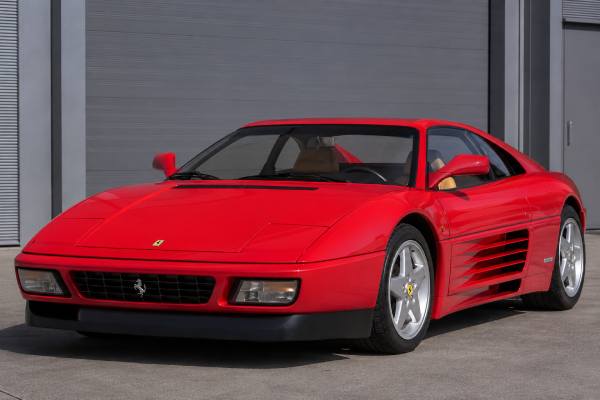
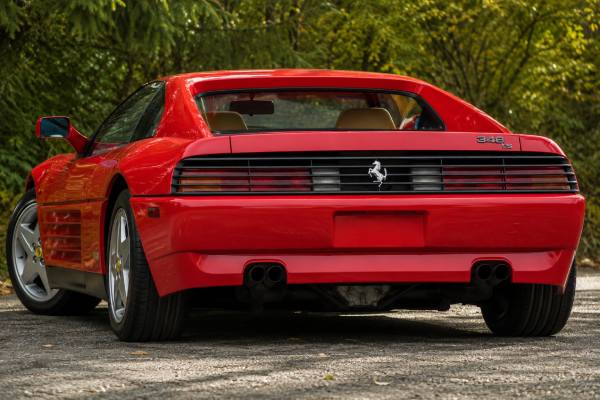
The Ferrari 348 ts is the removable-roof version of Ferrari’s first production V8 sports car to combine a longitudinal mid-mounted engine with a transverse manual gearbox. Built from 1989 to 1993, it uses the Tipo F119D 3.4-liter naturally aspirated V8, officially rated at 300 hp in European specification, and sits between the older 328 GTS and the later 348 GTS/F355 generation. The “ts” badge stands for Trasversale Spider, although the car is best understood as a targa, with a removable roof panel rather than a full folding soft top.
The 348 ts matters because it is both a bridge and a turning point. It kept the compact mid-engine Ferrari formula alive, but replaced the rounded 328 look with Testarossa-like side strakes, a wider stance, Bosch electronic engine management, ABS, and a more modern chassis layout. It is also one of the last analog Ferrari V8s before power steering, electronic dampers, and increasingly complex systems became normal.
For buyers, the 348 ts is appealing because it still offers a gated manual gearbox, a high-revving naturally aspirated V8, and a more attainable market position than many older and newer Ferraris. The caution is that “attainable” does not mean cheap to own. Condition, service history, originality, targa-roof fit, and evidence of proper engine-out belt service matter far more than mileage alone.
Quick Take
The Ferrari 348 ts is a sharp-edged, analog targa Ferrari with a 3.4-liter V8, a five-speed gated manual, and a distinctive 1990s design that links the 328, Testarossa, and F355 eras. Its strongest appeal is the mix of open-roof drama, mechanical involvement, and rising collector interest, while its main tradeoff is ownership sensitivity: neglected cars can quickly become expensive because belt service, clutch work, cooling-system repairs, suspension refreshes, and electrical sorting require specialist knowledge. The best examples are original, documented, well serviced, accident-free, and complete with books, tools, roof panel hardware, and clear provenance.
Table of Contents
- Model History and Ferrari Significance
- Engine, Chassis, and Key Specifications
- Production, Variants, and Factory Details
- Design, Engineering, and Special Features
- Driving Experience and Real Performance
- Reliability, Maintenance, and Restoration Risk
- Market Value, Buying Guide, and Rivals
Model History and Ferrari Significance
The 348 ts is important because it moved Ferrari’s junior mid-engine V8 line away from the 308/328 formula and into a more technical, wider, 1990s package. It was launched in 1989 alongside the fixed-roof 348 tb as the direct successor to the 328 GTS, but it felt like a different generation rather than a simple update.
The 328 was compact, rounded, and closely related to the 308 line. The 348 was more angular, more dramatic, and more heavily influenced by Ferrari’s bigger flat-12 Testarossa. Its side strakes, black lower body sections on early cars, wide rear bodywork, and rectangular rear lights gave it a stronger visual link to Ferrari’s late-1980s supercar design language.
The “348” name follows Ferrari’s traditional logic: 3.4 liters and 8 cylinders. The important extra letter is “t.” In the 348 tb and 348 ts, it refers to the transverse gearbox mounted behind the longitudinal V8. This layout was a major break from the earlier transverse-engine V8 Ferraris and gave the 348 a different mechanical identity.
The 348 ts also arrived at a sensitive time in Ferrari history. Enzo Ferrari died in 1988, and the 348 was one of the first new road cars to reach customers after his death. That gives the model a particular historical position: it was not a modern Ferrari in the later F355 sense, but it was no longer a classic carbureted or early injected Ferrari either.
Its reputation has changed over time. When new, the 348 faced strong criticism from some testers, especially once the Acura NSX showed how refined a mid-engine exotic could be. The Ferrari had heavier controls, more cabin heat, trickier low-speed manners, and a less forgiving chassis setup than many expected. Today, those traits are often viewed differently. Enthusiasts looking for a raw, mechanical Ferrari see the 348 ts as one of the last cars before the brand’s V8 line became smoother, faster, and easier to drive.
The 348 ts is collectible for several reasons:
- It has a gated five-speed manual gearbox.
- It uses a naturally aspirated, dry-sump V8 with no turbochargers or hybrid assistance.
- It has a removable targa roof, which gives it more open-air character than the 348 tb.
- It was produced in much smaller numbers than many modern sports cars.
- It sits in a useful price band below the most celebrated air-cooled Porsche 911 Turbo and many later manual Ferraris.
- It rewards careful maintenance and originality, which gives collectors clear standards when judging examples.
It is not the most loved Ferrari V8 by general reputation. The F355 that followed is prettier to many eyes, more powerful, and more polished. But that is exactly why the 348 ts has become interesting. It is a more demanding car, and its value depends heavily on whether the buyer wants involvement and period character rather than modern usability.
Engine, Chassis, and Key Specifications
The 348 ts uses the Tipo F119D 3.4-liter V8, mounted behind the cabin and driving the rear wheels through a five-speed manual gearbox. Its key engineering identity is the pairing of a longitudinal engine with a transverse gearbox, a layout that helped define the 348 range.
| Item | Specification |
|---|---|
| Production years | 1989–1993 |
| Body style | Two-seat targa with removable roof panel |
| Engine code | Tipo F119D |
| Engine type | 90-degree V8, naturally aspirated |
| Displacement | 3,404.70 cc |
| Bore x stroke | 85 mm x 75 mm |
| Valve gear | Double overhead camshafts per bank, four valves per cylinder |
| Fuel system | Bosch Motronic electronic fuel injection |
| Compression ratio | 10.4:1 |
| Maximum power | 221 kW / 300 hp at 7,200 rpm |
| Maximum torque | 324 Nm at 4,200 rpm |
| Lubrication | Dry sump |
| Transmission | Five-speed manual, gated shifter |
| Drive | Rear-wheel drive |
The engine is oversquare, meaning the bore is larger than the stroke. In simple terms, that helps the V8 rev freely and suits the car’s character. It is not a low-rev torque engine. It likes heat in its fluids, clean ignition, correct cam timing, and a driver willing to use the upper half of the tachometer.
The dry-sump system is also important. Instead of keeping all engine oil in a deep pan below the crankshaft, it stores oil separately and pumps it through the engine. This allows a lower engine position and helps oil control during hard cornering. For owners, it also means oil-level checking must be done correctly, usually with the engine warm and according to the proper procedure.
| Item | Specification |
|---|---|
| Chassis/body | Steel monocoque with rear tubular subframe |
| Front suspension | Independent double wishbones, coil springs, anti-roll bar |
| Rear suspension | Independent double wishbones, coil springs, anti-roll bar |
| Brakes | Ventilated discs with ABS |
| Steering | Rack and pinion, unassisted |
| Front tires | 215/50 ZR17 |
| Rear tires | 255/45 ZR17 |
| Length | 4,230 mm |
| Width | 1,894 mm |
| Height | 1,170 mm |
| Wheelbase | 2,450 mm |
| Dry weight | About 1,393 kg |
| Top speed | Over 275 km/h |
The chassis is more modern than the 328’s, but still very analog. There is no power steering, no paddle-shift gearbox, no electronic differential, and no active suspension. The driver is dealing with tire temperature, steering weight, throttle position, road camber, and suspension geometry directly.
One point worth noting is output terminology. European figures are often quoted as 300 hp or 300 PS, while some U.S. references list slightly different horsepower due to market-specific certification. For a 1989–1993 348 ts discussion, 300 hp is the commonly used headline figure, with the understanding that market documents may differ slightly.
Production, Variants, and Factory Details
The 348 ts was the more open counterpart to the 348 tb and was produced in larger numbers than the fixed-roof car. Ferrari built 4,228 examples of the 348 ts between 1989 and 1993, making it a limited-production collector car by normal standards but not a rare Ferrari in the extreme sense.
The 348 range can be confusing because Ferrari used several related names in a short period. The basic early cars are the 348 tb and 348 ts. Later came the revised 348 GTB, 348 GTS, and 348 Spider, plus limited and competition-oriented versions.
| Version | Body style | Main identity |
|---|---|---|
| 348 tb | Fixed-roof berlinetta | Original coupe version with transverse gearbox layout |
| 348 ts | Targa | Removable-roof version covered here |
| 348 Serie Speciale | tb and ts-based | U.S.-market limited series with visual and mechanical changes |
| 348 GTB | Fixed-roof berlinetta | Updated later version with more power and refinements |
| 348 GTS | Targa | Successor to the 348 ts with later updates |
| 348 Spider | Full convertible | True open-top body introduced after the early ts |
For collectors, the most important distinction is that a 1989–1993 348 ts is not the same as a later 348 GTS. The GTS belongs to the updated phase, with engine and detail changes. The ts is the earlier targa model with the original 300 hp identity.
Factory options were not as complex as on later Ferraris, but specification still matters. Exterior color, interior trim, seat style, market equipment, wheels, and the presence of original accessories can all influence desirability. Rosso Corsa over tan remains the default collector-friendly Ferrari combination, but unusual colors can be very attractive when original and well documented.
Important originality items include:
- Original books and pouch
- Service book with stamps or invoices
- Tool kit and jack kit
- Correct targa roof panel and storage bag
- Original wheels or documented factory-correct replacements
- Matching engine, chassis, and identification records
- Original interior materials where possible
- Paint meter readings that support the car’s story
- Ferrari dealer or specialist maintenance invoices
The targa roof is a major identification and condition point. A 348 ts should have a removable roof panel that fits cleanly, seals properly, and stores as intended. Poor roof fit can come from worn seals, damaged hardware, accident repair, or body misalignment. On a collector-grade car, the roof should not be treated as a minor accessory. It is central to the model’s identity.
U.S.-market cars may differ from European cars in lighting, bumper details, emissions equipment, labels, and documentation. A gray-market import can still be desirable, but only when its import paperwork, federalization work, and current registration status are clear. For a buyer, uncertainty in paperwork should reduce confidence, not create excitement.
Matching-numbers relevance is different from older 1960s Ferraris, where engine identity can dominate value, but it still matters. A 348 ts with its original engine, gearbox, chassis tags, books, and a clean service trail is easier to value and easier to sell later. A car with a replacement engine, missing records, repaint, or heavy modifications may still be enjoyable, but it should be priced accordingly.
Design, Engineering, and Special Features
The 348 ts looks distinctive because it translates Ferrari’s late-1980s supercar language into a smaller V8 targa body. Its straked side intakes, flat rear grille, rectangular tail lamps, low nose, and wide stance make it one of the most recognizable Ferraris of its period.
The design was by Pininfarina, and it clearly shares visual ideas with the Testarossa. The side strakes are not only decorative; they frame the cooling-air path into the side intakes and give the car a broad, architectural profile. The rear-end treatment is similarly dramatic, with black horizontal elements that visually widen the car.
The early 348 also used black lower body sections, which gave the body a lighter, more technical look. Some cars have since been repainted or updated with body-color lower panels, so buyers should check whether the finish matches the car’s original specification and build period. A color change is not always a problem, but on a collector car it must be disclosed and reflected in value.
The removable roof panel is the defining feature of the ts. It gives the car a more open and emotional driving experience than the 348 tb while retaining more structure than a full convertible. That said, a targa body can introduce extra inspection concerns. Roof seals, latch mechanisms, wind noise, water leaks, and panel storage condition all matter.
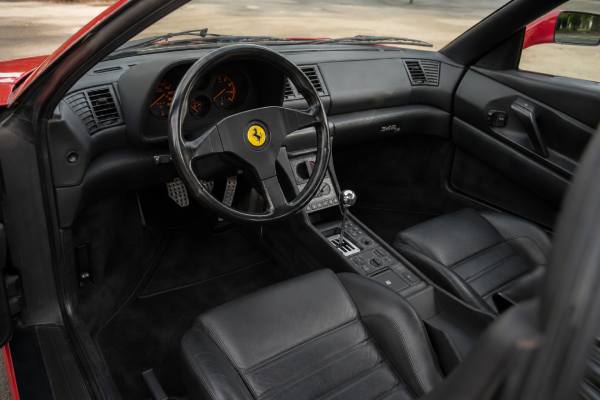
Inside, the 348 ts is compact and driver-focused. The seating position is low, the windshield is close, the dashboard is simple, and the gated shifter sits in full view. It does not have the polished ergonomics of a modern Ferrari. Some controls feel old-fashioned, and the cabin can become warm in traffic. But for many owners, that is part of the appeal. The car feels mechanical before it feels luxurious.
Several engineering features define the 348 ts:
- The longitudinal V8 improves the model’s technical identity compared with the older transverse-engine V8 cars.
- The transverse gearbox keeps the drivetrain compact behind the engine.
- The dry-sump lubrication system suits hard cornering and a low engine position.
- The steel monocoque and rear subframe make major drivetrain service possible, but labor-intensive.
- The unassisted steering gives strong feedback once the car is moving.
- ABS provides a useful safety layer without making the car feel modern or filtered.
Cooling and airflow were major design priorities. The side intakes feed the engine bay and radiators, while the rear grille helps remove heat. A healthy 348 should manage heat correctly, but marginal fans, old hoses, blocked radiators, and weak electrical connections can quickly reveal themselves in traffic.
The sound is a major part of the car’s character. The V8 is not as silky as a later five-valve F355 engine, but it has a harder-edged, mechanical tone. At low rpm it can feel slightly busy and industrial. Above the midrange, it becomes sharper and more urgent. Exhaust choice matters greatly. A tasteful period-correct exhaust can enhance the car, while a loud or poorly mapped setup can make it tiring and hurt originality.
The 348 ts is special because it sits at an intersection. It has enough modern hardware to be usable, but not enough electronic assistance to hide its mechanical layout. Its design is dramatic rather than universally pretty, and its engineering rewards a driver who understands warm-up, tire condition, shift technique, and maintenance discipline.
Driving Experience and Real Performance
The Ferrari 348 ts is not a modern point-and-shoot performance car. It is a physical, temperature-sensitive, analog Ferrari that feels best when warmed properly, driven with mechanical sympathy, and allowed to rev.
At low speed, the first impression is effort. The clutch is heavier than in most modern sports cars. The unassisted steering is weighty during parking. The gearbox can feel stiff when cold, especially when selecting second gear. This does not automatically mean the car is faulty; many gated manual Ferraris prefer gentle shifts until the gearbox oil is warm. But a car that grinds, jumps out of gear, or resists selection after warm-up needs specialist inspection.
Once moving, the steering becomes one of the car’s strongest qualities. It is direct, textured, and honest. The 348 ts tells the driver what the front tires are doing in a way that many newer cars do not. On a good road, this makes the car very satisfying. On rough pavement, it also means the driver must pay attention because tramlining, old tires, poor alignment, or worn suspension bushings can make the car feel nervous.
The engine rewards revs. Below the midrange it is responsive but not explosive. From roughly the middle of the tachometer upward, it becomes more alive, with stronger intake and exhaust sound and a more urgent pull toward the upper rpm range. It is quick by period standards, but not shocking by modern standards. The appeal is not just acceleration; it is the process of using the gated shifter, balancing the chassis, and hearing the V8 work.
The gearbox is central to the experience. A good 348 shift has a deliberate metal-on-metal feel through the open gate. It should not be rushed when cold. Fast, careless shifts can punish synchros and drivetrain components. A smooth driver will get more from the car than an aggressive one.
Handling is often debated. Early 348s gained a reputation for being less forgiving than the F355 and less polished than the NSX. Some of that reputation is fair. The car has a wide rear, no power steering, and an old-school mid-engine balance. It reacts strongly to tire choice, tire age, alignment, ride height, and suspension condition. A tired car can feel vague or twitchy. A properly set up car feels much more precise and confidence-inspiring.
Braking performance is period-appropriate. The ventilated discs and ABS are useful, but the pedal feel and stopping distances should be judged against early-1990s sports cars, not modern carbon-ceramic systems. Old brake hoses, worn pads, aged fluid, sticky calipers, or mismatched tires can make the system feel worse than it should.
The targa roof changes the personality. With the panel removed, the 348 ts feels more dramatic and more open than the tb. Wind noise rises, the cabin feels less sealed, and the engine note becomes more present. Some flex and roof-related noise may be more noticeable than in the berlinetta, but excessive creaks, leaks, or poor panel fit should not be dismissed.
In normal use, the 348 ts asks for compromise. Rear visibility is limited, luggage space is modest, the cabin can be hot, and low-speed traffic is not its natural habitat. But on an open road, with warm fluids and good tires, it gives the kind of direct Ferrari experience that newer cars often smooth away.
Reliability, Maintenance, and Restoration Risk
The 348 ts can be reliable when maintained correctly, but it is unforgiving of neglect. The expensive cars are not always the ones with high mileage; they are the ones with missing records, deferred belt service, old rubber, poor electrical repairs, worn suspension, and uncertain accident history.
The major service is the central ownership issue. The timing belts, tensioners, cam seals, water pump area, accessory belts, and related components require specialist attention. On the 348, major belt service is typically treated as an engine-out or drivetrain-out job by many specialists. That makes labor a major part of the bill, but it also gives a good shop access to inspect hoses, mounts, clutch parts, wiring, fuel lines, and hidden leaks.
A buyer should not accept “recent service” as a vague phrase. Ask what was done, who did it, when it was done, which parts were replaced, and whether photos or invoices exist. A belt-only service is not the same as a comprehensive major.
Common inspection areas include:
- Timing belts, tensioners, cam seals, and service date
- Water pump, coolant hoses, radiator condition, and fan operation
- Fuel hoses, injector seals, fuel pumps, and smell of fuel in the engine bay
- Clutch wear, release bearing noise, and hydraulic leaks
- Gearbox behavior when cold and fully warm
- Engine mounts and drivetrain mounts
- Oil leaks from cam covers, seals, and dry-sump lines
- Suspension bushings, ball joints, dampers, and alignment
- Brake calipers, hoses, discs, pads, and ABS warning lights
- Fuse box, relays, window motors, HVAC controls, and lighting
- Targa roof seals, latches, storage hardware, and water leaks
The cooling system deserves special attention. A healthy 348 should not constantly overheat, but age makes every part of the system suspect. Radiators can lose efficiency, fans can weaken, sensors can fail, and old hoses can swell or split. Any car that runs hot in traffic needs diagnosis rather than optimistic explanations.
Electrical issues are common in aging exotic cars. On the 348, poor grounds, aging connectors, relay problems, window issues, HVAC faults, and warning lights can consume time. None of these automatically makes the car bad, but random electrical behavior should be priced into the purchase.
The gearbox is sturdy when treated well, but abuse and old oil can create problems. A slightly stiff second gear when cold is familiar to many owners. A gearbox that baulks badly when warm, grinds under normal shifts, or has noisy bearings is a different matter. Rebuilds are not casual jobs.
Interior restoration can also be expensive. Leather shrinkage, worn bolsters, sticky or faded trim, damaged switchgear, missing roof bags, and incorrect aftermarket audio equipment all reduce collector appeal. A retrimmed interior may look nice, but originality and material accuracy matter on higher-value examples.
Rust is not the dominant 348 issue in the way it is on some older classics, but the car is still steel-bodied. Check lower panels, wheel arches, jacking points, floor areas, door bottoms, windshield edges, battery area, and any place where water may sit. Poor accident repair is a bigger concern than normal surface corrosion. Uneven panel gaps, mismatched paint, strange tire wear, and roof misalignment should trigger a deeper inspection.
For restoration, the risk is simple: a cheap 348 ts can become an expensive 348 ts very quickly. Mechanical parts, body trim, Ferrari-specific hardware, correct interior materials, and specialist labor are not priced like ordinary used-car parts. A sorted car with records usually costs less in the long run than a bargain car needing everything.
Market Value, Buying Guide, and Rivals
The 348 ts occupies a useful collector niche: it is a real mid-engine manual Ferrari with rising analog appeal, but it usually remains below the strongest F355, 328 GTS, and rare 348 special-series prices. Current public auction and listing data suggest usable examples often trade around the high-five-figure to low-six-figure range, with exceptional mileage, color, documentation, and originality capable of pushing values higher.
Value is driven less by the badge alone and more by risk control. A 348 ts with a complete service file, recent major service, original books and tools, clean paint history, good roof fit, and no stories will always be easier to buy, own, and resell than a cheaper car with gaps.
| Value factor | Why it matters |
|---|---|
| Major service history | Reduces immediate engine-out service risk |
| Originality | Collectors prefer correct paint, trim, wheels, and equipment |
| Documentation | Books, tools, invoices, and ownership history support value |
| Condition over mileage | A low-mile neglected car can be worse than a used but maintained car |
| Roof fit and seals | Targa-specific issues affect usability and buyer confidence |
| Accident history | Body and chassis repairs can strongly affect collector value |
| Color combination | Rosso Corsa is safe; rare original colors can be desirable |
| Market specification | U.S., European, and imported cars can differ in paperwork and equipment |
A proper pre-purchase inspection is essential. It should be done by a Ferrari specialist who knows the 348, not just a general exotic-car shop. The inspection should include a lift inspection, compression or leak-down testing when appropriate, review of service records, paint readings, roof-panel check, road test from cold, hot restart, gearbox evaluation, and scan or diagnosis of any warning lights where equipment allows.
Seek cars with:
- A recent documented major service by a known specialist
- Consistent mileage records
- Clean title and clear import history
- Original books, tools, jack, and roof accessories
- Good cold start and stable warm idle
- Smooth gearbox behavior once warm
- Correct cooling behavior in traffic
- Even panel gaps and clean paint readings
- No fuel smell or unexplained warning lights
- Sensible, reversible upgrades if any
Avoid cars with:
- Missing service history
- Long storage without recommissioning
- Fresh cosmetic work hiding mechanical neglect
- Poor targa roof fit or water damage
- Hot-running behavior
- Gearbox grinding when warm
- Heavy modifications without original parts
- Accident repair with no documentation
- “Needs only minor work” claims that involve Ferrari-specific parts
The closest rivals depend on what the buyer wants. A Ferrari 328 GTS is older, prettier to many eyes, and more classic in feel, but usually less powerful and often more expensive for excellent examples. The F355 GTS is faster, more polished, and more famous for its sound, but maintenance can be even more complex and expensive. The Acura NSX is easier to use and more refined, but it does not deliver the same Ferrari theater. The Porsche 911 Turbo of the period offers stronger straight-line performance and everyday durability, but a completely different rear-engine character. A Lotus Esprit Turbo or V8 can offer exotic looks and strong performance for less money, though parts and specialist knowledge bring their own challenges.
For long-term collectability, the 348 ts has several positives: manual gearbox, analog controls, naturally aspirated Ferrari V8, open-roof body, recognizable design, and a production number low enough to matter. Its negatives are also clear: mixed period reputation, high service sensitivity, and less universal desirability than the F355. That combination makes condition the deciding factor.
The right 348 ts is not the cheapest one. It is the car with the fewest unknowns.
References
- Ferrari 348 TS (1989) – Ferrari.com 1989 (Manufacturer Specification)
- Ferrari 348 TB (1989) – Ferrari.com 1989 (Manufacturer Specification)
- Check for Recalls: Vehicle, Car Seat, Tire, Equipment | NHTSA 2026 (Recall Database)
- Ferrari 348 ts Market – CLASSIC.COM 2026 (Market Data)
Disclaimer
This article is for informational purposes only and is not a substitute for professional diagnosis, repair advice, valuation advice, or a specialist pre-purchase inspection. Specifications, torque values, service intervals, parts, procedures, equipment, emissions systems, and recall applicability can vary by VIN, model year, market, and individual vehicle history. Always verify details against official Ferrari service documentation and consult a qualified Ferrari specialist before buying, repairing, or restoring a Ferrari 348 ts.
If you found this guide useful, please share it on Facebook, X/Twitter, or your favorite car community to support our work.