
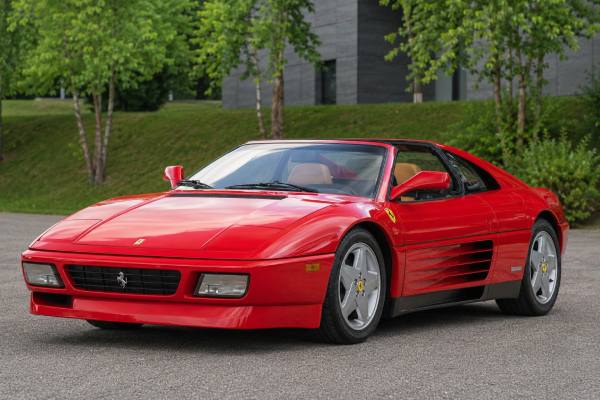
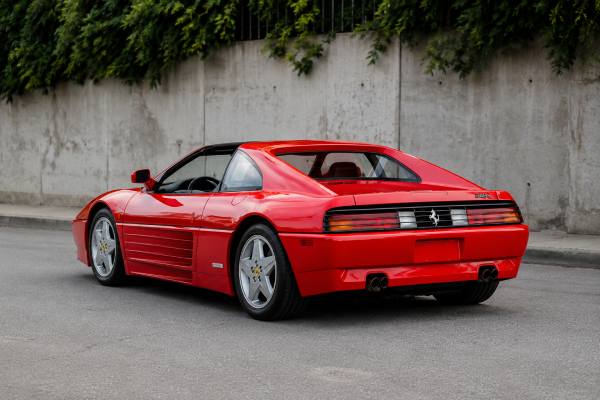
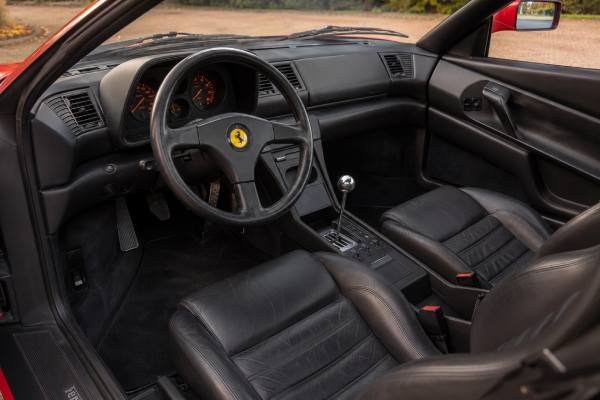
The Ferrari 348 ts Serie Speciale is the targa-roof, North American special-series version of the 348, built for 1992–1993 with the Tipo F119D 3.4-liter V8, 312 hp, a five-speed gated manual gearbox, and a more focused chassis setup than the standard early 348 ts. It matters because it sits in a narrow and interesting place: rarer than a normal 348, more raw than the later F355, and more usable than Ferrari’s harder-edged competition variants.
The 348 ts Serie Speciale was not a full homologation car or a stripped track model. It was a limited-production road car aimed at buyers who wanted the drama of the 348’s mid-engine layout, Testarossa-inspired styling, and open targa roof, but with factory upgrades that sharpened the car’s response. The changes were not cosmetic only. Ferrari added engine-management and exhaust revisions, a shorter final drive, a wider rear track, Pirelli P Zero tires, and identifying interior and exterior details.
Today, the car attracts two different types of attention. Enthusiasts like it because it is one of the last analog-feeling mid-engine V8 Ferraris, with manual steering feel, a gated shifter, and little electronic filtering. Collectors like it because production was limited, documentation matters, and the best examples stand apart from ordinary 348 ts cars. That same rarity also makes buying one more complicated: condition, originality, service history, and correct Serie Speciale details carry real weight.
Quick Take
The Ferrari 348 ts Serie Speciale is most appealing as a rare, factory-upgraded open-roof 348 with sharper gearing, a wider rear stance, 312 hp, and strong North American collector identity. Its character is mechanical, direct, and more demanding than a modern Ferrari, which is exactly why many buyers care about it. The main caution is that these cars are highly condition-sensitive: deferred belt service, poor accident repair, missing plaques or seats, weak documentation, and tired suspension can erase much of the advantage of buying the special model in the first place.
Table of Contents
- History and Collector Significance
- F119D V8, Chassis, and Key Specs
- Production Split, Variants, and Options
- Pininfarina Design and Special Engineering
- Road Feel, Performance, and Usability
- Service Risks, Restoration, and Ownership
- Values, Buying Advice, and Rivals
History and Collector Significance
The 348 ts Serie Speciale matters because it turned the early 348 formula into a rarer, sharper North American package before Ferrari revised the wider 348 range. It is not just a trim edition; it marks a point where Ferrari responded to criticism of the standard 348’s dynamics and gave the U.S. market a more distinctive version.
Ferrari introduced the 348 in 1989 as the replacement for the 328. That was a major shift. The 328 had been an evolution of the 308 idea: compact, curvy, and familiar. The 348 was more angular, wider, and visually tied to the Testarossa era. Its side strakes, rectangular tail treatment, and low wedge profile gave it a very different presence from the rounder 1980s V8 cars.
The “348” name followed Ferrari’s traditional logic: 3.4 liters and eight cylinders. The “t” in tb and ts referred to the transverse gearbox layout, not to turbocharging. In the 348, the V8 sits longitudinally behind the cabin, while the gearbox is mounted transversely. This layout was technically important for Ferrari’s mid-engine V8 line and helped separate the 348 from the older 308 and 328.
The 348 ts was the targa-roof version. It offered open-air driving without becoming a full convertible. The removable roof panel gave it a different personality from the fixed-roof 348 tb, but it kept the same basic mid-engine structure, drivetrain, and proportions. For buyers who wanted the sound and feel of the V8 without giving up the roof-off experience, the ts was the natural choice.
The Serie Speciale arrived in 1992 for the North American market. Ferrari built 100 examples across the tb coupe and ts targa body styles, with the ts accounting for the larger share. The package brought extra power, a more assertive rear track, a shorter final drive, and several visual changes that made the car easier to identify. The result was a 348 that felt more purposeful without becoming too compromised for road use.
Its historical position is also helped by what came after it. In 1993, Ferrari updated the 348 range with the GTB, GTS, and Spider, carrying over some of the lessons learned from the Serie Speciale. Then the F355 arrived and changed the conversation again with more power, a more polished chassis, power steering, and a more modern overall feel. That left the 348 Serie Speciale as a short-lived bridge between the raw early 348 and the more refined later Ferrari V8 era.
Collectors care because the car has several things that make a limited Ferrari interesting:
- documented low production
- clear regional identity
- numbered Serie Speciale plaques
- factory mechanical upgrades
- distinctive interior and exterior features
- direct connection to the final analog period before the F355
- strong visual link to the Testarossa and F40 design language
The 348’s reputation has changed over time. For years, the model sat in the shadow of both the 328 and F355. Some buyers saw it as the awkward middle child of Ferrari’s V8 line. That view is now too simple. The 348 can feel less polished than an F355, but it also gives more mechanical texture. In Serie Speciale form, especially as a ts, it offers a mix of rarity, open-roof usability, and old-school Ferrari involvement that is difficult to duplicate.
F119D V8, Chassis, and Key Specs
The 348 ts Serie Speciale uses the same basic mid-mounted 3.4-liter Ferrari V8 architecture as the standard 348, but the Serie Speciale tune raised output to 312 hp and sharpened acceleration. The most meaningful changes were not huge in isolation, but together they made the car feel more alert.
The engine is a naturally aspirated, quad-cam, 32-valve V8 with dry-sump lubrication. Dry-sump lubrication uses a separate oil tank and scavenging system rather than relying only on a deep oil pan. In a mid-engine sports car, that helps oil control during hard cornering and allows the engine to sit lower.
Fuel and ignition control came through Bosch Motronic engine management. The 348 also used a five-speed manual transaxle with the famous open metal shift gate. The gearbox is part of the 348’s identity: it is physical, mechanical, and slower to operate when cold, but satisfying when used correctly.
| Item | Specification |
|---|---|
| Model years | 1992–1993 |
| Body style | Two-seat targa, removable roof panel |
| Engine | Tipo F119D 3.4-liter naturally aspirated V8 |
| Displacement | 3,405 cc |
| Valvetrain | Double overhead camshafts, four valves per cylinder |
| Maximum output | 312 hp at 7,200 rpm |
| Torque | About 238 lb-ft at 4,200 rpm |
| Induction | Naturally aspirated, Bosch Motronic fuel injection |
| Transmission | Five-speed gated manual transaxle |
| Drivetrain | Rear-wheel drive, limited-slip differential |
| Speciale chassis changes | Wider rear track, shorter final drive, Pirelli P Zero tires |
| Factory 0–60 mph figure | About 5.3 seconds |
| Quarter mile | About 13.75 seconds |
The standard 348 ts was already a serious car for its period, but the Serie Speciale revisions gave it a stronger launch and a slightly more aggressive feel through the gears. The shorter final drive is especially important. It does not create extra engine output, but it changes how quickly the car gets into the useful part of the powerband. On a winding road, that can matter more than a top-speed claim.
The chassis used steel construction with a rear subframe carrying the powertrain. Suspension was independent at all four corners, with unequal-length wishbones, coil springs, telescopic dampers, and anti-roll bars. Braking was by ventilated discs with ABS. The steering is one of the major character points. Compared with later Ferraris that use more assistance and filtering, the 348 gives the driver a dense, direct sense of the front tires.
The 348 ts body is compact by modern supercar standards. It is wide enough to feel serious, but it is not a large car. Visibility is better than many later mid-engine exotics because the glass area is useful and the nose is low. The targa roof adds open-air appeal, but it also makes roof seals, panel fit, and wind noise part of the buying inspection.
| Area | Detail |
|---|---|
| Wheelbase | 2,450 mm |
| Length | About 4,230 mm |
| Width | About 1,894 mm |
| Height | About 1,170 mm |
| Front tires | 17-inch performance tire fitment |
| Rear tires | Wider 17-inch rear performance tire fitment |
| Brakes | Ventilated discs with ABS |
The numbers only tell part of the story. The Serie Speciale’s appeal comes from the combination of a responsive V8, tight gearing, light-feeling front end, broad rear track, and manual controls. It is not as fast as modern Ferraris, but it is fast enough to demand attention and mechanical sympathy.
Production Split, Variants, and Options
Ferrari built the 348 Serie Speciale as a 100-car limited run for North America, split between the tb coupe and ts targa. The 348 ts Serie Speciale is the open-roof version, and its desirability depends heavily on whether the car still has its correct factory details and documentation.
The most commonly accepted production split is 35 tb coupes and 65 ts targas. That makes the ts less rare than the tb within the Serie Speciale group, but still much rarer than a regular 348 ts. For many buyers, the targa body is also the more desirable road car because it adds the open-air experience without the full structural and visual change of a later Spider.
The Serie Speciale was not a separate model in the way a later Challenge Stradale or Scuderia was. It was a special-series specification applied to the 348 platform. That makes identification important. A real car should have the correct plaques, body details, seats or documented seat specification, service records, and VIN-consistent history.
How to identify a genuine Serie Speciale
A proper 348 ts Serie Speciale should not be judged only by badges. Buyers should look for a full pattern of correct features:
- numbered Serie Speciale plaque
- special interior identification
- factory body-color lower trim treatment
- revised front spoiler
- specific rear and tail-light treatment
- F40-style sport seats or documented factory seat option
- wider rear track specification
- shorter final-drive specification
- period-correct wheels and tire sizing
- original books, tools, records, window sticker, or Ferrari documentation where available
Because these cars are valuable relative to normal 348s, small differences matter. A standard 348 ts modified with similar wheels, seats, paintwork, or exhaust parts is not the same thing. The premium belongs to factory identity, not to a later recreation.
Seats, trim, and originality
The F40-style seats are a major visual and collector feature. They give the cabin a more special feel and help separate the Serie Speciale from a normal 348. However, some cars may have been delivered or later fitted with standard seats, so documentation is important before assuming a car is incomplete or incorrect.
Interior condition matters more than casual shoppers expect. Connolly leather can shrink, dry, pull at seams, or discolor. Dash leather and door panels deserve close inspection. The numbered plaque should be present, undamaged, and consistent with the car’s history. Replacing missing trim may be possible in some cases, but correct original parts are not always easy to find.
Colors and special-order appeal
Rosso Corsa over tan is the classic Ferrari combination and is common across the 348 world. It is easy to sell and easy to understand. Unusual factory colors can bring extra interest, but only when the paperwork supports the claim. A rare color without documentation should be treated carefully, especially if the car has been repainted.
For collectors, the strongest examples usually combine:
- verified Serie Speciale identity
- factory-correct color and trim
- complete books and tools
- clear ownership chain
- accident-free body history
- documented major services
- low but usable mileage
- original seats, wheels, plaques, and trim
A high-mileage but honest, serviced, complete car can still be a better buy than a low-mileage example with stale belts, paint questions, missing parts, or unclear history. On limited Ferraris, originality and condition work together. One without the other is rarely ideal.
Pininfarina Design and Special Engineering
The 348 ts Serie Speciale looks distinctive because it combines the normal 348’s Pininfarina wedge shape with a small set of factory changes that make the car lower, cleaner, and more assertive. The design is not subtle, but it is very much of its period.
The 348’s exterior belongs to the late-1980s and early-1990s Ferrari design language. The side strakes immediately connect it to the Testarossa, while the low nose and angular tail connect it to Ferrari’s supercar mood of the time. The 348 was not trying to be a soft evolution of the 328. It was sharper, flatter, and more technical in appearance.
The Serie Speciale added a front spoiler inspired by Ferrari’s more aggressive aero thinking of the period. The body-colored bumpers and rocker panels make the car look less like a standard 348 with black lower trim and more like a special factory variant. The revised rear treatment and grille details also help, especially for buyers who know what they are looking at.
The targa roof changes the character
The removable roof panel is central to the 348 ts identity. With the roof fitted, the car feels more enclosed and purposeful. With the panel removed, the engine note and intake sound become more present, and the car feels more theatrical at normal road speeds.
The targa format also brings practical concerns. Roof-panel fit should be checked carefully. Wind noise, water leaks, worn seals, damaged latches, and incorrect storage hardware can all affect ownership. These details may sound minor compared with engine service, but they matter on a collector-grade ts.
Cooling, packaging, and side strakes
The side strakes are not just styling theater. They are part of the 348’s cooling and packaging story, feeding air toward the radiators and powertrain area. Mid-engine cars concentrate heat behind the cabin, so airflow management is important. A neglected 348 may suffer from tired hoses, dirty radiators, weak fans, or poor bleeding after cooling-system work.
The engine bay is tight, and access is one reason major service can be expensive. The 348’s timing-belt service is commonly treated as an engine-out job by specialists. That sounds intimidating, but for a well-kept car it is part of normal exotic-car ownership, not a sign that the model is flawed.
Sound and mechanical feel
The flat-plane-crank V8 is one of the 348’s best features. It does not have the high-rpm shriek of the later five-valve F355, but it has a harder, more mechanical tone. In Serie Speciale form, the freer-flowing exhaust helps the car feel more awake.
The sound is also more honest than in many modern cars. There are no drive modes, no synthesized cabin enhancement, and no automatic gearbox programming to shape the experience. What the driver hears is closely tied to throttle opening, revs, gear choice, and load.
The cockpit is simple by modern standards. The driving position is low, the dashboard is clean, and the gated shifter is a central event. Pedals, steering, clutch, and shift action all require deliberate inputs. That makes the car less effortless than a modern Ferrari but more memorable at everyday speeds.
Road Feel, Performance, and Usability
The 348 ts Serie Speciale feels quick, mechanical, and demanding rather than effortlessly fast. Its 312 hp output is modest by current supercar standards, but the short gearing, mid-engine layout, and direct controls make the performance feel vivid.
Acceleration is strongest when the engine is allowed to rev. The V8 is not a lazy, torque-heavy engine. It wants heat, revs, and clean inputs. Below the middle of the tachometer it feels flexible enough for normal driving, but the real character arrives as it climbs toward the upper range. The shorter final drive helps keep the engine in that useful zone.
The gearbox is a major part of the experience. When cold, second gear can feel reluctant, and forcing it is poor practice. Many owners shift from first to third during the early minutes of a drive, then use second normally once the oil warms. A good 348 gearbox should feel mechanical, not vague or grinding. A bad one can point to worn synchros, clutch drag, linkage issues, or abuse.
Steering feel is one of the car’s strengths. The 348 tells the driver a lot through the wheel, especially once the tires are warm and the alignment is correct. It does not isolate the driver from surface changes. On rough roads, that can make it busy. On a good road, it makes the car feel alive.
The wider rear track of the Serie Speciale helps address one of the early 348’s most discussed traits: rear-end sensitivity. The standard early cars could feel nervous if the tires were old, pressures were wrong, bushings were tired, or alignment was poor. The Serie Speciale is still a mid-engine Ferrari and should be respected, but the rear stance and tire package give it a more planted attitude.
Ride quality is firm but not punishing when the suspension is healthy. Old dampers, worn bushings, flat-spotted tires, and incorrect alignment can make the car feel much worse than it should. This is why test drives are so important. A sorted 348 has a coherent rhythm. A neglected one feels loose, harsh, and nervous at the same time.
Braking performance is period-appropriate. The ventilated discs and ABS are useful, but this is not a modern carbon-ceramic setup. Pedal feel, fluid age, hose condition, pad choice, and caliper health all make a difference. For road use, a properly serviced braking system is more important than chasing aggressive track pads.
As a road car, the ts Serie Speciale is more usable than its exotic shape suggests. Visibility is reasonable, the cabin is not overly complicated, and the engine is tractable once warm. However, it is not a car that enjoys neglect or constant short trips. It prefers proper warm-up, regular use, and careful maintenance.
The roof-off experience is one of the main reasons to choose the ts. At lower speeds, the open panel makes the car feel more special without needing to drive quickly. On long highway trips, wind noise and heat management depend heavily on roof seals, climate-control health, and the condition of the cabin insulation. A perfect example can be enjoyable; a tired one can feel old very quickly.
Service Risks, Restoration, and Ownership
The 348 ts Serie Speciale can be reliable when serviced correctly, but it is an aging mid-engine Ferrari with expensive labor, limited special parts, and no tolerance for deferred maintenance. The right car is rewarding; the wrong car can become a long and costly project.
The most important recurring service issue is the timing-belt major service. On the 348, this work is normally approached as an engine-out service. A proper major often includes belts, tensioners, cam seals, valve-cover gaskets, accessory belts, fluids, filters, inspection of the water pump, fuel hoses, coolant hoses, engine mounts, clutch area, and related “while you are there” items.
Service intervals are a subject of debate among owners because age, mileage, climate, and usage all matter. For buying purposes, the safest approach is simple: do not pay collector money for a car with old belts or vague records. A low-mileage car that has sat for years is not automatically better than a regularly driven car with fresh major service.
Common areas to inspect
A pre-purchase inspection by a Ferrari specialist is essential. The inspection should go beyond a basic road test and paint-meter reading. Important areas include:
- timing-belt age and service invoices
- compression and leak-down results where appropriate
- cam-cover, cam-seal, and crank-seal leaks
- coolant hoses, radiator condition, and fan operation
- fuel hoses and fuel smell after shutdown
- clutch wear, release bearing noise, and hydraulic leaks
- gearbox synchro behavior, especially second gear
- engine mounts and rear subframe condition
- suspension bushings, ball joints, dampers, and alignment
- brake discs, calipers, hoses, and ABS warning lights
- fuse panel, relays, window motors, lights, and HVAC controls
- roof seals, targa panel fit, and water leaks
- seat condition, dash leather shrinkage, and plaque originality
- accident repair around the front structure, sills, rear quarters, and engine bay
Electrical faults are not always dramatic, but chasing them can be frustrating. Window operation, fan speeds, warning lights, charging-system health, and old connectors should all be checked. A weak battery or poor grounds can create symptoms that look more serious than they are.
The cooling system deserves special respect. Mid-engine Ferraris run long coolant paths, and trapped air, tired hoses, weak caps, or clogged radiators can cause problems. Any sign of overheating, repeated coolant loss, or improvised hose repairs should slow the purchase process.
Restoration and parts reality
Restoring a 348 ts Serie Speciale is different from restoring a normal used sports car. Mechanical parts can often be sourced through specialists, but Serie Speciale-specific trim, seats, plaques, and body details are harder. Missing unique parts affect value because the buyer pool for a limited Ferrari expects correctness.
Paintwork needs careful evaluation. Many 348s have had front-end paintwork from stone chips, and that is not automatically a problem. Poor panel gaps, mismatched texture, overspray, distorted underbody panels, or missing factory labels are more serious. A repaired car can still be enjoyable, but it should not be priced like an untouched collector example.
Interior restoration also has tradeoffs. Fresh leather can look attractive, but collectors often prefer carefully preserved original material if it remains presentable. Over-restored interiors, incorrect stitching, wrong seat materials, or missing factory details can reduce authenticity.
The best ownership pattern is regular but careful use. Cars that sit for long periods often develop leaks, sticky components, flat-spotted tires, weak batteries, and stale fuel issues. A 348 that is driven, warmed properly, serviced on time, and stored in a dry environment is usually a better long-term proposition than a museum piece that needs recommissioning.
Values, Buying Advice, and Rivals
The 348 ts Serie Speciale sits above ordinary 348 ts values because of rarity, factory upgrades, and North American collector appeal. The spread between an average car and an exceptional one can be large, because the market rewards proof, originality, mileage, condition, and recent specialist service.
As of 2026, public market data shows the Serie Speciale occupying a stronger position than standard 348 models, with benchmark values around the high-six-figure-to-low-$200,000 area and exceptional auction examples capable of reaching more. A highly unusual color, very low mileage, recent major service, factory seats, complete documentation, and concours-level condition can push a car well beyond a normal driver-grade example.
For buyers, the key is not simply finding the cheapest Serie Speciale. A deferred-maintenance car can look attractive until the first major service, tire replacement, clutch work, cooling-system refresh, and interior correction are added. The better question is whether the car’s price correctly reflects its condition and completeness.
| Priority | Why it matters |
|---|---|
| Verified identity | The value premium depends on the car being a genuine Serie Speciale, not a modified standard 348. |
| Recent major service | Old belt service or vague invoices create immediate cost and risk. |
| Original special parts | Seats, plaques, trim, and body details are central to collectability. |
| Accident-free structure | Mid-engine Ferrari repairs can be expensive and value-sensitive. |
| Complete records | Ownership chain, mileage history, window sticker, books, and tools support market confidence. |
| Correct driving behavior | A sorted car should feel tight, stable, and mechanical, not nervous or worn out. |
Examples to seek
The best cars usually have a calm, consistent story. Look for long-term ownership, Ferrari specialist invoices, clear mileage progression, original books and tools, correct plaques, proper seats, and a clean inspection. A recent engine-out service by a known shop is a major advantage, especially if it includes photos and parts details.
Good driver-grade cars can be excellent purchases if priced honestly. They may have some paintwork, moderate mileage, or light interior wear, but they should be mechanically strong and complete. These cars are often more enjoyable than ultra-low-mileage examples because owners feel less pressure every time they add miles.
Examples to avoid
Avoid cars with missing Serie Speciale identifiers, unclear title history, poor paintwork, old tires, stale belts, electrical warning lights, roof leaks, or sellers who cannot explain the service history. Also be cautious with heavily modified cars. Exhaust changes, wheels, audio upgrades, or cosmetic changes may suit personal taste, but they rarely help collector value unless all original parts are included.
Mileage should be judged intelligently. Very low mileage is valuable only when the car has been maintained despite lack of use. Higher mileage is not fatal if the records are excellent. What hurts most is uncertainty.
The closest Ferrari alternatives are the standard 348 ts, later 348 GTS, 348 Spider, F355 GTS, and 328 GTS. The standard 348 ts gives much of the same shape and basic feel for less money, but without the rarity or factory upgrades. The 348 GTS is more developed, while the Spider offers full open-air driving. The F355 is faster, more polished, and more famous, but often more expensive to maintain and less raw in feel. The 328 GTS is older, simpler, and more classically pretty, but it does not offer the same 1990s mid-engine drama.
Outside Ferrari, the Acura NSX is the most obvious comparison. It is easier to live with, more refined, and generally less temperamental, but it does not deliver the same Ferrari theater. The Porsche 964 Turbo offers huge character and a very different rear-engine feel. The Lotus Esprit provides exotic shape and turbocharged personality, but its market and ownership profile are different.
Long-term collectability looks favorable for correct 348 ts Serie Speciale examples because the car has the ingredients collectors usually revisit: limited production, manual gearbox, naturally aspirated V8, open-roof body style, factory upgrades, and period styling that now feels more distinctive than awkward. It is still a specialist car, not a casual purchase. Buy the best-documented, best-sorted example you can justify, and treat originality as part of the mechanical specification, not as a cosmetic bonus.
References
- Ferrari 348 TS (1989) – Ferrari.com 1989 (Manufacturer Specifications)
- The Serie Speciale just for North America 2019 (Manufacturer Article)
- Safer Car Vehicle Safety, Ratings and Recalls 2026 (Recall Database)
- Ferrari 348 Serie Speciale Market 2026 (Market Data)
- 1993 Ferrari 348 Serie Speciale tb | Miami 2026 (Auction Result)
Disclaimer
This article is for informational purposes only and is not a substitute for professional diagnosis, inspection, maintenance, or repair. Specifications, torque values, service intervals, procedures, parts, emissions equipment, and factory details can vary by VIN, market, production date, and equipment. Always verify important information against official Ferrari service documentation and have any 348 ts Serie Speciale inspected by a qualified Ferrari specialist before purchase or repair.
If this guide helped you, please share it on Facebook, X/Twitter, or your favorite enthusiast community to support our work.