
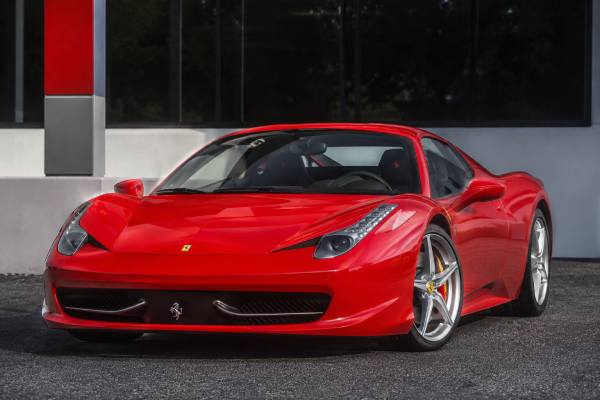
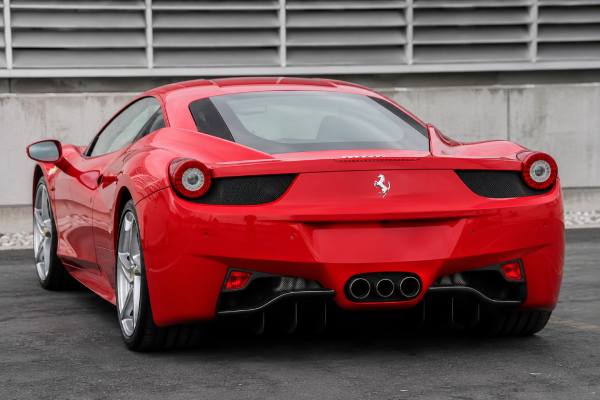
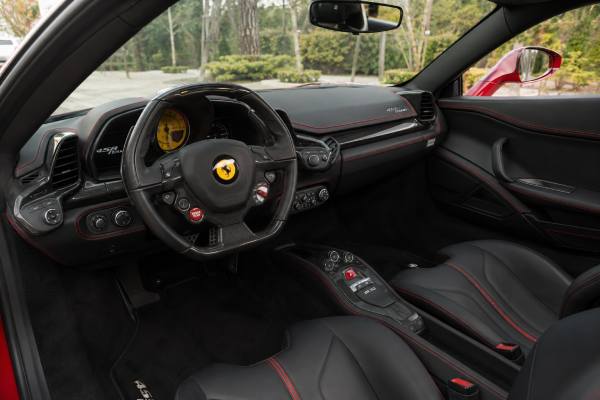
The Ferrari 458 Italia 20th Anniversary Special Edition is a 2012 China-market limited edition of the F142-generation 458 Italia, powered by the F136 FB 4.5L naturally aspirated V8 with 570 hp. Built to mark 20 years of Ferrari’s presence in China, it was not a mechanical evolution of the 458, but a highly collectible presentation of one of Ferrari’s most admired modern mid-engine cars.
Its importance comes from two things working together. Underneath, it is the standard 458 Italia coupe: aluminum structure, rear-mid V8 layout, seven-speed dual-clutch transmission, carbon-ceramic brakes, sharp steering, and a 9,000 rpm engine. On top of that, it adds a China-only identity with Marco Polo Red paint, gold exterior details, a golden dragon motif, special cabin embroidery, and a numbered 20th Anniversary plaque. For collectors, the question is less about extra horsepower and more about originality, provenance, and whether the car still carries its limited-edition details exactly as supplied.
Quick Take
The Ferrari 458 Italia 20th Anniversary Special Edition is most appealing as a rare factory-bodied, China-only collector version of the naturally aspirated 458 Italia. Its technical identity is pure 458: a high-revving 4.5L V8, dual-clutch transmission, rear-wheel drive, and one of the last non-turbo Ferrari mid-engine road-car experiences. The main caution is that its value depends heavily on documentation, paint/livery originality, complete edition-specific trim, recall completion, and expert inspection, because replacement or restoration of unique cosmetic details can be far harder than maintaining the shared 458 mechanical package.
Table of Contents
- History, Context, and Collector Significance
- Engine, Chassis, and Key Specifications
- Production, Variants, and Factory Options
- Design, Engineering, and Special Features
- Driving Experience and Performance Character
- Reliability, Maintenance, and Restoration Risk
- Market Value and Buying Guide
History, Context, and Collector Significance
The 20th Anniversary Special Edition matters because it turns the already important Ferrari 458 Italia into a very small-run regional commemorative model. Ferrari created it in 2012 for the Chinese market, with only 20 examples planned, to celebrate two decades since the first Ferrari was ordered in Beijing.
The base car was already a landmark. The 458 Italia replaced the F430 and moved Ferrari’s mid-engine V8 line into a more modern era. It kept a naturally aspirated V8, but the rest of the car felt like a major reset: a new aluminum chassis, direct fuel injection, a dual-clutch gearbox, tighter electronic chassis control, and bodywork shaped around airflow rather than simple visual drama.
The 20th Anniversary edition did not change the car’s basic layout. It used the standard 458 Italia coupe body and powertrain, which means the same 4.5L V8, 570 hp output, and rear-wheel-drive layout. What changed was the meaning and presentation. Ferrari tied the car to China through color, graphics, interior details, and symbolism. The golden dragon on the hood, black-and-gold striping, gold wheels, and edition plaque make it instantly separate from a regular Rosso Corsa 458.
That distinction is central to how collectors should view it. This is not the track-focused 458 Speciale, and it is not a lightweight mechanical package. It is a rare factory special edition built around market history, cultural imagery, and limited allocation. Its value comes from rarity, condition, and authenticity rather than lap-time improvements.
The timing also helps its status. The 458 sits near the end of Ferrari’s naturally aspirated mid-engine V8 era. The later 488 GTB moved to twin-turbo power, which made the 458’s throttle response, sound, and high-rpm character more desirable to many enthusiasts. The 20th Anniversary Special Edition adds rarity to a model that already has strong emotional appeal.
For Ferrari collectors, this car fits into a specific category: modern limited editions with regional significance. These cars often live or die by paperwork. A standard 458 with repaint work or missing books may still be a wonderful driver. A 20th Anniversary Special Edition with missing provenance, damaged graphics, or incorrect refinishing becomes a much more complicated purchase.
Its significance is therefore not only mechanical. It is a record of Ferrari’s growth in China, a design object from the 2012 Year of the Dragon period, and a low-volume version of a car that many still consider one of the best-driving modern Ferraris.
Engine, Chassis, and Key Specifications
Mechanically, the 20th Anniversary Special Edition follows the 2012 Ferrari 458 Italia coupe. The core specification is the F136 FB-family 4.5L naturally aspirated V8, a seven-speed dual-clutch transmission, rear-wheel drive, and an aluminum chassis tuned for fast road and track use.
| Category | Specification |
|---|---|
| Model | Ferrari 458 Italia 20th Anniversary Special Edition |
| Platform code | F142 |
| Model year | 2012 |
| Body style | Two-seat berlinetta coupe |
| Layout | Rear-mid engine, rear-wheel drive |
| Engine | F136 FB 90-degree naturally aspirated V8 |
| Displacement | 4,497 cc |
| Maximum power | 570 hp / 570 CV at 9,000 rpm |
| Maximum torque | 540 Nm / 398 lb-ft at 6,000 rpm |
| Fuel system | Direct injection |
| Transmission | Seven-speed dual-clutch F1 gearbox |
| Chassis | Aluminum spaceframe |
| Front suspension | Double wishbone |
| Rear suspension | Multi-link |
| Brakes | Carbon-ceramic discs |
| Front tires | 235/35 ZR20 |
| Rear tires | 295/35 ZR20 |
The engine is the star. It is a high-compression, dry-sump, flat-plane-crank V8 that builds power through revs rather than boost. The 9,000 rpm peak power point is not a marketing detail; it defines the car’s whole personality. Below the top of the rev range, the engine is still responsive and flexible, but the real theater arrives as the tachometer climbs.
The dual-clutch gearbox is also important. Earlier Ferrari mid-engine V8s used single-clutch automated manuals in many versions. Those gearboxes have their own character, but they can feel abrupt in traffic and expensive when clutch wear becomes an issue. The 458’s dual-clutch unit shifts faster and smoother, while still giving the driver a strong connection through the paddles.
| Measurement | Figure |
|---|---|
| Length | 4,527 mm / 178.2 in |
| Width | 1,937 mm / 76.3 in |
| Height | 1,213 mm / 47.8 in |
| Wheelbase | 2,650 mm / 104.3 in |
| Dry weight | About 1,380 kg / 3,042 lb |
| 0–100 km/h | About 3.4 seconds |
| Top speed | Over 325 km/h / over 202 mph |
| Combined fuel consumption | About 13.3 L/100 km on the European combined cycle |
| CO2 emissions | About 307 g/km |
The 458’s chassis systems include E-Diff electronic differential control, F1-Trac traction control, stability management, magnetorheological dampers, and a steering setup known for unusually quick response. These systems matter because they make the car more approachable than the numbers suggest. A 570 hp mid-engine Ferrari can sound intimidating, but the 458’s electronics and chassis tuning give it a wide usable range when tires, alignment, and brakes are in good condition.
Production, Variants, and Factory Options
The 20th Anniversary Special Edition is best understood as a limited China-market version of the 458 Italia coupe, not as a separate performance model. Its production identity is the key fact: only 20 cars were created for the anniversary celebration.
The edition was tied to Ferrari’s China story rather than to motorsport homologation or weight reduction. It commemorated the first Ferrari ordered in Beijing in 1992 and arrived alongside Ferrari’s brand exhibition at the Italia Center of Shanghai World Expo Park. That background is part of the car’s provenance, and serious buyers should expect the paperwork to support it.
The standard 458 family includes several important variants:
- 458 Italia coupe: the original berlinetta and the basis for the 20th Anniversary Special Edition.
- 458 Spider: the retractable-hardtop open version, introduced after the coupe.
- 458 Challenge: a one-make racing version for Ferrari’s customer race series.
- 458 GT2, GT3, and GTE race cars: competition cars with major differences from the road car.
- 458 Speciale: the later, more powerful, lighter, track-focused road version.
- 458 Speciale A: the limited open-top version of the Speciale.
The 20th Anniversary Special Edition sits apart from these. It does not get the Speciale’s 605 hp engine, revised aerodynamics, or weight-saving program. It remains a 570 hp 458 Italia. That is not a weakness; it simply defines what a buyer is paying for. The premium belongs to rarity, factory presentation, and correct edition details.
Edition-specific identifiers
A correct car should be checked for the special items that separate it from a normal 458 Italia:
- Marco Polo Red exterior finish.
- Gold dragon graphic on the front hood.
- Black-and-gold livery stripes.
- Gold-finished wheels.
- Gold finish on the aeroelastic front winglets.
- Gold headrest embroidery.
- Engine start button with simplified Chinese characters.
- 20th Anniversary Special Edition plaque on the dashboard.
These details should be treated like mechanical components on a rare car. A missing plaque, poorly recreated graphic, incorrect wheel finish, or non-original paintwork can affect value heavily. Factory records, selling-dealer paperwork, import documents, registration history, and any Ferrari Classiche-related documentation are especially useful.
Factory options on regular 458 Italias could include carbon-fiber interior and exterior pieces, seat choices, stitching, wheel finishes, front lift, telemetry-related equipment in some markets, audio upgrades, parking sensors, cameras, and extensive personalization through Ferrari’s tailoring programs. With this special edition, originality matters more than adding desirable modern equipment. A highly optioned car is attractive, but a complete, unaltered anniversary car with clear provenance is usually the stronger collector proposition.
Design, Engineering, and Special Features
The 20th Anniversary Special Edition combines the 458 Italia’s aerodynamic shape with edition-specific Chinese design symbolism. The result is one of the most visually distinctive 458 factory specials, even though its body panels and mechanical layout remain standard Italia.
The 458 was designed with close attention to cooling and airflow. Its nose, headlights, front intakes, underbody, side openings, and rear vents are all part of the airflow management. The small flexible aero elements at the front are one of the car’s signature details. At speed, they deform slightly to alter airflow, helping balance drag and downforce without heavy active mechanisms.
The body is compact but not delicate. It has a low nose, rising shoulder line, deeply shaped side intakes, and a short rear deck over the engine. Compared with the F430, the 458 looks smoother and more technical. Compared with the later 488, it looks cleaner because it does not need the same turbocharger cooling architecture.
The China-market special edition adds a much more symbolic layer. The longma theme links the dragon and horse imagery, joining Chinese cultural meaning with Ferrari’s prancing horse identity. The golden dragon on the hood is the most dramatic element, while the black-and-gold stripes give the car a more ceremonial look than a standard 458.
Inside, the standard 458 cockpit is driver-focused and somewhat unconventional. Many controls live on the steering wheel, including indicators, drive-mode selection, lights, wipers, and the engine-start button. This layout can feel busy at first, but it reflects Ferrari’s effort to keep the driver’s hands near the wheel during fast driving.
The special edition’s interior details are important because they are harder to correct later. Gold embroidery, the unique start button, and the dash plaque should all be inspected carefully. Worn leather can be repaired. A missing edition plaque or incorrect embroidery is a bigger concern because it affects authenticity.
From an engineering standpoint, the most distinctive feature remains the naturally aspirated V8. Modern turbocharged supercars often produce more torque at lower revs, but the 458’s appeal is its response and sound. The exhaust note hardens as the revs rise, and the engine feels more alive the closer it gets to its upper range. That character is central to why the 458 remains desirable long after newer cars surpassed it on paper.
Driving Experience and Performance Character
A well-sorted 458 Italia feels immediate, vocal, and unusually precise, and the 20th Anniversary Special Edition should drive like the standard coupe underneath. Its performance is still very serious: about 3.4 seconds to 100 km/h and a top speed above 325 km/h.
The engine dominates the experience. At low revs, it is cleaner and more tractable than many older exotic engines. It does not need constant clutch management, and the dual-clutch gearbox makes town driving easier than in older single-clutch Ferraris. But the engine’s real personality appears at high rpm. The power delivery sharpens, the sound becomes more urgent, and the car feels lighter than the numbers suggest.
Throttle response is one of the biggest reasons enthusiasts prefer the 458 over many later turbocharged cars. There is no boost delay and no soft buildup. The engine reacts directly to pedal movement, which helps the driver meter power through bends. That response also makes poor tires, bad alignment, or old suspension components more noticeable.
The steering is very quick. Some drivers love it immediately; others need time to trust it. Small inputs produce a clear reaction, so a nervous driver can make the car feel busier than it is. Once settled, the 458’s front end is one of its strengths. It places accurately and gives the car a light, alert feel.
The gearbox is smooth in normal use and fast when driven hard. It does not have the theatrical pause of Ferrari’s older F1 automated manuals, but it is far better suited to mixed driving. On the road, it lets the driver enjoy the engine without fighting the drivetrain. On track, it keeps the car in its power band with little interruption.
Ride quality depends heavily on wheels, tires, damper condition, and road surface. The 458 is firm, but it is not crude. The magnetorheological dampers give it enough range for normal roads, especially when the driver uses the softer damper setting on rough pavement. A tired car can feel crashy or loose; a well-maintained one should feel controlled and alert.
The brakes are powerful, but carbon-ceramic systems need proper inspection. They can last a long time in gentle road use, yet track driving, poor pad choice, heat cycles, and surface damage can create large bills. Pedal feel should be firm and consistent. Any warning about brake fluid level, uneven pedal travel, or visible fluid loss must be taken seriously.
Visibility is better than some modern supercars but still requires care. The nose is low, the rear quarters are wide, and the car is expensive to repair. A front lift system, if fitted, is valuable for steep driveways and urban use. Parking sensors and cameras are also useful, but they do not replace a careful driver.
The best examples feel tight, fast, and alive without seeming fragile. The worst examples feel like expensive problems: sticky interior switches, old tires, weak batteries, deferred annual service, worn suspension joints, and brake uncertainty can ruin the experience quickly.
Reliability, Maintenance, and Restoration Risk
The 458 is generally respected among modern Ferraris, but ownership is still exotic-car ownership. The right car can be reliable when maintained by specialists; the wrong car can become expensive through age, storage, accident history, or incomplete recall work.
The engine itself is a major attraction because it avoids turbochargers, hybrid systems, and some of the complexity found in later supercars. It still needs strict servicing. Oil quality, coolant condition, belt and accessory inspection, clean intake systems, correct diagnostics, and proper warm-up habits matter. A car that has sat for long periods may need more attention than a higher-mileage car driven and serviced regularly.
The dual-clutch transmission is less clutch-wear sensitive than Ferrari’s older single-clutch F1 gearboxes, but it is not maintenance-free. Shift quality should be smooth at low speed and decisive under load. Any hesitation, warning lights, fluid leaks, or harsh behavior needs specialist diagnosis. Software updates and correct fluids matter.
Known ownership areas to inspect include:
- Brake system condition: confirm recall completion, inspect for leaks, and check carbon-ceramic rotor condition by specialist methods.
- Crankshaft recall relevance: certain 2011–2012 458 Italia cars were subject to crankshaft-related recall action, so VIN-specific confirmation is essential.
- Takata airbag recall status: many Ferrari models from the period are covered by Takata-related programs depending on market and VIN.
- Sticky interior controls: common on many modern Ferraris as soft-touch coatings age.
- Suspension wear: ball joints, bushings, dampers, and alignment should be checked carefully.
- Exhaust and heat shielding: inspect for cracks, loose mounts, heat damage, and non-original modifications.
- Battery health: low voltage can trigger confusing electronic faults.
- Front lift system: if equipped, check operation and leaks.
- Tire age: old tires can make a 458 feel dangerous even if tread depth looks acceptable.
The 20th Anniversary Special Edition adds a restoration problem that normal 458s do not have: its unique finish and trim. Repainting a standard 458 in a factory color is already expensive. Correctly restoring Marco Polo Red paint, the gold dragon graphic, the black-and-gold livery, wheel finish, and special interior details is much more sensitive.
Accident damage is especially important. A front-end repair can affect the hood graphic, front aero winglets, bumper alignment, radiators, headlights, and underbody panels. A rear repair can involve exhaust, diffuser, engine bay heat shielding, and structural inspection. Because the 458 uses aluminum construction, repairs should be performed by facilities with the correct equipment and Ferrari experience.
Documentation should include annual service records, recall completion evidence, battery replacement history, tire dates, brake inspections, diagnostic reports, ownership history, original books, tools, keys, and any market-specific import paperwork. For this edition, photographs from early ownership or delivery can also help prove original presentation.
A pre-purchase inspection should be done by a Ferrari specialist, not a general performance-car shop. The inspection should include diagnostic scan, paint-depth readings, underbody inspection, brake condition, suspension condition, gearbox behavior, fluid leaks, recall status, and verification of all special-edition items. On a car this rare, authenticity inspection is as important as mechanical inspection.
Market Value and Buying Guide
The 20th Anniversary Special Edition should be valued as a rare collector 458, not simply as a normal 2012 458 Italia with a special color. The challenge is that public sales are scarce, so buyers must compare normal 458 Italia market data, limited-edition premiums, condition, provenance, and the strength of the car’s documentation.
Regular 458 Italia coupes have a broad market spread. Higher-mileage or modified examples sit far below low-mileage, highly original cars. Late-production cars, desirable colors, clean histories, and strong options usually bring more. The 20th Anniversary Special Edition should stand above ordinary coupes when it is complete and documented, but the premium is only justified when the car is clearly authentic and correctly preserved.
Value drivers include:
- Confirmed identity as one of the 20 China-market anniversary cars.
- Original Marco Polo Red paint and correct livery.
- Complete dashboard plaque, start button, embroidery, and wheel finish.
- Clear Ferrari dealer and ownership documentation.
- Low but believable mileage.
- No accident history or high-quality documented repair if any damage occurred.
- Complete recall history.
- Original books, tools, keys, covers, and accessories.
- No irreversible modifications.
- Strong service history from authorized Ferrari dealers or respected specialists.
The best cars to seek are complete, original, lightly used, regularly serviced, and clearly documented from new. A few miles are not a problem; in fact, a car that has been exercised carefully may be healthier than one stored as static art. What matters is how it was used, who maintained it, and whether its rare details remain correct.
Cars to avoid include examples with vague import stories, missing plaques, non-original graphics, mismatched paint readings, accident gaps, warning lights, incomplete recall records, heavily modified exhaust or electronics, old tires, or sellers who cannot explain the edition-specific details. A normal 458 buyer might accept some cosmetic corrections. A special-edition buyer should be much stricter.
Pre-purchase inspection priorities
| Area | What to check | Why it matters |
|---|---|---|
| Edition identity | Plaque, livery, paint, embroidery, start button, factory records | These details create the collector premium |
| Paint and body | Paint depth, panel gaps, hood graphic, aluminum repairs | Incorrect repairs can reduce value sharply |
| Engine | Leaks, service history, diagnostic codes, crankshaft recall relevance | The V8 is durable when properly maintained |
| Transmission | Shift quality, warning lights, fluid leaks, software status | DCT repairs require specialist knowledge |
| Brakes | Recall status, fluid condition, rotor wear, pad condition | Carbon-ceramic brake work can be very costly |
| Interior | Sticky controls, leather condition, special embroidery | Trim condition affects both usability and originality |
| Documents | Books, tools, keys, invoices, ownership chain, import papers | Paperwork supports authenticity and future resale |
As a long-term collectible, the car has several strengths. It is rare, visually distinctive, tied to a specific Ferrari market milestone, and based on the naturally aspirated 458 Italia. It also avoids the problem of being overshadowed mechanically by its own identity, because it does not pretend to be a Speciale. It is a commemorative 458 Italia, and that clarity helps.
The main ownership risk is paying a special-edition price for a car that cannot prove its special-edition integrity. A complete, verified car is a serious collector object. An incomplete or poorly restored car is harder to price and may be difficult to return to correct condition. For most buyers, the smartest approach is to pay more for documentation and originality rather than chase the cheapest available example.
References
- Ferrari 458 Italia (2009) – Ferrari.com 2009 (Manufacturer Specifications)
- RC52 cover USA.pmd 2012 (Recall Notice)
- Part 573 Safety Recall Report 21V-833 2022 (Recall Report)
- Takata Air Bag Recall Spotlight | NHTSA 2026 (Recall Database)
- Ferrari 458 Italia Coupe Market – CLASSIC.COM 2026 (Market Data)
Disclaimer
This article is for informational purposes only and is not a substitute for professional diagnosis, repair, appraisal, or inspection. Specifications, torque values, service intervals, recall status, parts, and procedures can vary by VIN, market, equipment, and service history. Always verify details against official Ferrari service documentation and a qualified Ferrari specialist before buying, maintaining, or repairing the vehicle.
If this guide was useful, please consider sharing it on Facebook, X/Twitter, or your preferred car community to support our work.