
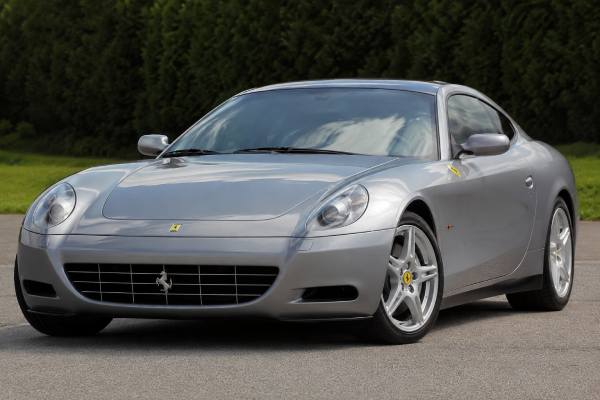
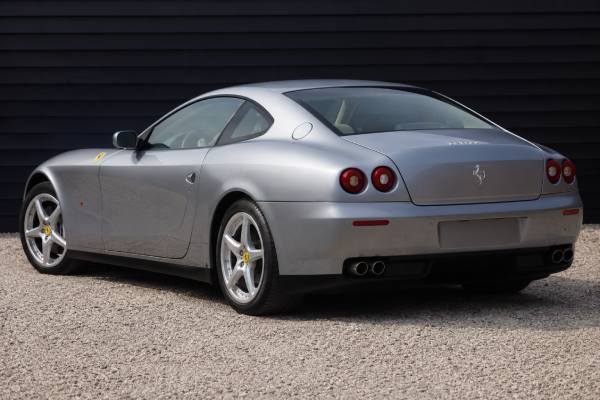
The Ferrari 612 Scaglietti is a front-mid-engine V12 grand tourer built for fast, refined distance travel rather than pure two-seat drama. In early 2004–2007 form, it sits in an interesting place: modern enough to use an aluminum structure, adaptive damping, stability control, and an F1 automated manual option, yet old-school enough to offer a naturally aspirated F133F V12 and, in rare cases, a gated six-speed manual gearbox.
It replaced the 456M as Ferrari’s large 2+2 GT, but it was not simply a bigger 456. The 612 was more spacious, more structurally advanced, and more usable at high speed. Its design was controversial when new, but time has helped its long-nose proportions, scalloped sides, and understated grand touring character feel more deliberate. For buyers today, the appeal is clear: a 540 hp Ferrari V12 with real cabin space, serious long-distance ability, and values that remain below more obvious modern V12 Ferraris.
Quick Take
The 2004–2007 Ferrari 612 Scaglietti is most appealing as a usable, front-engined V12 Ferrari with genuine four-seat practicality and a sophisticated aluminum chassis. Its identity is tied to the F133F 5.7-liter naturally aspirated V12, Pininfarina bodywork, and the early pre-OTO production phase, where rare manual cars and well-specified F1 cars now attract different kinds of buyers. The main caution is that affordability on the used market can be misleading: clutch wear, timing-belt history, suspension wear, sticky interior parts, old tires, and incomplete documentation can turn a cheaper car into the expensive one. The best examples are original, fully documented, recently serviced, and inspected by a Ferrari specialist before purchase.
Table of Contents
- Ferrari 612 Scaglietti History and Significance
- F133F V12, Chassis and Key Specifications
- Production, Variants and Factory Options
- Design, Engineering and Special Features
- Road Character, Performance and Driving Feel
- Reliability, Maintenance and Restoration Risk
- Market Values, Buying Guide and Inspection
Ferrari 612 Scaglietti History and Significance
The 612 Scaglietti matters because it moved Ferrari’s V12 2+2 grand tourer into the modern aluminum era. It was larger, stiffer, and more technically advanced than the 456M it replaced, while keeping the classic Ferrari formula of a naturally aspirated front-mounted V12 driving the rear wheels.
Ferrari introduced the 612 Scaglietti for the 2004 model year as the brand’s flagship four-seat GT. The name honored Sergio Scaglietti, the Modenese coachbuilder closely linked with many great aluminum-bodied Ferraris of the 1950s and 1960s. That connection was more than sentimental. The 612 itself used aluminum body and chassis technology, and the body construction reflected Ferrari’s push toward lighter, stiffer modern structures.
The 612 sits between two important eras. Before it came the 456 and 456M, elegant but more traditional steel-bodied V12 2+2s. After it came the FF, which changed the formula with a shooting-brake body and four-wheel drive. The 612 is therefore the last conventional front-engine, rear-drive Ferrari V12 2+2 before Ferrari changed the layout dramatically.
The 2004–2007 cars covered here are the early, pre-One-to-One phase. They use the F133F 5.7-liter V12, either a six-speed manual or the F1A electrohydraulic automated manual, and a cabin layout that feels more traditional than later 2008-on OTO cars. Later 612s gained the faster SuperFast-style gearbox calibration, the updated One-to-One personalization program, and other refinements, but the early cars are important because they define the original model.
The 612 also helped normalize the idea of a large, genuinely usable Ferrari. It was not a stripped driver’s car like a Challenge Stradale or a mid-engine berlinetta. It was a car for covering huge distances quickly with luggage, passengers, and comfort. That makes it easy to misunderstand. In period, some buyers found it too large, too restrained, or too subtle. Today, those same traits help it stand out from more theatrical Ferraris.
Its collectability is increasingly split into three groups:
- Six-speed manual cars, which are very rare and command a major premium.
- Well-kept F1 cars, which offer the most accessible route into a modern Ferrari V12.
- Special-specification cars, including HGTS, HGTC, unusual colors, and very low-mileage examples.
The early 612 is not yet a universally loved collectible, but it has the ingredients buyers often begin to appreciate later: a naturally aspirated V12, limited overall production, analog proportions, Pininfarina design, and a clear role in Ferrari’s grand touring history.
F133F V12, Chassis and Key Specifications
The heart of the 2004–2007 612 Scaglietti is the F133F 5,748 cc naturally aspirated V12. It produces 540 hp at 7,250 rpm and 588 Nm of torque at 5,250 rpm, giving the car effortless high-speed performance despite its grand touring size.
| Category | Specification |
|---|---|
| Model code | F137 |
| Engine code | F133F |
| Engine layout | 65-degree naturally aspirated V12 |
| Displacement | 5,748 cc / 5.7 liters |
| Bore x stroke | 89 mm x 77 mm |
| Compression ratio | 11.2:1 |
| Maximum power | 540 hp at 7,250 rpm |
| Maximum torque | 588 Nm at 5,250 rpm |
| Drivetrain | Front-mid engine, rear-wheel drive |
| Gearboxes | Six-speed manual or six-speed F1A automated manual |
The engine is related to the V12 family used in the 575M Maranello, but the 612’s role is different. In this car, the V12 is tuned for broad, refined performance as much as top-end excitement. It pulls cleanly at lower revs, builds hard through the middle of the tachometer, and still has the smooth, metallic upper-register sound expected from a Ferrari twelve-cylinder.
The chassis is one of the car’s most important features. The 612 uses an aluminum spaceframe with aluminum body panels, making it more advanced than the 456M and helping control weight in a very large car. It is still heavy by sports-car standards, but the structure gives the 612 good stiffness, predictable handling, and a more modern feel than its predecessor.
| Item | Figure |
|---|---|
| Length | 4,902 mm |
| Width | 1,957 mm |
| Height | 1,344 mm |
| Wheelbase | 2,950 mm |
| Dry weight | About 1,725 kg, market dependent |
| Kerb weight | About 1,840 kg, market dependent |
| Weight distribution | 46% front / 54% rear |
| Fuel tank | 108 liters |
| Front tires | 245/45 ZR 18 |
| Rear tires | 285/40 ZR 19 |
| Front brakes | 345 mm x 32 mm ventilated discs |
| Rear brakes | 330 mm x 28 mm ventilated discs |
| 0–100 km/h / 0–62 mph | About 4.2 seconds |
| Top speed | Over 320 km/h / about 196–199 mph |
| Combined fuel consumption | About 20.7 L/100 km, European-market figure |
The suspension uses double wishbones and electronically controlled adaptive dampers. Ferrari’s stability and traction system, known as CST, was part of the car’s modern safety and handling package. Steering is hydraulic rather than electric, which helps the car retain a natural feel despite its size.
The standard brakes on early cars are steel discs. Carbon-ceramic brakes became important on HGTC-equipped cars and later special specifications, so buyers should confirm the exact braking system fitted to a specific car rather than assuming all 612s are the same.
Production, Variants and Factory Options
The 2004–2007 612 Scaglietti is best understood as the early production phase before the later One-to-One updates. These cars share the same basic body, F133F V12, and front-mid-engine layout, but gearbox choice, handling packages, brake specification, color, and interior configuration strongly affect desirability.
Total 612 Scaglietti production is commonly cited at a little over 3,000 cars across the full 2004–2011 run. Only a small fraction were built with the traditional six-speed manual gearbox. That manual rarity is now one of the biggest value drivers in the entire 612 market.
| Version or option | What it means for buyers |
|---|---|
| Standard F1A | The most common early 612. Check clutch wear, actuator condition, service history, and recall completion. |
| Six-speed manual | Very rare and highly collectible. Originality and documentation matter greatly. |
| HGTS | Handling-focused package with sportier calibration and visual/mechanical upgrades depending on market and year. |
| HGTC | More desirable handling package usually associated with carbon-ceramic brakes and a sharper specification. |
| 612 Sessanta | Limited 60th-anniversary model introduced in 2007; highly collectible, but outside the normal early-car value pattern. |
| Special-order colors | Can improve desirability when tasteful, documented, and paired with a good interior specification. |
The two gearbox choices create two very different ownership experiences. The manual is the collector’s choice because it is rare, tactile, and connected to the last era of manual V12 Ferraris. The F1A gearbox is more common and more affordable, but it must be assessed carefully. A good F1A system can be satisfying on the open road. A worn clutch, poor calibration, hydraulic leak, or weak pump can make the car feel clumsy and expensive.
Factory options varied by market and customer order. Commonly important items include Daytona-style seats, contrasting stitching, upgraded audio, modular wheels, parking sensors, shields, luggage, special leather, and carbon or aluminum interior trim. Some buyers prefer understated colors such as Grigio Silverstone, Nero Daytona, Tour de France Blue, and Argento Nürburgring because they suit the car’s grand touring shape. Rosso Corsa cars exist and can be striking, but the 612 is often valued most highly when the color matches its elegant GT character.
Documentation is especially important. A strong car should have books, tools, keys, service invoices, recall records, option records, and ideally Ferrari dealer or specialist inspection history. Ferrari Classiche certification can support originality, but buyers should not treat it as a replacement for a mechanical inspection.
For identification, buyers should confirm:
- VIN and market specification.
- Gearbox type from build records, not only from the current interior layout.
- Original paint and trim colors.
- Factory options and later modifications.
- Brake system type.
- Completion of relevant recall campaigns.
- Service records matching mileage and ownership history.
A manual conversion should not be valued like a factory manual. It may be enjoyable to drive, but the collector market treats original factory manual cars very differently.
Design, Engineering and Special Features
The 612 Scaglietti’s design is distinctive because it uses classic Ferrari front-engine proportions in a much larger, more modern body. The long hood, rear-set cabin, scalloped sides, and rounded tail create a shape that rewards a slower look more than an instant glance.
Pininfarina designed the car with references to the 1954 Ferrari 375 MM associated with Ingrid Bergman. The most obvious tribute is the sculpted side scallop, which breaks up the long body side and gives the car a more coachbuilt feel. The 612 is not delicate in the way a 250 GT or 275 GTB is, but it uses visual length and surface movement rather than wings, vents, and aggressive spoilers.
The body was engineered around Ferrari’s aluminum construction methods. Compared with a steel-bodied grand tourer, the structure helped reduce mass and improve rigidity. That mattered because the 612 had to do several jobs at once: carry four people, remain stable near 200 mph, deliver Ferrari-level steering response, and feel refined enough for long-distance use.
The engine sits behind the front axle line, which is why the car is described as front-mid-engined. This layout helps the 612 avoid the nose-heavy feel that can affect large front-engine cars. The gearbox is mounted at the rear in a transaxle layout, helping weight distribution and traction.
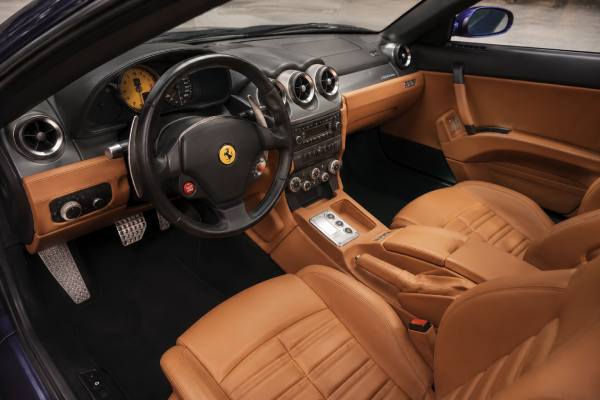
Inside, the cabin is more formal than flashy. Early cars have a mix of traditional Ferrari leather, clear analog instruments, and some 2000s electronics that now feel period rather than modern. The rear seats are one of the car’s defining features. They are not limousine seats, but they are far more usable than the cramped rear accommodations in many 2+2 sports cars. The trunk is also practical enough for touring luggage.
Several engineering features define the ownership and driving character:
- Dry-sump lubrication helps the V12 maintain oil control during sustained high-speed or cornering use.
- Adaptive dampers allow the car to feel more composed than its size suggests.
- CST stability control adds a layer of security, especially in wet conditions.
- Transaxle packaging improves balance.
- F1A paddle shift, where fitted, gives the car a period Ferrari experience that feels best when driven decisively.
- Hydraulic steering gives more natural feedback than many later electric systems.
The 612 is also a very sensory car. It is quieter and more insulated than a mid-engine Ferrari, but the V12 still gives it a clear mechanical identity. The intake and exhaust note build in a smooth, expensive way rather than shouting at every speed. That suits the car. It is not a track weapon wearing a GT suit; it is a grand tourer that becomes genuinely fast when the road opens.
Road Character, Performance and Driving Feel
The 612 Scaglietti feels fastest when driven as a grand tourer rather than forced to act like a smaller sports car. Its strength is the way it combines high-speed stability, V12 thrust, long-distance comfort, and enough balance to make a mountain road enjoyable.
The F133F engine dominates the experience. At low revs, it is smooth and flexible. In the midrange, it gives the car effortless passing power. Near the top of the rev range, it gains the harder edge expected from a Ferrari V12. The car is heavy, but the engine’s response and broad torque make it feel lighter in real-world driving than the numbers suggest.
Manual cars are the most involving. The gated shifter, clutch, and V12 create a direct connection that collectors now prize. The manual gearbox also makes the driver more central to the car’s rhythm. Smooth shifts, rev matching, and deliberate inputs turn the 612 into a more traditional Ferrari experience.
F1A cars are different. The automated manual is not a modern dual-clutch transmission and should not be judged as one. At low speed, it can feel abrupt if driven lazily or if the clutch calibration is poor. It works best when the driver treats it like a manual controlled by paddles: lift slightly during gentle shifts, be decisive when driving quickly, and avoid creeping in traffic. On open roads, the F1 system makes more sense, especially in Sport mode, where shifts become sharper.
Steering is one of the car’s pleasant surprises. It is not tiny-car quick, but it is accurate, naturally weighted, and confidence-building. The long wheelbase gives stability, while the rear-biased weight distribution helps the car rotate more cleanly than expected. On narrow roads, the size is always present. On flowing roads, it shrinks around the driver.
Ride quality is better than many expect from a Ferrari. The adaptive dampers allow the 612 to cover poor surfaces without the constant nervousness found in more focused performance cars. That does not mean neglected suspension parts can be ignored. Worn bushings, tired dampers, old tires, or poor alignment can make a good 612 feel loose and unimpressive.
Braking performance is strong when the system is fresh. Steel-brake cars should feel progressive and stable. Carbon-ceramic cars need careful inspection because replacement costs are high. Brake feel, rotor condition, pad life, and warning lights all matter.
The car is most satisfying in these settings:
- Highway touring, where the V12, long gearing, and stability make sense.
- Fast A-roads or mountain routes, where the balance can be enjoyed without tight-city frustration.
- Long weekend trips, where the rear seats and luggage space justify the car’s size.
- Occasional spirited driving, provided the tires, brakes, and fluids are fresh.
It is less happy in heavy traffic, tight parking garages, or short trips where the engine never warms fully. A 612 can handle normal use, but it rewards owners who let the car reach temperature and then drive it properly.
Reliability, Maintenance and Restoration Risk
The 612 Scaglietti can be a durable Ferrari when maintained correctly, but it is not a cheap used luxury coupe. The main ownership risk is not one famous fatal flaw; it is the cost of catching up years of deferred maintenance on a complex V12 Ferrari.
The F133F engine is generally respected, but it needs evidence of proper care. Timing belts, tensioners, fluids, oil leaks, cooling components, ignition parts, and regular annual servicing all matter. A car that has covered few miles but sat for long periods can need more work than a car that was driven and serviced consistently.
The timing-belt history is one of the first items to verify. Do not accept vague claims such as “recent major service” without invoices showing what was actually replaced. A proper service record should identify belts, tensioners, fluids, filters, and any related seals or hoses. Because these cars are now around two decades old, age matters as much as mileage.
The F1A transmission brings its own inspection needs. A specialist should read clutch wear, check engagement quality, inspect the hydraulic system, and confirm that recalls and updates have been handled where applicable. A worn clutch is not automatically a reason to reject a car, but the price should reflect the work needed.
Common inspection areas include:
- Timing belts, tensioners, cam seals, and valve-cover leaks.
- Cooling hoses, thermostat, radiator condition, and fan operation.
- F1 clutch wear, actuator behavior, hydraulic pump health, and warning lights.
- Gearbox and differential leaks.
- Engine mounts and transmission mounts.
- Suspension bushings, ball joints, dampers, and alignment.
- Brake discs, pads, brake fluid age, and caliper condition.
- Sticky interior switches and soft-touch trim deterioration.
- Leather shrinkage on the dashboard, rear shelf, and airbag areas.
- Window regulators, seat motors, HVAC operation, and alarm/immobilizer behavior.
- TPMS sensor age and tire date codes.
- Battery condition and evidence of correct battery-maintainer use.
The 2005–2007 F1 cars were affected by a clutch-sensor recall campaign in the United States, so documentation should show that any applicable car had the work completed. The broader 2022 brake-fluid reservoir cap recall also means buyers should check recall status by VIN, especially for cars that have moved between markets or independent dealers.
Body and chassis inspection is another major point. Aluminum does not rust like old steel, but it is not immune to corrosion, poor repairs, galvanic issues, or accident damage. Aluminum repair requires the right equipment and knowledge. A badly repaired 612 can look presentable but be expensive to correct.
Restoration is rarely straightforward. Interior retrimming must match Ferrari leather, stitching, and color codes. Bodywork must preserve panel gaps and aluminum repair quality. Mechanical restoration can quickly exceed the value difference between a cheap car and a good car. For that reason, originality and preventive maintenance are usually better than rescue-project pricing.
Owners should also understand the originality-versus-upgrade tradeoff. Upgraded exhausts, modern audio, suspension refreshes, and improved sticky-button refinishing can make a 612 more usable. But irreversible modifications, non-original color changes, manual conversions presented as factory manuals, and poor aftermarket wiring can hurt value.
The best ownership pattern is simple: buy the best documented car available, service it proactively, use a specialist who knows early 2000s Ferraris, and keep every invoice.
Market Values, Buying Guide and Inspection
The 612 Scaglietti remains one of the more attainable modern Ferrari V12s, but the market is no longer flat. Manual cars, Sessanta examples, HGTC cars, low-mileage cars, and excellent color combinations have separated sharply from ordinary F1 examples.
As of the current collector-car market, average public sale data places the 612 around the low six-figure range, with ordinary F1 cars often trading below the best 575M, 599, and manual 612 examples. The cheapest cars are usually cheap for a reason: mileage alone is not the issue, but missing service history, sticky interiors, old belts, worn clutches, accident history, or poor cosmetics can absorb the discount quickly.
A practical value view looks like this:
| Value factor | Effect on desirability |
|---|---|
| Factory manual gearbox | Major premium; one of the strongest collector factors. |
| Complete service history | Essential; weak records reduce confidence and value. |
| Recent major service | Important, but only if invoices show belts, fluids, and related work. |
| HGTC or HGTS package | Improves enthusiast appeal, especially with desirable colors. |
| Low mileage | Helpful, but only when condition and service history support it. |
| Color combination | Elegant metallics and documented special colors can help. |
| Deferred maintenance | Can erase any purchase-price advantage quickly. |
| Accident or poor aluminum repair | Serious negative unless fully documented and expertly corrected. |
For many buyers, the sweet spot is not the cheapest F1 car. It is a properly serviced, well-optioned F1 car in a desirable color with fresh tires, strong clutch life, clean interior, and no stories. Such a car gives most of the V12 Ferrari experience at a still-rational price. Buyers chasing collector upside will focus instead on factory manual cars, rare packages, and special editions.
A serious pre-purchase inspection should include:
- VIN and build verification. Confirm year, market, gearbox, color, options, and whether it is a factory manual or conversion.
- Diagnostic scan. Use Ferrari-capable equipment to check F1 clutch wear, fault history, suspension, engine ECUs, and warning systems.
- Service-document review. Look for annual maintenance, timing-belt invoices, fluid changes, brake work, tires, battery history, and recall completion.
- Cold start and warm test drive. Listen for chain-like rattles, belt noise, misfires, exhaust leaks, suspension knocks, slow F1 engagement, or overheating.
- Body inspection. Check paint depth, panel gaps, undertrays, jacking points, aluminum repair quality, and signs of front or rear impact.
- Interior inspection. Look for sticky controls, warped leather, shrinking dash trim, seat wear, airbag-cover lifting, and failed switches.
- Brake and tire inspection. Confirm rotor condition, tire age, alignment wear, and brake-fluid service.
- Ownership-cost review. Price the next major service before purchase, not after.
Cars to seek include original examples with long-term ownership, continuous Ferrari or respected specialist service, recent belt work, a clean clutch reading, complete accessories, and a specification that suits the car’s GT character. Cars to avoid include neglected low-mileage examples, undocumented imports, cars with warning lights, poor repaint work, missing books, vague “just serviced” claims, and F1 cars that creep, slip, or shift harshly when warm.
The long-term collectability case is strongest for manuals and special specifications. Standard F1 cars are more likely to remain usable V12 GT values, which is not a bad thing. They offer a rare experience: a naturally aspirated Ferrari V12 with real space, classic proportions, and modern enough engineering to be driven regularly.
References
- Ferrari 612 Scaglietti (2004) – Ferrari.com 2004 (Manufacturer)
- Stampa Scheda Ferrari 1 2008 (Technical Specifications)
- USA RECALL CAMPAIGN 2008 (Recall Database)
- Part 573 Safety Recall Report 22V-536 2022 (Recall Database)
- Ferrari 612 Scaglietti Market – CLASSIC.COM 2026 (Market Data)
Disclaimer
This article is for informational purposes only and is not a substitute for professional diagnosis, repair, valuation, or pre-purchase inspection. Specifications, torque values, service intervals, recall applicability, parts, and procedures can vary by VIN, market, model year, equipment, and prior repair history. Always verify details against official Ferrari service documentation and consult a qualified Ferrari specialist before making maintenance, repair, or buying decisions.
If this guide was useful, please consider sharing it on Facebook, X/Twitter, or your preferred car community to support our work.