
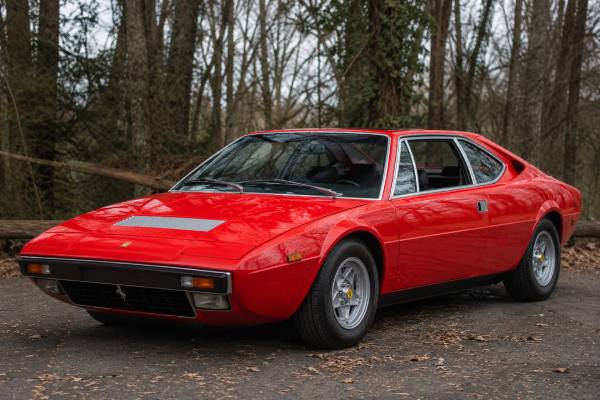
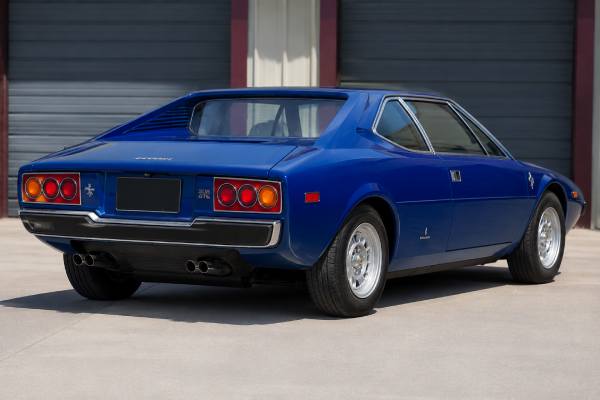
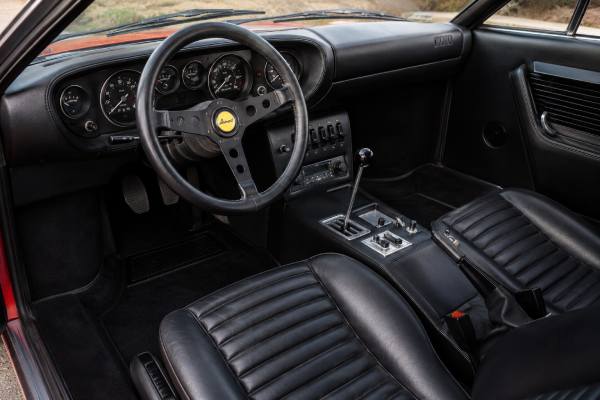
The Ferrari Dino 208 GT4 was the small-displacement version of Ferrari’s angular mid-engined 2+2, built from 1975 to 1980 with the F 106 C 000 two-litre V8 and the F 106 CL 100 chassis type. It was created mainly for the Italian market, where taxation made engines above two litres much more expensive to own. On paper, the 208 GT4 looks like a detuned 308 GT4. In reality, it is one of Ferrari’s most unusual 1970s road cars: a high-revving, carbureted V8 coupe with four seats, Bertone styling, compact dimensions, and a character shaped as much by legislation as by performance.
Its appeal today is different from that of a Dino 246 or a 308 GTB. The 208 GT4 is not the fastest choice and never pretends to be. It matters because it combines Ferrari’s early production V8 architecture, Marcello Gandini’s wedge-era design language, and a rare sub-two-litre engine that makes the car fascinating to collectors who value engineering oddities, originality, and period-correct feel. Good examples are still relatively approachable by classic Ferrari standards, but condition, corrosion, documentation, and correct 208-specific details matter far more than headline price.
Quick Take
The Dino 208 GT4 is most appealing as a rare, high-revving, Italian-market Ferrari with genuine 1970s mid-engine character and a fascinating tax-era 2.0-litre V8. Its strongest identity is not outright speed but the mix of Bertone design, 2+2 practicality, carbureted response, and historical importance as part of Ferrari’s first production mid-engined V8 family. The main caution is that a cheap or tired example can become expensive quickly, especially if it has rust, poor past repairs, incorrect trim, neglected timing belts, carburetor issues, or weak documentation. Buyers should prioritize originality, matching numbers, body condition, specialist maintenance history, and correct 208 GT4 details over color preference or short-term bargain appeal.
Table of Contents
- History and Collector Significance
- Engine, Chassis and Key Specifications
- Production, Variants and Factory Details
- Bertone Design and Engineering Character
- Road Feel, Performance and Usability
- Maintenance, Reliability and Restoration Risks
- Market Values, Buying Advice and Rivals
History and Collector Significance
The Dino 208 GT4 matters because it sits at a turning point in Ferrari history: it belongs to the first production Ferrari V8 road-car family and to the final phase of the separate Dino identity. It took the 308 GT4’s mid-engined 2+2 package and adapted it for buyers who needed to stay below Italy’s two-litre tax threshold.
The 308 GT4 arrived before the 208, and it was already a bold break from Ferrari habit. Instead of a front-mounted V12 or a curvy Pininfarina body, the GT4 used a transverse mid-mounted V8, four-seat cabin layout, and sharp Bertone styling. The 208 GT4 followed in 1975 with a smaller engine, narrower tires, and a personality of its own. Early cars carried Dino branding, continuing Ferrari’s practice of using Dino for smaller-engined sports cars. By the later 1970s, Ferrari badging became part of the GT4 story, which is why period examples can appear with different badge details depending on year, market, and history.
The car’s reason for existing was practical. In Italy during this period, larger-capacity cars attracted heavy taxation, so a two-litre Ferrari made commercial sense even if it gave away power to the 308 GT4. Ferrari did not simply make a four-cylinder economy version. It retained a V8 configuration, reduced displacement, and created a remarkably compact eight-cylinder engine. That makes the 208 GT4 historically interesting even to people who might otherwise prefer the more powerful 308.
Its designer connection is also central to its importance. The GT4 line was styled by Bertone under Marcello Gandini, rather than by Ferrari’s usual partner Pininfarina. Gandini’s work gave the car a crisp wedge profile, slim pillars, a low nose, and an unexpectedly practical cabin. At launch, the shape divided opinion. Today, it has gained respect because it captures the 1970s so clearly and because it shows Ferrari experimenting with packaging, design language, and market position.
As a collector car, the 208 GT4 remains a specialist choice. It is rarer than the 308 GT4 but less universally desired by buyers who want traditional Ferrari speed. That split is exactly why it attracts thoughtful collectors. The best cars are not bought merely as affordable Ferraris. They are bought as rare, technically unusual, tax-era Italian-market machines with a direct link to Ferrari’s early V8 road-car development.
Engine, Chassis and Key Specifications
The 208 GT4 uses a 1,990.64 cc version of Ferrari’s 90-degree Dino V8, mounted transversely behind the cabin and driving the rear wheels through a five-speed manual gearbox. The important takeaway is that this is a real Ferrari V8 experience, but with less torque and a stronger need to use revs than the 3.0-litre 308 GT4.
| Item | Specification |
|---|---|
| Production years | 1975–1980 |
| Chassis type | F 106 CL 100 tubular steel frame |
| Engine type | F 106 C 000, 90-degree V8 |
| Displacement | 1,990.64 cc |
| Bore x stroke | 66.8 mm x 71 mm |
| Valve gear | Double overhead cams per bank, 2 valves per cylinder |
| Fuel system | Four Weber 34 DCNF carburetors |
| Compression ratio | 9.0:1 |
| Output | 125 kW / 170 CV at 7,700 rpm |
| Torque | About 186 Nm at 4,900 rpm |
| Transmission | 5-speed manual, rear-wheel drive |
| Suspension | Independent wishbones, coil springs, telescopic dampers, anti-roll bars |
| Brakes | Discs front and rear |
| Steering | Rack and pinion |
| Tyres | 195/70 VR 14 |
| Wheelbase | 2,550 mm |
| Length x width x height | 4,300 mm x 1,800 mm x 1,180 mm |
| Dry weight | About 1,150 kg |
| Fuel capacity | 80 litres |
| Top speed | About 220 km/h |
The engine is the heart of the car’s identity. Ferrari reduced bore size compared with the larger 308 unit while retaining the short, rev-friendly nature of the V8 layout. The result is a small engine that needs rpm to feel alive. Below the midrange it is not especially forceful, but it rewards clean carburetion, correct ignition setup, and a driver willing to keep it spinning.
There is a small but important note about power figures. Modern Ferrari specification listings commonly use 125 kW, or 170 CV, while some period-style references and manuals may quote different horsepower numbers depending on the measurement standard. For buying and comparison purposes, treat the car as the 170 hp-class version and verify the exact documentation for the specific chassis.
The chassis is closely related to the 308 GT4’s tubular steel structure. It gives the car a rigid, compact base and supports the unusual package: mid-engine balance, two front seats, two small rear seats, and useful luggage space by exotic-car standards. The suspension layout is conventional for a serious sports car of the period, with independent wishbones at each corner. That is good news for handling and serviceability, but condition makes a huge difference. Worn bushings, old dampers, and incorrect modern tires can make a GT4 feel far worse than its design deserves.
Production, Variants and Factory Details
The Dino 208 GT4 was produced in small numbers, with about 840 examples built from 1975 to 1980. For collectors, the important points are not only production quantity but also correct identification, Dino-versus-Ferrari badging, matching drivetrain numbers, and preservation of 208-specific details.
The 208 GT4 was not a broad global model in the way many later Ferraris became. Its main purpose was to serve the Italian domestic market, although cars have since moved through Europe and beyond. All examples were left-hand drive, and the car was offered as a fixed-roof 2+2 coupe. There was no factory Spider version and no separate lightweight or competition version.
Compared with the 308 GT4, the 208 GT4 has several key differences that matter during inspection:
- The engine is the two-litre F 106 C unit, not the 3.0-litre 308 engine.
- Carburetion uses smaller Weber 34 DCNF carburetors.
- The chassis type is F 106 CL rather than the 308 GT4’s F 106 AL reference.
- Tyre size is 195/70 VR 14 rather than the wider 308 fitment.
- Gearing and final-drive feel are different to suit the smaller engine.
- Some visual details, trim finishes, and badge arrangements vary by year and market.
Badging deserves careful attention. Early cars belong to the Dino-branded period, while later cars are more commonly associated with Ferrari badging. Over decades, many cars have had badges changed, replaced, or “updated” to suit owner taste. That does not automatically ruin a car, but it can affect originality and value. Buyers should look at build records, period photos, ownership history, and expert inspection rather than relying only on what appears on the nose or tail today.
Factory options and finishes were typical of small-volume 1970s Ferrari practice. Cars could be ordered or delivered with different paint, interior trim, radio arrangements, air conditioning, electric windows, and market-specific details. Cloth, vinyl, and leather interior combinations all need to be judged against the original build information. A newly retrimmed interior may look attractive, but the wrong material, incorrect stitching, modern carpets, or non-standard seat inserts can reduce collector appeal.
Documentation is especially valuable because the 208 GT4 is a niche model. The most desirable files include original books, service invoices, ownership records, import papers if the car has moved countries, restoration photos, engine and gearbox records, and any Ferrari heritage or specialist verification. Matching engine and gearbox numbers matter. So does the quality of evidence. A seller’s verbal claim is not the same as a documented chain of history.
Bertone Design and Engineering Character
The 208 GT4’s design is distinctive because it solves a difficult packaging problem: mid-mounted V8, compact overall length, four seats, and reasonable usability. Its shape is not decorative in the older Ferrari sense; it is architectural, angular, and practical.
Marcello Gandini’s Bertone design gives the GT4 its sharp nose, low beltline, slim glasshouse, and folded surfaces. The car looks wider and more purposeful than its displacement suggests. It also looks very different from the Dino 246 GT that came before it. Where the 246 is rounded and flowing, the GT4 is disciplined and geometric. That contrast explains why the GT4 was controversial when new and why it has become more appreciated with time.
The 2+2 cabin is one of the car’s cleverest features. The rear seats are small, but they are not meaningless. They can carry children, luggage, jackets, or soft bags, which makes the car more usable for weekend travel than many mid-engined exotics. The driving position is low and period-correct, with a simple dashboard, strong forward view, and controls that reward familiarity. The cabin is narrow by modern standards but not cramped for the driver and front passenger if the seats, pedals, and steering wheel are correctly set up.
Cooling and airflow are central to the design. A transverse V8 placed behind the cabin needs careful management of heat, intake air, and engine-bay ventilation. The side intakes, rear deck treatment, and engine-cover details all serve this purpose. Buyers should treat missing shields, improvised fans, incorrect hoses, or hacked engine-bay trim as warning signs. These cars can run well, but they do not respond kindly to neglected cooling systems or casual modifications.
The sound is another special feature. The 208’s V8 does not have the low-end muscle of the 308, but it has a lighter, sharper voice. With properly tuned Weber carburetors and a healthy exhaust, it sounds mechanical, busy, and eager. Poor carb balance, exhaust leaks, weak ignition, or tired engine mounts can turn that character into harshness or vibration, so sensory impressions during a test drive matter.
The design also carries restoration challenges. Panel fit was never modern-production perfect, but uneven gaps, bubbling paint, sagging doors, poorly aligned headlamp covers, or thick filler should prompt caution. The car is valuable enough to restore but not so valuable that every poor restoration makes financial sense. That makes originality and body condition unusually important.
Road Feel, Performance and Usability
The 208 GT4 drives best when treated as a momentum car with a high-revving Ferrari V8, not as a small supercar with huge torque. Its performance is period-quick rather than dramatic, but a sorted example feels alert, balanced, and more involving than the raw numbers suggest.
Acceleration depends heavily on tune, gearing, driver technique, and mechanical health. A healthy car reaches its best stride above the lower rev range, where the engine clears its throat and pulls more cleanly toward the top end. Around town, the driver needs patience. The clutch, throttle, and gearbox feel mechanical and slightly heavy compared with modern cars. Once warm, the car becomes more fluent, especially on open roads where the engine can stay in its preferred range.
The five-speed manual gearbox is a major part of the experience. Shift quality should feel deliberate, not vague or crunchy. Like many classic Ferraris, it may feel reluctant when cold, especially into lower gears. That is not unusual, but severe graunching, jumping out of gear, or a very noisy transaxle points to expensive work. A careful test drive should include cold behavior, warm shifting, clutch take-up, and steady-speed noise.
Steering is one of the car’s strengths. There is no modern filter, no electric assistance, and no artificial weighting. At parking speeds it needs effort, but once moving it gives useful feedback. The narrow 195-section tyres help the car feel light and communicative. Oversized wheels or modern low-profile tyres can spoil the ride and steering, even if they look more aggressive.
Ride quality is firm but not punishing when the suspension is healthy. Old bushings, tired Koni dampers, incorrect ride height, or mismatched tyres can make the car nervous. A properly set-up 208 GT4 should feel compact and balanced, with the engine mass behind the driver but not a constant threat. It is not a modern stability-control car, so wet roads, old tires, and abrupt inputs deserve respect.
Braking is adequate for the period, but expectations must be realistic. The discs should deliver a firm pedal and straight stops. Pulling, vibration, sinking pedal feel, or seized calipers need investigation. Owners who plan spirited mountain driving should make sure the brake system has fresh fluid, good hoses, correct pads, and properly serviced calipers.
Usability is better than many people expect. Visibility is good for a mid-engined classic, the cabin has useful storage by exotic standards, and the rear seats add flexibility. The tradeoffs are heat, noise, carburetor warm-up behavior, low-speed steering effort, and the need to drive with mechanical sympathy. It is a car that rewards regular use, but only if maintenance stays ahead of age.
Maintenance, Reliability and Restoration Risks
A Dino 208 GT4 can be dependable when used and serviced properly, but deferred maintenance can turn it into a costly project. The biggest risks are not exotic electronics; they are age, corrosion, fuel-system deterioration, belt service, cooling neglect, poor past repairs, and hard-to-find 208-specific parts.
Timing belts are one of the first checks. The F 106 C V8 uses belt-driven camshafts, so belt age, tensioner condition, and service history matter. A seller should be able to show when belts, tensioners, cam seals, accessory belts, and related gaskets were last addressed. Many specialists treat belt work as time-based as well as mileage-based because classic Ferraris often sit for long periods.
The carburetors need proper attention. Four Weber 34 DCNF units can work beautifully, but only if clean, balanced, and fed by a healthy fuel system. Stale fuel, worn throttle shafts, perished hoses, clogged filters, incorrect jets, and weak ignition can cause hesitation, hot starting problems, fuel smell, or uneven idle. Any fuel odor in the cabin or engine bay should be taken seriously.
Cooling is another priority. Radiator condition, water pump health, fan operation, thermostat function, hoses, header tank, and bleeding procedure all affect reliability. A mid-engined carbureted Ferrari can tolerate normal traffic when its system is correct. It will not tolerate years of sediment, bypassed switches, tired fans, or improvised wiring.
Corrosion is often the most expensive hidden problem. Inspect the lower doors, sills, wheel arches, front and rear valances, battery area, floor sections, suspension pickup areas, windscreen surrounds, and lower body seams. Look underneath for crushed tubes, poorly repaired jacking damage, accident repairs, and patches hidden under underseal. Rust repair on a GT4 is not simple used-car bodywork; it affects structure, originality, panel fit, and value.
Common ownership checks include:
- Engine oil leaks from cam covers, seals, sump areas, and hoses.
- Worn engine mounts causing vibration or exhaust stress.
- Weak ignition components, old coils, poor grounds, and brittle wiring.
- Fuse-board and connector issues causing intermittent electrical faults.
- Clutch wear, dragging clutch action, or noisy release bearing.
- Second-gear synchro wear, especially if abused when cold.
- Seized brake calipers, old flexible hoses, and contaminated fluid.
- Perished suspension bushings and tired dampers.
- Incorrect wheels, tyres, exhaust, seats, mirrors, or steering wheel.
- Missing books, missing tools, and undocumented engine or gearbox work.
Restoration must be approached with discipline. A full cosmetic rebuild can easily exceed the value difference between an average car and a good one. The best strategy is to buy the soundest, most complete example available rather than the cheapest. Mechanical work is manageable through Ferrari specialists, but trim, body, and model-specific parts can become slow and expensive. Upgrades such as electronic ignition, improved cooling fans, modern fuel hoses, and better relays can be sensible if they are discreet and reversible. Major cosmetic changes, engine swaps, non-standard interiors, and modernized dashboards usually hurt collector appeal.
Market Values, Buying Advice and Rivals
The 208 GT4 remains one of the more attainable classic Ferrari V8s, but the cheapest car is rarely the best buy. Recent public sales and market benchmarks generally place many usable examples in the mid-five-figure range, while exceptional, highly original, freshly serviced, or unusually well-documented cars can command more.
The value story is nuanced. The 208 is rarer than the 308 GT4, but the 308 has more power and broader international recognition. Some buyers prefer the 308 because it is faster and easier to understand. Others prefer the 208 because it is rarer, more unusual, and tied closely to Italian tax-era history. That means values depend heavily on finding the right buyer.
| Value factor | Why it matters |
|---|---|
| Original body condition | Rust and accident repair can overwhelm any apparent bargain. |
| Matching engine and gearbox | Important for collector confidence and long-term desirability. |
| Correct 208 GT4 specification | Wrong carbs, trim, badges, wheels, or interior details reduce authenticity. |
| Service documentation | Belts, fuel system, brakes, suspension, and cooling work need evidence. |
| Interior originality | Correct materials and period details are harder to restore than they appear. |
| Color and presentation | Rosso is easy to sell, but rare original colors can be very appealing. |
| Market location | European-market cars, import duties, and registration status affect real cost. |
A serious inspection should start before the test drive. Confirm chassis type, engine type, visible identification plates, body numbers where accessible, and paperwork. Compare the car’s current specification with period records. Check whether the interior, badges, wheels, carburetors, airbox, exhaust, lights, and instruments are correct or merely close.
During the test drive, look for stable temperature, clean throttle response, straight braking, smooth warm shifts, even idle, good oil pressure, and no fuel smell. After the drive, recheck for leaks, coolant discharge, hot-start problems, fan operation, and smoke. A specialist pre-purchase inspection is not optional on a car like this. It is cheap compared with buying rust, a weak transaxle, or an undocumented engine.
Cars to seek:
- Long-term ownership with detailed service records.
- Known chassis, engine, and gearbox identity.
- Original or carefully restored body with minimal filler.
- Correct wheels, tyre size, trim, instruments, and engine-bay details.
- Recent belt, fuel, brake, cooling, and suspension work.
- Honest patina rather than a rushed cosmetic flip.
Cars to avoid:
- Fresh paint with no restoration photos.
- Missing or inconsistent identification details.
- Strong fuel smell, overheating, or poor carburetor behavior.
- Non-standard engine conversions or heavy cosmetic modifications.
- Cheap cars needing “only minor finishing.”
- Sellers who cannot explain service history or import paperwork.
The closest rival is the Ferrari 308 GT4. It offers the same basic body and chassis concept with stronger performance and wider recognition. The Ferrari 308 GTB and GTS are more familiar, prettier to many buyers, and often more liquid, but they lack the GT4’s 2+2 layout and Bertone story. The Dino 246 GT is the spiritual predecessor, but its market sits in a much higher category. Outside Ferrari, the Lamborghini Urraco, Maserati Merak, Lotus Esprit, De Tomaso Pantera, and period Porsche 911 variants all overlap in different ways. None matches the 208 GT4’s exact combination of two-litre Ferrari V8, mid-engine 2+2 packaging, and tax-driven rarity.
For long-term collectability, the 208 GT4’s future depends on buyers continuing to value unusual history over simple speed. That seems likely. It is rare, distinctive, usable, and linked to an important Ferrari transition. The right car should be bought for condition and authenticity first, with market appreciation treated as a bonus rather than a rescue plan.
References
- Ferrari Dino 208 GT4 (1975) 1975 (Manufacturer Specifications)
- Ferrari 208 GT4 Dino 1975 1975 (Owner’s Manual)
- Ferrari Dino 208 GT4 Specifications – SBR Engineering 2025 (Technical Specifications)
- Ferrari Dino 208 GT4 Market – CLASSIC.COM 2026 (Market Data)
- 1975 Ferrari Dino 208 GT4 | Paris 2022 | RM Sotheby’s 2022 (Auction Catalogue)
Disclaimer
This article is for informational purposes only and is not a substitute for professional diagnosis, repair, inspection, or valuation. Specifications, torque values, service intervals, fluids, procedures, and correct parts can vary by VIN, market, production date, and equipment. Always verify details against official service documentation and consult a qualified Ferrari specialist before buying, repairing, or restoring a Dino 208 GT4.
If you found this guide useful, please consider sharing it on Facebook, X/Twitter, or your favorite car community to support our work.