
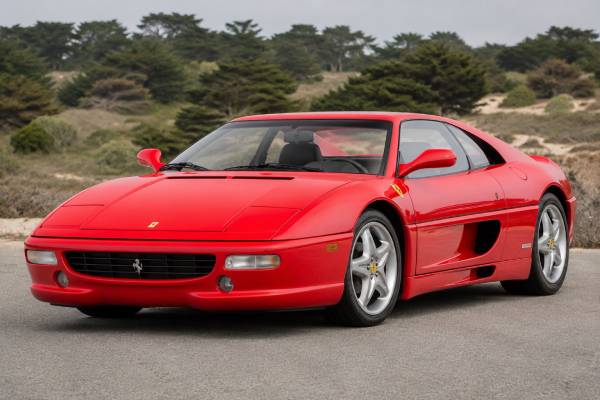
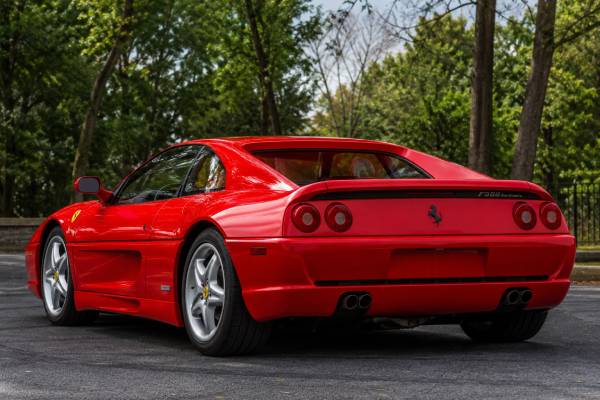
The Ferrari F355 Berlinetta is the fixed-roof, rear-mid-engine V8 Ferrari that bridged the analog 348 era and the more modern 360 Modena generation. Built from 1994 to 1999, it used a 3.5-liter F129-series V8 with five valves per cylinder, dry-sump lubrication, Bosch engine management, and 380 hp at a soaring 8,250 rpm. It kept the classic gated six-speed manual at launch, then later introduced Ferrari’s first production-road-car F1-style paddle-shift gearbox. For buyers and collectors, the Berlinetta is often the purest F355 body style: stiffer than the Spider, cleaner than the GTS, and strongly tied to the last wave of compact, pop-up-headlight Pininfarina Ferraris. It remains desirable because it combines beauty, sound, real usability, and serious maintenance demands in one of the most characterful Ferrari V8 packages of the 1990s.
Table of Contents
- Why the F355 Berlinetta still matters
- F129 V8 specs and chassis data
- Berlinetta production, gearboxes, and originality
- Pininfarina shape, aero, and five-valve engineering
- How the F355 Berlinetta drives
- Maintenance realities and known weak points
- Market values and buying checklist
Why the F355 Berlinetta still matters
The F355 Berlinetta matters because it restored confidence in Ferrari’s compact V8 line after the sharper but more demanding 348. It was not a clean-sheet replacement, but it felt like a major reset in engine response, ride quality, steering, aerodynamics, cabin finish, and real-world drivability.
Launched in 1994, the Berlinetta was the first F355 body style and the most traditional. It replaced the 348 TB and carried forward the rear-mid-engine layout, steel-and-aluminum construction approach, and two-seat cabin, but almost every important area was reworked. Ferrari wanted the car to feel faster and more forgiving without losing the drama expected from a Maranello sports car.
The F355 name itself tells part of the story. Instead of simply following the older displacement-and-cylinder naming pattern, “355” refers to a 3.5-liter engine with five valves per cylinder. That five-valve cylinder head was central to the car’s identity. It helped the V8 breathe at high rpm and gave the F355 its sharp, metallic, rising sound.
The Berlinetta also arrived at an important moment for Ferrari. The company was modernizing its road cars, refining quality, and drawing more directly from Formula 1 technology. In 1997, the F355 Berlinetta became the first production Ferrari road car offered with the electrohydraulic “F1” paddle-shift system. That gearbox seems slow compared with modern dual-clutch units, but historically it was a major step toward the transmission layout that later became normal in supercars.
For collectors, the F355 Berlinetta sits in a valuable middle ground. It is modern enough to use on real roads, yet old enough to feel mechanical and compact. It has hydraulic power steering, a naturally aspirated V8, a low roofline, an open manual gate on most cars, and no modern stability-control layer managing the experience. Good examples have become especially desirable because many cars were driven hard, modified, neglected, or maintained cheaply when values were lower.
The Berlinetta’s significance also comes from its design lineage. It was one of the final Ferrari V8 coupes with pop-up headlights and flying-buttress rear roof treatment, linking it visually to earlier mid-engine Ferraris while previewing the smoother surfaces of the 360 Modena. Today, it appeals both to collectors who want a blue-chip 1990s Ferrari and to drivers who want a car that still feels alive at human road speeds.
F129 V8 specs and chassis data
The F355 Berlinetta’s core specification is a 3,495.5 cc naturally aspirated V8, mounted longitudinally behind the cabin and driving the rear wheels. Its factory headline figures are 380 hp, 363 Nm of torque, 0–100 km/h in 4.7 seconds, and a 295 km/h top speed.
| Category | Specification |
|---|---|
| Model | Ferrari F355 Berlinetta |
| Type | F129 |
| Production period | 1994–1999 |
| Body style | Two-seat fixed-roof berlinetta coupe |
| Engine | Rear-mid-mounted 90-degree V8, F129 B/C family |
| Displacement | 3,495.50 cc |
| Bore x stroke | 85 mm x 77 mm |
| Valvetrain | Five valves per cylinder, double overhead camshafts per bank |
| Compression ratio | 11.0:1 |
| Fuel and ignition | Bosch Motronic electronic injection and ignition |
| Lubrication | Dry sump |
| Maximum power | 380 hp / 279 kW at 8,250 rpm |
| Maximum torque | 363 Nm at 6,000 rpm |
| Transmission | Six-speed manual or six-speed F1 automated manual |
| Drivetrain | Rear-wheel drive with limited-slip differential |
The engine is often discussed as the reason the F355 feels more special than its paper figures suggest. It is not just a larger 348 engine. The stroke increased to 77 mm, displacement rose to almost 3.5 liters, and the cylinder heads used three intake valves and two exhaust valves per cylinder. That layout was meant to improve breathing at high rpm. In simple terms, the engine could move air more efficiently, so it made power in a dramatic, rev-hungry way.
Early cars used Bosch Motronic M2.7 management, while later cars moved to M5.2. For buyers, this matters because the engine bay layout, diagnostics, emissions equipment, and some service details differ. Enthusiasts often prefer the slightly more mechanical feel and separate-management character of early M2.7 cars, while later M5.2 cars can be easier to live with in some service situations. Condition is still more important than the management version.
| Item | Figure or layout |
|---|---|
| Length | 4,250 mm |
| Width | 1,900 mm |
| Height | 1,170 mm |
| Wheelbase | 2,450 mm |
| Front track | 1,514 mm |
| Rear track | 1,615 mm |
| Dry weight | 1,350 kg |
| Front tires | 225/40 ZR18 |
| Rear tires | 265/40 ZR18 |
| Suspension | Independent double wishbones with coil springs, dampers, and anti-roll bars |
| Brakes | Ventilated discs with ABS |
| 0–100 km/h | 4.7 seconds |
| 0–400 m | 12.9 seconds |
| 0–1,000 m | 23.7 seconds |
| Top speed | 295 km/h |
The F355’s chassis layout is conventional for a mid-engine Ferrari of its period, but the tuning made the difference. Double-wishbone suspension, power-assisted steering, a relatively short wheelbase, and wide rear track gave it agility without the nervousness often associated with earlier mid-engine cars. The Berlinetta body is also the stiffest standard road-car body style in the F355 range, which helps steering response and long-term structural feel.
Berlinetta production, gearboxes, and originality
The Berlinetta is the fixed-roof F355 and was built in smaller numbers than the whole F355 family combined, with 4,871 road-going Berlinetta examples commonly quoted. Of those, 3,829 were six-speed manuals and 1,042 used the later F1 transmission.
The earliest Berlinettas were manual only. That means 1994, 1995, and most pre-F1 cars appeal strongly to buyers who want the classic metal-gate Ferrari experience. The gated shifter is not just a romantic detail; it also affects value, ease of ownership, and the way the car feels. A well-adjusted manual car has a precise mechanical action once warm, while a neglected one can feel obstructive, baulky, or vague.
The F1 Berlinetta arrived later and is historically important. It uses the same basic six-speed gearbox architecture, but gear selection and clutch operation are controlled by an electrohydraulic system with steering-column paddles. It was advanced in period and helped establish the template for future Ferrari paddle-shift models. Today, buyers judge it differently. Some value it as a milestone; others prefer the durability, involvement, and market strength of the manual.
Key Berlinetta version differences
| Version | Main difference | Buyer relevance |
|---|---|---|
| Early manual Berlinetta | Six-speed gated manual, early engine-management layout | Strong enthusiast appeal; verify valve-guide history and service records |
| Later manual Berlinetta | Six-speed gated manual with later running changes | Often highly desirable if original, documented, and well maintained |
| F1 Berlinetta | Paddle-shift electrohydraulic transmission | Historically important and usually cheaper than manual, but needs careful clutch and hydraulic checks |
| Challenge-related cars | Race-prepared or kit-converted competition use | Interesting but different from normal road Berlinetta buying; documentation is critical |
Originality matters more now than it did when these cars were simply used exotics. Important details include factory color, interior trim, books, tools, stamped service history, invoices, ownership chain, and evidence that major mechanical work was done by recognized Ferrari specialists. A repaint is not automatically a problem, but the reason matters. Paintwork after stone-chip correction is different from paintwork hiding crash repair.
Factory specification can also affect desirability. Rosso Corsa over tan leather remains the familiar poster-car combination, but well-kept darker colors, Giallo Modena, Argento, Blu, and unusual interior combinations can attract serious collectors when the car is original and documented. The safest buying approach is to value condition and provenance first, color second, and mileage third. A very low-mile car with old belts, original tires, sticky controls, and no recent inspection can be a bigger risk than a higher-mile car that has been maintained correctly.
Ferrari Classiche certification can add confidence, especially for cars presented as unusually original or investment-grade. It does not make a poor car excellent, and it does not replace a pre-purchase inspection, but it can help confirm major-number and specification authenticity against factory records.
Pininfarina shape, aero, and five-valve engineering
The F355 Berlinetta looks delicate, but its design was shaped by serious cooling, airflow, and packaging needs. Pininfarina gave it a cleaner and more resolved form than the 348, while Ferrari used the body and underfloor to improve stability at speed.
The front end is low and simple, with pop-up headlights, wide air openings, and a flatter stance than its predecessor. The side intake treatment still links the car to Ferrari’s 1980s and early 1990s design language, but the surfaces are smoother. At the rear, the buttressed glass area and round tail lamps create one of the most recognizable Ferrari V8 views of the period.
The F355 was also developed with extensive wind-tunnel work. The underbody is important because it helps manage airflow beneath the car rather than relying only on visible wings or spoilers. The rear edge treatment, often described as a small nolder-style profile, contributes to high-speed balance without spoiling the shape. This is part of why the Berlinetta looks understated compared with later supercars, yet remains stable at its claimed top speed.
Why the five-valve V8 feels special
The engine’s five-valve-per-cylinder arrangement is the technical signature. Most road-car engines use two, three, or four valves per cylinder. Ferrari’s layout used three intake valves and two exhaust valves. The goal was better intake flow and high-rpm breathing. The result is an engine that does not feel lazy or overly torque-led. It builds energy as the revs rise and rewards the driver for using the upper half of the tachometer.
Dry-sump lubrication also matters. In a dry-sump system, oil is stored in a separate tank instead of relying only on a deep oil pan below the engine. This helps oil control during hard cornering and lets the engine sit lower in the chassis. Lower engine placement helps the center of gravity, which improves handling.
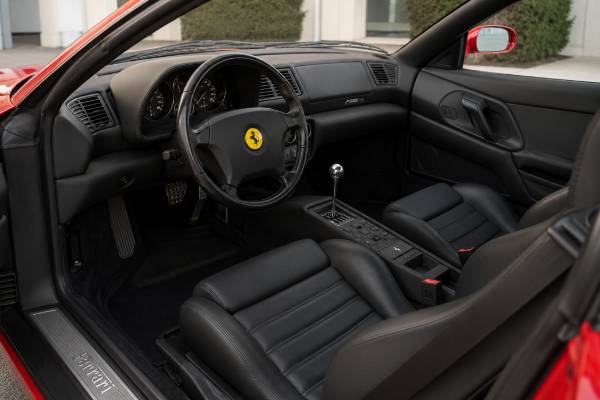
The interior has a different kind of appeal. It is compact, low, and driver-focused without the screen-heavy feel of modern performance cars. The open-gate manual shifter is the centerpiece in most Berlinettas. The seats, leather dashboard, analog gauges, and narrow pillars create a cabin that feels special without feeling oversized. Some details, such as sticky switchgear and shrinking leather, are now ownership issues, but the basic layout remains one of the car’s strengths.
Sound is another defining feature. The intake, exhaust manifolds, bypass valve, and high-revving V8 combine to create a sharper tone than earlier Ferrari V8s. A standard, healthy car is already dramatic. Modified exhausts can sound spectacular, but buyers should be cautious: loud systems may hide failing manifolds, worn catalytic converters, or a bypass valve problem.
How the F355 Berlinetta drives
A good F355 Berlinetta feels light, accurate, and intensely mechanical by modern standards. It is fast, but the lasting appeal is the way the steering, engine, gearbox, brake pedal, and chassis all ask the driver to participate.
The engine is the center of the experience. Below about 3,000 rpm it is tractable enough for town driving, but it does not feel like a modern turbocharged car with huge low-end torque. The reward comes as the revs climb. Past the mid-range, the V8 sharpens, the sound hardens, and the car starts to feel far quicker than its displacement suggests. The 8,500-rpm redline gives the driver a long, dramatic pull through each gear.
Manual cars need sympathy when cold. The shift from first to second can be stiff until the gearbox oil warms, and forcing it is poor practice. Once warm and correctly adjusted, the open-gate shift is one of the car’s great pleasures. It has weight, sound, and rhythm. A vague or obstructive shift after warm-up points to adjustment, bushing, clutch, or internal wear issues.
F1 cars drive differently. The system is best approached as a period racing-inspired manual gearbox with automated clutch control, not as a smooth modern automatic. It can be satisfying on open roads when driven with mechanical sympathy, but it may feel jerky in traffic. Clutch wear depends heavily on setup and driver behavior, so inspection data matters more than mileage alone.
The steering is a major reason enthusiasts love the car. It has hydraulic assistance, but it still communicates surface texture, load, and front-end grip. The F355 is more approachable than the 348, yet it is not numb. It turns in cleanly, feels compact on narrow roads, and gives the driver enough warning before the rear tires become the limiting factor.
Ride quality is better than many expect. It is firm, but not brutally stiff if the dampers, bushings, tires, and alignment are correct. Old tires can ruin the car. So can worn suspension joints or incorrect ride height. Because the chassis is sensitive, a well-sorted F355 can feel brilliant while a tired one feels nervous, noisy, and expensive.
Braking is strong for road use when the system is fresh, but the F355 is not a modern carbon-ceramic-brake supercar. Brake hoses, fluid age, pad choice, caliper condition, and ABS health all matter. On track, heat management becomes important, and repeated hard use will expose neglected maintenance quickly.
Visibility is good for a mid-engine exotic. The low scuttle, compact size, and clear forward view help. Rear visibility is acceptable rather than generous, and the nose needs care over ramps and steep driveways. Cabin heat, low seating, limited luggage space, and heavy urban clutch work remind you this is still a 1990s Ferrari, not a normal daily car.
Maintenance realities and known weak points
The F355 Berlinetta can be reliable when maintained correctly, but it is not cheap to own casually. The expensive cars are often the ones that look good, have deferred service, and need several “while you are in there” jobs at once.
The most famous maintenance item is the timing-belt service. On the F355, belt access usually means engine-out work, which turns a scheduled service into a major event. Many service schedules and specialists treat belt replacement as time-based as well as mileage-based, commonly discussed around three years or 50,000 km. During that service, a careful owner also considers tensioners, accessory belts, water pump condition, engine mounts, hoses, seals, clutch access, and exhaust hardware.
Common mechanical concerns
- Valve guides: Early cars are known for possible premature valve-guide wear. Symptoms can include oil consumption, smoke, weak compression, and catalytic-converter damage.
- Exhaust manifolds: Factory headers can crack. A ticking sound at cold start or idle can be a warning sign.
- Catalytic converters: Failed manifolds, oil burning, or overheating can damage the cats. Replacement can be expensive.
- Exhaust bypass valve: Rattles, sticking, or incorrect operation can affect sound and drivability.
- Cooling system: Radiators, hoses, clamps, fans, and coolant pipes need inspection because heat and age are constant enemies.
- Fuel system: Confirm recall and campaign work where applicable, and inspect fuel hoses, clamps, rails, and divider-block-related updates.
- Clutch and flywheel: Manual and F1 cars both need clutch checks; F1 cars also need hydraulic-system and actuator assessment.
- Suspension: Bushings, dampers, ball joints, wheel bearings, and alignment strongly affect the way the car feels.
- Electrical items: Slow windows, warning lights, aging connectors, alarm issues, and sensor faults are common age-related concerns.
Interior aging is another major ownership topic. The soft-touch coating on switches and trim can become sticky. Leather dashboards can shrink near vents and edges. Seat bolsters wear, carpets fade, and air-conditioning performance may be weak if the system has not been maintained. These problems are not always mechanically serious, but restoring a cabin to a high standard can be costly.
Body and structure inspections should focus on accident history as much as corrosion. Check panel gaps, headlight alignment, undertray damage, front structure, suspension pickup points, rear subframe areas, jacking points, and evidence of poor paintwork. Many F355s have had front bumper repairs from road rash or low-speed contact; that is not unusual. Bent structure, poor welding, mismatched finishes, or missing underbody panels are more serious.
| Area | What to verify | Why it matters |
|---|---|---|
| Timing belts | Date, mileage, invoices, and parts replaced | Deferred belt service is a major cost and risk |
| Valve guides | Compression, leak-down test, oil use, specialist notes | Failure can lead to expensive top-end work |
| Headers and cats | Cold-start noises, heat damage, emissions history | Cracked headers can damage downstream parts |
| F1 gearbox system | Clutch wear reading, pump behavior, actuator condition | Repairs can erase the purchase-price saving over a manual |
| Cooling and fuel systems | Hoses, clamps, radiators, fuel lines, recall evidence | Heat and fuel leaks are serious safety concerns |
| Interior | Sticky parts, leather shrinkage, HVAC, switch function | Cosmetic restoration is expensive when done correctly |
| Structure | Panel gaps, underbody, suspension points, paint readings | Crash repair and corrosion hurt safety and value |
A pre-purchase inspection should be done by a Ferrari specialist who knows the F355 specifically. A general exotic-car inspection may miss model-specific problems. The best inspection includes a cold start, lift inspection, diagnostic checks, compression or leak-down testing where justified, clutch assessment, suspension review, paint readings, and document verification.
Market values and buying checklist
The F355 Berlinetta is now a recognized modern-classic Ferrari, and the market strongly favors documented, original, gated-manual cars. F1 Berlinettas remain historically important and can be good value, but they usually trade below equivalent manuals unless condition, mileage, color, or provenance is exceptional.
Recent public market data shows manual Berlinettas commonly sitting in the low-to-mid six-figure dollar range, with standout low-mile or especially original cars asking or achieving more. F1 Berlinettas are often less expensive, but a cheap F1 car is not automatically a bargain. A weak clutch, tired hydraulic system, sticky interior, old belts, cracked headers, and poor paintwork can quickly exceed the price difference.
Mileage needs context. Very low mileage can help value, but only when the car has been stored and recommissioned correctly. Long periods of inactivity can age belts, tires, seals, fuel hoses, brake components, and electrical contacts. A 35,000-mile car with excellent records can be a better driving car than a 7,000-mile example needing full recommissioning.
What drives value
- Original gated manual transmission, especially on well-kept Berlinettas
- Complete service history with recent engine-out belt work
- Documented valve-guide, header, catalyst, and fuel-system history
- Factory paint color and interior combination
- Books, tools, keys, records, window sticker, and ownership chain
- Ferrari Classiche certification or strong factory documentation
- Original body panels and clean paint-meter readings
- Correct wheels, trim, exhaust, and unmodified electrical systems
- Specialist inspection report with compression or leak-down data when needed
Cars to seek
Look for a Berlinetta that starts cleanly from cold, idles evenly, pulls hard through the rev range, shifts properly when warm, tracks straight, stops cleanly, and has no overheating behavior. The service file should show regular care, not just a recent oil change. Ideally, the car should have documented belt services, clutch history, header or catalyst notes, cooling-system work, and evidence of recall or campaign completion where applicable.
A good F1 Berlinetta should not be dismissed. If the system is healthy, properly adjusted, and documented, it can deliver a distinctive period Ferrari experience at a lower entry price. It is especially appealing to buyers who value the F355’s historical role in bringing paddle-shift technology to production Ferraris.
Cars to avoid
Avoid cars sold only on shine, mileage, or color. Be cautious with missing records, unexplained repaints, non-original wheels, poorly fitted aftermarket exhausts, warning lights, hot-start issues, heavy smoke, gearbox faults, and sellers who resist specialist inspection. A bargain F355 can become expensive faster than almost any normal used car.
| Priority | Question to answer before buying |
|---|---|
| Authenticity | Does the car match its factory identity, numbers, color, trim, and transmission type? |
| Documentation | Are books, tools, invoices, ownership history, and specialist records complete? |
| Major service | When was the last engine-out belt service, and what else was replaced? |
| Engine health | Are compression, leak-down, oil consumption, and exhaust condition acceptable? |
| Transmission | Does the manual shift correctly, or does the F1 system have current clutch and hydraulic data? |
| Body condition | Do paint readings, gaps, underbody panels, and structure support the seller’s claims? |
| Total cost | Does the purchase price leave budget for immediate service, tires, fluids, and age-related repairs? |
Long-term collectability looks strong because the F355 Berlinetta has the right ingredients: Pininfarina design, naturally aspirated V8, manual availability, historical F1 gearbox significance, limited body-style production, and a reputation as one of Ferrari’s best-sounding modern classics. The safest investment is still the best car you can verify, not the cheapest car you can find.
References
- Ferrari F355 Berlinetta (1994) – Ferrari.com 1994 (Technical Specifications)
- Ferrari 355 F1 Berlinetta (1997) 1997 (Technical Specifications)
- Ferrari Classiche: Certification – Ferrari.com 2026 (Certification)
- Vehicle Detail Search – 1999 FERRARI F355 | NHTSA 2026 (Recall Database)
- Ferrari F355 Berlinetta – Manual Market 2026 (Market Data)
Disclaimer
This article is for informational purposes only and is not a substitute for professional diagnosis, inspection, maintenance, or repair. Specifications, torque values, service intervals, procedures, parts, recalls, and technical details can vary by VIN, market, model year, equipment, and prior repairs. Always verify information against the official Ferrari service documentation for the specific car and consult a qualified Ferrari specialist before purchase or repair.
If you found this guide useful, please consider sharing it on Facebook, X/Twitter, or with another Ferrari enthusiast to support our work.