

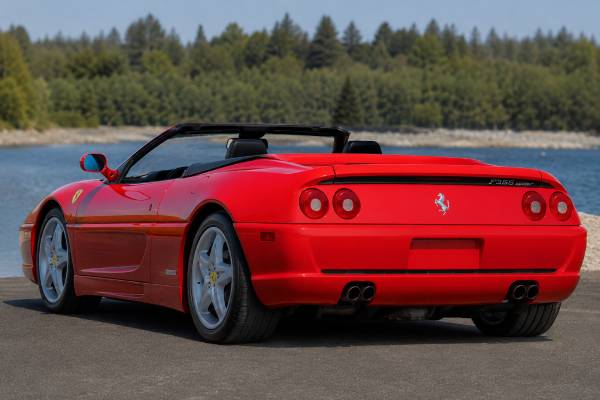

The Ferrari F355 Spider is the open-top version of Ferrari’s Tipo F129 mid-engine V8 sports car, built from 1995 through 1999. It sits between the sharper-edged 348 and the later aluminum-bodied 360 Modena, and it matters because it combines classic Ferrari drama with a more usable, more polished driving experience than its predecessor. Its defining feature is the 3.5-liter F129 V8, a five-valve-per-cylinder engine rated at 380 metric horsepower and famous for its high-revving sound. The Spider adds an electrically operated soft-top, open-air theatre, Pininfarina styling, and strong collector demand. Today, buyers care less about simple mileage and more about service history, originality, valve-guide condition, exhaust manifolds, roof operation, and documentation. A good F355 Spider can be one of the most rewarding modern-classic Ferraris; a neglected one can become expensive very quickly.
Table of Contents
- Why the F355 Spider still matters
- F129 V8, chassis, and key specifications
- Production, variants, and authenticity details
- Pininfarina design and Ferrari engineering
- How the F355 Spider drives
- Maintenance risks and restoration priorities
- Market values and buying checklist
Why the F355 Spider still matters
The F355 Spider matters because it turned Ferrari’s compact V8 line from a difficult, specialist car into something faster, sweeter, and easier to enjoy. It kept the mid-engine layout and dramatic proportions of the 348, but improved the engine, aerodynamics, gearbox feel, suspension tuning, and day-to-day drivability.
Ferrari launched the F355 Berlinetta first in 1994, followed by the GTS and Spider. The Spider arrived for the 1995 model year as the full convertible version. It was not simply a roof-cut coupe. Ferrari and Pininfarina worked to keep the car elegant, stable, and usable with the top down, while preserving the sharp character expected from a Maranello V8.
The F355 sits at an important point in Ferrari history. It was one of the last compact V8 Ferraris with a strong analog feel, a naturally aspirated flat-plane-crank V8, hydraulic steering, and a gated manual gearbox available for most of its production run. At the same time, it introduced newer technology that pointed forward. Later cars could be ordered with the F1 electro-hydraulic paddle-shift transmission, a road-car link to Ferrari’s Formula 1 thinking of the period.
The Spider also had a special image. It offered the high-revving V8 soundtrack without a roof, which made the car feel more theatrical than the Berlinetta or GTS. That matters to enthusiasts because the F355’s sound is central to its appeal. It is not the fastest Ferrari by modern standards, but it is one of the most memorable.
Collectors value the model for several reasons:
- It is a Pininfarina-designed mid-engine Ferrari from the final years before the 360 changed the formula.
- It has a five-valve-per-cylinder V8, a rare layout even among Ferraris.
- Manual cars deliver the classic open-gate experience many buyers now seek.
- The Spider body style adds emotional appeal and strong visual identity.
- Good examples are becoming harder to find because many cars have had deferred maintenance, aftermarket exhausts, repainting, interior wear, or incomplete service records.
The F355 Spider’s reputation today is mixed in a useful way. It is loved for its steering, sound, balance, and beauty, but respected for its ownership demands. That creates a clear divide in the market. The best cars are those with evidence: documented belt services, compression or leak-down results, verified valve-guide history, working roof systems, clean underbody condition, and correct factory specification. A cheap F355 Spider is rarely cheap for long.
F129 V8, chassis, and key specifications
The F355 Spider’s core specification is simple but special: a 3.5-liter, naturally aspirated, dry-sump V8 mounted behind the cabin and driving the rear wheels. Its 380 hp output, high redline, and five-valve cylinder heads gave it one of the strongest specific outputs of its era.
| Item | Specification |
|---|---|
| Model | Ferrari F355 Spider |
| Factory type | F129 |
| Production period | 1995–1999 |
| Body style | Two-seat convertible Spider |
| Engine | Rear longitudinal 90-degree V8 |
| Engine codes | F129 B / F129 C, depending on version and engine-management period |
| Displacement | 3,495.5 cc |
| Bore x stroke | 85 mm x 77 mm |
| Valvetrain | Double overhead camshafts per bank, five valves per cylinder |
| Compression ratio | 11.0:1 |
| Fuel and ignition | Bosch Motronic electronic injection and ignition |
| Lubrication | Dry sump |
| Maximum power | 380 metric hp at 8,250 rpm |
| Maximum torque | 363 Nm at 6,000 rpm |
| Transmission | 6-speed gated manual or optional 6-speed F1 automated manual on later cars |
| Drivetrain | Rear-wheel drive |
| Suspension | Independent double wishbones with coil springs, anti-roll bars, and electronically controlled dampers |
| Brakes | Ventilated discs with ABS |
| Factory tire sizes | 225/40 ZR18 front, 265/40 ZR18 rear |
| Length / width / height | 4,250 mm / 1,900 mm / 1,170 mm |
| Wheelbase | 2,450 mm |
| Dry weight | About 1,350 kg |
| Top speed | 295 km/h |
| 0–100 km/h | About 4.7 seconds |
The engine is the main reason the car still feels exotic. Ferrari used five valves per cylinder: three intake valves and two exhaust valves. The idea was to improve breathing at high rpm, allowing the relatively small V8 to make serious power without forced induction. The result is an engine that does its best work high in the rev range. It pulls cleanly at moderate speeds, but the real character arrives as the tachometer moves toward the upper third of the dial.
Dry-sump lubrication is also important. Instead of keeping oil in a deep conventional sump, the system stores oil in a separate tank and helps control oil supply during hard cornering. That is useful in a mid-engine car designed for high lateral loads. It also helps the engine sit lower, supporting the F355’s low center of gravity.
Early F355s used Bosch Motronic 2.7 engine management, while later cars moved to Motronic 5.2. Buyers often discuss the difference because the earlier arrangement is associated with a slightly rawer feel and separate control architecture, while the later system is simpler in some diagnostic respects and tied to later emissions requirements. For a road car, condition matters more than internet arguments about which version is “best.”
The chassis follows the traditional Ferrari mid-engine recipe of the period. The car uses a steel structure with aluminum body panels, independent suspension, and electronically adjustable dampers. The driver can select a firmer suspension setting, but the car still depends heavily on tire quality, alignment, bushing condition, and damper health. A tired F355 can feel loose and nervous; a sorted one feels light, accurate, and alive.
Production, variants, and authenticity details
The F355 Spider was one of three main F355 body styles, alongside the Berlinetta coupe and GTS targa. For collectors, the key distinctions are body style, transmission, market specification, production year, color, documentation, and whether the car remains close to its factory build.
The Spider was introduced after the Berlinetta and joined the range as the full convertible. The soft-top is electrically operated, a notable feature for a Ferrari of this period. Manual cars were available throughout the run, while the F1 paddle-shift transmission became available later and is usually found on 1997–1999 cars.
| Version | Basic description | Collector note |
|---|---|---|
| Berlinetta | Fixed-roof coupe | Usually the sharpest and most rigid road version |
| GTS | Targa-style removable roof panel | Often valued for rarity and open-air flexibility |
| Spider | Full convertible with powered soft-top | Most theatrical open version and the focus of this guide |
| F355 Challenge | Track-oriented car for Ferrari Challenge racing | Separate collector niche; not directly comparable to a road Spider |
| Serie Fiorano Spider | Late limited Spider with handling and trim upgrades | Highly desirable, especially with manual transmission and strong provenance |
Production totals vary slightly depending on how sources count market versions, late cars, and special editions, but the commonly cited Spider total is a little over 3,700 cars. Manual Spiders outnumber F1 Spiders overall, but the market does not treat them equally. The gated six-speed manual usually brings a premium because it delivers the traditional Ferrari shift experience and is simpler to understand long-term. The F1 gearbox is historically important, but maintenance condition and clutch wear matter greatly.
What makes one Spider more desirable than another
The strongest cars tend to have a combination of original specification, clean history, and major service documentation. A buyer should look beyond paint color and mileage. A 20,000-mile car with old belts, smoking valve guides, sticky interior plastics, and a slow roof can be worse than a 40,000-mile car with excellent records and recent specialist work.
Important value factors include:
- Original color combination and factory trim.
- Manual gearbox versus F1 transmission.
- Market specification, such as U.S., European, or right-hand drive.
- Original books, tools, manuals, service book, keys, and factory records.
- Matching engine and gearbox where documentation is available.
- Evidence of timing-belt services and major engine-out work.
- Verified roof operation on Spider models.
- Clean body structure with no hidden accident repair.
- Sensible originality rather than heavy cosmetic modification.
Serie Fiorano cars sit in a special category. They used upgrades inspired by the Challenge program, including firmer suspension tuning and distinctive trim details. Because they are rare and often traded as collector cars rather than ordinary used exotics, documentation is critical. Numbered plaques, build records, market specification, and transmission type all affect value.
Authenticity checks should include chassis number, engine number, gearbox number where possible, paint code, interior trim, option history, and service invoices. Ferrari Classiche certification can help with high-end examples, but it does not replace a proper mechanical inspection. A car can be authentic and still need expensive work.
Pininfarina design and Ferrari engineering
The F355 Spider’s appeal comes from how cleanly it blends engineering with drama. Pininfarina gave the car smoother lines than the 348, while Ferrari used underbody aerodynamics, improved cooling, and a much more advanced engine to move the V8 line forward.
The exterior is compact, low, and balanced. Compared with the 348, the F355 has less visual heaviness and a more graceful rear treatment. The side intake remains a defining mid-engine Ferrari feature, but the car looks cleaner and less slatted than its predecessor. The pop-up headlights keep the 1990s supercar identity, while the rear grille, round lamps on later Ferrari design language, and four exhaust outlets give the car a lasting presence.
Pininfarina’s work was not only about styling. The F355 was developed with serious attention to airflow. The shape and underbody helped reduce lift and improve stability at high speed. For the Spider, this mattered even more because open cars can suffer from turbulence and body shake. The F355 Spider is not as rigid as the Berlinetta, but it was engineered to feel composed rather than like a compromised convertible.
The power-operated soft-top is a major feature. It gives the Spider a more luxurious feel than older manual-roof convertibles, but it also adds maintenance complexity. The top mechanism works with seat movement and hydraulic or electric components, depending on the part of the system being discussed. When everything is adjusted correctly, operation feels special. When neglected, it can be slow, uneven, or costly to repair.
Inside, the F355 keeps a simple driver-focused cockpit. There is no modern screen-based interface. The main instruments are clear, the console is narrow, and the gated shifter sits proudly in the cabin on manual cars. The driving position has the traditional Italian feel: low seat, long reach, and pedals that may not suit every driver perfectly. Good seat, steering wheel, and pedal alignment are worth checking during a test drive, especially for taller owners.
The engine bay is part of the experience. The V8 sits under a rear deck that reminds the driver this is a real mid-engine Ferrari, not a front-engine grand tourer. Heat management is a recurring theme. Exhaust manifolds, catalytic converters, engine-bay insulation, hoses, wiring, and plastic parts all live in a hot environment. That heat is part of why maintenance quality matters so much.
The sound is one of the car’s signature features. The flat-plane V8, five-valve heads, and bypass exhaust arrangement create a hard-edged note that builds with rpm. At low speed, the car can be relatively restrained. At higher revs, it becomes sharp, metallic, and unmistakably Ferrari. Many cars have aftermarket exhausts, but originality and quality matter. A loud exhaust is not automatically better, especially if it hides manifold leaks, catalyst problems, or poor workmanship.
How the F355 Spider drives
A sorted F355 Spider feels light, responsive, and emotional rather than brutally fast by today’s numbers. Its performance is still serious, but the main attraction is the way the engine, steering, gearbox, and open cabin work together.
The V8 needs revs to show its full character. It is tractable enough for normal driving, yet it rewards patience. Below the midrange, the engine feels crisp rather than muscular. Above that, it becomes urgent, and near the top end it delivers the sound and response that made the model famous. This is not a modern turbocharged engine with instant low-rpm torque. It is an engine that asks the driver to choose the right gear and enjoy the climb.
The manual gearbox is central to the experience. When cold, the shift can feel stiff, especially into second gear. That is normal for many Ferraris of this era, but it should improve as the oil warms. A good gated manual shift is mechanical and satisfying, with a clear metal-on-metal feel through the gate. If it crunches, baulks when warm, or jumps out of gear, the issue needs specialist attention.
The F1 transmission gives a different character. It is not a modern dual-clutch gearbox. It is a single-clutch automated manual that uses hydraulic actuation to operate the clutch and shift mechanism. Driven well, it can be enjoyable and historically interesting. Driven in heavy traffic or poorly maintained, it can wear clutches quickly and feel clumsy. Buyers should have clutch wear, actuator condition, pump behavior, and calibration checked.
Steering is one of the F355’s strengths. The hydraulic power steering gives more feel than many later systems. At parking speeds it is not feather-light, but on a flowing road it becomes accurate and confidence-building. The car responds best to smooth inputs. It is mid-engined, so abrupt throttle lifts or poor tires can still make it feel nervous.
Ride quality depends heavily on condition. Fresh dampers, good suspension bushings, correct tires, and proper alignment make a huge difference. A well-kept F355 Spider can cover real distance without feeling punishing. A neglected one may tramline, crash over bumps, or feel unsettled. Many complaints blamed on “old Ferrari behavior” are actually maintenance problems.
Braking performance is strong for the era, but buyers should judge the pedal carefully. The brakes should feel firm and progressive, not wooden, pulsing, or vague. Old brake hoses, tired fluid, uneven discs, sticking calipers, and aged tires can all reduce confidence. The F355 predates modern carbon-ceramic brake expectations, so maintenance is more conventional, but not cheap.
As a Spider, the car adds wind, noise, and theatre. With the roof down, the engine note becomes more immediate and the sense of speed increases. There may be more body movement than in a Berlinetta, but a good Spider should not shake excessively. Serious scuttle shake, rattles, or roof misalignment can point to worn structure, poor adjustment, or previous accident damage.
Maintenance risks and restoration priorities
The F355 Spider is not a casual-maintenance exotic. The big ownership risks are timing-belt service, valve guides, exhaust manifolds, catalyst heat, F1 clutch wear on paddle-shift cars, roof mechanism faults, sticky interior parts, and age-related rubber, wiring, and hydraulic deterioration.
The timing-belt service is the headline item. The F355 uses timing belts, and belt failure can cause severe engine damage. Many specialists perform the major belt service with the engine removed or the powertrain dropped, because access is limited and the opportunity to inspect other parts is valuable. Market expectations often favor cars with recent engine-out service from a known Ferrari specialist.
A major service should not be just belts. A proper job may also include tensioners, cam seals, valve-cover gaskets, accessory belts, coolant hoses, fluids, water pump inspection, engine mounts, fuel lines, ignition parts, and a full look at the exhaust system. The invoice should be detailed. A vague “major done” note is not enough.
Common mechanical issues to inspect
| Area | Why it matters | What to look for |
|---|---|---|
| Timing belts | Failure can be catastrophic | Recent documented belt service with parts and labor details |
| Valve guides | Worn guides can cause oil use, smoke, poor sealing, and further damage | Compression and leak-down results, history of guide replacement, exhaust smoke |
| Exhaust manifolds | Factory manifolds can crack from heat and age | Ticking noises, heat damage, repair invoices, quality replacement headers |
| Catalytic converters and exhaust bypass | Heat and misfires can damage catalysts and sensors | Warning lights, slow-down lights, poor running, non-original modifications |
| Cooling system | Heat control is critical in a mid-engine Ferrari | Radiator condition, fans, hoses, coolant history, leaks, overheating signs |
| Clutch | Replacement is expensive, especially if linked to other service work | Engagement point, slip, noise, F1 clutch wear reading where applicable |
| Spider roof | The powered top is complex and costly when neglected | Smooth movement, seat operation, fabric condition, frame alignment, leaks |
| Interior plastics | Sticky switchgear is common on Ferraris of this era | Soft or tacky buttons, refinished controls, missing markings |
| Suspension | Old bushings and dampers ruin the car’s handling | Knocks, leaks, uneven tire wear, poor alignment, failed electronic damper control |
Valve guides are one of the most discussed F355 issues. Some earlier cars used guide material that can wear prematurely. Symptoms may include oil smoke, poor compression, high oil consumption, and weak leak-down results. The safest approach is not to rely on model year assumptions. Ask for documentation, test results, and specialist inspection.
Exhaust manifolds are another major area. Factory headers can crack, often producing a ticking sound, heat problems, and possible downstream catalyst issues. Some cars have upgraded aftermarket manifolds, but quality varies. A well-documented, high-quality replacement may be a practical improvement. A poorly installed exhaust can reduce value and create new problems.
Spider-specific work deserves extra attention. The roof should operate evenly and without drama. The fabric, rear window, seals, frame, microswitches, motors, and hydraulic elements should be checked. Water leaks can damage trim and electronics. A car that has lived outside or sat unused for long periods may need more roof work than its mileage suggests.
Restoration is possible, but expensive. Paintwork, leather, switchgear, roof fabric, wheels, engine-bay components, and underbody hardware can all be restored, yet costs climb quickly if originality matters. Collector buyers should avoid cars that have been cheaply repainted, converted, heavily modified, or repeatedly repaired without records.
The best maintenance strategy is preventive. Annual fluid service, regular exercise, battery care, fresh tires, brake-fluid changes, and prompt attention to small leaks prevent bigger bills. The worst ownership pattern is long storage followed by hard driving without recommissioning.
Market values and buying checklist
The F355 Spider now sits firmly in modern-classic Ferrari territory, with manual cars, rare colors, low mileage, and Serie Fiorano examples leading the market. Values vary widely because condition and history can change the real cost of ownership by tens of thousands of dollars.
As a broad 2026 market guide, ordinary driver-quality F1 Spiders tend to sit below comparable manual cars. Good manual Spiders often trade in low-six-figure territory, while exceptional low-mileage examples and rare specifications can go much higher. Serie Fiorano Spiders can enter a different price band, especially when mileage, originality, and documentation are excellent.
| Value driver | Effect on price | Buyer note |
|---|---|---|
| Manual gearbox | Usually strong positive | Most collectors prefer the gated six-speed |
| F1 gearbox | Often lower than manual | Can be good value if properly maintained and correctly calibrated |
| Recent major service | Strong positive | Must be documented, detailed, and performed by a credible specialist |
| Valve-guide history | Major confidence factor | Test results and invoices matter more than verbal claims |
| Original paint and interior | Positive if condition is good | Originality helps, but poor original condition still costs money |
| Sticky interior controls | Negative if severe | Proper refinishing is better than quick cosmetic coating |
| Spider roof condition | Important on all cars | Slow, leaking, or misaligned roofs should affect the offer price |
| Serie Fiorano specification | Major positive | Requires careful verification of production identity and equipment |
A smart buying process starts before the test drive. Ask for the VIN, service file, ownership history, factory books, tool kit details, tire dates, belt-service date, clutch history, and any records for valve guides, manifolds, catalytic converters, roof repairs, and sticky interior restoration. If the seller cannot provide clear answers, price the car as a risk.
Pre-purchase inspection priorities
A Ferrari specialist should inspect the car before purchase. The inspection should include:
- Cold start behavior, hot restart behavior, and idle quality.
- Compression and leak-down testing if recent results are not available.
- Belt-service date, tensioner history, and engine-out service detail.
- Exhaust manifold condition and catalyst health.
- Cooling-system pressure test and hose inspection.
- Gearbox operation when cold and warm.
- Clutch wear measurement, especially on F1 cars.
- Suspension bushing, damper, ball joint, and steering-rack condition.
- Brake disc, pad, caliper, and hose condition.
- Roof operation from fully closed to fully open and back again.
- Evidence of accident damage, repainting, corrosion, or poor panel fit.
- Interior condition, switchgear, HVAC function, windows, alarm, and instruments.
- Tire age and correct performance rating.
Do not buy solely on mileage. Low mileage can be attractive, but a Ferrari that has sat unused may need recommissioning. Rubber hardens, seals dry, fuel systems gum up, batteries fail, and tires age out. A higher-mileage car with consistent use and specialist care can be the better driver.
Examples to seek include cars with original colors, complete books and tools, detailed invoices, no accident history, recent major service, healthy compression, documented valve-guide status, sorted manifolds, clean roof operation, and factory-correct presentation. Examples to avoid include cars with missing records, overheating history, smoke on startup after warm running, warning lights, roof faults, cheap repainting, unknown clutch wear, or claims that expensive service “was done by a friend.”
Long-term collectability looks strong because the F355 Spider combines several things enthusiasts still want: naturally aspirated V8 sound, Pininfarina styling, compact dimensions, a manual option, and a clear place in Ferrari history. It is not rare enough for every example to become a blue-chip collector car, but the best cars are increasingly separated from average ones. Buy the best documented car you can afford, not the cheapest car with the right color.
References
- Ferrari F355 Spider (1995) – Ferrari.com 1995 (Manufacturer Specifications)
- Vehicle Detail Search – 1999 FERRARI F355 | NHTSA 2026 (Recall Database)
- usa recall campaign 2009 (Recall Campaign)
- Ferrari F355 Spider – Manual Market 2026 (Market Data)
- Buying Guide: Ferrari F355 (1994–99) 2024 (Buying Guide)
Disclaimer
This article is for informational purposes only and is not a substitute for professional diagnosis, repair, valuation, or inspection. Specifications, torque values, service intervals, procedures, factory equipment, and recall applicability can vary by VIN, market, model year, and individual vehicle history. Always verify details against official Ferrari service documentation and have any Ferrari F355 Spider inspected by a qualified marque specialist before purchase or repair.
If you found this guide useful, please consider sharing it on Facebook, X/Twitter, or your preferred automotive community to support our work.