
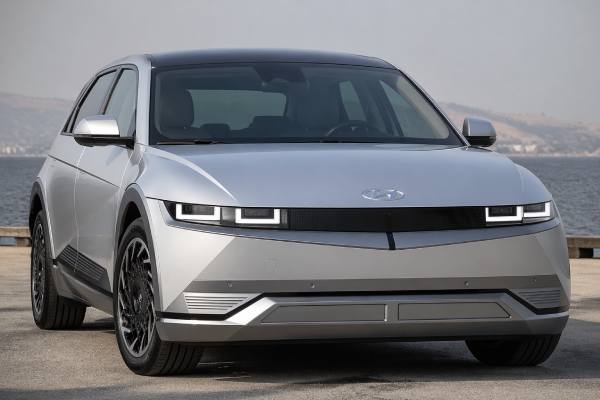

The 2022–2024 Hyundai IONIQ 5 with the 125 kW rear motor is the standard-range, rear-drive version that sits at the practical end of the early IONIQ 5 family. It gives up some outright range and headline pace compared with the larger-battery models, but it keeps the same E-GMP platform, 800-volt charging architecture, long 3,000 mm wheelbase, and unusually airy cabin. That combination makes it more interesting than a basic entry model usually sounds on paper.
For ownership, the appeal is easy to understand. It is smoother, lighter, and simpler than the AWD versions, it can still charge very quickly in good conditions, and it remains one of the roomiest EVs in its class. The main thing to watch is not routine servicing, but campaign history and software status. Early IONIQ 5s benefited from charging, brake-logic, and control-unit updates, so documentation matters more than on many rivals. Buy the right example, and this version is still a smart, efficient family EV.
Owner Snapshot
- Spacious cabin, flat floor, and a large boot make it more practical than many similarly sized EVs.
- The 58 kWh rear-drive setup is lighter and more efficient than the dual-motor versions in everyday use.
- Fast 800-volt charging remains a real strength when the battery is warm and the charger is strong.
- Recall and software history matter, especially ICCU and early control-system updates.
- Replace the cabin air filter every 30,000 km or 24 months, and rotate tyres about every 12,000 km.
Navigate this guide
- IONIQ 5 NE rear-drive character
- IONIQ 5 NE technical figures
- IONIQ 5 NE grades and safety tech
- Common faults and campaigns
- Maintenance plan and buying tips
- On-road range and manners
- How it stacks up today
IONIQ 5 NE rear-drive character
The 125 kW rear-drive IONIQ 5 is the version that makes the early NE platform feel most honest. It does not chase the biggest battery or the quickest acceleration time. Instead, it leans into the basic strengths of the car: space, comfort, clean design, and an EV platform that still feels modern. In many markets, this was the standard-range model with the 58.0 kWh pack, and that is the version this guide focuses on. It is worth separating it from the later facelift-era 63 kWh car, because used listings can blur them together.
On the road, this version has a calmer personality than the AWD cars. The rear-drive layout and lower weight help it feel a touch less heavy at low speeds and a little more natural in ordinary driving. It still has immediate electric response, but it is less forceful off the line than the dual-motor variants, which actually suits the car’s comfort-first mission. For commuting, family use, and mixed suburban driving, it feels quietly capable rather than obviously compromised.
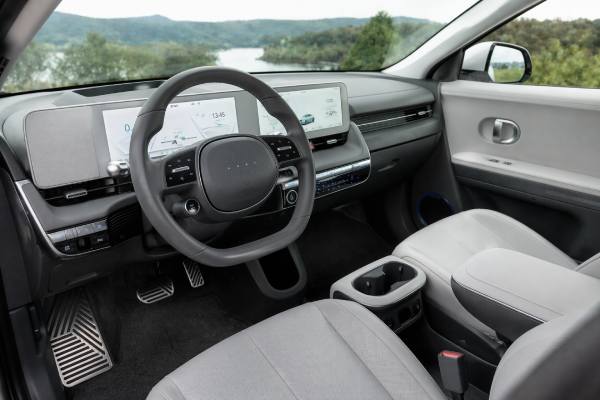
The cabin remains one of its biggest selling points. Hyundai used the long wheelbase brilliantly, and even now the IONIQ 5 feels more open inside than several rivals with similar exterior dimensions. The flat floor, movable center console, wide front seats, and generous rear legroom all help. It feels less like a converted hatchback and more like a dedicated EV that was designed around people rather than around packaging leftovers.
Where this version asks for compromise is motorway range. The official WLTP figure is respectable, but real-world high-speed use shrinks the margin more quickly than in the larger-battery cars. That does not make it a poor EV. It just means it suits drivers who can charge regularly and do not expect every trip to be a long winter highway run. In return, you get a simpler drivetrain, lower running weight, and often a more attractive used price.
The best way to think about it is as the thoughtful IONIQ 5, not the flashy one. It preserves the platform’s best ideas, including very fast charging potential, strong cabin packaging, and mature ride quality, while avoiding the extra cost and complexity of the more powerful versions. For buyers who want a design-led EV with real family usefulness and do not need the longest range in the lineup, it still makes a convincing case.
IONIQ 5 NE technical figures
Powertrain and battery
| Spec | Value |
|---|---|
| Platform code | NE |
| Powertrain layout | Single-motor rear-wheel-drive battery electric vehicle |
| Motor type | Permanent Magnet Synchronous Motor (PMSM) |
| Motor count and axle | Single rear motor |
| Max power | 168 hp (125 kW) |
| Max torque | 350 Nm (258 lb-ft) |
| Battery chemistry | Lithium-ion, NMC, pouch-cell pack |
| Traction battery gross capacity | 58.0 kWh |
| Traction battery usable capacity | 54.0 kWh |
| Battery layout | Underfloor, within wheelbase |
| Battery module and cell layout | 288 cells, 144s2p |
| System voltage | 522.7 V |
| Battery thermal management | Liquid-cooled |
| Official test cycle | WLTP |
| Rated efficiency | 16.7 kWh/100 km (269 Wh/mi) |
| Rated range | 384 km (239 mi) |
| Real-world highway at 120 km/h, mild weather | 20.0 kWh/100 km (322 Wh/mi), about 270 km (168 mi) |
| Real-world highway at 120 km/h, cold weather | 25.7 kWh/100 km (414 Wh/mi), about 210 km (131 mi) |
Driveline and charging
| Spec | Value |
|---|---|
| Transmission and drive unit | Single-speed reduction gear |
| Drive type | RWD |
| Differential type | Open |
| AC charge connector | Type 2, three-phase |
| DC charge connector | CCS2 |
| Charging port location | Right rear quarter |
| Onboard AC charger | 11 kW |
| AC charging time | 10–100% in 4 h 59 min |
| DC charging time, 350 kW station | 10–80% in 17 min 16 sec |
| DC charging time, 50 kW station | 10–80% in 45 min 45 sec |
| Typical 10–80% DC average power | About 131 kW |
| Charger compatibility | 400 V and 800 V infrastructure |
| Vehicle-to-Load output | Up to 3.6 kW |
Performance, dimensions, and safety
| Spec | Value |
|---|---|
| 0–100 km/h | 8.5 s |
| Top speed | 185 km/h (115 mph) |
| Front suspension | MacPherson strut |
| Rear suspension | Multi-link |
| Steering type | Rack-and-pinion, R-MDPS |
| Front and rear brakes | Disc / disc |
| Wheel and tyre size | 235/55 R19 |
| Ground clearance | 160 mm (6.3 in) |
| Length | 4,635 mm (182.5 in) |
| Width | 1,890 mm (74.4 in) |
| Height | 1,605 mm (63.2 in) |
| Wheelbase | 3,000 mm (118.1 in) |
| Turning circle | 11.98 m (39.3 ft) |
| Kerb weight | 1,830–1,910 kg (4,034–4,211 lb) |
| GVWR | 2,370 kg (5,225 lb) |
| Boot capacity | 527 L |
| Rear cargo volume, seats folded | 1,587 L |
| Front cargo volume | 57 L |
| Euro NCAP rating | 5 stars |
| Euro NCAP scores | Adult 88%, Child 86%, Vulnerable Road Users 63%, Safety Assist 88% |
| IIHS crash picture | Good in the major core crash tests |
| IIHS headlight rating | Good with LED projector lamps, Acceptable with LED reflector lamps |
| LATCH ease of use | Acceptable |
Service and ownership data
| Spec | Value |
|---|---|
| Cabin air filter interval | 30,000 km or 24 months |
| Brake fluid | DOT 4 |
| Brake fluid interval | 30,000 km or 24 months |
| Battery warranty | 8 years or 160,000 km |
| Wheel nut torque | 11–13 kgf·m (79–94 lb-ft) |
| Typical tyre rotation interval | About 12,000 km |
| Common battery charging target for daily use | 80% |
IONIQ 5 NE grades and safety tech
The 125 kW rear-drive IONIQ 5 was usually positioned as the standard-range, lower-power version in the lineup, so equipment varied widely by market. In Europe and other export markets, it generally appeared in entry or mid-level trims rather than in the most lavish versions. That means the core hardware was consistent, but the ownership feel could differ quite a bit depending on how the original buyer specified the car.
Most examples of this drivetrain sit on 19-inch wheels, and that is usually a good sign from a used-car point of view. The smaller wheel package tends to ride better, make less road noise, and preserve more range than the 20-inch setup fitted to more expensive trims. Inside, even simpler cars still get the broad dashboard layout, the dual-screen arrangement, a roomy rear bench, and the signature flat-floor packaging. Higher trims add the things buyers will notice every day: powered tailgate convenience, upgraded seats, better lighting, richer cabin materials, surround-view parking assistance, upgraded audio, and more advanced highway-assist functions.
Quick identifiers help when listings are vague. Projector-style headlamps, blind-spot camera views, head-up display, Bose audio, and the most advanced parking aids usually point to better-equipped cars. More basic versions are more likely to have reflector lamps, simpler seat trim, and fewer visual cues beyond the 19-inch wheels. Because the rear-drive standard-range car was often a value-focused variant, many used examples lean toward practical spec rather than showpiece spec.
Safety is strong across the board. Euro NCAP awarded the IONIQ 5 five stars, and the scoring was solid in the areas that matter most to family buyers: adult occupant protection, child protection, and safety-assist systems. Structurally, the car was competitive from launch, with a center airbag, strong passenger-cell performance, and a broad active-safety suite. In IIHS testing, the IONIQ 5 also performed well. The main detail worth knowing is that headlights are trim-sensitive. Projector-lamp versions score better than reflector-lamp cars, so buyers who drive a lot at night should check the exact lighting setup instead of assuming every IONIQ 5 is the same.
ADAS availability also evolved. Forward collision avoidance, lane keeping, lane following, smart cruise control, rear cross-traffic support, blind-spot monitoring, and highway-assist features became more complete as trim levels rose and as later software arrived. After any front-end repair, windscreen replacement, bumper work, or alignment correction, calibration quality matters. On a used IONIQ 5, poor ADAS calibration can be more annoying than normal wear items, so a clean repair history is worth paying for.
For families, child-seat provision is good rather than exceptional. The platform offers useful rear space and acceptable LATCH ease-of-use, but access is not as foolproof as the best-in-class systems. Even so, the overall mix of structure, passive safety, and active assistance is still one of the car’s strongest arguments on the used market.
Common faults and campaigns
The early IONIQ 5 does not have a disastrous reliability profile, but it does have a campaign-heavy profile. That is an important difference. The main threat to ownership confidence is not chronic battery failure or widespread motor destruction. It is whether the car received the right updates and recall work at the right time.
The issue that matters most is the ICCU, or Integrated Charging Control Unit. On affected cars, ICCU faults can lead to warning lights, interrupted charging, 12 V battery problems, reduced-power operation, and in some cases a no-drive or limp-home situation. Hyundai’s recall work focused on software inspection and updates, with ICCU and fuse replacement when fault codes justified it. From a buyer’s perspective, this is the first item to verify. A seller who cannot show campaign completion is asking you to take on unnecessary risk.
There were also important software-related fixes that are less dramatic but still relevant in daily use. Early regenerative-braking brake-light logic was updated to improve system behavior, and later control software refined how the car handled certain regen and braking situations. Those updates do not sound exciting, but they matter because early-build EVs often feel rougher around the edges until the software matures.
In used ownership terms, the common problem map looks like this:
- Common, medium-to-high severity: ICCU and 12 V support faults. Symptoms include charging errors, warning messages, sudden battery discharge, or reduced power. Remedy is software inspection, possible ICCU replacement, and fuse replacement where required.
- Occasional, medium severity: charging-session inconsistency in cold weather or repeated fast-charge use, sometimes improved by battery-conditioning or control updates rather than by hardware replacement.
- Occasional, low-to-medium severity: brake corrosion or uneven friction-brake use because regen handles much of the deceleration. Symptoms include noise, rusty discs, or poor pedal feel after standing.
- Occasional, low severity: trim rattles, charging-flap complaints, sensor alignment issues, and infotainment glitches that are more irritating than expensive.
Battery health itself is usually the calmer part of the picture. The pack is liquid-cooled, and there is no widely established pattern suggesting the 58 kWh standard-range pack is unusually fragile. That does not mean every car is equal. Heavy reliance on frequent DC fast charging, long spells parked at very high state of charge, or repeated operation in extreme heat can age any EV faster. Still, on this model, the charging-control hardware and software history deserve more scrutiny than headline battery-fade anxiety.
Driveline hardware is generally sound, but buyers should still listen for bearing or reduction-gear noise and inspect the underbody carefully. Because the car is heavy and quiet, worn suspension bushes, tyres, or wheel bearings can hide behind the general EV calm until they become obvious. Corrosion points are usually the conventional ones: brake hardware, fasteners, exposed underbody edges, and any area that has seen poor repairs or rough lifting. A tidy, campaign-complete IONIQ 5 is far more attractive than a cheaper one with patchy paperwork.
Maintenance plan and buying tips
A standard-range rear-drive IONIQ 5 does not need much routine maintenance, but it does need disciplined inspection. The mistake some owners make is assuming that fewer moving parts means almost no upkeep. In reality, EVs shift the workload away from oil services and toward tyres, brake condition, cooling-system care, software status, and battery-health awareness.
A sensible ownership plan starts with a yearly inspection. Every 12 months, or roughly every 15,000 km in normal mixed use, inspect tyres, brakes, steering, suspension, 12 V battery condition, visible cooling hardware, and any stored fault history. Tyre rotation every 12,000 km is good practice, especially because the IONIQ 5 is heavy and can wear expensive EV tyres quickly if alignment drifts. Cabin air filter replacement at 30,000 km or 24 months is straightforward and worth keeping on time. Brake fluid should also be replaced every 30,000 km or 24 months. On some Hyundai service schedules for E-GMP cars, low-conductivity coolant and standard coolant follow different intervals, so this is one place where VIN-specific servicing really matters.
For practical ownership, these are the service points that matter most:
- Test the 12 V battery at least yearly once the car is out of its early life, and sooner if it has any ICCU or charging history.
- Inspect brake pads and discs at every tyre rotation, because regen can hide friction-brake neglect.
- Watch alignment closely. A straight-tracking IONIQ 5 is quiet and efficient; a poor one burns tyres and range.
- Keep wheel-nut torque correct at 79–94 lb-ft after tyre work.
- Use AC charging as the default when convenient, and save frequent DC charging for genuine need.
As a used buy, the checklist should be tighter than average. Ask for recall completion proof, dealer service history, charging-system work orders, and any mention of ICCU, DC–DC, fuse, or software reprogramming. Then check how the car actually behaves. A good example should start cleanly, charge cleanly, and show no warning-message drama. If possible, observe a DC fast-charge session rather than just trusting the dashboard state of charge.
Also inspect the car as a chassis, not just as an EV. Look for uneven tyre wear, suspension knocks, poor panel repair, damaged undertrays, and bent jacking points. On this car, a messy underside can tell you more than a polished dashboard.
The versions to seek are usually the ones with 19-inch wheels, a complete software history, and well-documented servicing. The main versions to avoid are neglected early cars with vague charging complaints, missing campaign proof, or unrealistic seller claims about battery health. Long term, the battery itself is not usually the first expensive worry. More likely high-cost items are control electronics, charging hardware, tyres, and neglected brake or suspension work. Buy on condition and paperwork, not just on mileage.
On-road range and manners
The rear-drive 125 kW IONIQ 5 is not fast in a bragging-rights sense, but it is very well judged for everyday use. Around town, it feels smooth, light-footed for its size, and easy to place. The steering is not especially talkative, yet it is predictable, and the low battery placement helps the car settle naturally over broken surfaces. This version is also easier to drive neatly than the quicker AWD cars because it delivers its torque in a calmer, more linear way.
Ride quality is one of its strong points, especially on 19-inch wheels. The body is well controlled, and the suspension usually avoids the brittle edge that some large EV crossovers pick up on heavier wheel packages. At motorway speeds, the IONIQ 5 feels stable and mature, though wind and tyre noise can rise on coarse surfaces. It still feels more refined than many first-generation EVs, and that is a big reason it has aged well.
The powertrain character suits normal drivers. Step-off response is crisp enough to feel modern, mid-range pull is clean, and the single-speed reduction gear keeps everything simple. It will not pin you back in the seat, but it is quick enough to make merging and overtaking easy. The regen system is also one of the car’s better everyday traits. Drivers can choose several levels with the paddles, and one-pedal driving is easy to adapt to. Brake feel remains mostly consistent, though like many EVs it can feel a little synthetic at the final part of the stop.
Real-world efficiency is respectable, but this is not the IONIQ 5 for heavy motorway users. In mild city use, consumption can sit in the mid-teens kWh per 100 km. In mixed use, expect something closer to roughly 16–18 kWh/100 km. At a steady 120 km/h in decent conditions, it is more realistic to think in terms of about 20 kWh/100 km and around 260–270 km of usable highway range. In cold weather, the same kind of driving can push consumption well into the mid-20s, which brings the highway figure much closer to roughly 200–220 km. That is the main compromise of the 58 kWh pack.
Charging is still a real advantage. At home or work, the 11 kW AC setup makes overnight charging easy on a suitable supply. On a warm battery and a strong ultra-rapid charger, the car can still feel very modern, with short 10–80% stops and a useful average charge rate across the main window. Cold batteries, weak chargers, and high starting states of charge reduce that advantage fast, so software status and battery temperature matter. But when conditions are right, this IONIQ 5 charges more like a newer EV than many direct rivals from the same era.
How it stacks up today
The closest technical rival is the Kia EV6, because it shares the same E-GMP bones and similar charging philosophy. The Kia usually feels lower, tighter, and a little more driver-focused. The Hyundai feels more open, more lounge-like, and more family-friendly in the way the cabin is arranged. For many buyers, especially those who value rear-seat comfort and interior atmosphere, the IONIQ 5 is the easier car to live with.
Against the Volkswagen ID.4, the Hyundai still stands out for charging speed and interior sense of occasion. The ID.4 can feel more conventional and sometimes a little more relaxed in its tuning, but the IONIQ 5 brings the more interesting design, the flatter floor, and a stronger impression of technical ambition. The Hyundai’s main weakness in this particular comparison is that the standard-range 58 kWh version has less motorway margin than some larger-battery rivals.
The Tesla Model Y remains a different kind of challenge. Tesla answers with efficiency, software integration, route planning, and often stronger long-trip ease. The Hyundai replies with a more distinctive cabin, better material warmth, more conventional controls, and often a more comfortable ride. The standard-range IONIQ 5 is not the best weapon against a Model Y on pure range logic, but it can still be the more appealing everyday object for buyers who care about comfort and interior design.
The Ford Mustang Mach-E feels more overtly sporty from the driver’s seat, especially in steering response and general attitude. The Hyundai is the more laid-back and more spacious-feeling family EV. On a long day, the IONIQ 5’s relaxed cabin and fast-charging architecture can be easier to appreciate than the Ford’s extra visual drama.
That leads to the honest verdict. The 125 kW rear-drive IONIQ 5 is not the universal best IONIQ 5 to buy. The larger-battery rear-drive model is easier to recommend if your life includes regular long-distance travel. But the 58 kWh standard-range car still makes sense when price, use case, and expectations line up. It is best for buyers who mainly drive locally or regionally, can charge regularly, and want the IONIQ 5’s space and design without paying for power or range they will rarely use.
In that role, it still feels smart. It is roomy, efficient enough, comfortable, and technically interesting without being overcomplicated in daily driving. Buy a well-kept one with the right updates, and it remains one of the more satisfying used EV family cars in its bracket.
References
- Hyundai IONIQ 5. 2022 (Specification Sheet)
- Maintenance & service | Hyundai Motor Europe 2026 (Maintenance)
- Official Hyundai IONIQ 5 2021 safety rating 2021 (Safety Rating)
- 2024 Hyundai Ioniq 5 2024 (Safety Rating)
- Safety Recall 272: Integrated Charging Control Unit (ICCU) 2024 (Recall Database)
Disclaimer
This article is for informational purposes only and is not a substitute for professional diagnosis, repair, or vehicle inspection. Specifications, torque values, intervals, procedures, and equipment can differ by VIN, model year, market, software level, and factory options, so always confirm against the correct official service documentation for the exact vehicle.
If this guide was useful, please consider sharing it on Facebook, X, or another social platform to support our work.