

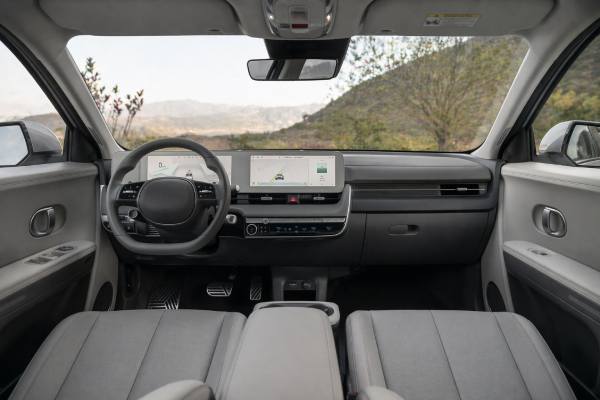
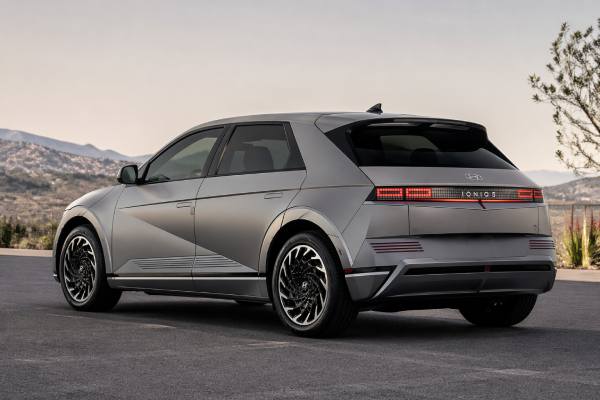
The 125 kW rear-wheel-drive Hyundai IONIQ 5 is the simpler, lighter, and more affordable side of the early NE-generation range. It uses the smaller 58 kWh battery, but it still keeps the core engineering that made the IONIQ 5 stand out when it launched: Hyundai’s E-GMP platform, an 800 V charging architecture, a long 3,000 mm wheelbase, and a cabin that feels larger than many compact-to-midsize crossovers. Officially, this version covers the pre-facelift 2021–2024 run, and in Europe it paired 170 hp with 350 Nm and a WLTP range up to 400 km depending on wheel and trim choice.
For buyers, that creates a very clear ownership profile. This is not the IONIQ 5 to choose for maximum motorway range, towing, or outright pace. It is the one to choose if you want the easiest entry into the model line, quick DC charging, a roomy interior, and a smoother, simpler single-motor rear-drive layout. The main caution is that software status, recall completion, and charging-system history matter more here than on a typical combustion crossover.
Quick Specs and Notes
- Very fast 800 V DC charging for a 58 kWh family EV, with roughly 17–18 minutes from 10% to 80% in ideal conditions.
- Spacious cabin and long 3,000 mm wheelbase make it feel larger inside than its footprint suggests.
- Rear-drive single-motor setup is smooth, predictable, and mechanically simpler than the dual-motor version.
- Early cars are worth buying only after checking ICCU recall work, charging-system updates, and software campaign history.
- Tire rotation is due every 12,000 km, and the reduction gear fluid is checked every 60,000 km in the official maintenance schedule.
Navigate this guide
- IONIQ 5 NE in Context
- IONIQ 5 NE Specs and Data
- IONIQ 5 NE Trims and Safety Tech
- Reliability Issues and Service Actions
- Maintenance and Used Buying Advice
- Real-World Driving and Range
- How It Stacks Up Against Rivals
IONIQ 5 NE in Context
The 170 hp IONIQ 5 matters because it gives you most of the platform’s best ideas without forcing you into the bigger battery or the heavier all-wheel-drive setup. Mechanically, it is straightforward: one rear electric motor, one reduction gear, and a smaller 58 kWh battery pack mounted low in the floor. That keeps the center of gravity down, preserves the flat cabin floor, and helps the car feel tidier and less nose-heavy than some front-drive EV rivals. Hyundai also gave even this entry-level version the same 800 V hardware concept used across the early range, so it never feels like a stripped-down engineering compromise.
That is the first major reason the car still makes sense on the used market. Many entry EVs from the same era charged slowly once you moved past city use. The 58 kWh IONIQ 5 did not. In ideal conditions it can accept up to 175 kW on a suitable DC charger, and the charging window from 10% to 80% is short enough to make regional trips practical, even if the battery itself is not large. In real ownership terms, that helps offset the standard-range car’s biggest weakness: motorway endurance. It is easy to live with in town and mixed driving, but repeated 120 km/h motorway runs in winter will shrink usable distance far more than on the 72.6 or 77.4 kWh versions.
The second reason this version deserves attention is packaging. Hyundai stretched the wheelbase to 3,000 mm, which is unusually long for the car’s exterior length. The result is a lounge-like front seating area, generous rear leg room, and a boot that is useful for real family duty. The standard-range rear-drive version also gets the small front trunk, though in this configuration it remains more of a cable bin than a full cargo space. This is an EV designed around cabin usability rather than around a dramatic coupe profile, and that still works in its favor today.
Ownership, however, is not just about the platform’s strengths. Early IONIQ 5s built their reputation on fast charging and smart packaging, but they also built a paper trail of software campaigns, charging logic updates, and ICCU-related recalls. That does not automatically make the 125 kW model a bad used buy. It does mean that documentation matters. A later car with completed recall work, updated charging software, and healthy battery behavior is usually the smarter choice than an early bargain example with missing service records. For cold-climate drivers, a car with battery conditioning and a heat pump is especially attractive, because those items do more to preserve charging performance and winter usability than cosmetic trim upgrades ever will.
The cleanest way to think about this model is simple. It is the rational IONIQ 5: less about bragging rights, more about usability. If your driving is mostly urban, suburban, and mixed-route, and you can charge at home or at work, the 58 kWh rear-drive car still feels well judged. If you routinely tow, do high-speed winter road trips, or want the strongest resale desirability, the larger-battery versions are easier recommendations.
IONIQ 5 NE Specs and Data
Powertrain, battery and efficiency
| Specification | Value |
|---|---|
| Motor type | Permanent-magnet synchronous motor |
| Motor layout | Single rear motor |
| Drive type | Rear-wheel drive |
| Max power | 170 hp (125 kW) |
| Max torque | 350 Nm (258 lb-ft) |
| Battery chemistry | Lithium-ion polymer, NMC cathode |
| Battery gross capacity | 58.0 kWh |
| Battery usable capacity | 54.0 kWh |
| Battery layout | Floor-mounted traction pack |
| Cell count | 288 cells |
| Nominal battery voltage | 523 V |
| Electrical architecture | 800 V class |
| Official test cycle | WLTP |
| Official range | 384 km to 400 km (239 to 249 mi) |
| Official efficiency | 16.3 to 16.7 kWh/100 km |
| Real-world range | 295 km (183 mi) |
| Highway consumption at 110 km/h | 20.0 kWh/100 km mild weather; 25.7 kWh/100 km cold weather |
| Highway range at 110 km/h | 270 km mild weather; 210 km cold weather |
| Heat pump | Optional on some trims and markets |
Charging and driveline
| Specification | Value |
|---|---|
| Transmission | Single-speed reduction gear |
| AC charging connector | Type 2 |
| DC charging connector | CCS Combo 2 |
| Charging port location | Right rear quarter |
| Onboard AC charger | 10.5 kW three-phase |
| Max DC fast charge rate | 175 kW |
| Average DC power, 10% to 80% | 140 kW |
| Typical DC 10% to 80% time | 17 to 18 minutes |
| Typical AC 0% to 100% time | About 6 hours |
| Battery preconditioning | Available with battery conditioning software and supported navigation trigger |
| Vehicle-to-load output | Up to 3.6 kW |
Performance and chassis
| Specification | Value |
|---|---|
| 0–100 km/h | 8.5 s |
| Top speed | 185 km/h (115 mph) |
| Front suspension | MacPherson strut |
| Rear suspension | Multi-link |
| Steering | Motor-driven power steering |
| Tyres | 235/55 R19 or 255/45 R20 |
| Turning circle | 12.0 m (39.4 ft) |
| Kerb weight | 1830 to 1910 kg (4034 to 4211 lb) |
| GVWR | 2370 kg (5225 lb) |
| Payload | 460 to 540 kg (1014 to 1190 lb) |
| Unbraked towing | 750 kg (1653 lb) |
Dimensions, safety and service data
| Specification | Value |
|---|---|
| Length | 4635 mm (182.5 in) |
| Width | 1890 mm (74.4 in) |
| Height | 1605 mm (63.2 in) |
| Wheelbase | 3000 mm (118.1 in) |
| Cargo volume, seats up | 527 to 531 L |
| Cargo volume, seats folded | 1587 to 1591 L |
| Front trunk | 57 L |
| Euro NCAP | 5 stars; Adult 88%, Child 86%, Vulnerable Road Users 63%, Safety Assist 88% |
| IIHS | Top Safety Pick+ for 2024, with trim-dependent headlight ratings |
| Reduction gear fluid | HK ATF 65 SP4M-1; 3.4 to 3.5 L |
| Brake fluid | DOT 4 LV / ISO 4925 Class 6 |
| Standard coolant capacity | 6.3 to 6.4 L |
| Low-conductivity coolant capacity | 8.8 to 9.4 L |
| A/C refrigerant | R-1234yf or R-134a depending system version |
| Compressor oil | POE J639, 150 to 180 g depending system version |
| Wheel nut torque | 108 to 127 Nm (79 to 94 lb-ft) |
IONIQ 5 NE Trims and Safety Tech
For the 58 kWh rear-drive car, the most useful baseline is the Europe and UK specification, because that is where Hyundai clearly separated the standard-range model into everyday trims rather than niche special editions. In MY23 UK form, the 125 kW 58 kWh car was offered mainly as SE Connect and Premium, both rear-wheel drive. That matters because used buyers will often see visually similar cars with very different winter and safety equipment. Premium was not just a comfort trim. It could bring a more desirable feature mix for long-term ownership, including upgraded lighting, larger wheel choices, extra convenience equipment, and a broader driver-assistance set.
The smart options are the ones that change how the car lives, not how it photographs. Heat pump availability is one of those. On these 58 kWh cars, it was optional on some trims rather than universally standard, so buyers in colder regions should actively look for it. Battery heating and pre-conditioning also became more important over time because they improved real fast-charging usefulness in low temperatures. A standard-range IONIQ 5 without the right thermal and software setup can feel much less impressive in winter than the headline charging numbers suggest. Later MY23-era equipment and update support made the car easier to live with in that respect.
Quick trim identifiers help. SE Connect is usually the value choice. Premium is usually the sweet spot. Larger wheels look sharper but tend to hurt efficiency and ride quality on the smaller-battery car, so the simpler wheel-and-tyre setups are often better for real ownership. The same logic applies inside: the best used example is not necessarily the flashiest one, but the one with the most complete software history, the better thermal equipment, and the least evidence of neglected charging hardware. On this model, practical specification beats cosmetic specification.
Safety is one of the stronger parts of the IONIQ 5 story. Euro NCAP awarded five stars with 88% adult occupant protection, 86% child occupant protection, 63% vulnerable road user protection, and 88% safety assist, and the result was maintained through later annual reviews for the pre-facelift car. That is a good structural baseline for the entire line, and Euro NCAP explicitly tied the assessment to the IONIQ 5 family rather than to one luxury trim only.
IIHS adds useful nuance for North American readers. The IONIQ 5 earned Top Safety Pick+ for 2024, but the detail that matters is the headlight variation. Some trims scored Good, while others were only Acceptable. That means equipment matters, especially if you drive often at night on unlit roads. IIHS also noted improvements for later models in side-impact performance due to structural reinforcements.
The ADAS package is broad for the class and era. Depending on year and trim, you can find forward collision avoidance with vehicle, pedestrian and junction functions, adaptive cruise, lane-keeping and lane-following support, blind-spot systems, rear cross-traffic assist, intelligent speed limit support, Highway Driving Assist, parking sensors, and camera-based convenience features. Airbag coverage is also strong, including a front-center airbag on many cars, while ISOFIX points on the outer rear seats make family use straightforward. The real buying point is not whether the car has assistance systems at all, but whether they are present in the trim you are viewing and whether windscreen, camera, radar, or bumper repairs have been calibrated properly afterward.
Reliability Issues and Service Actions
The IONIQ 5’s reliability record is best understood in layers. The battery, motor, and basic platform have generally avoided the kind of catastrophic pattern that ruins an EV’s reputation. The problem areas are more specific: charging-system electronics, 12 V support, software logic, and a few quality issues around trim and hardware. On the 125 kW rear-drive car, that makes documentation more important than mileage alone.
The headline issue is the ICCU, or Integrated Charging Control Unit. This is the known watchpoint on 2022–2024 IONIQ 5s, because failure can reduce or stop 12 V battery charging and eventually push the car into a fail-safe condition with reduced or lost motive power. Hyundai’s recall remedy involved inspection, possible ICCU and fuse replacement, and a software update. For a used buyer, this is the first VIN-level check to make. If the seller cannot show recall completion or dealer confirmation, treat that as a major risk flag rather than a minor paperwork gap.
A second group of issues is software-led rather than hardware-led. Early cars needed updates for battery conditioning, AC charging logic, regenerative braking lamp behavior, i-Pedal behavior, charging restart logic, and some infotainment faults. These are important because they directly affect how “sorted” the car feels day to day. A car without the right software can charge more erratically on AC, respond less cleanly in regen, or miss out on better cold-weather DC charging behavior. On this model, software is not an optional extra. It is part of the mechanical health picture.
Common low-to-medium severity issues include tailgate rattle, charging-port detail faults, and the general annoyance of 12 V battery sensitivity after repeated low-voltage events. Tailgate noise is widely known and often curable with revised bumpers or adjustment rather than major parts. Charging-port latch, seal, or cap issues are less dramatic than ICCU faults but still worth checking, especially on cars that have spent time outside or have used public chargers heavily. A scruffy, loose, or overheated-looking port is a reason to slow down the purchase process.
There are also a few issue patterns that are less dramatic but still matter in long ownership. Like many EVs with strong regenerative braking, the IONIQ 5 can hide friction-brake neglect. Discs and pads may look worse than expected because the car simply does not use them much in gentle driving. Light corrosion, noise, and uneven pad use are therefore more common than outright brake-system failure. Suspension wear is not an epidemic on this model, but heavy-wheel cars on rough roads will age bushings, links, and tyres faster than 19-inch cars used more gently.
The main pre-purchase request list should therefore include the full service history, proof of recall and campaign work, any invoice mentioning ICCU, VCU, VCMS, or battery-conditioning updates, and evidence of correct coolant and charging-system maintenance. Ask whether the car has had any battery-module, onboard charger, charge-port, or 12 V battery replacement. Also ask for a battery health report and a charging session demonstration where possible. This is a car that rewards evidence.
Maintenance and Used Buying Advice
The IONIQ 5 is not maintenance-free, but it is maintenance-light when treated properly. The official schedule is straightforward, and most of the sensible ownership advice focuses on inspections, fluid condition, brakes, tyres, charging hardware, and keeping software current rather than on large routine mechanical jobs. Hyundai’s maintenance guidance for the 2022-era car includes monthly checks for coolant, lights, tyre pressures, and wheel-lug security, annual checks for items such as brake fluid and 12 V battery terminal condition, tire rotation every 12,000 km, and reduction-gear fluid inspection every 60,000 km, with closer attention under severe use.
A practical ownership schedule looks like this:
- Every month: check tyre pressures, coolant levels, washer fluid, and the charge-port area for dirt or seal damage.
- Every 12,000 km or 12 months: rotate tyres, inspect brake pads and discs, inspect suspension joints, inspect steering components, and check wheel alignment if tyre wear is uneven.
- Every 24 months: inspect the cabin filter closely and replace it sooner in dusty use; check A/C performance and inspect hoses and visible cooling hardware.
- Every 60,000 km: inspect reduction-gear fluid per the official schedule and review any noise, seepage, or driveline vibration.
- Every 12 months: test the 12 V battery, because the car’s support electronics place more importance on a healthy auxiliary battery than many owners expect.
- Any time charging behavior changes: inspect AC and DC charging performance, update software, and check for campaign eligibility.
For severe use, shorten your inspection mindset rather than waiting for a hard failure. Frequent DC fast charging, repeated high-speed motorway use, towing, hot climates, and extreme cold all increase thermal demand. On this car, that means cooling-system cleanliness, correct coolant type, and charging behavior deserve closer monitoring than on a lightly used city EV. Hyundai specifies EV-specific coolant systems on the IONIQ 5, and using the wrong fluid is not a harmless shortcut. The standard coolant and low-conductivity coolant capacities differ depending on heat-pump configuration, while the rear reduction gear uses HK ATF 65 SP4M-1 in roughly 3.4 to 3.5 liters. Wheel nuts are tightened to 108 to 127 Nm.
As a used buy, the best strategy is to value condition and update status over badges. Seek later 2023–2024 examples with documented campaign completion, healthy AC and DC charging behavior, and no repeated 12 V incidents. In colder regions, a heat-pump car is worth paying for. Cars on 19-inch wheels are often the better real-world choice because they usually ride better and preserve efficiency. Be careful with neglected early examples that look cheap but have patchy recall history or vague answers about charging issues.
Your inspection checklist should focus on five areas. First, battery health: ask for a state-of-health report and compare displayed range with state of charge and ambient temperature. Second, charging hardware: test both AC and DC if possible, and inspect the port, flap, latch, and seals. Third, cooling and thermal management: look for correct coolant history, quiet fans, and no warning messages. Fourth, chassis and brakes: check for tyre-edge wear, brake corrosion, and knocks from the suspension. Fifth, electronics: verify ADAS, cameras, infotainment, navigation-based charger routing, and OTA or dealer software history.
Long term, the outlook is good if the car is serviced properly. The most likely higher-cost items are not the motor itself, but charging-system electronics, 12 V support issues, and eventually tyres and suspension wear on heavier wheel packages. That is a manageable risk profile for a used EV, provided the paper trail is strong.
Real-World Driving and Range
On the road, the 125 kW IONIQ 5 is better than its numbers suggest in normal use and less impressive than its design suggests in sustained high-speed use. Around town it feels stronger than a 170 hp figure implies because the motor delivers its 350 Nm immediately and without shift interruptions. The rear-drive layout gives it a clean, natural step-off feel, and the single-motor setup is smooth rather than dramatic. It never feels fast in the way a dual-motor EV does, but it feels more than adequate for urban traffic, short slip roads, and everyday overtakes. The official 0–100 km/h time of 8.5 seconds matches that character well.
Ride quality is one of the car’s stronger points, especially on smaller wheels. The long wheelbase settles the body over broken surfaces better than many rivals, and the low battery mass helps it feel planted without becoming harsh. The flip side is that it is not a small, playful hatchback. It is a broad, quiet crossover with a comfort-first balance. That suits the rear-drive standard-range car nicely. On 19-inch wheels, it tends to feel calmer and more efficient. On 20-inch setups, appearance improves, but road noise and energy use usually move the wrong way.
Regenerative braking is one of the IONIQ 5’s most useful features. Once familiar with the paddles and drive modes, most owners adapt quickly. One-pedal driving can be genuinely convenient in traffic, and the system offers enough variation between coast and stronger regen to suit different tastes. Early software updates mattered here, though, because Hyundai revised brake-light logic, i-Pedal behavior, and some related control functions on affected cars. A well-updated car feels more polished than an early one that missed campaigns.
Range is where expectations need to stay realistic. Official WLTP figures reach up to 400 km in the most favorable configuration, but real-world average range is closer to 295 km. On a steady 110 km/h run, independent data points to about 270 km in mild weather and around 210 km in cold weather, with energy use rising from roughly 20.0 to 25.7 kWh/100 km. Push speed higher, add strong HVAC demand, or use larger wheels, and the smaller battery becomes the limiting factor very quickly. This is why the 58 kWh IONIQ 5 makes most sense as a commuter, mixed-use family EV, or regional-trip car rather than as a frequent long-distance motorway machine.
Charging is the feature that saves it on longer trips. The car’s 800 V architecture still feels special in this class because it lets the battery accept power much faster than many same-era rivals with similar or even larger packs. Peak DC charging reaches 175 kW on the 58 kWh car, with an average around 140 kW in the key 10% to 80% window under ideal conditions, and that is why real trip time stays competitive. Battery temperature matters, though. Preconditioning, route guidance to a charger, and ambient conditions all affect whether you see the headline numbers or something much slower. On AC, the three-phase onboard charger is straightforward for home or workplace use, and a full charge is roughly a six-hour job on suitable hardware.
In short, the 125 kW IONIQ 5 drives like a well-resolved daily EV. It is quiet, smooth, spacious, and relaxing. Its biggest dynamic flaw is not performance but stamina when conditions turn unfavorable.
How It Stacks Up Against Rivals
Against rivals, the 58 kWh IONIQ 5 wins with architecture, space, and charging sophistication. It is not always the cheapest used EV, and it is not the longest-range option in its power bracket, but it still feels like a more advanced product than many alternatives from the same years.
The closest mechanical rival is the Kia EV6 standard-range rear-drive model. Because it shares the E-GMP platform, it offers similar charging advantages and broadly similar drivetrain behavior. The difference is in character. The EV6 feels lower, more driver-focused, and slightly tighter in its responses, while the IONIQ 5 feels airier, more practical, and more relaxed. If you value cabin space and upright usability, the Hyundai is the easier recommendation. If you want a slightly sportier seating position and styling, the Kia has the edge.
The Volkswagen ID.4 in smaller-battery form is the calmer, more familiar alternative. It usually rides well and is easy to place on the road, but it does not match the Hyundai’s fast-charging punch or interior sense of occasion. The IONIQ 5 also feels more special in packaging terms, thanks to its wheelbase and flat-floor design. The VW’s appeal is simplicity and brand familiarity. The Hyundai’s appeal is better EV-native engineering.
The Nissan Ariya 63 kWh is another credible competitor for buyers who value refinement and cabin quality. In some respects it feels more premium, but it generally does not offer the same charging theater or interior packaging efficiency as the Hyundai. The IONIQ 5 also has a clearer identity as an EV-first product rather than as a crossover adapted into the EV era.
At the lower-price end, the MG 4 Long Range deserves mention because it can undercut the Hyundai while being lighter, more playful, and often surprisingly good to drive. What it does not match is the IONIQ 5’s interior space, family-crossover stance, or premium charging hardware feel. The Hyundai remains the more complete road-trip and family-use proposition when update status and condition are right.
So where does that leave the 125 kW IONIQ 5? In a strong position, with one important condition: buy carefully. As a used EV, it is more compelling than many rivals because the platform still feels modern, the cabin is genuinely spacious, and the charging system is still fast. As a used purchase, though, it is less tolerant of missing history than simpler, slower rivals. The best examples are excellent. The neglected ones can turn the ownership experience into a troubleshooting exercise. For many buyers, the sweet spot is a later 2023 or 2024 car with complete recall work, documented software updates, and either the heat pump or at least confirmed battery conditioning support. That version delivers most of what makes the IONIQ 5 special without dragging you into the cost and weight of the more powerful models.
References
- Hyundai IONIQ 5 redefines electric mobility lifestyle 2021 (Press Kit)
- 2. Vehicle information – Hyundai | UK | User Manuals 2022 (Owner’s Manual)
- 9. Maintenance – Hyundai | UK | User Manuals 2022 (Owner’s Manual)
- Official Hyundai IONIQ 5 2021 safety rating 2021 (Safety Rating)
- 2024 Hyundai Ioniq 5 2024 (Safety Rating)
Disclaimer
This article is for informational purposes only and is not a substitute for professional diagnosis, repair, or official workshop guidance. Specifications, torque values, service intervals, software actions, and procedures can vary by VIN, market, build date, and equipment, so always verify details against official service documentation for the exact vehicle.
If this guide helped you, please consider sharing it on Facebook, X, or another social platform to support our work.