


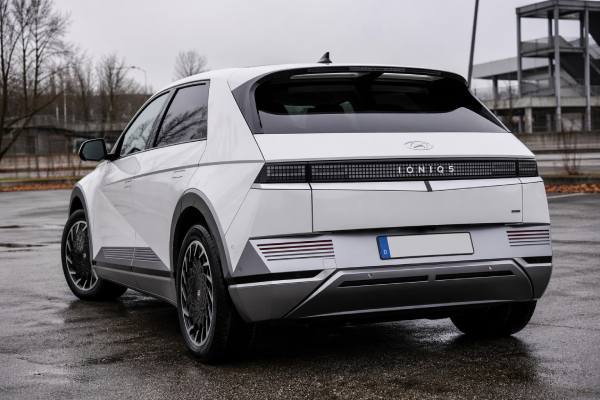
The 2021–2022 Hyundai IONIQ 5 with the 160 kW rear motor is one of the most interesting early mainstream EVs of its era. It combines Hyundai’s E-GMP platform, a long wheelbase, an 800-volt charging system, and rear-wheel drive in a package that feels more thoughtful than many rivals. For owners, that usually translates into very fast DC charging when the charger cooperates, a roomy cabin, strong comfort, and smooth daily performance. The 217 hp version is not the quickest IONIQ 5 on paper, but it is often the sweeter long-term choice because it is lighter, simpler, and efficient enough to make real-world use easy. The catch is that early cars reward careful buying: software history, charging behavior, 12 V support, and recall completion matter more than glossy paint or wheel size. Get a good one, and this version of the IONIQ 5 remains a genuinely modern EV.
At a Glance
- Very fast 800-volt DC charging can make long trips easier than in many same-era rivals.
- Rear-wheel drive gives the car a smooth, tidy balance without the extra complexity of the AWD model.
- The cabin and wheelbase make it feel larger and airier than many compact and mid-size EVs.
- Used buyers should check ICCU and charging-system campaign history carefully before purchase.
- A sensible ownership rhythm is tyre rotation and brake inspection every 12,000 km or 12 months.
Quick navigation
- Hyundai IONIQ 5 NE ownership basics
- Hyundai IONIQ 5 NE specs and data
- Hyundai IONIQ 5 NE trims and safety
- Reliability, faults, and service actions
- Maintenance plan and used buying
- Range, charging, and road manners
- How the IONIQ 5 compares
Hyundai IONIQ 5 NE ownership basics
The 160 kW rear-drive IONIQ 5 is the version that best explains why this model mattered when it arrived. It was not just another electric crossover with a flat floor and a large screen. Hyundai gave it a dedicated EV platform, a long 3,000 mm wheelbase, and a charging architecture that could use very high-power DC stations properly. In practice, that meant the car often felt one generation ahead of many mainstream rivals in day-to-day usability.
This rear-drive long-range model also lands in a useful middle ground. It has enough performance to feel brisk rather than merely adequate, yet it avoids the extra mass and complexity of the dual-motor AWD version. Around town, the instant response is clean and easy to modulate. On faster roads, the rear motor’s 350 Nm gives it enough mid-range pull to merge, pass, and climb without drama. It is not a sports EV, but it never feels strained.
What owners usually notice first is how well packaged it is. The cabin feels wide, the rear seat area is generous, and the square-opening hatchback layout makes it easier to live with than some sleeker EVs. The ride is another major strength. Even on larger wheels, the IONIQ 5 usually feels calmer than many firm-riding electric rivals, and the long wheelbase helps it settle over broken roads.
The main ownership advantage, however, is charging. On a strong DC charger, the IONIQ 5 can add range quickly enough to change how road trips feel. The car is still limited by charger quality, battery temperature, and state of charge, but when conditions line up it behaves like a premium EV in an area where many same-era models do not.
That does not mean every early example is trouble-free. The 2021–2022 cars deserve a more careful used-buying approach than a casual walk-around suggests. The critical questions are not only battery health and tyre wear. They are software status, recall completion, charging behavior, 12 V support, and whether the car has had any charging-system or ICCU work. Early IONIQ 5s are fundamentally appealing, but they are much better when they have been kept current.
For many buyers, that is the real summary of this version: it is a modern, highly usable EV with standout charging and packaging, but it rewards informed ownership more than a simpler low-voltage hybrid or a late-model combustion crossover.
Hyundai IONIQ 5 NE specs and data
Powertrain and battery
| Spec | Value |
|---|---|
| Motor type | Permanent Magnet Synchronous Motor (PMSM) |
| Motor layout | Single rear motor, rear axle |
| Drive type | RWD |
| Transmission / drive unit | Single-speed reduction gear |
| Max power | 217 PS / 160 kW / about 217 hp |
| Max torque | 350 Nm / 258 lb-ft |
| Battery chemistry | Lithium-ion polymer, NMC-type pack |
| Gross battery capacity | 72.6 kWh |
| Usable battery capacity | about 70.0 kWh |
| System voltage | 653 V nominal |
| Architecture | 800 V-class |
| Battery layout | Floor-mounted underbody pack |
| Cell count | 360 cells |
| Module count | 30 modules |
| Pack configuration | 180s2p |
Charging and range
| Spec | Value |
|---|---|
| AC connector | Type 2 |
| DC connector | CCS |
| Charging port location | Right rear quarter |
| Onboard AC charger | 10.5 kW three-phase |
| Typical AC max acceptance | 10.5–11 kW |
| AC 0–100% charge time | 6 h 9 min to about 7 h 30 min |
| DC fast-charge peak | about 220–221 kW |
| DC 10–80% time | about 17–18 min on high-power DC |
| DC 10–80% average power | about 179 kW |
| DC 10–80% time on 150 kW charger | about 21 min |
| DC 10–80% time on 50 kW charger | about 56–62 min |
| Typical taper point | strongest taper usually begins above about 55–60% SOC |
| Official test standard | WLTP |
| WLTP range, 19-inch wheels | up to 485 km / 300 mi |
| WLTP range, 20-inch wheels | up to 451 km / 281 mi |
| Rated efficiency, 19-inch wheels | 16.8 kWh/100 km |
| Rated efficiency, 20-inch wheels | 17.9 kWh/100 km |
| Real-world highway estimate at 120 km/h | about 22–25 kWh/100 km |
| Real-world highway range at 120 km/h | about 280–320 km / 174–199 mi |
Performance and capability
| Spec | Value |
|---|---|
| 0–100 km/h | 7.4 s |
| 0–62 mph | 7.4 s |
| Top speed | 185 km/h / 115 mph |
| Towing capacity, braked | 1,600 kg / 3,527 lb |
| Towing capacity, unbraked | 750 kg / 1,653 lb |
| Payload | 440–520 kg / 970–1,146 lb |
| Turning circle | about 12.0 m / 39.4 ft |
Chassis and dimensions
| Spec | Value |
|---|---|
| Front suspension | MacPherson strut |
| Rear suspension | Multi-link |
| Steering type | Column motor-driven power steering |
| Steering turns lock-to-lock | 2.67 |
| Front brakes | 345 mm ventilated discs |
| Rear brakes | 345 mm ventilated discs |
| Tyres, common 19-inch fitment | 235/55 R19 |
| Tyres, common 20-inch fitment | 255/45 R20 |
| Length | 4,635 mm / 182.5 in |
| Width | 1,890 mm / 74.4 in |
| Height | about 1,605 mm / 63.2 in |
| Wheelbase | 3,000 mm / 118.1 in |
| Kerb weight | about 1,910–1,990 kg / 4,211–4,387 lb |
| GVWR | 2,430 kg / 5,357 lb |
| Cargo volume, seats up | 527–531 L / 18.6–18.7 ft³ |
| Cargo volume, seats down | 1,587–1,591 L / 56.0–56.2 ft³ |
| Front trunk | about 57 L / 2.0 ft³ |
Safety and service data
| Spec | Value |
|---|---|
| Euro NCAP rating | 5 stars |
| Euro NCAP adult occupant | 88% |
| Euro NCAP child occupant | 86% |
| Euro NCAP vulnerable road users | 63% |
| Euro NCAP safety assist | 88% |
| IIHS award | Top Safety Pick+ on qualifying 2022 vehicles |
| IIHS headlight rating | Good on projector setup; Acceptable on reflector setup |
| Standard core ADAS | AEB, lane keep assist, lane follow assist, intelligent speed limit assist, rear camera |
| Reduction gear oil spec | Hyundai / Kia ATF 65 SP4M-1 |
| Reduction gear oil capacity, RWD | about 3.4–3.5 L / 3.6–3.7 US qt |
| Brake fluid spec | DOT 4 LV / ISO 4925 Class 6 type |
| Standard coolant capacity, RWD with heat pump | about 6.3 L / 6.7 US qt |
| Standard coolant capacity, RWD without heat pump | about 6.4 L / 6.8 US qt |
| Low-conductivity coolant capacity, RWD with heat pump | about 9.4 L / 9.9 US qt |
| Low-conductivity coolant capacity, RWD without heat pump | about 8.8 L / 9.3 US qt |
| A/C refrigerant, heat pump car | R-1234yf, about 900 ± 25 g |
| A/C refrigerant, no heat pump | R-1234yf, about 700 ± 25 g |
| A/C compressor oil, heat pump car | POE oil, about 180 ± 10 g |
| A/C compressor oil, no heat pump | POE oil, about 150 ± 10 g |
| Wheel nut torque | 108–127 Nm / 79–94 lb-ft |
| High-voltage battery warranty | 8 years / 160,000 km in many European markets |
Hyundai IONIQ 5 NE trims and safety
In its early UK and European form, the 160 kW rear-drive IONIQ 5 was usually offered in a straightforward trim ladder. In the UK, the main names were SE Connect, Premium, and Ultimate, with option packs that mattered because they changed both comfort equipment and cold-weather usability. That matters on the used market because two cars with the same battery and motor can feel quite different in winter or on long trips.
SE Connect was not a stripped car. It still brought the core cabin layout, dual-screen dashboard, navigation, regenerative braking paddles, and the main active-safety systems. Premium added the equipment that many buyers actually wanted, such as upgraded lighting, more convenience features, heated items, and a better everyday feel. Ultimate pushed harder into luxury territory with larger wheels, a richer cabin, extra parking and visibility tech, and in many markets the most complete ADAS set. The trade-off was obvious: the larger wheel and tyre package looked better, but it usually cost some efficiency and real range.
Option packs are worth studying carefully. Early cars could be specified with features such as a heat pump and battery-heating hardware, vehicle-to-load equipment, upgraded parking assistance, and richer seat configurations. On a used IONIQ 5, those options are more important than cosmetic details because they change how pleasant the car is in winter and how flexible it feels in everyday use. A car with a heat pump, for example, is usually the smarter long-term buy in colder climates.
Quick identifiers help. In many markets, 19-inch wheels generally point to the more efficiency-focused versions, while 20-inch wheels usually signal a higher trim. Projector-style headlights and the fuller parking-assistance package also tend to indicate a better-equipped car. Inside, seat trim, audio system branding, and whether the car has the more advanced parking and blind-spot display functions can separate lower and upper grades quickly.
On safety, the IONIQ 5 started strongly. Euro NCAP gave it five stars in 2021, and the tested European car was a 160 kW left-hand-drive version, which makes the result especially relevant here. The strong adult and child scores were backed up by solid structural performance and an effective centre airbag strategy to reduce occupant-to-occupant contact. In North America, qualifying 2022 cars also achieved a strong IIHS result, though headlight performance varied by lighting setup.
The ADAS suite is broad for the period. Core equipment usually includes autonomous emergency braking, lane keeping, lane centring support, intelligent speed assistance, driver-attention monitoring, rear camera support, and tyre-pressure monitoring. Higher trims add stronger blind-spot support, cross-traffic features, parking assistance, and in some markets the more advanced Highway Drive Assist 2 system. Used buyers should confirm what the car actually has rather than trusting a sales listing, because early equipment mixes vary more than many buyers expect.
Reliability, faults, and service actions
The early IONIQ 5 is not a fundamentally fragile EV, but it is a software-sensitive and campaign-sensitive one. In other words, a fully updated car with documented dealer history is usually a much better bet than a superficially similar example with gaps in recall and service records.
A practical way to understand reliability is to split problems by frequency and consequence:
- Common and medium-to-high importance: ICCU and 12 V charging support issues.
- Occasional and medium importance: charging interruptions, slower-than-expected AC charging, and charging-port related fixes.
- Occasional and low-to-medium importance: software calibration issues, warning messages, and small drivability or charging-behavior quirks.
- Occasional and low importance: trim noise, tailgate rattles, brake feel complaints, and minor electronic glitches.
The most important known issue is the ICCU story. Symptoms can start with warning messages, charging irregularities, or a 12 V battery that no longer seems properly supported. In the worst case, the car can enter a reduced-power fail-safe mode as the low-voltage battery depletes. The correct remedy is not guesswork. Owners should confirm completion of the latest ICCU recall or campaign action, because Hyundai’s later fix superseded earlier work on some vehicles.
Charging behavior is the next area to check. Some cars have had interrupted AC charging sessions, reduced Level 2 charging speed, or charge-port related service actions. Symptoms include the car stopping charge unexpectedly, charge speed dropping for no obvious reason, or a charge port that has clearly been apart before. These issues often point to software updates, charging-port hardware inspection, or campaign work rather than a failed traction battery.
Battery health itself is usually less dramatic than internet discussion suggests. On these cars, owners are more likely to notice winter efficiency swings, preconditioning differences, and charging-speed variation than severe early capacity loss. A healthy example should still feel consistent in range delivery and charging behavior. A car that shows a large gap between displayed state of charge and practical usable range, or one that charges unusually slowly without a temperature explanation, deserves a closer battery-health inspection.
Other areas to watch are more conventional. Listen for front and rear suspension knocks, check for uneven tyre wear that suggests alignment trouble, and inspect the underbody for damage around battery shields and covers. Because regen does a lot of the slowing, friction brakes can develop corrosion or light binding if the car has been used gently for long periods. That is usually a maintenance issue, not a design disaster, but it does matter.
Before buying, ask for proof of completed recalls, software updates, charging-system work, coolant-related service where applicable, and any high-voltage repairs or module replacements. On this model, paperwork matters almost as much as the test drive.
Maintenance plan and used buying
The IONIQ 5 is lighter on routine service than a combustion SUV, but it is not maintenance-free. The best ownership approach is a simple annual schedule with a few EV-specific checks added to the usual tyre, brake, and suspension routine.
A sensible maintenance plan looks like this:
- Every 12,000 km or 12 months
- Rotate tyres.
- Inspect brake pads, discs, and calipers.
- Check tyre wear pattern and alignment.
- Inspect suspension joints, bushes, and steering components.
- Test the 12 V battery and charging support.
- Inspect underbody shields, battery-case area, and fasteners.
- Check coolant levels and look for leaks.
- Confirm software and campaign status.
- Every 24,000 km or 24 months
- Replace the cabin air filter in normal use.
- Inspect brake fluid condition closely.
- Recheck brake corrosion, especially on lightly used cars.
- Clean and inspect the charge-port seals and latch hardware.
- Around 24–48 months depending on market schedule and use
- Replace brake fluid.
- Shorten the interval in humid climates or hard-use conditions.
- Every 60,000 km
- Check reduction-gear fluid condition.
- Inspect half-shafts, seals, and drive-unit mounts.
- Pay closer attention if the car has done repeated high-speed driving or frequent towing.
- Severe-use adjustments
- If the car sees frequent DC fast charging, long motorway runs, mountain driving, towing, or extreme cold or heat, shorten inspection intervals for tyres, brakes, charging hardware, and drivetrain fluids.
For used buyers, the inspection checklist should focus on the areas that actually change ownership cost. Start with battery health. Ask for a state-of-health report, then compare the car’s real-world projected range at a normal state of charge with what the trim and wheel size should reasonably deliver. A healthy pack can still show winter loss, but it should not feel erratic.
Then check charging. Make sure AC charging is stable, DC charging begins normally, and there is no obvious evidence of repeated overheating or charging interruption complaints. Inspect the charge port, flap, latch, and seals. Ask whether the car has had ICCU work, VCMS charging updates, or charge-port campaign work.
Next, inspect brakes and tyres carefully. The IONIQ 5 is heavy, and poor alignment or neglected brake hardware shows up faster than on a small hatchback. Check the inner tyre shoulders. Check the discs for heavy corrosion. A car used mostly in the city with strong regen may need brake-service attention earlier than buyers expect.
Finally, think strategically about trim choice. For many buyers, the best used example is a long-range rear-drive car on 19-inch wheels with documented recall completion, a heat pump if available in that market, and a full dealer or specialist history. That is usually the sweet spot for comfort, range, simplicity, and long-term value.
From a durability perspective, the outlook is good if the car is kept updated. Expect modest battery aging in normal use, but budget for tyres, brake service due to low-use corrosion, a 12 V battery at some point, and the possibility of campaign-related charging-system work rather than major traction-battery failure.
Range, charging, and road manners
On the road, the 160 kW rear-drive IONIQ 5 feels more mature than exciting, and that is mostly a compliment. The first impression is smoothness. Step-off response is immediate but not snappy in a tiring way, and the motor’s torque delivery is easy to meter in traffic. In normal driving, the car feels relaxed and quiet rather than aggressively fast.
Ride quality is one of the car’s strongest points. The long wheelbase helps it calm down broken surfaces, and the body control is generally better than people expect from a large, heavy EV on crossover tyres. The steering is not especially talkative, but it is predictable, light enough at parking speeds, and stable on the motorway. Rear-wheel drive gives the car a cleaner balance than some front-heavy EVs, especially in wet conditions where the front axle is not trying to do everything at once.
Regenerative braking is also well judged. The paddle-adjustable system gives the driver useful control, and one-pedal style driving is easy to learn. The main complaint some drivers have is the usual EV handoff issue: under some conditions, the transition between regen and friction braking is not as natural as the best systems in the class. It is acceptable, but not perfect.
Efficiency depends heavily on speed and wheel size. In city and suburban use, mild-weather consumption in the mid-teens kWh/100 km is realistic, and the car can feel impressively frugal for its size. Mixed driving in good conditions often lands around 16–19 kWh/100 km. On faster roads, the picture changes. At a steady 120 km/h, this version is no longer especially thrifty, and consumption around 22–25 kWh/100 km is a reasonable expectation. That usually means real highway range in the rough 280–320 km window in mild conditions, with winter weather, wind, and larger wheels dragging it down further.
Cold weather matters more here than on paper specs suggest. Cabin heating, battery temperature, and road speed can take a noticeable bite out of usable range. A car with a heat pump and the right charging-related software is the better winter companion.
Charging remains the headline strength. At home, the car is easy to live with, and a proper three-phase AC setup lets it recover overnight without stress. On DC, the IONIQ 5 can still feel genuinely fast by modern standards. When the battery is warm and the charger is capable, the car charges hard through the useful mid-band and can make short road-trip stops feel genuinely short. That does not mean every session is perfect. Cold packs, busy stations, and high starting state of charge still reduce the benefit. But when conditions are right, this Hyundai makes many same-era EVs feel slower to travel in.
How the IONIQ 5 compares
Against its main rivals, the 160 kW rear-drive IONIQ 5 stands out less for any single number than for its overall mix. It is one of those cars that wins by being well judged in several important areas at once.
The most obvious comparison is the Kia EV6 rear-drive long-range model, because the two cars share their core platform. The EV6 feels lower, slightly tighter, and more driver-focused, while the IONIQ 5 feels airier, calmer, and more practical. If you value style, a lower seating position, and a slightly sharper road feel, the Kia makes a strong case. If you care more about cabin space, rear-seat comfort, and a more relaxed daily character, the Hyundai is usually the easier car to recommend.
The Tesla Model Y is a different kind of rival. It tends to win on software integration, route planning, and outright efficiency, and it can feel more energetic. The Hyundai fights back with a more distinctive cabin atmosphere, friendlier physical ergonomics for some drivers, and often a more settled ride. The Tesla also feels more minimalist, which some buyers love and others strongly dislike. The IONIQ 5 is the better choice for buyers who want an EV to feel modern without feeling stripped back.
Compared with the Volkswagen ID.4 and Skoda Enyaq from the same period, the Hyundai usually offers quicker-feeling charging and a more technically ambitious platform. The German rivals often feel more conventional in their driving position and controls, and some buyers may prefer that. But the IONIQ 5 generally feels more advanced where long-distance EV use really counts.
Where does the Hyundai lose ground? It is not the most efficient EV at sustained motorway speeds, and the styling means some buyers expect sports-car responses that the chassis never fully delivers. The cabin is roomy, but not every trim justifies its used price equally well, especially if large wheels or missing cold-weather equipment hurt real-world value.
Overall, this version of the IONIQ 5 compares best as a smart, fast-charging, comfort-first EV. It is not the sharpest, cheapest, or most efficient choice in every scenario. But it is one of the most rounded. For buyers who care about long-trip usability, a spacious cabin, and a modern EV architecture without stepping into a luxury badge, it remains one of the strongest used electric crossovers of its generation.
References
- IONIQ 5 – Pricing, Specification and Technical information 2021 (Technical Specifications)
- 9. Maintenance – Hyundai | UK | User Manuals 2022 (Owner’s Manual)
- Euro NCAP | Hyundai IONIQ 5 2021 (Safety Rating)
- 2022 Hyundai Ioniq 5 2022 (Safety Rating)
- Safety Recall 272: Integrated Charging Control Unit (ICCU) 2024 (Recall Database)
Disclaimer
This article is for informational purposes only and is not a substitute for professional diagnosis, repair, or official service information. Specifications, torque values, service intervals, charging behavior, and repair procedures can vary by VIN, market, model year, trim, software level, wheel size, and fitted equipment, so always verify details against the correct official service documentation for the exact vehicle.
If this guide helped you, please consider sharing it on Facebook, X, or your preferred social platform to support our work.