
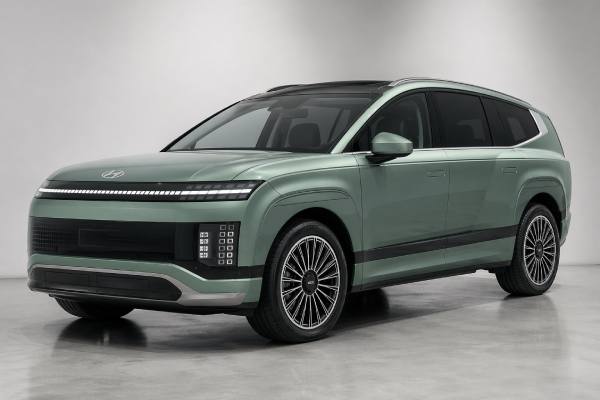


The Hyundai IONIQ 9 AWD is Hyundai’s clearest attempt yet to turn the E-GMP platform into a true large-family flagship. It takes the fast-charging foundation of the IONIQ 5 and IONIQ 6, stretches it into a genuine three-row SUV, and adds the sort of space, comfort, and towing ability buyers expect from a full-size premium electric vehicle. In CE-market form, the long-range AWD version uses a 110.3-kWh battery and dual-motor layout that prioritises usable performance, stable motorway manners, and long-distance efficiency rather than headline acceleration alone. That matters, because this is a vehicle people are more likely to load with passengers, luggage, and winter gear than launch away from traffic lights. The ownership story looks strong on paper: quick DC charging, heat-pump efficiency, generous cabin packaging, and advanced safety technology. The main caveat is simple: it is still new, so long-term reliability patterns are only just beginning to emerge.
Essential Insights
- The 800-volt E-GMP platform and 24-minute 10–80% DC charging time are major strengths for long trips.
- The long-range AWD layout blends useful traction with a large 110.3-kWh battery and up to 606 km WLTP range.
- Cabin space is a core advantage, with proper three-row packaging and strong cargo flexibility for family use.
- Because the model is still very new, software history and early campaign completion matter more than high mileage.
- A practical routine interval to remember is cabin-filter replacement every 30,000 km or 24 months.
Section overview
- Hyundai IONIQ 9 AWD core idea
- Hyundai IONIQ 9 AWD specifications
- Hyundai IONIQ 9 AWD trims and ADAS
- Fault outlook and early campaigns
- Service planning and used checks
- Real-world driving and efficiency
- IONIQ 9 AWD versus competitors
Hyundai IONIQ 9 AWD core idea
The long-range AWD IONIQ 9 sits in the middle of the range in exactly the right way. It is not the entry model, and it is not the dual-160-kW Performance AWD flagship either. Instead, it combines a 70-kW front motor and 160-kW rear motor with the big 110.3-kWh battery, giving the car enough pace for confident overtaking and easy motorway merging without turning it into an overly heavy, tyre-hungry performance special. Hyundai quotes 0–100 km/h in 6.7 seconds, which is quick for a three-row SUV, but the more important figure is the overall balance. This version is the one most family and business buyers are likely to want because it preserves the strongest mix of traction, efficiency, range, and price discipline.
That balance is helped by the way Hyundai has packaged the vehicle. At 5,060 mm long and riding on a 3,130 mm wheelbase, the IONIQ 9 is a genuinely large SUV, not just a stretched crossover with a token third row. The interior packaging looks like one of its biggest selling points. Hyundai’s European material is unusually confident here, and for good reason. There is real third-row space, a flat floor, proper six- and seven-seat options, and cargo volume that starts at 338 litres with all seats in place and expands to more than 2,400 litres with the rear rows folded flat. That makes the IONIQ 9 more than a style statement. It is a serious people-and-luggage machine.
The technical foundation also suits that role. Hyundai’s 800-volt E-GMP architecture remains one of the strongest in the industry for DC charging performance, and the IONIQ 9 keeps the 400V/800V multi-charging flexibility that has already become a known advantage on related Hyundai and Kia EVs. Add the standard heat pump on the main European trims, battery preconditioning, vehicle-to-load capability, and strong route-planning integration, and the car starts to look less like a giant electric experiment and more like a mature long-distance product.
Its limitations are easy to define. This is a large, heavy SUV, so no amount of aerodynamic work will make it feel as efficient as an IONIQ 6 or as light on its feet as a smaller crossover. The AWD version is also the sensible compromise, not the maximum-range version. Rear-wheel drive is the economy choice, and the Performance AWD is the thrill choice. The long-range AWD is the version for buyers who want to cover distance with passengers in comfort and without too many charging stops. In that role, it looks very well judged.
Hyundai IONIQ 9 AWD specifications
Powertrain, battery, and efficiency
| Specification | Value |
|---|---|
| Motor type | Permanent-magnet synchronous motors |
| Motor count and axle | Dual motor, front and rear |
| System voltage | 610 V nominal, 800-V charging architecture |
| Battery chemistry | Lithium-ion NMC |
| Traction battery capacity | 110.3 kWh gross |
| Usable battery capacity | 107.0 kWh |
| Pack layout | Floor-mounted battery pack |
| Pack structure | 152s3p, 38 modules |
| Front motor output | 70 kW |
| Rear motor output | 160 kW |
| Combined output | 226 kW (307 PS / about 303 hp) |
| Front motor torque | 255 Nm |
| Rear motor torque | 350 Nm |
| Combined torque | 605 Nm (446 lb-ft) |
| Thermal management | Liquid-cooled battery and power electronics |
| Heat pump | Standard on core European trims |
| Battery preconditioning | Available |
| Efficiency test standard | WLTP |
| Rated efficiency | 20.4 kWh/100 km (20-inch) / 20.6 kWh/100 km (21-inch) |
| Rated range | 606 km (20-inch) / 600 km (21-inch) |
| Real-world highway at 120 km/h | Approx. 26.0 kWh/100 km (418 Wh/mi), approx. 412 km (256 mi) |
Driveline and charging
| Specification | Value |
|---|---|
| Transmission / drive unit | Single-speed reduction gears, front and rear |
| Final drive ratio | Front 10.65 / Rear 13.16 |
| Drive type | AWD |
| Torque distribution | Dual-motor electronic front and rear axle control |
| AC connector | Type 2, three-phase AC |
| DC connector | CCS Combo 2 |
| Charging port location | Right rear side |
| Onboard charger | 10.5 kW AC |
| Max AC acceptance | 11 kW |
| DC fast-charge peak | Up to 257 kW peak |
| Typical DC charging curve | About 195 kW average over 10–80% |
| DC 10–80% | 24 min |
| AC 0–100% | Approx. 10 h |
| Battery preconditioning trigger | Automatic via navigation to charger |
| 400V / 800V compatibility | Yes |
| Vehicle-to-Load | Yes |
| Plug and Charge | Supported in Europe |
Performance and dimensions
| Specification | Value |
|---|---|
| 0–100 km/h | 6.7 s |
| Top speed | 200 km/h (124 mph) |
| Towing capacity | 2,500 kg braked / 750 kg unbraked |
| Payload | 572–722 kg |
| Suspension front | MacPherson strut with dual lower arm |
| Suspension rear | Five-link, self-levelling dampers |
| Steering | Motor-driven power steering |
| Steering lock-to-lock | 2.93 turns |
| Brakes | Front 360 × 30 mm ventilated discs / Rear 345 × 20 mm ventilated discs |
| Wheel and tyre sizes | 275/50 R20 or 285/45 R21 |
| Ground clearance | 174 mm (6.9 in) |
| Length / Width / Height | 5,060 / 1,980 / 1,790 mm |
| Wheelbase | 3,130 mm |
| Turning circle | 12.48 m |
| Kerb weight | 2,578–2,728 kg |
| GVWR | 3,300 kg |
| Cargo volume | 338 L / 908 L / 2,419 L (VDA, 7-seat) and 2,494 L max in 6-seat form |
| Frunk volume | 52 L |
Safety and service figures
| Specification | Value |
|---|---|
| Euro NCAP | 5 stars; Adult 84%, Child 87%, VRU 77%, Safety Assist 83% |
| IIHS | Top Safety Pick+ |
| IIHS headlight rating | Good |
| Airbags | Front, side, curtain, and centre-side airbag configuration |
| ADAS suite | FCA 2.0, HDA 2, SCC, LFA 2, LKA, BCA, RCCA, ISLA, RSPA 2, SVM, BVM depending trim |
| Battery warranty | 8 years / 160,000 km |
| Routine Hyundai EV service cadence | Typically yearly or every 2 years / 15,000 or 30,000 km depending market plan |
| Cabin air filter interval | 30,000 km or 24 months |
Hyundai IONIQ 9 AWD trims and ADAS
For a CE-market buyer, the IONIQ 9 range is unusually easy to read. Hyundai Europe positions it in GLS, Top, and Top Calligraphy trims, with each step adding a fairly logical layer of comfort and technology rather than hiding essential EV hardware behind the most expensive versions. That is important because the long-range AWD version is already a premium vehicle. Buyers do not want to be forced into a flagship trim just to get battery preconditioning, key safety hardware, or basic winter-use equipment. Hyundai gets that right here. Even GLS includes the 110.3-kWh battery, heat pump, vehicle-to-load, Highway Driving Assist 2, Forward Collision-Avoidance Assist 2.0, a three-zone climate system, dual 12.3-inch curved displays, and six 100W USB-C charging ports. For a large EV SUV, that is a strong baseline.
Top is where the car begins to feel genuinely premium. It adds 20-inch wheels, the Intelligent Front-lighting System, a head-up display, BOSE audio, blind-spot view monitoring, surround-view parking support, and Remote Smart Parking Assist 2.0. For many buyers, that is the sweet spot. It adds the features that materially change daily usability without necessarily pushing the car into the most expensive visual trim package. Top Calligraphy then adds the styling and luxury touches: 21-inch wheels, Nappa leather, more decorative interior finishes, UV-C tray equipment, and six-seat lounge-oriented options with swivelling or relaxation seats depending configuration and market.
There are also meaningful functional differences hidden inside the trim ladder. GLS is the efficiency-minded choice because it rides on 19-inch wheels and keeps the specification focused. Top typically moves to 20-inch wheels, which trims some range but brings more visual presence and more premium equipment. Top Calligraphy on 21s is the most luxurious version, but it is also the least efficient and most likely to ride more firmly over poor surfaces. That makes the used-market hierarchy fairly clear already. Buyers who want maximum value should aim at GLS or Top AWD. Buyers who want the full premium-family experience will gravitate toward Top Calligraphy, especially in six-seat form.
Safety equipment is another strong point. Euro NCAP’s five-star rating is not just a headline badge. The IONIQ 9 scored particularly well for child protection and respectable numbers for vulnerable road users and safety assist, which matters in a large vehicle likely to spend much of its life in suburban family use. IIHS has also rated the 2026 IONIQ 9 as a Top Safety Pick+, with Good headlight results and Good scores across the major crashworthiness and crash-avoidance categories. Hyundai’s ADAS package is also unusually broad for the class. Standard and upper-trim features cover AEB for cars, pedestrians, cyclists and junction scenarios, lane support, adaptive cruise, blind-spot intervention, rear cross-traffic support, intelligent speed-limit assistance, and advanced parking automation. The only real caution is the usual modern one: after body repairs, windscreen replacement, or alignment work, ADAS recalibration should be treated as essential rather than optional.
Fault outlook and early campaigns
Because the IONIQ 9 is still new, the most honest reliability verdict is a measured one. There is not yet enough long-term fleet age to call it bulletproof, nor is there evidence of a broad structural problem that should scare buyers away. What we do know is that the IONIQ 9 shares Hyundai’s E-GMP philosophy and some related component logic with other recent Hyundai and Kia EVs. That gives the car two advantages and one caution. The advantages are mature charging architecture and proven packaging. The caution is that Hyundai’s recent EV history shows how important software maturity, low-voltage support systems, and campaign completion can be in the first years of production.
At the moment, the best way to describe the issue picture is by separating carryover risks from IONIQ 9-specific actions.
- Most likely early watch area: software and control-module calibration. This is normal for a brand-new high-content EV. The IONIQ 9 carries advanced charging logic, route planning, ADAS, seat-control functions, and connected services, so updates matter.
- Moderate watch area: battery and charging hardware quality control on very early production. A 2026 U.S.-market recall covered a tiny number of IONIQ 9 vehicles for under-torqued high-voltage bus-bar retention bolts inside the battery system assembly. That is not a mass-market failure trend, but it is exactly the sort of early-production quality point that used buyers should want documented as checked or closed.
- Low-to-moderate watch area: trim and interior mechanism issues. Hyundai also issued a U.S. service campaign for certain 2026 IONIQ 9 vehicles over a walk-in seat switch that might not have been properly secured, and another campaign addressed Shift-by-Wire software logic that could leave a fault code and prevent shifting out of Park.
- Lower-cost long-term watch item: friction-brake corrosion. Like many heavy EVs with strong regen, the IONIQ 9 may use its friction brakes lightly in daily driving, which can accelerate surface corrosion if the car lives in wet or salty conditions and is driven gently.
What is missing so far is just as important. There is no established public pattern of widespread drive-unit failures, catastrophic pack degradation, repeated onboard charger breakdowns, or recurring pack isolation faults specific to the IONIQ 9. That does not mean such things can never happen. It means there is not yet evidence of a defining weak point beyond the sort of early campaign activity many new EV launches see.
Battery durability should be viewed in context. The IONIQ 9’s large pack, liquid thermal control, preconditioning capability, and relatively modest state of tune in long-range AWD form all work in its favour. In normal mixed use, that should support good long-term health. The bigger risk factors are repeated high-speed motorway driving in heat, very frequent back-to-back DC charging, neglect of cooling-system service, and owners ignoring software or recall notices because the car still “seems fine.” On a vehicle like this, the difference between a strong used buy and a risky one may come down less to mileage and more to whether its campaign and software history is complete.
For that reason, I would treat the first used examples the way experienced EV buyers already treat early Teslas, Mercedes EQ models, or E-GMP Hyundais: ask for service records, ask for campaign printouts, confirm charger behaviour, and do not assume a low-mileage car is automatically the better car.
Service planning and used checks
The IONIQ 9 AWD is a low-routine vehicle, but it is not a no-maintenance vehicle. Hyundai’s general EV service guidance makes that clear, and buyers should take it seriously because large electric SUVs hide their wear well. A neglected EV can feel fine in a short test drive while quietly storing up brake, tyre, suspension, or thermal-system expenses.
A sensible maintenance routine starts with time, not just mileage. Hyundai’s EV guidance says service may be yearly or every two years depending on the market plan, usually built around 15,000 km or 30,000 km steps. That matters because many IONIQ 9s will cover modest mileage while doing heavy family or executive use. Time-based checks are therefore just as important as distance-based ones.
A practical ownership plan looks like this:
- Every 12 months or around 15,000 km: inspect tyres, tread pattern, shoulder wear, brake discs and pads, steering joints, suspension bushings, dampers, underbody shields, charging-port seals, and the 12-volt battery state.
- Every 24 months or around 30,000 km: replace the cabin air filter, renew brake fluid where the market schedule calls for it, and inspect the cooling circuits and heat-pump operation carefully.
- At every service visit: check for software updates, ADAS calibration status, open recalls or service actions, and battery-conditioning function.
- Any time the car has lived through hard winter use or frequent towing: inspect the friction brakes more closely and do not wait for noise before cleaning or servicing them.
- Before warranty expiry milestones: request a formal battery-health check and confirm the vehicle has no stored charging or isolation faults.
The IONIQ 9’s consumable pattern is also predictable. Tyres are likely to be a notable running cost because this is a heavy AWD SUV riding on 19-, 20-, or 21-inch wheels, often with wide-section tyres. The 21-inch Calligraphy setup will look best and wear most expensively. Alignment matters more than many owners realise, because a slightly heavy front toe setting on a large EV can eat the shoulders of a premium tyre surprisingly quickly. Wiper blades, washer fluid, and cabin filtration are ordinary ownership items, but brake service deserves more attention than many EV owners expect. Regeneration lowers wear, but it does not eliminate corrosion.
For used buyers, the inspection checklist should be focused and specific:
- Battery and charging: check state of health, DC charging performance from a low state of charge, and whether battery preconditioning activates correctly.
- Thermal management: confirm the heat pump works properly, check for coolant odours or unexplained residue, and verify there are no repeated warnings relating to cooling or charging.
- 12-volt and electrical support systems: look for battery replacement history, unexplained resets, random warnings, or evidence of repeated dealer electrical work.
- Chassis and brakes: inspect inner disc faces, lower suspension hardware, tyre wear pattern, and underbody aero panels.
- Cabin and convenience systems: test all seat motions, sliding and folding hardware, power tailgate operation, parking cameras, and smart parking features.
- Documentation: ask for proof of campaign completion, especially on very early 2025–2026 production vehicles.
The long-term durability outlook is promising if the car is maintained properly. The long-range AWD version is not stressed enough to suggest chronic motor or battery punishment in ordinary use, and Hyundai’s battery warranty support is reassuring. The highest-cost risks are more likely to be electronics, charging-related hardware, or suspension and tyre wear than sudden battery failure. That is a good place for a new flagship EV to start.
Real-world driving and efficiency
The IONIQ 9 AWD’s strongest dynamic quality is that it seems to understand what kind of vehicle it is. This is not a fake sports SUV. It is a large, three-row electric family car that has been tuned to travel cleanly, quietly, and with far less effort than its size suggests. That makes it more impressive than some quicker rivals.
Straight-line stability should be one of its biggest strengths. The long wheelbase, low battery placement, and relatively conservative long-range AWD tune all point in the same direction: calm high-speed travel. In daily driving, the 226-kW combined output is enough to make the car feel strong rather than explosive. That is the right calibration. The IONIQ 9 does not need to feel dramatic. It needs to move seven people and a boot full of luggage without strain, and the long-range AWD version looks well chosen for that role.
Ride and NVH are also likely to be central to the verdict. Hyundai’s suspension layout is more substantial than on its smaller EVs, with a MacPherson and dual-lower-arm front setup and a multi-link rear arrangement with self-levelling dampers. That should help the car cope with changing passenger and cargo loads. Wheel choice still matters, though. The 19-inch GLS will almost certainly be the comfort and efficiency sweet spot. The 20-inch Top trim is likely to be the best all-round compromise. The 21-inch Top Calligraphy will trade some range and softness for style and grip.
Real-world efficiency is strong for the size. Officially, the AWD sits at 600–606 km WLTP depending on wheel size. That is already competitive for a full-size electric SUV. In more realistic use, the picture still looks convincing. A sensible motorway figure in ideal conditions is around 412 km at a true 120 km/h, while moderate-speed mixed driving can stretch much further. In milder highway-style running closer to 110 km/h, the car looks capable of roughly 455 km, and cold-weather highway use can pull that down toward 360 km. Those are solid results for a three-row SUV with this much space and towing ability.
Charging is one of the IONIQ 9’s clearest advantages over more traditional rivals. Hyundai quotes 10–80% in 24 minutes on a 350-kW charger, and European material says the system can peak at up to 257 kW. In real terms, that means the car can add meaningful trip distance in a short break, rather than simply recovering from range anxiety. The public-charging experience matters far more on a vehicle like this than the home-charging number, but home use is still straightforward enough at 11 kW AC. Overnight charging is realistic, and the 400V/800V flexibility remains valuable in mixed charging networks.
Load and towing do change the picture. The IONIQ 9 AWD is rated to tow up to 2,500 kg braked, which is excellent for an EV in this class, but anyone towing regularly should expect a major range penalty. A rough 25–40% hit under real towing conditions is entirely plausible depending on speed, trailer shape, weather, and terrain. That does not make the IONIQ 9 a bad tow vehicle. It simply means its best self is still revealed as a big, efficient, fast-charging passenger SUV rather than as a long-haul electric tow machine.
IONIQ 9 AWD versus competitors
The obvious comparison is the Kia EV9 AWD, because the two vehicles share platform thinking, fast-charging DNA, and a similar family brief. The Hyundai’s advantage is that it feels like the more range-led and aero-conscious interpretation of the formula. The Kia still looks tougher and more upright, and some buyers will prefer its more SUV-like presence, but the Hyundai makes a stronger case as the smoother long-distance car. In simple terms, the EV9 feels slightly more rugged, while the IONIQ 9 feels more polished.
Against the Volvo EX90, the Hyundai takes a different route to the same family-premium target. The Volvo offers stronger brand cachet in some markets, a more overt luxury image, and a more safety-first design identity. The Hyundai answers with quicker charging, a more value-conscious equipment story, and a cabin that is arguably more openly designed around family flexibility. The Volvo is the more restrained premium choice. The Hyundai is the more technically assertive one.
The Peugeot E-5008 is a useful contrast because it shows what the IONIQ 9 is not. The Peugeot is cheaper, lighter on outright power, and easier to justify for buyers who simply need an electric seven-seater without moving into the premium-large-SUV class. But it is also smaller in concept, slower to charge, and less ambitious in towing, cabin luxury, and overall flagship feel. Buyers cross-shopping both are usually deciding between rational value and full-size EV comfort.
That leaves the IONIQ 9 AWD with a clear identity. It is not the cheapest seven-seat EV, and it is not the quickest large electric SUV either. What it offers is arguably more useful: one of the best combinations of cabin space, long-distance efficiency, charging speed, towing ability, and everyday refinement currently available in a CE-market electric family SUV. For buyers who actually plan to use all three rows, travel far, and keep the vehicle for several years, that blend is more important than an extra half-second to 100 km/h or a more dramatic badge on the grille.
References
- All-new Hyundai IONIQ 9 2025 (Press Kit)
- IONIQ 9 | Highlights | Hyundai Motor Europe 2025 (Model Overview)
- Maintenance & service | Hyundai Motor Europe 2026 (Maintenance Guide)
- Euro NCAP | Hyundai IONIQ 9 2025 (Safety Rating)
- 2026 Hyundai Ioniq 9 2026 (Safety Rating)
Disclaimer
This article is for informational purposes only and is not a substitute for professional diagnosis, repair, inspection, or official workshop guidance. Specifications, torque values, service intervals, procedures, recalls, software content, and equipment can vary by VIN, market, trim, model year, and installed options, so always verify details against official service documentation before making maintenance or purchase decisions.
If this guide helped you, please consider sharing it on Facebook, X, or another social platform to support our work.