


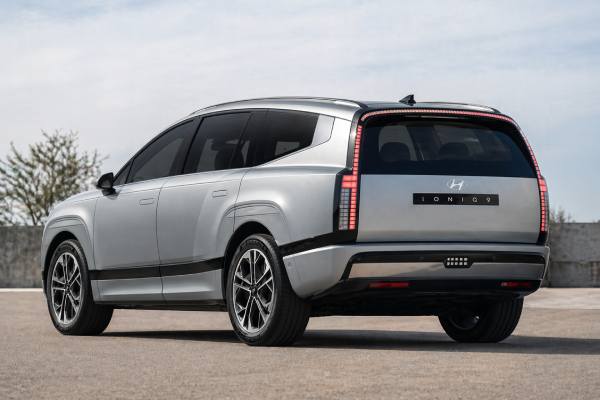
The Hyundai IONIQ 9 AWD Performance is Hyundai’s biggest and most family-focused electric vehicle so far, but it is not built like a soft, slow people carrier. This version combines dual 160 kW motors, a large 110.3 kWh battery, 800-volt charging hardware, and proper long-distance towing ability in a three-row SUV that still aims to feel efficient and refined. That mix is what makes it important. Many large electric SUVs can do one or two things well. The IONIQ 9 tries to do almost all of them at once.
For owners, the appeal is easy to understand. It has genuine road-trip charging speed, useful seven-seat packaging, quiet high-speed manners, and much stronger towing credentials than most EVs. The main caveat is that it is still a new model on a complex electrical platform, so update history, recall completion, and charging-system health matter more than they do on simpler older SUVs. Treated that way, the 422 hp IONIQ 9 looks like one of the most complete large EVs now on sale.
Essential Insights
- The 110.3 kWh battery and 800-volt system make this one of the better long-distance large electric SUVs.
- The 422 hp dual-motor setup gives strong overtaking pace without making the car feel nervous or harsh.
- AWD versions can tow up to 2,500 kg braked, which is a real advantage in this class.
- Early buyers should check software status and VIN-based campaign work, especially on U.S.-market cars.
- A sensible service rhythm is every 15,000 km or 12 months, with tyres and brakes checked more often if you tow or fast-charge heavily.
Guide contents
- Hyundai IONIQ 9 AWD explained
- Hyundai IONIQ 9 AWD figures
- Hyundai IONIQ 9 AWD grades and protection
- Issue patterns and recall watch
- Care schedule and buyer checks
- On-road character and range
- IONIQ 9 AWD versus competitors
Hyundai IONIQ 9 AWD explained
The Hyundai IONIQ 9 AWD Performance sits at the top of the regular IONIQ 9 range and does an unusually broad job. It is a seven-seat electric SUV with real family packaging, but it also offers strong power, fast motorway charging, and towing figures that many EV rivals still struggle to match. That combination is the core of its appeal. Hyundai is not selling this car as a niche luxury toy. It is meant to be a practical flagship that can replace a diesel or hybrid family SUV without forcing too many compromises.
A lot of that comes down to the hardware. The dual-motor setup uses a 160 kW motor on each axle for a combined 314 kW, which is about 422 hp in the wording most buyers will search for. Total torque is 700 Nm, enough to move this large SUV with real authority even when it is loaded with passengers. The 110.3 kWh battery is large by any standard, and because the car sits on Hyundai’s E-GMP platform it also gets 800-volt charging architecture rather than a slower, cheaper electrical system. That matters more than the headline battery size. A big battery is only part of the road-trip story. The ability to recharge it quickly is what makes a large EV easy to live with.
Hyundai has also worked hard to stop the IONIQ 9 from feeling like a heavy box on wheels. The wheelbase stretches to 3.13 metres, which helps cabin space, but the body is also shaped for airflow. Even a three-row SUV like this achieves a low drag coefficient for the class, and that pays back in calmer high-speed cruising and better real-world range. The cabin is another part of the engineering story. Hyundai designed separate climate control for the rear rows, a heat pump for better cold-weather efficiency, and route planning that considers charging needs and battery temperature.
That makes the IONIQ 9 more rounded than some direct rivals. It is not trying to be the sharpest handling electric SUV or the most overtly luxurious one. It is trying to be the one that fits large-family use best while still feeling advanced and genuinely effortless over distance.
The main ownership caveat is simple: this is still a new and very software-dependent EV. Long-term reliability patterns are not fully established yet, and the model inherits some background caution from Hyundai’s wider E-GMP platform history. That does not make it a bad bet. It means buyers should approach it like a modern premium EV: check the VIN, check the updates, confirm campaign work, and treat charging and battery health as part of normal due diligence. Do that, and the IONIQ 9 AWD Performance makes a strong case for itself.
Hyundai IONIQ 9 AWD figures
Powertrain, battery and efficiency
| Specification | Value |
|---|---|
| Motor type | Permanent Magnet Synchronous Motor |
| Motor count and axle layout | Dual motor, front and rear axles |
| Drive type | AWD |
| Combined max power | 422 hp (314 kW) |
| Front motor power | 215 hp (160 kW) |
| Rear motor power | 215 hp (160 kW) |
| Combined max torque | 700 Nm (516 lb-ft) |
| Battery chemistry | Lithium-ion polymer, NCM lithium-ion |
| Battery gross capacity | 110.3 kWh |
| Battery usable capacity | 106.0 kWh |
| Battery layout | Floor-mounted high-voltage battery pack |
| System voltage | 610 V |
| Heat pump | Standard |
| Climate and battery preparation | Climate pre-conditioning and route planning that considers battery temperature |
| Official efficiency test | WLTP |
| Rated efficiency | 20.6 kWh/100 km |
| Rated range | 600 km (372 mi) |
| Real-world highway at 120 km/h (75 mph) | 26.0 kWh/100 km (418 Wh/mi), about 412 km (256 mi) |
Charging and driveline
| Specification | Value |
|---|---|
| Transmission | Single-speed reduction gear |
| Electrical architecture | 400V and 800V multi-charging capability |
| Charging connector (AC) | Type 2, 3-phase |
| Charging connector (DC) | CCS2 |
| Charging port location | Right rear |
| Onboard charger (AC) | 10.5 kW |
| Max AC acceptance | 11 kW |
| DC fast-charge peak | 233 kW |
| Typical DC charging curve, 10–80% average | About 195 kW |
| DC 10–80% time | 24 min |
| AC 0–100% time | 10 h |
| 50 kW DC 10–80% time | 1 h 43 min |
| Battery preconditioning for DC charging | Yes, through navigation and thermal management logic |
| Vehicle-to-load | Yes, interior outlet and external adapter support |
Chassis, dimensions and capability
| Specification | Value |
|---|---|
| Suspension front | MacPherson strut with dual lower arm |
| Suspension rear | 5-link multilink |
| Steering type | Motor Driven Power Steering (R-MDPS) |
| Steering lock-to-lock | 2.93 turns |
| Brakes front | 360 mm ventilated disc |
| Brakes rear | 345 mm ventilated disc |
| Wheels and tyres | 285/45 R21 on 21-inch alloy wheels |
| Ground clearance | 174 mm (6.9 in) |
| Length | 5,060 mm (199.2 in) |
| Width | 1,980 mm (78.0 in) |
| Height | 1,790 mm (70.5 in) |
| Wheelbase | 3,130 mm (123.2 in) |
| Turning circle (kerb-to-kerb) | 12.48 m (40.9 ft) |
| Kerb weight | 2,610–2,744 kg (5,754–6,049 lb) |
| GVWR | 3,320 kg (7,320 lb) |
| Payload | 576–710 kg (1,270–1,565 lb) |
| Towing capacity, braked | 2,500 kg (5,512 lb) |
| Towing capacity, unbraked | 750 kg (1,653 lb) |
| Roof load | 100 kg (220 lb) |
| Cargo volume, seats up behind 3rd row | 338 L (11.9 ft³), VDA |
| Cargo volume, seats up behind 2nd row | 908 L (32.1 ft³), VDA |
| Cargo volume, seats down | 2,419 L (85.4 ft³), VDA |
| Frunk volume | 52 L (1.8 ft³) |
Safety and service data
| Specification | Value |
|---|---|
| Euro NCAP rating | 5 stars |
| Euro NCAP adult occupant | 84% |
| Euro NCAP child occupant | 87% |
| Euro NCAP vulnerable road users | 77% |
| Euro NCAP safety assist | 83% |
| IIHS status | Top Safety Pick+ |
| IIHS headlights | Good |
| Airbags | Front, front side, curtain, centre front, and knee airbags |
| Child-seat provision | ISOFIX on rear outer seats |
| Standard ADAS | FCA 2.0, HDA 2.0, LKA, LFA, BCA, ISLA, Driver Status Monitor, Trailer Stability Assist |
| Vehicle warranty | 5 years, unlimited mileage |
| High-voltage battery warranty | 8 years or 100,000 miles |
| Annual vehicle health checks | 5 years |
| A/C refrigerant | R-1234yf |
| A/C refrigerant charge | 875 g |
Hyundai IONIQ 9 AWD grades and protection
In the UK and much of Europe, the IONIQ 9 range is simple enough to understand once you separate powertrain from trim. The ladder starts with Premium in rear-wheel-drive form, moves to Ultimate with the lower-output dual-motor AWD system, and then reaches the Calligraphy versions that sit at the top. The 422 hp model belongs here. In practice, that means the subject of this article is not just the quickest IONIQ 9. It is also the most fully equipped mainstream version.
The key trims matter because Hyundai has tied certain wheel sizes and comfort features to them. Premium gets the 19-inch setup and the best official range, but it is rear-wheel drive only. Ultimate uses the 307 PS AWD powertrain and 20-inch wheels, which is probably the quietest compromise between equipment and efficiency. The 422 hp version is Calligraphy Performance AWD, available as a seven-seater or as a six-seater with second-row independent swivelling seats. That is the flagship format, and it comes with the 21-inch wheels, Nappa leather, head-up display, Bose 14-speaker audio, digital key support, Remote Smart Park Assist 2, surround view monitor, and Hyundai’s more upscale lighting and cabin trim.
Quick identifiers are straightforward. The Performance AWD Calligraphy rides on 21-inch wheels, uses body-coloured wheel arch treatment rather than the darker lower-spec look, and carries the fuller premium interior. The six-seat version is easy to spot once you open the rear doors because the second row changes from a bench to individual chairs. Buyers who need easy three-row access should think carefully about that choice. The six-seat version feels more premium, but the seven-seat layout is usually the more practical family tool.
Safety equipment is generous even before you reach the top trims. All versions get a strong base of active systems, including Forward Collision Avoidance Assist 2, Highway Drive Assist 2, Lane Keep Assist, Lane Follow Assist, Blind Spot Collision Avoidance Assist, Intelligent Speed Limit Assist, Driver Status Monitor, Electronic Stability Control, and Trailer Stability Assist. Ultimate and Calligraphy add more visibility and parking assistance, including Blind Spot View Monitor, Rear Cross Traffic Collision Avoidance Assist, Parking Collision Avoidance Assist in reverse, and Surround View Monitor. That makes the upper trims easier to place in tight spaces, which matters because the IONIQ 9 is a very large vehicle.
The published safety results are strong. Euro NCAP gave the IONIQ 9 five stars, with particularly solid child-occupant and safety-assist performance. IIHS gave the U.S.-market 2026 Ioniq 9 Top Safety Pick+ status, and its headlight rating is Good rather than merely acceptable. Those results matter because they support the idea that Hyundai has not treated the IONIQ 9 as just a packaging exercise. The structure, restraint systems, and active safety layers are credible.
One practical note for used buyers is calibration. On a sensor-heavy SUV like this, a windscreen replacement, bumper repair, suspension knock, or poor wheel alignment can upset the ADAS feel surprisingly quickly. If the car does not track neatly, nags too often, or shows camera or radar faults, do not treat that as a minor annoyance. On the IONIQ 9, the best versions feel polished because the underlying systems are working together properly.
Issue patterns and recall watch
The IONIQ 9 is still too new for a true long-term fault map, so this section needs a measured view rather than forced certainty. That is important. There is a difference between known issues, platform watchpoints, and normal wear on a very heavy performance-oriented family EV. Right now, the IONIQ 9 mostly sits in the second and third categories.
The clearest confirmed technical concern so far is a 2026 U.S.-market recall covering certain IONIQ 9 vehicles with high-voltage battery bus bars that may have been assembled with insufficient bolt torque. In practical terms, that can lead to electrical arcing inside the pack, a fire risk, or a voltage-sensor fault that pushes the vehicle into failsafe operation with limited drivability. The dealer remedy is inspection and tightening or repair as needed. For owners and used buyers, the lesson is simple: check campaign completion by VIN, not by assumption.
Beyond that, the more realistic issue map looks like this:
- Common, low to medium cost — tyre and alignment wear.
A large AWD EV on 21-inch tyres can wear the shoulders quickly if pressures are neglected or the alignment drifts. This is especially true on cars used for towing, fast motorway work, or frequent urban curb contact. - Common, low to medium cost — friction brake under-use.
Regenerative braking does a lot of daily work, which is good for efficiency but not always good for disc cleanliness. Cars that spend most of their lives on gentle suburban routes can still develop rusty disc faces, light judder, or uneven pad deposits. - Occasional, medium cost — software and charging-system complaints.
On new EVs, not every warning means failed hardware. Slow preconditioning behavior, route-planner quirks, intermittent charge-session dropouts, or driver-assistance irritations can sometimes be corrected with software rather than parts. That is why dealer update history matters. - Occasional, medium cost — charge-port, latch, or seal wear.
This is not yet a major public pattern on the IONIQ 9, but frequent public charging and weather exposure put real wear into the flap, latch, seal, and locking hardware. Any resistance, poor closure, or water-trap signs deserve an early fix. - Occasional, medium to high cost — low-voltage support hardware concerns.
Hyundai’s wider E-GMP platform history means it is sensible to pay attention to 12 V behavior, wake-up issues, or unexplained charging interruptions, even though there is not yet a well-established IONIQ 9-specific pattern. - Rare, high cost — high-voltage isolation or moisture ingress faults.
There is no major public trend here at the moment, but any EV with a large battery, external charging hardware, and underbody exposure needs respect. Warning messages linked to isolation, reduced power, or repeated DC charging refusal need specialist diagnosis, not guesswork.
Battery durability itself looks promising on paper. The pack is large, the thermal management is sophisticated, and Hyundai gives the car a serious battery warranty. That does not make degradation irrelevant. Repeated 100% charges, long storage at full charge, very high-speed motorway use, and frequent hot-weather DC charging will still age the pack faster than moderate family use.
For pre-purchase or early ownership, ask for dealer campaign proof, OTA and workshop update history, charging records if available, and a battery health report. Then test both AC and DC charging. On a vehicle this new, good documentation is one of the clearest signs that the previous owner or supplying dealer understood what the car needs.
Care schedule and buyer checks
The IONIQ 9 does not need old-fashioned engine servicing, but it still benefits from a disciplined maintenance plan. The best way to think about it is as a large, heavy, premium EV with real towing and road-trip ability. That means the important jobs are different: tyres, brakes, software, cooling, charging hardware, and battery condition matter more than oils and belts.
A sensible practical schedule looks like this:
| Item | Practical interval |
|---|---|
| General inspection and software check | Every 15,000 km or 12 months |
| 12 V battery condition test | Every 15,000 km or 12 months |
| Tyre rotation, wear check, and pressure check | Every 10,000–15,000 km or 12 months |
| Wheel alignment check | Every 15,000 km or 12 months |
| Brake pads, discs, calipers, and parking brake inspection | Every 15,000 km or 12 months |
| Cabin air filter | Every 30,000 km or 24 months |
| Suspension and steering inspection | Every 30,000 km or 24 months |
| Cooling system and heat pump inspection | Every 30,000 km or 24 months |
| Brake fluid replacement | Every 40,000 km or 36 months |
| Wiper blades | About every 12 months |
| High-voltage battery health check | At annual service and before buying used |
For severe use, shorten the intervals. Frequent DC fast charging, towing, repeated motorway driving at high speed, mountain routes, and very cold or very hot climates all justify more frequent tyre, brake, alignment, and charging-system checks. On a heavy EV, tyres tell the truth early. Uneven shoulder wear can reveal alignment trouble long before the steering wheel feels obviously wrong.
For decision-making, a few service details matter. The air-conditioning system uses R-1234yf refrigerant, with a published charge of 875 g. Brake fluid should be Hyundai-approved DOT 4. Washer fluid is simple, but still worth keeping topped up because camera cleanliness and visibility are part of the car’s safety system in real use. The public spec sheets do not publish every coolant fill quantity or workshop torque, so owners should always match the exact VIN and market before authorizing major thermal-system service. One publicly available Hyundai manual figure often seen for wheel fasteners is 107–127 Nm, but this should still be verified against the exact vehicle documentation before wheel or brake work.
Used-buyer strategy matters because this is a new model with a lot of expensive hardware. Focus on these points:
- Confirm all recalls and campaigns by VIN.
- Check that AC and DC charging both work properly.
- Ask for a battery state-of-health report, not just a claimed range figure.
- Inspect the charge port, flap, latch, and seals closely.
- Check for tyre edge wear, wheel damage, and any sign of repeated curb strikes.
- Inspect the brake discs for corrosion or heat damage.
- Verify that every camera, parking aid, and ADAS function behaves normally.
- Ask whether the car has towed often, then inspect tyres and rear suspension accordingly.
The long-term outlook is good, but the likely expensive items are not the battery first. They are tyres, brake components, damaged wheels, alignment-related wear, and possibly charging-system or low-voltage support hardware if update history has been neglected. In other words, this is a sophisticated family SUV, and it rewards owners who treat it like one.
On-road character and range
The IONIQ 9 AWD Performance does not drive like a sports SUV, and that is mostly a good thing. Hyundai has aimed for stability, quietness, and easy pace rather than fake sharpness. On the move, the car feels long, settled, and deliberate. The dual-motor system gives it strong step-off response, but the power delivery is clean rather than wild. That suits the vehicle. In a three-row SUV this size, confidence matters more than drama.
Straight-line refinement is one of the car’s real strengths. The long wheelbase helps smooth the body motions, and the low-mounted battery keeps the vehicle from feeling top-heavy in normal driving. At city speeds, the IONIQ 9 feels calm and easy to place considering its size. On the motorway, it becomes a very effective cruiser. Wind and road noise are well managed, and the body shape helps it move through the air with less effort than a boxier rival. That is one of the reasons the real range story is stronger than many buyers will expect from such a large EV.
Handling is secure rather than playful. Steering response is tidy, but the car is too large and too comfort-focused to feel genuinely eager on a twisty road. The AWD system helps with traction in wet weather, on rough surfaces, and when pulling away with a full load. For towing, Hyundai’s trailer mode is useful because it adjusts the range prediction and holds a 50:50 torque split on AWD models. That is the kind of engineering detail that matters more in ownership than a flashy launch-control figure.
The powertrain character is strong in the middle of the speed range. Hyundai quotes 80–120 km/h in 3.4 seconds for the Performance AWD, and that is the number that best explains the car’s real-world pace. It is not just fast from a stop. It is genuinely effortless when overtaking or climbing with passengers and luggage on board.
Real-world consumption depends heavily on speed and temperature. In mild weather, city and slower mixed use can keep the car in the low-20s kWh/100 km, which means 500 km or more is realistic with careful driving. At a steady 120 km/h motorway cruise, around 26 kWh/100 km and roughly 400–415 km is a sensible expectation in good conditions. In winter, especially with cabin heat and wet roads, that can fall closer to the mid-300 km range. That is still respectable for a three-row AWD SUV with this size and power.
Charging performance is a real advantage. On home AC at 11 kW, a full recharge is an overnight job, roughly 10 to 11.5 hours depending on conditions and charging losses. On rapid DC charging, the car can go from 10% to 80% in about 24 minutes under ideal conditions. Starting battery temperature and starting state of charge matter, as they always do, but the IONIQ 9 remains one of the more convincing long-trip chargers in the large electric SUV class.
IONIQ 9 AWD versus competitors
The IONIQ 9 AWD Performance competes in a small but quickly improving part of the EV market: large, family-sized electric SUVs that are expected to do everything. That means space, refinement, range, safety, charging, and price all matter at once. Few rivals balance those areas equally well.
The nearest rival in spirit is the Kia EV9. That is not surprising given the shared wider platform background, but the two cars still feel different in concept. The EV9 is more upright, more rugged in appearance, and a little more obviously utility-led. The IONIQ 9 is sleeker and more aero-conscious. On paper, that helps it in efficiency and high-speed calm. Buyers who like a tougher, squarer design may prefer the Kia. Buyers who want better aerodynamic efficiency and a more lounge-like cabin mood are likely to lean toward the Hyundai.
The Volvo EX90 targets a more premium and safety-led buyer. It has a more restrained luxury image, a stronger badge in some markets, and a beautiful cabin design. But it is also expensive, and its charging performance is not Hyundai’s strongest point of comparison. The IONIQ 9 generally answers with faster charging, stronger towing value, and a more practical price-to-space ratio. The Volvo feels more upscale. The Hyundai feels better optimized as an EV family tool.
The Tesla Model X is still relevant because of its pace, software, and Supercharger ecosystem, but it is also older in concept and less conventional in layout and ownership character. The IONIQ 9 is easier to treat like a normal premium family SUV. For some buyers, that is a major advantage. Tesla still wins on brand-specific charging integration and straight-line drama. Hyundai wins on everyday packaging normality and, in many markets, clearer value.
The Mercedes-Benz EQS SUV is the softer luxury alternative. It majors on comfort and brand image, but it is usually more expensive and less obviously practical as a family seven-seater for the money. The IONIQ 9 is less prestigious, but it feels more grounded in the practical needs of real owners.
That is the IONIQ 9’s strongest competitive point. It does not try to dominate one number. It simply has very few weak areas. It is roomy, quiet, genuinely quick in this Performance AWD form, fast-charging, tow-capable, and now independently proven in crash testing. For buyers who want a large electric SUV that behaves like a complete product instead of a rolling tech demonstration, that balance is exactly why the IONIQ 9 deserves serious attention.
References
- Hyundai IONIQ 9 | Pricing, Specs & Tech | July 2025 2025
- Hyundai IONIQ 9: Game-changing Electric SUV Offers Long Range and Next-level Comfort, Features and Capabilities 2025
- Hyundai IONIQ 9 2025 (Safety Rating)
- 2026 Hyundai Ioniq 9 2026 (Safety Rating)
- Part 573 Safety Recall Report 26V068 2026 (Recall Database)
Disclaimer
This article is for informational purposes only and is not a substitute for professional diagnosis, repair, or vehicle-specific technical advice. Specifications, torque values, service intervals, procedures, and equipment can vary by VIN, market, trim, software version, and production date, so always verify critical details against the official service documentation for the exact vehicle.
If this guide helped you, please consider sharing it on Facebook, X, or another social platform to support our work.