
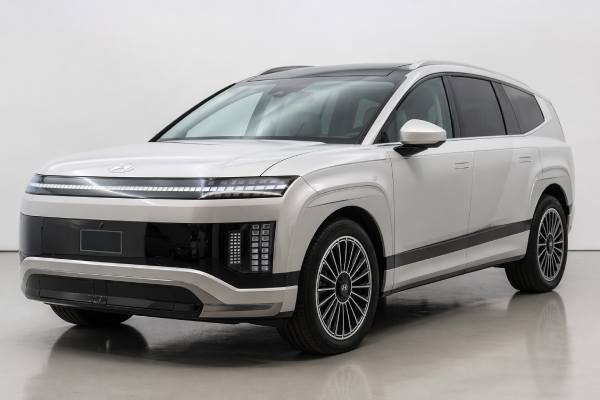


The Hyundai IONIQ 9 (ME1) with the 160 kW rear motor is the long-range, rear-wheel-drive version of Hyundai’s flagship electric SUV, and it is the one that makes the most sense for buyers who care about efficiency, comfort, and charging performance more than outright speed. It combines a very large 110.3 kWh battery, Hyundai’s 800-volt E-GMP platform, and a three-row cabin with genuinely useful family space. That makes it unusual in today’s EV market: it is a big SUV, but it still aims to behave like a well-optimised electric car rather than simply a heavy luxury vehicle with a battery. For most owners, the real appeal is not the 215 hp headline. It is the 620 km WLTP range, the 24-minute 10 to 80 percent charging claim, the quiet cabin, and the calm long-distance character. The main caution is simple: this is still a very new model, so early ownership judgment depends more on build quality, software maturity, and service history than on a long record of proven field reliability.
Fast Facts
- Very long official range for a full-size seven-seat electric SUV.
- Strong 800-volt charging performance makes long trips easier than in many rivals.
- Spacious three-row cabin and useful cargo flexibility are genuine strengths, not brochure filler.
- Long-term model-specific reliability is still developing, so software level and campaign history matter.
- Cabin air filter replacement typically falls due every 30,000 km or 24 months.
On this page
- Hyundai IONIQ 9 ME1 profile
- Hyundai IONIQ 9 ME1 figures
- Hyundai IONIQ 9 ME1 grades and safety
- Known faults and campaign status
- Service planning and used-buy tips
- Driving feel and energy use
- Against today’s electric SUV rivals
Hyundai IONIQ 9 ME1 profile
The IONIQ 9 is Hyundai’s attempt to prove that a large, family-sized electric SUV does not have to feel like a compromise. In rear-drive 160 kW form, it is not about performance theatre. It is about delivering the most sensible version of the vehicle’s engineering brief. Hyundai has used its E-GMP architecture, a 110.3 kWh battery, and a low-drag body to create a three-row EV that is meant to travel long distances without turning every trip into a charging exercise. That matters because large electric SUVs often stumble in one of two places: they either carry too much drag and mass for their battery size, or they charge too slowly to make the size worthwhile. The IONIQ 9’s rear-drive version is designed to avoid both traps.
Physically, it is a large vehicle. At just over five metres long, nearly two metres wide, and with a 3.13 m wheelbase, it sits in a class where space is not a bonus but an expectation. Hyundai has leaned into that by giving the car a flat floor, six- or seven-seat layouts, a roomy third row, and a broad, lounge-like cabin theme. Unlike some electric SUVs that advertise seven seats but really offer five good ones and two occasional extras, the IONIQ 9 appears to have been shaped around genuine passenger use in all three rows. That makes it particularly relevant to buyers who would otherwise be looking at a Kia EV9, Volvo EX90, or large premium SUV.
The rear-drive powertrain keeps the proposition focused. Output is 160 kW and 350 Nm, which is enough for everyday use but clearly not the main event. The real story is energy management. Hyundai pairs the single rear motor with a battery large enough to produce up to 620 km WLTP range, a low drag coefficient, and charging hardware that supports very fast DC sessions on high-power chargers. That gives the IONIQ 9 an identity that is more sophisticated than the usual “big battery equals big range” formula. It is a large EV that tries to be efficient by design.
There are also some less obvious engineering details that shape ownership. Hyundai says the IONIQ 9 uses an improved power electronics system with a two-stage inverter for efficiency and an optimised gear ratio for hill climbing. The body structure is designed for crash-energy distribution, and the cabin has serious attention paid to noise suppression through acoustic glass, sealing, tyre tuning, and Hyundai’s ANC-R road-noise cancellation on higher trims. That helps explain why early reviews and Hyundai’s own launch material present the IONIQ 9 as a comfort-focused flagship first and a family hauler second.
The reason this 215 hp version matters is that it is likely to become the line-up’s rational choice. The dual-motor versions offer stronger acceleration and more traction, but they add complexity, mass, and cost. The rear-drive IONIQ 9 does what many buyers in this class actually need: long range, fast charging, quiet cruising, useful towing ability, and a large, flexible interior. For owners who prioritise long-distance family use over performance bragging rights, that is exactly where the smartest version of the model usually sits.
Hyundai IONIQ 9 ME1 figures
Powertrain, battery and efficiency
| Spec | Value |
|---|---|
| Motor type | Permanent magnet synchronous motor |
| Motor layout | Single rear motor |
| Drive type | Rear-wheel drive |
| Platform architecture | 800 V E-GMP |
| Battery chemistry | NCM lithium-ion |
| Traction battery capacity | 110.3 kWh gross |
| Battery layout | Floor-mounted |
| Max power | 215 hp (160 kW) |
| Max torque | 350 Nm (258 lb-ft) |
| Thermal management | Liquid-cooled battery and power electronics |
| Heat pump | Standard |
| Official efficiency test | WLTP |
| Rated efficiency | 19.4 kWh/100 km |
| Rated range | 620 km (385 mi) |
| Real-world highway at 120 km/h | 26 kWh/100 km (419 Wh/mi) |
| Real-world highway range at 120 km/h | 412 km (256 mi) |
Driveline and charging
| Spec | Value |
|---|---|
| Transmission | Single-speed reduction gear |
| Drive architecture | 400 V and 800 V multi-charging compatible |
| Differential | Open rear differential with brake-based control |
| AC charging connector | Type 2 |
| DC charging connector | CCS2 |
| Charging port location | Right rear side |
| Onboard charger | 11 kW AC |
| AC 0–100% | 11 h 30 min |
| DC fast-charge peak | 257 kW |
| Typical DC 10–80% average | 195 kW |
| DC 10–80% | 24 min |
| Battery preconditioning | Available, automatic via navigation |
| Plug and Charge | Supported on compatible networks |
| Vehicle-to-Load output | 3.6 kW |
Performance and capability
| Spec | Value |
|---|---|
| 0–100 km/h | 9.4 s |
| 0–60 mph | 8.4 s |
| 80–120 km/h | 6.8 s |
| Top speed | 190 km/h (118 mph) |
| Towing capacity, braked | 1,600 kg (3,527 lb) |
| Towing capacity, unbraked | 750 kg (1,653 lb) |
Chassis and dimensions
| Spec | Value |
|---|---|
| Front suspension | MacPherson strut |
| Rear suspension | Multi-link |
| Steering | Motor-driven electric power steering |
| Wheel sizes | 19-inch, 20-inch, 21-inch |
| Tyres | 255/60 R19, 275/50 R20, 285/45 R21 |
| Length | 5,060 mm (199.2 in) |
| Width | 1,980 mm (78.0 in) |
| Height | 1,790 mm (70.5 in) |
| Wheelbase | 3,130 mm (123.2 in) |
| Kerb weight | 2,549 kg (5,620 lb) |
| GVWR | 3,180 kg (7,011 lb) |
| Cargo volume, seats up | 338 L (11.9 ft³) |
| Cargo volume, third row folded | 908 L (32.1 ft³) |
| Cargo volume, all rear seats folded | 2,419 L (85.5 ft³) |
| Frunk volume, RWD | 88 L (3.1 ft³) |
Safety and service data
| Spec | Value |
|---|---|
| Euro NCAP rating | 5 stars |
| Euro NCAP adult occupant | 84% |
| Euro NCAP child occupant | 87% |
| Euro NCAP vulnerable road users | 77% |
| Euro NCAP safety assist | 83% |
| IIHS small overlap front | Good |
| IIHS updated moderate overlap front | Good |
| IIHS side | Good |
| IIHS headlight rating | Good |
| IIHS award | Top Safety Pick+ |
| Airbags | 7 |
| Cabin filter interval | 30,000 km or 24 months |
| Battery warranty | 8 years or 160,000 km |
Hyundai IONIQ 9 ME1 grades and safety
The IONIQ 9 range is easier to understand than its size suggests. Mechanically, Hyundai’s line-up is centred on the battery and motor choice, not on a maze of trim-specific chassis changes. That is good news for buyers, because it means the 160 kW rear-drive version keeps its core character across the range. In European trim planning, Hyundai has broadly separated the car into entry, mid, and flagship themes rather than dramatically different mechanical personalities. The entry-grade car already brings the main EV hardware: the 110.3 kWh battery, rear-drive layout, 800-volt charging architecture, heat pump, Highway Driving Assist 2, Forward Collision-avoidance Assist 2.0, V2L capability, and three-zone climate control. From there, higher trims add more comfort, more camera tech, more premium materials, and larger wheels.
That wheel choice is more important than many buyers will realise. The most efficient rear-drive version uses 19-inch wheels, and that is where the official range story is strongest. Once you move up to larger wheels, you gain visual presence and sometimes more desirable trim packages, but you also start giving back some of the car’s biggest advantage. In a large electric SUV, wheel size can change not just ride and road noise, but also how much of the official range promise survives in real use. For buyers who genuinely want the smartest ME1 version, the small-wheel rear-drive car is likely to be the best ownership choice.
In cabin terms, the IONIQ 9 has a clear equipment ladder. Higher trims add the features buyers in this segment expect, including premium leather, head-up display, surround-view monitor, blind-spot view monitor, Remote Smart Parking Assist 2.0, Bose audio, ANC-R active noise cancellation, digital key functionality, and more elaborate seat options. At the top, Calligraphy models bring the luxury-focused details, while six-seat layouts and second-row comfort features are positioned as flagship options rather than universal fitments. That means buyers need to be precise about what they actually want from a used or nearly new car. A lower trim with smaller wheels may be a better car to live with than a higher trim chosen mainly for its look.
Safety is one of the IONIQ 9’s strongest assets. Euro NCAP awarded it five stars in 2025, and the score breakdown is solid rather than inflated by a single category. Adult protection is good, child protection is especially strong, and the assistance systems perform well enough to keep the IONIQ 9 competitive in a demanding modern test environment. There are still useful details behind the headline. Euro NCAP noted that chest protection in the more severe side-pole test was marginal, and it also noted the absence of child-presence detection. Those are not deal-breakers, but they matter when comparing high-end family EVs with different safety philosophies.
The IIHS picture is also strong for 2026 models. The IONIQ 9 earns Top Safety Pick+, with Good results in the small overlap front test, the updated moderate overlap test, the updated side test, and for headlights. That last part matters more than it sounds, because lighting performance remains one of the easiest ways a new car can lose ground in U.S. safety scoring. Hyundai also benefits from some platform sharing logic here, because parts of the crash picture align with what has already been shown on the related Kia EV9 structure, while the updated moderate-overlap performance is specific to the IONIQ 9’s own 2026 assessment.
In practical ownership terms, the car’s assistance systems deserve respect after repairs. Highway Driving Assist 2, forward collision avoidance, blind-spot systems, surround cameras, parking sensors, and remote parking functions all depend on good calibration and clean sensor alignment. Windscreen replacement, front bumper repair, ride-height changes, or careless alignment work can all affect how well these systems function. On a nearly new car, that means repair paperwork matters almost as much as service paperwork. The safest IONIQ 9 is not just the one with the best test score. It is the one whose sensors, software, and structure still match the way Hyundai intended them to work.
Known faults and campaign status
The IONIQ 9 is still too new to have a mature reliability map, so the right way to judge it is in layers. The first layer is what the model itself has already shown in public record. The second is what Hyundai’s wider E-GMP family has already taught owners about charging systems, low-voltage support, software dependence, and brake behaviour. The third is what is still unknown because this specific vehicle simply has not been on the road long enough. Buyers who approach the car that way will make better decisions than those who assume either “it is brand new, so it will be perfect” or “it shares a platform, so every older issue automatically applies.”
So far, the cleanest confirmed IONIQ 9-specific service action is the early 2026 U.S. recall covering a very small group of 2026 IONIQ 9 vehicles built with battery-system assemblies that may have had insufficiently tightened high-voltage bus bar retention bolts. Hyundai’s remedy is inspection and repair. The risk described is serious in principle, because loose internal battery-pack connections can lead to electrical arcing, fire risk, or a failsafe mode with limited drivability. The good news is that the affected population is small and very specific. The larger lesson is not that the IONIQ 9 has a pack-failure problem. It is that early build-quality campaigns on a new EV should always be taken seriously, even when the number of affected cars is small.
Beyond that, most ownership watchpoints are inherited rather than fully model-specific. Hyundai’s E-GMP platform has already shown that buyers should pay attention to charging-system history, 12-volt support health, and software level. On earlier Hyundai EVs, ICCU-related problems became the best-known example of how a technically strong EV can still be inconvenienced by support electronics. There is not enough public evidence to say the IONIQ 9 has developed its own widespread ICCU pattern, but there is enough platform context to say that buyers should still ask careful questions about warning lights, charging irregularities, 12-volt behaviour, and completed updates.
A sensible fault map for the IONIQ 9 looks like this:
- Common and low-cost: brake-disc rust or uneven use from heavy regeneration, tyre wear on a heavy vehicle, wheel damage, minor trim or seal wear around the charging-port area, and calibration issues after repair work.
- Occasional and medium-cost: weak 12-volt battery behaviour, parking-sensor or camera faults, charging-door or latch problems, software glitches in route planning or connected services, and ADAS warnings caused by blocked or misaligned sensors.
- Occasional and high-cost: battery-pack campaign work on early cars, charging-control hardware faults, or replacement of higher-value electronic modules tied to charging, safety, or infotainment.
- Rare but important: high-voltage isolation warnings, water ingress around critical connectors or pack-protection areas after damage, and expensive structural or electrical problems on poorly repaired cars.
Software is a bigger part of the reliability story than it would be on a conventional SUV. Hyundai uses over-the-air update capability and a heavily connected operating environment, which is useful when improvements are rolled out correctly. It also means the car’s behaviour can change over time as route planning, charging logic, energy reporting, AI assistant functions, or driver-assistance features evolve. For owners, the practical rule is simple: software history is part of service history. A car that has missed updates, been disconnected from connected services, or has repeated complaints around route planning or charging preparation deserves closer inspection.
Battery health is another area where honesty matters. There is no strong evidence yet of an IONIQ 9-specific degradation problem, and the large liquid-cooled NCM pack should be well placed for normal long-term use. Still, the car is new enough that no one should pretend there is a decade of field proof behind it. For now, the best signs are the usual ones: normal DC charging behaviour, no unexplained warnings, sensible range consistency, stable thermal performance, and no sign of repeated pack-related visits in the service file.
On the chassis side, the vehicle’s size brings its own realities. It is heavy, it rides on large wheels, and some versions will tow. That means wheel bearings, tyres, alignment, and brake hardware deserve proper attention even if the EV systems themselves behave perfectly. Add the fact that it is a low-drag SUV with important underbody covers and battery shielding, and one more lesson becomes clear: a clean underside and careful repair history are worth real money on a used example.
Service planning and used-buy tips
The IONIQ 9 does not need the sort of maintenance a combustion seven-seater does, but it still benefits from structure and discipline. Owners should think of servicing in four groups: regular chassis inspections, brake preservation, thermal-system oversight, and battery or charging-system checks. The absence of engine oil changes does not make the vehicle low-attention. It simply moves the attention elsewhere. For a large electric SUV that may carry seven people, tow, and spend long hours on motorways, tyres, brakes, cooling, and electronics matter more than ever.
A practical service schedule for the IONIQ 9 looks like this:
- Every 15,000 km or 12 months: inspect tyres, tyre pressures, wheel condition, brake pads and discs, underbody covers, steering and suspension joints, charge-port seals, and the 12-volt battery condition.
- Every 30,000 km or 24 months: replace the cabin air filter, replace brake fluid, and inspect brake-hardware condition closely if the car has spent most of its life using strong regeneration.
- Every 30,000 km or 24 months: check wheel alignment if tyre wear shows edge loading, tramlining, or steering pull, especially after pothole impacts or towing use.
- At every annual service: inspect coolant condition and the entire visible battery and power-electronics thermal system for leaks, damage, or contamination.
- From year three onward: test the 12-volt battery annually and be realistic about replacement timing if the car shows slower system wake-up, warning messages, or poor cold-weather behaviour.
- Under severe use: shorten tyre, brake, and alignment inspection intervals if the vehicle tows regularly, runs at high motorway speeds, sees rough roads, or uses frequent ultra-fast DC charging.
The lack of publicly detailed service-capacity data for this exact ME1 variant means buyers should not rely on generic EV assumptions. Brake fluid still matters. Coolant quality still matters. Reduction-gear lubrication still matters if abnormal noise or contamination appears in inspection. On a vehicle this new, the safest rule is to follow Hyundai’s official service system by VIN and not let general workshop habit substitute for model-specific guidance. That is especially important with cooling-system fluids, air-conditioning hardware, and any work that touches high-voltage shielding or charging components.
For nearly new or used buyers, the checklist should begin with charging behaviour. Ask whether the car AC-charges normally and whether it DC fast-charges without unexpected warnings, abnormal taper, or repeated charger-handshake failures. Confirm that battery preconditioning works through the navigation system if it is relevant in your market. A healthy EV is not just one with good brochure range. It is one that behaves predictably at the charger.
Next, inspect the charge-port area itself. The door, latch, seals, and surrounding trim should all feel precise and intact. Damage here can point to careless public-charger use, poor repairs, or repeated strain. Then move to the low-voltage side. The 12-volt system still supports a great deal of daily function, and many “EV problems” owners experience at first are actually support-voltage problems rather than traction-battery faults.
The thermal-management inspection matters too. Ask whether the correct coolant has been used and whether the car has had any HVAC, heating, or thermal warnings. Heat-pump operation is especially valuable on a vehicle like this because range preservation in cold weather is one of the things that helps justify the car’s size and price. If the heating system is weak, noisy, or inconsistent, it deserves proper follow-up.
The chassis check should be treated seriously. This is a large, expensive EV, and it rides accordingly. Look at inner and outer tyre wear, check the underside for scraped covers or deformed shielding, and listen for bearing noise or suspension knocks on a test drive. Then test the friction brakes properly. Large EVs can hide neglected brake hardware behind strong regeneration for longer than buyers expect.
As for which versions to seek, the answer is straightforward for most people. The rear-drive 19-inch car is the best ownership bet if efficiency, range, and tyre cost matter most. It is the purest expression of the model’s engineering logic. Higher trims make sense if you want the extra comfort, camera, and audio features, but they are best chosen for genuine use rather than status. The versions to avoid are not defined by trim badge so much as by weak history: unresolved campaign work, vague charging complaints, poor repair records, missing updates, or signs of hard towing use with little inspection evidence.
Long term, the IONIQ 9 should not be judged like a simple family SUV. It is more likely to reward careful owners and punish neglect through electronics, charging hardware, and calibration rather than through traditional engine wear. The battery itself is not the first thing to fear. The bigger ownership risks are expensive support systems, poor repair quality, and people assuming a modern flagship EV can be maintained casually.
Driving feel and energy use
The 160 kW rear-drive IONIQ 9 is a large SUV, and it feels like one, but that is not a criticism. Hyundai has tuned it to be settled, quiet, and confidence-inspiring rather than artificially sporty. That suits the car. The steering is designed to be accurate and stable, not chatty. The chassis feels like it is there to support comfort and long-distance confidence, not to entertain on a fast B-road. In a seven-seat electric flagship, that is exactly the right priority.
Straight-line performance is more modest than the battery size might make some buyers expect. With 9.4 seconds to 100 km/h, the rear-drive IONIQ 9 is comfortably adequate rather than quick by EV standards. Yet in daily use it should feel stronger than that number suggests because EV torque arrives immediately and the 80 to 120 km/h passing figure is still respectable. This is not the version you buy for drama. It is the version you buy because it gives up less range, costs less to run, and still feels effortless in ordinary traffic.
Ride quality is likely to be one of the car’s most appealing traits. Hyundai has put clear effort into suppression of road and wind noise through acoustic glazing, sealing, tyre development, and available ANC-R noise cancellation. On long trips, those details matter more than a small gain in cornering sharpness would. The large wheelbase also helps. A 3.13 m platform gives the IONIQ 9 a naturally composed stride on faster roads, and it should feel especially at home on motorways where many large EVs reveal either too much tyre roar or too much suspension restlessness.
Wheel choice again matters. The 19-inch versions are likely to ride best, run quietest, and preserve the most energy. The 20- and 21-inch cars will look more expensive and may feel a touch more tied down, but large wheels on a heavy EV usually bring a cost in road noise, replacement expense, and real range. In the IONIQ 9, that trade is especially important because the rear-drive model’s whole logic rests on efficient long-range use.
Energy use is strong for a vehicle this large, but buyers should still keep perspective. The official WLTP story is impressive: up to 620 km and about 19.4 kWh/100 km in the most efficient rear-drive form. In real life, a big SUV still obeys big-SUV physics. Around town and in mixed use, the IONIQ 9 should do well if temperatures are moderate and the driver is not rushing. At steady motorway pace, real consumption climbs into the mid-20s kWh/100 km area, and a true 120 km/h cruise will bring the usable range down into the low-400 km region in good conditions. That is still a strong result for a three-row electric SUV, but it is different from a light, sleek electric saloon.
Cold weather will matter, as it does in any EV. The good news is that Hyundai gives the IONIQ 9 a heat pump and climate pre-conditioning, which should help winter range and cabin comfort. Even so, a loaded seven-seat SUV with heating running and motorway speeds sustained will consume energy quickly. Buyers should view the official range as a best-case rating, not as an all-season travel guarantee.
Charging is one of the car’s biggest real-world advantages. Hyundai’s 800-volt system and multi-charging capability mean the IONIQ 9 can still make long trips feel practical despite its size. A 10 to 80 percent session in about 24 minutes is genuinely useful in a vehicle of this class, and Hyundai says 15 minutes can add roughly 304 km of range under the right conditions. That matters more than peak power alone. The car is designed to recover meaningful distance quickly, not just to produce an impressive charger screen for a few moments.
For towing or heavy family loading, the rear-drive version remains usable but not ideal. The car’s trailer mode can account for the weight and adjust predicted range, which is a useful touch, but physics still wins. A moderate trailer or full passenger load can knock a substantial percentage off the available range, especially at motorway speeds or on long climbs. Buyers who tow often may still be better served by an AWD version, but for ordinary family driving the rear-drive model remains the best-balanced choice.
Against today’s electric SUV rivals
The most obvious rival is the Kia EV9, because the two cars share so much underneath. That makes the comparison less about engineering quality and more about format and character. The EV9 feels boxier, more upright, and a little more traditional as a large family SUV. The IONIQ 9 is more aerodynamic, more lounge-like inside, and more clearly optimised around range efficiency. In rear-drive long-range form, the Hyundai’s official range advantage is significant enough to matter, while the Kia answers with a more square-edged design and a slightly more utilitarian flavour. Buyers who value maximum range and a more refined, premium atmosphere will likely prefer the Hyundai. Buyers who like the more assertive, practical, upright feel of the Kia may still lean EV9.
The Volvo EX90 is the premium alternative. It brings stronger brand cachet in some markets, a richer sense of Scandinavian luxury, and a sharper safety-led identity. Its charging and range picture has improved with later updates, and in power terms it easily outguns this rear-drive IONIQ 9. But the Hyundai fights back with price logic, space efficiency, and a more measured ownership case in rear-drive form. The Volvo is the car for buyers who want prestige and very strong safety branding. The Hyundai is the car for buyers who want a large premium-feeling EV without paying quite as much for the badge.
The Peugeot E-5008 approaches the question from a different angle. It is lighter, more affordable, and easier to package into mainstream family budgets. It also offers seven seats and very competitive official range in long-range form. But it sits in a different class in feel and mission. The E-5008 is a practical family EV. The IONIQ 9 is a large flagship. Hyundai offers more cabin space, more outright charging sophistication, and a more expansive long-distance experience. Peugeot’s value story will be attractive, but it does not really replace what the IONIQ 9 is trying to be.
A less direct but still relevant rival is the large premium electric-SUV set from BMW, Mercedes-Benz, and Audi. Those brands offer stronger badges, often more lavish cabin finishing, and in some cases more advanced suspension hardware. Yet the IONIQ 9 still undercuts them by being unusually coherent. It combines seven-seat practicality, very fast charging, a genuinely large battery, and a carefully optimised body into one package without drifting too far into six-figure pricing territory. That is a real strength.
The rear-drive 160 kW version deserves special credit in that context. In many EV ranges, the base or efficiency-led motor option feels like the compromised one. Here it feels like the intelligent one. It sacrifices straight-line sparkle, but it keeps the vehicle’s biggest strengths fully intact. That makes it especially attractive to buyers who understand that a large EV’s quality is measured more by charging time, refinement, range consistency, and cabin usability than by acceleration alone.
In the end, the IONIQ 9’s strongest argument is not that it beats every rival in every category. It does not. Its case is that it brings together a very large battery, seven-seat practicality, excellent charging ability, strong safety credentials, and a refined cabin in a way that feels unusually complete. The rear-drive ME1 version is the trim that best expresses that idea. It is the least flashy, but also the least wasteful. For many owners, that will make it the best IONIQ 9 in the range.
References
- All-new Hyundai IONIQ 9 2025
- IONIQ 9 | Highlights 2026
- Hyundai IONIQ 9 2025 (Safety Rating)
- 2026 Hyundai Ioniq 9 4-door SUV 2026 (Safety Rating)
- Part 573 Safety Recall Report 26V068 2026 (Recall Database)
Disclaimer
This article is for informational purposes only and is not a substitute for professional diagnosis, repair, or official service guidance. Specifications, torque values, service intervals, charging performance, and repair procedures can vary by VIN, market, software version, trim, seating layout, and equipment, so always verify details against the correct official Hyundai service documentation for the exact vehicle.
If this guide helped you, please consider sharing it on Facebook, X, or another social platform to support our work.