
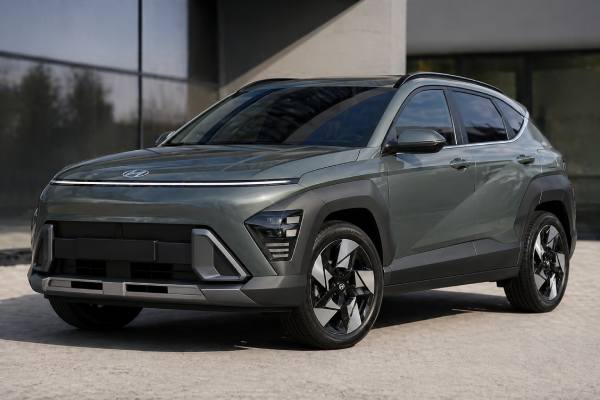
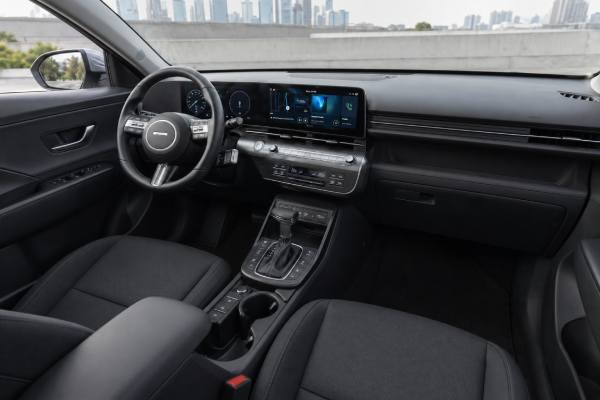
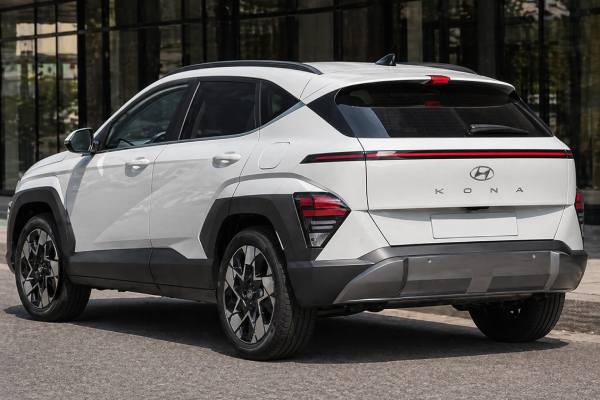
The second-generation Hyundai KONA SX2 is no longer the slightly cramped, slightly quirky crossover the first KONA was. In 1.6 T-GDi 4WD form, it becomes a genuinely quick small SUV with a broader cabin, a more useful cargo area, and the kind of all-weather traction that makes everyday driving easier. The turbo engine delivers strong mid-range pull, while AWD versions add a multi-link rear suspension that helps the chassis feel calmer and more planted than many front-drive rivals. This is also one of the more complete non-hybrid KONA variants for buyers who still want a conventional petrol drivetrain. The trade-off is that it is usually the thirstiest mainstream KONA, and exact specifications vary by market. Some versions use a 7-speed dual-clutch gearbox, others an 8-speed automatic, and some later European listings do not match the earlier 198 hp tune. That is why VIN-specific confirmation matters almost as much as the badge.
Fast Facts
- Strong mid-range shove and secure wet-weather traction make it an easy daily driver.
- The SX2 body is roomier than the old KONA and offers a genuinely useful 407 L boot.
- AWD versions get a multi-link rear suspension, which improves composure over rough roads.
- Early-build cars are worth checking carefully for completed recalls and software campaigns.
- Engine oil and filter are due every 10,000 km or 12 months, or every 5,000 km in severe use.
Guide contents
- Hyundai KONA SX2 4WD at a Glance
- Hyundai KONA SX2 4WD Specs and Data
- Hyundai KONA SX2 Trims and Safety
- Reliability, Issues, and Service Actions
- Maintenance Plan and Buying Advice
- Road Manners and Real Performance
- KONA SX2 Against Key Rivals
Hyundai KONA SX2 4WD at a Glance
The SX2-generation KONA is a much more mature vehicle than the earlier model. It is longer, wider, and better packaged, and that matters even more in 1.6 T-GDi 4WD form because this version is aimed at buyers who want more than city-car convenience. It is the petrol KONA for people who live with steep winters, fast rural roads, or simply prefer the security of four driven wheels.
The heart of the package is the 1.6-liter turbocharged direct-injection four-cylinder. In the configuration covered here, it delivers 198 hp and 265 Nm, which is enough to make the KONA feel brisk rather than merely adequate. More important than the headline number is the shape of the power delivery. It has useful torque from low revs, so the car does not need to be driven hard to feel responsive. Around town, it is easy to place in traffic. On a fast uphill road, it has enough reserve to overtake without drama.
This trim also benefits from hardware changes beyond the engine. The AWD layout is not just about traction. In many markets, the 4WD car uses a more sophisticated rear suspension than lower front-drive versions, and that gives the SX2 a calmer body control profile. It rides with a more planted feel at motorway speeds and tends to feel less busy on patchy surfaces than some torsion-beam rivals. That does not make it sporty in the hot-hatch sense, but it does make it more confidence-inspiring.
The main ownership caveat is that there is no single global KONA 1.6 T-GDi 4WD specification. Europe, Australia, and other regions can differ in gearbox type, trim names, wheel sizes, equipment, and even output calibration by year. Some early specifications align neatly with the 198 hp figure, while some later European listings show lower power outputs for similar-looking cars. That means used-car buyers should never rely only on a sales description.
In practical terms, the SX2 4WD suits three buyers especially well:
- Drivers who want a compact SUV with real motorway pace.
- Owners in wet or snowy climates who value traction more than off-road image.
- Buyers who want current safety tech and a modern cabin without stepping up to a larger SUV.
The version makes less sense for buyers whose priorities are lowest fuel use, softest ride, or simplest long-term mechanical layout. The hybrid KONA is cheaper to fuel, and some naturally aspirated rivals are mechanically simpler. Still, if the brief is a compact petrol SUV with strong torque, AWD reassurance, and up-to-date driver assistance, the SX2 1.6 T-GDi 4WD is one of the more rounded choices in the class.
Hyundai KONA SX2 4WD Specs and Data
The most important thing to understand is that Hyundai sold this drivetrain with market-specific detail changes. The figures below center on the 1.6 T-GDi 4WD SX2 in its 146 kW, 198 hp form, while also noting where gearbox or wheel-size differences can change the exact result.
| Specification | Value |
|---|---|
| Code | Smartstream G1.6 T-GDi / G4FIII |
| Engine layout and cylinders | Transverse inline-4, DOHC, 4 valves per cylinder |
| Bore × stroke | 75.6 × 89.0 mm (2.98 × 3.50 in) |
| Displacement | 1.6 L (1,598 cc) |
| Induction | Turbocharged |
| Fuel system | Direct injection |
| Compression ratio | 10.0:1 |
| Max power | 198 hp (146 kW) @ 6,000 rpm |
| Max torque | 265 Nm (195 lb-ft) @ 1,600–4,500 rpm |
| Transmission | 7-speed DCT or 8-speed automatic, market-dependent |
| Drive type | On-demand AWD / 4WD |
| Differential layout | Open axle differentials with electronically controlled AWD coupling |
| Rated efficiency | About 6.7–7.6 L/100 km (35–31 mpg US / 42–37 mpg UK), depending on market cycle and wheel size |
| Real-world highway at 120 km/h | Typically about 7.5–8.5 L/100 km (31–28 mpg US / 38–33 mpg UK) |
| Specification | Value |
|---|---|
| Suspension | MacPherson strut front / multi-link rear |
| Steering | Rack-and-pinion motor-assisted steering, about 2.5 turns lock-to-lock |
| Brakes | 305 mm (12.0 in) ventilated front / 284 mm (11.2 in) solid rear |
| Most common tyre sizes | 215/55 R18 or 235/45 R19, depending on trim |
| Ground clearance | About 175 mm (6.9 in) |
| Length / width / height | About 4,385 / 1,825 / 1,590 mm (172.6 / 71.9 / 62.6 in) on higher-spec turbo AWD versions |
| Wheelbase | 2,660 mm (104.7 in) |
| Turning circle | 10.6 m (34.8 ft) |
| Kerb weight | About 1,450–1,585 kg (3,197–3,494 lb) |
| GVWR | About 2,040 kg (4,497 lb) |
| Fuel tank | 47 L (12.4 US gal / 10.3 UK gal) |
| Cargo volume | 407 / 1,241 L (14.4 / 43.8 ft³), VDA |
| 0–100 km/h | Roughly 7.8–8.3 seconds, depending on market and transmission |
| Top speed | 210 km/h (130 mph) |
| Braking distance | About 35.0 m from 100–0 km/h (115 ft from 62–0 mph), where published for this spec |
| Towing capacity | 1,300 kg (2,866 lb) braked / 600 kg (1,323 lb) unbraked |
| Payload | About 455–590 kg (1,003–1,301 lb), depending on trim and equipment |
| Specification | Value |
|---|---|
| Engine oil | 0W-20, API SN PLUS/SP or ILSAC GF-7; 4.8 L (5.1 US qt) |
| Coolant | Ethylene-glycol coolant, typically 50/50 mix; 8.5 L (9.0 US qt) |
| Automatic transmission fluid | ATF SP-IV; 6.5 L (6.9 US qt) for applicable automatic transmission |
| Rear differential oil | API GL-5 SAE 75W/85; about 0.4–0.5 L (0.42–0.53 US qt) |
| Transfer case oil | About 0.62–0.68 L (0.66–0.72 US qt) |
| Brake fluid | DOT 4 |
| Key torque spec | Wheel nuts: 107–127 Nm (79–94 lb-ft) |
| Euro NCAP | 4 stars; Adult 80%, Child 83%, Vulnerable Road Users 64%, Safety Assist 60% |
| IIHS | Strong U.S. crash scores for the 2024-on family, with Acceptable headlight rating on tested trims |
| ADAS suite | AEB, adaptive cruise, lane-centering support, blind-spot monitoring, rear cross-traffic alert, speed-sign support; exact standard or optional fitment varies by trim and market |
Note: The SX2 is one of those cars where brochures can look deceptively similar while VIN-level specifications differ. Confirm output, transmission, wheel size, tow rating, and ADAS content against the exact market version before ordering parts or comparing trims.
Hyundai KONA SX2 Trims and Safety
Trim structure depends heavily on region, so the smartest way to think about the SX2 1.6 T-GDi 4WD is by equipment band rather than by one universal trim ladder. In most markets, this is not the entry-level KONA. It sits in the better-equipped part of the range, often in N Line, Premium, or similarly named upper trims. That matters because this powertrain usually arrives with bigger wheels, more cabin technology, and broader safety equipment than the cheaper front-drive variants.
Mechanically, the biggest distinction is not cosmetic. The turbo AWD car can bring a different gearbox depending on region and often a more sophisticated rear suspension layout. Wheel and tyre packages also matter. An 18-inch setup is usually the better choice for ride comfort, tyre cost, and winter use. The 19-inch package looks sharper and can improve lateral grip on dry roads, but it adds impact harshness and makes the KONA feel busier over rough surfaces.
Quick identifiers for higher-spec AWD cars usually include:
- 18-inch or 19-inch alloy wheels.
- Full-width digital display layouts on upper trims.
- N Line exterior and seat details in markets where the sporty trim is offered.
- More complete parking assistance, camera views, and blind-spot camera functions on richer trims.
Safety equipment is one of the SX2’s stronger selling points. Depending on market, the car can offer seven airbags, including a front-centre airbag, plus ISOFIX points on the rear outboard seats and three top tether anchors. The core active-safety package is broad: autonomous emergency braking with vehicle, pedestrian, and cyclist detection, adaptive cruise control, lane keeping, lane-following support, blind-spot monitoring, rear cross-traffic alert, driver-attention monitoring, and intelligent speed limit assistance are all common features. Higher trims can add parking collision avoidance, surround-view cameras, blind-spot view monitor, and remote parking assistance.
The important ownership detail is calibration. On a modern KONA, replacing a windshield, repairing front crash damage, removing bumpers, or even performing some alignment-related work can require camera or radar recalibration. A used car with no warning lights is not automatically a perfectly calibrated car. Buyers should ask whether glass replacement or body repairs have been followed by proper ADAS setup.
Crash-test performance is good rather than class-leading. Euro NCAP’s result reflects a structurally competent small SUV with respectable child protection and decent active-safety coverage, but not a perfect score. U.S. IIHS testing has been stronger overall for the later SX2 family, which is reassuring for buyers who prioritize crash structure and front crash prevention. The big picture is simple: the KONA SX2 is well equipped for safety, but upper-trim convenience tech and region-specific option packs can change the exact equipment list more than many shoppers expect.
Reliability, Issues, and Service Actions
The SX2-generation KONA is still new enough that long-term reliability patterns are not yet fully mature. That is important. There is a difference between a model that is proven over 150,000 km and one that merely has no obvious disaster pattern in its first years. At this stage, the 1.6 T-GDi 4WD KONA looks more like a car to buy carefully than a car to avoid outright.
In prevalence terms, the current picture looks like this:
- Common, low to medium severity: software quirks, occasional driver-assist warnings, infotainment or connected-services glitches, high road noise on 19-inch tyres, and fuel use that climbs quickly in short-trip city driving.
- Occasional, medium severity: transmission behavior complaints that depend on market gearbox, camera-related warning messages that need software or calibration attention, and brake feel complaints caused by pad condition, inactivity, or wheel imbalance rather than a core design defect.
- Rare, high severity: recall-grade issues on some early-build cars.
The most important official service actions have centered on specific production batches rather than the full population of cars. Early examples in some markets were subject to a rear seat belt concern involving the retractor mechanism. Certain 2024-model vehicles also saw a campaign involving a battery cable and crush-shield arrangement, with the safety concern tied to post-crash electrical risk. Another official recall targeted an EGR valve assembly issue on some 2024 petrol vehicles, where contamination in the sensor area could trigger a malfunction indicator and, in the worst case, lead to a loss of motive power. These are exactly the sorts of checks a used buyer should verify by VIN before doing anything else.
Software also matters more than on older crossovers. Hyundai has issued updates for connected-car functions and front-camera logic on some vehicles. In plain terms, a KONA that flashes an occasional warning or has odd infotainment behavior does not always need hardware. Sometimes it needs the correct update and a proper calibration routine.
As for the powertrain itself, there is not yet strong evidence that the SX2 1.6 T-GDi has a widespread internal-engine failure trend. That said, it is still a small direct-injected turbo engine, so oil discipline matters. Owners should use the correct full-synthetic oil, respect the severe-service schedule when their driving pattern qualifies, and avoid the trap of stretching intervals just because the car still feels fine. Heavy city use, short cold trips, and towing are harder on this engine than an easy motorway commute.
For the AWD hardware, the risk is less drama and more neglect. The transfer case and rear differential are easy to ignore because they are not talked about much in sales literature. They still have fluids, and those fluids matter, especially on cars used in mountain areas, in deep winter, or after water exposure.
For a pre-purchase inspection, ask for four things: complete service history, proof of recall completion, confirmation of any software campaigns, and a test drive from cold. A good SX2 should start cleanly, shift without hesitation or banging, track straight, brake evenly, and show no active warning messages.
Maintenance Plan and Buying Advice
The official maintenance pattern for the 1.6 T-GDi is straightforward, but this is one of those engines where the severe-service schedule matters in the real world. Many owners qualify for severe use without realizing it, especially if they do repeated short trips, frequent stop-and-go driving, cold starts, mountain driving, or towing.
| Item | Practical interval | What matters |
|---|---|---|
| Engine oil and filter | 10,000 km or 12 months; 5,000 km in severe use | Use the correct full-synthetic 0W-20 and do not stretch intervals on short-trip cars |
| Tyre rotation | 10,000 km or 12 months | Important for AWD tyre wear balance |
| Cabin air filter | 30,000 km or 24 months | Replace sooner in dusty or urban conditions |
| Brake fluid | 30,000 km or 24 months | Do not ignore time-based replacement |
| Engine air filter | Inspect regularly; replace around 40,000 km | More often in dusty use |
| Spark plugs | 70,000 km | Turbo DI engines respond badly to overdue plugs |
| Valve clearance | Inspect at 90,000 km or 72 months where applicable | Relevant for long-term ownership |
| Coolant | First change at 200,000 km or 120 months, then every 40,000 km or 24 months | Use the correct coolant mix |
| Automatic transmission fluid | No routine service under normal schedule; around 100,000 km in severe use | Important on hard-used cars |
| Transfer case and rear differential | Inspect at 60,000 km or 48 months; replace sooner after submersion or severe use | Easy to overlook, important on AWD models |
| Serpentine belt and hoses | Inspect every service | Listen for noise and check for age cracking |
| 12 V battery | Test annually from about year 4 | Weak batteries can trigger misleading electronic faults |
The fuel filter is typically not a routine stand-alone replacement item in the way older external filters were. The timing system is chain-driven, so there is no fixed belt replacement interval, but any cold-start rattle, cam-correlation fault, or persistent timing error deserves quick attention.
From a buying perspective, later examples with documented campaign completion are the easy recommendation. Very early 2024 builds are not automatically bad, but they deserve a more careful VIN check because several official actions cluster around the early production period. A mid-to-upper trim on 18-inch wheels is often the sweet spot. It preserves the good cabin tech and safety suite while avoiding some of the ride penalty and tyre cost of 19-inch packages.
When inspecting a used one, look for uneven tyre wear, bent wheels, poor-quality replacement tyres, warning lights, rough cold starts, delayed transmission engagement, and any sign that camera or radar-related hardware has been replaced without proper recalibration. Also inspect the lower body and undertray area for damage if the car has been used on poor roads or winter slush.
Long-term, the outlook is cautiously positive. The SX2 feels better engineered and better packaged than the old car. The missing piece is time. Right now, it looks like a promising compact AWD turbo SUV that still needs disciplined maintenance and careful used-car verification.
Road Manners and Real Performance
On the road, the SX2 1.6 T-GDi 4WD feels more mature than the old KONA and more substantial than its footprint suggests. The first impression is stability. At city speeds it is easy to thread through traffic, but the bigger gain comes once speeds rise. The SX2 tracks straighter on fast roads, feels less nervous over expansion joints, and has a calmer body than many small crossovers with tall suspensions and basic rear setups.
The engine suits the car well. It is not a high-drama turbo unit, but it has enough torque to make normal driving feel easy. You do not need to chase the redline to make progress. In traffic, it steps off cleanly. On a motorway slip road, it builds speed with less fuss than most naturally aspirated 2.0-liter rivals. There can still be a trace of turbo delay right off idle, but once boost builds, the KONA feels properly strong for its class.
Ride quality depends heavily on wheel choice. The 18-inch setup is the more rounded daily option. It gives the car enough grip while leaving more compliance in reserve. The 19-inch versions look good and can feel sharper on smooth roads, but they transmit more edge into the cabin and can become noisy on coarse surfaces. That is why buyers who drive on broken pavement every day often prefer the smaller wheel package.
The steering is accurate and light enough for urban work, but feedback is modest. That is normal in this class. What matters more is that the car is predictable. The front axle bites cleanly, the rear follows neatly, and the AWD system helps the KONA feel secure on wet exits and winter roads. It is not an off-roader, but for real weather and real roads, it gives useful traction rather than just a badge.
Real-world fuel use is reasonable for a turbo AWD small SUV, but it is not standout. Expect roughly:
- City: around 8.5–10.5 L/100 km in heavy urban use.
- Highway: around 7.5–8.5 L/100 km at a true 120 km/h.
- Mixed driving: around 7.5–9.0 L/100 km, depending on tyres, climate, and route.
Short cold trips can push consumption well above those numbers. Likewise, carrying a full load or towing near the rated limit can add roughly 20 to 35 percent to fuel use. The tow rating is useful for a small SUV, and the chassis feels stable enough for moderate trailer work, but this is still a compact crossover. It handles occasional towing better than constant heavy-duty towing.
The bottom line is simple: the SX2 1.6 T-GDi 4WD is one of the more convincing driver-oriented versions of the KONA, not because it is thrilling, but because it feels complete.
KONA SX2 Against Key Rivals
The SX2 1.6 T-GDi 4WD sits in a crowded part of the market, so its appeal depends on what you value most. It is not the cheapest to run, not the softest riding, and not the most rugged-looking. What it does unusually well is blend usable turbo performance, modern cabin technology, a practical body, and a broad safety suite into one compact package.
| Rival | Where the rival is stronger | Where the KONA is stronger |
|---|---|---|
| Toyota Corolla Cross AWD-i | Lower fuel use, simpler ownership feel, strong hybrid economy | More turbo punch, often richer display tech, more energetic motorway response |
| Mazda CX-30 AWD | Richer cabin ambience, sharper steering feel | More rear-seat and cargo usefulness, broader ADAS value in many trims |
| Subaru Crosstrek AWD | Better rough-road compliance and more natural AWD character | Stronger straight-line pace, more modern digital presentation |
| Volkswagen T-Roc 4Motion | Sometimes more polished body control and a more European driving flavor | Often better safety value, fresher cabin design, strong packaging |
| Kia Seltos AWD | Often good value and familiar Hyundai-group parts logic | Newer-feeling interior architecture and a more polished overall execution |
Against these rivals, the KONA’s core strengths are easy to see. It has a bigger-feeling cabin than its footprint suggests, genuinely useful rear cargo space, and enough engine to feel effortless in daily driving. The AWD hardware and multi-link rear suspension give it more composure than many buyers expect from a small SUV, and Hyundai’s current safety-tech strategy is competitive.
Its weaknesses are equally clear. It can ride firmly on big wheels, it is less fuel-efficient than a good hybrid rival, and the market-to-market complexity means spec sheets must be read carefully. Some competitors are simpler to understand because their trim ladder changes less between regions.
So where does that leave the SX2 1.6 T-GDi 4WD? As an all-rounder with a specific advantage: it suits buyers who still want a conventional petrol SUV, but do not want one that feels flat, cheap, or under-equipped. It is especially appealing if you drive in mixed weather, value brisk overtaking performance, and want a compact SUV that feels modern inside. Buy the right build, verify the recall history, avoid neglected examples on poor tyres, and it makes a very convincing case for itself.
References
- Hyundai Kona Electric | Press information | September 2023 2023 (Press Information)
- Recommended lubricants and capacities 2025 (Owner’s Manual)
- Normal Maintenance Schedule (Smartstream 1.6 T-GDi) 2025 (Owner’s Manual)
- Euro NCAP | Hyundai KONA 2023 (Safety Rating)
- 2024 Hyundai Kona 2024 (Safety Rating)
Disclaimer
This article is for informational purposes only and is not a substitute for professional diagnosis, inspection, or repair. Specifications, torque values, service intervals, procedures, software actions, and equipment can vary by VIN, market, production date, and trim level, so always verify details against the correct official service documentation for the exact vehicle.
If this guide helped you, please consider sharing it on Facebook, X, or another social platform to support our work.