
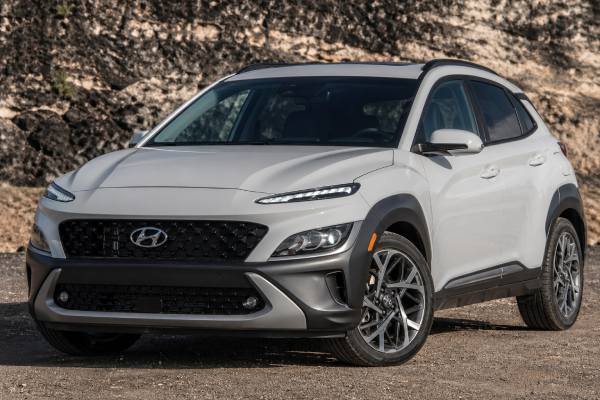
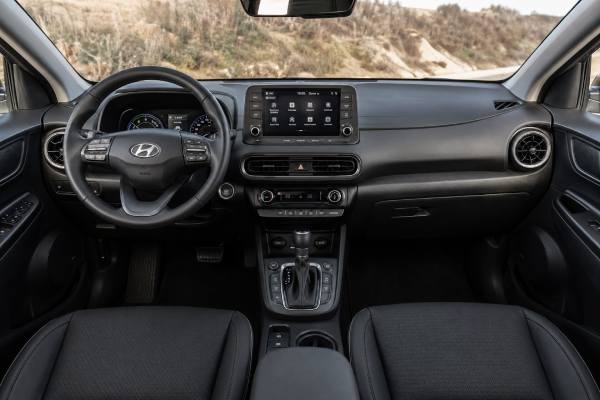
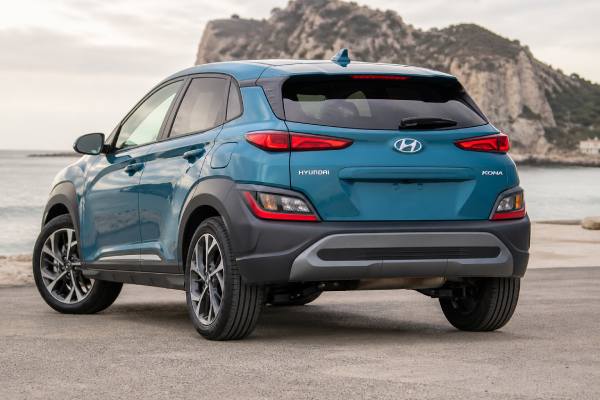
The 2021 Hyundai KONA AWD with the 1.6 T-GDi engine is the sharper, more eager side of the first-generation KONA story. In facelift-era form, it combines the familiar OS-platform small-crossover packaging with a turbocharged 1.6-liter direct-injection four-cylinder, a 7-speed dual-clutch transmission, and an active on-demand all-wheel-drive system. That mix gives it a real advantage over the naturally aspirated versions: stronger mid-range pull, better highway passing, and a more planted rear suspension layout because AWD cars use a multi-link rear axle.
For owners, though, the appeal is not only pace. This version is compact, easy to park, and genuinely usable year-round. The trade-off is complexity. Compared with the 2.0-liter automatic KONA, the turbo AWD model asks for closer attention to transmission behavior, software updates, and maintenance history. Buy a well-kept example with the right service record, and it is one of the more interesting small AWD crossovers of its period.
Essential Insights
- The turbocharged 1.6 T-GDi and AWD setup make this KONA much quicker and more flexible than the 2.0-liter model.
- AWD versions get a multi-link rear suspension, which helps stability and gives the chassis a more mature feel.
- Upper trims usually bring the best mix of LED lighting, active safety tech, and comfort features.
- The main ownership caution is the dry-clutch 7-speed DCT, which needs smooth use and proper software support.
- A practical oil-service target is every 10,000 km or 12 months, cut to 5,000–6,000 km in harsh stop-start use.
Start here
- Hyundai KONA AWD 1.6T profile
- Hyundai KONA AWD hard data
- Hyundai KONA AWD grades and ADAS
- Ownership risks and factory fixes
- Service planning and smart buying
- Road manners and fuel use
- Rival crossovers worth weighing
Hyundai KONA AWD 1.6T profile
The 2021 AWD 1.6 T-GDi KONA sits in the sweet spot for buyers who want a small crossover that still feels alert and reasonably premium from the driver’s seat. In the OS range, the turbo engine changes the car more than the spec sheet first suggests. Yes, it adds a clear power increase, but just as importantly it comes with the drivetrain and chassis pieces that make the KONA feel more serious: the 7-speed dual-clutch transmission, stronger brake package, and the AWD car’s multi-link rear suspension.
That matters because the standard 2.0-liter KONA is competent but plainly tuned for low-cost everyday transport. The 1.6 T-GDi version, by contrast, feels like Hyundai deliberately gave the small SUV a sportier edge without turning it into a harsh or compromised performance model. In normal commuting it is still easy to drive, but it has enough torque to feel relaxed on faster roads and steep grades. That is the practical advantage. You do not need to work the powertrain hard just to merge or pass.
This version is also one of the better examples of a compact crossover that stays compact. It is not oversized, visibility is decent, and it still fits city life well. The driving position is upright, the front seats are generally comfortable, and cargo space remains useful for the class. That makes it appealing to owners who need one car to cover commuting, winter driving, and occasional longer trips.
There is an important ownership caveat, though. The 1.6 T-GDi AWD KONA is not the “simplest possible” KONA. The engine is direct-injected and turbocharged, which means more heat, more plumbing, and more long-term deposit risk than the 2.0 MPI. The transmission is also more sensitive to driving style and maintenance support than a conventional torque-converter automatic. In other words, this is the better KONA for people who care about performance and AWD traction, but not automatically the safer choice for buyers who want the lowest possible ownership risk.
For 2021 specifically, market differences are worth remembering. Some regions received facelift styling and newer safety packaging, while others still grouped equipment differently. The core AWD 1.6 T-GDi formula stayed recognizable, however: a compact turbo crossover with enough punch to feel lively, but not so much that it becomes expensive to run when properly maintained.
Hyundai KONA AWD hard data
The table below focuses on the core 2021 AWD 1.6 T-GDi OS hardware. Some trim-dependent items and market-cycle numbers vary, especially fuel economy, towing, and wheel fitment, but the mechanical layout stays very consistent.
| Item | Specification |
|---|---|
| Code | Gamma 1.6 T-GDi |
| Engine layout and cylinders | Inline-4, DOHC, 16 valves, 4 valves per cylinder |
| Bore × stroke | 77.0 × 85.4 mm (3.03 × 3.36 in) |
| Displacement | 1.6 L (1,591 cc) |
| Induction | Turbocharged |
| Fuel system | Gasoline direct injection |
| Compression ratio | 10.0:1 |
| Max power | 175 hp (130 kW) @ 5,500 rpm |
| Max torque | 265 Nm (195 lb-ft) @ 1,500–4,500 rpm |
| Timing drive | Chain |
| Transmission | 7-speed dry dual-clutch automatic with manual mode |
| Drive type | Active on-demand AWD |
| Differential | Open differentials with brake-based torque vectoring |
| Suspension | MacPherson strut front / multi-link rear |
| Steering | Motor-driven power steering; 13.8:1 ratio |
| Brakes | Front ventilated discs 305 × 25 mm (12.0 × 1.0 in), rear solid discs 284 × 10 mm (11.2 × 0.4 in) |
| Most common tyre size | 235/45 R18 |
| Turning circle | 10.6 m (34.8 ft) kerb-to-kerb |
| Item | Specification |
|---|---|
| Length / width / height | 4,165 / 1,800 / 1,550–1,565 mm (164.0 / 70.9 / 61.0–61.6 in) |
| Wheelbase | 2,600 mm (102.4 in) |
| Ground clearance | 170 mm (6.7 in) |
| Kerb weight | About 1,477–1,507 kg (3,256–3,322 lb), depending on market and trim |
| GVWR | About 1,930 kg (4,255 lb) |
| Payload | Roughly 420–450 kg (925–992 lb), depending on equipment |
| Fuel tank | 50 L (13.2 US gal / 11.0 UK gal) |
| Cargo volume | 544 L (19.2 ft³) seats up / 1,296 L (45.8 ft³) seats down, SAE method |
| Rated efficiency | AWD EPA: 26 / 29 / 27 mpg US city / highway / combined, about 9.0 / 8.1 / 8.7 L/100 km |
| Real-world highway @ 120 km/h (75 mph) | Usually around 7.5–8.5 L/100 km in calm conditions with stock-size tyres |
| Acceleration | Typically low-8-second range to 100 km/h for the AWD 175 hp tune |
| Top speed | Usually around 200 km/h class, depending on market tune and tyres |
| Braking distance | Factory brochures rarely publish a verified figure for this exact configuration |
| Towing capacity | Market-dependent; some regions discouraged towing, while some export specs listed up to 1,250 kg (2,756 lb) braked and 600 kg (1,323 lb) unbraked |
| Item | Specification |
|---|---|
| Engine oil | API latest / ILSAC latest or ACEA A5/B5; 5W-30 preferred; 4.5 L (4.76 US qt) |
| Coolant | Phosphate-based ethylene glycol for aluminum radiator; 7.1 L (7.5 US qt) |
| DCT fluid | API GL-4 SAE 70W DCT fluid; 1.9–2.0 L (2.01–2.11 US qt) |
| Transfer case oil | API GL-5 SAE 75W/90; 0.47–0.52 L (0.44–0.49 US qt) |
| Rear differential oil | 0.47–0.52 L (0.44–0.49 US qt) |
| Brake fluid | FMVSS 116 DOT-3 or DOT-4; 0.7–0.8 L (0.74–0.85 US qt) |
| A/C refrigerant | R-1234yf; 450 ±25 g (15.9 oz) |
| A/C compressor oil | PAG; 120 ±10 mL (4.2 ±0.35 fl oz) |
| Key torque spec | Wheel nuts: 107–127 Nm (79–94 lb-ft) |
| Euro NCAP | 5 stars; 87% adult, 85% child, 62% vulnerable road users, 60% safety assist |
| IIHS | Top Safety Pick, but only with the optional front crash-prevention system and the better headlights |
| IIHS headlight rating | Good with LED projector setups, Poor with lower halogen setups |
| ADAS suite | AEB, lane support, blind-spot warning, rear cross-traffic alert, and adaptive cruise varied by trim and market |
The key takeaway is simple: the 1.6 T-GDi AWD KONA is mechanically much more serious than the entry-level versions, but it also becomes more market-sensitive. Always decode the exact trim and country spec before assuming towing, lighting, or safety equipment.
Hyundai KONA AWD grades and ADAS
Trim strategy for the AWD 1.6 T-GDi KONA varied a lot in 2021, especially because different regions handled the facelift at different points in the model cycle. Even so, the turbo AWD version almost always sat in the upper half of the lineup. It was rarely the true base car. That is helpful for used buyers, because it means most AWD 1.6T examples come with better wheels, better interior trim, and more standard equipment than the simpler 2.0-liter trims.
In North American-style lineups, the turbo engine was typically associated with grades such as Trend, Night, Limited, Ultimate, or N Line-related packages, depending on market. In facelift markets, it also became more common to see stronger SmartSense packaging, bigger infotainment screens, and a more distinct visual gap between base and upper trims. The practical difference is that a buyer shopping only by engine may accidentally compare two very different cars.
Mechanically, there are usually fewer trim differences than cosmetic differences. The real hardware changes are mostly tied to the turbo AWD powertrain itself: 18-inch wheels are common, the stronger brake package is fitted, and the multi-link rear suspension comes with the AWD setup. Some markets also added drive-mode changes or an AWD lock function in snow or low-grip conditions, while others relied more on automatic torque distribution and brake-based control logic. Either way, this is not a low-range off-road system. It is a road-biased traction system built for wet roads, gravel, and winter use.
Lighting is one of the most important trim separators. On paper, buyers often focus on wheels or upholstery, but headlight performance matters more in daily use. The best LED projector headlamps are a meaningful upgrade. Lower halogen setups can feel weak on dark secondary roads and are less desirable in the used market.
Safety equipment also varies enough to change the value equation. Six airbags, ABS, electronic stability control, hill-start assist, and rear camera coverage are usually standard. Beyond that, features such as forward collision-avoidance assist, pedestrian detection, blind-spot monitoring, rear cross-traffic alert, adaptive cruise control, lane keeping assist, lane following support, and driver attention warning may be standard, optional, or absent depending on trim and region.
Crash-test results are generally strong. Euro NCAP carried the first-generation KONA’s five-star safety result through a facelift review in late 2020, and the rating also applied to 1.6 T-GDI DCT 4×4 variants. IIHS ratings were also strong, but with an important condition: the 2021 KONA only qualified as a Top Safety Pick when fitted with the optional front crash-prevention system and the correct headlights. That means a lower-spec used car can be materially less impressive than the brochure summary suggests.
For buyers, the best trims are usually the ones that combine the turbo AWD powertrain with LED headlights and the broader active-safety package. That is where the KONA feels fully rounded.
Ownership risks and factory fixes
The 2021 AWD 1.6 T-GDi KONA is not a fundamentally fragile vehicle, but it has clear pattern areas that buyers should understand before purchase. The major point is that its risks are different from those of the 2.0-liter model. The big oil-ring recall story that shaped the reputation of some 2019–2021 Kona 2.0 MPI cars does not define the 1.6 T-GDi version. Instead, the turbo AWD KONA is more about driveline behavior, direct-injection aging, and normal compact-SUV wear points.
The most common concern is the 7-speed dry dual-clutch transmission. Symptoms usually show up as low-speed shudder, hesitant take-up, rough creeping in parking maneuvers, or an awkward 1–2 shift when hot and heavily used in traffic. The likely causes range from worn clutch packs to calibration issues and adaptation problems. The right remedy depends on diagnosis: software updates and relearn procedures can improve behavior on some cars, while others need clutch-related repair. This is why a dealer-level scan history matters.
The second recurring pattern is direct-injection maintenance. Over time, intake-valve carbon deposits can build up because fuel does not wash the intake valves in a GDI engine. Typical symptoms are rough cold starts, uneven idle, and softer response at lower revs. This is not unique to Hyundai, but it is part of long-term ownership planning on any turbo direct-injected car. Around 80,000 to 120,000 km, some examples start to feel noticeably better after intake cleaning.
Occasional issues include ignition-coil or spark-plug sensitivity, boost-hose and intercooler-hose leaks, PCV-related oil misting, and cooling-system seepage around hoses or plastic housings as the vehicle ages. None of these are unique disasters, but they are expensive to ignore once drivability starts to deteriorate.
On the chassis side, watch for:
- Rear brake corrosion or uneven wear, especially in winter climates and short-trip use.
- Front suspension noises from links, bushings, or top mounts on rough roads.
- Wheel bearing hum on higher-mileage or pothole-exposed cars.
- Underbody corrosion around fasteners, brake lines, and rear suspension hardware in salt-heavy regions.
Software and calibration also matter more than buyers often assume. On a modern KONA, proper ADAS alignment after windshield replacement or front-end repair is not optional. A car can drive straight and still have a partially misaligned safety system.
Before buying, ask for proof of software updates, DCT work if applicable, full service history, and recent fluid services on the AWD hardware. Then do a cold start and a long test drive with low-speed parking maneuvers, a hill start, and a few mid-speed kickdowns. A good 1.6T AWD KONA should feel clean, quick, and tidy. If it feels clumsy at walking pace, it usually needs attention.
Service planning and smart buying
This is the section that separates a good KONA 1.6T AWD from an expensive one. The basic rule is simple: treat it like a turbo direct-injected car with a dual-clutch transmission, not like a generic small crossover. That means shorter oil intervals in real life, proper spark-plug timing, and serious attention to the AWD and transmission fluids when the vehicle is used hard.
| Item | Practical interval |
|---|---|
| Engine oil and filter | Every 10,000 km or 12 months normal use; every 5,000–6,000 km or 6 months in heavy traffic, short trips, heat, dust, or repeated cold starts |
| Tyre rotation | Every 10,000 km |
| Cabin air filter | Every 20,000 km or 12 months |
| Engine air filter | Inspect regularly; replace around every 40,000 km sooner in dust |
| Spark plugs | Every 70,000 km |
| Valve clearance | Inspect around 90,000 km or 72 months if symptoms or noise suggest it |
| Drive belt | First inspection at 96,000 km or 72 months, then every 20,000 km or 24 months |
| Coolant | First replacement at 192,000 km or 10 years, then every 48,000 km or 24 months |
| DCT fluid | Inspect and service based on use; severe-use schedules often call for replacement around 116,000 km |
| Transfer case and rear differential | Practical AWD service target: around 100,000–120,000 km, earlier after repeated heavy winter use or contamination |
| Brake fluid | Practical interval every 2–3 years |
| 12 V battery | Test annually from year 4 onward |
The fluid specs also matter. This engine wants quality oil in the correct viscosity, not bargain-bin fill. The DCT needs the right fluid type, and the AWD case oils should not be guessed. On a used car, proof is better than promises.
For buyers, the inspection checklist should focus on the following:
- DCT behavior from cold and hot.
- Boost delivery with no surging, whistles, or limp-mode signs.
- Oil leaks around the turbo plumbing, valve-cover area, and PCV routing.
- Cooling-system stains or dried residue.
- Rear brake condition and even pad wear.
- Tyre match and alignment wear.
- Evidence of water or salt corrosion underneath.
- All ADAS warning lights off, and all driver-assistance functions actually present and working.
The trims to seek are usually mid-to-upper turbo AWD versions with LED lights and the fuller safety package. The trims to be more cautious with are lower-spec cars on weaker headlights, cars with mismatched tyres, and cars that were clearly used hard in city traffic without transmission-related follow-up.
Long-term durability is good enough to recommend, but only with paperwork. The 1.6T AWD KONA is best when bought as a maintained enthusiast’s daily, not a neglected budget AWD bargain.
Road manners and fuel use
The AWD 1.6 T-GDi KONA drives with much more energy than its modest size suggests. It is not a hot hatch in disguise, but it is one of those small crossovers that feels alert from the first block. The steering is light rather than deeply communicative, yet the front end reacts quickly and the chassis does not feel top-heavy. That is one of the car’s quiet strengths. It turns in cleanly and stays composed, especially compared with softer rivals.
Ride quality is trim-sensitive. Eighteen-inch wheels bring better stance and response, but also more sharp-edge impact over broken asphalt. Even so, the AWD setup’s multi-link rear suspension gives this version a more settled feel than the simpler rear axle on lower-spec models. On fast secondary roads, the car feels planted enough to build confidence without asking much from the driver.
The powertrain is the main event. Below about 1,500 rpm, response is reasonable but not explosive. Once the turbo is in its stronger torque band, the KONA feels energetic and much more relaxed than the 2.0 MPI version. That is especially noticeable on highway merges and mid-speed overtakes. You do not need huge revs to make progress.
The DCT, however, defines part of the experience. In open-road driving it suits the engine well, giving quick shifts and a more direct feel than a conventional automatic. In crawling traffic or repeated parking maneuvers, it can still show the familiar dry-clutch awkwardness: mild shudder, hesitation, or that slight mechanical pause before engagement. Drivers who come from manual cars adapt quickly. Drivers expecting perfect torque-converter creep sometimes need time.
Real-world fuel use depends heavily on traffic and weather. In mixed use, most owners should expect roughly 8.5 to 9.5 L/100 km. Highway use at legal cruising speeds can drop into the mid-to-high 7s if the road is flat and the weather is calm. Dense urban use, winter warm-up, short trips, and aggressive acceleration can push the number above 10 L/100 km. Cold weather usually costs about 0.7 to 1.2 L/100 km.
AWD traction is a real asset in rain and snow, but tyres still decide the final result. On proper winter tyres, the KONA is confident and easy to place. On mediocre all-seasons, the AWD system helps launches and stability, but cannot mask limited grip. That is worth stating clearly because some buyers overestimate what the drivetrain alone can do.
Under load, the 1.6T still copes well. With passengers and luggage, it loses less urgency than the 2.0 car. Fuel use rises, of course, and moderate towing or full-load hill work can raise consumption by 15 to 25 percent. But as a small all-weather daily with genuine passing ability, this version makes a strong case for itself.
Rival crossovers worth weighing
The 2021 KONA AWD 1.6 T-GDi works best when compared with other small crossovers that try to offer more than basic transport. In that group, it has a clear identity: quicker than most plain entry-level rivals, smaller and more playful than many compact SUVs, and more interesting than its size suggests.
Against the Kia Seltos turbo AWD, the Hyundai feels shorter, tidier, and more city-friendly. The Kia usually gives you more rear-seat space and a roomier cabin, but the KONA feels more compact and more eager. If you carry adults in the back often, the Seltos can win. If you value smaller dimensions and sharper responses, the KONA remains appealing.
Against the Mazda CX-30 AWD, the comparison is about character. The Mazda usually feels richer inside and more polished in steering and damping, while the Hyundai counters with a more upright crossover feel, simpler controls, and often lower used pricing. The Mazda is the more refined object. The Hyundai is the more extroverted and sometimes better-value one.
Against the Subaru Crosstrek, the KONA is quicker in turbo form and feels more lively. The Subaru counters with a calmer, more rugged long-distance personality and a very straightforward AWD reputation. The Crosstrek is the rational traction-first choice. The KONA is the driver’s choice if you want more response and less bulk.
Against older Honda HR-V and Nissan Kicks rivals, the KONA’s advantage is stronger acceleration and better available AWD capability. Those competitors can be simpler or more spacious in some respects, but neither feels as punchy in comparable trim.
Even inside the Hyundai lineup, the KONA 1.6T AWD deserves a separate verdict. The 2.0 MPI version is the simpler ownership play. The 1.6T AWD is the better all-round driver’s car. For many buyers, that is enough to justify the extra complexity.
Its advantages are easy to summarize. It is compact, quick enough to be enjoyable, confidence-inspiring in poor weather, and still practical enough for real life. Its weaknesses are equally clear: rear-seat space is only adequate, the DCT wants understanding, and trim differences matter more than many shoppers expect. Choose carefully, and it remains one of the more rewarding subcompact AWD crossovers of its era.
References
- 2021 Kona Specifications 2021 (Product Guide)
- OS CAN-E 7.qxp 2020 (Owner’s Manual)
- OS CAN-E 8.qxp 2020 (Owner’s Manual)
- 2021 Hyundai Kona 4-door SUV 2021 (Safety Rating)
- Euro NCAP | Hyundai KONA 2020 (Safety Rating)
Disclaimer
This article is for informational purposes only and is not a substitute for professional diagnosis, inspection, or repair. Specifications, torque values, maintenance intervals, procedures, towing limits, and equipment can vary by VIN, market, trim, and production date, so always verify the correct details against the official service documentation for the exact vehicle.
If this guide was useful, please consider sharing it on Facebook, X, or another platform to support our work.