
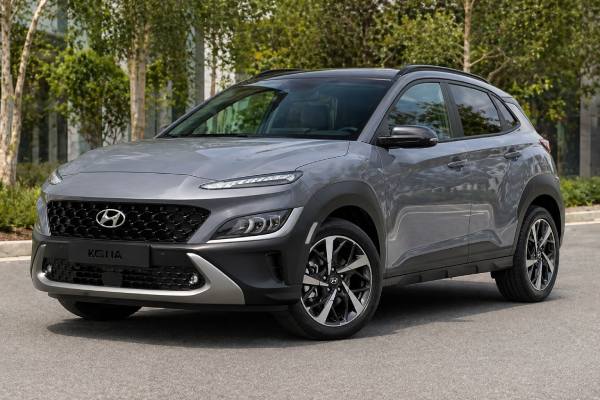

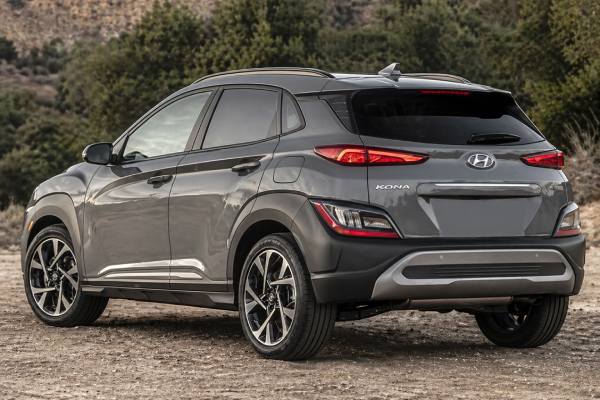
The 2022–2023 Hyundai KONA AWD with the 1.6 T-GDi engine is the late-cycle version of the first-generation Kona that makes the most sense for drivers who want compact size with real pace. In this facelift form, the 1.6-litre turbo four produces 195 hp, works through a seven-speed dual-clutch automatic, and can send power to all four wheels through Hyundai’s active on-demand AWD system. That hardware matters because it gives the Kona a stronger mid-range, better wet-weather traction, and a calmer rear suspension setup than front-wheel-drive models. By 2022 and 2023, Hyundai had also refined the design, infotainment, and safety-tech package, so this version feels more mature than early OS cars. It is not the cheapest Kona to own, and it does demand closer gearbox and service-history scrutiny than the naturally aspirated 2.0 model, but as a used compact crossover it offers an appealing mix of performance, everyday usability, and year-round confidence.
Essential Insights
- The 1.6 T-GDi AWD setup gives the facelift Kona strong mid-range punch and much better passing performance than the 2.0 model.
- AWD versions use a multi-link rear suspension, which improves body control and rough-road composure.
- The 2022–2023 facelift cabin feels more modern, with stronger infotainment and broader active safety coverage.
- The main ownership caution is the seven-speed dual-clutch transmission, which needs a smooth road test and a clean history.
- A practical oil-service baseline is every 10,000 km or 12 months, with shorter intervals in severe use.
Explore the sections
- Hyundai KONA AWD late-facelift focus
- Hyundai KONA AWD numbers and hardware
- Hyundai KONA AWD trims and protection tech
- Known issues and factory actions
- Upkeep plan and buying checks
- Real-world driving and economy
- Best alternatives in the class
Hyundai KONA AWD late-facelift focus
The 2022–2023 Hyundai KONA AWD 1.6 T-GDi sits in a very useful niche. It is quicker and more engaging than the ordinary 2.0-litre Kona, but it stops short of the much more aggressive and more expensive Kona N. For many buyers, that makes it the sweet-spot petrol Kona.
The first thing that separates it from lower trims is not just power. Yes, the 195 hp turbo engine changes the car’s pace in a major way, but the AWD hardware also changes the way the Kona feels underneath you. Unlike front-wheel-drive versions that use a torsion-beam rear axle, AWD models get a multi-link rear suspension. That single difference gives the car a more settled feel over broken surfaces, better control through quick direction changes, and a slightly more planted character at highway speed. It still behaves like a compact crossover, not a hot hatch, but the chassis feels more complete.
The late-facelift timing matters too. By 2022 and 2023, Hyundai had already smoothed out the visual update introduced earlier in the facelift cycle. The result is a Kona that looks cleaner, a bit more mature, and less busy than the original 2018 launch model. Inside, the later cars feel more modern thanks to stronger screen options, better software presentation, and a generally tidier dashboard layout. These updates matter in the used market because they help the car feel newer than its platform age suggests.
From an ownership standpoint, this version is aimed at buyers who want one vehicle to handle commuting, winter conditions, occasional spirited driving, and long-distance use. The active AWD system is not designed for serious off-road work, but it does make the Kona feel more secure in rain, slush, and light snow. The higher-output engine also fixes the main weakness of the 2.0-litre car, which is ordinary passing power once the vehicle is loaded with passengers or luggage.
There are trade-offs. Fuel economy is clearly worse than the smaller-engined front-drive Kona. Tyres, brakes, and driveline fluids matter more because this version encourages harder use. The seven-speed dual-clutch automatic also needs to be evaluated carefully, especially on used cars that have spent a lot of time in stop-start traffic. A healthy car feels sharp and decisive. A neglected one can feel clumsy at low speed.
In the current used market, the 2022–2023 AWD 1.6 T-GDi works best for drivers who want a subcompact SUV that does not feel slow or stripped down. It offers genuine extra capability without becoming excessively large or costly to run. That balance is what keeps it relevant.
Hyundai KONA AWD numbers and hardware
For this article, the baseline is the North American 2022–2023 facelift Hyundai KONA AWD with the 1.6-litre turbocharged petrol engine rated at 195 hp. Exact wheel sizes and feature content vary by trim, but the mechanical package is very consistent across N Line and Limited AWD versions.
| Item | Specification |
|---|---|
| Code | Gamma / Smartstream-family 1.6 T-GDi |
| Engine layout and cylinders | Inline-4, DOHC, 16 valves, 4 cylinders, 4 valves per cylinder |
| Bore × stroke | 75.6 × 89.0 mm (2.98 × 3.50 in) |
| Displacement | 1.6 L (1,591 cc) |
| Induction | Turbocharged |
| Fuel system | GDI |
| Compression ratio | 10.0:1 |
| Max power | 195 hp (145 kW) @ 6,000 rpm |
| Max torque | 195 lb-ft (264 Nm) @ 1,500–4,500 rpm |
| Timing drive | Chain |
| Rated efficiency | About 8.4 city / 7.4 highway / 8.1 combined L/100 km (28 / 32 / 29 mpg US; 33.6 / 38.4 / 34.8 mpg UK) for the late-facelift U.S. 1.6T AWD setup |
| Real-world highway @ 120 km/h (75 mph) | Typically about 7.8–8.8 L/100 km (27–30 mpg US / 32–36 mpg UK), depending on weather, tyres, and load |
| Item | Specification |
|---|---|
| Transmission | 7-speed EcoShift DCT, dry-clutch type, with manual shift mode |
| Drive type | Active on-demand AWD |
| Differential | Open differentials with brake-based torque vectoring and electronically controlled rear coupling |
| Suspension (front / rear) | MacPherson strut / multi-link |
| Steering | Rack-and-pinion, motor-driven power steering |
| Brakes | Four-wheel disc brakes; official U.S. consumer specification sheets do not consistently publish rotor diameters by trim for this exact 2022–2023 AWD version |
| Wheels and tyres | Typical factory sizes are 18-inch alloys with 235/45 R18 tyres |
| Ground clearance | About 170 mm (6.7 in) |
| Length / width / height | 4,205 / 1,800 / 1,565 mm (165.6 / 70.9 / 61.6 in) approximately, trim dependent |
| Wheelbase | 2,600 mm (102.4 in) |
| Turning circle | About 10.6 m (34.8 ft) |
| Kerb weight | About 1,483–1,509 kg (3,271–3,327 lb) in U.S.-spec AWD 1.6T trims |
| GVWR | About 1,930 kg (4,255 lb) |
| Fuel tank | 50 L (13.2 US gal / 11.0 UK gal) |
| Cargo volume | 544 L (19.2 ft³) behind rear seats / 1,296 L (45.7 ft³) seats folded, SAE |
| Acceleration 0–100 km/h | About 8.2–8.5 seconds in typical real-world testing conditions |
| Top speed | Not consistently published in U.S. consumer material for this exact late-facelift trim |
| Braking distance 100–0 km/h | Not consistently published in official Hyundai specification sheets for this exact variant |
| Towing capacity | Not recommended in Hyundai U.S. consumer specification material |
| Payload | Approximately 421–447 kg (928–986 lb), depending on exact trim and curb weight |
| Item | Specification |
|---|---|
| Engine oil | SAE 0W-20 meeting current API and ILSAC guidance; about 4.8 L (5.1 US qt) |
| Coolant | Ethylene glycol-based long-life coolant; about 8.5 L (9.0 US qt) |
| Transmission fluid | Hyundai-specified DCT fluid, VIN-specific in service documentation; consumer literature does not present a simple retail spec line |
| Differential / transfer case | Use Hyundai-approved AWD gear oils; capacities depend on service method and component |
| A/C refrigerant | R-1234yf on late-facelift North American cars |
| A/C compressor oil | VIN-specific PAG-type specification |
| Key torque specs | Wheel nuts typically 107–127 Nm (79–94 lb-ft) |
| Crash ratings | IIHS ratings remained strong for the 2023 Kona family; no dedicated Euro NCAP late-facelift 2022–2023 test was published for this exact North American AWD trim, so the earlier first-generation Euro NCAP result should be treated as broader family context rather than a trim-specific rerating |
| Headlight rating | Trim dependent; better lamp units on richer trims are preferable |
| ADAS suite | Forward collision avoidance, lane keeping and lane following assist, blind-spot collision warning or avoidance, rear cross-traffic alert, driver attention warning, and smart cruise control depending on trim |
The most important technical takeaway is that this is not just a more powerful Kona. It is also the more sophisticated chassis Kona in the non-N lineup.
Hyundai KONA AWD trims and protection tech
For 2022 and 2023 in North America, the 195 hp AWD 1.6 T-GDi version generally lived in richer trims rather than entry-level grades. That matters because most used examples on the market will not be stripped-out cars. They tend to be N Line or Limited models, and both bring more than just a stronger engine.
The easiest trim split is between N Line AWD and Limited AWD. The N Line is the more overtly sporty car. It usually adds unique front and rear styling, darker trim, a more aggressive wheel design, metal-look pedals, stronger seat bolstering, and a sportier visual theme. The Limited is the more polished premium option. It tends to trade some of the N Line attitude for richer comfort and convenience features, sometimes with a slightly more upscale cabin finish.
Mechanical differences are smaller than appearance differences. Both AWD trims share the same broad hardware: the 1.6 turbo engine, seven-speed DCT, active AWD system, and multi-link rear suspension. The more meaningful real-world differences come from tyres, wheel finish, available seat materials, sunroof fitment, sound system tier, and the specific safety package installed by year and market.
The quick used-buyer identifiers are straightforward:
- N Line AWD: sporty bumpers, more aggressive grille treatment, N Line badging, darker cabin accents, and often a more youthful look overall
- Limited AWD: cleaner exterior trim, richer seat finish, more comfort-led cabin equipment, and often the fullest technology package
In 2022 and 2023, Hyundai had already broadened the active safety story on the Kona. Even so, it is still worth checking what is standard and what is package dependent. Key systems on upper trims usually include forward collision avoidance with pedestrian detection, lane keeping assist, lane following assist, driver attention warning, blind-spot monitoring or avoidance, rear cross-traffic alert, and smart cruise control on richer versions. Rear automatic braking and better parking assistance may also appear depending on trim and options.
The safety story is solid, but trim-sensitive. The Kona’s structure has a good reputation, and the IIHS ratings for the 2023 model remain strong overall. The weaker point, as in many small SUVs, can be lighting differences between trims. Better-equipped headlamp units are easier to live with at night and can materially improve the ownership experience. That matters more than buyers sometimes expect.
Inside, these late-facelift trims also feel more refined than early OS cars. The bigger screen layouts, improved graphics, and tidier center stack help the Kona feel newer than its basic platform age. That is one reason the 2022–2023 cars tend to hold interest better in the used market.
One point many buyers overlook is ADAS calibration. On a modern Kona, a car can have every listed driver-assistance feature and still need recalibration after a windscreen change, alignment correction, or front-end repair. When reviewing a used example, ask whether any camera or radar work was followed by proper calibration. On a car with blind-spot, lane, and forward collision systems, that is not a small detail.
Known issues and factory actions
The late-facelift 1.6 T-GDi AWD Kona is generally a decent ownership proposition, but it is not the kind of car you buy purely on badge and mileage. As with many modern turbocharged small crossovers, its reliability depends heavily on service quality and how it was used.
The biggest concern is the occasional, medium-to-high-cost one: the seven-speed dry-clutch dual-clutch transmission. When it is healthy, it fits the car well and gives the Kona crisp response. When it is worn, badly adapted, or used heavily in stop-and-go traffic, it can show classic dry-DCT complaints. Symptoms include hesitant launch, shudder when moving off, jerky low-speed parking maneuvers, awkward creep behavior, or rough gear engagement when cold. The likely causes range from software and clutch adaptation issues to clutch-pack wear or actuator-related problems. The remedy depends on the diagnosis, so a proper scan and road test matter far more than assumptions.
The engine itself is usually the less dramatic part of the car, but there are still common, low-to-medium-cost issues to watch. Because this is a direct-injected turbo engine, long oil intervals, repeated short trips, and cheap fuel can gradually lead to rougher cold running, heavier spark plug wear, oil dilution concerns, or carbon-related deposit build-up. Most owners will notice slightly hesitant throttle response or a less clean idle before they notice anything major. The cure is boring but effective: good oil, sensible intervals, correct plugs, and not using the car only for short urban hops.
Another occasional, medium-cost issue is boost-side plumbing or ignition trouble. Misfire under load, weak mid-range pull, or intermittent engine lights can come from ignition coils, plugs, sensor drift, or intercooler and charge-hose leaks rather than from a failed turbocharger itself. That is good news, because these problems are usually manageable if caught early.
The AWD system is usually reliable, but it has one clear ownership requirement: matching tyres. Uneven circumference, mixed brands, or major tread-depth differences can create driveline stress and make the system feel less smooth than it should. The same applies to neglected AWD fluids. Even when a manufacturer does not market those fluids as a routine consumer talking point, long-term owners benefit from checking and servicing them sensibly.
Chassis wear is ordinary class stuff. Expect common, low-cost anti-roll-bar links, suspension bushes, and rear brake corrosion on lightly used cars. Because this version tends to be driven harder, brake wear and tyre quality tell you a lot about how the previous owner treated it. A car on premium matching tyres with even tread is usually a better sign than a cheap set of mixed replacements.
As for recalls and campaigns, the right approach is VIN-first. Hyundai’s official recall lookup and dealer records are the only reliable way to confirm campaign completion. Late-cycle cars are generally less worrying than early-run models in many families, but that is not an excuse to skip verification. On a used 2022–2023 Kona AWD, documented campaign completion, software history, and clean diagnostic health matter more than marketing claims about reliability.
Before buying, ask for:
- full service records with dates and mileage
- proof of recall and service-campaign completion
- cold-start behavior and a proper low-speed road test
- scan results for engine, transmission, and ADAS systems
- matching tyre brand, size, and even tread depth
- evidence of calibration after windscreen or front-end work
- fluid-service history where available for AWD components
A good example feels tight, eager, and easy. A poor one usually reveals itself through clumsy low-speed gearbox behavior and weak paperwork.
Upkeep plan and buying checks
This Kona responds best to conservative maintenance. The drivetrain is modern and reasonably durable, but it is not especially tolerant of long neglect. Shorter service intervals than the most optimistic brochure logic are usually the right call.
| Item | Distance or time | Why it matters |
|---|---|---|
| Engine oil and filter | Every 10,000 km or 12 months | Shorten to about 5,000–8,000 km in severe service, heavy traffic, cold starts, or repeated short trips |
| Engine air filter | Inspect every service, replace around 30,000–45,000 km | Earlier in dusty conditions |
| Cabin air filter | Every 15,000–20,000 km or 12 months | Helps HVAC performance and demisting |
| Spark plugs | About 60,000–75,000 km | Do not stretch on a boosted GDI engine |
| Coolant | Inspect yearly, replace by official schedule or earlier if contamination appears | Use the correct Hyundai-compatible coolant only |
| Timing chain | No fixed routine replacement interval | Inspect if startup rattle, correlation faults, or poor history raise concern |
| Brake fluid | Every 2 years | Moisture control matters for pedal feel and corrosion resistance |
| Brake pads and rotors | Inspect at every service | Rear corrosion and uneven wear can show up on low-use cars |
| DCT health check | Road-test and scan at every major service | Early software or clutch-behavior issues are cheaper to catch than to ignore |
| AWD and driveline fluids | Inspect regularly; proactive service around 50,000–80,000 km is sensible | Especially wise for snow, hills, or heavy urban driving |
| Tyre rotation and alignment | Every 10,000–12,000 km and after impacts | Important for AWD smoothness and tyre life |
| 12 V battery test | Annually from year 4 | Weak voltage can aggravate electronics and drivability complaints |
Useful quick-reference figures for owners and buyers include:
- engine oil capacity: about 4.8 L
- fuel tank: 50 L
- common tyre size: 235/45 R18
- wheel fastener torque: about 107–127 Nm
- curb weight: roughly 1,483–1,509 kg
For buying, the best examples are usually the cars with full records, matching tyres, and a smooth road-test result. A later 2023 car may feel slightly fresher on software and trim condition, but a clean 2022 with better history is usually the smarter purchase.
A practical pre-purchase checklist should include:
- cold start from fully cold, not pre-warmed
- no clutch shudder in reverse or parking maneuvers
- smooth launch on an incline
- no flare, banging, or hesitation in gear changes
- even tread wear and matching tyres on all four corners
- no leaks around the engine, transfer case, or rear driveline
- clean operation of blind-spot, lane, and forward-collision systems
- proof of campaign completion and service receipts
Trims to seek are usually Limited AWD if you want the richest everyday package, or N Line AWD if you care more about visual presence and sportier cabin details. Trims to avoid are not defined by badge as much as by maintenance gaps. A cheaper car with a rough DCT and mixed tyres is rarely a bargain.
Long-term durability is fair to good if the car is maintained proactively. It is not as carefree as a basic naturally aspirated automatic, but it can be a satisfying long-term small SUV when bought carefully.
Real-world driving and economy
On the road, the 2022–2023 Kona AWD 1.6 T-GDi feels like the version the chassis was always waiting for. It is not wild, but it is genuinely quick enough to change the way the car is used. Where the 2.0 can feel merely adequate once loaded up, the 1.6 turbo still has useful passing power in reserve.
The engine’s best trait is its mid-range. There is enough torque low down that normal overtakes and on-ramp merges do not require dramatic planning. Full-throttle response is stronger than the spec sheet alone suggests, and the car feels eager in a way most subcompact crossovers do not. Turbo lag exists, but it is modest. Most drivers will only notice it if they ask for full thrust from very low revs.
The seven-speed DCT is a mixed character trait. At normal road speeds it suits the engine well. Shifts are quick, the drivetrain feels alert, and manual control is available when you want it. At very low speed, especially in stop-start traffic or when reversing uphill, it still behaves like a dry-clutch dual-clutch system rather than a traditional automatic. That means a little more mechanical feel and a little less smooth creep. Healthy cars are still easy to live with, but the difference is real.
Ride and handling are better than many buyers expect from a small SUV. The multi-link rear suspension on AWD cars gives the Kona more control over broken surfaces and better composure in quick lane changes. Body roll is moderate, grip is decent, and the car stays tidy through corners. The steering is light rather than richly communicative, but it is accurate and easy to trust. Straight-line stability is strong for the size.
Noise levels are acceptable rather than class-leading. The engine is fairly subdued at normal speeds, but tyre and road noise become more noticeable on coarse surfaces, especially on 18-inch wheel packages. Good tyres make a large difference here.
Real-world economy is respectable for a quick AWD crossover, though clearly not a headline strength:
- city: about 9.0–10.4 L/100 km
- highway: about 7.2–8.5 L/100 km
- mixed: about 8.1–9.2 L/100 km
That translates roughly to:
- 22.6–26.1 mpg US in city-heavy use
- 27.7–32.7 mpg US on the highway
- 25.6–29.0 mpg US in mixed driving
In UK terms, that is usually about 27–39 mpg UK, depending on use. Winter tyres, roof accessories, cold weather, and short-trip operation can easily add 0.7–1.5 L/100 km.
The AWD system is reassuring rather than dramatic. It does not advertise itself much in dry conditions, but in rain, slush, or snow it gives the Kona a more secure feel than most front-drive rivals can match. That extra confidence is part of the appeal of this exact version.
Best alternatives in the class
The late-facelift Kona AWD 1.6 T-GDi competes in an awkward but interesting corner of the market. It is smaller than many compact SUVs, quicker than most basic subcompact crossovers, and more practical than most warm hatchbacks. That makes its natural rivals a mix of sporty small SUVs and premium-adjacent crossovers.
Against the Mazda CX-30 AWD, the Hyundai feels quicker in turbo response and more obviously energetic. The Mazda counters with a richer cabin feel and slightly more mature refinement. If you want premium atmosphere, the Mazda often edges ahead. If you want a more eager powertrain in a smaller footprint, the Kona holds its ground well.
Against the Volkswagen Taos 4Motion, the Kona usually feels more focused and more vivid to drive. The Volkswagen offers better rear-seat and cargo practicality, but the Hyundai tends to feel more special from the driver’s seat, especially in N Line trim.
Against the Subaru Crosstrek 2.5, the choice is simple. The Subaru offers a calmer traditional automatic feel and stronger rough-road confidence, while the Hyundai is clearly quicker and more urban-friendly. The Subaru is the outdoors tool. The Hyundai is the city-and-highway all-rounder.
Against the Toyota Corolla Cross AWD, the Hyundai wins on performance and personality. The Toyota usually wins on drivetrain simplicity and low-stress ownership. Buyers who want brisk acceleration and stronger equipment often prefer the Kona. Buyers who want the most conservative long-term ownership case often lean Toyota.
Against a MINI Countryman Cooper ALL4, the Kona is usually the value pick. The MINI has badge appeal and a more premium cabin atmosphere, but the Hyundai typically offers more equipment per dollar and less intimidating ownership cost.
The Kona’s strongest case is this:
- it is compact and easy to park
- it is faster than most small crossovers
- AWD adds real four-season usefulness
- the facelift cabin and safety tech still feel current
- the chassis is more sorted than the basic Kona versions
Its weaker points are just as clear:
- the DCT is less relaxed than a conventional automatic
- rear-seat and cargo space are only average
- fuel economy is fine, not exceptional
- a neglected example can get expensive quickly
As a used buy, the 2022–2023 Hyundai KONA AWD 1.6 T-GDi is one of the more appealing sporty-leaning subcompact SUVs if you value compact size, genuine pace, and all-weather confidence. The key is to buy the right one. A clean, smooth, fully documented car is easy to recommend. A rough one with gearbox hesitation and missing records is exactly the sort of “cheap fast crossover” that becomes costly.
References
- 2022 Kona Specifications 2022 (Specifications)
- 2023 Kona Specifications 2023 (Specifications)
- Normal Maintenance Schedule (Smartstream 1.6 T-GDi) 2021 (Owner’s Manual)
- Maintenance under severe usage conditions 2021 (Owner’s Manual)
- 2023 Hyundai Kona 2023 (Safety Rating)
Disclaimer
This article is for informational purposes only and is not a substitute for professional diagnosis, inspection, or repair. Specifications, torque values, intervals, procedures, fluids, and equipment can vary by VIN, market, trim, and production date, so always verify the exact vehicle against official service documentation before making repair or purchase decisions.
If this guide helped you, please consider sharing it on Facebook, X, or other social platforms to support our work.