


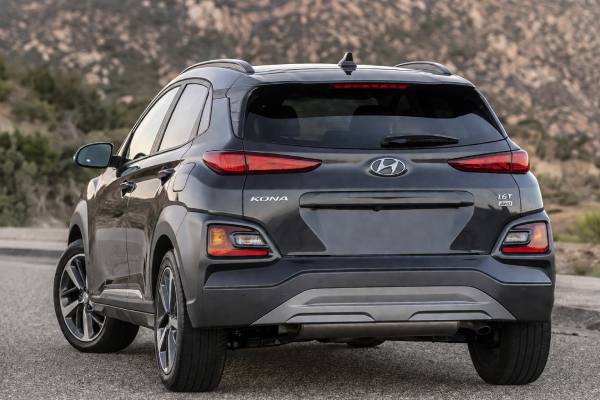
The 2018–2020 Hyundai KONA AWD OS with the 1.6 T-GDi turbo petrol engine is the quick, higher-spec side of the first-generation KONA range. It combines a strong 175 hp output, a 7-speed dual-clutch transmission, and a genuine on-demand all-wheel-drive system, which makes it more than just a dressed-up small crossover. Compared with the simpler 1.0 T-GDi front-wheel-drive models, this version feels more substantial, more secure in poor weather, and noticeably stronger in the mid-range. It also brings a multi-link rear suspension and larger brakes, so the engineering package is meaningfully different, not just quicker in a straight line.
That said, it is also the KONA that asks more of its owner. The turbo engine, direct injection, AWD hardware, and dry-clutch DCT raise the maintenance stakes. Buy a well-kept example and it can be an unusually capable small SUV. Buy a neglected one and running costs rise fast.
Essential Insights
- Strong turbo performance for the class, with useful all-weather traction from the AWD system.
- Multi-link rear suspension gives this version a more planted, mature feel than lower-power KONA models.
- Premium GT specification usually brings the richest equipment and strongest safety package.
- The DCT and AWD system need careful inspection on used cars, especially if they have seen heavy urban use.
- A practical service rhythm is every 15,000 km or 12 months, with tyres rotated every 10,000 km or 12 months.
What’s inside
- Hyundai KONA AWD character
- Hyundai KONA AWD technical data
- Hyundai KONA AWD trim and safety
- Reliability faults and service actions
- Maintenance plan and buyer checks
- Real-world driving and fuel use
- How the KONA compares
Hyundai KONA AWD character
Among early KONA variants, the 1.6 T-GDi AWD is the one that feels engineered with the fewest compromises. It is still a compact crossover with city-friendly dimensions, but Hyundai gave it more than just extra power. This version gets the turbocharged 1.6-liter direct-injection petrol engine, a 7-speed dual-clutch transmission, a rear multi-link axle instead of the torsion-beam setup used on lower-output front-drive models, and an electronically controlled AWD system with a driver-selectable lock function at low speed. Together, those changes make the car feel more substantial than the base versions.
That matters on the road. The AWD turbo KONA is the model that gives the first-generation platform genuine long-distance confidence. It tracks well at motorway speed, feels more secure on wet surfaces, and has enough reserve performance to overtake cleanly without needing to plan every maneuver. In a used market full of small SUVs that look rugged but are fundamentally slow and front-driven, this KONA stands out as a more complete package.
It also has a slightly different ownership logic from the diesel KONA or the smaller 1.0 T-GDi. The diesel makes best sense for high-mileage commuters. The 1.0 works well as a lighter, cheaper urban crossover. The 1.6 T-GDi AWD is for the buyer who wants stronger all-round pace, winter traction, and richer equipment, and is willing to accept higher fuel use and more mechanical complexity. It is the more desirable enthusiast-adjacent KONA, even if it is not a hot hatch in SUV form.
Packaging remains typical KONA. Front-seat space is good, the driving position is upright without being van-like, and the cabin layout is easy to understand. Rear-seat space is usable rather than generous, and the AWD system trims cargo volume versus front-drive models, so the boot is merely adequate. Still, the car feels well judged as an everyday vehicle. It is small enough for town, stable enough for open-road use, and more confidence-inspiring in poor weather than many B-segment rivals.
The real caution is that this is the version most likely to have been bought for its performance image. That means some used examples have seen harder launches, more aggressive driving, or less sympathetic DCT use. In this KONA, condition matters more than trim hype. A quieter, regularly serviced car with good tyres is usually a far better buy than a flashier one with patchy maintenance and a tired transmission.
Hyundai KONA AWD technical data
The 2018–2020 KONA AWD 1.6 T-GDi uses Hyundai’s 1.6-liter turbocharged direct-injection four-cylinder petrol engine in 177 PS tune, which is roughly 175 hp. In European-period factory data, it is paired with a 7-speed dual-clutch automatic and an electronically controlled AWD system that can vary torque from a mainly front-drive state to a fixed 50:50 split at low speed when lock mode is selected. This is also the KONA that gains a multi-link rear suspension and larger brake package, which helps explain why it feels more settled than lower-power versions.
| Item | Specification |
|---|---|
| Code | 1.6 T-GDi / Gamma 1.6 turbo petrol |
| Engine layout and cylinders | Inline-4, DOHC, 4 valves per cylinder |
| Bore × stroke | 77.0 × 85.44 mm (3.03 × 3.36 in) |
| Displacement | 1.6 L (1,591 cc) |
| Induction | Turbocharged with intercooler |
| Fuel system | Direct injection petrol |
| Compression ratio | 10.0:1 |
| Max power | 175 hp (130 kW) @ 5,500 rpm |
| Max torque | 265 Nm (196 lb-ft) @ 1,500–4,500 rpm |
| Timing drive | Chain |
| Transmission | 7-speed dual-clutch automatic |
| Drive type | AWD with electronically controlled multi-plate coupling |
| Differential | Open front and rear differentials, torque transfer through AWD coupling |
| Rated efficiency | 6.8–7.1 L/100 km (33.1–34.6 mpg US / 39.8–41.5 mpg UK) |
| Real-world highway @ 120 km/h (75 mph) | Typically about 7.8–8.8 L/100 km when in good condition |
| Item | Specification |
|---|---|
| Suspension (front/rear) | MacPherson strut / multi-link |
| Steering | Electric rack and pinion; 13.82:1 ratio; 2.5 turns lock-to-lock |
| Brakes | Ventilated front discs 320 mm (12.6 in); solid rear discs 284 mm (11.2 in) |
| Wheels and tyres | Most common size 235/45 R18 on 18-inch rims |
| Ground clearance | 177.5 mm (7.0 in) |
| Approach / departure / breakover | 15.7° / 29.6° / 16.7° |
| Length / width / height | 4,165 / 1,800 / 1,565 mm (164.0 / 70.9 / 61.6 in) |
| Wheelbase | 2,600 mm (102.4 in) |
| Turning circle | 10.6 m (34.8 ft) |
| Kerb weight | About 1,401–1,496 kg (3,089–3,298 lb), market and trim dependent |
| GVWR | 1,910 kg (4,211 lb) |
| Fuel tank | 50 L (13.2 US gal / 11.0 UK gal) |
| Cargo volume | 334 L / 1,116 L (11.8 / 39.4 ft³), VDA |
| Towing capacity | 1,250 kg braked / 600 kg unbraked (2,756 / 1,323 lb) |
| Payload | About 414–509 kg (913–1,122 lb) |
| Item | Specification |
|---|---|
| Acceleration | 0–100 km/h (0–62 mph) in 7.9 s |
| Top speed | 205 km/h (127 mph) |
| Braking distance | Public factory sheets do not publish a verified 100–0 km/h figure for this variant |
| Engine oil | Hyundai-approved turbo-petrol full-synthetic oil per VIN and market; commonly 0W-30 or 5W-30 depending region; 4.5 L (4.76 US qt) with filter |
| Coolant | Phosphate-based ethylene glycol coolant; typically 50:50 mix with deionized or distilled water |
| Automatic transmission fluid | Factory DCT fluid; public owner sources do not list a routine change interval or public fill specification |
| Rear differential and transfer case | Inspect every 60,000 km or 48 months; exact fluid grade and fill volumes should be verified by VIN in service literature |
| A/C refrigerant | R-1234yf; 450 ± 25 g (15.2 ± 0.84 oz) |
| A/C compressor oil | PAG; 120 ± 10 g (4.07 ± 0.33 oz) |
| Key torque spec | Wheel nuts: 107–127 Nm (79–94 lb-ft) |
| Crash ratings | Euro NCAP 5 stars; Adult 87%, Child 85%, Vulnerable Road Users 62%, Safety Assist 60% |
| IIHS | No directly corresponding public rating for this exact European-market configuration in the sources used here |
One useful detail for buyers is that the AWD hardware is not just symbolic. Hyundai’s system can vary torque distribution automatically and also hold a low-speed 50:50 split with the lock function, which gives this KONA more genuine winter and loose-surface ability than many small-SUV rivals of the same era.
Hyundai KONA AWD trim and safety
For the 2018–2020 pre-facelift period, the clearest baseline market is the UK launch specification, where the 1.6 T-GDi 177 PS AWD powertrain sat at the top of the range in Premium GT trim. That matters because this version was never just an engine upgrade. Hyundai bundled it with a richer equipment mix and its most complete early safety setup, so most AWD turbo KONA examples arrive with stronger standard specification than lower-output cars.
Premium GT is easy to spot once you know what to look for. Externally, it usually rides on 18-inch wheels with 235/45 tyres, gets full LED headlamps with high-beam assist and static bending function, and uses LED rear lighting. Inside, it adds the larger driver display, richer infotainment, and the equipment level buyers usually expect in a range-topping small crossover. In many markets, it also includes the head-up display and upgraded audio, though exact combinations vary by country.
That trim positioning is important for used buyers because it reduces guesswork. On many rivals, the most powerful engine could be ordered with a confusing range of trim combinations. On this KONA, the AWD turbo version is usually tied to a high equipment level, so you are less likely to find a sparsely equipped fast model. That helps residual appeal and day-to-day satisfaction, especially when features such as heated seats, parking sensors, camera systems, wireless charging, and upgraded lighting are still useful years later.
Safety equipment was strong for the class, but it also evolved by trim. Across the broader KONA range, Hyundai fitted Driver Attention Alert, Electronic Stability Control, Hill-start Assist Control, Lane Keeping Assist, Downhill Brake Control, and tyre-pressure monitoring widely. Blind Spot Detection and Rear Cross Traffic Alert appeared on the upper trims, and in the UK launch matrix the AWD Premium GT made Autonomous Emergency Braking with pedestrian recognition standard rather than optional. That is a meaningful used-car advantage because active-safety features that were optional on rivals often remain expensive or impossible to retrofit later.
Structurally, the KONA platform also performed well in Euro NCAP testing, earning a five-star rating. The published result applies across relevant variants in the model range review period, including the 1.6 T-GDi DCT 4×4 derivative. Adult and child occupancy protection were both strong, while the weaker number was safety assist, which reflects the standards of the time rather than a poor result by 2018 B-segment crossover norms.
Child-seat practicality is conventional and good enough. ISOFIX mounting points are fitted on the outer rear seats, the body shell feels solid, and the higher trims’ added parking aids help in day-to-day family use. The only real caution is that windscreen, camera, radar, and rear bumper work on heavily optioned cars can involve recalibration if the car has ADAS features, so buyers should look for repair invoices that show this was done properly after accident or glass replacement.
Reliability faults and service actions
The 1.6 T-GDi AWD KONA is not a fundamentally weak car, but it is absolutely a version where complexity changes the ownership equation. The engine itself is strong enough when serviced correctly, yet this model layers turbocharging, direct injection, a dual-clutch transmission, and AWD hardware on top of a small-SUV platform. That means there are more systems to age, and more systems to inspect before purchase.
The issue profile breaks down fairly clearly.
- Common, medium-cost: low-speed DCT hesitation, shudder, or awkward clutch take-up in traffic; worn spark plugs and coils causing misfire under load; tyres creating noise and masking alignment or suspension issues.
- Occasional, medium-to-high cost: boost leaks from hoses or clamps, carbon build-up typical of direct-injection petrol engines, oil seepage around aging seals, and neglected rear differential or transfer-case inspection intervals.
- Rare, high-cost: persistent DCT clutch or actuator faults, AWD coupling problems, or engine damage on cars that were run low on oil or serviced badly.
The transmission is the system most buyers should focus on. Hyundai’s 7-speed dry-clutch DCT can work well when healthy, but it does not like abuse, repeated creeping on steep inclines, or drivers who treat it like a torque-converter automatic. Symptoms to watch for are take-off shudder, an inconsistent first-to-second shift, hesitation when pulling into traffic, or warning messages after hot stop-start use. Some cars improve with software learning and calibration work. Others need clutch or actuator-related repairs, which are far more expensive.
The engine’s main long-term concerns are mostly familiar turbo direct-injection ones. Ignition-related misfires, dirty intake valves, and oil-level neglect matter more here than on the simpler 1.0 T-GDi. The turbo motor is also sensitive to poor servicing discipline. Extended oil intervals, low-grade oil, or repeated short cold runs can show up later as noisy timing hardware, sticky control solenoids, or turbo response problems.
On the chassis side, the AWD car is generally durable, but it adds inspection points. Check for rear driveline hum, fluid neglect, and any signs of impact damage around the rear suspension and underbody. A car that feels nervous on the motorway may only need tyres and alignment, but it can also be hiding curb damage or poor-quality prior repairs.
As for official actions, the sensible approach is VIN-first rather than rumor-first. Market-specific recalls and campaigns vary, and buyers should verify completion through Hyundai dealer records and official VIN-check systems. For a used-car inspection, that matters as much as the stamped service book. The key question is not whether a KONA had a campaign, but whether the exact car in front of you had it completed properly.
Maintenance plan and buyer checks
On paper, Hyundai’s public service information for the 1.6 T-GDi looks manageable. In practice, this is a version that benefits from being maintained more conservatively than the broadest headline intervals suggest. That does not mean the KONA is fragile. It means the turbo petrol engine and DCT reward shorter, cleaner service habits, especially once the car is no longer young.
| Item | Official baseline | Practical ownership view |
|---|---|---|
| Engine oil and filter | Every 15,000 km or 12 months; severe use can shorten this dramatically | 10,000–15,000 km or 12 months is a sensible target on a used car |
| Air cleaner filter | Inspect regularly, replace around 40,000 km in the normal schedule | Inspect every service and replace early in dusty or urban use |
| Cabin air filter | Every 30,000 km or 24 months | Often worth replacing yearly |
| Spark plugs | Every 70,000 km | Do not stretch on a turbo direct-injection engine |
| Coolant | First replacement at 200,000 km or 120 months, then every 40,000 km or 24 months | Inspect level and hose condition at every service anyway |
| Brake fluid | Every 30,000 km or 24 months | Important on any performance-oriented AWD crossover |
| Tyre rotation | Every 10,000 km or 12 months | Use this as an AWD wear and alignment checkpoint |
| Valve clearance | Inspect every 90,000 km or 72 months | Listen for noise and verify history on higher-mileage cars |
| Transfer case and rear differential | Inspect every 60,000 km or 48 months | Do not ignore this on an AWD used car |
| DCT fluid | No routine service listed in the public owner schedule | Inspect for leaks, heat-related behavior, and proper clutch adaptation |
A smart buyer should treat inspection as a systems check, not a cosmetic walk-around. Start with the cold start. The engine should fire cleanly, idle evenly, and settle without warning lights or chain-like rattle. On the road, the DCT should engage smoothly, not lurch or shudder repeatedly when parking or creeping uphill. Then check the AWD side: matching tyre brand and size on all four corners, even wear patterns, no rear driveline rumble, and no evidence that someone ignored the inspection interval for rear driveline fluids.
Underneath, look closely at the lower front end, undertrays, rear suspension arms, and exhaust heat shields. A lot of small crossovers live hard lives in urban parking environments, and this KONA’s sporty trim can tempt owners into rougher use. Inside, test every powered convenience item, especially on high-spec cars. Premium equipment is great when it works, but it also raises reconditioning costs.
The best versions to seek are the ones with boring paperwork. Full annual servicing, documented spark-plug replacement, clean tyre history, no mixed-budget tyres, and a smooth DCT on a long test drive matter more than color or option bragging. Avoid cars with unresolved shudder, aggressive aftermarket tuning, or evidence of repeated battery-flat episodes, because modern Hyundais can become strange and time-consuming when basic electrical health is ignored.
In long-term durability terms, the KONA AWD 1.6 T-GDi is best seen as solid rather than carefree. It can age well, but only when routine maintenance is not treated as optional.
Real-world driving and fuel use
This is the KONA that most clearly delivers on the promise of a compact SUV that is actually pleasant to drive. The turbo engine gives it the thrust the standard car sometimes lacks, and the chassis changes underneath it help the extra power feel properly supported. It is still not a sports car, but it is one of those rare small crossovers that does not feel overmatched by its own output.
The first impression is low-end response. The 1.6 T-GDi picks up with more authority than the 1.0, and the torque plateau is broad enough that everyday driving feels easy. In mixed traffic, the car pulls well from moderate revs and makes short work of merging or overtaking. Turbo lag is limited rather than absent. There is a brief pause if you ask for sudden full load from very low rpm, but once it wakes up, the mid-range is strong for the class.
The DCT shapes the character as much as the engine does. At speed, it suits the car well. Upshifts are quick, the engine settles into cruise cleanly, and the drivetrain feels efficient. At low speed, it behaves like many dry-clutch systems: fine when used decisively, less graceful when forced to inch, crawl, or hold on gradients. Buyers who are used to torque-converter automatics sometimes mistake normal dry-DCT behavior for failure, but there is a line between normal firmness and genuine shudder. A healthy car should feel tidy, not clumsy.
Ride and handling are among the reasons to choose this version. The multi-link rear axle and wider tyre package give it better body control and a more tied-down feel than lower-power front-drive KONA models. Steering is light, but not vague. Cornering balance is secure, and the car feels more stable on fast roads than many soft small-SUV rivals. The downside is ride sharpness. On 18-inch wheels, broken surfaces are felt more clearly, and poor tyres can make the car sound harsher than it really is.
Fuel economy is decent rather than remarkable. Official combined figures land roughly in the high-6 to low-7 L/100 km range, but real ownership depends heavily on route and driver behavior. Expect about 8.5–10.0 L/100 km in dense city use, roughly 7.8–8.8 L/100 km on steady 120 km/h motorway running, and around 8.0–9.0 L/100 km in mixed conditions. Cold weather, short trips, aggressive boost use, and heavy 18-inch tyres push it upward quickly.
The AWD system adds useful security. In normal driving it mostly behaves like a front-driven car, but on wet surfaces, gravel, or snow it gives the KONA a calmer, more confident feel. The low-speed lock mode is helpful on slippery climbs or rough ground, though this is still a road-biased crossover rather than a true off-roader. Moderate towing is also within its comfort zone, but consumption rises noticeably under load, often by 20–30% depending on speed and terrain.
How the KONA compares
The most interesting thing about the KONA AWD 1.6 T-GDi is that it competes in a part of the market where true rivals are fewer than they first appear. Many B-segment crossovers from this period offered turbo petrol power or SUV styling, but not many combined both with genuine AWD and a properly upgraded rear suspension. That gives the KONA a distinctive used-market identity.
| Model | Main strength | Main drawback | Why choose the KONA instead |
|---|---|---|---|
| Suzuki Vitara 1.4 Boosterjet AllGrip | Light, efficient, and effective in poor weather | Cabin quality and refinement feel thinner | The KONA feels richer, quicker, and more grown-up at speed |
| Mazda CX-3 AWD 2.0 | Sharp steering and polished driving manners | Less torque and generally tighter rear space | The KONA offers stronger turbo shove and better overtaking ease |
| Volkswagen T-Roc 4Motion | More mature motorway feel and strong cabin layout | Usually costs more to buy like-for-like | The KONA often gives more equipment for the same used budget |
Against the Suzuki Vitara AllGrip, the Hyundai wins on polish. The Suzuki is light and useful, but it feels more utilitarian. The KONA feels heavier in the good sense, with a stronger sense of isolation and a more premium cabin impression. Against the Mazda CX-3, the Hyundai gives up some purity of steering feel, but it pays back with stronger mid-range torque and a more effortless drivetrain for everyday use.
The Volkswagen T-Roc is probably the nearest rival in spirit if budget is no object, because it blends premium ambition with compact size and available four-wheel drive. Even so, the Hyundai often makes the stronger value case. Equipment levels are generous, the styling still looks contemporary, and the KONA’s chassis changes on this AWD turbo model make it more than a badge-led choice.
The key verdict is simple. Pick the KONA AWD 1.6 T-GDi if you want a small SUV that feels genuinely upgraded rather than merely upsold. It is quicker, more secure in poor weather, and dynamically more complete than the lower-power KONA variants. It is not the cheapest version to own, and it absolutely rewards careful maintenance. But for the right buyer, it is one of the most convincing first-generation KONA models and one of the more interesting used options in the compact crossover class.
References
- OWNER’S MANUAL 2019 (Owner’s Manual)
- Hyundai Kona – Specifications 2018 (Technical Specifications)
- Hyundai Kona | Technische Daten | Stand: 7.2018 2018 (Technical Specifications)
- Hyundai KONA 2017 (Safety Rating)
- Safety Gate: the EU rapid alert system for dangerous non-food products 2023 (Recall Database)
Disclaimer
This article is for informational purposes only and is not a substitute for professional diagnosis, inspection, or repair. Specifications, torque values, intervals, procedures, and equipment can vary by VIN, market, trim, calibration, and factory options, so always verify details against the correct official service documentation for the exact vehicle.
If this guide helped you, please consider sharing it on Facebook, X, or another platform to support our work.