


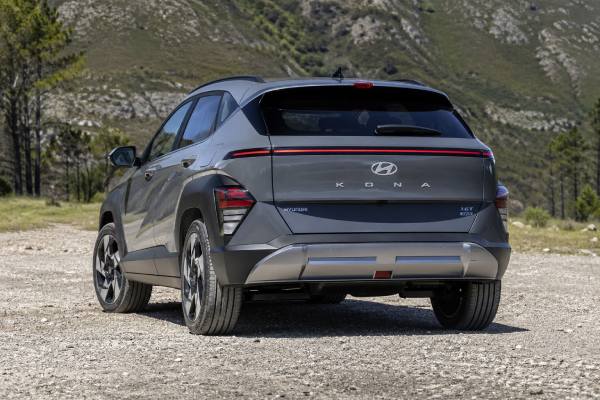
The second-generation Hyundai KONA HTRAC AWD with the 2.0 MPI engine is the sensible side of the SX2 lineup. It skips the stronger turbo engine, but in return it gives buyers a simpler naturally aspirated four-cylinder, Hyundai’s IVT automatic, and an active all-wheel-drive system that adds real four-season usefulness. That matters because the 2024-on KONA is larger, quieter, and more mature than the old model, yet it still fits easily into city life. In AWD form, it also gets a multi-link rear suspension instead of the torsion-beam setup used on front-drive 2.0 versions, which improves composure over rough roads. The trade-off is straightforward: this is not the quick Kona, and the IVT is tuned more for smoothness and economy than urgency. Still, if you want the SX2 Kona in its lowest-stress gasoline form with winter traction, this is the version that often makes the most ownership sense.
At a Glance
- The 2.0 MPI and IVT combination is smoother and mechanically simpler than the turbo alternatives.
- HTRAC AWD adds useful snow traction and a multi-link rear suspension that improves ride control.
- The SX2 body is roomier and more refined than the earlier Kona, especially in the rear seat and cargo area.
- The main caution is that long-term durability data is still developing, so recall history and software status matter more than on an older platform.
- A practical oil and filter interval is every 10,000 km or 12 months, sooner in severe use.
On this page
- Hyundai KONA SX2 ownership shape
- Hyundai KONA SX2 hard numbers
- Hyundai KONA SX2 grade guide
- Fault patterns and campaign history
- Service routine and used buying
- Ride quality and fuel costs
- Against rivals and best fit
Hyundai KONA SX2 ownership shape
The easiest way to understand the 2024-present Kona HTRAC AWD 2.0 is to see it as the practical drivetrain in Hyundai’s larger, better-packaged second-generation body. It is not the version that sells the biggest headline numbers, but it is the one many owners will probably find easiest to live with.
The SX2 generation is a much more substantial vehicle than the old OS Kona. It is longer, wider in feel, and noticeably more usable inside. Rear-seat room is better, the dash design is more modern, and cargo space is no longer a clear weakness. That alone changes the ownership equation. The older Kona could feel like a raised hatchback. The SX2 feels more like a genuine small SUV.
The 2.0-litre engine fits that personality. Hyundai uses an Atkinson-cycle naturally aspirated four-cylinder here, paired with its Intelligent Variable Transmission. On paper, 147 hp is modest, and on the road it feels that way when the vehicle is loaded or asked to pass quickly uphill. But in daily use the engine is smooth, predictable, and free of the sudden surge or low-speed hesitation that can make some small turbo crossovers feel fussy. For a commuter, school-run, or mixed suburban car, that matters more than brochure acceleration.
HTRAC AWD gives this version a second reason to exist. The system is not intended for hard off-road use, but it does improve launch traction in rain, slush, and snow, and it adds Snow mode to the drive settings. More importantly, AWD Konas get an independent multi-link rear suspension. That gives the car a calmer, more settled ride over broken surfaces than the front-drive 2.0 models, which use a torsion-beam rear axle. It is one of the least obvious but most meaningful advantages of choosing the AWD version.
Trim structure has also evolved. At launch in 2024, the 2.0 AWD could be found in SE, SEL, and SEL Convenience form in the U.S. By the 2026 model year, Hyundai had simplified the 2.0 AWD lineup to trims such as SE AWD and SEL Sport AWD. That matters in the used and nearly-new market because the engine stayed the same while equipment bundles changed.
As an ownership proposition, the SX2 2.0 AWD makes the most sense for drivers who want modern safety tech, a roomy small footprint, and real winter traction, but who do not want the higher purchase cost or extra complexity of the turbo engine. Its biggest strength is not excitement. It is balance.
Hyundai KONA SX2 hard numbers
For this article, the baseline is the U.S.-market Hyundai KONA HTRAC AWD (SX2) with the naturally aspirated 2.0-litre engine and IVT transmission. The core engineering stayed consistent from 2024 through the current model run, although trim names and feature bundles changed.
| Item | Specification |
|---|---|
| Code | Nu PE / Smartstream G2.0 Atkinson family |
| Engine layout and cylinders | Inline-4, DOHC, 16 valves, 4 cylinders, 4 valves per cylinder |
| Bore × stroke | 81.0 × 97.0 mm (3.19 × 3.82 in) |
| Displacement | 2.0 L (1,999 cc) |
| Induction | Naturally aspirated |
| Fuel system | MPI / PFI |
| Compression ratio | 12.5:1 |
| Max power | 147 hp (110 kW) @ 6,200 rpm |
| Max torque | 179 Nm (132 lb-ft) @ 4,500 rpm |
| Timing drive | Chain-driven valve train |
| Rated efficiency | Typically about 8.7–9.0 city / 8.1 highway / 8.4–8.7 combined L/100 km (26–27 / 29 / 27–28 mpg US; 31.2–32.4 / 34.8 / 32.4–33.6 mpg UK), depending on trim |
| Real-world highway @ 120 km/h (75 mph) | Usually around 7.8–8.8 L/100 km (27–30 mpg US / 32–36 mpg UK) |
| Item | Specification |
|---|---|
| Transmission | Intelligent Variable Transmission (IVT); EPA listings identify the 2.0 AWD transmission family as Automatic (AV-S1) |
| Drive type | HTRAC active on-demand AWD |
| Differential | Open differentials with electronically controlled rear coupling and brake-based torque management |
| Suspension (front / rear) | MacPherson strut with coil springs / multi-link |
| Steering | Column-mounted motor-driven power steering; overall ratio 13.6:1 |
| Brakes | Front ventilated discs 305 mm (12.0 in), rear solid discs 284 mm (11.2 in) on AWD applications |
| Wheels and tyres | Most common AWD fitment is 235/45 R18; some trims use 17-inch wheels |
| Ground clearance | 206 mm (8.1 in) on 17/18-inch AWD trims; 211 mm (8.3 in) on 19-inch AWD trims |
| Length / width / height | 4,351 mm (171.3 in) overall length, or 4,384 mm (172.6 in) for N Line body; width 1,826 mm (71.9 in); height about 1,605–1,610 mm (63.2–63.4 in) for AWD trims |
| Wheelbase | 2,659 mm (104.7 in) |
| Turning circle | 10.6 m (34.8 ft) kerb-to-kerb |
| Kerb weight | About 1,453–1,515 kg (3,203–3,340 lb), trim dependent |
| GVWR | Roughly 1,940–2,020 kg (4,277–4,453 lb), trim dependent |
| Fuel tank | 47 L (12.4 US gal / 10.3 UK gal) |
| Cargo volume | 722 L (25.5 ft³) seats up / 1,804 L (63.7 ft³) seats down, SAE |
| Acceleration 0–100 km/h | Official U.S. figure not published; in real use expect roughly 10.5–11.5 seconds depending on trim and conditions |
| Top speed | Not consistently published in U.S. owner-facing specification material |
| Braking distance 100–0 km/h | Not consistently published in official U.S. specification sheets |
| Towing capacity | Not recommended in Hyundai U.S. consumer specification material |
| Payload | About 425–500 kg (937–1,102 lb), depending on trim |
| Item | Specification |
|---|---|
| Engine oil | SAE 0W-20, API SN PLUS/SP or ILSAC GF-6; 4.3 L (4.5 US qt) drain and refill |
| Coolant | Ethylene glycol-based coolant for aluminium radiator; 6.9 L (7.3 US qt) |
| Transmission fluid | MICHANG SP-CVT1 or Hyundai Genuine SP-CVT1; 6.9 L (7.1 US qt) AWD |
| Rear differential oil | API GL-5 SAE 75W/85 hypoid gear oil; 0.4–0.5 L (0.6–0.7 US qt) |
| Transfer case oil | API GL-5 SAE 75W/85 type; 0.62–0.68 L (0.8–0.9 US qt) |
| A/C refrigerant | R-1234yf; exact charge varies by production spec and is not clearly published in owner-facing U.S. sources |
| A/C compressor oil | VIN-specific PAG-type specification; charge quantity should be verified in service data |
| Key torque specs | Wheel nuts: 107–127 Nm (79–94 lb-ft) |
| Crash ratings | IIHS ratings are strong and apply to 2024–26 models; no separate Euro NCAP rating is published for this exact U.S.-market HTRAC AWD 2.0 trim |
| Headlight rating | IIHS: Acceptable |
| ADAS suite | AEB, LKA, LFA, blind-spot monitoring or warning, rear cross-traffic assistance, smart cruise control, and rear automatic braking depending on trim and year |
The table tells the main story clearly. This is a roomy, lightweight small SUV with good ground clearance, useful cargo space, and a conservative naturally aspirated powertrain rather than a performance-focused setup.
Hyundai KONA SX2 grade guide
The trim story on the 2.0 HTRAC AWD matters more than some buyers expect, because Hyundai changed the lineup even though the engine itself stayed basically the same. The result is that a 2024 AWD 2.0 and a current AWD 2.0 can share the same core mechanical hardware while feeling quite different in equipment.
At launch, the 2024 U.S. Kona 2.0 AWD range was easy to understand. You had SE AWD as the base version, SEL AWD in the middle, and SEL AWD with Convenience Package as the better-equipped value play. All of them kept the same 147 hp 2.0-litre engine, IVT, and HTRAC AWD layout. The mechanical reward for choosing AWD was the same across them: multi-link rear suspension, Snow mode, and a more planted ride than front-drive 2.0 cars.
By the 2026 model year, Hyundai simplified the lineup. The 2.0 AWD is still present, but trim names shifted toward SE AWD and SEL Sport AWD. That is worth knowing because current nearly-new cars and dealer stock may not line up neatly with 2024 used listings. Equipment names changed more than the hardware did.
A practical trim guide looks like this:
- SE AWD: the honest value choice, usually with the full safety backbone, 17-inch wheels, cloth trim, and the essential infotainment package.
- SEL AWD / SEL Sport AWD: the sweet spot for many buyers, because these versions add convenience features, richer cabin trim, and a more complete tech package without forcing you into the turbo engine.
- SEL Convenience AWD in 2024–2025: often the smartest used buy if you want the 2.0 engine with the better screens and driver-assistance content.
The safety and ADAS story is one of the SX2 Kona’s strongest points. Even lower trims are no longer bare-bones in the way small crossovers once were. The Kona’s IIHS results are strong, and the vehicle earns Top Safety Pick+ status in the redesigned generation with ratings applying across the 2024–26 run. IIHS also lists headlights as Acceptable, pedestrian front crash prevention as Good, and LATCH ease of use as Acceptable. That is a solid baseline for a class where night visibility and rear-seat child-seat access can still vary a lot.
In practical trim terms, the 2.0 AWD car can bring features such as forward collision-avoidance assist, lane keeping assist, lane following assist, intelligent speed limit assist, blind-spot monitoring, rear cross-traffic support, smart cruise control, and rear automatic braking depending on model year and package level. On richer trims, Hyundai also adds larger displays, navigation-linked cruise features, and better everyday convenience equipment.
The most important caution is calibration after repair. On a modern Kona, a windscreen replacement, front-end repair, or even a poor alignment job can leave the vehicle with camera- and radar-based systems that need recalibration. For a used buyer, that matters almost as much as whether the option list looks good on paper.
Fault patterns and campaign history
Because the SX2 Kona is still young, its reliability story is more about what has not happened than about a long list of known wear-out failures. That is good news, but it also means buyers should be disciplined. You cannot rely on decades of forum wisdom yet. You have to rely on recalls, service history, and the way the vehicle behaves in front of you.
The first encouraging point is that no clear, widespread mechanical disaster has emerged around the 2.0 MPI engine itself. That matters. The naturally aspirated Atkinson-cycle four-cylinder is not exciting, but it is also less mechanically stressed than Hyundai’s turbo alternatives. As of now, the major watchpoints are not chronic engine failures. They are recall-related early-production issues, software behavior, and general modern small-SUV wear patterns.
The best documented early concern for gasoline SX2 Konas is the occasional, medium-to-high-severity recall side. Certain 2024 Kona gasoline vehicles were included in Hyundai’s EGR valve assembly recall. In plain language, contamination in a sensor inside the EGR valve could lead to an electrical short, warning lights, or sudden loss of motive power. That does not make every 2024 Kona risky, but it absolutely means VIN-level recall checking is non-negotiable on early cars. A used buyer should want written proof of remedy completion, not a seller’s memory.
Beyond recalls, the most plausible real-world ownership issues are common but low-cost ones. Expect the same small-SUV stuff every modern crossover collects: rattles, trim buzzes, infotainment hiccups, uneven tyre wear from poor alignment, and rear brake surface corrosion on cars that do mostly short, gentle trips. These are not catastrophic, but they do affect how “new” the car feels.
The IVT deserves its own note. So far, there is no widely established pattern that marks it as a major weak point on this model. Still, as a continuously variable transmission, it is the part of the drivetrain most likely to make the car feel bad before anything actually breaks. A rough or delayed take-up, rpm flare that feels odd, droning under light throttle, or jerky simulated-ratio behavior are all worth noticing. In many cases, these are calibration or fluid-related concerns rather than signs of imminent failure. But on a newer platform, any abnormal transmission feel should be taken seriously while the vehicle is still within reach of warranty or dealer diagnostics.
The AWD system itself looks structurally sensible. The usual ownership risk is not a bad coupling design. It is owner neglect. Mismatched tyres, widely different tread depths, and ignored driveline-fluid service can make any on-demand AWD system noisier and less smooth over time. Because this is a newer model, some owners will assume it is “too new to need anything.” That is not a great strategy.
What should a buyer request?
- full dealer or specialist service history
- recall and campaign completion records
- ADAS warning-light scan
- smooth cold start and warm restart
- even tyres on all four corners
- no humming, binding, or odd feedback from the AWD system in tight low-speed turns
- evidence of proper repair and calibration after any front-end or windscreen work
The broad verdict is encouraging: the SX2 2.0 AWD does not yet show a strong pattern of inherent drivetrain weakness. But because it is still new, good paperwork matters more than folklore.
Service routine and used buying
This Kona is still young enough that many examples will be dealer-maintained, which is helpful. Even so, the right approach is to treat it like a long-term vehicle from day one, not like a disposable lease return. The 2.0 engine is simple by current standards, but the combination of IVT, AWD, and modern safety electronics still rewards methodical maintenance.
| Item | Distance or time | Practical note |
|---|---|---|
| Engine oil and filter | Every 10,000 km or 12 months | Shorten to about 5,000–8,000 km in severe use, repeated short trips, traffic, dust, or extreme temperatures |
| Tyre rotation | Every 10,000 km | Important on AWD to keep tread depth even |
| Engine air filter | Inspect regularly, replace around 40,000–50,000 km | Earlier in dusty or sandy use |
| Cabin air filter | Every 15,000–20,000 km or 12 months | Helps HVAC efficiency and window demisting |
| Brake fluid | Every 2 years | Moisture control matters more than mileage |
| Coolant | Follow official long-life schedule, inspect yearly | Replace sooner if contamination or unexplained loss appears |
| Spark plugs | Inspect by schedule, replace when wear or drivability justifies | The 2.0 is easier on plugs than a small turbo engine, but they are not lifetime parts |
| IVT health check | At every major service | Any abnormal noise, flare, or shudder deserves an early scan and road test |
| Rear differential and transfer case oil | Inspect regularly; proactive replacement around 50,000–80,000 km is sensible | Especially wise for snow, hills, and frequent short trips |
| Brake pads and rotors | Inspect every service | Rear corrosion can show up on lightly used cars |
| 12 V battery test | Annually from year 4 | Weak voltage can trigger odd electronic complaints |
| Alignment | Check yearly or after pothole impacts | Tyre wear tells a lot on this platform |
Useful owner-reference figures are straightforward:
- engine oil: 4.3 L, SAE 0W-20
- IVT fluid: 6.9 L for AWD
- coolant: 6.9 L
- rear differential oil: 0.4–0.5 L
- transfer case oil: 0.62–0.68 L
- fuel tank: 47 L
- wheel nuts: 107–127 Nm
As a used buy, this model is at an unusual stage. It is new enough that mileage is usually low, but old enough that the earliest 2024 cars may now be out in the used market. That means you should buy on history and repair transparency, not just on low odometer numbers.
A smart inspection checklist includes:
- recall completion paperwork
- full scan for stored transmission and ADAS faults
- matched tyres with similar tread depth
- smooth IVT behavior from cold
- no harsh ratio flare or droning under gentle acceleration
- stable coolant level
- no signs of front-end repair hidden behind a clean exterior
- proper operation of blind-spot, lane-centering, and cruise systems
The trims to seek depend on priorities. SE AWD is the low-stress value option. SEL AWD or SEL Convenience AWD in 2024–2025 is the better balance of comfort and equipment. SEL Sport AWD in the current lineup makes sense if you want the newer naming structure and a cleaner near-new buy.
Long-term durability should be decent, but it is still too early to call this drivetrain truly proven in the same way as an older, mature platform. That is why clean maintenance history is so important.
Ride quality and fuel costs
On the road, the SX2 Kona HTRAC AWD 2.0 does not try to feel fast. It tries to feel easy, and in normal use it succeeds. That may sound faint praise, but in this class it is a real strength.
The engine’s character is simple. The 2.0-litre four-cylinder responds cleanly, starts smoothly, and behaves well in town. There is no turbo lag because there is no turbo, and the throttle is easy to meter in parking lots or stop-and-go traffic. The downside is that power arrives in a steady, fairly ordinary way. With one or two people onboard, the Kona feels adequate. Fully loaded, climbing grades, or trying to pass quickly at highway speed, it feels exactly like a 147 hp small SUV.
The IVT transmission shapes that impression. At light throttle it is smooth and unobtrusive, and that suits the car’s daily-driver mission. Under heavier throttle, it can hold revs in a way some drivers still associate with older CVT behavior. Hyundai’s tuning is reasonable, but this is not a gearbox that adds entertainment. It adds efficiency and smoothness.
The AWD chassis is where the HTRAC 2.0 makes its strongest case. The multi-link rear suspension gives the vehicle a calmer, more planted feel than front-drive 2.0 Konas on rough pavement. Broken city streets, patched asphalt, and mid-corner bumps are handled with a little more control and less rear-end hop. The steering is light and accurate rather than rich in feel, but the car tracks straight and feels stable on the highway.
Noise levels are respectable for a subcompact SUV. Wind and tyre noise are lower than the old Kona’s, and the larger SX2 body feels more substantial at speed. The engine remains quiet in normal driving, though it becomes more noticeable when you ask for all the power it has.
Real-world economy is one of the vehicle’s better traits, though the AWD penalty is real:
- city: about 8.8–9.8 L/100 km
- highway: about 7.4–8.6 L/100 km
- mixed: about 8.1–9.0 L/100 km
That equals roughly:
- 24–27 mpg US in city-heavy use
- 27–32 mpg US on the highway
- 26–29 mpg US in mixed driving
In UK terms, that is usually about 29–38 mpg UK, depending on use. Winter fuel, roof accessories, and repeated short trips can push consumption upward by another 0.5–1.0 L/100 km.
HTRAC AWD is reassuring in bad weather, not dramatic in dry weather. It is at its best in rain, slush, light snow, and greasy cold-road conditions where the car simply feels more planted and easier to trust. That is the real reason to buy this version.
Against rivals and best fit
The SX2 Kona 2.0 AWD competes in one of the busiest parts of the market, so its appeal depends on what kind of buyer you are. It is not the quickest small AWD crossover, and it is not the cheapest. Its strength is balance.
Against the Subaru Crosstrek 2.0 AWD, the Hyundai usually feels more modern inside and more tech-rich for the money. The Subaru counters with a tougher rough-road identity and a simpler AWD image. The Hyundai wins on infotainment and cabin freshness. The Subaru wins on outdoors credibility.
Against the Mazda CX-30 AWD, the Kona is the roomier and more SUV-like choice. The Mazda often feels more premium and more engaging on a good road, but its rear-seat and cargo packaging are tighter. Buyers who want style and driving polish lean Mazda. Buyers who want better space efficiency and current safety tech often lean Hyundai.
Against the Toyota Corolla Cross AWD, the choice comes down to personality. The Toyota is calmer and more conservative in its design and ownership image. The Hyundai feels more modern, more spacious, and more visibly up to date inside. The Toyota may prove the lower-stress long-term choice. The Kona is the more compelling everyday package right now.
Against the Kia Seltos AWD, the comparison gets interesting because the corporate relationship means some hardware logic overlaps. The Seltos offers a little more upright utility feel. The Kona answers with newer interior execution, strong IIHS results, and a more polished generational update.
Against the Honda HR-V AWD, the Kona usually feels more advanced in infotainment and active safety packaging, while the Honda counters with a calm, simple driving experience and a broad reputation for consistency. The Hyundai is the sharper value choice if you prioritize equipment and packaging.
The buyers who will like this Kona most are easy to identify:
- drivers who want AWD and modern safety tech without turbo complexity
- families who need a genuinely usable rear seat in a compact footprint
- commuters who value smoothness and decent fuel economy more than quick acceleration
- buyers in wet or snowy climates who want more than a basic front-drive crossover
The buyers who should keep looking are also clear:
- anyone who wants strong highway passing power
- drivers who dislike CVT-style power delivery
- owners who plan to tow
- shoppers who want the most proven long-term platform history possible
As a whole, the Hyundai KONA HTRAC AWD (SX2) 2.0 MPI is a smart, well-shaped compact SUV with a conservative mechanical setup inside a very modern package. It is not the emotional choice in the range. It is the practical one. For many owners, that is exactly why it deserves attention.
References
- 2024 Kona Specifications 2024 (Specifications)
- 26MY Kona Pricing 2025 (Pricing)
- Recommended lubricants and capacities 2025 (Owner’s Manual)
- 2024 Hyundai Kona 2024 (Safety Rating)
- Part 573 Safety Recall Report 24V-308 2024 (Recall Database)
Disclaimer
This article is for informational purposes only and is not a substitute for professional diagnosis, inspection, or repair. Specifications, torque values, intervals, procedures, fluids, trims, and safety equipment can vary by VIN, market, model year, and installed options, so always verify the exact vehicle against official service documentation before making maintenance or purchase decisions.
If this guide was useful, please consider sharing it on Facebook, X, or other social platforms to support our work.