
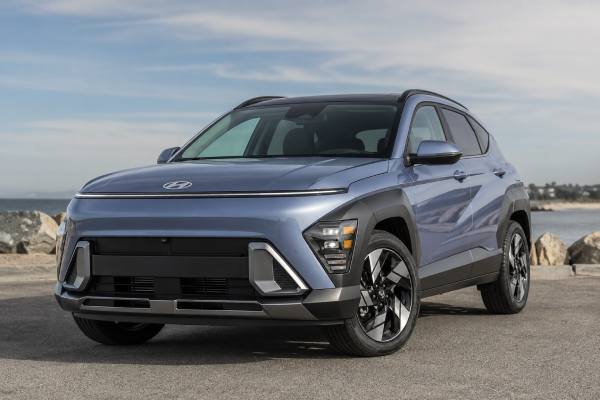


The Hyundai KONA HTRAC AWD SX2 with the 1.6 T-GDi engine is the version of the new-generation KONA that best balances pace, traction, and everyday usability. It keeps the larger body, smarter interior layout, and stronger tech package of the second-generation car, but adds the more capable turbo engine, an 8-speed automatic, and Hyundai’s active all-wheel-drive system. That combination matters more than the horsepower figure alone. This KONA is not just quicker than the 2.0-liter model. It also gets the multi-link rear suspension, Snow mode, stronger mid-range response, and a more planted feel on wet or broken roads. For buyers who want the new KONA shape without going electric or full N-Line theater, this is the most complete gasoline version. The trade-off is predictable: more complexity, more fuel use, and higher tyre and driveline costs than the simpler front-drive models. As a long-term buy, condition and maintenance history matter more than trim badges.
Top Highlights
- Strongest non-N KONA gasoline powertrain, with useful turbo torque and better all-weather grip.
- Multi-link rear suspension gives the AWD version a more settled, mature feel than front-drive SX2 models.
- Spacious cabin and a genuinely large boot for the class make it more practical than the old KONA.
- Running costs are higher than the 2.0-liter model, and neglected transmission or AWD fluid service can become expensive later.
- A sensible real-world service rhythm is every 10,000 to 15,000 km or 12 months, with tyre rotation and brake inspection at similar intervals.
Guide contents
- Hyundai KONA SX2 turbo AWD
- Hyundai KONA SX2 core specifications
- Hyundai KONA SX2 grades and safeguards
- Weak spots and service bulletins
- Maintenance planning and buyer checks
- Road behavior and fuel use
- Standing against class rivals
Hyundai KONA SX2 turbo AWD
The SX2-generation KONA is a very different vehicle from the older OS model. It is larger in every important dimension, it offers far more rear-seat and cargo usefulness, and it feels like a more ambitious vehicle inside. In that bigger, more mature body, the 1.6 T-GDi HTRAC AWD setup makes more sense than it would have in the old car. It gives the new KONA the performance and traction to match its more confident design.
That is the key ownership point. The 190 hp 1.6-liter turbo engine is not extreme, but it is enough to keep the SX2 feeling lively. It also avoids one of the older KONA turbo model’s biggest compromises by using an 8-speed automatic torque-converter transmission rather than a dual-clutch unit. In practical ownership terms, that is important. It usually means better low-speed smoothness, less parking-lot awkwardness, and fewer worries about the kind of stop-start wear that often makes compact turbo crossovers feel less refined than they should.
The HTRAC system also changes the car’s role. This is not an off-roader, but it is noticeably calmer in poor weather than the front-drive models. Torque distribution is managed automatically, and Snow mode is included on AWD versions. More importantly, the AWD car gets the independent multi-link rear suspension rather than the simpler torsion-beam setup used on front-drive versions. That upgrade is easy to overlook on a spec sheet, but it helps the KONA feel more composed on uneven roads and at highway speeds.
This version is also market-specific. In North America, the 1.6 T-GDi HTRAC AWD has been the upscale gasoline KONA setup through the SX2 run, but the trim ladder has moved around. In 2024 and 2025, U.S. buyers usually found it in N Line and Limited forms, with 2025 also broadening the turbo trim structure. In the current lineup, the same powertrain continues in SEL Premium AWD and Limited AWD form. That matters for used buyers because equipment names change, but the mechanical core stays familiar.
The larger body makes this engine choice more appealing than the older KONA’s small turbo ever was. The cabin is roomy enough for real family use, the cargo area is genuinely useful, and the technology feels modern enough that the car does not ask you to compromise on the experience just because you want a gasoline engine. The real decision is not whether this KONA is good. It is whether you want the richer, more capable turbo AWD version badly enough to accept its extra maintenance exposure over the 2.0-liter car.
Hyundai KONA SX2 core specifications
Official North American specifications show the 1.6 T-GDi HTRAC AWD as the performance-focused non-N powertrain in the SX2 range. It pairs the Smartstream 1.6-liter turbocharged direct-injection four-cylinder with an 8-speed automatic and Hyundai’s on-demand all-wheel drive. Compared with the 2.0-liter KONA, it adds more torque, different gearing, more rear-axle sophistication, and a stronger brake package.
| Item | Specification |
|---|---|
| Code | Smartstream / Gamma II 1.6 T-GDi |
| Engine layout and cylinders | Inline-4, DOHC, 4 valves per cylinder |
| Bore × stroke | 75.6 × 89.0 mm (2.97 × 3.50 in) |
| Displacement | 1.6 L (1,598 cc) |
| Induction | Turbocharged |
| Fuel system | Gasoline direct injection |
| Compression ratio | 10.0:1 |
| Max power | 190 hp (142 kW) @ 6,000 rpm |
| Max torque | 195 lb-ft (264 Nm) @ 1,700–4,500 rpm |
| Timing drive | Chain |
| Transmission | 8-speed automatic torque-converter transmission |
| Drive type | HTRAC active on-demand AWD |
| Differential | Open differentials with electronically managed torque distribution and brake-based control |
| Rated efficiency | 24/29/26 mpg US city/highway/combined, about 9.8/8.1/9.0 L/100 km |
| Real-world highway @ 120 km/h (75 mph) | Typically about 8.1–8.9 L/100 km in steady conditions |
| Item | Specification |
|---|---|
| Suspension (front/rear) | MacPherson strut / multi-link |
| Steering | Motor-driven power steering; 13.6 ratio; 2.5 turns lock-to-lock |
| Brakes | Ventilated front discs 12.0 in (304.8 mm); solid rear discs 11.2 in (284.5 mm) |
| Wheels and tyres | Most common fitment 235/45 R19 on 7.5J × 19 rims; some trims use 215/55 R18 |
| Ground clearance | AWD: 8.1 in on 17/18-inch wheels and 8.3 in on 19-inch wheels (about 206–211 mm) |
| Angles | Official North American sheets reviewed do not publish approach, departure, or breakover angles |
| Length / width / height | 171.3–172.6 / 71.9 / about 62.4–62.6 in (4,350–4,384 / 1,825 / about 1,585–1,590 mm), trim dependent |
| Wheelbase | 104.7 in (2,660 mm) |
| Turning circle | 34.8 ft (10.6 m) |
| Curb weight | 3,483–3,505 lb (1,580–1,590 kg), trim dependent |
| GVWR | 4,453 lb (2,020 kg) |
| Fuel tank | 13.2 US gal (50 L) |
| Cargo volume | 25.5 / 63.7 ft³ SAE (723 / 1,803 L) |
| Towing capacity | Not recommended in the North American factory material reviewed here |
| Payload | Varies by trim and equipment; not separately published as a standalone figure in the factory sheets reviewed here |
| Item | Specification or note |
|---|---|
| Acceleration | North American factory sheets reviewed here do not publish an official 0–100 km/h figure |
| Top speed | Not officially published in the North American factory material reviewed here |
| Braking distance | Not officially published in the factory sheets reviewed here |
| Engine oil | SAE 0W-20, API SN Plus/SP or ILSAC GF-6; 4.8 L (5.1 US qt) drain and refill |
| Coolant | Ethylene-glycol coolant for aluminum radiator mixed with distilled water; 8.5 L (9.0 US qt) |
| Automatic transmission fluid | SP-IV specification; 6.5 L (6.8 US qt) |
| Rear differential oil | API GL-5 SAE 75W/85; 0.4–0.5 L |
| Transfer case oil | 0.62–0.68 L; verify exact fluid specification by VIN before service |
| A/C refrigerant | R-1234yf; 450 ± 25 g (15.2 ± 0.84 oz) |
| A/C compressor oil | PAG; 120 ± 10 g (4.07 ± 0.33 oz) |
| Key torque spec | Wheel nuts: 107–127 Nm (79–94 lb-ft) |
| IIHS | 2025 Hyundai Kona earns Top Safety Pick+ with good crashworthiness scores, acceptable headlights, and good standard crash prevention performance |
| Euro NCAP | No directly corresponding Euro NCAP rating for this exact North American 1.6 T-GDi HTRAC AWD configuration is cited here |
The most useful technical takeaway is that the AWD turbo KONA is not just an engine upgrade. It is also the better-suspended, better-braked, more mature chassis within the gasoline lineup.
Hyundai KONA SX2 grades and safeguards
This powertrain has worn different badges across the run, which can confuse buyers if they only search by year. In 2024, the 1.6 T-GDi HTRAC AWD was closely tied to the upper end of the U.S. gasoline range, especially N Line and Limited. In 2025, Hyundai broadened the trim ladder, and in the current lineup the same turbo AWD setup continues in SEL Premium AWD and Limited AWD form. The key point is that the mechanical package remains recognizable even when the trim naming changes.
That matters because trim changes affect how a used example feels, how much it costs to recondition, and which safety systems it actually has. N Line versions lean toward styling and driving feel. They usually bring 19-inch wheels, more aggressive exterior treatment, sportier interior trim, and a stronger visual identity. Limited versions or their current equivalents lean further into convenience and technology, with extra camera views, stronger parking support, richer audio, and more comfort equipment. The underlying powertrain can be the same, but ownership costs are not always.
For everyday buyers, the middle ground is often the smartest place to be. A well-equipped turbo AWD KONA with the right safety and comfort package can feel complete without becoming too gadget-heavy. The more luxurious versions look tempting, but features such as surround-view monitoring, remote parking functions, and more elaborate seat trim do add reconditioning cost later. On the used market, the best trim is often the one that gives you the powertrain and core safety equipment without loading the car with expensive non-essential features.
The safety story is strong. IIHS testing for the redesigned Kona is a real asset for this model. The current-generation vehicle has good scores in the small overlap, updated moderate overlap, and updated side tests, while the 2025 Kona earns Top Safety Pick+ status. The standard front crash prevention system performs well, and IIHS also notes standard blind-spot detection, lane departure warning and prevention, and standard rear automatic braking on the rated U.S.-market configuration. Headlights are rated acceptable across trims rather than excellent, which is worth noting, but the overall safety package is still competitive.
In trim terms, the turbo AWD versions tend to be better equipped than the base cars even before you get to luxury-oriented extras. Higher trims add Highway Driving Assist, navigation-based smart cruise control, stronger parking sensors, surround view on the richer versions, and a larger digital instrument display. The most feature-packed versions also bring Bose audio, heated steering wheel, ventilated front seats, and hands-free tailgate functions.
The main practical advice is simple. Shop by equipment sheet, not just by trim badge. Hyundai has already moved the names around within this short model run. Confirm the exact drivetrain, wheel size, safety features, and equipment level from the VIN or original spec sheet instead of relying on model-name memory.
Weak spots and service bulletins
Because the SX2 KONA is still a relatively new vehicle, its reliability picture is less about long-established chronic faults and more about known risk areas. The good news is that the 1.6 T-GDi HTRAC AWD avoids one major headache associated with older compact turbo crossovers: it uses an 8-speed torque-converter automatic rather than a dual-clutch transmission. That removes one big potential source of urban drivability complaints. Even so, this is still a turbocharged, direct-injection, AWD-equipped vehicle with a lot of electronics. It deserves careful ownership.
The highest-probability issues are still the usual modern turbo-petrol ones. Oil quality matters. Ignition components matter. Cooling-system health matters. Small turbo engines that run hot and rely on direct injection do not respond well to lazy service habits. A car that skips oil changes, runs low on oil, or spends much of its life on repeated short cold trips is more likely to develop noisy startup behavior, reduced smoothness, or boost-related irritations as mileage climbs. None of that means this engine is fundamentally weak. It means discipline matters.
The next watch area is software and calibration. The SX2 is much more digitally integrated than the old KONA. ADAS cameras, parking sensors, front radar, over-the-air updates, and infotainment integration bring real day-to-day benefits, but they also create more ways for a poorly repaired or badly maintained car to feel wrong. Windscreen replacement, front bumper repair, rear corner repairs, and even low-speed parking damage can turn into bigger issues if the associated safety hardware is not recalibrated properly.
On the driveline side, the AWD system itself is not usually the first thing to fail. Neglect is the problem. Mismatched tyres, ignored fluid service, or repeated hard use on poor-quality tyres can make the rear driveline feel rougher or noisier than it should. That kind of wear is avoidable, but only when owners treat the AWD hardware as a real system rather than a marketing badge.
Public recall history is not a reason to panic, but it is a reason to check. Early-production North American SX2 Konas have seen official recall activity, and 1.6T-equipped vehicles are not immune from that broader reality. For a used buyer, the right approach is VIN-first, not rumor-first. Ask the seller for proof of recall completion, check Hyundai’s official recall tools in your market, and confirm dealer service history where possible. That matters more than internet folklore.
So far, the biggest risk is not that this KONA is secretly fragile. The risk is that buyers assume “still quite new” means “nothing to inspect.” With modern turbo AWD vehicles, that is exactly the wrong mindset.
Maintenance planning and buyer checks
The smartest way to look after the 1.6 T-GDi HTRAC AWD is to be slightly more conservative than the broadest marketing language suggests. Modern Hyundai gasoline engines can be durable, but they respond best to timely oil changes, correct fluids, and regular inspection of the systems that work hardest: ignition, cooling, brakes, tyres, and AWD hardware.
| Item | Practical interval | Why it matters |
|---|---|---|
| Engine oil and filter | Every 10,000 to 15,000 km or 12 months | Protects turbocharger, timing system, and direct-injection engine health |
| Air cleaner filter | Inspect every service, replace about every 32,000 km | Helps maintain boost response and fuel economy |
| Cabin air filter | About every 16,000 km or yearly in dusty use | Keeps HVAC performance strong |
| Spark plugs | Every 72,000 km | Important on turbo engines for clean combustion and load response |
| Drive belts | First inspect at 96,000 km or 72 months, then every 32,000 km | Replace earlier if cracks or tension loss appear |
| Coolant | First replace at 192,000 km or 120 months, then every 40,000 km or 24 months | Important for turbo thermal stability |
| Brake fluid | Every 48,000 km or about 36 months | Maintains pedal feel and protects ABS and ESC hardware |
| Automatic transmission fluid | Every 96,000 km | Worth taking seriously on an AWD turbo crossover |
| Tyre rotation and brake inspection | Every 8,000 to 12,000 km | Helps ride, braking consistency, and AWD wear balance |
| Intercooler and intake hoses | First inspect at 8,000 km or 6 months, then every 32,000 km | Boost leaks can hide behind minor drivability complaints |
Fluid discipline is especially important here. The engine wants 0W-20 full synthetic meeting the proper API or ILSAC standard, not a cheaper substitute chosen for convenience. The automatic transmission uses SP-IV fluid. AWD cars also need the correct rear differential and transfer-case lubricants, and this is one of those areas where guessing or using a “universal” alternative is a bad idea. The factory capacity numbers are clear enough to plan the job properly.
As a used buy, the checklist is straightforward. Start with cold-start behavior. Then look at the service record. After that, test the car in the situations that expose weak ownership. You want to feel the transmission at parking speed, hear the engine when cold and when fully warm, and check whether the car tracks straight on a rough road without tyre roar or odd rear-end reactions. AWD cars also deserve a close tyre inspection. Matching brand, size, and wear depth matter more than many buyers realize.
The best examples will usually have boring paperwork. Regular oil services, clean recall history, correct tyres, and no vague excuses about “software issues” or “a little hesitation when cold” are exactly what you want. The wrong example is the one with flashy trim, unclear history, and evidence that routine maintenance was treated as optional.
Road behavior and fuel use
This is the KONA that feels the most complete in ordinary driving. The 2.0-liter car is smoother and cheaper to justify, but it lacks the mid-range pull that makes the SX2 body feel fully alive. The 1.6 T-GDi fixes that. It gives the KONA enough torque to feel relaxed in traffic and strong enough on faster roads that overtakes do not need as much planning.
The powertrain character suits the vehicle well. Turbo response is not instantaneous, but it is good enough that the car feels alert rather than sleepy. The torque arrives early, and the 8-speed automatic handles it more naturally than a dual-clutch would. Low-speed take-up is clean, creeping in traffic is easy, and the vehicle is more pleasant in daily use than many small turbo crossovers that chase sportiness at the expense of smoothness.
Ride and handling are also stronger than the class stereotype suggests. The AWD version’s multi-link rear suspension makes a real difference. It helps the KONA stay composed over broken surfaces and gives it a calmer, more planted feel at motorway speed. On 19-inch wheels, you do feel more edge and sharpness over poor pavement, but the platform itself is solid. If comfort is the priority, smaller-wheel variants are the better bet. If visual appeal and steering response matter more, the 19-inch setup makes sense.
Steering is accurate but not especially talkative. The KONA is easy to place, and it turns in neatly enough for a compact crossover, but this is not an enthusiast car. It is better judged as a secure, tidy, well-controlled small SUV that happens to have a properly useful turbo engine. Braking feel is consistent and strong enough, which matters because the turbo KONA is often driven harder than the entry-level versions.
Noise, vibration, and harshness are respectable. At gentle throttle openings the engine is fairly subdued, and the larger SX2 body feels better insulated than the old KONA. Push harder and you will hear the engine, but it never sounds strained. Highway cruising is one of its stronger points. This version feels much more at home on long-distance work than the 2.0-liter IVT car.
Real-world fuel economy is decent rather than outstanding. The official EPA-style figures already tell the truth: you are paying a clear fuel penalty for turbo power and AWD. In practice, expect roughly 10.0 to 11.5 L/100 km in dense city use, around 8.1 to 8.9 L/100 km on steady highway work, and about 8.8 to 10.0 L/100 km in mixed driving. Winter weather, short trips, larger wheels, and a heavier right foot will push the number upward.
In return, you get a small SUV that feels easier, stronger, and more confidence-inspiring than the cheaper versions. For many buyers, that trade is entirely reasonable.
Standing against class rivals
The KONA HTRAC AWD 1.6 T-GDi does not compete directly with basic front-drive economy crossovers. Its real rivals are the upper-end gasoline versions of other small SUVs: the Mazda CX-30 AWD, Subaru Crosstrek 2.5, Volkswagen Taos 4Motion, and to some extent the Honda HR-V and Toyota Corolla Cross AWD when buyers care more about traction and equipment than outright speed.
| Model | Main strength | Main drawback | Why choose the KONA instead |
|---|---|---|---|
| Mazda CX-30 AWD | Richer cabin feel and polished steering | Tighter rear packaging and often a firmer feel | The KONA offers more cargo room, a fresher tech layout, and stronger AWD trim value |
| Subaru Crosstrek 2.5 AWD | Standard AWD and strong rough-weather confidence | CVT character and slightly less upscale cabin feel | The KONA feels quicker, more modern inside, and more refined in everyday mixed driving |
| Volkswagen Taos 4Motion | Good packaging and mature highway manners | Transmission reputation and mixed long-term confidence in some versions | The KONA’s 8-speed automatic and recent IIHS performance strengthen its ownership case |
| Toyota Corolla Cross AWD | Strong reputation for low-drama ownership | Less punchy powertrain and plainer cabin atmosphere | The KONA offers a more energetic engine, stronger feature content, and more upscale presentation |
Against the Mazda CX-30, the Hyundai’s biggest win is practicality. The Mazda still feels slightly more premium from the driver’s seat, but the KONA gives you more usable rear space and boot volume while staying competitive in technology. Against the Crosstrek, the Hyundai feels more modern and a little more energetic. Subaru still wins on outdoorsy credibility, but the KONA is the more urban-friendly choice.
The Taos is probably the closest rival in concept because it tries to blend European-style road manners with compact-SUV usefulness. But the Hyundai’s drivetrain mix is easier to recommend. The 8-speed automatic in the KONA is a strong point in this company. The Corolla Cross AWD makes the opposite argument: it is calmer, more conservative, and probably the lower-anxiety ownership choice if you care only about minimal drama. Yet it is also less satisfying and less interesting.
That is where the KONA lands. It does not dominate the class in a single metric, but it assembles a lot of good answers in one vehicle: useful space, confident AWD, strong technology, respectable safety, and enough engine to make the bigger SX2 body feel properly matched. That is why it stands out.
If you want the most sensible SX2, buy the 2.0-liter model. If you want the most rounded non-electric SX2, this 1.6 T-GDi HTRAC AWD is the one that makes the strongest case.
References
- 2024 Kona Specifications 2023 (Technical Specifications)
- 26MY Kona Pricing 2025 (Pricing and Specifications)
- 2. Vehicle Information 2024 (Owner’s Manual)
- 9. Maintenance 2024 (Owner’s Manual)
- 2025 Hyundai Kona 2025 (Safety Rating)
Disclaimer
This article is for informational purposes only and is not a substitute for professional diagnosis or repair. Specifications, torque values, intervals, procedures, fluid requirements, safety equipment, and trim content can vary by VIN, market, model year, and factory options, so always verify the exact details against official service documentation for the specific vehicle.
If this guide was useful, please consider sharing it on Facebook, X, or another platform to support our work.