

The facelifted 2020–2023 Hyundai KONA 4WD with the 1.6 T-GDi engine is the version that gives the first-generation Kona its sharpest all-round character without stepping all the way into Kona N territory. It pairs Hyundai’s 198 hp Smartstream turbo four-cylinder with a seven-speed dual-clutch transmission and an on-demand four-wheel-drive system, then adds a multi-link rear suspension that changes the way the car feels compared with front-drive Konas. The facelift also brought better infotainment, broader safety technology, and meaningful ride and steering tuning. That matters because this model sits in a sweet spot for buyers who want compact size, real cold-weather traction, and stronger performance than the 1.0- and 1.6 diesel versions. The trade-offs are clear too: fuel economy is average rather than exceptional, and the dual-clutch gearbox needs careful assessment in used examples. With the right history, though, this remains one of the more interesting and complete small performance-leaning crossovers of its era.
Top Highlights
- The 1.6 T-GDi 4WD gives the facelift Kona strong real-world pace without the cost and intensity of the Kona N.
- Four-wheel drive adds a multi-link rear suspension, which improves composure, traction, and body control.
- The facelift brought cleaner cabin design, stronger infotainment, and a broader safety-tech spread.
- The main ownership watchpoint is the seven-speed dual-clutch gearbox, especially on neglected or traffic-heavy cars.
- A sensible baseline is engine oil and filter every 10,000 km or 12 months, sooner in severe use.
What’s inside
- Hyundai KONA 4WD facelift profile
- Hyundai KONA 4WD technical sheet
- Hyundai KONA 4WD trims and safety tech
- Reliability patterns and service actions
- Care schedule and buying tips
- Road behavior and real fuel use
- Rival matchups and verdict
Hyundai KONA 4WD facelift profile
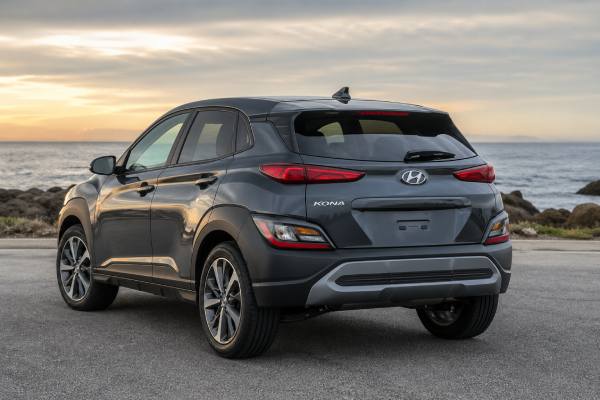
This is the version of the first-generation facelift Kona that makes the strongest case for the model as more than a stylish urban crossover. The 1.6 T-GDi 4WD setup gives it proper pace, useful bad-weather traction, and a more serious chassis than the lower-power front-drive cars. It still looks like a compact B-segment SUV, and it still fits easily into city life, but it feels closer to a warm crossover than a basic high-riding hatchback.
The key to understanding it is the hardware mix. Hyundai’s updated 1.6-litre Smartstream turbo petrol engine produces 198 hp and 265 Nm, and it is paired with a seven-speed dual-clutch gearbox. On paper, that is enough to push the Kona from 0 to 100 km/h in about 8.1 seconds in 4WD form, which is brisk for the class. More importantly, the engine has a wide enough torque band that the car feels strong in the middle of the rev range, not just at the top. That makes overtakes, uphill work, and motorway joining much easier than in the smaller 1.0 T-GDi model.
The four-wheel-drive system matters for more than traction. On the Kona range, 4WD brings a multi-link rear suspension instead of the front-drive torsion beam. That gives this version a calmer, more planted feel over poor surfaces and during faster direction changes. It does not transform the Kona into a sports SUV, but it does make it more settled and more confident than the lighter front-drive variants. Hyundai also retuned the facelift car’s suspension, steering, stabilizer bars, and tyres for better comfort and lower noise, while the 1.6 T-GDi 4WD N Line got its own steering calibration.
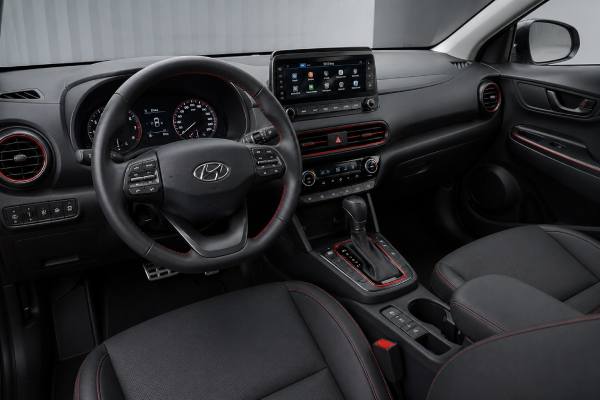
The facelift itself was meaningful. Outside, the Kona became cleaner and more mature. Inside, the cabin gained a more modern layout, an available 10.25-inch cluster and navigation screen, better voice control, and a broader spread of connected services. Safety tech also improved. Features such as lane following assist, updated forward collision avoidance, blind-spot collision avoidance on the right trim and transmission combinations, and rear cross-traffic collision avoidance made the facelift car feel much more current.
There are still compromises. Rear-seat room is acceptable rather than generous, and boot space is useful but not class-leading. The 4WD system adds weight, so this version is less efficient than the smaller-engined Kona variants. The seven-speed DCT also changes the ownership picture. When it is healthy, it suits the engine well. When neglected, it can introduce low-speed jerkiness or expensive diagnosis.
As a used buy, this facelift 1.6 T-GDi 4WD makes the most sense for drivers who want one car to cover commuting, winter roads, motorway use, and occasional enthusiastic driving. It is especially appealing if you like the Kona’s compact footprint but want a version that feels properly grown up.
Hyundai KONA 4WD technical sheet
For this article, the focus is the facelifted first-generation Kona sold in Europe from late 2020 through 2023 with the 1.6 T-GDi petrol engine, seven-speed dual-clutch transmission, and four-wheel drive. Exact trim content varies by market, but the core mechanical package is consistent.
| Item | Specification |
|---|---|
| Code | Smartstream 1.6 T-GDi |
| Engine layout and cylinders | Inline-4, DOHC, 16 valves, 4 cylinders, 4 valves per cylinder |
| Bore × stroke | 75.6 × 89.0 mm (2.98 × 3.50 in) |
| Displacement | 1.6 L (1,598 cc) |
| Induction | Turbocharged |
| Fuel system | Direct injection |
| Compression ratio | 10.0:1 |
| Max power | 198 hp (145.6 kW) @ 6,000 rpm |
| Max torque | 265 Nm (195.5 lb-ft) @ 1,600–4,500 rpm |
| Timing drive | Chain |
| Rated efficiency | Typically 7.0–7.4 L/100 km (31.8–33.6 mpg US / 38.2–40.4 mpg UK) WLTP combined, depending on year and wheel package |
| Real-world highway @ 120 km/h (75 mph) | Usually about 7.8–8.8 L/100 km (26.7–30.2 mpg US / 32.1–36.2 mpg UK) |
| Item | Specification |
|---|---|
| Transmission | 7-speed dual-clutch automatic; Hyundai consumer material does not consistently publish a public gearbox code for this variant |
| Drive type | On-demand 4WD |
| Differential | Open front and rear differentials with electronically controlled coupling and brake-based torque management |
| Suspension (front / rear) | MacPherson strut / multi-link |
| Steering | Rack-and-pinion, motor-driven power steering; 2.5 turns lock-to-lock |
| Brakes | Power-assisted ABS/EBD disc system; front ventilated discs, rear solid discs. Official consumer sheets do not consistently publish disc diameters for this exact facelift AWD trim |
| Wheels and tyres | Common factory fitments include 18-inch alloys with 235/45 R18 or 225/45 R18 depending on market and trim |
| Ground clearance | About 165 mm (6.5 in) on the 1.6 T-GDi 4WD facelift setup |
| Length / width / height | 4,205 mm (165.6 in) overall length; N Line body 4,215 mm (166.0 in). Width 1,800 mm (70.9 in). Height about 1,565 mm (61.6 in) |
| Wheelbase | 2,600 mm (102.4 in) |
| Turning circle | 10.6 m (34.8 ft) |
| Kerb weight | About 1,395–1,504 kg (3,075–3,316 lb), trim dependent |
| GVWR | 1,915 kg (4,222 lb) |
| Fuel tank | 50 L (13.2 US gal / 11.0 UK gal) |
| Cargo volume | 374 L (13.2 ft³) seats up / 1,156 L (40.8 ft³) seats folded, VDA |
| Acceleration 0–100 km/h | 8.1 seconds |
| Top speed | 210 km/h (130 mph) |
| Braking distance 100–0 km/h | Not consistently published in Hyundai’s consumer-facing data for this exact powertrain |
| Towing capacity | 1,250 kg (2,756 lb) braked / 600 kg (1,323 lb) unbraked, market dependent |
| Payload | About 411–520 kg (906–1,146 lb) |
| Item | Specification |
|---|---|
| Engine oil | SAE 0W-20, API SN Plus or SP / ILSAC GF-6; 4.8 L (5.1 US qt) drain and refill |
| Coolant | Ethylene glycol-based coolant for aluminium radiator; 8.5 L (9.0 US qt) |
| Transmission fluid | ATF SP-IV type approved by Hyundai; 6.5 L (6.8 US qt) |
| Rear differential oil | API GL-5 SAE 75W/85 hypoid gear oil; 0.4–0.5 L (0.6–0.7 US qt) |
| Transfer case oil | API GL-5 SAE 75W/85 type; 0.62–0.68 L (0.8–0.9 US qt) |
| Brake fluid | DOT 4 |
| A/C refrigerant | R-1234yf on facelift-era European cars |
| A/C compressor oil | VIN-specific refrigerant oil specification |
| Key torque spec | Wheel fasteners are typically tightened in the 107–127 Nm (79–94 lb-ft) range |
| Crash ratings | Euro NCAP: 5 stars, with 87% adult occupant, 85% child occupant, 62% vulnerable road users, and 60% safety assist. IIHS: strong crashworthiness scores across the 2018–23 Kona family, with award status depending on headlights and front crash prevention equipment |
| Headlight rating | Trim dependent; better LED units are clearly preferable to weaker basic lamp setups |
| ADAS suite | AEB, lane keeping and lane following assist, blind-spot collision avoidance, rear cross-traffic avoidance, smart cruise control with stop and go, speed limit warning, and eCall depending on trim and market |
The numbers tell a clear story. This is not the lightest or cheapest Kona to own, but it is the most rounded fast petrol version below the full Kona N. It combines useful torque, respectable straight-line pace, and a more capable rear suspension with compact dimensions.
Hyundai KONA 4WD trims and safety tech
For trims, a Europe-first view makes the most sense, because the 198 hp 1.6 T-GDi 4WD was more relevant there than in every export market. Exact grade names vary, but the facelift lineup usually placed this powertrain in richer trims and, very often, in the N Line family or upper non-N Line grades.
The easiest way to think about it is this: the 1.6 T-GDi 4WD was not the bargain version. It was the performance-leaning premium petrol choice before the Kona N arrived. That means most used examples are reasonably well equipped, even if the exact trim label differs by country.
In practical used-market terms, the likely buckets are:
- well-equipped non-N Line cars, which combine the stronger powertrain with a subtler exterior and more comfort-led trim
- N Line cars, which add unique bumpers, body-colour cladding, specific 18-inch wheels, red-stitched interior details, metal pedals, and a sportier cabin theme
- top trims, which add the best lighting, richer seat materials, larger screens, and the broadest ADAS spread
The visual identifiers are helpful. N Line cars are easy to spot because of their bumper shapes, more aggressive air intake design, different lower trim treatment, and twin-exit style rear treatment. Inside, N Line cars usually add red stitching, N logos, and a darker, sportier feel. Upper trims, whether N Line or not, often carry the better lamp units, larger center display, digital cluster, heated seats, and more complete parking and safety assistance.
Mechanically, the big differences inside the 1.6 T-GDi 4WD group are not about engine tune but about tyre package, steering calibration, and equipment. Hyundai gave the facelift a wider round of tuning updates for comfort, isolation, and steering feel, and the 1.6 T-GDi 4WD N Line received its own steering setup to match the more performance-focused character. That means the sharpest-looking version is also slightly more deliberately tuned.
Safety equipment improved noticeably with the facelift. Standard forward collision avoidance expanded, and lane following assist and leading vehicle departure alert became part of the Kona’s more modern driver-assistance feel. On the right trims, especially DCT-equipped upper cars, blind-spot collision avoidance, rear cross-traffic collision avoidance, upgraded smart cruise control, intelligent speed limit warning, safe exit warning, and eCall became available.
The star-rating view needs a little nuance. Euro NCAP’s five-star Kona result still gives the model a solid reputation for basic crash performance, and the IIHS testing across the broader Kona family shows a strong structure. But headlight performance and active-safety availability vary a lot by trim. This matters in the real world. A well-equipped facelift 1.6 4WD with better LED lamps and the fuller safety package is meaningfully easier to recommend than a lower-spec car with weaker night visibility and less assistance technology.
The passive safety basics are strong: front airbags, side airbags, curtain airbags, ESC, ABS, and child-seat anchor provisions. In later and richer facelift specs, some markets also got seven airbags across parts of the range. As with any modern ADAS-equipped used car, calibration history matters. Windscreen replacement, front-end body repair, radar bracket damage, or poor alignment work can leave safety systems technically present but not working as intended. On a used Kona, that is worth checking.
Reliability patterns and service actions
The facelift 1.6 T-GDi 4WD is not defined by one giant engine scandal in the way some other Hyundai-family petrols have been, but it is also not a car to buy lazily. Its long-term health depends heavily on service quality, usage type, and gearbox behavior.
The most important ownership issue is the occasional, medium-to-high-cost one: seven-speed dual-clutch transmission behavior. When the gearbox is healthy and correctly adapted, it suits the engine well. Shift response is quick, and the powertrain feels lively. When the car has spent its life creeping in heavy traffic, been driven harshly from cold, or has skipped software checks, owners can report hesitation, clutch shudder, rough take-up, or jerky parking-speed behavior. Symptoms usually show up first as awkward low-speed manners rather than outright failure. The right remedy depends on what is wrong: adaptation and software update in mild cases, clutch or actuator work in more expensive ones.
The next pattern is common, low-to-medium-cost small turbo petrol behavior. This 1.6 direct-injection engine generally feels strong, but like many modern turbo DI units it dislikes neglect. Long oil intervals, constant cold starts, poor oil choice, and purely urban use can lead to rougher cold running, increased deposit build-up, faster spark plug wear, or occasional hesitation under load. The fix is usually conservative servicing rather than dramatic repair. Frequent oil changes and correct plugs matter more here than heroic aftermarket additives.
A related occasional, medium-cost area is intake and emissions-system cleanliness. This is not a diesel DPF problem, but short-trip use can still leave the engine feeling less crisp over time. Intercooler hoses, boost leaks, and ignition components also deserve attention if a car develops uneven response, misfire, or a check-engine light. These are not necessarily chronic faults, but they are the usual places to investigate first.
The 4WD system itself is usually sturdy if the tyres match and the fluids are not ignored. The weak ownership pattern here is not a bad transfer case design so much as poor maintenance culture. Some owners treat all-wheel-drive crossovers as sealed-for-life appliances. That is not wise. Uneven tyre circumference, mixed brands, or badly delayed drivetrain fluid checks can make the system noisier and less refined than it should be.
Chassis issues are familiar class items rather than structural flaws. Expect common, low-cost wear in drop links, bushes, and rear brake hardware, plus the usual risk of wheel damage or alignment drift on cars with large wheels and low-profile tyres. Because this is the faster Kona, it is also more likely to have been driven hard. That makes tyre quality and brake condition especially telling during inspection.
Campaign and recall history is important, but not because this exact powertrain is known for one universal defect in every market. The better way to see it is that facelift Konas saw broader platform-level campaign activity depending on year and region, while this 1.6 T-GDi 4WD also benefits from software and calibration checks as part of routine dealer support. That means a VIN-level recall search and dealer-history review are essential. A seller saying “it has no issues” is less useful than seeing every campaign closed properly.
Ask for these pre-purchase checks:
- full service history with dates and mileage, not just annual stamps
- proof of gearbox software and drivability updates where applicable
- evidence of matching tyres on all four corners
- no AWD, engine, or transmission warning lights
- smooth cold-start idle and clean warm restart
- calm low-speed maneuvering with no clutch snatch
- recent brake and alignment work records on 18-inch cars
- official VIN recall and service-campaign confirmation
A good facelift 1.6 T-GDi 4WD feels tight, quick, and polished. A poor one often reveals itself in the first ten minutes through jerky gearbox manners, cheap tyres, or patchy paperwork.
Care schedule and buying tips
This Kona responds well to slightly stricter maintenance than the broadest factory intervals might suggest. It is a turbocharged direct-injection petrol with a DCT and 4WD. None of that is fragile on its own, but all of it rewards timely servicing.
| Item | Distance or time | Why it matters |
|---|---|---|
| Engine oil and filter | Every 10,000 km or 12 months | Factory normal schedule is 10,000 km in the referenced manual; severe use shortens this further and city use justifies being conservative |
| Engine oil and filter in severe use | Every 5,000 km | Important for short trips, traffic, cold weather, towing, mountain driving, and repeated stop-start use |
| Tyre rotation | Every 10,000 km or 12 months | Keeps 4WD tyre circumference even and helps reduce driveline stress |
| Air cleaner filter | Inspect regularly, replace about every 40,000 km | Earlier in dust or poor-road use |
| Cabin air filter | Every 30,000 km or 24 months | Helps HVAC efficiency and demist performance |
| Spark plugs | Every 70,000 km | Do not stretch this on a boosted DI petrol engine |
| Brake fluid | Every 30,000 km or 24 months | Moisture control matters on a quick, heavy-for-size crossover |
| Engine coolant | First at 200,000 km or 120 months, then every 40,000 km or 24 months | Use correct coolant only |
| Valve clearance | Inspect every 90,000 km or 72 months | Important if the engine becomes noisier or less smooth |
| Transfer case and rear differential | Inspect every 60,000 km or 48 months | Replace earlier if contaminated or after water submersion; severe-use schedule is stricter |
| Automatic transmission fluid | No routine check or service listed in the referenced normal schedule | For long-term ownership, many specialists still prefer conservative fluid management and close drivability monitoring |
| 12 V battery testing | Annually from year 4 | Weak voltage can worsen DCT and electronics behavior |
The core service-fill figures worth remembering are:
- engine oil: 4.8 L, SAE 0W-20, API SN Plus or SP
- transmission fluid: 6.5 L, ATF SP-IV type
- coolant: 8.5 L
- transfer case oil: 0.62–0.68 L
- rear differential oil: 0.4–0.5 L
- fuel tank: 50 L
For used buyers, the most valuable inspection point is still the drivetrain’s overall feel. The engine and DCT should feel sharp but smooth, not snappy, jerky, or confused. A healthy car pulls cleanly from low revs, shifts decisively, and settles into a calm motorway cruise without fuss.
The smartest used buys are usually later facelift cars with clear service history and good tyres. In many markets, that means a well-kept N Line 1.6 T-GDi 4WD or an upper non-N Line trim with the same powertrain. A mid-spec car with full history is usually a better ownership bet than a flashy top-spec example with missing paperwork and tired consumables.
Watch closely for:
- mismatched tyres or heavily uneven tread depths
- harsh or hesitant take-up when parking
- boost leaks, misfire, or engine warning lights
- neglected brake fluid and rusty rear brake hardware
- poor alignment or steering pull
- unresolved recall or campaign history
- evidence of repeated short-trip use with long oil intervals
- cheap replacement parts on suspension or ignition systems
Long-term durability is good rather than exceptional. This is a car that stays satisfying when serviced properly, but it loses its polish faster than a simpler naturally aspirated automatic if owners cut corners. Buy on history, not just mileage.
Road behavior and real fuel use
The facelift Kona 1.6 T-GDi 4WD is one of those small SUVs that feels better once you are moving than its footprint suggests. It is quick enough to feel genuinely eager, but small enough to remain easy and unintimidating in town.
The first thing most drivers notice is how much more effortless it feels than the 1.0-litre Kona. The 1.6 turbo has enough torque that you do not need to work around its powerband. It picks up cleanly from the mid-range, merges well, and feels strong on inclines. Turbo lag is present if you ask too much from very low revs, but it is modest. The real character of the engine is broad, usable shove rather than one dramatic peak.
The seven-speed DCT fits that character when the car is in good health. At normal road speeds it shifts quickly and helps the Kona feel more alert than many torque-converter rivals. During hard acceleration, the drivetrain works well. During creeping traffic or repeated tight parking maneuvers, it can feel more mechanical and less silky than a conventional automatic. That is the main trade-off.
The chassis is the bigger strength. The 4WD car’s multi-link rear suspension makes it feel more planted than front-drive Konas over mid-corner bumps and patched tarmac. The facelift’s retuned springs, dampers, stabilizer bars, tyres, and steering also helped. Ride quality is still on the firm side on 18-inch wheels, but it is better resolved than the sportier appearance might suggest. There is enough body control to support the performance, yet enough compliance for daily commuting.
Steering is light in town and reasonably consistent as speeds rise. It is not full of feel, but it is accurate and easy to trust. Straight-line stability is good, and the car changes direction neatly. N Line versions feel slightly more focused in their steering calibration, though tyres still shape the outcome as much as trim level.
Noise levels are fair for the class. At urban pace the drivetrain is subdued. Under hard load, the turbo four sounds workmanlike rather than exciting. At motorway speed, tyre roar is the main variable. Cars on better tyres and well-kept suspension feel noticeably more refined than cars on cheap replacement rubber.
Real-world fuel use depends heavily on where and how you drive:
- city: about 8.5–10.0 L/100 km
- highway: about 7.2–8.4 L/100 km
- mixed: about 7.8–9.0 L/100 km
That works out to roughly:
- 23.5–27.7 mpg US in city-heavy use
- 28.0–32.7 mpg US on the highway
- 26.1–30.2 mpg US in mixed use
In UK figures, that is commonly about 28–39 mpg UK, depending on trip type. Cold weather, short runs, roof load, and repeated boost use can add more than 1.0 L/100 km.
The 4WD system itself is reassuring rather than dramatic. In normal driving it behaves unobtrusively. On slippery roads, snow, mud, or gravel, it gives the Kona a more secure and more expensive-feeling character than many front-drive rivals can match. On equipped cars, terrain modes for snow, mud, and sand adjust wheel-slip control, engine response, and shift logic. That does not turn the Kona into an off-roader, but it does make it unusually capable for a small crossover.
Rival matchups and verdict
The facelift Kona 1.6 T-GDi 4WD occupies a slightly unusual niche. It is not a full hot crossover like the Kona N, but it is much quicker and more capable than the typical 1.0-litre B-SUV. That means its most relevant rivals are not always the smallest-engined class basics.
Against the Volkswagen T-Roc 2.0 TSI 4Motion, the Hyundai is usually the more distinctive and slightly more playful-feeling car, while the Volkswagen counters with a broader cabin and a more understated image. The T-Roc can feel more grown up. The Kona often feels more lively and a little less generic.
Against the Ford Puma 1.0 EcoBoost mHEV, the Hyundai wins on outright shove and all-weather traction. The Ford is the sharper front-drive driver’s car and often the better steering benchmark, but it cannot match the Kona’s combination of stronger power and 4WD security.
Against the Toyota C-HR 2.0 Hybrid, the answer depends on use. The Toyota is quieter and more economical in urban work and has a strong reliability reputation, but the Hyundai is the more natural motorway and overtaking companion. It also feels more conventional to drive for people who dislike e-CVT behavior.
Against the MINI Countryman Cooper S ALL4, the Kona usually wins on value, practicality per euro, and simplicity of ownership cost. The MINI offers a richer badge experience and a more premium interior feel, but it tends to cost more to buy and maintain.
Against Mazda’s CX-30 AWD in equivalent petrol form, the Mazda feels more mature and a little more premium inside, but the Hyundai strikes back with stronger turbo urgency, a smaller urban footprint, and often better equipment value.
So where does the Kona land today? Its strongest selling points are easy to summarize:
- strong mid-range performance without going full hot-hatch
- compact size with genuine all-weather usefulness
- facelifted cabin and safety tech that still feel current
- better chassis balance than front-drive Konas thanks to multi-link rear suspension
Its weaker points are just as clear:
- fuel economy is only average for a small SUV
- the DCT demands more careful evaluation than a conventional automatic
- rear-seat and cargo space are merely decent, not class-leading
For the right buyer, though, this is an excellent used crossover. It gives you compact dimensions, meaningful pace, and real foul-weather confidence in one package. The trick is buying carefully. A documented, well-maintained facelift 1.6 T-GDi 4WD can still feel sharp and special. A neglected one quickly becomes just another expensive small turbo crossover. On balance, it remains one of the most interesting non-N Konas to own.
References
- Hyundai unveils enhancements for Kona and launches all-new Kona N Line 2020 (Press Information)
- 202009_Technical Data_new Kona and all-new Kona N Line 2020 (Technical Data)
- Normal Maintenance Schedule (Smartstream 1.6 T-GDi) 2021 (Owner’s Manual)
- 2021 Hyundai Kona 2021 (Safety Rating)
- Euro NCAP | Hyundai KONA 2017 (Safety Rating)
Disclaimer
This article is for informational purposes only and is not a substitute for professional diagnosis, inspection, or repair. Specifications, torque values, service intervals, fluids, procedures, trim content, and safety equipment can vary by VIN, market, production date, and installed options, so always verify the exact vehicle against official service documentation and manufacturer records.
If this guide was useful, please consider sharing it on Facebook, X, or other social platforms to support our work.