

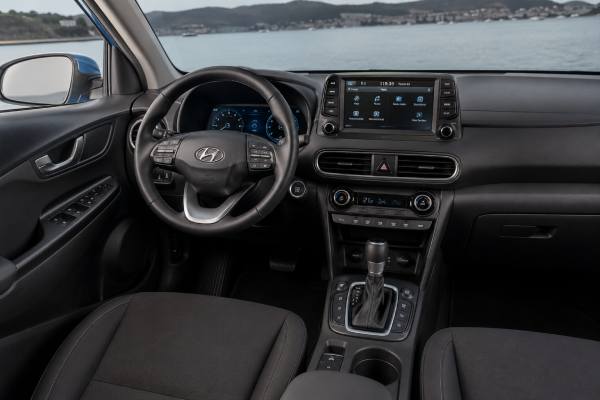
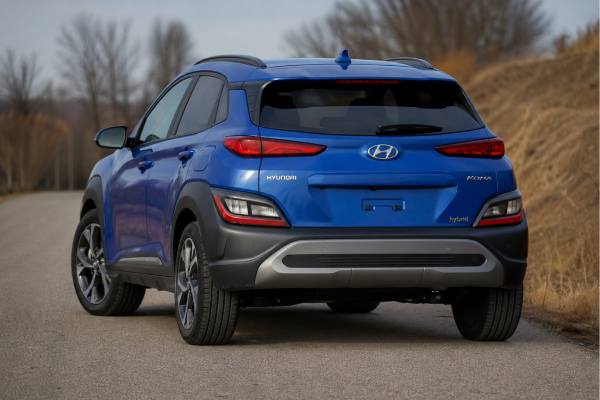
The facelifted 2020–2023 Hyundai KONA Hybrid (OS) is one of the more interesting small crossovers of its era because it does not follow the usual hybrid formula too closely. Instead of an eCVT, it uses a 1.6-liter direct-injection petrol engine, a small traction battery, an electric motor, and a 6-speed dual-clutch transmission. That gives it a more familiar stepped feel on the road, while still delivering the low-speed efficiency gains buyers expect from a hybrid.
It also arrived at the right moment in the KONA story. The facelift brought cleaner styling, improved infotainment, and a more polished safety-tech offering in many European markets. For owners, the appeal is clear: compact size, strong urban economy, easy daily usability, and less fuel spend without moving to a plug-in or full EV. The main caveat is that this is still a more complex car than a basic petrol KONA, so service history, hybrid-system health, and transmission behavior matter.
Quick Specs and Notes
- The hybrid system delivers strong urban efficiency without the cost or charging demands of a plug-in.
- The 6-speed dual-clutch gearbox gives a more conventional driving feel than many eCVT hybrids.
- Facelift cars usually have better infotainment, cleaner styling, and broader active-safety coverage.
- The main ownership watchpoint is low-speed DCT behavior and proof of proper servicing.
- A sensible oil-service interval is every 10,000–12,000 km or 12 months, sooner in hard city use.
What’s inside
- Hyundai KONA Hybrid facelift essentials
- Hyundai KONA Hybrid figures and specifications
- Hyundai KONA Hybrid trims and protection tech
- Common faults and service campaigns
- Upkeep schedule and buying pointers
- Real-world manners and economy
- Where the hybrid sits among rivals
Hyundai KONA Hybrid facelift essentials
The facelift-era Hyundai KONA Hybrid occupies a smart middle ground in the small-crossover market. It is not as simple as the base petrol model, and it is not as radical as the full-electric KONA Electric. Instead, it is built for buyers who want lower running costs, easy everyday usability, and a familiar refueling routine. That makes it especially attractive in cities and suburban use, where regenerative braking and frequent stop-start driving allow the hybrid system to show its strengths.
Mechanically, this version combines a 1.6-liter GDi four-cylinder petrol engine with a permanent-magnet synchronous electric motor, a lithium-ion polymer battery, and a 6-speed dual-clutch transmission. Combined output is listed at 141 hp in most market summaries, with the hybrid system delivering a useful 265 Nm of torque. That matters more than the peak power figure suggests. Around town, the electric support helps the car step away cleanly and reduces the flat, overworked feel that some small naturally aspirated crossovers suffer from.
One of the KONA Hybrid’s defining traits is that it does not drive like a textbook hybrid. Because it uses a dual-clutch gearbox instead of an eCVT, it feels more conventional at moderate speeds. Some drivers prefer that immediately. You get real ratio changes, a more familiar engine-speed relationship, and less of the elastic response that often divides opinion in hybrid rivals. The trade-off is that the low-speed experience can be slightly less seamless than the smoothest eCVT-based systems.
The facelift helped the package. Hyundai sharpened the look, improved the cabin technology in many trims, and made the KONA feel less like an early entry in the segment and more like a mature product. European and UK-spec facelift cars also gained clearer trim separation, better connected-car features, and a broader spread of driver-assistance hardware depending on grade.
There are, however, a few things buyers should understand before treating the hybrid as the automatic best choice. It is front-wheel drive only, so buyers in snowy regions who want the extra traction of AWD need a different KONA powertrain. Rear-seat space is still only average for the class. Cargo space is also affected by the hybrid packaging, so it is useful rather than class-leading. And while the hybrid system itself is generally well judged, the car still has more components to monitor than a basic 2.0-liter petrol version.
In short, the facelifted KONA Hybrid makes sense for buyers who value efficiency, compact size, and a more traditional driving feel than many hybrids provide. It is a thoughtful urban and mixed-use crossover, not a performance model and not the roomiest choice in its class, but it is one of the more balanced ones when chosen carefully.
Hyundai KONA Hybrid figures and specifications
The facelift-era KONA Hybrid sold in Europe and the UK uses a specific hybrid package that differs in meaningful ways from the non-hybrid petrol models. It remains front-wheel drive, but its suspension, battery packaging, and fuel-tank size give it a distinct ownership profile. The table below reflects the 2020–2023 facelift OS hybrid in mainstream European trim.
| Item | Specification |
|---|---|
| Code | 1.6 GDi HEV |
| Engine layout and cylinders | Inline-4, D-CVVT, 16 valves, 4 valves per cylinder |
| Bore × stroke | 72.0 × 97.0 mm (2.83 × 3.82 in) |
| Displacement | 1.6 L (1,580 cc) |
| Motor | PMSM, single front-mounted motor, 240 V system, lithium-ion polymer battery |
| Battery capacity | 1.56 kWh |
| Induction | Naturally aspirated |
| Fuel system | Gasoline direct injection |
| Compression ratio | 13.0:1 |
| Max engine power | 105 hp class (77.2 kW) |
| Max engine torque | 147 Nm (108 lb-ft) @ 4,000 rpm |
| Motor output | 32 kW and 170 Nm (125 lb-ft) |
| System output | 141 hp class and 265 Nm (195 lb-ft) |
| Timing drive | Chain |
| Transmission | 6-speed dual-clutch automatic |
| Drive type | FWD |
| Differential | Open differential with brake-based traction control |
| Suspension | MacPherson strut front / multi-link rear |
| Steering | Rack and pinion, motor-driven power steering |
| Steering ratio | About 13.4:1 |
| Brakes | Front ventilated discs 305 mm (12.0 in), rear solid discs 284 mm (11.2 in) |
| Most common tyre sizes | 205/60 R16 and 225/45 R18 |
| Item | Specification |
|---|---|
| Length / width / height | 4,205 / 1,800 / 1,565 mm (165.6 / 70.9 / 61.6 in) |
| Wheelbase | 2,600 mm (102.4 in) |
| Ground clearance | About 165 mm (6.5 in) |
| Turning circle | 10.6 m (34.8 ft) |
| Kerb weight | 1,376–1,453 kg (3,034–3,203 lb) |
| GVWR | 1,880 kg (4,145 lb) |
| Payload | 427–504 kg (941–1,111 lb) |
| Fuel tank | 38 L (10.0 US gal / 8.4 UK gal) |
| Cargo volume | 374 L (13.2 ft³) seats up / 1,156 L (40.8 ft³) seats folded, VDA method |
| Acceleration | 0–100 km/h in 11.0 s on 16-inch wheels or 11.3 s on 18-inch wheels |
| Top speed | 161 km/h (100 mph) |
| Rated efficiency | Typically around 5.0–5.4 L/100 km depending on wheel size and market test cycle |
| Real-world highway @ 120 km/h (75 mph) | Usually around 5.5–6.2 L/100 km in stable warm-weather conditions |
| Towing capacity | Up to 1,300 kg (2,866 lb) braked and 600 kg (1,323 lb) unbraked, depending on market and homologation |
| Item | Specification |
|---|---|
| Engine oil | Market-specific specification; commonly 0W-20 or 5W-30 depending on climate and service guidance |
| Coolant | Separate attention required for engine and inverter cooling circuits per official documentation |
| Transmission fluid | DCT fluid type must follow Hyundai service documentation for the exact VIN |
| A/C refrigerant | R-1234yf in later-market documentation |
| Key torque spec | Wheel nuts: verify by VIN; Hyundai technical literature commonly places this in the 107–127 Nm range |
| Euro NCAP | 5 stars; 87% adult, 85% child, 62% vulnerable road users, 60% safety assist |
| IIHS | No dedicated market-baseline IIHS assessment for the European OS Hybrid configuration |
| ADAS availability | AEB, lane support, adaptive cruise, blind-spot monitoring and rear cross-traffic alert varied by trim |
The important practical takeaway is that the KONA Hybrid is not just a petrol KONA with better fuel economy. The hybrid hardware changes the packaging, the service profile, the fuel-tank size, and the way the car should be assessed as a used buy.
Hyundai KONA Hybrid trims and protection tech
For the facelift OS Hybrid, the best way to understand trim structure is to use the UK and broader European market as the baseline. In those markets, the KONA Hybrid was positioned as a more premium and efficiency-led member of the range rather than an entry-level model. That generally meant better standard equipment, a more mature infotainment setup, and a stronger safety-tech story than the cheapest petrol versions.
In UK facelift trim structure, the main hybrid grades were SE Connect, Premium, and Ultimate. Those names matter because equipment differences are large enough to change the ownership experience in meaningful ways. SE Connect already brought the essentials, including the hybrid powertrain, touchscreen infotainment, smartphone connectivity, lane support features, and forward collision assistance. That makes it a usable and fairly well-equipped small crossover rather than a stripped economy special.
Premium is often the sweet spot. It tends to add better comfort equipment, smarter wheel designs, and more of the technology buyers expect in a modern hybrid daily driver. Heated seats, stronger convenience features, and more complete active-safety content become more common here. For many used buyers, this is the trim where the KONA Hybrid begins to feel properly complete.
Ultimate is the fully rounded version. In facelift-era UK specification it brought the best lighting, more advanced safety support, and higher-value comfort touches such as stronger cabin trim, extra seat functions, and a broader connected-tech package. That trim also matters for night driving and long-term desirability because it typically gets the better headlamp setup and the richest ADAS coverage.
Wheel size is another factor that sounds minor but changes the verdict. The 16-inch wheels are better for ride comfort and slightly better for efficiency. The 18-inch setup looks more expensive and improves stance, but it brings a mild efficiency penalty and can make the KONA feel firmer over broken urban roads. Buyers focused on low running costs should not ignore that.
Safety hardware is also clearly tiered. Hyundai’s lane-keeping assist, lane-following support, and leading-vehicle departure alert were broad-coverage features in facelift specifications. Forward collision-avoidance assist was also a central selling point, though the exact detection scope could differ by trim. Higher grades added or expanded pedestrian and cyclist detection, smart cruise control with stop-and-go, blind-spot collision warning or avoidance, rear cross-traffic collision avoidance, highway driving assistance, and safe-exit alerts.
Crash-test performance remains a genuine strength. Euro NCAP’s five-star result carried over well into the facelift period, and the official applicability list includes the 1.6 petrol hybrid 4×2. That matters because it confirms the hybrid was not just assumed into the rating by association. The underlying structure and restraint strategy were already strong, and the facelift kept the model competitive from a passive-safety standpoint.
For used buyers, the practical advice is simple: do not shop the facelift KONA Hybrid by powertrain alone. Shop it by trim, lighting, ADAS coverage, and wheel size. A well-equipped Premium or Ultimate usually offers the strongest balance of value, visibility, safety, and long-term ownership satisfaction.
Common faults and service campaigns
The facelift KONA Hybrid generally has a better ownership reputation than many buyers expect, but that does not mean it is free of predictable weak spots. Its issues are usually more about system interaction and usage patterns than about one catastrophic design flaw. That is good news, because a well-maintained example can be very solid. It also means pre-purchase inspection should focus on behavior, warning messages, and evidence of proper servicing rather than waiting for dramatic symptoms.
The most common watchpoint is the 6-speed dual-clutch transmission. In the hybrid, it gives the car a more natural stepped feel than an eCVT rival, but it also introduces low-speed quirks. Owners may notice slight hesitation, mild shudder, or awkward engagement when creeping in traffic, parking uphill, or repeatedly inching forward. Hyundai’s own owner guidance includes transmission overheating and self-protection messages, which is a clear sign that this unit does not like being abused with prolonged clutch slip. The likely root cause is heat and clutch load rather than a single dramatic failure. The remedy is proper diagnosis, software checks, and, where needed, clutch-related service.
Brake condition is another recurring issue, especially on lightly driven or urban hybrid cars. Because regeneration reduces friction-brake use, discs can rust or glaze more easily than on a conventional petrol crossover. Hyundai even includes a brake-disc-cleaning function in owner documentation for relevant hybrid applications. In practical terms, that tells buyers something important: a quiet, efficient hybrid can still need more brake attention than expected if it is used mostly for short trips.
Hybrid warning messages deserve serious attention even if the car still drives. Messages such as “Check Hybrid system,” power-supply warnings, or inverter-coolant alerts should never be dismissed as harmless glitches. Often the cause is not a failed battery pack, but a sensor, cooling issue, 12 V support problem, or communication fault. The right approach is always a proper scan and system check rather than guesswork.
Battery degradation is not a dominant public pattern on this model, which is reassuring. The pack is small, buffer-managed, and used in a way that tends to be easier on long-term durability than large plug-in batteries. Even so, buyers should still ask for hybrid-system health checks and confirm warranty status where applicable. Hyundai’s UK warranty materials also provide an 8-year or 100,000-mile high-voltage battery coverage window, which is useful context for late-facelift used examples.
Other occasional issues are more ordinary:
- Weak 12 V battery behavior after infrequent use or repeated short journeys.
- Tyre wear from poor alignment or mixed-brand tyres.
- Suspension knocks from links or bushings on rough roads.
- Underbody corrosion on winter-driven cars, especially around brake hardware and rear suspension fasteners.
- ADAS faults or warning lights after windshield replacement or front-end repair if calibration was not done correctly.
Recall and campaign verification matters even when no major hybrid-specific recall dominates the public narrative. Hyundai provides official recall and service-campaign lookup tools, and those should be checked against dealer history before purchase. A clean hybrid KONA should feel seamless enough, quiet enough, and ordinary enough in daily use. If it feels confused, clumsy, or warning-light prone, there is usually a reason worth finding.
Upkeep schedule and buying pointers
Owning the KONA Hybrid well is mostly about disciplined routine care rather than unusual specialist work. The hybrid system reduces fuel use, but it does not remove the need for sensible service intervals. In fact, because this car combines a direct-injection petrol engine, a dual-clutch transmission, regenerative braking, and high-voltage components, it rewards owners who pay attention to the full system rather than focusing only on fuel economy.
A good rule is to treat official long-life intervals as the outer limit and use a more conservative schedule in real city use. Hybrids spend a lot of time in short-trip conditions, and that can be harder on oil, brakes, and the 12 V battery than low annual mileage suggests.
| Item | Practical interval |
|---|---|
| Engine oil and filter | Every 10,000–12,000 km or 12 months; reduce to 8,000–10,000 km in severe short-trip use |
| Tyre rotation | Every 10,000–12,000 km |
| Cabin air filter | Every 20,000–30,000 km or 12–24 months |
| Engine air filter | Inspect at each service; often replace around 30,000–45,000 km depending on dust |
| Spark plugs | Usually around 60,000–75,000 km in real-world ownership planning |
| Timing chain | No fixed replacement interval; inspect for noise, stretch symptoms, and correlation faults |
| Brake fluid | Every 2 years is a sensible practice |
| Brake pads and discs | Inspect at every service; watch for corrosion because regen can mask low friction-brake use |
| DCT fluid and operation check | Operation check at routine services; practical fluid service around 90,000–100,000 km in hard use |
| Engine and inverter coolant | Follow official long-life schedule, then shorten intervals after first replacement |
| 12 V battery test | Annually from year 4 onward |
| Hybrid-system inspection | Request during major services and before purchase of any used example |
The fluid-specification story is slightly more delicate than on a simple petrol model because open-market documents do not always publish all service-fill capacities consistently by VIN and region. That means buyers and workshops should verify oil grade, DCT fluid type, coolant specification, and torque values against the official service data for the exact car rather than guessing from generic KONA literature.
As a used buy, the inspection checklist should cover several specific areas. Check the cold start and the first few low-speed movements for hesitation or harshness. Make sure the hybrid transitions feel normal and quiet. Confirm that the brake discs are clean enough and not badly pitted. Inspect the underside for winter corrosion. Ask whether the car has had regular dealer or specialist servicing and whether any hybrid warnings have appeared in recent history.
The best examples are usually facelift cars in mid or upper trims with matching tyres, complete history, and calm, predictable transmission behavior. Cars to be more cautious with are short-trip city cars with rusty brakes, weak 12 V support, and vague answers about warning messages or software updates.
Long-term durability looks promising when the car is serviced correctly. The hybrid pack is not usually the first thing to fear. Neglect, poor diagnostics, and ignored drivability symptoms are the bigger risks.
Real-world manners and economy
The facelift KONA Hybrid is at its best when you use it like a compact daily tool rather than asking it to pretend it is a hot hatch or a long-wheelbase family car. In that role, it works very well. It is easy to place in traffic, simple to park, and more polished on the move than many people expect from a small hybrid crossover.
The steering is light but accurate enough, and the chassis feels tidy rather than floaty. One advantage of the hybrid version is that it does not feel especially nose-heavy or awkwardly tuned. It remains composed in town and stable enough on open roads, with good straight-line tracking for the class. The multi-link rear layout helps it feel more mature than some small crossover rivals with simpler rear suspensions.
At low speeds, the hybrid system does what buyers want. The electric motor helps the KONA move away smoothly and quietly, and in city traffic the engine often stays in the background. That gives the car an easy, unforced character. The transition between electric assistance and petrol power is generally well managed, though it is not always as invisible as the best eCVT hybrids. The DCT means you sometimes feel the driveline more clearly, especially in stop-start traffic or during delicate parking moves.
On faster roads, the KONA Hybrid is adequate rather than brisk. The system’s 141 hp class output is enough for normal use, and mid-range response is helped by electric torque, but the car is not quick. Overtaking needs planning, especially with passengers or on hilly roads. The upside is that the powertrain feels more natural at steady speed than some hybrids that let the engine drone under load.
Refinement is good in urban use and acceptable on the motorway. The cabin is reasonably quiet around town, while coarse-road surfaces and larger wheel packages bring more tyre noise at speed. Sixteen-inch wheels are still the smart choice for buyers who prioritize comfort and economy over appearance.
Fuel economy is the real attraction. In mixed real-world use, many owners should see roughly 4.8 to 5.8 L/100 km without trying hard. Urban use can be particularly strong if journeys are long enough for the hybrid system to settle into a rhythm. Highway running at 120 km/h usually lands closer to the mid-5s or low-6s. Cold weather typically adds a noticeable penalty because the engine has to run more often for heat and system management.
There is also a subtle ownership benefit here: because the KONA Hybrid retains a conventional-feeling gearbox and no charging routine, it asks less adaptation from the driver than a plug-in or EV. That makes it easy to recommend to buyers moving from a normal petrol crossover.
Under full load, the performance margin narrows, and economy can worsen by roughly 10 to 20 percent. Even so, the car remains calm and predictable. That sums it up well: not exciting, but very competent, and often impressively efficient in the conditions it was designed for.
Where the hybrid sits among rivals
The facelift KONA Hybrid sits in a useful niche because it blends small-SUV packaging with a hybrid powertrain that still feels familiar to conventional drivers. That gives it a different character from several key rivals, and whether that is an advantage depends on what the buyer values most.
Against the Toyota C-HR Hybrid, the Hyundai’s main distinction is the transmission feel. The Toyota is smoother and more polished in stop-start traffic thanks to its eCVT-style hybrid operation, and it has a very strong reputation for hybrid-system durability. The KONA counters with a more conventional stepped response, slightly squarer packaging, and a cabin layout that many drivers find easier to adapt to. The Toyota feels more seamless. The Hyundai feels more traditional.
Against the Kia Niro Hybrid, the comparison is close because the underlying philosophy is similar. The Niro usually wins on rear-seat and cargo practicality, while the KONA feels more compact, more urban-friendly, and a little more distinct in styling. If you need space, the Niro makes the stronger case. If you want a smaller footprint and crossover stance, the KONA is easier to like.
Against the Renault Captur E-Tech Hybrid, the Hyundai often feels more straightforward in daily use and easier to understand from a long-term ownership perspective. The Renault can be clever and efficient, but the KONA tends to feel more conventional and less experimental in its driving manners. That matters for buyers who want hybrid efficiency without unusual driveline behavior.
Against the Honda HR-V e:HEV, the Hyundai usually loses on interior space and sometimes on overall refinement, but it can still win on size, maneuverability, and the simplicity of its controls. The Honda feels like the roomier and more mature family tool. The Hyundai feels more compact and more city-sized.
Inside Hyundai’s own range, the biggest comparison is with the regular petrol KONA and the full-electric KONA Electric. The petrol model is simpler and sometimes cheaper to service, but it cannot match the hybrid’s urban fuel economy. The electric model is stronger on low-speed response and daily running costs if you can charge easily, but it asks buyers to change their routine. The hybrid is the compromise for people who want efficiency without committing to charging.
That is really the KONA Hybrid’s strength. It is not the roomiest small hybrid crossover, not the smoothest hybrid system in traffic, and not the most exciting car to drive. But it balances efficiency, conventional feel, compact dimensions, and feature availability very well. For many buyers, especially those doing mixed city and suburban mileage, that balance is exactly what makes it the right choice.
References
- Pricing and specifications for Kona Hybrid and the new N Line 2020 (Press Kit)
- 202009_Technical Data_new Kona and all-new Kona N Line 2020 (Technical Data)
- Euro NCAP | Hyundai KONA 2020 (Safety Rating)
- 5-Year Warranty | New Cars | Hyundai Motor UK 2026 (Warranty)
- Hyundai Owners manuals | Hyundai Motor UK 2026 (Owner’s Manual)
Disclaimer
This article is for informational purposes only and is not a substitute for professional diagnosis, inspection, or repair. Specifications, torque values, service intervals, procedures, and equipment can vary by VIN, market, trim, and production date, so always verify the correct details against the official service documentation for the exact vehicle.
If this guide helped you, please consider sharing it on Facebook, X, or another platform to support our work.