

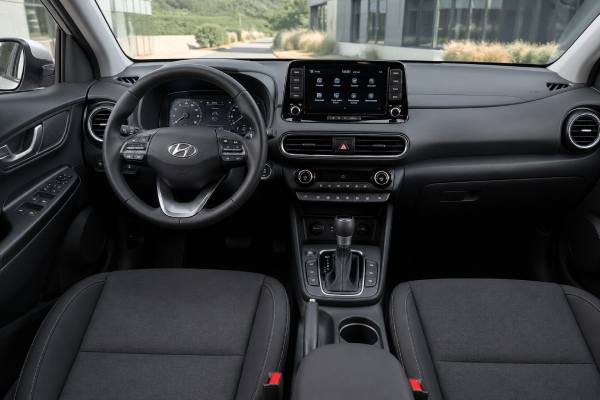

The 2021 facelift Hyundai KONA (OS) 1.6 T-GDi is the sharp end of the regular petrol range, sitting above the slower everyday engines and below the dedicated KONA N. In markets that still offered this tune in facelift form, it paired the familiar 1.6-litre turbo petrol four-cylinder with a seven-speed dual-clutch transmission and a much more eager personality than the standard KONA. That matters because this version is not just quicker on paper. It feels more effortless in traffic, more confident on motorway merges, and more enjoyable on a back road without becoming difficult to live with. The other side of the equation is equally important. This is a direct-injection turbo petrol with a dual-clutch gearbox, so it needs cleaner maintenance discipline than the simpler naturally aspirated models. It also varies by market more than many buyers expect. Some facelift regions kept the 177 PS tune, while others moved to newer outputs and different trim structures, so exact VIN and market verification always matters.
Essential Insights
- Strong mid-range torque gives the facelift KONA 1.6 T-GDi a genuinely brisk, easygoing feel.
- Compact size and quick responses make it one of the more entertaining small crossovers to drive.
- Better-equipped 1.6 T-GDi trims usually bring a strong safety and comfort package.
- The dry-clutch DCT and direct-injection turbo engine are fine when maintained well, but they are less forgiving of neglected servicing.
- A practical baseline is engine oil and filter every 10,000 km or 6–12 months in real use.
Guide contents
- Hyundai KONA OS facelift petrol profile
- Hyundai KONA OS 1.6T data sheet
- Hyundai KONA OS grades and safety tech
- Known faults and campaign checks
- Service routine and smart buying
- Everyday pace and road feel
- Facelift KONA against competitors
Hyundai KONA OS facelift petrol profile
The facelifted 2021 KONA 1.6 T-GDi is the version for buyers who like the KONA’s size and visibility but do not want it to feel underpowered. On the road, that difference shows up quickly. The turbo engine brings a broad torque band, the gearbox keeps it in the useful part of the rev range, and the car moves with more confidence than the lower-output versions. It is not a hot hatch in disguise, but it is one of the few small crossovers in this class that can feel genuinely lively without becoming harsh or tiring.
The facelift matters because Hyundai did more than tweak the bumpers. The updated KONA arrived with cleaner front-end styling, a more mature cabin presentation, and in many regions a better separation between mainstream trims and sportier variants. On a used example, that means a facelift 1.6 T-GDi often feels more modern than an older OS car even before you start the engine. Better lighting, a neater dash layout, stronger driver-assistance packaging, and a higher-grade interior all help.
This version also needs a market note. The 2021 facelift KONA range was not globally uniform. Some regions kept a 177 PS version, which translates to about 175 hp. Others moved to a slightly different 180 PS or even stronger configuration, often linked to N Line branding or all-wheel drive. So when shoppers search “2021 facelift KONA 1.6 turbo,” they are often talking about a family of closely related cars rather than one globally identical build. For that reason, the most honest way to assess one is by its exact trim, VIN, drive layout, and local brochure.
From an ownership angle, the appeal is clear. You get the easy parking and urban footprint of a B-segment SUV, but with enough performance to make it feel more like a warm hatch on stilts than an economy crossover. It is especially effective for buyers who regularly carry passengers, climb grades, or drive mixed motorway and suburban routes. The 1.0-litre cars can be entirely adequate, but the 1.6 T-GDi feels much less busy under the same load.
Its main caveat is mechanical complexity. A direct-injection turbo petrol engine and a dry-clutch dual-clutch transmission can be durable, but only when used and maintained properly. This is not the version to buy because it merely looks sporty. It is the version to buy when you actually value the stronger drivetrain and are prepared to care for it accordingly.
Hyundai KONA OS 1.6T data sheet
The specification picture for the 2021 facelift 1.6 T-GDi depends on market, but the open brochure data below reflects the facelift 1.6 Turbo configuration sold in markets that retained the 177 PS tune with front-wheel drive and the seven-speed dual-clutch transmission. Where public factory material does not clearly publish a number, it is more useful to say so directly than to invent precision.
| Item | Hyundai KONA (OS) facelift 1.6 T-GDi |
|---|---|
| Code | Gamma 1.6 T-GDi, commonly associated with the G4FJ engine family |
| Engine layout and cylinders | Inline-4, DOHC, 16 valves, 4 valves per cylinder |
| Bore × stroke | 77.0 × 85.44 mm (3.03 × 3.36 in) |
| Displacement | 1.6 L (1,591 cc) |
| Induction | Turbocharged |
| Fuel system | Gasoline direct injection |
| Compression ratio | 10.0:1 |
| Max power | 175 hp (130 kW / 177 PS) @ 5,500 rpm |
| Max torque | 265 Nm (196 lb-ft) @ 1,500–4,500 rpm |
| Timing drive | Chain-driven valvetrain layout is typical for this engine family; confirm by VIN when ordering service parts |
| Rated efficiency | Varies notably by market and test cycle; some open facelift brochures for this exact tune do not publish a single combined figure |
| Real-world highway @ 120 km/h | Usually around 6.8–7.6 L/100 km (34.6–30.9 mpg US / 41.5–37.2 mpg UK) when healthy and on suitable tyres |
| Item | Hyundai KONA (OS) facelift 1.6 T-GDi |
|---|---|
| Transmission | 7-speed dual-clutch transmission |
| Drive type | 2WD / FWD in the open facelift 177 PS brochure spec covered here |
| Differential | Open |
| Suspension (front / rear) | MacPherson strut / coupled torsion beam axle |
| Steering | Motor-driven power steering; exact ratio not clearly published in the open facelift brochure |
| Brakes | Ventilated front discs and solid rear discs; open brochure does not clearly publish rotor diameters in mm |
| Wheels and tyres | 18-inch alloy wheels with 235/45 R18 tyres |
| Ground clearance | Not clearly published in the open facelift brochure for this exact market version |
| Length / Width / Height | 4,165 / 1,800 / 1,550 mm (164.0 / 70.9 / 61.0 in) |
| Width including mirrors | 2,052 mm (80.8 in) |
| Wheelbase | 2,600 mm (102.4 in) |
| Turning circle | Public facelift brochure does not clearly state it for this market version |
| Fuel tank | 50 L (13.2 US gal / 11.0 UK gal) |
| Cargo volume | 361 L (12.7 ft³) seats up, VDA; seats-down figure not clearly published in the open brochure |
| Item | Hyundai KONA (OS) facelift 1.6 T-GDi |
|---|---|
| Acceleration | 0–100 km/h (0–62 mph) in 7.7 s |
| Top speed | Not clearly published in the open facelift brochure for this market version |
| Braking distance | Not publicly published in the open official brochure |
| Towing capacity | Verify by VIN and local plate data before purchase; public towing data varies heavily by market |
| Payload and kerb weight | Not clearly published in the open facelift brochure |
| Engine oil | Public Hyundai 1.6 Turbo maintenance material shows 0W-20 and a 4.5 L fill reference; always verify against VIN-specific service literature |
| Coolant | Premix coolant in the public Hyundai maintenance sheet; interval reference 100,000 km initially, then 80,000 km |
| Transmission fluid | Public Hyundai 1.6 Turbo maintenance sheet lists SAE 70 DCT fluid reference |
| A/C refrigerant and compressor oil | Check the under-bonnet label before service |
| Key torque specs | Always verify from the official workshop data for the exact VIN; wheel torque is market-dependent but typically falls in the normal Hyundai small-SUV range |
| Crash ratings | Euro NCAP 5 stars for the KONA range, with 87% adult occupant, 85% child occupant, 62% vulnerable road users, and 60% safety assist |
| IIHS | Top Safety Pick in U.S. specification when equipped with the relevant headlights and optional front crash prevention package |
| ADAS suite | Depending on market and trim: FCW, FCA, SCC, LKA, BCW, RCCW, DAW, plus standard stability and hill-control systems |
The headline numbers tell the real story. This KONA is not about heroic top speed. It is about useful thrust, quick response, and enough chassis grip to make the 1.6 turbo feel proportionate to the body. That is exactly why it remains the enthusiast’s choice in the non-N KONA lineup.
Hyundai KONA OS grades and safety tech
The facelift 1.6 T-GDi is unusual because in many markets it was not just a powertrain option. It was effectively the premium mainstream petrol KONA. That means buyers often got a higher equipment level along with the stronger engine, which changes the used-car equation a great deal. In simple terms, a 1.6 T-GDi facelift KONA often feels like a more complete product than the lower-output trims, not merely a faster one.
In the open facelift 177 PS brochure specification, the 1.6 Turbo version sits above the simpler 2.0-litre models and brings a clear equipment upgrade. It typically includes 18-inch wheels, LED lighting, leather or leather-combination trim depending on colour and market, full automatic climate control, a head-up display, wireless charging, a rear-view camera with dynamic guide, parking assistance, and a stronger SmartSense package. That matters because it lifts the cabin from sensible to genuinely modern.
Quick identifiers are useful when shopping. The 1.6 T-GDi often wears the 18-inch wheel package, richer exterior lighting, a fuller instrument display, and additional driver-assistance menu items in the screen. On some facelift cars, interior stitching or colour accents also help separate it from lower trims. In markets where N Line styling was tied to stronger petrol engines, exterior details such as unique bumpers, body-colour cladding, and twin-exit style cues may also appear. But buyers should still decode the actual equipment list from the car rather than relying on badge language in adverts.
Safety is one of the KONA’s strongest ownership arguments. Structurally, the model has a solid base for the segment, and Hyundai backed that with a wide spread of active safety systems. Even before you get to radar-based features, the KONA offers the core expected systems such as ABS, ESC, traction control, vehicle stability management, hill-start assist, downhill brake control, and ISOFIX child-seat points. On the better-equipped turbo trims, the package gets much more persuasive.
The facelift 1.6 T-GDi commonly adds blind-spot collision warning, rear cross-traffic collision warning, lane keeping assist, smart cruise control, forward collision warning, forward collision avoidance assist, and driver attention warning. In real ownership terms, this is more important than a single safety rating headline. It means the better 1.6T cars are the ones most likely to feel current in everyday driving.
One practical note: ADAS hardware brings calibration responsibility. Windscreen replacement, front-end accident repair, bumper removal, and even poor-quality alignment work can affect camera and radar accuracy. A used KONA with no warning lights is good. A used KONA with documented post-repair calibration is better. For many second owners, that is the difference between simply having the tech and knowing it still works properly.
Known faults and campaign checks
The 2021 facelift KONA 1.6 T-GDi is generally a solid small performance-leaning crossover, but it is not a car that enjoys neglect. The main trouble areas are predictable for the type: a turbocharged direct-injection petrol engine, a dry-clutch dual-clutch gearbox, and a chassis package that can hide wear until a test drive reveals it. None of that makes it fragile. It simply means the wrong car can become expensive faster than a basic naturally aspirated KONA.
| Prevalence and cost tier | What owners notice | Likely cause and direction |
|---|---|---|
| Common / low to medium | DCT hesitation at crawl speed, brake rust, weak 12 V battery, tyre wear on inner edges | Normal dry-DCT behaviour worsened by traffic, low use, age, alignment, worn links or bushes |
| Occasional / medium | Shudder on take-off, misfire under load, boost leak, warning lights after screen or bumper work | Clutch adaptation or clutch wear, plugs or coils, split hose or loose clamp, lost ADAS calibration |
| Less common / high | Persistent gearbox overheating or slip, turbo wear, heavier oil use, timing-correlation faults | Poor service history, repeated hard city use, late oil changes, deeper engine or transmission wear |
The seven-speed DCT is the part most buyers misread. Slightly deliberate low-speed behaviour can be normal. Strong shudder, repeated slipping, harsh parking manoeuvres, or heat-related warnings are not. A healthy car may still feel less creamy than a torque-converter automatic, especially in bumper-to-bumper traffic. That is a characteristic. But if the gearbox feels confused even when warm, or engages with a repeated judder, budget for adaptation checks and possibly clutch work.
On the engine side, the most sensible concerns are not dramatic failures. They are the long-term consequences of poor upkeep. This engine likes clean oil, healthy plugs, intact boost plumbing, and a functioning cooling system. Repeated short trips, low-quality oil habits, or very long change intervals are the sort of background that later produces coil complaints, carbon build-up, lazy response, or turbo health questions. A rough idle, hesitant mid-range pull, and oil mist around hoses or breathers are all worth investigating.
Direct injection also means intake deposits can become a real-world ownership issue over time, especially on cars that do mostly cold urban use. It is rarely the first thing to fail, but it is one reason a supposedly sporty turbo crossover can start feeling flat after years of indifferent servicing.
Chassis concerns are more ordinary. Drop links, bushings, and wheel alignment deserve attention on any 18-inch KONA that has seen rough roads. Rear brake condition also matters because lightly used cars can corrode there faster than owners expect. Electronics are usually fine, but a tired 12 V battery can trigger a surprisingly broad range of nuisance warnings.
For recalls and service actions, the golden rule is simple: do not guess from internet lists. Campaigns vary by market and VIN. Use the official Hyundai recall portal or your local safety authority database, then ask the dealer or seller for completion proof. That is much more valuable than a verbal “it was all done.”
Service routine and smart buying
Owning the facelift 1.6 T-GDi well is mostly about shortening risk, not chasing perfection. This is not a car that needs exotic rituals, but it does reward timely fluid changes and good inspection habits. A buyer who wants the car’s punch without the car’s bills should treat it like a quality turbo petrol and not like a disposable lease special.
| Item | Practical interval | Owner note |
|---|---|---|
| Engine oil and filter | Every 10,000 km or 6–12 months | Do it sooner in hard city use or repeated short trips |
| Engine air filter | Inspect each service; replace around 30,000–40,000 km | Shorter interval in dusty or hot climates |
| Cabin air filter | Every 20,000–30,000 km or 12–24 months | Worth doing earlier if cooling performance or demisting falls off |
| Spark plugs | About 60,000 km on the public Hyundai 1.6 Turbo service sheet | Misfire under load often starts here |
| DCT fluid | Check service history carefully; public Hyundai 1.6 Turbo service material lists a 60,000 km fluid change point | Important on city-driven cars |
| Brake fluid | Every 2 years | Cheap and worthwhile preventive maintenance |
| Coolant | Public Hyundai schedule shows 100,000 km first change, then every 80,000 km | Use the correct premix coolant only |
| Drive belt and hoses | Inspect annually; replace when cracked, noisy, or at the scheduled major service | Do not ignore squeal or visible wear |
| Brake pads, discs, and calipers | Inspect every service | Rear corrosion is common on lightly used cars |
| Tyres and alignment | Rotate and inspect every 10,000–15,000 km | 18-inch cars reveal alignment problems quickly |
| 12 V battery test | Annually from year four onward | Weak batteries create nuisance faults and false warnings |
| Timing chain monitoring | No routine replacement interval, but inspect if there is cold-start rattle or timing-correlation fault history | Noise and fault codes matter more than mileage alone |
A few buying checks matter more than the rest. Start with service history and ask whether oil changes were done on time, not merely whether the car was “maintained.” Then look for proof of spark plug service, gearbox fluid attention, battery age, tyre brand consistency, and any ADAS calibration paperwork after glass or front-end work.
The inspection shortlist should include:
- Smooth cold start without extended rattle.
- Clean, progressive take-off once warm, without repeated DCT shudder.
- Even boost delivery on a full-throttle road test.
- No vibration through the steering at speed.
- No significant inner-edge tyre wear.
- No persistent warning lights, especially for engine, safety, or TPMS systems.
- No evidence of cheap accident repair around the front bumper, radar area, or windscreen.
The best cars to buy are normally the ones with boring paperwork and unexciting owners. A one-owner example with complete receipts, matching tyres, no modification history, and frequent fluid changes is far more desirable than a cosmetically flashy car with a thin record. The trims to seek are usually the well-equipped 1.6T versions that were not overloaded with aftermarket wheels or intake parts. The cars to avoid are tuned examples, heavily city-used cars with rough DCT manners, and any seller who cannot explain service history clearly.
Long-term durability can be very good, but only if the car has been treated like a serious turbo petrol. That is the whole buyer’s guide in one sentence.
Everyday pace and road feel
This KONA’s main talent is that it feels lighter and quicker than most small SUVs without turning every drive into an event. The turbo engine picks up early, the mid-range is strong, and the car carries speed neatly on ordinary roads. That makes it much more satisfying than the base-powertrain KONA versions, especially once the road opens up.
Throttle response is good once rolling, though not perfectly immediate from a standing start in all situations. Part of that comes from the DCT. When you are asking for a quick move from a slow crawl, the gearbox can pause for a beat, then commit. Once you understand that, it becomes easy to drive smoothly. Drivers coming from conventional automatics may need a short adjustment period.
The ride is controlled rather than plush. On 18-inch wheels, the KONA 1.6T feels more tied down and more alert than the softer versions, but broken urban surfaces can sound sharper through the cabin. The payoff is better turn-in and less body slack on a fast road. It is still an SUV with a high seating position, but it does not wobble or feel vague when pushed moderately hard.
Steering is light in town and clean on the move. It is not rich with feel, but it is accurate enough to make the car easy to place. Straight-line stability is good, braking feel is confident when the discs are in good condition, and cabin noise is acceptable for the class. This is not a whisper-quiet long-distance car, yet it avoids the hollow, overworked sound some small crossovers produce when asked to keep up with traffic.
Real-world fuel use depends heavily on how the car is driven. In city work, expect roughly 8.5–10.0 L/100 km if trips are short and traffic is heavy. On a steady motorway run, 6.8–7.6 L/100 km is realistic. Mixed use usually lands somewhere in the mid-7s to high-8s. Cold weather, aggressive throttle use, cheaper tyres, roof loads, and permanent stop-start driving all move the number in the wrong direction.
For real performance, the 7.7-second 0–100 km/h figure only tells part of the story. What matters more is the easy overtaking punch from the middle of the rev range. That is what makes the 1.6 T-GDi feel worth the extra cost over a slower KONA. It is the difference between a small SUV that copes and one that actually feels willing.
Facelift KONA against competitors
The facelift KONA 1.6 T-GDi sits in an interesting place among small performance-leaning crossovers. It is not the most spacious choice, not the softest rider, and not the cheapest to run if you ignore maintenance. But it is one of the better-balanced options for drivers who want genuine energy without moving into full hot-crossover territory.
| Rival | Where the rival may do better | Where the KONA answers back |
|---|---|---|
| Ford Puma 1.0 EcoBoost | More playful chassis, cleverer boot packaging | Stronger straight-line performance in 1.6T form and often richer safety equipment |
| Volkswagen T-Roc 1.5 TSI | More mature motorway feel and more conservative ergonomics | More distinctive styling and a livelier top petrol option in many markets |
| SEAT Arona 1.5 TSI | Lower weight and often lower running costs | Feels more premium on upper trims and often offers a fuller ADAS package |
| Mazda CX-30 2.0 | Cabin quality and steering feel | Turbo shove and stronger low-rpm flexibility |
The KONA’s strongest case is that it mixes real pace with a manageable footprint. Some rivals are more elegant, some are softer, and some are simpler. But few of them offer the same combination of compact size, useful power, strong trim content, and straightforward day-to-day usability. That matters in the used market, where a car often has to serve several roles at once.
Its weakest point versus rivals is complexity per dollar. A simpler naturally aspirated CX-30 or a carefully chosen Arona may be easier to own on a tight budget. A T-Roc can feel more mature on long journeys. A Puma can be more playful. But the facelift KONA 1.6 T-GDi usually lands in the sweet spot for buyers who want a small SUV that does not feel slow or dull.
That is why it remains such a persuasive niche choice. If your priorities are relaxed overtaking, good equipment, compact dimensions, and a more engaging drive than the average crossover delivers, the facelift KONA 1.6 T-GDi deserves serious attention. Just buy the cleanest, best-documented one you can find.
References
- Hyundai_KONA_Malaysia Brochure_A4_SinglePage_PDF 2021 (Brochure)
- 2021 Kona Specifications 2021 (Specifications)
- Periodic Maintenance Service | Maintenance | Hyundai Malaysia 2025 (Maintenance Schedule Index)
- Euro NCAP | Hyundai KONA 2017 (Safety Rating)
- 2021 Hyundai Kona 2021 (Safety Rating)
Disclaimer
This article is for informational purposes only and is not a substitute for professional diagnosis, inspection, or repair. Specifications, torque values, maintenance intervals, capacities, procedures, and equipment can vary by VIN, market, trim, drivetrain, and production date, so always verify details against the official service documentation for the exact vehicle.
If you found this guide useful, please consider sharing it on Facebook, X, or another social platform to support our work.