

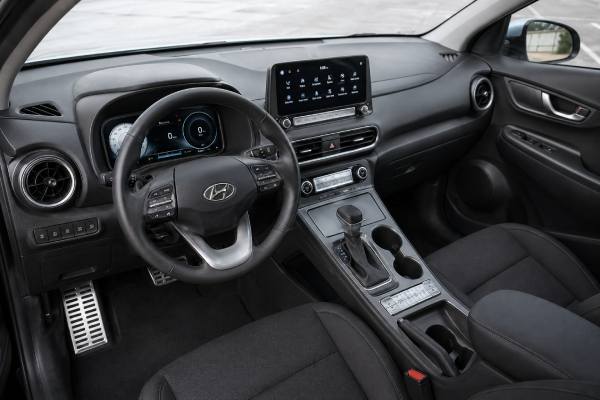
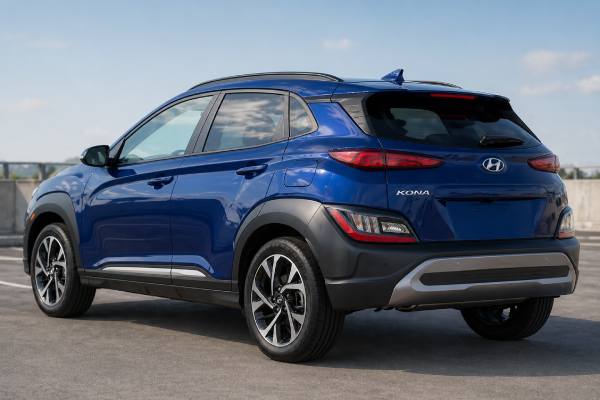
The late-facelift 2022–2023 Hyundai KONA 1.6 T-GDi is the strongest non-N version of the first-generation OS KONA. In this form, the compact crossover uses Hyundai’s 1.6-liter turbocharged petrol engine with 195 hp, paired mainly with a 7-speed dual-clutch transmission, and in some markets it could be ordered with either front-wheel drive or all-wheel drive. That matters, because this version is not just a dressier KONA with a larger engine. It is the model that gives the platform real pace, stronger overtaking ability, and a more complete chassis feel, especially when fitted with AWD and the multi-link rear suspension. The facelift also brought cleaner styling, better infotainment, and broader driver-assistance coverage. For owners, the appeal is easy to understand: compact size, useful performance, and a more mature feel than many small SUVs manage. The trade-offs are predictable too: higher fuel use than the hybrid, more dependence on gearbox condition, and a stronger need for proper servicing than the simpler petrol models.
Quick Specs and Notes
- Strong 265 Nm torque and quick response make it one of the livelier small crossovers in its class.
- Facelift updates improved infotainment, safety technology, and the overall cabin impression.
- AWD versions gain a more substantial rear suspension setup and better poor-weather traction.
- The 7-speed dual-clutch transmission needs smooth operation and a solid service history on used examples.
- A practical oil and filter service rhythm is every 12 months or about 10,000 miles, with shorter intervals in severe use.
On this page
- Hyundai KONA facelift turbo identity
- Hyundai KONA 195 hp specs and measurements
- Hyundai KONA trims, equipment, and safety tech
- Known issues and service campaign watchpoints
- Maintenance routine and smart used buying
- Driving impressions and real fuel use
- How the KONA 1.6 T-GDi stacks up
Hyundai KONA facelift turbo identity
The 2022–2023 Hyundai KONA 1.6 T-GDi sits in an interesting place within the first-generation KONA range. It is not the pure efficiency choice, because that role belongs to the hybrid. It is not the flagship performance model either, because that is the KONA N. Instead, this is the most rounded high-output everyday version: quick enough to feel genuinely strong, refined enough for regular commuting, and still compact enough to work as an urban crossover.
The facelift made that role easier to justify. Hyundai sharpened the front-end design, revised the lighting signatures, and improved the digital side of the cabin with better screens, broader connected features, and a more polished interior presentation. Those changes matter on the used market because they make late OS KONA models feel newer than many rivals from the same period. Buyers stepping from an earlier small SUV usually notice the improvement immediately in the dashboard layout, camera quality, and general usability.
Mechanically, the appeal starts with the engine. The 1.6 T-GDi delivers 198 PS, which translates to about 195 hp, and 265 Nm of torque. In a small crossover body, that is enough to make the KONA feel eager rather than merely adequate. It does not need to be driven hard to feel responsive. It simply has enough torque and enough power reserve to cope with hills, passengers, motorway merging, and overtaking without strain. That makes it a better fit for mixed driving than many smaller turbo-petrol crossovers that look competitive on paper but feel busier in practice.
Depending on market, the 1.6 T-GDi could be configured as a front-wheel-drive car or with optional all-wheel drive. That distinction is worth understanding before buying. The front-wheel-drive version is lighter, a little quicker, and usually more efficient. The AWD version adds traction and a more substantial rear chassis layout, which gives the car a more planted feel in bad weather and on rougher roads. Neither version is intended for heavy off-road use, but the AWD car clearly feels like the more complete long-distance machine.
This model suits a fairly clear owner profile. It works well for drivers who want compact dimensions and a commanding seating position but do not want the slow responses or soft character that some small SUVs bring. It is also a good fit for people who regularly use faster roads and want an easy overtaking margin without stepping into a full performance model. The main compromise is cost of running. It is not a thirsty disaster, but it is noticeably less frugal than the hybrid KONA and less forgiving of neglected tyres, fluids, and transmission behavior.
As a used choice, the late-facelift 1.6 T-GDi is strongest when bought for what it is: a brisk, well-equipped compact SUV with real day-to-day capability, not just a badge upgrade over the smaller engines.
Hyundai KONA 195 hp specs and measurements
Official Hyundai European data for the facelifted OS KONA shows the 1.6 T-GDi as the strongest mainstream petrol engine in the lineup. Some figures vary by market, wheel size, and whether the car is front-wheel drive or all-wheel drive, so the tables below focus on the late-facelift 1.6 T-GDi range and note where the 2WD and 4WD split matters.
| Item | Specification |
|---|---|
| Code | 1.6 T-GDi 7DCT, late-facelift OS KONA |
| Engine layout and cylinders | Inline-4, DOHC, 16 valves, swing-arm type valvetrain |
| Bore × stroke | 75.6 × 89.0 mm (2.98 × 3.50 in) |
| Displacement | 1.6 l (1,598 cc) |
| Induction | Turbocharged |
| Fuel system | Gasoline direct injection |
| Compression ratio | 10.0:1 |
| Max power | 195 hp (146 kW / 198 PS) @ 6,000 rpm |
| Max torque | 265 Nm (195 lb-ft) @ 1,600–4,500 rpm |
| Timing drive | Verify exact service procedure by VIN and market workshop data before major engine work |
| Transmission | 7-speed dual-clutch automatic |
| Drive type | 2WD or optional 4WD, depending on trim and market |
| Differential | Open differential layout with electronic traction support |
| Rated efficiency | WLTP combined about 6.5–6.2 l/100 km for 2WD and 7.1–6.7 l/100 km for 4WD |
| Real-world highway @ 120 km/h | Usually high-6 to low-8 l/100 km depending on weather, tyres, and load |
| Item | Specification |
|---|---|
| Suspension | Front MacPherson strut; rear CTBA on 2WD and multi-link on 4WD |
| Steering | Rack-and-pinion motor-driven power steering |
| Brakes | Ventilated front discs and rear solid discs with EBD-assisted braking system |
| Most popular tyre sizes | 205/60 R16, 215/55 R17, or 235/45 R18 depending on trim |
| Ground clearance | About 170 mm (6.7 in); N Line figures can be slightly different |
| Length / width / height | 4,205 / 1,800 / 1,565 mm (165.6 / 70.9 / 61.6 in), with N Line length around 4,215 mm |
| Wheelbase | 2,600 mm (102.4 in) |
| Turning circle | About 10.6 m (34.8 ft) |
| Kerb weight | About 1,301–1,505 kg (2,868–3,318 lb), depending on drivetrain and trim |
| Fuel tank | 50 l (13.2 US gal / 11.0 UK gal) |
| Cargo volume | 374 l (13.2 ft³) seats up / 1,156 l (40.8 ft³) seats folded, VDA |
| Towing capacity | Typically 1,250 kg (2,756 lb) braked / 600 kg (1,323 lb) unbraked, subject to market equipment |
| Item | Specification |
|---|---|
| 0–100 km/h | About 7.7 s in 2WD / 8.1 s in 4WD |
| Top speed | 210 km/h (130 mph) |
| Braking distance | No single official Hyundai public figure published across all trims |
| Engine oil | Use VIN-specific Hyundai-approved turbo-petrol oil grade and viscosity from the owner’s manual |
| Coolant | Use Hyundai-approved coolant only; exact mix and capacity vary by market and service procedure |
| Transmission fluid | Use Hyundai-approved DCT fluid only |
| Differential and transfer case | Applicable only to 4WD models; confirm oil type and fill by VIN before service |
| A/C refrigerant and compressor oil | Always confirm from the under-bonnet label before charging |
| Key torque specs | Wheel, brake, and suspension torque values should be checked against VIN-specific workshop data |
| Crash ratings | Euro NCAP platform result: 5 stars, with 87% adult, 85% child, 62% vulnerable road user, and 60% safety assist |
| ADAS suite | Availability varies by trim, but late cars commonly offered forward collision assist, lane support, blind-spot functions, rear cross-traffic support, and smart cruise control |
The practical story behind these figures is simple. The 1.6 T-GDi gives the KONA the pace many buyers expect from the styling, and the drivetrain split lets buyers choose between a lighter, more efficient 2WD setup and a more secure, better-planted 4WD version.
Hyundai KONA trims, equipment, and safety tech
By 2022 and 2023, the facelifted first-generation KONA had matured into a better-equipped and more clearly tiered lineup. The 1.6 T-GDi usually sat near the upper end of the mainstream range, often paired with richer trim levels and, in some markets, the sportier N Line presentation. That matters because the late OS KONA can vary a lot in feel and hardware even when two cars share the same engine badge.
In practical terms, there are three layers to understand. First, there are the regular higher-trim 1.6 T-GDi cars, which often combine the strong petrol engine with useful comfort equipment and the most sensible wheel sizes. Second, there are N Line-styled versions, which bring sportier bumpers, unique trim details, and often larger wheels. Third, there are market-specific option packs that can change the technology level dramatically, especially in relation to driver assistance and parking support.
Mechanically, the main distinction is between 2WD and 4WD. Front-wheel-drive cars are lighter and quicker, and in everyday use they feel slightly more agile. AWD cars add traction and, more importantly, the multi-link rear suspension. That extra hardware gives the car a calmer rear axle and a more mature feel over poor surfaces. For drivers in wet or winter-prone climates, the AWD version makes a lot of sense. For drivers in milder areas who value efficiency and lower running costs, the 2WD car can be the better buy.
Wheel and tyre package matters too. Smaller-wheel cars usually ride better and keep real-world economy closer to the brochure figures. Larger-wheel N Line cars look sharper and respond more crisply to steering inputs, but they also ride more firmly and cost more when tyres are due. That does not make one version better than the other. It simply means the right trim depends on where and how the car will be used.
The facelift also strengthened the KONA’s safety case. Hyundai expanded SmartSense coverage, and many late cars include a more generous ADAS package than earlier OS models. Depending on trim and region, buyers may find forward collision-avoidance assist with vehicle, pedestrian, and cyclist detection, lane keeping and lane following assist, driver attention warning, blind-spot collision warning or avoidance, rear cross-traffic alert, leading vehicle departure alert, intelligent speed support, and smart cruise control.
The crucial point for used buyers is that availability was not uniform. Some markets bundled these systems together. Others tied them to navigation, upper trims, or style packs. That means a car that looks high-spec on the outside may still lack one or two of the most useful assistance systems.
The best trim choices are often the ones that combine the 1.6 T-GDi with sensible wheels, strong safety content, and full service records. Buyers should verify the actual equipment list on the car, not rely on badge assumptions. On this model, the difference between “well specified” and “merely attractive” can be large.
Known issues and service campaign watchpoints
The late-facelift KONA 1.6 T-GDi is best described as a condition-sensitive performance crossover rather than a fundamentally troublesome one. The engine itself is usually strong when serviced on time with the right oil and sensible warm-up habits. The real ownership difference between a good car and a poor one tends to come from transmission condition, cooling-system health, tyre quality, and whether the previous owner treated the car like a warm hatchback, an economy car, or something in between.
The main watchpoint is the 7-speed dual-clutch transmission. In this engine application it gives the KONA quick responses and a sportier feel than a conventional automatic, but it can also become the defining issue on neglected used examples. Symptoms include low-speed shudder, awkward hill starts, hesitant parking maneuvers, or clumsy take-up after repeated crawling in traffic. That does not always mean the gearbox is failing. It can point to adaptation, clutch wear, calibration, or driving history. Still, a car that feels consistently rough at low speed deserves careful diagnosis, not optimistic guesswork.
On the engine side, ignition and intake cleanliness matter more than many owners assume. Worn spark plugs can produce hesitation under load well before a fault becomes obvious. Because this is a direct-injection turbo engine, intake-valve carbon build-up can also appear over time, particularly on short-trip or lightly loaded cars. This usually shows up as soft response, uneven idle quality, or a less clean pull than the power figure suggests. It is rarely a reason to avoid the model outright, but it is a reason to buy on condition rather than brochure numbers.
Cooling system vigilance is sensible too. Turbo engines do not forgive neglected coolant condition, weak hoses, or poorly handled repairs. Intercooler pipe leaks, oil misting around charge pipes, or signs of past overheating should all be taken seriously. Most are manageable issues when caught early.
Other known ownership themes are less dramatic:
- Common, low to medium severity: DCT parking-speed roughness, worn tyres upsetting traction and steering feel, rear brake corrosion on low-mileage cars, weak 12 V battery causing multiple warnings.
- Occasional, medium severity: wheel-bearing noise, anti-roll-bar link wear, camera or parking-sensor faults, infotainment glitches.
- Occasional, medium to high severity: neglected gearbox drivability complaints, poor calibration after battery replacement or software resets.
- Rare, higher severity: heavily abused cars with compounded transmission, cooling, and previous-repair issues.
Software history matters more than buyers sometimes realize. Hyundai service networks typically check and apply recommended updates during servicing, and that can affect engine response, transmission behavior, infotainment stability, and ADAS operation. On a late KONA, evidence of dealer or specialist software attention is a plus.
As for recalls and service actions, the safest route is always verification. Ask for an official VIN campaign check and dealer records. A car with complete recall history, smooth transmission behavior, and no unexplained warnings is on an entirely different footing from one that merely looks clean and drives acceptably for ten minutes.
Maintenance routine and smart used buying
This is not a difficult KONA to maintain, but it is not the version to run on the bare minimum either. The 1.6 T-GDi rewards routine servicing, correct fluids, and attention to the small things that keep a turbo engine and dual-clutch transmission feeling healthy. Buyers hoping to keep the car for the long term should think in terms of preventive care rather than reactive repair.
A sensible maintenance approach starts with annual servicing. Even where a market schedule allows wider flexibility, a practical rhythm of about 10,000 miles or 12 months for oil and filter changes is a strong habit, especially on a turbocharged direct-injection engine. Severe use such as repeated short trips, hot weather, hard driving, or towing justifies shorter intervals.
| Item | Practical interval | Why it matters |
|---|---|---|
| Engine oil and filter | About every 12 months or 10,000 miles | Protects the turbo engine and timing hardware |
| Engine air filter | Inspect every service, replace sooner in dust | Helps response, economy, and turbo efficiency |
| Cabin air filter | Usually every 12–24 months | Improves HVAC performance and screen clearing |
| Spark plugs | Follow the handbook schedule and inspect early if response softens | Misfires and hesitation often begin here |
| Coolant | By official schedule and condition | Turbo engines depend on good cooling-system health |
| DCT fluid | Use preventive servicing on mileage cars and follow VIN-market guidance | Only use Hyundai-approved fluid |
| Brake fluid | Time-based replacement is wise | Hydraulic condition matters as much as pad thickness |
| Brake pads and discs | Inspect every service | Rear brake corrosion can appear on lightly used cars |
| Tyre rotation and alignment | Check regularly | Important for handling, economy, and AWD behaviour if fitted |
| 12 V battery test | Once the car reaches middle age | Weak batteries cause misleading warning cascades |
| AWD rear and transfer oils | For 4WD models, inspect and service preventively on higher-mileage cars | Useful extra protection for towing or hard use |
Because the 1.6 T-GDi is a direct-injection turbo petrol engine, intake cleanliness, quality fuel, and timely plug changes all matter. The fuel filter is not usually treated as a normal routine item in the way older cars did, but contaminated fuel or poor running deserves proper investigation.
For a used buyer, the smartest inspection checklist is quite targeted:
- Cold-start behavior should be smooth and clean.
- The gearbox should not shudder repeatedly in parking maneuvers.
- Full-throttle acceleration should be strong and linear, without hesitations.
- Cooling fans, hoses, and intercooler pipework should look healthy.
- All four tyres should match in type and wear.
- Rear brakes should be free of deep corrosion or drag.
- Cameras, parking sensors, and ADAS systems should work normally.
- A VIN campaign check and service invoices should back up the car’s history.
The best late KONA 1.6 T-GDi examples are often cars with complete maintenance records, sensible wheel sizes, and owners who serviced them on time rather than chasing the lowest possible running cost. Those are the cars most likely to stay enjoyable and dependable.
Driving impressions and real fuel use
The facelift KONA 1.6 T-GDi feels like the point where the first-generation KONA platform wakes up properly. In lower-output forms, the car is neat and easy to like, but this engine gives it the level of urgency the design always hinted at. There is enough low-end torque to make everyday driving easy and enough top-end power to keep it feeling strong once speeds rise.
The engine’s character is one of the model’s best qualities. Peak torque arrives early, and that gives the car confident part-throttle response in normal traffic. It does not need to be worked hard to feel lively. That matters in a small SUV, where buyers often want easy overtaking and quick merging more than outright drama. Under stronger acceleration there is a brief sense of turbo build rather than big lag, and once it is in the middle of the rev range the engine pulls with real purpose.
The 7-speed DCT suits this engine better than it suits some lower-torque applications. It shifts quickly, helps the car feel alert, and contributes to the more premium, more mechanical feel of the drivetrain. Still, it remains a dual-clutch gearbox. In crawling traffic and repeated parking maneuvers, it is less creamy than a good torque-converter automatic. Buyers who spend most of their time in congestion should test this carefully rather than assume all automatics feel the same.
Chassis feel depends partly on drivetrain. The front-wheel-drive KONA 1.6 T-GDi is the quicker and slightly more efficient version, and it feels light on its feet. The 4WD car gives away a little outright pace, but it adds traction and a more settled rear axle thanks to the multi-link suspension. On broken surfaces and in wet weather, that extra hardware can make the 4WD car feel more mature than the numbers alone suggest.
Ride quality is respectable, though wheel size matters. Smaller-wheel trims cope better with poor roads and keep road noise down. N Line-style cars on larger wheels look sharper and feel tauter but can transmit more impact harshness. None of these versions are uncomfortable by class standards, but the KONA is still a small crossover with a short wheelbase, so tyre choice and pressure have a noticeable effect.
Real-world fuel economy depends heavily on route and right foot. In mixed driving, a careful owner can stay reasonably close to the WLTP combined numbers, especially in 2WD form. Highway use at a genuine 120 km/h tends to push consumption upward more sharply than urban and suburban commuting. Short trips, cold weather, and enthusiastic use of the engine will move the car away from the brochure figure quickly.
A realistic pattern looks like this:
- Mixed commuting: usually reasonable for a nearly 200 hp crossover.
- Fast motorway use: decent, but no longer standout.
- Town driving: fine, though it will never match the hybrid.
- Hard use or winter conditions: expect a clear fuel-use penalty.
The overall dynamic verdict is positive. The 1.6 T-GDi turns the KONA into a compact SUV that feels brisk, easy, and more sophisticated than many similarly sized rivals, provided the transmission is healthy and the tyres are right.
How the KONA 1.6 T-GDi stacks up
The facelifted KONA 1.6 T-GDi competes in a crowded part of the market, but its strengths are clearer than they first appear. It is not trying to be a budget runabout, and it is not trying to be a true hot crossover either. Its role is to offer strong mainstream performance in a compact SUV body, and that gives it a slightly different flavor from many direct rivals.
Against cars such as the Ford Puma 1.0 EcoBoost, Renault Captur TCe, or Volkswagen T-Roc 1.5 TSI, the Hyundai’s big advantage is that it feels more substantial in higher-output form. It has stronger mid-range shove than many small-capacity rivals, and the optional AWD version adds a layer of traction and composure that most of those alternatives do not offer. The downside is that some rivals can feel smoother at parking speeds if they use a different automatic transmission type.
Against Mazda’s CX-30 and smaller CX-3 alternatives, the Hyundai fights back with better straight-line pace in this engine form and a richer feature count in many late trims. Mazda counters with more natural steering feel and, in some cases, a slightly more premium cabin atmosphere. Buyers who value response and technology often prefer the KONA. Buyers who prioritize traditional driving feel may still lean Mazda.
The strongest internal rival is actually Hyundai’s own KONA Hybrid. The hybrid is the rational choice for heavy urban mileage, lower fuel costs, and simpler commuting. The 1.6 T-GDi makes its case through performance, towing usefulness, and a more assertive feel on open roads. One is the efficient everyday tool. The other is the compact crossover for drivers who want pace without jumping all the way to a KONA N.
That is why the late OS KONA 1.6 T-GDi remains easy to recommend in the right context. It is not the cheapest KONA to buy or run, and it does ask more of the transmission and tyres than the lesser-engined models. But it gives something tangible back: real performance, strong overtaking ability, and a more complete chassis experience than many small SUVs deliver.
For buyers who want a small crossover that still feels energetic and grown up, this version lands in a sweet spot. It has enough power to feel special, enough practicality to make sense, and enough late-facelift polish to remain competitive as a used purchase. That combination is exactly why the 2022–2023 KONA 1.6 T-GDi continues to matter.
References
- 202009_Technical Data_new Kona and all-new Kona N Line 2020 (Technical Data)
- Hyundai Kona Electric | Press information | September 2023 2023 (Model Range Overview)
- Hyundai KONA 2017 (Safety Rating)
- Hyundai Owners manuals 2026 (Owner’s Manual)
- 5-Year Warranty | New Cars | Hyundai Motor UK 2026 (Warranty)
Disclaimer
This article is for informational purposes only and is not a substitute for professional diagnosis, repair, or official service information. Specifications, torque values, intervals, procedures, safety equipment, and drivetrain details can vary by VIN, market, trim, and model year, so always verify the exact vehicle against official service documentation before carrying out maintenance, repairs, or parts ordering.
If this guide helped you, please consider sharing it on Facebook, X, or another social platform to support our work.