


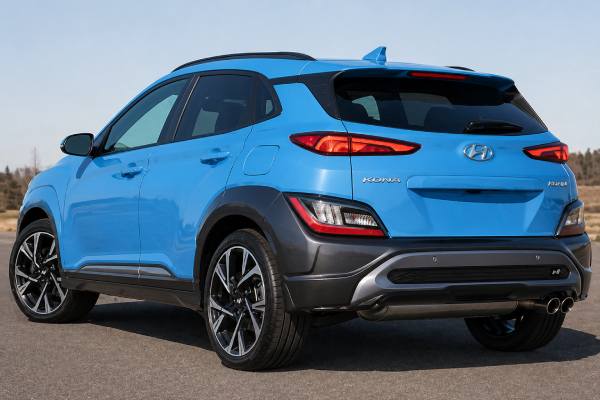
The facelifted Hyundai KONA N is the version that turns the first-generation KONA from a tidy small crossover into a serious front-wheel-drive performance machine. Under the sharper facelift bodywork sits Hyundai’s 2.0-litre turbocharged four-cylinder, an eight-speed wet dual-clutch transmission, an electronically controlled limited-slip differential, adaptive dampers, bigger brakes, and a full set of N-specific cooling, drive-mode, and launch-control hardware. On paper, that sounds like a hot hatch recipe lifted into a taller shell, and in practice that is exactly why the car works.
For owners, the KONA N is appealing because it feels focused without becoming unusable. It is quick, adjustable, and far more entertaining than most compact SUVs. The trade-off is that this is not a low-stress budget KONA. Tyres, brakes, fluids, and gearbox behavior matter, and neglected service history can turn a brilliant car into an expensive one. The best examples are the ones maintained like performance cars, not treated like ordinary family crossovers.
At a Glance
- The KONA N combines strong real-world pace with a chassis that feels far more precise than most small SUVs.
- An electronically controlled limited-slip differential and adaptive dampers help it put power down cleanly.
- The wet N DCT suits the engine well and gives the car genuine launch and overtaking ability.
- Brake, tyre, and fluid costs are meaningfully higher than on ordinary KONA models, so maintenance budgeting matters.
- Engine oil should be changed every 10,000–15,000 km or 12 months at the latest, and sooner with hard driving.
On this page
- Hyundai KONA N facelift character
- Hyundai KONA N technical breakdown
- Hyundai KONA N trim and safety equipment
- Known issues and service actions
- Maintenance plan and buyer checklist
- Road feel and measured performance
- KONA N against performance rivals
Hyundai KONA N facelift character
The KONA N arrived as Hyundai N’s answer to a question many enthusiasts did not expect to ask seriously: can a high-riding compact crossover still deliver the focus and aggression of a proper hot hatch? In this case, the answer is yes, mostly because Hyundai did not just add power and cosmetics. It reworked the whole package around performance use.
The basic recipe is familiar to anyone who has followed the i30 N. The engine is the 2.0-litre Theta II turbo four-cylinder, tuned here to 280 PS, which translates to roughly 276 hp. It drives the front wheels through Hyundai’s eight-speed wet-clutch N DCT and an electronically controlled limited-slip differential. The suspension, steering, exhaust, brakes, cooling hardware, and software calibration are all N-specific. That matters because the KONA N does not feel like a normal crossover trying to imitate a sports car. It feels like a performance model that happens to have a taller seating position.
That tall body still shapes the experience. You sit higher than in an i30 N or a traditional hot hatch, and you can feel the extra vertical mass in rapid direction changes. But Hyundai’s engineering work goes a long way to contain it. The car turns in eagerly, resists understeer better than most front-drive SUVs, and remains remarkably stable under hard braking. The steering is quick, the front axle is strong, and the drivetrain has enough character to make the car feel alive even at moderate road speeds.
Ownership appeal comes from that dual nature. The KONA N is much faster than most buyers actually need, yet it is still easy enough to use every day. The cabin is recognisably KONA, so visibility, entry height, and general practicality remain intact. Rear space is not class-leading, and the ride can be busy on poor roads, but you do not have to tolerate the usual full-time compromises of a stripped-out performance car. That is one reason the KONA N found an audience beyond pure badge loyalists.
The downside is equally clear. This is not a car that thrives on half-hearted maintenance. The tyres are expensive, the brakes work hard, and the drivetrain’s performance software depends on clean fluid, healthy sensors, and correct servicing. A neglected KONA N will still start and move like a regular used car, but it will not feel like a proper N product. The difference between an average example and a carefully maintained one is larger here than on many ordinary crossovers.
As a used proposition, the KONA N is best judged as a specialist performance car in compact-SUV clothing. That is what makes it interesting, and that is also what makes service history essential.
Hyundai KONA N technical breakdown
The table below reflects the facelift-era KONA N sold for 2022–2023 in European and UK-facing markets. Market details can vary slightly, but the core powertrain and chassis specification is highly consistent for this model.
| Item | Specification |
|---|---|
| Code | Theta II 2.0 T-GDi gasoline |
| Engine layout and cylinders | Inline-4, DOHC, 16-valve, 4 valves per cylinder |
| Bore × stroke | 86.0 × 86.0 mm (3.39 × 3.39 in) |
| Displacement | 2.0 L (1,998 cc) |
| Induction | Turbocharged |
| Fuel system | Direct injection |
| Compression ratio | 9.5:1 |
| Max power | 276 hp / 280 PS (205.9 kW) @ 5,500–6,000 rpm |
| Max torque | 392 Nm (289 lb-ft) @ 2,100–4,700 rpm |
| Timing drive | Chain |
| Rated efficiency | Around 8.4–8.5 L/100 km (28.0–27.7 mpg US / 33.6–33.2 mpg UK), market dependent |
| Real-world highway at 120 km/h | Usually about 8.0–9.2 L/100 km (29.4–25.6 mpg US / 35.3–30.7 mpg UK) |
| Item | Specification |
|---|---|
| Transmission | 8-speed N DCT, wet dual-clutch |
| Drive type | FWD |
| Differential | Electronically controlled limited-slip differential |
| Suspension front / rear | MacPherson strut / multi-link with electronically controlled suspension |
| Steering | Rack and pinion, motor-driven power steering |
| Brakes | Ventilated discs front and rear; front 360 mm (14.2 in), rear 314 mm (12.4 in) |
| Most popular tyre size | 235/40 R19 on 19-inch wheels |
| Ground clearance | About 170 mm (6.69 in) |
| Length / width / height | 4,215 / 1,800 / 1,565 mm (165.94 / 70.87 / 61.61 in) |
| Wheelbase | 2,600 mm (102.36 in) |
| Turning circle | About 10.9 m (35.8 ft) |
| Kerb weight | About 1,510 kg (3,329 lb) |
| GVWR | About 1,930 kg (4,255 lb) |
| Fuel tank | 50 L (13.21 US gal / 11.00 UK gal) |
| Cargo volume | 361 L (12.7 ft³), VDA |
| Item | Specification |
|---|---|
| 0–100 km/h | 6.4 s standard, about 5.5 s with launch control in 0–62 mph testing |
| Top speed | 240 km/h (149 mph) |
| Braking distance | Typically mid-30 m range from 100 km/h, tyre and surface dependent |
| Towing capacity | Not generally marketed as a tow-focused variant; verify by VIN and market homologation |
| Payload | About 420 kg (926 lb), market dependent |
| Engine oil | High-performance fully synthetic engine oil to Hyundai specification; verify market viscosity by manual and climate |
| Coolant | Long-life coolant for aluminium components; verify exact capacity and mix by workshop data |
| Transmission fluid | Wet N DCT fluid, model-specific specification, workshop verification recommended |
| Differential / transfer case | No separate transfer case; front e-LSD integrated in driveline system |
| A/C refrigerant | R-1234yf, verify charge by vehicle label |
| Key torque spec | Wheel nuts 107–127 Nm (79–94 lb-ft) |
| Crash ratings | Euro NCAP 5-star platform background; active-safety fitment varies by market and equipment |
| IIHS | Good major crash-test ratings for 2018–23 KONA structure; award status depended on front crash prevention and headlights |
The most important technical point is that the KONA N is not just an engine upgrade. The car’s differential, dampers, transmission mapping, exhaust calibration, and cooling system all work together to shape the verdict. That integrated engineering is why it feels more complete than many rivals that rely on power alone.
Hyundai KONA N trim and safety equipment
Unlike the mainstream KONA range, the KONA N is fairly easy to understand from a trim perspective. In most markets it was sold as a single high-spec performance model rather than a wide ladder of trims. That simplifies shopping, because most of the mechanical hardware is standard. You are usually choosing condition, colour, wheel and tyre history, and optional comfort features rather than deciding between soft and hard versions of the same powertrain.
Standard KONA N equipment is generous. Expect the full N body kit, 19-inch alloy wheels, N-specific front seats, N steering wheel, model-specific digital cluster graphics, performance drive modes, launch control, active exhaust, electronically controlled suspension, the N Grin Control System, and the e-LSD. The cabin is more serious than luxurious, but Hyundai did a good job of making it feel distinct from lesser KONA models without over-decorating it.
There are also a few practical cues that help identify a genuine, unmodified car. Factory KONA N models have the red exterior trim line, twin exhaust outlets, larger front brake package, N badging throughout, and the N-specific software menus in the centre display and cluster. The front seats, steering-wheel buttons, and exhaust hardware are harder to fake convincingly than cosmetic trim, so they are worth checking when inspecting a used car.
Safety is stronger than the performance image might suggest. The underlying KONA platform performed well in official crash testing, and Hyundai’s broader active-safety philosophy carried over into this model. Depending on market, the KONA N typically includes or offers:
- Forward collision avoidance functions
- Lane keeping and lane following support
- Driver attention warning
- Intelligent speed assist
- Rear parking sensors and camera
- Blind-spot and rear cross-traffic support on some specifications
- Multiple airbags and ISOFIX rear-seat mounts
That said, buyers should still confirm exact equipment. The KONA’s safety-technology story has always been trim- and market-sensitive, and even performance variants can differ slightly by country. Some markets prioritised full safety-pack fitment, while others varied the lighting and assistance package more than buyers expect.
For service and body repair, ADAS calibration remains important. Windscreen replacement, front bumper work, mirror replacement, and suspension geometry changes can all affect how the systems behave. On a car like the KONA N, where owners are more likely to fit aftermarket tyres or alignment settings, it is worth checking that the safety systems still operate properly after any modifications.
The KONA N’s real advantage is that it gives buyers near-flagship hardware without forcing them into a maze of trim logic. The core car is already the one enthusiasts want. The trick is finding one that has stayed close to factory specification and has not been abused by poor modifications or missed servicing.
Known issues and service actions
The KONA N is generally robust for a high-output front-drive turbo car, but it must be judged by performance-car standards rather than ordinary crossover standards. It carries more heat, more tyre load, more brake demand, and more driveline stress than other KONA variants. That does not make it fragile, but it does make neglect more costly.
Common and usually low to medium cost
- Front tyre wear, especially on the outer shoulders
- Brake dust, brake lip formation, and occasional pad squeal
- Minor trim rattles in the cabin
- Wheel damage or tyre sidewall damage from 19-inch wheel use
- Occasional infotainment or driver-profile software quirks
Occasional, medium cost
- Wet DCT calibration complaints such as abrupt low-speed behavior or hesitation when hot
- Engine mounts or driveline harshness becoming more noticeable with age
- Cooling-system hose or clamp seepage after repeated heat cycles
- Exhaust valve or flap noises
- Alignment drift after pothole impacts or hard kerb contact
Less common, but expensive if ignored
- Turbocharger stress accelerated by poor oil quality or hard shutdown habits
- Brake overheating and rotor cracking on heavily tracked or aggressively driven cars
- Differential or gearbox complaints after repeated hard launches and skipped fluid care
- Engine knock or fuel-quality-related issues in cars run on poor fuel under high load
The good news is that most KONA N problems announce themselves early. A tired example usually shows uneven tyre wear, a steering wheel slightly off-centre, rough brake feel, or a driveline that no longer feels crisp. These are useful warnings rather than hidden traps. On a test drive, a strong car should start cleanly, warm up smoothly, shift decisively, track straight, and pull hard without hesitation.
The N DCT is one area that deserves special attention. It is a wet-clutch unit and fundamentally tougher than the dry-clutch gearboxes used in lesser Hyundai models, but that does not mean it should be ignored. Repeated launch-control use, poor fluid care, and aggressive hot-city driving can make shift quality degrade over time. Persistent flare, abrupt engagement, or odd behavior when manoeuvring deserves a proper diagnostic check.
Cooling health also matters more here than on regular KONA models. The KONA N’s performance depends on temperature control, not just engine strength. A car that has been tracked or repeatedly driven hard should be checked carefully for coolant staining, radiator condition, fan operation, and intercooler area damage. Owners who have fitted non-standard intakes or boost-related hardware also deserve extra scrutiny.
For campaigns and software, the safest approach is still to verify by VIN with Hyundai and request dealer records. A performance Hyundai can benefit meaningfully from control-unit and driveline calibration updates, and a car with documented dealer attention is usually worth more than one with only enthusiastic owner claims.
In used form, the KONA N is best bought from an owner who understood warm-up, cooldown, tyre management, and fluid discipline. That history matters more than low mileage alone.
Maintenance plan and buyer checklist
The KONA N needs to be maintained like a serious hot hatch, because that is effectively what it is. The official service schedule provides the base, but owners who drive hard or keep the car long term are usually better served by shorter fluid intervals and a more inspection-heavy mindset.
| Item | Practical interval | Notes |
|---|---|---|
| Engine oil and filter | 10,000–15,000 km or 12 months; sooner after track work or repeated hard use | Use the correct high-performance synthetic oil and keep the level exact |
| Engine air filter | Inspect every service | Earlier replacement if driven in dusty conditions or with performance use |
| Cabin air filter | Every 24 months or sooner | Routine item, but worth maintaining on a car with strong HVAC demand |
| Spark plugs | Typically around 60,000–75,000 km, sooner if tuned or heavily used | Critical for turbo performance and knock resistance |
| Coolant | Inspect regularly and renew by official schedule | Cooling condition matters more than mileage alone |
| N DCT fluid | Inspect and consider earlier service for hard-driven cars | Important for shift quality and long-term durability |
| Brake fluid | Every 24 months, or more often with enthusiastic driving | Track or mountain-road use can justify much shorter intervals |
| Brake pads and discs | Inspect every service | Wear depends heavily on driving style and tyre grip |
| Tyres | Inspect monthly and rotate by wear strategy if appropriate | Matching tyres are essential for balance and braking |
| Alignment | At least annually, or after pothole strikes and tyre replacement | Huge effect on steering precision and tyre life |
| Timing chain | No routine replacement interval | Investigate noise, correlation faults, or oil-neglect history immediately |
| 12 V battery test | Annually from year 4 onward | Low voltage can create misleading electronic symptoms |
When shopping used, the inspection routine should be disciplined:
- Check tyres first. They tell the truth about alignment, driving style, and budget discipline.
- Inspect front brake discs for lip, heat spots, or cracking.
- Drive the car gently and then briskly to judge DCT behavior at both ends of the speed range.
- Listen for exhaust flap noise, suspension knocks, or mount-related harshness.
- Confirm software, service, and fluid history with invoices, not just stamps.
- Look for signs of tuning, non-standard boost hardware, or aftermarket parts removed before sale.
The best cars to buy are lightly modified or fully stock examples with transparent servicing. The ones to avoid are cars with mixed cheap tyres, unexplained power mods, overconfident sellers, or paperwork that only covers basic annual work while ignoring performance-related consumables.
As a long-term ownership proposition, the KONA N can be durable, but only in the hands of an owner who accepts that the car’s performance hardware needs performance-level care.
Road feel and measured performance
From behind the wheel, the KONA N’s biggest achievement is that it feels eager rather than heavy-footed. Many fast compact SUVs gain power but never really lose their crossover looseness. The Hyundai goes further than that. It turns in quickly, loads the front axle confidently, and delivers the kind of front-end bite that makes it feel related to the i30 N more than to ordinary small crossovers.
The engine is central to that impression. Hyundai’s 2.0 T-GDi has a broad, muscular mid-range and enough top-end strength to keep pulling beyond the point where most small turbo SUVs have already signed off. It is not a delicate engine. It feels dense, purposeful, and tuned for hard real-world acceleration. The N DCT also suits it well. In normal driving it can behave calmly enough, but switch into the more aggressive modes and the gearbox becomes one of the car’s best features. Shifts are fast, decisive, and well matched to the engine’s character.
Real-world pace is strong. Launch control is not just brochure theatre. In the right conditions it gives the KONA N genuinely rapid standing-start performance, and in everyday overtaking the car feels even more convincing than the 0–100 km/h number suggests. The mid-range shove between about 80 and 120 km/h is one of the reasons the car feels so grown-up on fast roads.
Ride quality is the usual compromise area. The adaptive dampers help, but this is still a stiffly controlled crossover on 19-inch tyres. On good roads it feels tied down and alert. On broken urban surfaces it can become busy, and sharp edges are more noticeable than they are in a normal KONA. That trade-off is predictable and, for most enthusiastic drivers, acceptable.
Grip and traction are impressive for a front-drive car at this output. The e-LSD does real work, helping the car pull itself out of bends with more discipline than many rivals. There is still understeer if you overdrive the entry too hard, but the front axle has more authority than the body style suggests. Braking is similarly convincing, with a firm pedal and good resistance to fade in normal enthusiastic road use. Hard track work, however, will expose the limits of stock pads and fluid sooner than casual owners might expect.
Fuel economy is reasonable for the pace on offer, though no one buys a KONA N for thrift. Expect roughly 10.5–12.0 L/100 km in city use, around 8.0–9.2 L/100 km at a steady 120 km/h, and roughly 8.8–10.0 L/100 km in mixed driving. That translates to about 26.7–23.5 mpg US mixed, or roughly 32.1–28.2 mpg UK.
In simple terms, the KONA N drives like a properly engineered fast car that happens to sit higher than a hatchback. That is its main triumph.
KONA N against performance rivals
The KONA N lives in a small but interesting performance niche. It is not really competing with ordinary compact crossovers, because its pace and hardware sit above them. Instead, it faces a mix of fast small SUVs and very quick hot hatchbacks that buyers might cross-shop when practicality and driving involvement both matter.
| Rival | Where the KONA N is stronger | Where the rival may suit better |
|---|---|---|
| Volkswagen T-Roc R | More playful front-drive character, often better value, more distinctive personality | AWD traction and a calmer premium feel |
| Ford Puma ST | Much stronger straight-line pace, richer tech package, dual-clutch convenience | Lighter weight, purer steering feel, lower running costs |
| Cupra Formentor VZ | Sharper rawness and more obvious hot-hatch connection | Broader cabin, more mature long-distance feel, stronger premium image |
| Audi SQ2 | More characterful drivetrain mapping and better enthusiast value | AWD traction, badge prestige, more subdued presentation |
| Hyundai i30 N DCT | Higher seating position and crossover usability | Lower centre of gravity, cleaner body control, slightly purer enthusiast verdict |
What keeps the KONA N relevant is not that it wins every dynamic category. It does not. A lower hot hatch is still the cleaner performance solution, and an AWD rival may be easier to deploy in poor weather. What Hyundai offers instead is a rare mix of genuine performance engineering, compact dimensions, and everyday usability in a body style many buyers already prefer.
Its biggest strength is personality. The KONA N does not feel sanitised. The drivetrain, exhaust, and chassis all have real attitude, and that matters in a segment where fast crossovers can often feel quick but emotionally flat. At the same time, it remains practical enough to use every day without explaining away major sacrifices.
The main argument against it is that it sits between categories. Buyers seeking pure driver involvement may still choose an i30 N, Civic Type R, or Golf GTI-style hatchback. Buyers seeking all-weather security may prefer an AWD fast SUV. But for the driver who wants something compact, entertaining, usable, and a little unusual, the KONA N makes a strong case.
As a used purchase, it remains one of the more interesting performance crossovers of its generation. It is not the cheapest to run, and it should never be bought casually. But a well-maintained KONA N can deliver far more engagement than its shape suggests, which is exactly why it still stands out.
References
- Hyundai KONA N | Technical specifications 2021 (Technical Data)
- Kona N Pricing and Specification – Hyundai Europe 2021 (Pricing and Specification)
- Hyundai KONA 2017 (Safety Rating)
- 2022 Hyundai Kona 2022 (Safety Rating)
- 2021 TOP SAFETY PICKs 2021 (Safety Rating)
Disclaimer
This article is for informational purposes only and is not a substitute for professional diagnosis, repair, or model-specific workshop guidance. Specifications, torque values, service intervals, fluid requirements, equipment, and procedures vary by VIN, market, production date, and setup, so always verify critical details against the official service documentation for the exact vehicle.
If this guide was useful, please consider sharing it on Facebook, X, or another social platform. That support helps us keep publishing detailed and practical vehicle guides.