
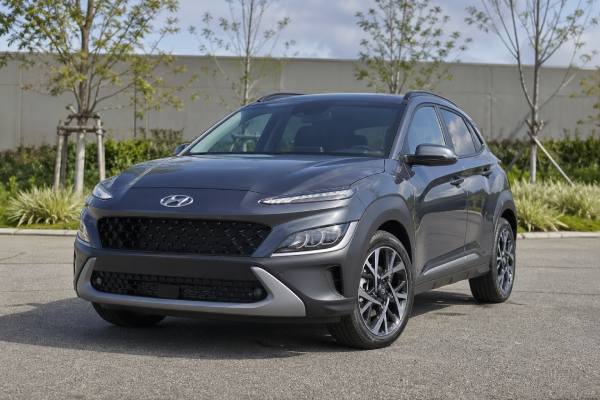
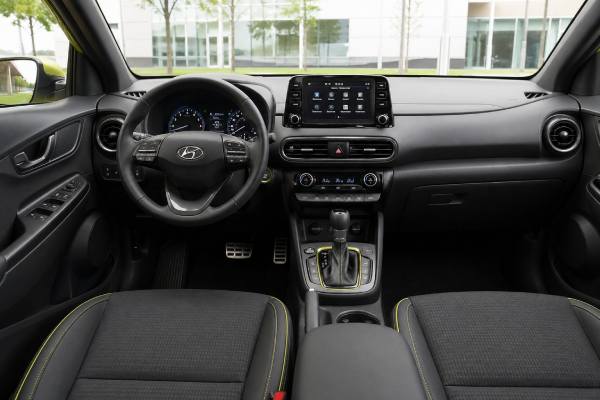
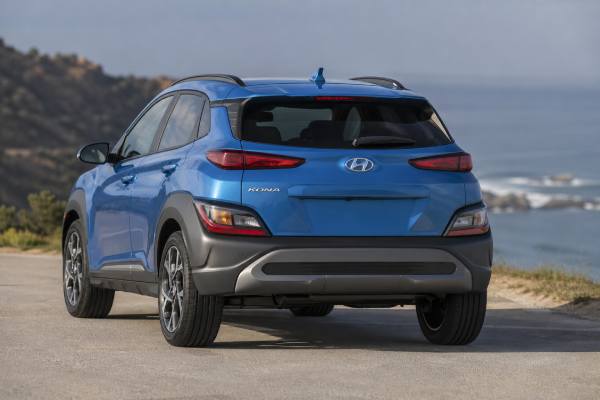
The facelifted Hyundai KONA OS with the 1.0 T-GDi 48V powertrain is the version that tried to make the small KONA feel more modern without turning it into a full hybrid or an expensive performance model. Hyundai paired its 120 hp three-cylinder turbo petrol engine with a 48-volt mild-hybrid system and a six-speed Intelligent Manual Transmission, creating a crossover that is still compact and easy to own, but a little cleverer in the way it saves fuel. The 48V setup cannot drive the car on electricity alone. Instead, it supports stop-start smoothness, engine-off coasting, and better efficiency in everyday driving.
That makes this facelift KONA appealing for buyers who want lower running costs than the stronger 1.6-litre turbo, but more character than a basic non-electrified small SUV. It is also one of the better-looking facelift updates in the class. The key to ownership is understanding that the mild-hybrid hardware is simple by hybrid standards, but the turbo engine still depends on disciplined servicing.
Quick Specs and Notes
- The 48V mild-hybrid system improves coasting and stop-start behavior without adding full-hybrid complexity.
- The facelift brought a cleaner front end, updated cabin tech, and a more polished ride than early OS cars.
- The 1.0 T-GDi has useful mid-range torque, so it feels stronger in daily driving than the power figure suggests.
- This remains a service-sensitive turbo petrol engine, so missed oil changes and cheap spark plugs are false economy.
- A sensible oil-and-filter interval for mixed use is every 10,000–15,000 km or 12 months, whichever comes first.
What’s inside
- Hyundai KONA facelift 48V profile
- Hyundai KONA 48V numbers and specs
- Hyundai KONA facelift trims and safety kit
- Frequent faults and factory fixes
- Care plan and used-buying tips
- Daily manners and efficiency
- Rivals worth cross-shopping
Hyundai KONA facelift 48V profile
The facelifted 2020–2023 KONA OS is best understood as a refinement of the original concept rather than a clean-sheet replacement. Hyundai did not reinvent the car. It sharpened the design, revised the cabin, tuned the ride more carefully, and broadened the powertrain story with mild-hybrid hardware. In 1.0 T-GDi 48V form, the result is one of the more balanced small crossovers of its period.
This model uses Hyundai’s Smartstream 1.0-litre turbocharged three-cylinder petrol engine with a 48-volt mild-hybrid system. The key parts are a belt-driven Mild Hybrid Starter Generator, a small lithium-polymer battery under the luggage area, and a DC/DC converter. The system does not add full-hybrid torque fill in the way a self-charging hybrid does, but it does help restart the engine more smoothly, support coasting, and reduce fuel use in the kinds of mixed driving most owners actually do.
The six-speed Intelligent Manual Transmission is also central to the car’s identity. It still uses a clutch pedal, so it is not an automatic, but the clutch actuation is electronically managed in ways that help the engine decouple during coasting. In daily use that means the car can feel slightly more refined and efficient than a conventional small turbo manual, especially in gentle motorway and suburban driving. Buyers who expect EV-like behavior will be disappointed. Buyers who want a familiar petrol crossover with a little more intelligence usually get the point quickly.
The facelift itself matters beyond the engine. The front end became slimmer and more modern, the rear design cleaner, and the interior gained a stronger digital feel. Better screens, broader availability of the 10.25-inch cluster and navigation display, and a tidier centre stack helped the KONA age well against newer rivals. Hyundai also revised the suspension and stabilizer tuning, which is why facelift cars tend to feel slightly calmer over broken roads than some early pre-facelift examples.
Ownership-wise, this version sits in a useful middle ground. It is simpler and cheaper to run than the stronger turbo models with DCT and AWD. It is also less complicated than the full hybrid and far less expensive to worry about than the electric version once warranty age starts to matter. The trade-off is that it remains a small direct-injection turbo engine. That means oil quality, plug condition, battery health, and cooling-system attention still shape long-term durability.
As a used buy, the 1.0 T-GDi 48V facelift makes most sense for drivers who want urban-friendly size, a modern cabin, and decent real-world efficiency without giving up a manual gearbox. It is not exciting in the way the big-engine KONA can be, but it is often the smarter long-term ownership choice.
Hyundai KONA 48V numbers and specs
The table below focuses on the facelifted OS-generation KONA with the 1.0 T-GDi 48V mild-hybrid system, front-wheel drive, and six-speed Intelligent Manual Transmission. Some values vary by trim, wheels, market, and homologation file, so exact part-ordering data should always be checked by VIN.
| Item | Specification |
|---|---|
| Code | Smartstream G1.0 T-GDi 48V MHEV |
| Engine layout and cylinders | Inline-3, DOHC, 12-valve, 4 valves per cylinder |
| Bore × stroke | 71.0 × 84.0 mm (2.80 × 3.31 in) |
| Displacement | 1.0 L (998 cc) |
| Motor and hybrid system | Belt-driven Mild Hybrid Starter Generator, single front-mounted 48 V system, lithium-polymer battery |
| System voltage | 48 V |
| Battery chemistry and capacity | Lithium-polymer, 0.44 kWh |
| Induction | Turbocharged |
| Fuel system | Direct injection |
| Compression ratio | 10.5:1 |
| Max power | 120 hp / 120 PS (88.3 kW) @ 6,000 rpm |
| Max torque | 172 Nm (126.9 lb-ft) @ 1,500–4,000 rpm |
| Timing drive | Chain-driven valvetrain; no routine public replacement interval |
| Rated efficiency | 5.5–6.1 L/100 km (42.8–38.6 mpg US / 51.4–46.3 mpg UK), WLTP range by trim and wheel size |
| Real-world highway at 120 km/h | Usually about 6.3–7.1 L/100 km (37.3–33.1 mpg US / 44.8–39.8 mpg UK) |
| Item | Specification |
|---|---|
| Transmission | 6-speed Intelligent Manual Transmission (6iMT) |
| Drive type | FWD |
| Differential | Open front differential with brake-based traction support |
| Suspension front / rear | MacPherson strut / coupled torsion beam axle |
| Steering | Rack-and-pinion with Motor Driven Power Steering |
| Brakes | Power-assisted split-circuit braking with EBD; disc sizing varies by market and wheel package |
| Most popular tyre size | 215/55 R17; other common sizes include 205/60 R16 and 235/45 R18 |
| Ground clearance | 170 mm (6.69 in), typically 165 mm (6.50 in) on N Line |
| Length / width / height | 4,205 / 1,800 / 1,500 mm (165.55 / 70.87 / 59.06 in) |
| Height with roof rails | 1,565 mm (61.61 in) |
| Wheelbase | 2,600 mm (102.36 in) |
| Turning circle | About 10.6 m (34.8 ft) |
| Kerb weight | About 1,265–1,387 kg (2,789–3,058 lb) |
| GVWR | About 1,795 kg (3,958 lb), market dependent |
| Fuel tank | 50 L (13.21 US gal / 11.00 UK gal) |
| Cargo volume | 374 / 1,156 L (13.21 / 40.82 ft³), VDA |
| 0–100 km/h | 11.9 s |
| Top speed | 180 km/h (112 mph) |
| Braking distance | Not published in Hyundai’s public tech sheets; usually mid-30 m range from 100 km/h depending on tyres |
| Towing capacity | 1,200 kg (2,646 lb) braked / 600 kg (1,323 lb) unbraked |
| Payload | About 408–530 kg (899–1,168 lb) |
| Item | Specification |
|---|---|
| Engine oil | ACEA C2, SAE 0W-30; about 3.6 L (3.8 US qt) |
| Coolant | Phosphate-based ethylene glycol coolant for aluminium radiator; about 5.5 L (5.8 US qt) |
| Transmission oil | Verify by VIN and service literature; public owner-facing 6iMT fill data is not consistently published by market |
| Differential / transfer case | Not applicable |
| A/C refrigerant | R-1234yf; charge varies by market build, verify by under-bonnet label |
| A/C compressor oil | Verify by VIN and A/C label when servicing |
| Key torque spec | Wheel nuts 107–127 Nm (79–94 lb-ft) |
| Crash ratings | Euro NCAP 5 stars; 87% adult, 85% child, 62% vulnerable road user, 60% safety assist |
| IIHS | Strong crashworthiness ratings apply across 2018–23 models; award status depends on equipment |
| ADAS suite | FCA, LFA, LKAS, eCall, rear seat alert, and more depending on trim; blind-spot and rear cross-traffic were trim-sensitive |
The main takeaway from the data is that the 48V KONA is not about headline speed. It is about using mild-hybrid assistance to make a familiar turbo petrol crossover feel more efficient and slightly more refined without changing the character of the car.
Hyundai KONA facelift trims and safety kit
For the facelift years, the 1.0 T-GDi 48V was typically positioned as the mainstream petrol mild-hybrid option in Europe and the UK. That means the trim spread is fairly broad, but the basic mechanical package stayed simple: front-wheel drive, 6iMT, torsion-beam rear axle, and the 48V system. The big differences are equipment, wheel size, infotainment, and safety technology.
Using the UK facelift range as a clear baseline, the 1.0 T-GDi 48V appeared in trims such as SE Connect, N Line, Premium, and, depending on market mix, better-equipped variants above that. The useful part for buyers is how these trims separate in real life.
| Trim level | Main equipment clues | Practical ownership effect |
|---|---|---|
| SE Connect | 17-inch alloys, 8-inch display audio, rear camera, digital supervision cluster, manual air conditioning | Usually the value choice, with lower tyre costs and a calmer ride |
| N Line | Sportier bumpers, 18-inch wheels, red cabin details, larger centre screen, upgraded audio and styling | Better-looking and better equipped, but firmer and usually costlier on tyres |
| Premium | 18-inch wheels, heated front seats, electric parking brake, front parking sensors, added convenience kit | Often the sweet spot for comfort and resale appeal |
| Ultimate or top trim | LED headlights, more seat adjustment, sunroof on some markets, broader driver-assist package | Best safety and convenience spec, but more sensors and more trim-specific parts |
The facelift also sharpened Hyundai’s safety story. Across the range, Hyundai added or expanded features such as Leading Vehicle Departure Alert, Lane Following Assist, eCall, Rear Seat Alert, and Forward Collision-Avoidance Assist with pedestrian detection. That is important because many small SUVs from the same period still treated some of these systems as higher-cost options.
Still, buyers should not assume every 1.0 T-GDi 48V has the full suite. Equipment depends heavily on trim and market. Better cars may include:
- Forward collision avoidance
- Lane keeping and lane following support
- Intelligent speed limit warning
- Blind-spot collision warning
- Rear cross-traffic collision warning
- Safe Exit Warning
- Front and rear parking sensors
- LED headlamps and upgraded rear lighting
On safety ratings, context matters. The KONA’s Euro NCAP five-star result belongs to the same first-generation platform, so it remains relevant, but it was not a completely new post-facelift retest under a fresh redesign. In the US, IIHS ratings are also strong and apply across 2018–23 models, but top award status depended on equipment, especially collision-prevention hardware and lighting specification. That means the basic shell and crash structure are reassuring, while the exact active-safety score depends on what the individual car actually has.
For used buyers, the simple rule is to separate trim appeal from service risk. An N Line or Ultimate is easier to like on a test drive, but a well-kept SE Connect or Premium can be the better ownership choice because smaller wheels, fewer sensors, and less cosmetic complexity often age better. The best buy is usually the car with the clearest history, not the fanciest brochure.
Frequent faults and factory fixes
The facelift 1.0 T-GDi 48V KONA is generally dependable when maintained properly, but it is not an engine-and-electrics combination that enjoys neglect. The 48V system itself is fairly modest in complexity compared with a full hybrid, which helps. Most long-term trouble still comes from familiar small-turbo petrol issues rather than from the mild-hybrid battery alone.
Common and usually low to medium cost
- Weak 12 V battery causing rough stop-start behavior, warning messages, or disabled coasting
- Spark plug or ignition-coil related hesitation under load
- Front brake corrosion and rear disc lip build-up on lightly used cars
- Tyre shoulder wear on 18-inch cars if alignment is even slightly off
- Cabin rattles, infotainment glitches, or camera issues after battery voltage drops
Occasional and more costly
- Boost leaks from charge pipes or clamps
- Coolant seepage from hose joints or plastic fittings
- Carbon build-up effects typical of direct-injection petrol engines
- 48 V system fault messages linked to battery state, starter-generator control, or software adaptation
- Clutch feel issues or abnormal pedal response if the 6iMT system has calibration or actuator-related trouble
Less common, but expensive if ignored
- Timing-chain noise after poor oil service history
- Turbo wear accelerated by dirty oil or repeated hot shutdowns after hard use
- Catalyst damage after long periods of misfire
- Persistent warning-light faults involving the DC/DC converter or mild-hybrid control chain
The ownership pattern is predictable. Cars used for short trips, repeated cold starts, and delayed oil changes age faster than those that live on mixed or longer routes. The 48V system helps efficiency, but it does not eliminate the old turbo-petrol rule that oil quality matters. On this engine, stretching service intervals to the limit and then adding hard use is exactly how small drivability faults become expensive ones.
Software also matters more than many buyers expect. Hyundai used the facelift to add more electronic driver assistance and the iMT logic is more electronically managed than a traditional manual. That means some complaints are not mechanical failures at all, but software or calibration issues that need proper dealer-level diagnosis. When a car shows erratic stop-start, inconsistent coasting, or a mild-hybrid warning without obvious mechanical symptoms, a scan and software history check should come before any parts are ordered.
Public campaign visibility is market-specific, so the smartest recall advice is still the simplest: run the VIN through Hyundai’s official recall checker and ask the seller for retailer paperwork showing campaign completion. That is more reliable than forum summaries. It is also wise to ask whether any infotainment, ADAS, or control-module updates were carried out during routine servicing.
A used example that starts cleanly, pulls smoothly from 1,500 rpm, holds a steady idle, and shows no battery or charging warnings is usually a good sign. A car with intermittent warning lamps, rough restarts, or a vague service history deserves much closer scrutiny.
Care plan and used-buying tips
For long-term ownership, the facelift 1.0 T-GDi 48V KONA benefits from conservative maintenance rather than theoretical maintenance. The mild-hybrid system does not change that. It simply adds a few more electrical checks to what is still, at heart, a small turbo petrol crossover.
| Item | Practical interval | Why it matters |
|---|---|---|
| Engine oil and filter | 10,000–15,000 km or 12 months; 5,000–7,500 km or 6 months in severe use | Best protection for turbo, chain, and internal cleanliness |
| Engine air filter | Inspect every service; replace as needed | Dirty filters hurt response and economy |
| Cabin air filter | Every 24 months or sooner | Helps climate efficiency and cabin air quality |
| Spark plugs | About 75,000 km | Critical on a direct-injection turbo engine |
| Coolant | Long-life factory fill, but inspect regularly and replace by official schedule for your market | Avoids small leak issues becoming overheating issues |
| Brake fluid | Every 24–48 months depending on use and climate | Preserves pedal feel and hydraulic component life |
| 6iMT transmission oil | Inspect for leaks; replace by condition or when clutch and gearbox work is carried out | Useful for long-term shift quality even if not heavily promoted in owner literature |
| Drive belt and auxiliaries | Inspect from about 90,000 km onward | Important because the MHSG is belt-linked |
| Timing chain | No fixed public replacement interval; inspect when noisy or out of correlation | Oil quality is the main life factor |
| Brake pads and discs | Inspect every service | City cars can rust brakes before they wear them out |
| Tyre rotation and alignment | Every 10,000–15,000 km | Important for steering feel and tyre costs |
| 12 V battery test | Annually from year 4 onward | Many “hybrid” complaints actually start here |
| 48 V battery and charging check | Check during fault diagnosis or annual inspection once the car ages | Useful for cars with stop-start or coasting complaints |
For buyers, the inspection checklist should focus on the areas that tell the truth quickly:
- Cold start behavior and idle quality
- Evidence of frequent short-trip use
- Clutch take-up and pedal feel
- Smooth turbo response in second and third gear
- 12 V and 48 V warning history
- Cooling-system smell, seepage, or past top-up evidence
- Uneven tyre wear and brake corrosion
- Screen, camera, and ADAS operation
- Service invoices that specify oil grade, not just “service done”
The most attractive trims to own long term are often SE Connect or Premium on 17-inch wheels. They usually strike the best balance of equipment, ride quality, tyre cost, and simplicity. N Line versions are more visually appealing, but the 18-inch wheel package can make them firmer and slightly pricier to keep tidy.
Years to seek are usually the middle and later facelift cars with a complete history and no unexplained warning-light record. Years to avoid are not really about production date so much as maintenance pattern. A 2023 car with weak paperwork can be a worse buy than a 2021 car that has clearly been cared for.
The durability outlook is good if the car has been maintained like a turbo petrol, not like an appliance. That distinction matters.
Daily manners and efficiency
On the road, the facelift 1.0 T-GDi 48V KONA feels more polished than dramatic. It is not quick in the 1.6 T-GDi sense, but it is also not slow in normal driving because the engine’s useful torque arrives early. Around town, that means fewer downshifts than many naturally aspirated small SUVs need. On a steady A-road or dual carriageway, it feels entirely adequate for solo or two-person use.
The mild-hybrid setup mostly works in the background. Owners notice it through smoother stop-start operation and the way the engine can decouple more neatly when lifting off. The system does not transform the KONA into a hybrid-driving experience, but it does make the car feel a little more sophisticated than a basic 1.0 turbo manual. That is especially true in gentle mixed driving, where the iMT and 48V hardware can quietly trim fuel use without asking the driver to change their habits much.
Ride quality is one of the facelift’s better improvements. Hyundai retuned the suspension and stabilizer bars, and facelift cars usually feel a touch calmer over poor surfaces than earlier OS cars. On 17-inch wheels the balance is very good for the class. On 18-inch wheels, especially N Line versions, the car looks sharper but loses some isolation over broken asphalt and expansion joints.
Steering is light rather than rich in feedback, but it is accurate enough and suits the car’s size well. The KONA remains easy to place in town and secure at motorway speeds. Straight-line stability is respectable, and the upright driving position helps the car feel more mature than some small hatchback-based rivals. Brake feel is normal and predictable, though lightly used cars can develop the familiar Hyundai-Kia tendency toward rusty discs before they develop actual wear.
Real-world fuel consumption is where this version earns its place in the lineup. In city traffic, most owners should expect roughly 6.5–7.8 L/100 km depending on weather, route length, and how often the stop-start system actually gets to work. At a true 120 km/h cruise, about 6.3–7.1 L/100 km is realistic. Mixed use often lands around 5.9–6.8 L/100 km. That translates to roughly 39.9–34.6 mpg US or about 47.9–41.5 mpg UK in mixed conditions.
Cold weather matters. Short winter journeys can add around 0.5 to 1.0 L/100 km compared with mild-weather mixed driving. Roof loads, underinflated tyres, and overdue air filters show up quickly on a 1.0-litre turbo crossover, so this is a car where basic maintenance has a visible effect on fuel use.
In everyday terms, the facelift 48V KONA drives like a tidy, efficient small crossover with enough torque to avoid feeling strained. It is most convincing when used as a smart daily driver, not when asked to pretend it is a warm SUV.
Rivals worth cross-shopping
The facelift KONA 1.0 T-GDi 48V sits in one of the busiest parts of the market, so context matters. Its real rivals are not only other small SUVs, but specifically the better-equipped mild-hybrid or turbo-petrol versions of those SUVs. The most relevant comparisons include the Ford Puma 1.0 EcoBoost Hybrid, Renault Captur TCe 140, SEAT Arona 1.0 TSI, Volkswagen T-Cross 1.0 TSI, Kia Stonic 1.0 T-GDi, and Hyundai’s own BAYON.
| Rival | Where the KONA is stronger | Where the rival may suit better |
|---|---|---|
| Ford Puma 1.0 EcoBoost Hybrid | More SUV-like seating position, calmer styling, often simpler ownership image | Sharper steering, stronger boot innovation, more eager chassis |
| Renault Captur TCe 140 | Stronger perceived build quality and clearer safety identity | Better rear packaging and a softer, more family-oriented feel |
| SEAT Arona 1.0 TSI | More distinctive cabin and crossover stance | Lighter feel, neat road manners, simple petrol efficiency without mild-hybrid messaging |
| Volkswagen T-Cross 1.0 TSI | Often better standard safety value and more characterful design | Smarter rear-seat flexibility and a more mature packaging solution |
| Kia Stonic 1.0 T-GDi | More substantial cabin and facelift tech presentation | Often lower purchase price and slightly simpler trim logic |
| Hyundai BAYON 1.0 T-GDi 48V | Stronger road presence and a more premium feel inside | Newer packaging, often slightly better efficiency, easier value proposition |
What keeps the KONA competitive is its balance. It is not the roomiest and not the sportiest. But it has an unusually broad appeal because it combines compact dimensions, a modern interior, strong safety credibility, and a powertrain that is more interesting than a plain small-capacity petrol without becoming awkward to live with.
Its main weakness against newer rivals is packaging. Cars like the Captur and T-Cross can feel more useful in the second row and luggage area. Against the Puma, the KONA is less playful. Against the BAYON, it can look a little heavier and cost more for similar real-world pace. Yet the KONA still feels like the more substantial product than some of those rivals, and that matters to many buyers.
For used buyers, the verdict is simple. If you want maximum boot cleverness, there are better choices. If you want the sharpest steering, there are better choices. But if you want one of the more complete all-round small crossovers from the early 2020s, the facelift KONA 1.0 T-GDi 48V remains easy to recommend when it has the right history.
References
- 202009_Technical Data_new Kona and all-new Kona N Line 2020 (Technical Data)
- Pricing and specifications for Kona Hybrid and the new N Line 2020 (Press Information)
- Hyundai’s KONA family offers ideal model for every customer 2021 (Powertrain and WLTP Data)
- Euro NCAP | Hyundai KONA 2017 (Safety Rating)
- 2023 Hyundai Kona 2023 (Safety Rating)
Disclaimer
This article is for informational purposes only and is not a substitute for professional diagnosis, repair, or model-specific workshop guidance. Specifications, torque values, service intervals, fluid requirements, procedures, equipment, and safety features can vary by VIN, market, production date, and trim, so always verify critical details against the official service documentation for the exact vehicle.
If this guide was useful, please consider sharing it on Facebook, X, or another social platform. That support helps us keep publishing detailed vehicle guides.