
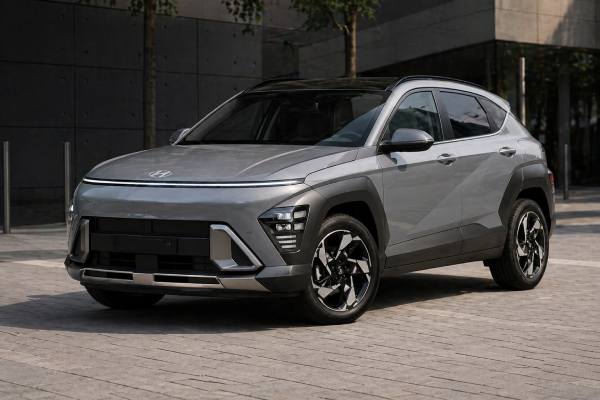
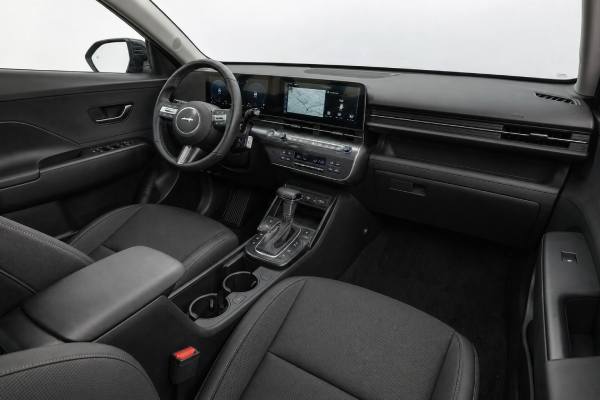
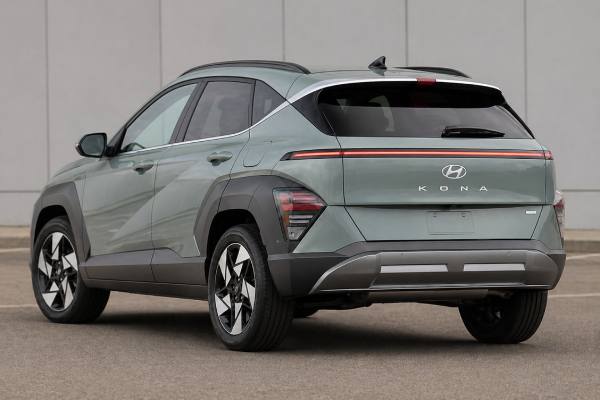
The 2023–2025 Hyundai KONA Hybrid (SX2) is the version of the new-shape KONA that makes the strongest everyday case. It combines a naturally aspirated 1.6-litre petrol engine, an electric motor, regenerative braking, and a six-speed dual-clutch transmission in a package that is compact outside but much roomier than the older KONA inside. The result is a small SUV that feels modern, efficient, and easy to recommend for mixed urban and suburban use. It is also a useful step away from the usual small-turbo crossover formula. The hybrid powertrain brings better low-speed response, lower fuel use, and calmer stop-start behaviour than many comparable petrol-only rivals. The compromise is not hard to understand. This is not a fast SUV, and it is still a fairly complex hybrid with high-voltage components, battery cooling, and a DCT that deserves sensible driving and timely servicing. For most owners, though, this is the smartest all-round SX2 KONA.
What to Know
- Excellent urban and mixed-route economy is this model’s biggest advantage.
- The hybrid system feels smoother in daily traffic than many small turbo petrol rivals.
- The SX2 body is noticeably roomier and more mature than the older KONA.
- Keep the hybrid battery cooling duct clear and pay attention to DCT behaviour in repeated hill starts or heavy stop-start use.
- A sensible engine oil and filter interval is every 10,000 km or 12 months, sooner in hard use.
Contents and shortcuts
- Hyundai KONA Hybrid SX2 key traits
- Hyundai KONA Hybrid SX2 technical picture
- Hyundai KONA Hybrid SX2 trims and safety systems
- Hybrid trouble spots and campaign advice
- Service planning and used-buy checks
- Real-world behaviour and economy
- How the SX2 hybrid stacks up
Hyundai KONA Hybrid SX2 key traits
The SX2-generation KONA Hybrid takes a very different approach from the sportier petrol KONA variants. It is not trying to impress with a turbo punch or aggressive launch feel. Instead, Hyundai tuned it around efficiency, refinement in ordinary traffic, and the kind of daily usability that matters more after six months of ownership than it does on a test drive. That is exactly why it is arguably the most rational KONA in the current range.
The foundation is a full hybrid system built around a 1.6 GDi petrol engine and a front-mounted permanent-magnet electric motor. In practice, that means the car can pull away gently on electric power, use the petrol engine more intelligently than a normal stop-start car, and recover energy under braking or coasting. Hyundai also gives the SX2 Hybrid more than a simple economy pitch. It gets model-specific hybrid displays, regenerative braking control through the paddles, and a more sophisticated energy-flow strategy than many buyers realise. It feels engineered rather than merely electrified.
One reason this KONA works so well is the platform itself. The SX2 body is longer, wider, and better packaged than the old OS-generation KONA. Rear-seat space is meaningfully improved, the cabin design feels cleaner and more upscale, and the luggage area is far more usable for real family duties. That matters because the hybrid version is the one most likely to be bought as a long-term household car rather than a short-term lease toy.
There are a few market quirks worth knowing. Public Hyundai documents do not always agree perfectly on every technical number. Some markets publish the hybrid battery at 1.32 kWh, while others show 1.56 kWh. Some retail pages round the combined output slightly differently. That does not mean Hyundai built completely different cars. It means public market sheets sometimes mix usable and gross battery figures, or use different homologation and marketing conventions. The core engineering remains the same: a compact full hybrid with about 141 hp combined, a 6-speed DCT, front-wheel drive, and a clear focus on fuel efficiency.
This version also suits a particular owner profile. It is ideal for drivers who do a lot of city, suburban, or mixed commuting and want a small SUV that does not feel clumsy or thirsty. It is less ideal for someone who expects hot-hatch responses, spends every day at motorway pace with a full load, or wants the absolute simplest long-term mechanical package. The SX2 Hybrid is still a modern electrified car, not an old-school basic petrol crossover. But within that category, it is one of the more convincing examples.
Hyundai KONA Hybrid SX2 technical picture
For this model, public Hyundai spec sheets from different regions broadly agree on the core layout but differ slightly in a few details. The tables below focus on the common engineering picture and flag the places where public market documents vary.
| Item | Hyundai KONA Hybrid (SX2) 1.6 GDi HEV |
|---|---|
| Code | Smartstream 1.6 GDi Hybrid, G4LIII family in public Hyundai spec sheets |
| Engine layout and cylinders | Inline-4, DOHC, 16 valves, D-CVVT, Atkinson-cycle calibration, 72.0 × 97.0 mm (2.83 × 3.82 in) |
| Displacement | 1.6 L (1,580 cc) |
| Motor | Permanent-magnet synchronous motor, single front-mounted drive motor |
| Battery | Lithium-ion polymer, 240 V, with public Hyundai documents listing 1.32 to 1.56 kWh depending on market sheet |
| Induction | Naturally aspirated |
| Fuel system | GDi direct injection |
| Compression ratio | 14.0:1 |
| Petrol engine max power | 105 hp (77 kW) @ 5,700 rpm |
| Electric motor max power | 32 kW (43.5 hp) |
| System output | 141 hp (104 kW) combined |
| System torque | 265 Nm (195 lb-ft) |
| Timing drive | Chain |
| Rated efficiency | 3.9 L/100 km on the Australian ADR combined cycle; WLTP figures vary by trim, wheel size, and market |
| Real-world highway @ 120 km/h | Usually about 5.4–6.2 L/100 km (43.6–37.9 mpg US / 52.3–45.6 mpg UK) |
| Item | Hyundai KONA Hybrid (SX2) 1.6 GDi HEV |
|---|---|
| Transmission | 6-speed dual-clutch transmission, D6KF1-2 in public spec sheets |
| Drive type | FWD |
| Differential | Open |
| Suspension (front / rear) | MacPherson strut / multi-link |
| Steering | Column-mounted motor-driven power steering, rack and pinion, 2.5 turns lock-to-lock |
| Brakes | Ventilated front discs 305 × 25 mm (12.0 × 1.0 in), solid rear discs 284 × 10 mm (11.2 × 0.4 in), integrated electric brake booster on hybrid spec |
| Wheels and tyres | Common sizes are 205/65 R16 and 215/55 R18, market and trim dependent |
| Ground clearance | About 160 mm (6.3 in) on 16-inch wheels and 170 mm (6.7 in) on 18-inch wheels in public European sheets |
| Length / Width / Height | 4,350 / 1,825 / about 1,570–1,585 mm (171.3 / 71.9 / 61.8–62.4 in), with N Line styling slightly longer |
| Wheelbase | 2,660 mm (104.7 in) |
| Turning circle (kerb-to-kerb) | 10.6 m (34.8 ft) |
| Kerb weight | About 1,410–1,525 kg (3,109–3,362 lb), market and trim dependent |
| GVWR | About 1,950 kg (4,299 lb) |
| Fuel tank | 38 L (10.0 US gal / 8.4 UK gal) |
| Cargo volume | Public Hyundai documents vary from 407 to 466 L seats up and 1,241 to 1,300 L seats down, depending on market sheet, wheel size, and load-floor specification |
| Item | Hyundai KONA Hybrid (SX2) 1.6 GDi HEV |
|---|---|
| Acceleration | 0–100 km/h in about 10.9–11.2 s, depending mainly on wheel size and market spec |
| Top speed | About 155–165 km/h (96–103 mph), depending on wheel size and drive mode |
| Braking distance | No single open official stop-distance figure published across markets |
| Towing capacity | 1,300 / 600 kg (2,866 / 1,323 lb) braked / unbraked in open Hyundai sheets |
| Payload | Roughly 425–540 kg (937–1,190 lb), depending on trim and regional definition |
| Engine oil | Use the exact Hyundai-approved SAE grade and market specification listed in the owner’s manual for the VIN; public open hybrid pages do not cleanly publish one universal fill figure |
| Coolant | Use Hyundai-approved coolant only and follow the VIN-specific interval; hybrid systems also require attention to inverter-coolant warnings where fitted |
| Transmission fluid | Use the correct 6DCT fluid only; verify service quantity by VIN and workshop data |
| A/C refrigerant | Check the under-bonnet label before service |
| Key torque specs | Wheel nuts: 107–127 Nm (79–94 lb-ft) |
| Crash ratings | Euro NCAP 2023: 4 stars, with 80% adult, 83% child, 64% vulnerable road users, and 60% safety assist; published tested model was an electric LHD KONA |
| ADAS suite | AEB, lane keeping, lane following, intelligent speed limit assist, driver attention monitoring, adaptive cruise on higher trims, rear cross-traffic and blind-spot functions on better-equipped versions |
The technical picture is clear. This is a front-drive hybrid with a fairly sophisticated chassis, a conventional-feeling 6DCT rather than an e-CVT, and the kind of low fuel use that makes a strong case for itself in city and mixed driving.
Hyundai KONA Hybrid SX2 trims and safety systems
The SX2 KONA Hybrid is one of those cars where trim choice changes the ownership experience more than the raw powertrain does. The base hybrid is already fundamentally competent, but better trims add the features that make the car feel more modern and much easier to live with. The exact trim names vary by market, but the general pattern is consistent: entry and mid-grade cars focus on value and comfort, while upper trims and N Line versions add more appearance detail, more safety hardware, and more of the digital features buyers expect in a current-generation small SUV.
Mechanically, the hybrid powertrain itself does not change much across the standard lineup. The main differences tend to be wheel size, interior trim, lighting, and the amount of SmartSense equipment included as standard. Sixteen-inch cars are usually the efficiency champions and often the best choice for ride comfort. Eighteen-inch cars look better and feel a little sharper on turn-in, but they usually cost more on tyres and can lose a little of the hybrid’s fuel-economy edge. That matters more on this KONA than many buyers expect, because the car’s straight-line performance and efficiency both respond visibly to wheel and tyre spec.
N Line versions deserve a separate note. On the hybrid, N Line is usually a styling and equipment treatment rather than a major mechanical transformation. Expect different bumpers, exterior details, wheel designs, interior trim, and often better headlamps and seats. It looks more purposeful, but it does not turn the hybrid into a hot model. Buyers choosing N Line should do it for the appearance and equipment, not because they expect a radically different drivetrain.
Safety is strong, though not flawless. The SX2 KONA scored 4 stars in Euro NCAP’s 2023 assessment, which is more nuanced than it first sounds. The category scores were respectable for adult and child occupant protection, and the car’s active-safety package is broad. But Euro NCAP marked it down in a few crash-test details and some assisted-driving scenarios, which kept it from a 5-star result. That does not make the KONA a poor safety choice. It means it is a good modern small SUV that falls slightly short of the very best current benchmarks.
In everyday ownership terms, the available safety systems are more important than the star count alone. Hyundai equips the SX2 KONA Hybrid with a wide menu of active features, including forward collision-avoidance assist, lane keeping assist, lane following assist, intelligent speed limit assist, driver attention warning, and, on better-equipped cars, blind-spot monitoring, rear cross-traffic collision-avoidance assist, safe exit warning, highway driving assist, and adaptive cruise. Some markets also add blind-spot camera view and richer parking assistance on upper trims.
For family buyers, there are a few useful practical points. Seven airbags appear on some European specs, including a front-centre airbag. ISOFIX points are present on the outboard rear seats. The rear seat is much better packaged than the older KONA’s, and the wider-opening doors help with child-seat loading. The caution is that, as with any modern ADAS-heavy car, camera and sensor recalibration after windscreen or bumper repair matters more than ever.
Hybrid trouble spots and campaign advice
The SX2 KONA Hybrid is still too new to have built a long, ugly list of age-related failures, which is good news for buyers. But that does not mean it should be treated as maintenance-free. The powertrain is sophisticated, and modern hybrids tend to reward good habits while punishing neglect in quieter, more expensive ways than older cars did.
The first area to watch is not the battery itself but the systems around it. Hyundai’s owner-manual material makes it clear that the hybrid battery cooling duct sits under the rear-seat area and should be kept clean and unobstructed. That sounds trivial until you remember how many modern SUVs spend their lives carrying dog blankets, shopping bags, child-seat debris, and spilled drinks. A blocked or contaminated cooling path is exactly the sort of small issue that becomes an expensive one later. For this KONA, keeping the rear-seat battery cooling intake clean is a real maintenance task, not a theoretical note.
The second area is the transmission. Hyundai uses a 6DCT in the SX2 Hybrid rather than a conventional torque-converter automatic or an e-CVT. That gives the car a more connected feel than some hybrid rivals, but it also means owners should pay attention to heat, clutch behaviour, and low-speed manners. Hyundai’s own warning logic mentions steep grades, repeated stop-and-go launches, and transmission-overheat messages. In normal use, that is rarely a problem. In abusive use, especially with repeated hill starts or heavy creeping on inclines, it can become one.
Typical early-life warning signs to watch for include:
- Repeated hesitation or jerkiness when warm.
- Harsh clutch take-up on steep inclines.
- Persistent transmission overheat messages.
- Unusual hybrid warnings, especially repeated “Check Hybrid system” messages.
- Brake feel that changes abruptly after long periods of very light braking.
That last point matters because hybrids often use friction brakes less aggressively than non-hybrids. The KONA even includes a brake-disc cleaning function in some markets because Hyundai knows that regenerative braking can let the discs rust or glaze if the car is driven gently for long periods. This is not a design flaw. It is a hybrid ownership reality. Lightly used examples can develop noisy, rusty, or underworked brake hardware faster than buyers expect.
As for the high-voltage side, there is not yet a single universal public campaign that defines all 2023–2025 KONA Hybrids across all markets. That makes VIN-based checking essential. The right process is simple: run the VIN through the official Hyundai recall and service-campaign portal for the relevant country, then ask the dealer or seller for completion proof. General internet recall lists are much less useful than that.
The broader reliability outlook is positive. Hyundai’s hybrid system design is mature, and the 1.6 hybrid hardware is not radically experimental. But “positive” is not the same as “ignore it.” This is a car that wants software updates, clean cooling paths, healthy brakes, correct fluids, and a driver who does not abuse the DCT.
Service planning and used-buy checks
A good maintenance plan for the SX2 KONA Hybrid has to treat the car as both a petrol vehicle and an electrified one. That means the routine items still matter, but so do the hybrid-specific ones that owners of older non-hybrid SUVs never had to think about. The smart approach is simple: keep the consumables fresh, keep the battery cooling path clear, and do not assume “hybrid” means lower-maintenance in every system.
| Item | Practical interval | Owner note |
|---|---|---|
| Engine oil and filter | Every 10,000 km or 12 months; sooner in severe use | Hybrid use still involves repeated engine start-stop cycles and fuel dilution risk |
| Engine air filter | Inspect every service, replace around 30,000–45,000 km | Shorten in dusty use |
| Cabin air filter | About every 30,000 km or 24 months | Useful for HVAC performance and demisting |
| Spark plugs | About 70,000–90,000 km is a sensible planning range | Do not wait for misfire or rough restarts |
| Brake fluid | Every 2 years | Regenerative braking does not eliminate brake-fluid ageing |
| Coolant | Use the official VIN-market schedule; recent Hyundai schedules use long first-change intervals | Do not mix coolant types or improvise |
| 6DCT fluid | No reason to ignore it long term; inspect history and consider proactive service around 60,000–90,000 km if use is hard | Especially relevant for steep terrain and urban creep |
| Brake pads and discs | Inspect every service | Hybrids can hide rusty or underused discs |
| Tyre rotation and alignment | Every 10,000 km or 12 months | Important for straight-line stability and economy |
| HSG belt and auxiliary drive items | Inspect at scheduled service visits | Wear here can affect charging and cooling behaviour |
| 12 V battery | Test annually from year four onward | A weak 12 V battery can create misleading hybrid warnings |
| Hybrid battery cooling duct | Check and clean regularly | Keep it dry, open, and free of lint or luggage blockage |
For buyers, the inspection checklist is slightly different from a normal small SUV. You still want full history, clean body alignment, even tyre wear, and no warning lights. But you should also check whether the battery cooling intake area is dirty, whether the brake discs are heavily corroded, whether the car throws any hybrid messages after a long test drive, and whether the DCT behaves cleanly on a steep hill and in repeated slow manoeuvres.
Good used examples usually share the same traits:
- Complete main-dealer or specialist service history.
- No hybrid or transmission warnings.
- Four matching tyres in good condition.
- Quiet, clean low-speed take-up.
- Healthy brakes despite a gentle-use life.
- No signs of water ingress, rear-seat spills, or blocked battery cooling.
The best versions to buy are usually the ones with the equipment you actually want rather than the visually busiest trim. A 16-inch mid-grade hybrid can be the smartest ownership choice. An upper trim with good history is also excellent. The cars to avoid are neglected ex-urban-delivery examples, cars with repeated warning resets, and anything that feels rough or confused in low-speed DCT operation. Long-term durability should be strong, but it will depend more on attention to detail than on headline engineering slogans.
Real-world behaviour and economy
On the road, the SX2 KONA Hybrid feels more polished than its modest output suggests. The hybrid system covers up the usual weak point of a naturally aspirated small SUV, which is low-speed response. From a stop, the electric motor adds smoothness and immediacy. At everyday urban speeds, that makes the car feel lighter and more willing than the raw 141 hp figure implies.
The other pleasant surprise is that Hyundai did not make the car feel numb. The 6-speed dual-clutch transmission gives the SX2 Hybrid a more conventional and more connected feel than many e-CVT hybrid rivals. At steady speeds it behaves naturally, and on a country road the power delivery feels more linear than you might expect from a full hybrid. It is still an economy-focused SUV, not a warm crossover, but it does not feel anesthetised.
Ride and handling are well judged. The multi-link rear suspension helps the car feel more settled over mid-corner bumps than many class rivals that use simpler rear axle layouts. Steering is light, but accurate enough. Straight-line stability is good, and the car feels mature at motorway speed for its size. Noise levels are also respectable. The hybrid is quiet around town, and the engine is much less intrusive than in older small hybrids, though it will still make itself heard under sustained uphill throttle.
Wheel choice matters. Sixteen-inch cars are the better comfort and efficiency choice. Eighteen-inch cars look stronger and can feel a touch more precise, but they usually give away a bit of ride softness and economy. That trade-off shows up clearly in official performance and top-speed figures, which vary by wheel size.
Real-world efficiency is where this KONA makes its strongest argument. In city and suburban driving, around 4.3–5.1 L/100 km is realistic for a careful driver. Mixed use usually lands around 4.7–5.6 L/100 km. A steady 100–120 km/h motorway run will usually move the number into roughly the mid-5s or low-6s. Cold weather, roof loads, faster cruising, and aggressive use of Sport mode can push that higher, but the car still remains frugal for a roomy small SUV.
As for performance, about 11 seconds to 100 km/h is enough rather than exciting. Overtaking is competent, but it rewards planning more than impulse. The hybrid system’s torque fill helps most when pulling away or climbing gently, not when trying to deliver a big top-end surge. That means the SX2 Hybrid feels best when driven smoothly and intelligently, which fits its whole character.
The real verdict is simple. It is not fast, but it is pleasant. It is not sporty, but it is more polished than many economy crossovers. For the target buyer, that is the right result.
How the SX2 hybrid stacks up
The SX2 KONA Hybrid sits in one of the busiest parts of the market, so the question is not whether it is good. The question is whether it is better than the obvious rivals. Its closest competitors are cars like the Toyota C-HR Hybrid, Toyota Corolla Cross Hybrid, Renault Captur E-Tech, Kia Niro Hybrid, and Honda HR-V e:HEV. Each of those has a valid argument, but the Hyundai answers back in a few important ways.
Its biggest advantage is balance. The KONA Hybrid combines a roomy and modern cabin, low real-world fuel use, broad safety equipment, and clean small-SUV dimensions in a way that very few rivals manage without a major compromise somewhere else. Some competitors are more obviously focused on economy, some are more conservative, and some are more flamboyant. The KONA is the one that feels broadly right.
Against Toyota’s hybrids, the Hyundai’s six-speed DCT gives it a more conventional driving feel, which many drivers will prefer. Against the Kia Niro Hybrid, the KONA tends to feel more compact and easier to place in town, though the Niro can make a stronger case for outright interior practicality. Against the Captur E-Tech, the Hyundai generally feels more resolved in cabin quality and everyday ergonomics. Against the Honda HR-V e:HEV, the KONA often matches or beats it on infotainment and trim breadth, though the Honda has its own strengths in seating flexibility and refinement.
The KONA’s weaknesses are just as clear. It is not the fastest hybrid in the class, and it is not the most mechanically simple because Hyundai chose a DCT rather than a more familiar hybrid CVT-style setup. Buyers who want the absolute most conservative hybrid ownership model may still lean Toyota. Buyers who want maximum rear-seat space or a taller cargo bay may prefer a Niro or Corolla Cross.
Even so, the SX2 KONA Hybrid remains one of the strongest all-rounders. It offers meaningful fuel savings without needing a charging cable, enough cabin and luggage space to work as a real family car, and a design that still looks current. It also avoids feeling dull, which is not something every hybrid crossover can claim.
That is why this version deserves attention. The Hyundai KONA Hybrid (SX2) is not the most dramatic choice, but it is one of the most intelligently complete ones. For many buyers, that is the strongest advantage of all.
References
- Hyundai KONA. 2023 (Specifications)
- Hyundai KONA Hybrid | Performance | Hyundai Motor UK 2026 (Performance)
- Hyundai KONA 2023 (Safety Rating)
- KONA Hybrid 2025 – Car & User Manual 2025 (Owner’s Manual)
- KONA Hybrid 2023 (Technical Sheet)
Disclaimer
This article is for informational purposes only and is not a substitute for professional diagnosis, repair, or workshop inspection. Specifications, torque values, service intervals, capacities, procedures, and equipment can vary by VIN, market, trim, wheel size, and production date, so always verify the exact vehicle against official Hyundai service documentation before making maintenance or repair decisions.
If this guide helped you, please consider sharing it on Facebook, X, or another social platform to support our work.