

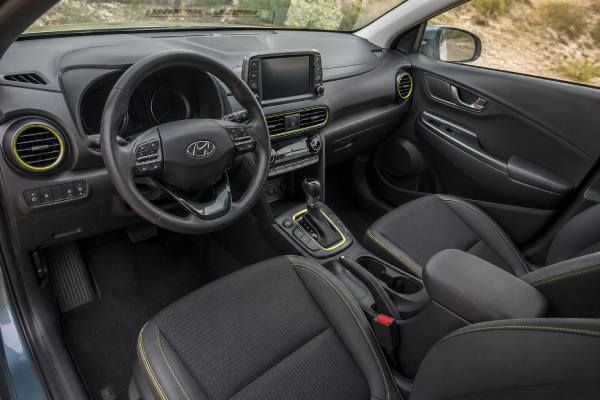
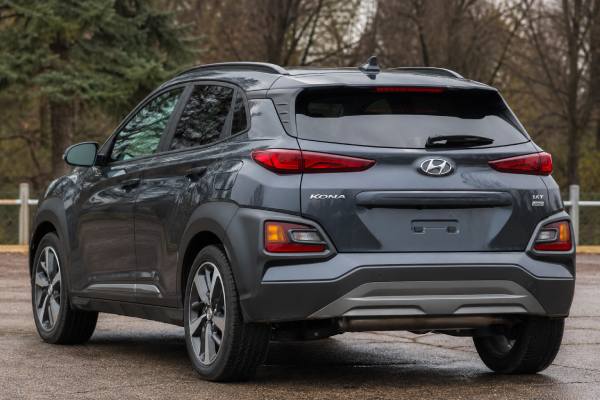
The 2018–2020 Hyundai KONA OS with the 1.6 T-GDi engine is the fast, high-spec side of the early KONA lineup. In period European-style trim, this version paired the 1.6-litre turbo petrol engine with a seven-speed dual-clutch transmission and on-demand all-wheel drive, giving the small crossover a very different character from the lighter 1.0 T-GDi manual models. It is quicker, grippier, and noticeably more confident under load, but it also asks more from its tyres, brakes, transmission, and service budget.
That balance defines ownership. A good 1.6 T-GDi KONA still feels modern because the chassis is tidy, the turbo engine has real mid-range strength, and the safety package was strong for its class. A neglected one, however, can become expensive faster than the smaller-engined versions, mainly because the DCT, AWD fluids, and turbo hardware do not reward delayed maintenance. For buyers, this is a condition-sensitive used SUV that makes most sense when performance and sure-footed traction matter as much as economy.
Essential Insights
- The 1.6 T-GDi gives the OS KONA the performance the chassis always felt ready for.
- AWD traction and the multi-link rear suspension make it more composed than lower-spec versions.
- Strong safety structure and available driver aids helped it remain competitive through 2020.
- The dry-clutch 7DCT needs smooth driving habits and prompt software attention if low-speed judder appears.
- Engine oil and filter should be changed every 15,000 km or 12 months, and sooner under heavy urban or short-trip use.
Navigate this guide
- Hyundai KONA OS 1.6 T-GDi basics
- Hyundai KONA OS turbo AWD specs
- Hyundai KONA OS grades and driver tech
- Known faults and campaign history
- Service schedule and buying checks
- On-road character and fuel use
- Where the 1.6T beats rivals
Hyundai KONA OS 1.6 T-GDi basics
The OS-generation Hyundai KONA covered a wide range of buyers, but the 1.6 T-GDi version was the one that turned the car from a sensible compact crossover into something genuinely brisk. Instead of the 1.0-litre three-cylinder and manual gearbox used in lower petrol trims, the 1.6 T-GDi came with Hyundai’s 1,591 cc Gamma turbo four-cylinder, a seven-speed dual-clutch transmission, and all-wheel drive in the better-known global specification. That matters because it changes more than straight-line pace. It also changes the rear suspension, braking package, tyre sizes, and overall driving feel.
In simple terms, this is the driver’s KONA of the pre-facelift period. Power comes in early, torque is broad, and the car feels more planted than the front-drive lower-output variants. Hyundai also backed the extra performance with more hardware than many rivals managed at the time. The AWD system could actively shuffle torque rearward when needed, and the rear multi-link suspension gave the car a calmer, more settled attitude over broken surfaces and fast directional changes than the torsion-beam versions.
That extra hardware does come with trade-offs. The 1.6 T-GDi AWD is heavier, more complex, and slightly less forgiving in ownership than the smaller petrol KONA. The dry-clutch DCT can feel sharp and efficient on the move, but it is not as tolerant of stop-start creeping as a torque-converter automatic. Tyres are usually wider, brake parts cost more, and fluid service becomes more important because the car now has a rear differential and transfer case to think about alongside the engine and transmission.
As a used purchase, though, the 1.6 T-GDi still makes a strong case. The cabin design has aged reasonably well, the raised seating position remains useful in everyday life, and the performance is enough to make the car feel easy on motorways, hills, and overtakes. For drivers who felt the basic B-segment crossover class could be too slow or too soft, this KONA landed in a useful middle ground. It is not a full hot crossover, but it has more energy and grip than many class rivals from the same years.
The best way to frame it is this: the 1.6 T-GDi OS KONA is the version you buy because you want the compact size and practicality of a small SUV without giving up real pace. That makes it appealing, but it also means service history, software status, and transmission condition matter even more than on the simpler versions.
Hyundai KONA OS turbo AWD specs
This section uses the 2018–2020 Hyundai KONA OS 1.6 T-GDi with seven-speed DCT and AWD as the baseline configuration. Some numbers vary slightly by market, wheel package, emissions cycle, and equipment level, so late-registered 2020 cars should always be confirmed by VIN and market sheet.
| Item | Specification |
|---|---|
| Code | Gamma 1.6 T-GDi |
| Engine layout and cylinders | Inline-4, DOHC, 16-valve, 4 valves per cylinder |
| Bore × stroke | 77.0 × 85.44 mm (3.03 × 3.36 in) |
| Displacement | 1.6 L (1,591 cc) |
| Induction | Turbocharged |
| Fuel system | T-GDi direct injection |
| Compression ratio | 10.0:1 |
| Max power | 175 hp class / 177 PS (130 kW) @ 5,500 rpm |
| Max torque | 265 Nm (195 lb-ft) @ 1,500–4,500 rpm |
| Timing drive | Chain-driven valvetrain; no routine replacement interval published in owner literature |
| Rated efficiency | About 6.7–6.9 L/100 km (35.1–34.1 mpg US / 42.2–40.9 mpg UK), market and test-cycle dependent |
| Real-world highway at 120 km/h | Usually around 7.3–8.2 L/100 km (32.2–28.7 mpg US / 38.7–34.5 mpg UK) |
| Item | Specification |
|---|---|
| Transmission | 7-speed dual-clutch transmission, dry clutch |
| Drive type | AWD, active on-demand system |
| Differential | Open differentials with brake-based traction control; rear drive engagement via AWD coupling |
| Suspension front / rear | MacPherson strut / multi-link |
| Steering | Column-mounted motor-driven power steering, rack and pinion; 2.5 turns lock-to-lock |
| Brakes | Ventilated front discs 305 × 25 mm (12.0 × 1.0 in), rear discs 284 × 10 mm (11.2 × 0.4 in) |
| Most popular tyre size | 235/45 R18 on 18 × 7.5J wheels |
| Ground clearance | 170 mm (6.69 in) |
| Angles | Approach 17°, departure 29°, breakover 16° |
| Length / width / height | 4,165 / 1,800 / 1,550 mm (163.97 / 70.86 / 61.02 in) |
| Height with roof rails | 1,565 mm (61.61 in) |
| Wheelbase | 2,600 mm (102.36 in) |
| Turning circle | 10.6 m (34.8 ft) |
| Kerb weight | About 1,414–1,507 kg (3,117–3,322 lb), depending on trim and market |
| GVWR | About 1,910–1,940 kg (4,210–4,277 lb), market dependent |
| Fuel tank | 50 L (13.21 US gal / 11.00 UK gal) |
| Cargo volume | 361 / 1,143 L (12.74 / 40.36 ft³), VDA |
| Item | Specification |
|---|---|
| 0–100 km/h | About 7.7–7.9 s, market dependent |
| Top speed | 205–210 km/h (127–130 mph) |
| 100–0 km/h braking | About 35.0 m (114.8 ft) on representative OEM-type tyres |
| Towing capacity | 1,250 kg (2,756 lb) braked / 600 kg (1,322 lb) unbraked |
| Payload | Roughly 430–525 kg (948–1,157 lb), depending on trim |
| Engine oil | ACEA C2; SAE 0W-30 preferred in Europe; 4.5 L (4.75 US qt) drain and refill |
| Coolant | Ethylene-glycol phosphate-based coolant; 7.1 L (7.5 US qt) |
| DCT fluid | API GL-4, SAE 70W DCTF; 1.9–2.0 L (2.0–2.1 US qt) |
| Rear differential oil | API GL-5 SAE 75W-90; 0.47–0.52 L (0.49–0.55 US qt) |
| Transfer case oil | API GL-5 SAE 75W-90; 0.47–0.52 L (0.49–0.55 US qt) |
| Brake and clutch fluid | DOT 3 or DOT 4; 0.7–0.8 L (0.7–0.8 US qt) |
| A/C refrigerant | R-1234yf; 450 g (15.87 oz) ± 25 g |
| A/C compressor oil | PAG; 120 g (4.23 oz) ± 10 g |
| Wheel lug torque | 107–127 Nm (79–94 lb-ft) |
| Crash ratings | Euro NCAP 5 stars; 87% adult, 85% child, 62% vulnerable road user, 60% safety assist |
| IIHS | Strong results overall; 2019–2020 awards depended on optional front crash prevention and specific headlights |
The key point is that the 1.6 T-GDi is not just a bigger engine. It sits on the more serious mechanical version of the OS KONA, which is why it feels noticeably more complete on the road than the entry-level petrol variants.
Hyundai KONA OS grades and driver tech
Trim structure for the OS KONA 1.6 T-GDi varied a lot by country, so it is more useful to think in layers than in market-specific trim names. Most regions used the 1.6 T-GDi as an upper-range engine, which means it was often bundled with richer equipment than the 1.0-litre cars. In practice, that usually translated into larger wheels, brighter exterior trim, more screen space, automatic climate control, keyless entry, stronger audio options, and broader active-safety availability.
| Spec level | What you usually get | What changes mechanically |
|---|---|---|
| Mid-spec turbo | Cloth or mixed trim, camera, smaller infotainment display, basic alloy wheels, cruise functions | Core 1.6 T-GDi, 7DCT, AWD, multi-link rear suspension, larger brakes than base petrol models |
| High-spec turbo | LED lighting elements, larger centre screen, smart key, automatic climate control, better interior trim | Usually same engine and driveline, but often with 18-inch wheels and wider tyres |
| Safety-pack or flagship | Blind-spot warning, rear cross-traffic alert, lane support, autonomous emergency braking, better headlights | No major power change, but tyre, brake feel, and ride can differ with wheel package |
Quick identifiers help when shopping used. The easiest clues are wheel size, headlamp type, blind-spot warning lamps in the mirrors, seat trim, and the size of the centre display. Higher-spec cars often have a more upscale cabin finish and more visible driver-assistance hardware. A build sheet or VIN equipment lookup remains the best way to confirm exactly what is fitted.
Safety is one of the OS KONA’s strongest selling points. Euro NCAP awarded the model five stars, and that rating applies across a range that includes the 1.6 T-GDi DCT 4×4 variant. Hyundai also did well in IIHS testing, but there is an important detail for buyers: award status depended on configuration. The strongest IIHS outcomes for 2019 and 2020 required optional front crash prevention content and specific headlights, so not every 1.6 T-GDi carries the same real-world equipment level.
Typical safety and ADAS content on better-equipped cars includes:
- Front, side, and curtain airbags
- ABS, ESC, brake assist, hill-start assist, and tyre-pressure monitoring
- ISOFIX or LATCH outer rear child-seat points
- Rear camera and parking assistance
- Lane keeping or lane departure support
- Blind-spot collision warning and rear cross-traffic warning
- Front crash prevention or autonomous emergency braking, depending on market and package
- High beam assist and speed-assist functions on some cars
From a repair standpoint, this matters because calibration is part of ownership. Windscreen replacement, front-end accident repair, bumper work, mirror replacement, and even poor-quality bodywork can upset camera or radar-based systems. If a used KONA has unexplained ADAS warnings or inconsistent lane-keeping behavior, it needs proper diagnostic work, not guesswork.
The smartest way to buy is to separate structure from specification. The structure and basic safety design are strong across the model. The exact ADAS feature count is trim-specific and should always be confirmed on the actual car.
Known faults and campaign history
The OS KONA 1.6 T-GDi is generally sturdier than its most alarming internet stories suggest, but it is not immune to real age-related faults. The most important thing is that problems tend to cluster around heat, lubrication, and the 7DCT’s behavior in low-speed use. This is not a car that likes neglect.
Common and usually low to medium cost
- DCT low-speed shudder or hesitation in traffic
- Worn front brakes and tyre shoulder wear on heavier 18-inch cars
- Coil, plug, or fuel-quality related misfire under boost
- 12 V battery weakness causing inconsistent stop-start or random warnings
- Cabin trim noises and infotainment glitches
Occasional and more expensive
- Turbo or boost-control faults, including hose leaks or wastegate actuator issues
- Cooling-system seepage around hoses, clips, or plastic junction points
- Carbon accumulation effects typical of direct-injection petrol engines
- AWD driveline noise if rear differential or transfer case oil has been ignored
Less common, but worth taking seriously
- Timing-chain noise on poorly serviced engines
- Excessive oil consumption on neglected examples
- DCT clutch wear accelerated by repeated creeping, hill-holding, or harsh urban use
- Heat-related issues after towing or sustained heavy-load use with poor maintenance
The 7DCT deserves special attention because it shapes the ownership experience more than any other component. A healthy transmission can feel quick and efficient once moving, but some cars develop low-speed judder, snatchy engagement, or a reluctance to creep smoothly. Hyundai issued service literature for clutch judder detection and a TCU software update that specifically includes 2018–2021 Kona OS 1.6T models. That is a useful signpost for buyers: a dealer-serviced car that has already had the logic update and, where needed, clutch work is often the better bet than one that has only been “lived with.”
There was also an early Hyundai service campaign for cruise-control logic ECM updating on Kona OS 1.6T-GDI models. That is not the kind of campaign that makes a car bad, but it does remind buyers to ask whether software campaigns and dealer actions were actually completed.
For the engine itself, symptoms matter. A car that hesitates under load, smells hot after moderate driving, or shows recurring boost-related fault codes needs proper diagnosis. On the 1.6 T-GDi, delayed oil changes are more dangerous than moderate mileage. Clean oil is what protects the turbo, the timing system, and the general health of a hot-running small-displacement turbo engine.
Corrosion is not usually catastrophic, but inspect the rear subframe area, suspension arms, lower body seams, brake pipes, and undertray-hidden fasteners on cars from wet or salted climates. Also inspect the front radiator area for stone damage and the intercooler plumbing for oil mist or looseness.
For pre-purchase work, ask for a complete service history, proof of campaigns, recent gearbox behavior notes, and evidence that the correct oil and plugs were used. On this version, records are part of the mechanical inspection.
Service schedule and buying checks
The best maintenance strategy for the 1.6 T-GDi is to treat it like a high-output daily driver, not like a basic economy crossover. Hyundai’s official schedule is a good floor, but real owners do better with shorter oil intervals and closer attention to the drivetrain fluids than the minimum book approach suggests.
| Item | Practical interval | Notes |
|---|---|---|
| Engine oil and filter | 15,000 km or 12 months normal; 7,500 km or 6 months severe use | Use ACEA C2 oil; Europe preference is SAE 0W-30 |
| Engine air filter | Inspect every service; replace sooner in dust | Boost response and economy suffer when overdue |
| Cabin air filter | Every 30,000 km or 24 months | Replace earlier in polluted or dusty use |
| Spark plugs | 75,000 km or 60 months | Do not stretch interval on a turbo GDI engine |
| Coolant | First replacement at 210,000 km or 10 years, then every 30,000 km or 24 months | Inspect level and leaks routinely long before the first change |
| Brake and clutch fluid | Every 24 months is sensible | Moisture contamination hurts pedal feel and component life |
| DCT fluid | Inspect by condition; replace sooner on hard-used cars, and after water submersion | Book guidance is lighter than many owners prefer; 80,000–120,000 km is a practical range for hard use |
| Rear differential and transfer case oil | Inspect regularly; replace around 60,000–100,000 km for long-term care | Mandatory replacement after water ingress |
| Brakes | Inspect every service | Heavier AWD cars can wear fronts quickly |
| Tyre rotation and alignment | Rotation every 10,000–15,000 km; alignment as wear requires | Important on 18-inch setups |
| Valve clearance | Inspect only if excessive valve noise or vibration is present | Official guidance is condition-based |
| Timing chain | No fixed replacement interval | Investigate cold-start rattle, fault codes, or timing irregularity immediately |
| Auxiliary belt and hoses | Inspect from about 90,000 km onward | Age matters as much as mileage |
| 12 V battery | Test annually from year 4 onward | Electrical oddities often start here |
Useful fluid and torque references for decision-making are straightforward: engine oil capacity is 4.5 L, DCT fluid is about 1.9–2.0 L, rear differential and transfer case oil are each about 0.47–0.52 L, and wheel lug torque is 107–127 Nm.
When inspecting a used example, focus on six areas:
- Cold start quality, including any chain rattle or unstable idle.
- DCT take-up from rest, especially when warm in traffic.
- Smooth boost delivery under medium and heavy throttle.
- Signs of coolant seepage, undertray oil mist, or gearbox sweating.
- Uneven tyre wear that points to alignment, bushing, or accident issues.
- Evidence that the AWD fluids, brake fluid, and spark plugs were not ignored.
The best cars to buy are usually mid- to high-spec examples with clear service invoices and no unexplained driveline behavior. The cars to avoid are the ones with modified intake or boost hardware, repeated low-speed transmission complaints, or vague service records that only say “full service” without fluid details.
Long-term durability is good when care is above average. It is mediocre when care is average. That is the simplest buyer’s guide summary for this version.
On-road character and fuel use
The 1.6 T-GDi changes the KONA from merely competent to properly energetic. Step off from a junction and the car feels stronger than most small crossovers of its era, not because it launches like a performance model, but because it has real torque from low revs and enough traction to use it cleanly. In dry conditions the car feels quick. In wet or cold conditions, the AWD system is the bigger story, because it helps the KONA put power down with less fuss than many front-drive rivals.
Ride and handling are also more mature than the class average. The multi-link rear suspension gives the 1.6T a calmer body response than the torsion-beam versions, and it feels more tied down on fast undulating roads. The steering is light around town and not especially rich in feedback, but it is accurate enough for the car’s mission. Straight-line stability is good, and the KONA feels secure rather than nervous at motorway pace.
The weak point in the driving experience is familiar Hyundai-Kia dry-DCT behavior. At low speed, especially when creeping in parking traffic, the gearbox can feel a little abrupt or hesitant. That does not automatically mean it is failing. It is partly a characteristic of the hardware. Still, a healthy car should not thump, flare badly, or shudder persistently. Once rolling, the gearbox usually redeems itself with fast, neat shifts and a generally alert response.
Noise levels are acceptable rather than premium. On smaller wheels the cabin is reasonably composed, but 18-inch cars transmit more road texture and tyre roar. The engine itself is smooth enough for a turbo four, though you hear it more clearly under hard acceleration than in relaxed cruising.
Real-world fuel use depends heavily on route and driving style. Around town, expect roughly 8.0–9.5 L/100 km in dense traffic. At a true 100–120 km/h cruise, many owners will see around 7.3–8.2 L/100 km. Mixed driving often lands in the 7.6–8.5 L/100 km range. In US and UK mpg terms, that translates to roughly 29.4–27.7 mpg US in mixed use, or about 35.3–33.2 mpg UK. Winter tyres, short trips, roof loads, and cold weather can shift those numbers noticeably.
For towing or carrying full loads, the 1.6T has enough torque to stay comfortable, but expect consumption to rise by roughly 25 to 40 percent depending on speed and trailer shape. Braking confidence stays decent, and the AWD system helps when pulling away on damp ramps or steep inclines.
Overall, the 1.6 T-GDi KONA is at its best when driven briskly but smoothly. It rewards momentum, clean throttle inputs, and good maintenance more than aggressive stop-start use.
Where the 1.6T beats rivals
The OS KONA 1.6 T-GDi sits in an interesting place among small SUV rivals because it is more performance-focused than the mainstream 1.0-litre crowd, but not as expensive or as serious as the fastest premium-branded compact crossovers. Its real competitors are the better-equipped, upper-engine versions of cars like the Suzuki Vitara Boosterjet AllGrip, SEAT Arona FR, Renault Captur TCe 155, Nissan Juke DIG-T, and some Volkswagen T-Roc petrol models.
| Rival | Where the KONA is stronger | Where the rival may suit better |
|---|---|---|
| Suzuki Vitara Boosterjet AllGrip | More modern cabin feel, stronger safety impression, better outright refinement | Lighter weight, simpler feel, often cheaper long-term running costs |
| Renault Captur TCe 155 | More secure high-speed feel, more robust sporty character, available AWD advantage in some markets | Better rear flexibility and softer family-focused packaging |
| Nissan Juke DIG-T | More mature ride-control balance, better all-rounder feel, less polarising cabin | More dramatic design and sometimes a more playful front-end feel |
| SEAT Arona FR | Stronger traction in poor weather, more muscular mid-range, better rough-road composure | Lighter front-drive feel and often cleaner low-speed gearbox behavior |
| Volkswagen T-Roc petrol | Usually better value at similar age, stronger standard safety story, compact size with real pace | Broader cabin feel and, in some trims, a more polished interior finish |
What gives the KONA an edge is that it feels more substantial than many B-segment rivals without becoming bulky. It has genuine turbo performance, useful traction, and a chassis that feels properly tuned rather than merely acceptable. The AWD and multi-link rear suspension also give it an engineering advantage over cheaper front-drive competitors that rely on power alone.
Where it gives ground is ownership sensitivity. A naturally aspirated rival or a torque-converter automatic may be easier for indifferent owners. The KONA 1.6T is better when cared for, but it does ask to be cared for. Buyers who want maximum simplicity may prefer something slower and less complex.
That said, for drivers who want a compact SUV that still feels lively and secure, the OS KONA 1.6 T-GDi remains one of the more appealing used choices from its period. It offers enough pace to stay interesting, enough traction to be useful year-round, and enough quality to feel like more than a warmed-over hatchback on stilts.
References
- OWNER’S MANUAL 2019 (Owner’s Manual)
- KONA 2018 (Brochure)
- Hyundai Kona. 2020 (Specification Sheet)
- Hyundai KONA 2017 (Safety Rating)
- 2019 Hyundai Kona 4-door SUV 2019 (Safety Rating)
Disclaimer
This article is for informational purposes only and is not a substitute for professional diagnosis, repair, or model-specific workshop guidance. Specifications, torque values, service intervals, fluids, equipment, performance figures, and repair procedures can vary by VIN, market, production date, and trim, so always verify critical details against official service documentation for the exact vehicle.
If this guide was useful, please consider sharing it on Facebook, X, or another social platform. That support helps us keep publishing detailed vehicle guides.