
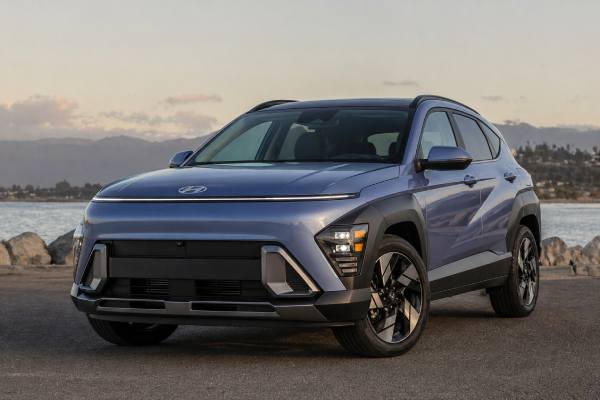

The 2025-present Hyundai KONA (SX2) with the 1.0 T-GDi engine is the straightforward petrol entry point into Hyundai’s larger, more mature second-generation compact SUV. It is not the fastest KONA, and it does not pretend to be. Instead, this version focuses on sensible running costs, a lighter front end, and simpler ownership than the hybrid or electric alternatives, while still benefiting from the SX2 car’s major gains in interior space, cargo room, safety systems, and cabin technology.
That combination matters more than the badge suggests. The SX2 generation is meaningfully roomier and calmer on the road than the old KONA, so even the smaller 1.0-liter turbo engine feels better supported by the platform underneath it. The main ownership question is not whether the car works, but whether this engine suits your use. For urban and mixed driving it makes sense. For frequent heavy loads or long high-speed motorway work, it can feel merely adequate rather than strong.
Quick Overview
- The SX2 KONA is much roomier and more useful than the old model, especially in the rear seat and boot.
- The 1.0 T-GDi engine keeps purchase cost and fuel use reasonable for daily urban and mixed driving.
- Seventeen-inch wheel setups usually give the best comfort and efficiency balance.
- The main caveat is modest performance when the car is fully loaded or used on fast motorway grades.
- A sensible oil-service target is every 10,000–12,000 km or 12 months, sooner in hard city use.
Guide contents
- Hyundai KONA SX2 1.0 petrol profile
- Hyundai KONA SX2 technical breakdown
- Hyundai KONA SX2 grades and driver aids
- Fault patterns and official actions
- Service planning and used-buy advice
- On-road behaviour and actual consumption
- How the 1.0 KONA fares against rivals
Hyundai KONA SX2 1.0 petrol profile
The second-generation KONA is a much more complete vehicle than the first. Hyundai stretched the wheelbase, widened the body, gave the car a more settled stance, and made the interior meaningfully more spacious. Those changes are especially important on the 1.0 T-GDi model, because this version is about value and balance rather than power. In the older KONA, the smallest petrol engine sometimes felt like a compromise attached to a stylish compact crossover. In the SX2, it makes more sense because the car around it is simply better packaged and more mature.
This version uses Hyundai’s 1.0-liter three-cylinder turbo petrol engine in a front-wheel-drive layout. In the 2025-present European-style specification covered here, it delivers about 115 hp and 200 Nm. That tells you most of what you need to know about its character. It has enough torque to cope with normal traffic, suburban roads, and moderate motorway use without constant gear changes, but it is not intended to feel fast. Buyers looking for stronger overtaking or easier full-load performance are better served by the 1.6 T-GDi or the full hybrid.
The real appeal of this variant is elsewhere. The SX2 KONA remains easy to park, easy to see out of, and more comfortable for rear passengers than the previous generation. The boot is also much more competitive. For small families, couples, or urban users who still want one car to do everything, that added space matters more than raw acceleration figures. It makes the basic petrol KONA feel less like the “cheap” one and more like the smart, rational one.
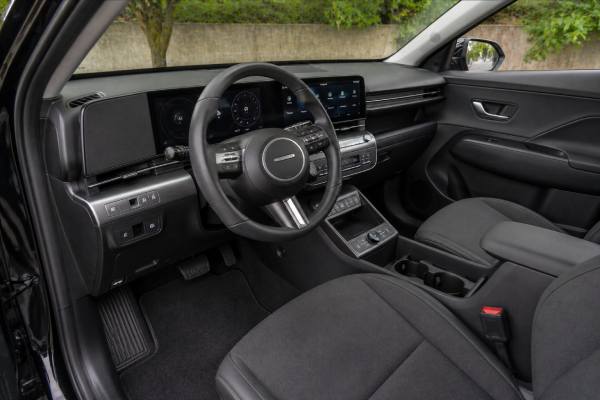
It also helps that the SX2 cabin is a genuine step forward. Even lower and mid trims can feel modern because the dashboard design, screen layout, and general ergonomics are cleaner than before. Hyundai has done a good job of making the KONA feel current without making it fiddly. That is exactly what buyers in this class usually want.
The compromise is straightforward. This is a small turbo engine in a larger body, so how happy you are with it depends heavily on how you drive. It suits city work, short-to-medium mixed journeys, and drivers who value economy and simplicity. It is less convincing if you spend long stretches at high speeds, often carry passengers and luggage, or live in a very hilly area where the engine has to work harder.
That is the right way to judge this KONA. It is not the most powerful or most glamorous SX2, but it is often the most logical one. If your priorities are price, packaging, and modern crossover usability, the 1.0 T-GDi version deserves serious attention.
Hyundai KONA SX2 technical breakdown
For 2025-present model-year coverage, the SX2 KONA 1.0 T-GDi sits at the accessible end of the petrol lineup in many European markets. Some regions list the engine at 100 PS, while broader European model material also shows a 115 PS version. This article focuses on the 115 hp class variant requested, while using current official SX2 platform dimensions, packaging, and equipment data for the present-generation petrol KONA.
| Item | Specification |
|---|---|
| Code | 1.0 T-GDi |
| Engine layout and cylinders | Inline-3, DOHC, 12 valves, 4 valves per cylinder |
| Bore × stroke | 71.0 × 84.0 mm (2.80 × 3.31 in) |
| Displacement | 1.0 L (998 cc) |
| Induction | Turbocharged |
| Fuel system | Gasoline direct injection |
| Compression ratio | 10.5:1 |
| Max power | 115 hp class (about 85 kW) @ around 6,000 rpm |
| Max torque | 200 Nm (148 lb-ft) @ around 2,000–2,500 rpm |
| Timing drive | Chain |
| Transmission | 6-speed manual in mainstream European petrol specification |
| Drive type | FWD |
| Differential | Open differential with brake-based traction control |
| Suspension (front / rear) | MacPherson strut / coupled torsion beam axle |
| Steering | Motor-driven power steering |
| Steering ratio / lock-to-lock | About 2.5 turns lock-to-lock |
| Brakes | Front ventilated discs, rear solid discs |
| Most common tyre sizes | 215/60 R17 or 215/55 R18 |
| Item | Specification |
|---|---|
| Length / width / height | 4,350 mm (171.3 in), or 4,385 mm (172.6 in) in N Line body styling / 1,825 mm (71.9 in) / 1,585 mm (62.4 in) |
| Wheelbase | 2,660 mm (104.7 in) |
| Turning circle | 10.6 m (34.8 ft) |
| Kerb weight | About 1,295–1,435 kg (2,855–3,164 lb), depending on trim and market |
| GVWR | 1,860 kg (4,101 lb) |
| Payload | About 425–565 kg (937–1,246 lb), depending on trim |
| Fuel tank | 47 L (12.4 US gal / 10.3 UK gal) |
| Cargo volume | 466 L (16.5 ft³) seats up / 1,300 L (45.9 ft³) seats folded, VDA method |
| Acceleration | Typically around 12 seconds to 100 km/h for the 115 hp class version |
| Top speed | About 178–180 km/h (111–112 mph), depending on exact market tune |
| Braking distance | No widely published official figure for this exact 1.0 T-GDi configuration |
| Towing capacity | About 1,210 kg (2,668 lb) braked / 600 kg (1,323 lb) unbraked in current petrol-type specification; always verify by VIN and market |
| Rated efficiency | WLTP combined is generally around 5.8–6.0 L/100 km depending on wheel size and trim |
| Real-world highway @ 120 km/h (75 mph) | Usually around 6.4–7.1 L/100 km in calm conditions |
| Item | Specification |
|---|---|
| Engine oil | Hyundai-approved full-synthetic oil in the correct climate-grade, commonly 0W-20 or 5W-30 depending on market guidance |
| Coolant | Long-life coolant for aluminum components; verify exact type by VIN |
| Transmission fluid | Manual gearbox fluid to Hyundai specification; verify exact fill data by VIN |
| Differential / transfer case | Not applicable as a separate service fill on this FWD version |
| A/C refrigerant | Later SX2 service literature uses R-1234yf |
| A/C compressor oil | Verify by VIN and refrigerant system version |
| Key torque spec | Wheel nuts should always be verified against official service information for the exact wheel and trim |
| Crash ratings | Euro NCAP 2023: 4 stars |
| Headlight rating | No IIHS headlight rating for this European market petrol configuration |
| ADAS suite | AEB, lane support, speed-limit assistance, driver monitoring, blind-spot and rear cross-traffic systems vary by trim |
In practical terms, the SX2 KONA’s biggest technical advantage is not the engine itself, but the platform around it. The added space and improved packaging make this smaller petrol version much easier to justify than the old-generation equivalent.
Hyundai KONA SX2 grades and driver aids
The 2025-present KONA range is trim-sensitive in a way that matters to used and new buyers alike. The 1.0 T-GDi engine may be the same basic powertrain across several grades, but the ownership experience changes noticeably depending on wheel size, lighting, seat trim, infotainment package, and ADAS coverage. In the UK-style current lineup, key grades include Advance, N Line, N Line S, and Ultimate, with the petrol engine available across the core non-hybrid side of the range.
Advance is the rational baseline. It usually rides on 17-inch wheels, which is good news for comfort and running costs, and it already includes the sort of equipment many buyers expect in a modern crossover. Parking sensors, connectivity features, and the main screen architecture mean it does not feel stripped. For buyers who care more about function than appearance, this is often the smartest trim mechanically.
N Line shifts the emphasis toward style. The longer N Line body length, larger 18-inch wheels, different bumpers, sportier interior treatment, and trim-specific detailing make the car look more assertive. That works well visually, but buyers should understand what it does not do. On the 1.0 T-GDi version, N Line is mostly a styling and cabin presentation upgrade. It does not turn the car into a performance KONA, and the larger wheels add a little road noise and reduce some of the easy-riding character that suits the powertrain well.
N Line S and Ultimate add the more desirable premium and technology features. Depending on market, these grades can bring full LED projection headlights, upgraded audio, surround-view monitoring, blind-spot view monitor, better seat materials, and stronger convenience equipment. That matters because the SX2 KONA’s cabin quality is one of its selling points, and higher trims make the most of it.
Safety equipment is one of the KONA’s better arguments. Even where exact packaging differs, the new-generation car typically offers forward collision-avoidance assist, lane keeping assist, lane following assist, intelligent speed-limit assist, driver attention warning, high beam assist, rear occupant reminders, and parking aids. Higher trims can add blind-spot collision-avoidance assist, rear cross-traffic systems, surround-view cameras, and more advanced parking support.
The Euro NCAP result deserves context. The SX2 KONA scored four stars in 2023. That is still a solid modern rating, but it is not the maximum result some buyers may expect from a current Hyundai. The test report noted that the passenger compartment remained stable in the frontal offset test and that side-impact protection was strong, but it also identified weaker chest protection readings in some frontal scenarios and assessed parts of the assistance package as adequate rather than class-leading. The result is best understood as competent and modern, but not benchmark-defining.
For most buyers, the best value lies in a mid-range trim with sensible wheels, the better lighting setup, and the broader ADAS package. That is usually where the SX2 KONA feels fully realized without asking the 1.0 engine to support unnecessary weight, style extras, and harsher tyre packages.
Fault patterns and official actions
Because the SX2 KONA is still a relatively new model, its reliability picture is still developing. That means the best approach is to focus on the likely engineering watchpoints of a modern 1.0-liter turbo petrol crossover rather than inventing a long list of established failures. So far, this version looks more like a case of normal modern-car complexity than a model defined by one notorious public defect.
The first area to watch is the 1.0 T-GDi engine itself. Downsized turbocharged three-cylinder engines can work very well, but they ask for proper maintenance. In a vehicle this size, the engine is adequate rather than over-specified, so hard urban use, repeated cold starts, steep terrain, and heavy motorway loads all matter more than they would in a more relaxed powertrain. Over time, the most likely trouble points are the familiar ones: ignition coils, spark plugs, boost-control hoses, sensors, and the gradual build-up patterns associated with direct injection. Symptoms to take seriously include uneven idle, weak cold-start behavior, hesitation under load, and mixture or misfire-related warning lights.
The second area is not unique to Hyundai, but it matters on a tech-heavy current crossover: software and calibration. The SX2 KONA depends on a network of driver-assistance systems and cabin electronics. Infotainment bugs, pairing glitches, camera issues, or warning messages can sometimes be software-related rather than hardware failures. That often makes the remedy less dramatic, but it also means buyers should value update history and dealer-level diagnostics rather than assume every warning means a major component is failing.
Typical issues to watch for as the cars age include:
- 12 V battery weakness, especially on lightly used cars.
- Brake corrosion on cars that do short journeys and spend time parked outside.
- Suspension noise from links or bushes on rough roads.
- Windscreen-related ADAS miscalibration after replacement.
- Uneven tyre wear from alignment drift, potholes, or cheap tyre replacements.
- Sensor faults that are minor individually but annoying if ignored.
On the chassis side, the torsion-beam rear axle is not a problem in itself. It is simple, compact, and suitable for this version. The main ownership concern is not complexity, but wear. Poor roads can accelerate bushing or link wear, and cars on larger wheels may be more prone to minor impact harshness and alignment changes.
At this stage, a used buyer should be less worried about dramatic long-term failure lore and more focused on basic evidence of good care. Because these cars are still young, maintenance quality, software follow-up, and accident repair standards matter more than odometer numbers alone. A lower-mileage example with weak history is less attractive than a higher-mileage one with strong documentation.
For pre-purchase checks, ask for full service history, confirm that any dealer campaigns have been completed, check that all ADAS functions operate normally, and insist on a cold start and a drive long enough to feel boost response, idle quality, and steering accuracy. On a modern current-generation car, ordinary negligence is usually a bigger threat than hidden old-age wear.
Service planning and used-buy advice
The SX2 KONA 1.0 T-GDi is easiest to own well when treated like a modern turbo petrol crossover rather than an old-school basic runabout. The engine is small, turbocharged, and direct-injected, so clean oil, good filters, and sensible inspection intervals matter. None of this is exotic, but it does mean that long brochure intervals should be treated with caution if the car lives in heavy traffic or does mostly short trips.
A practical maintenance approach should be conservative. The reward is not only better long-term durability, but also better drivability. Small turbo engines often reveal neglect through rough starts, lazy response, or minor warning lights long before they fail dramatically.
| Item | Practical interval |
|---|---|
| Engine oil and filter | Every 10,000–12,000 km or 12 months; sooner in hard city use |
| Tyre rotation and inspection | Every 10,000–12,000 km |
| Cabin air filter | Every 20,000–30,000 km or 12–24 months |
| Engine air filter | Inspect at each service and replace earlier in dusty use |
| Spark plugs | Usually around 45,000–60,000 km in practical ownership planning |
| Timing chain | No routine replacement interval; inspect if there is startup noise or timing-related faults |
| Brake fluid | Every 2 years is a sensible rule |
| Brake inspection | At every service, especially for lightly used cars prone to disc corrosion |
| Manual gearbox oil | Follow official service guidance, but monitor shift feel and leakage regularly |
| Coolant | Follow official long-life interval, then shorten after first replacement |
| Auxiliary belt and hoses | Inspect during routine service visits |
| 12 V battery | Test annually from year 3 or 4 onward |
For decision-making, the most important fluid point is simple: use the correct Hyundai-approved oil grade for the climate and the exact VIN. That matters more on this engine than trying to stretch intervals. Coolant, gearbox oil, and torque values should also be checked against the official documentation for the exact market version, because Hyundai’s service details can vary slightly by region and trim.
As a used purchase, the best 1.0 T-GDi KONA is usually a mid-grade car with 17-inch wheels, complete servicing, matching tyres, and no unresolved warning lights or repair shortcuts. The cars to be more cautious with are heavily urban-used examples that have only seen minimal servicing, plus N Line cars on larger wheels if the buyer values comfort and low tyre cost more than style.
A good used inspection should cover these points:
- Clean cold start and steady idle.
- No hesitation under boost.
- Smooth clutch and gear engagement.
- Straight steering and even tyre wear.
- No brake vibration or severe corrosion.
- Proper operation of cameras, parking sensors, lane support, and speed assistance.
- Evidence of software updates or dealer visits where needed.
- No signs of poor accident repair, water ingress, or cheap replacement tyres.
Long-term durability should be good if the car is serviced sensibly. This is not a fragile setup, but it is not the kind of engine that welcomes neglect. Owners who stay ahead of maintenance should find it a practical and efficient daily crossover rather than a troublesome one.
On-road behaviour and actual consumption
The 1.0 T-GDi SX2 KONA is not quick, but it is usually pleasant. That distinction matters. Hyundai has tuned the current-generation KONA to feel calmer, more stable, and more mature than the old model, and that benefits the smallest petrol version more than any performance statistic can show.
In town, the car is easy to place and easy to use. Visibility is decent, the steering is light, and the slightly taller seating position works well in traffic. The three-cylinder engine starts and settles cleanly when healthy, and around low-speed urban routes it feels responsive enough because the torque comes in early. That is where this powertrain makes the most sense. The car feels lighter on its feet than the higher-output, more heavily equipped versions, and it does not ask much of the driver.
On open roads, the SX2 platform improvement becomes clear. The longer wheelbase makes the car feel less busy than the old KONA, and motorway stability is better. That helps because the 1.0 engine is not powerful enough to distract you with speed. Instead, the improved refinement becomes the selling point. Wind and road noise are managed well enough for the class, especially on 17-inch wheels, and the KONA feels like a genuinely grown-up small SUV rather than a raised supermini.
The powertrain character is best described as willing but limited. There is enough low-end torque for everyday use, but once the car is loaded or pushed hard, you become more aware of the engine’s size. Overtaking needs planning, and long uphill sections at speed ask for more throttle than some drivers may expect. Buyers who frequently carry family and luggage or drive long fast routes every day may find the 1.6 T-GDi or full hybrid more relaxing.
Ride comfort depends heavily on wheel choice. Seventeen-inch wheels suit the car best, giving a well-balanced mix of body control and compliance. Eighteen-inch wheels sharpen the visual stance and help trim presence, but they add some surface harshness and tyre noise. The difference is large enough that buyers should choose with intention, not just appearance.
Real-world economy is good rather than miraculous. In mixed use, many owners should see around 6.0–6.8 L/100 km with normal driving. Urban trips can sit higher if they are very short and cold, while steady motorway running at 120 km/h usually lands in the mid-6s to low-7s depending on weather, load, and wheel size. Hard acceleration and hilly terrain push the numbers upward quickly because the engine has to work hard.
That overall driving picture suits the car’s purpose. The 1.0 T-GDi KONA is not meant to entertain like a hot hatch or impress with strong passing performance. It is meant to be a modern, compact SUV that feels easy every day, and in that role it does a credible job.
How the 1.0 KONA fares against rivals
The SX2 KONA 1.0 T-GDi competes in one of the busiest parts of the market, so it needs a clear reason to exist. Its advantage is not class-leading performance or the very lowest price. Instead, it combines a roomy current-generation body, modern cabin design, solid tech availability, and sensible petrol running costs in a package that still feels compact enough for urban use.
Against the Ford Puma 1.0 petrol, the Hyundai usually loses on outright driving sparkle. The Ford is still one of the most agile and rewarding small crossovers to drive. The KONA counters with more obvious rear-seat space, a larger-feeling cabin, and a more modern dashboard presentation in many trims. The Ford is the sharper car. The Hyundai is the more family-shaped and more digital-feeling one.
Against the Volkswagen T-Cross, the KONA feels more distinctive in both styling and cabin atmosphere. The Volkswagen remains a very rational, easy-to-use small SUV, but the Hyundai’s SX2 redesign has given it a stronger visual identity and a more modern sense of occasion inside. Buyers who want something a little less conservative often prefer the KONA.
Against the Renault Captur, the comparison depends on what matters most. The Captur is comfortable and flexible, and in some electrified forms it can be very attractive. The KONA usually feels more substantial and more cohesive in its cabin design, and its space gains in SX2 form make it a stronger family tool than the old KONA ever was.
Against the Nissan Juke, the Hyundai is the more practical all-rounder. The Juke has visual personality, but the KONA generally offers the easier rear seat, the easier boot, and the less compromised daily-use feel. For buyers choosing one household crossover, that matters a lot.
The internal Hyundai rival is arguably the BAYON. The BAYON often undercuts the KONA on price while offering similar basic logic, but the KONA feels like the more complete and more mature vehicle. It has the stronger safety-tech ceiling, the roomier interior, and the more substantial overall character. That is what buyers are really paying for.
The final verdict is straightforward. The SX2 KONA 1.0 T-GDi does not dominate any one category, but it is a very balanced answer to a common buyer need: a modern petrol compact SUV that is roomy enough, efficient enough, and current enough without forcing the owner into hybrid or EV ownership. For buyers who want simplicity with up-to-date design and technology, that balance is exactly the point.
References
- Hyundai KONA | Technical, Specifications and Pricing | Model year 2025 | June 2024 2024 (Technical Specifications)
- KONA | Performance | 2026 (Technical Overview)
- Hyundai KONA | Features | Hyundai Motor UK 2026 (Features)
- Euro NCAP | Hyundai KONA 2023 (Safety Rating)
- Hyundai Owners Manuals 2026 (Owner’s Manual)
Disclaimer
This article is for informational purposes only and is not a substitute for professional diagnosis or repair. Specifications, torque values, service intervals, procedures, and equipment can vary by VIN, market, trim, and production date, so always verify the correct details against the official service documentation for the exact vehicle.
If this guide helped you, please consider sharing it on Facebook, X, or another platform to support our work.