
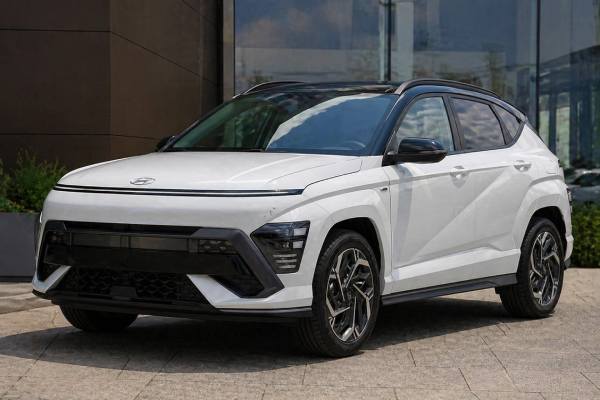

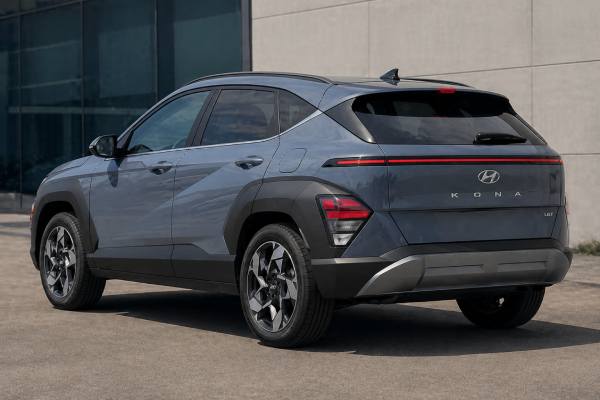
The Hyundai KONA SX2 1.0 T-GDi is the rational version of the second-generation KONA. It keeps the larger body, smarter cabin packaging, and much better tech of the new model, but pairs them with Hyundai’s smallest petrol engine instead of the costlier 1.6 turbo or hybrid drivetrains. In ownership terms, that matters. The 1.0-liter turbo gives the KONA enough torque for ordinary daily use, while the front-wheel-drive layout keeps weight, complexity, and running costs under better control than the more powerful versions.
That does not make it the best KONA for every driver. It is better suited to mixed commuting, urban driving, and moderate motorway work than to constant heavy loads or fast overtaking. It is also a market-sensitive model. Early SX2 launch material clearly shows the 120 PS version, but some later 2025 market sheets list a lower-output 1.0 tune instead. So this guide focuses on the 120 hp-class 1.0 T-GDi SX2 that buyers are most likely to encounter under this search term, while noting where later market variations matter.
What to Know
- Spacious cabin and a much bigger boot than the first-generation KONA.
- Strong low-end torque for a small petrol engine, especially in 7DCT form.
- Good standard safety technology across the SX2 range.
- Buy carefully if the car has a patchy oil-service history or any low-speed DCT complaints.
- A sensible real-world service target is every 10,000 to 15,000 km or 12 months, depending on use.
On this page
- Hyundai KONA SX2 1.0 overview
- Hyundai KONA SX2 specs and hardware
- Hyundai KONA SX2 trims and ADAS
- Watchpoints and factory actions
- Servicing roadmap and buying advice
- Daily use and real economy
- Rival crossovers worth considering
Hyundai KONA SX2 1.0 overview
The second-generation KONA is a very different vehicle from the older OS model. It is longer, wider, roomier, and much more digitally focused inside. Even in base-engine form, it feels like a bigger class of car than the first KONA. That is a major part of the 1.0 T-GDi’s appeal. You get most of the visual drama, technology, and packaging gains of the SX2 body, but without moving into the higher purchase price and mechanical complexity of the 1.6 turbo or hybrid versions.
This engine choice also explains the character of the car. Hyundai’s 1.0 T-GDi is a small three-cylinder turbo petrol, so it relies on torque rather than displacement. In SX2 form, it works best for drivers who want a light, efficient, front-drive crossover for everyday use. It is a better fit for city traffic, suburban commuting, and moderate intercity work than for towing-heavy use, repeated full-load motorway running, or a cabin constantly filled with adults and luggage. The body is now larger and more practical, but the engine is still the smallest in the non-hybrid range.
That said, the 1.0 is not underpowered in the way older small turbo engines often felt. The later SX2 KONA is well insulated, and the engine’s torque delivery is good enough to make daily driving easy. It is not especially fast, but it usually feels willing in ordinary conditions. The 7DCT version is the easier car to drive smoothly in mixed traffic, while the manual gives slightly more control and usually slightly better real-world dependability over very long ownership.
There is one important market note. At launch, UK and European press material clearly showed the 1.0 T-GDi at 120 PS with both 6MT and 7DCT options. Some later model-year documents, especially in 2024 and 2025 market sheets, show a lower-output 1.0 entry engine instead. For used buyers, that means two things. First, always verify the exact powertrain by VIN or registration details. Second, do not assume every 2025 1.0 KONA is automatically the same car as a 2023 launch-spec 120 PS version.
As a used proposition, the SX2 1.0 T-GDi makes most sense for buyers who care more about equipment, space, and reasonable running costs than about outright pace. It is the KONA for calm ownership. In that role, it can be a very sensible choice.
Hyundai KONA SX2 specs and hardware
The cleanest official snapshot for this version comes from the 2023 UK launch documentation, which still lists the 1.0 T-GDi at 120 PS in both 6-speed manual and 7-speed dual-clutch form. That matters because it captures the variant most buyers mean when they search for the SX2 1.0 T-GDi 120. Later documents in some markets show a lower-output 1.0, so for 2025 especially, engine output should be verified against the exact market and VIN.
| Item | 1.0 T-GDi 6MT | 1.0 T-GDi 7DCT |
|---|---|---|
| Code | Smartstream / Kappa 1.0 T-GDi | Smartstream / Kappa 1.0 T-GDi |
| Engine layout and cylinders | Inline-3, DOHC, 4 valves per cylinder | Inline-3, DOHC, 4 valves per cylinder |
| Bore × stroke | 71 × 84 mm (2.80 × 3.31 in) | 71 × 84 mm (2.80 × 3.31 in) |
| Displacement | 1.0 L (998 cc) | 1.0 L (998 cc) |
| Induction | Turbocharged | Turbocharged |
| Fuel system | Direct injection petrol | Direct injection petrol |
| Compression ratio | 10.5:1 | 10.5:1 |
| Max power | 120 hp (88.3 kW) @ 6,000 rpm | 120 hp (88.3 kW) @ 6,000 rpm |
| Max torque | 172 Nm (127 lb-ft) @ 1,500–4,000 rpm | 200 Nm (148 lb-ft) @ 2,000–3,500 rpm |
| Timing drive | Chain | Chain |
| Transmission | 6-speed manual | 7-speed dual-clutch automatic |
| Drive type | FWD | FWD |
| Differential | Open differential | Open differential |
| Rated efficiency | 5.8 L/100 km combined (40.6 mpg US / 48.7 mpg UK) | 6.0 L/100 km combined (39.2 mpg US / 47.1 mpg UK) |
| Real-world highway @ 120 km/h (75 mph) | Typically about 6.2–6.8 L/100 km | Typically about 6.5–7.1 L/100 km |
| Item | Specification |
|---|---|
| Suspension (front/rear) | MacPherson strut / coupled torsion beam axle |
| Steering | Motor-driven power steering; 2.5 turns lock-to-lock |
| Brakes | Ventilated front discs / solid rear discs; public UK sheet does not publish disc diameters |
| Wheels and tyres | Most common sizes 215/60 R17 or 215/55 R18, trim dependent |
| Ground clearance | About 170 mm (6.7 in), with small market and trim variation |
| Length / width / height | 4,350 / 1,825 / 1,585 mm (171.3 / 71.9 / 62.4 in); N Line length 4,385 mm |
| Wheelbase | 2,660 mm (104.7 in) |
| Turning circle | 10.6 m (34.8 ft) |
| Kerb weight | 1,295–1,445 kg (2,855–3,186 lb), depending on trim and transmission |
| GVWR | 1,855–1,860 kg (4,089–4,101 lb) |
| Fuel tank | 47 L (12.4 US gal / 10.3 UK gal) |
| Cargo volume | 466 / 1,300 L VDA (16.5 / 45.9 ft³) |
| Towing capacity | 1,200 kg braked / 600 kg unbraked (2,646 / 1,323 lb) |
| Payload | About 410–565 kg (904–1,246 lb) |
| Item | Specification or note |
|---|---|
| Acceleration | 0–100 km/h in 11.8 s (6MT) or 11.7 s (7DCT) |
| Top speed | 180 km/h (112 mph) |
| Braking distance | Public factory spec sheets reviewed do not publish a verified 100–0 km/h figure for this exact variant |
| Engine oil | SAE 0W-20, API SN Plus or SP / ILSAC GF-6; about 3.6 L (3.8 US qt) with filter |
| Coolant | Ethylene-glycol coolant for aluminum radiator; exact SX2 fill volume should be verified by VIN |
| Transmission fluid | Manual and 7DCT fill specifications vary by market; verify by VIN and transmission code before service |
| Differential / transfer case | Not applicable on this FWD variant |
| A/C refrigerant | Public SX2 UK spec sheet does not publish refrigerant charge for this variant |
| Key torque spec | Wheel nuts commonly 107–127 Nm (79–94 lb-ft); confirm with the exact workshop data for the car |
| Crash rating | Euro NCAP 4 stars; Adult 80%, Child 83%, Vulnerable Road Users 64%, Safety Assist 60% |
| IIHS | No direct IIHS rating applies to this exact European 1.0 T-GDi configuration |
The important technical point is not outright performance. It is that the SX2 platform gives this small engine a much more useful vehicle around it: bigger cabin, stronger boot, better tech, and a more grown-up road feel than the old KONA.
Hyundai KONA SX2 trims and ADAS
In the all-new KONA, trim matters almost as much as engine choice. Hyundai used the SX2 launch to push the model upmarket in design, cabin technology, and safety systems, so the 1.0 T-GDi can look either like a sensible family crossover or a fairly premium compact SUV depending on specification.
In the UK launch mix, the 1.0 T-GDi 120 sat across Advance, N Line, N Line S, and Ultimate. That already tells you something important: Hyundai did not treat this engine like a bargain-basement fleet unit. Buyers could pair it with a wide range of equipment levels, including some of the most visually distinctive trims in the range. If you are shopping used, that is good news. There are usually enough 1.0 cars on the market to choose either a value-led trim or a richer one without being pushed into the 1.6 turbo.
Advance is the sensible baseline. It gives you the larger new-shape KONA body, useful standard infotainment, roof rails, climate control, and Hyundai’s core safety pack. For most owners, this is the trim that makes the most practical sense. N Line adds the styling and feel many buyers really want: different bumpers, side skirts, twin-tip exhaust finishers, 18-inch wheels, a sportier cabin treatment, heated seats, and a more assertive overall look. N Line S adds even more equipment, including stronger lighting and extra driver-assistance hardware. Ultimate leans more into comfort and convenience than sporty detailing.
There are also quick identifiers worth knowing. N Line cars are easy to spot from the outside because of the unique bumpers, side skirts, and larger wheels. Inside, N Line and N Line S generally carry more distinctive seats and trim. Advance cars usually wear the less aggressive exterior treatment and slightly more conservative wheel setup. For used buyers, the trim tells you more than looks. Smaller-wheel Advance cars will often ride a little better and cost less to refurbish. N Line models usually feel more desirable and sell faster.
Safety is one of the strongest SX2 selling points. Hyundai made a broad SmartSense package standard across the launch range. That includes Downhill Brake Control, Driver Attention Warning, eCall, Forward Collision Avoidance Assist with car, pedestrian, cyclist, and junction-turning functions, Hill-start Assist Control, Intelligent Speed Limit Assist, Lane Keep Assist, Lane Follow Assist, and Leading Vehicle Departure Alert. Higher trims add blind-spot intervention, rear cross-traffic collision avoidance, extra parking warnings, reverse parking collision assist, safe exit warning, and surround-view monitoring.
The Euro NCAP result needs some context. The new KONA received four stars rather than five, which will catch some shoppers off guard. But the detailed result is more nuanced than the headline. Adult and child occupancy scores are still respectable, and the car’s active-safety systems are broad for the class. In practice, the SX2 still offers a modern safety package, especially when compared with older rivals bought at similar money. For family buyers, ISOFIX convenience and the rear-seat packaging are better than the old KONA too, even if the car is still not a true rear-seat standout.
Watchpoints and factory actions
Because the SX2 KONA is still relatively new, the reliability picture is not as settled as it is for older Hyundai models. That means the most useful approach is to separate proven public patterns from architecture-based watchpoints. There is not yet a long, well-documented list of 1.0 T-GDi SX2 mechanical failures in official public sources. That is good news. But it also means buyers should avoid false confidence. A young model can still develop patterns later.
The core engine itself should be viewed as moderately stressed rather than fragile. It is a small turbo three-cylinder, so oil quality and service frequency matter more than on a lazy naturally aspirated engine. On a well-maintained car, that is not a problem. On a neglected one, it can become one. The main things to watch are oil-change discipline, cold-start behavior, and any sign of misfire or weak boost response. Symptoms such as uneven idle, hesitation under load, or a whistle that changes oddly with throttle can point to coil issues, boost leaks, or early induction-related faults. None of these automatically make the model bad, but they are the right places to look.
Transmission choice changes the risk profile. The 6MT is mechanically simpler and likely the safer long-term bet if you keep cars for a long time. The 7DCT is more convenient, and it suits the engine’s torque delivery well, but it should be tested carefully at parking speed, in stop-start traffic, and when pulling away uphill. Small hesitations can be normal dual-clutch behavior. Repeated shudder, harsh engagement, or warnings are not.
Electrical and software issues are probably the most realistic early-SX2 watchlist items. New-generation Hyundai models are increasingly software-dependent. That means odd warning messages, camera or ADAS calibration complaints after glass replacement, or infotainment glitches may matter more in the first ownership years than any deep mechanical drama. These are usually lower-severity problems than engine or gearbox failures, but they can still be annoying and time-consuming if the car has poor dealer history.
As for recalls and campaigns, the public recall activity seen so far for early SX2 KONA production has not centered on a 1.0 T-GDi-specific engine scandal in the sources checked for this article. Some early SX2 public recalls in Australia and other markets concern collision-related battery-cable protection or other engine variants rather than this exact 1.0 powertrain. That means the smart buyer should treat recall checking as VIN-specific, not rumor-based. Ask the dealer for campaign printouts. Check the official recall portal in your market. Confirm that any open action was completed properly.
So the verdict here is cautious but positive. There is no strong evidence yet that the SX2 1.0 T-GDi is a trouble magnet. But it is still too new for lazy assumptions. Buy the best-documented car, not the cheapest one with the nicest wheels.
Servicing roadmap and buying advice
The maintenance strategy for the SX2 1.0 T-GDi should be conservative, especially if you expect to keep the car beyond its warranty period. Small turbo petrol engines reward clean oil, regular inspection, and early attention to minor symptoms. That does not mean the KONA is fragile. It means good habits matter.
| Item | Practical interval | Ownership note |
|---|---|---|
| Engine oil and filter | Every 10,000 to 15,000 km or 12 months | Shorter interval is smart for heavy city use, cold starts, or repeated short trips |
| Cabin air filter | About every 30,000 km or 24 months | Earlier in dusty or urban-heavy driving |
| Engine air filter | Inspect every service, replace around 30,000 to 45,000 km | Do not stretch if the car runs in dusty conditions |
| Brake fluid | Every 24 to 36 months | Time matters as much as mileage |
| Spark plugs | Usually around 60,000 to 75,000 km | Do earlier if misfire or weak cold starts appear |
| Tyre rotation | Every 10,000 to 15,000 km | Keeps wear even and preserves refinement |
| Coolant | Long-life item, but inspect every service and verify first replacement by VIN | Do not guess coolant chemistry |
| Manual or DCT fluid checks | Inspect for leaks every service | Ask for VIN-correct fluid before any change |
| Timing chain and related hardware | No fixed routine replacement | Listen for startup rattle and watch for timing-correlation faults on neglected cars |
| 12 V battery test | Annually from year three onward | Weak battery health can trigger modern electronic complaints |
The fluid side is simple in principle. Use the correct 0W-20 oil meeting Hyundai’s required API or ILSAC standard. Do not improvise transmission fluid on the 7DCT. Do not top off coolant with the wrong chemistry because “it looked the same.” On a newer Hyundai, wrong fluids create problems that do not always show up immediately.
As a used buyer, start with the service history and recall history. Then move to the test drive. You want a clean cold start, a stable idle, and no stored excuses for engine lights or transmission behavior. On a manual car, check clutch take-up, especially if the car has done mostly urban miles. On a DCT, drive it in creeping traffic, not just open roads.
Also inspect the body carefully. The SX2 has more tech and more calibration-sensitive equipment than the old KONA. Windscreen replacement, bumper repairs, and parking knocks can matter because cameras and radar-based systems need to work correctly. A car that has been repaired cheaply can still look excellent and drive badly.
The trims to seek depend on your priorities. Advance is usually the low-risk ownership choice. N Line and N Line S are easier to sell later and more satisfying if you like the styling, but they usually sit on pricier wheels and tyres. The versions to avoid are not specific trims. They are the cars with patchy oil changes, mixed cheap tyres, unclear repair history, or sellers who say the DCT “all does that.”
Daily use and real economy
The KONA SX2 1.0 T-GDi is easy to live with when you treat it like what it is: a roomy, tech-heavy compact crossover with an efficiency-focused petrol engine. It is not quick, but it rarely feels weak in day-to-day driving. The turbo three-cylinder pulls cleanly from low revs, and the larger SX2 cabin does not make the car feel ponderous unless you load it heavily or ask for hard acceleration repeatedly.
Around town, it suits itself well. The controls are light, visibility is decent, and the car is easy to position. The 1.0 engine’s main strength is that it feels more flexible than its size suggests at low and medium speeds. In urban and suburban traffic, that makes the KONA feel calm and usable. The 7DCT version is the more relaxed companion in congestion, though the manual is still perfectly sensible if you prefer simplicity.
Open-road performance is acceptable rather than exciting. The official 0–100 km/h times, in the high 11-second range, tell the story. This is not a car you buy for effortless overtaking with a full load. It can do the job, but it rewards anticipation. The 7DCT’s stronger torque figure helps, and in ordinary mixed driving it usually feels slightly more muscular than the manual. Still, buyers coming from larger turbo petrols or strong diesels will notice the difference.
Ride quality is one of the SX2’s biggest improvements over the older car. The platform feels more mature, and the longer wheelbase helps. On 17-inch wheels, the KONA is usually at its most comfortable. On 18s, it looks sharper and turns in more neatly, but you feel more of the smaller road imperfections. The steering is accurate enough but not rich in feedback. The overall handling balance is safe, predictable, and more polished than sporty.
Noise levels are respectable. At gentle throttle openings, the engine is unobtrusive. Push harder and the familiar three-cylinder note comes through, but it never sounds coarse enough to define the car. At motorway speeds, the KONA is calmer than the old model and feels like a larger vehicle than its class label suggests.
Real-world economy is solid. The official combined figures sit around 5.8 to 6.0 L/100 km for the 120 PS launch-spec car, and in sensible real use that is believable. Expect around 6.4 to 7.4 L/100 km in mixed driving, roughly 6.2 to 6.8 L/100 km on steady open-road runs, and more if the car spends its life in short-trip winter traffic. In other words, it is efficient, but not miraculous. It works best for drivers who want modern petrol simplicity rather than hybrid-level economy.
Towing is possible up to about 1,200 kg braked, but this is not the ideal KONA for frequent heavy towing. It is happier carrying people and luggage than dragging weight.
Rival crossovers worth considering
The KONA SX2 1.0 T-GDi competes in one of the busiest parts of the market, but its strongest rivals are not always the obvious badge names. The real comparison group is other compact crossovers that mix modest petrol power, strong technology, and realistic ownership costs.
| Model | Main strength | Main drawback | Why choose the KONA instead |
|---|---|---|---|
| Kia Stonic 1.0 T-GDi | Simple size, good value, familiar engine family | Smaller inside and less sophisticated overall | The KONA feels like a class up in cabin space and technology |
| Volkswagen T-Cross 1.0 TSI | Very good cabin usability and mature road manners | Often more expensive used for similar equipment | The KONA usually offers more visual drama and richer tech per budget |
| Peugeot 2008 PureTech | Stylish interior and strong comfort appeal | Driving position and control layout divide opinion | The KONA is easier to adapt to and often feels more straightforward to own |
| Renault Captur TCe | Comfortable, practical, and widely available | Can feel less substantial on faster roads | The KONA feels more planted and more digitally up to date |
Against the Kia Stonic, the Hyundai’s advantage is obvious: it feels like a newer, larger, more ambitious vehicle. The Stonic is easy to recommend as a simple small crossover, but the KONA offers noticeably better boot space, more rear-seat usefulness, and a more modern cabin. Against the Volkswagen T-Cross, the Hyundai fights on value. The Volkswagen is one of the best all-round rivals, but it often carries a stronger used-price premium that the KONA can undercut while still feeling contemporary.
The Peugeot 2008 is a more style-led alternative. It can feel elegant and plush inside, but the driving position still does not suit everyone. The KONA’s advantage is that it is easier to understand immediately. The Captur remains a smart practical choice, yet the Hyundai often feels more substantial and more advanced in its safety and interface design.
That is the KONA SX2 1.0 T-GDi’s real strength. It is not the fastest, not the softest-riding, and not the cheapest. But it combines several things well: strong packaging, good tech, reasonable efficiency, and manageable ownership risk. For many buyers, that broad competence matters more than one standout statistic.
If your priorities are easy daily driving, a roomy cabin for the class, and a newer-generation feel without stepping into hybrid or high-output turbo complexity, the SX2 1.0 T-GDi is one of the more convincing compact crossovers in the market. Just make sure you are buying the right market-specific version and not assuming every 2025 1.0 badge means the same output.
References
- Hyundai’s upscaled all-new Kona arrives with roomier smart space and high-tech convenience features 2023 (Press Information)
- Hyundai KONA range | Technical, Specifications and Pricing | July 2023 2023 (Technical Specifications)
- Hyundai KONA | Technical, Specifications and Pricing | Model year 2025 | June 2024 2024 (Technical Specifications)
- Hyundai KONA 2023 (Safety Rating)
Disclaimer
This article is for informational purposes only and is not a substitute for professional diagnosis or repair. Specifications, torque values, intervals, procedures, emissions calibrations, and equipment can vary by VIN, market, trim, transmission, and model year, so always verify the exact details against official service documentation for the specific vehicle.
If this guide helped you, please consider sharing it on Facebook, X, or another platform to support our work.