
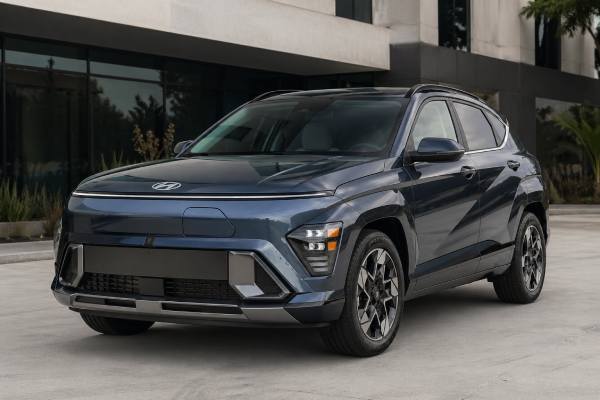

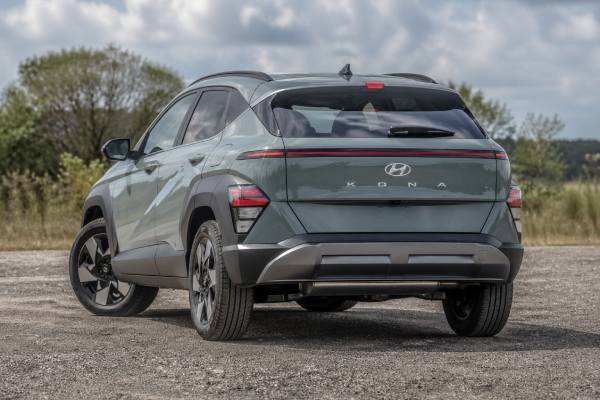
The 190 hp Hyundai KONA SX2 is the version that gives the second-generation KONA real depth. In U.S.-market form, it pairs the 1.6-liter turbocharged petrol engine with an 8-speed automatic and optional HTRAC all-wheel drive, which immediately separates it from the slower 2.0-liter models and from the European-spec KONA variants that use different power outputs and transmissions. That matters because this is not a marginal power bump. It changes how the KONA feels in daily use, especially on motorways, on grades, and with a full load of passengers.
The SX2 platform itself is also a major step forward from the older KONA. It is roomier, quieter, and more composed at speed, with a more useful back seat and a bigger cargo area. For owners, the result is a small SUV that finally feels like a complete family car. The trade-off is that it is a modern, electronics-heavy turbo crossover, so recall history, software status, and service discipline matter more than they do on simpler rivals.
Essential Insights
- The 190 hp turbo engine makes the SX2 KONA genuinely quick for the class and much more relaxed than the 2.0-liter base car.
- The 8-speed automatic suits the engine well and is easier to live with than a low-speed dual-clutch setup.
- Cargo space, rear-seat room, and long-trip refinement are better than many subcompact SUV rivals.
- Early 2024 vehicles deserve careful recall and campaign checks, especially for battery-cable, seat-belt, and EGR-related service actions.
- Engine oil and filter are due every 10,000 km or 12 months in normal use, and every 5,000 km in severe service.
Section overview
- Hyundai KONA SX2 turbo profile
- Hyundai KONA SX2 key figures
- Hyundai KONA SX2 trims and aids
- Trouble spots and recall work
- Service planning and used-buy tips
- Driving feel and fuel use
- Compact SUV rivals in context
Hyundai KONA SX2 turbo profile
The 190 hp KONA SX2 is the version that makes the U.S.-market petrol KONA feel complete. The lower-output 2.0-liter engine is adequate for commuting, but the 1.6 T-GDi changes the car from merely usable to properly confident. It gives the KONA the kind of mid-range response that suits American driving, where fast merges, long freeway grades, and loaded weekend use matter more than brochure numbers. The official output is 190 hp at 6,000 rpm and 195 lb-ft of torque from 1,700 to 4,500 rpm, and that wide torque band is more important than the headline horsepower figure. It means the KONA does not need to be worked hard to feel lively.
This version is also mechanically different in ways buyers should pay attention to. In the U.S., the 1.6T uses an 8-speed automatic torque-converter transmission rather than the 7-speed dual-clutch used with some overseas KONA turbo variants. That is a meaningful ownership advantage. It tends to be smoother in stop-and-go traffic, more predictable during parking maneuvers, and generally less fussy for buyers who do not want performance-car behavior from a family crossover. Optional HTRAC all-wheel drive also brings a multi-link rear suspension instead of the front-drive torsion-beam setup, which gives the AWD turbo KONA a small but real composure benefit over broken pavement.
The SX2-generation body helps just as much as the engine does. The KONA grew into a more useful family shape, with a 104.7-inch wheelbase, substantially better rear legroom than the old car, and a cargo area that no longer feels compromised. That matters because the 190 hp KONA is not marketed as a niche enthusiast model. It is the better mainstream KONA for buyers who want one vehicle to do everything: school run, daily commute, road trip, airport drive, and the occasional foul-weather weekend without complaint.
There is also a market-position point worth understanding. The 190 hp figure is a U.S.-market specification. Europe, Australia, and other regions use different KONA engine outputs and different trim structures, so buyers reading mixed global information online can easily confuse the 190 hp U.S. turbo with the 150 PS or 198 PS European cars. For this article, the focus is firmly the U.S.-market 1.6-liter turbo KONA sold from 2024 onward.
Its main strengths are easy to name. It has more real-world shove than most direct rivals, a mature cabin for the size class, and a solid safety story. The drawbacks are equally clear. Fuel economy is good but not outstanding, towing is not recommended in U.S. specs, and because the car is packed with cameras, radar, screens, and software layers, a good service history matters more than ever. Buy it as a quick, refined small SUV rather than a simple old-school runabout, and it makes a lot of sense.
Hyundai KONA SX2 key figures
For this section, the baseline is the U.S.-market Hyundai KONA SX2 1.6 T-GDi 190 hp sold from 2024 onward. This is the turbocharged petrol KONA offered with an 8-speed automatic and front-wheel drive or HTRAC all-wheel drive.
| Item | Specification |
|---|---|
| Code | Gamma II 1.6L Turbo-GDI |
| Engine layout and cylinders | Inline-4, DOHC, 16 valves, 4 valves per cylinder; bore × stroke 75.6 × 89.0 mm (2.98 × 3.50 in) |
| Displacement | 1.6 L (1,598 cc) |
| Induction | Turbocharged |
| Fuel system | Gasoline direct injection |
| Compression ratio | 10.0:1 |
| Max power | 190 hp (142 kW) @ 6,000 rpm |
| Max torque | 264 Nm (195 lb-ft) @ 1,700–4,500 rpm |
| Timing drive | Chain |
| Transmission | 8-speed automatic torque-converter transmission |
| Drive type | FWD or HTRAC AWD |
| Differential | Open differential; active on-demand AWD coupling where equipped |
| Rated efficiency | EPA-rated U.S. examples have generally sat around 26/32/28 mpg US FWD and 24–25/28–29/26 mpg US AWD, or about 9.0 / 7.4 / 8.4 L/100 km FWD and roughly 9.8 / 8.1 / 9.0 L/100 km AWD |
| Real-world highway @ 120 km/h (75 mph) | Typically around 7.5–8.5 L/100 km (31.4–27.7 mpg US / 37.7–33.2 mpg UK), depending on speed, weather, tyre package, and drivetrain |
| Item | Specification |
|---|---|
| Suspension (front / rear) | MacPherson strut with coil springs / coupled torsion beam axle on FWD, multi-link on AWD |
| Steering | Column-mounted motor-driven power steering; overall ratio 13.6 |
| Brakes | Ventilated front discs 305 mm (12.0 in); solid rear discs 284 mm (11.2 in) |
| Wheels and tyres | Most common turbo trim fitments are 19-inch alloy wheels on N Line, Limited, and current SEL Premium-style equivalents; some earlier trims used 18-inch wheels |
| Ground clearance | FWD 170–175 mm (6.7–6.9 in); AWD 206–211 mm (8.1–8.3 in), depending on wheel size |
| Length / Width / Height | 4,351 mm (171.3 in) or 4,384 mm (172.6 in) for N Line bodywork / 1,826 mm (71.9 in) / about 1,580–1,590 mm FWD or 1,605–1,615 mm AWD with roof rails |
| Wheelbase | 2,660 mm (104.7 in) |
| Turning circle (kerb-to-kerb) | 10.6 m (34.8 ft) |
| Kerb (curb) weight | About 1,482–1,505 kg (3,267–3,318 lb) FWD and 1,580–1,590 kg (3,483–3,505 lb) AWD in published 2024 turbo specs |
| GVWR | Up to about 1,940–2,020 kg (4,277–4,453 lb), depending on trim and drivetrain |
| Fuel tank | 50.0 L (13.2 US gal / 11.0 UK gal) |
| Cargo volume | 722 L seats up / 1,804 L seats down (25.5 / 63.7 ft³), SAE |
| Acceleration | Official U.S. 0–100 km/h or 0–60 mph figure is not published in Hyundai’s spec sheet |
| Top speed | No official U.S. top-speed figure published |
| Braking distance | Factory 100–0 km/h figure not published |
| Towing capacity | Not recommended in published U.S. 2024 turbo specifications |
| Payload | Verify by door-jamb loading label; useful allowance varies materially by trim, AWD fitment, and equipment |
| Item | Specification |
|---|---|
| Engine oil | SAE 0W-20, API SN PLUS/SP or ILSAC GF-7; 4.8 L (5.1 US qt) |
| Coolant | Mixture of antifreeze and distilled water, ethylene glycol base coolant for aluminium radiator; 8.5 L (9.0 US qt) |
| Transmission fluid | ATF SP-IV specification; 6.5 L (6.9 US qt) |
| Differential / transfer case | Rear differential oil 0.4–0.5 L (0.42–0.53 US qt), API GL-5 SAE 75W/85; transfer case oil 0.62–0.68 L (0.66–0.72 US qt) on AWD models |
| A/C refrigerant | Verify by VIN and under-bonnet label; one universal public fill value is not published across all trim and model-year combinations |
| A/C compressor oil | Verify by VIN and under-bonnet label |
| Key torque specs | Wheel nuts about 107–127 Nm (79–94 lb-ft) |
| Crash ratings | IIHS: 2024 Hyundai Kona is Top Safety Pick+, rating applies to 2024–26 models; Euro NCAP shared SX2-platform KONA result is 4 stars with 80% adult, 83% child, 64% vulnerable road users, and 60% safety assist |
| Headlight rating (IIHS) | Acceptable, all trims tested |
| ADAS suite | FCA/AEB, lane keeping, lane following, blind-spot warning, rear cross-traffic assist, intelligent speed limit assist; higher trims add Highway Driving Assist, navigation-based smart cruise control, surround-view monitor, blind-spot view monitor, parking collision assist and related features |
One detail worth stressing is that the turbo KONA’s specification is unusually coherent for the class. Unlike some rivals, the stronger engine is not paired with a temperamental transmission or a compromised chassis. The 8-speed automatic and the optional AWD system make the 190 hp KONA feel more substantial than its size suggests.
Hyundai KONA SX2 trims and aids
The trim story on the 190 hp KONA is more important than many buyers realize because Hyundai changed the names and packaging quite quickly after launch. The engine itself stayed familiar, but the trim ladder evolved. That means used buyers should decode the equipment carefully rather than assume every 190 hp KONA is the same.
For 2024, the 1.6T sat mainly in N Line and Limited form. That created a clear split. N Line was the sportier visual choice, with unique bumpers, trim details, twin-tip exhaust styling, and a more aggressive cabin look. Limited leaned more toward comfort and convenience, with richer driver aids, better parking tech, and a more premium equipment mix. Both trims could be had with front-wheel drive or HTRAC all-wheel drive, and AWD also added the multi-link rear suspension and Snow drive mode.
For 2025, Hyundai widened the 1.6T range. N Line S joined the lineup below the full N Line, giving buyers access to the stronger engine without the full price or option load of the more expensive turbo trims. That matters in the used market because N Line S is often the value sweet spot. It keeps the engine, 8-speed automatic, 19-inch wheels, and much of the visual appeal, but it is less loaded with high-cost camera and parking hardware than Limited.
By 2026, Hyundai simplified the gasoline KONA range again. The turbo engine moved into SEL Premium and Limited forms, while the N Line family was dropped from the U.S. petrol lineup. That is why current searches can make the car look different depending on model year. A 2024 or 2025 190 hp KONA may look sportier. A 2026 one may wear a more conventional trim badge even though the same basic engine is underneath.
| Model year | Main 190 hp trims | What matters most |
|---|---|---|
| 2024 | N Line, Limited | N Line for style; Limited for full comfort and parking tech |
| 2025 | N Line S, N Line, Limited | N Line S is often the best value turbo trim |
| 2026 | SEL Premium, Limited | SEL Premium replaces the sporty look with a more balanced equipment mix |
The safety story is strong, but it needs nuance. IIHS results are excellent for the redesigned KONA and apply across 2024–26 models. Crashworthiness scores are strong, pedestrian front crash prevention is rated Good, and headlights are rated Acceptable. That is a very solid result in this segment. Euro NCAP’s KONA result is less flattering at four stars, but it is still relevant because it reflects the same SX2 architecture. The weaker paper score comes mainly from how the car performed in certain protocol areas, not from the KONA being an unsafe design.
Practical safety equipment is generous. Seven airbags, including a front-center airbag, are standard. Rear LATCH anchors and upper tethers are standard. Lane keeping, lane following, blind-spot warning, rear cross-traffic alert, and rear automatic braking are standard or widely available depending on year and trim. Higher trims add the features owners actually notice every day: surround-view camera, blind-spot camera display, smart cruise with stop and go, and highway-assist functions.
The real ownership lesson is simple. Choose the trim for the equipment you will use, not the badge you like. Buyers who drive in crowded cities often benefit more from Limited’s parking and camera hardware than from N Line looks. Buyers who want the engine without the maximum hardware bill often do best with the intermediate turbo trim for their model year.
Trouble spots and recall work
The SX2 KONA is still a young vehicle, so reliability discussion should stay disciplined. There is not yet a deep ten-year pattern to judge, and the 190 hp turbo version is not showing one obvious engine defect that defines the whole model. The better picture is a collection of early-production recalls, a few software campaigns, and the usual maintenance sensitivity of a direct-injection turbo petrol engine.
The most important issues fall into clear groups.
Common and usually low to medium cost
- Infotainment glitches, profile resets, or temporary camera and sensor oddities after battery discharge.
- Brake noise or light rotor corrosion on vehicles used mainly for short urban trips.
- Minor trim squeaks from the cargo area, tailgate, or door cards.
Occasional and medium importance
- Uneven tyre wear from alignment drift or repeated impact damage, especially on 19-inch-wheel cars.
- 12-volt battery weakness that shows up first as warning messages, slow system boot-up, or erratic camera behavior.
- Normal but sometimes misunderstood automatic-transmission behavior during cold operation or aggressive kickdown.
Higher importance on early 2024 vehicles
- Recall 250 for rear seat belt assemblies that may have been improperly installed and may not extend properly.
- Recall 252 affecting certain 2024 KONA 1.6T vehicles where the 12-volt positive battery cable could be damaged in a frontal crash, creating post-crash fire risk.
- Recall 260 affecting certain 2024 KONA vehicles where solder-flux contamination in the EGR valve sensor could lead to a short, MIL illumination, or sudden loss of motive power.
That last group is where used buyers need to focus. The 190 hp turbo KONA itself is not inherently alarming, but early-production cars absolutely need campaign verification. The battery-cable recall is especially important because it specifically mentions 2024 KONA vehicles with the 1.6T engine in the U.S. market. That makes it directly relevant to this exact version, not just to the KONA range in general.
Software campaigns matter too. One lower-severity but useful example is the U.S. service campaign for the Central Communication Unit logic on certain 2024 Kona SX2 vehicles, intended to restore missing Wi-Fi hotspot MAC-address information. That is not a mechanical disaster, but it is a good example of the sort of issue that defines early ownership on modern vehicles: the car may drive well yet still need a campaign update to make all features work correctly.
For the engine itself, think in modern turbo-petrol terms. The timing chain has no routine replacement interval, but chain noise, timing-correlation faults, or rough cold starts should not be ignored. Direct injection also means intake deposits are possible over time, especially with repeated short-trip use. Oil quality matters. Stretching intervals or using the wrong oil on this engine is asking for trouble later.
The 8-speed automatic is one of this version’s strengths. Compared with many small turbo crossovers, it feels robust and well matched to the engine. That does not mean it is maintenance-free in the real world. Hard use, heat, or contaminated fluid can still shorten life, even if the normal schedule does not call for routine service. A clean test drive matters: no flare, no harsh engagement, and no odd behavior when the transmission is warm.
Before buying, request full service history, recall completion proof, and a cold-start inspection. Then drive the car in slow traffic, at highway speed, and over rough pavement. Check every ADAS feature, every camera, every sensor, and every warning light. On an SX2 KONA, a perfect screen and sensor system is part of reliability, not just a convenience bonus.
Service planning and used-buy tips
The KONA 1.6T is not difficult to maintain, but it is a car that rewards consistency. The official schedule is reasonable, yet the severe-use schedule is the one many real owners should pay attention to. Short commutes, heavy traffic, cold weather, dusty roads, frequent idling, and spirited driving all move the car closer to severe-service territory than many people assume.
| Item | Normal service | Practical note |
|---|---|---|
| Engine oil and filter | Every 10,000 km or 12 months | Use full-synthetic 0W-20 of the correct spec |
| Engine oil and filter, severe use | Every 5,000 km | Applies to short trips, heavy traffic, dust, hills, towing-like load, and harsh weather |
| Engine air filter | Inspect regularly, replace every 40,000 km | Replace earlier in dusty conditions |
| Cabin air filter | Every 30,000 km or 24 months | Earlier replacement helps HVAC and glass demisting |
| Spark plugs | Every 70,000 km | Do not stretch this on a turbo DI engine |
| Engine coolant | First at 200,000 km or 120 months, then every 40,000 km or 24 months | Use the correct coolant chemistry only |
| Brake fluid | Every 30,000 km or 24 months | Important for pedal feel and ABS performance |
| Tyre rotation | Every 10,000 km or 12 months | Include tread wear and pressure check |
| Drive belts | Inspect on schedule | Also inspect tensioner, idler, and alternator pulley |
| Valve clearance | Inspect every 90,000 km or 72 months | Check if excessive noise or vibration appears |
| Automatic transmission fluid | No routine service in normal schedule | Severe-use guidance and real-world prudence support earlier service than “lifetime” language suggests |
| AWD transfer case and rear differential | Inspect every 60,000 km or 48 months | Change immediately after water submersion; severe-use intervals are stricter |
| 12 V battery | Test annually from about year 4 | Weak batteries often trigger electronic complaints before outright failure |
The fluid and capacity numbers are useful buying tools, not just service data. The turbo engine takes 4.8 liters of 0W-20 oil. Coolant capacity is 8.5 liters. The automatic transmission family uses 6.5 liters of SP-IV-spec fluid. AWD cars add small but important transfer-case and rear-differential oil volumes. When a seller claims “full service,” these are the details that help you judge whether the statement means anything.
The used-buyer checklist is straightforward:
- Verify recall completion by VIN and dealer history.
- Inspect tyres closely for uneven wear, especially on 19-inch-wheel cars.
- Check the windshield, bumper fit, and camera operation for signs of poor accident repair.
- Test every ADAS function, every camera, and every parking sensor.
- Start the engine cold and listen for abnormal chain or accessory noise.
- Drive long enough for the transmission and brakes to warm fully.
- Scan for stored fault codes, not just active warning lights.
The best versions to seek depend on what matters most. If value matters, the intermediate turbo trims usually make more sense than the most expensive Limited. If comfort and visibility matter most, Limited is the easiest KONA 1.6T to recommend. If you want the strongest long-term ownership bet, a later-build example with documented campaign completion is the better choice than the earliest launch cars.
Long-term durability looks promising, but not yet fully settled. The powertrain is not unusually stressed, and the 8-speed automatic is a good sign. Still, this is a modern turbo SUV, so ignoring oil condition, battery health, and software status would be a mistake.
Driving feel and fuel use
On the road, the 190 hp KONA is one of the more convincing small SUVs in the class because it feels like a coherent package rather than a base crossover with extra power added. The engine, transmission, body control, and cabin all work together. That may be the most important compliment for a family buyer.
The engine’s character is the main draw. Peak torque arrives early and stays available through a wide band, so the KONA responds easily from normal road speeds. You do not need to bury the throttle to pass slower traffic or climb grades. The result is a car that feels calm rather than dramatic. It is quick enough to feel satisfying, but not so aggressive that it becomes tiresome in daily traffic.
The 8-speed automatic deserves credit here. In a class full of CVTs and some less polished dual-clutch gearboxes, the KONA’s torque-converter automatic gives it a more natural feel at low speeds. Parking maneuvers are smoother, part-throttle shifts are more predictable, and the whole powertrain feels more mature in town. Kickdown is not instant, but it is clean and logical. Sport mode sharpens the responses, while normal mode is the right choice for most owners.
Ride quality is another SX2 strength. The longer wheelbase makes the KONA more settled than the old car, and it no longer feels overly short-coupled on broken pavement. Front-drive cars ride well enough, but AWD cars with the multi-link rear suspension feel slightly more planted over uneven surfaces and in fast sweepers. Tyres still matter. The 19-inch-wheel cars look best, but they also transmit more impact harshness and cost more to re-shoe.
Steering is light and accurate rather than rich in feedback. That suits the car. The KONA is designed to feel secure and easy to place, not intimate or sports-car-like. Straight-line stability is very good for the class, and highway noise is better controlled than many image-focused subcompact crossovers. Brake feel is also predictable, though short-trip cars can pick up some rust and coarseness in the discs if they are never driven hard enough to clean themselves.
Real fuel use is fair, not class-leading. Expect roughly 9.0–10.5 L/100 km in dense city use, around 7.5–8.5 L/100 km at a real 120 km/h cruise, and about 8.0–9.0 L/100 km in mixed driving for most owners. That translates to about 26–31 mpg US in real mixed conditions depending on drivetrain, wheel size, weather, and driver behavior. AWD costs a little economy, and 19-inch tyres do not help. The hybrid KONA is the cheaper urban commuter, but it does not deliver the same easy turbo shove once the road opens up.
One practical point matters more than many buyers expect: towing. In U.S. specification, published 2024 turbo figures list towing as not recommended. That tells you how Hyundai sees this vehicle. It is a fast, compact crossover for people and luggage, not a mini tow rig. If towing is part of your routine, a class above makes more sense.
Compact SUV rivals in context
The 190 hp KONA occupies a useful space in the market because it is neither the cheapest small SUV nor the most premium one. Instead, it offers a strong middle ground: good space, real turbo performance, a mature chassis, and a strong safety story. That makes it easy to compare, but also easy to underestimate.
| Rival | Where the KONA is stronger | Where the rival can win |
|---|---|---|
| Mazda CX-30 Turbo | More rear-seat room, more practical cargo area, often easier infotainment learning curve | Richer cabin feel, better steering feedback, stronger premium impression |
| Volkswagen Taos | Quicker turbo response, broader safety equipment story, more polished current interior design | Simpler trim logic, easy ergonomics, roomy packaging for the footprint |
| Toyota Corolla Cross Hybrid | Stronger highway punch, more relaxed passing power, more upscale digital presentation | Better fuel economy, strong reliability reputation, lower urban running costs |
| Honda HR-V | Far quicker in turbo form, richer infotainment and camera features on upper trims | Simpler ownership, strong packaging, smoother value-oriented trim structure |
| Chevrolet Trailblazer RS | More mature ride, stronger engine, better torque-converter automatic feel | Often lower transaction price, lighter urban feel, decent equipment value |
The KONA’s biggest competitive advantage is that it feels like a more complete vehicle than many subcompact SUVs. Some rivals are sharper to steer, some are thriftier, and some are cheaper. Few combine this much space, this much equipment, and this much usable turbo performance in such a tidy footprint. That makes the 190 hp version especially appealing to buyers who regularly do motorway miles or who simply dislike underpowered crossovers.
Its main weakness is cost logic. Once you move into turbo KONA pricing, you are close to larger and often simpler compact SUVs. That means the 190 hp KONA only makes real sense if you value the stronger engine, the richer trim content, and the manageable size. If you want the cheapest ownership path, the hybrid or a simpler naturally aspirated rival may be smarter. If you want more prestige, the Mazda CX-30 may pull harder.
Still, the verdict is clear. The Hyundai KONA SX2 1.6 T-GDi 190 hp is one of the most rounded mainstream small SUVs sold in the U.S. market today. It is quick enough to feel special, refined enough to justify long trips, and practical enough to work as the only car in a household. Buy a good one, confirm the recalls and campaign work, and maintain it properly, and it is easy to see why this is the KONA variant many buyers should target first.
References
- 2024 Kona Specifications 2023 (Technical Data)
- Recommended lubricants and capacities 2025 (Owner’s Manual)
- Normal Maintenance Schedule (Smartstream 1.6 T-GDi) 2025 (Owner’s Manual)
- 2024 Hyundai Kona 2024 (Safety Rating)
- Euro NCAP | Hyundai KONA 2023 (Safety Rating)
Disclaimer
This article is for informational purposes only and is not a substitute for professional diagnosis, inspection, or repair. Specifications, torque values, intervals, procedures, recalls, software actions, and equipment can vary by VIN, model year, trim, drivetrain, and market, so always verify the exact vehicle against official service documentation and dealer records before buying, servicing, or repairing it.
If this guide helped you, please consider sharing it on Facebook, X, or another social platform to support our work.