

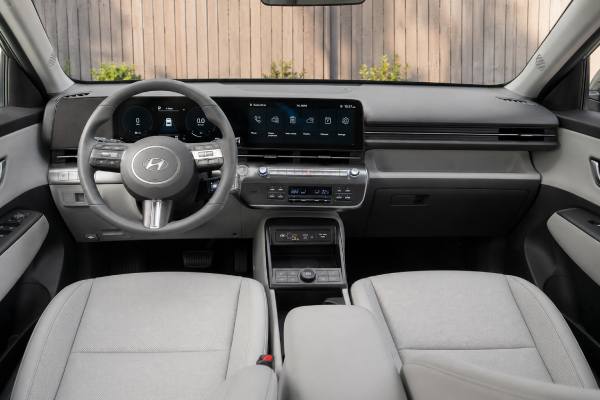
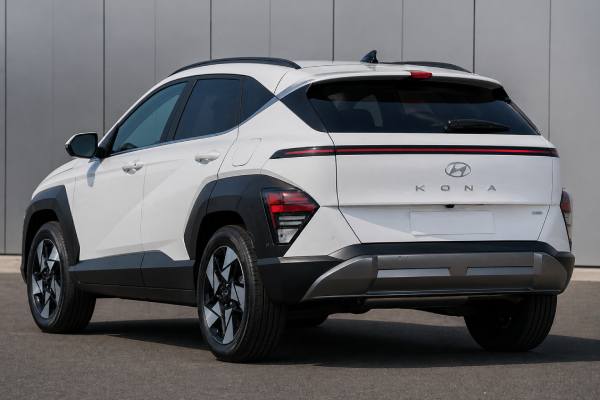
The second-generation Hyundai KONA SX2 is a very different vehicle from the earlier KONA. It is bigger, quieter, better packaged, and far more mature on the road. In 1.6 T-GDi 198 hp form, it is also the quickest mainstream petrol version of the range, giving the small SUV genuine punch without turning it into a hard-edged performance model. That balance is the main reason this version matters. It offers strong mid-range torque, modern cabin tech, a roomy rear seat for the class, and a useful cargo area, yet it still fits daily family use better than many sporty crossovers.
For buyers and owners, the key story is simple: the SX2 1.6 turbo is appealing when you want compact dimensions with real motorway pace, but it is best treated as a well-equipped, electronics-heavy modern Hyundai rather than a simple budget runabout. Market, trim, and drivetrain details do vary, so VIN-level checking remains important.
Quick Specs and Notes
- Strong 198 hp output and broad 265 Nm torque band make it one of the quicker small SUVs in this class.
- Cabin space, rear-seat room, and the overall driving refinement are much better than the first-generation KONA.
- Safety equipment is generous, especially on higher trims, and the platform feels more substantial at speed.
- Early-production cars deserve recall and software-campaign checks before purchase, especially 2023 and early 2024 builds.
- Engine oil and filter are due every 13,000 km or 12 months in normal service, and much sooner in severe use.
Guide contents
- Hyundai KONA SX2 essentials
- Hyundai KONA SX2 specs and data
- Hyundai KONA SX2 trims and safety
- Reliability and service actions
- Maintenance and buying advice
- Road manners and efficiency
- Against key small-SUV rivals
Hyundai KONA SX2 essentials
The SX2-generation KONA moved from feeling like a slightly quirky small crossover to feeling like a proper family B-SUV with real range breadth. Hyundai developed the newer model around a broader architecture strategy, which is why the body, cabin, and tech package feel more cohesive across petrol, hybrid, and electric versions. In 1.6 T-GDi form, the car sits at the sharp end of the non-electric lineup. It gives you 198 hp and 265 Nm, which is enough to make the KONA feel genuinely brisk rather than merely adequate.
What owners usually notice first is how much more grown-up the SX2 feels compared with the older car. The wheelbase is longer, rear legroom is better, and the cabin has more shoulder room. On the road, that translates into better straight-line stability and less of the slightly nervous feel that some earlier small crossovers had on fast roads. The turbo engine also suits the bigger body well. It does not need to be worked hard to keep pace, and on the motorway it feels more relaxed than smaller three-cylinder rivals.
The 1.6 turbo version is not identical in every market. European launch material paired it with a 6-speed manual or 7-speed dual-clutch transmission, and some markets also offered all-wheel drive. Other regions paired the same basic engine with an 8-speed automatic and different wheel packages. That matters because fuel use, curb weight, ride quality, and rear suspension layout can shift slightly depending on market and drivetrain. Still, the broad character stays the same: this is the more performance-oriented mainstream KONA.
From an ownership perspective, the biggest positives are easy to understand. It has enough performance to age well, the cabin packaging is excellent for the footprint, and Hyundai fitted a modern driver-assistance suite that makes long trips easier. The weak points are also typical of a very new, tech-rich vehicle. Early software fixes, a few recall actions, and trim-level complexity matter more than they would on an older, simpler SUV.
For many buyers, this version makes most sense if you want one car to do everything: commute, carry family, cover long motorway distances, and still feel lively when the road opens up. It is less appealing if your priority is the lowest possible running cost, because the hybrid is the thriftier KONA and some smaller-engined rivals are cheaper to buy and slightly simpler to live with.
Hyundai KONA SX2 specs and data
For this article, the reference point is the 1.6 T-GDi 198 hp SX2 as publicly documented in European launch and market material, with market-specific notes where they materially affect the numbers.
| Item | Specification |
|---|---|
| Code | Smartstream G1.6 T-GDi |
| Engine layout and cylinders | Inline-4, DOHC, 16 valves, 4 valves per cylinder; bore × stroke 75.6 × 89.0 mm (2.98 × 3.50 in) |
| Displacement | 1.6 L (1,598 cc) |
| Induction | Turbocharged |
| Fuel system | Direct injection |
| Compression ratio | 10.0:1 |
| Max power | 198 hp (145.6 kW) @ 6,000 rpm |
| Max torque | 265 Nm (195.5 lb-ft) @ 1,600–4,500 rpm |
| Timing drive | Chain |
| Transmission | 6-speed manual or 7-speed dual-clutch in Europe/UK launch specs; some markets used 8-speed automatic |
| Drive type | FWD standard in many European specs; AWD offered in some markets |
| Differential | Open differential |
| Rated efficiency | WLTP combined about 6.2–6.5 L/100 km (37.9–36.2 mpg US / 45.6–43.5 mpg UK) for FWD European examples |
| Real-world highway @ 120 km/h (75 mph) | Typically around 7.0–8.0 L/100 km (33.6–29.4 mpg US / 40.4–35.3 mpg UK), depending on tyres, weather, traffic, and drivetrain |
| Item | Specification |
|---|---|
| Suspension (front / rear) | MacPherson strut / CTBA on many FWD petrol versions; some AWD-market cars use multi-link rear suspension |
| Steering | Motor-driven power steering; 2.5 turns lock-to-lock |
| Turning circle | 10.6 m (34.8 ft) |
| Brakes | Ventilated front discs 305 × 25 mm (12.0 × 1.0 in); solid rear discs 284 × 10 mm (11.2 × 0.4 in) where published |
| Wheels and tyres | Most common 1.6 T-GDi fitment is 215/55 R18 on 18-inch rims; some markets also offered 17-inch or 19-inch packages |
| Ground clearance | About 170–175 mm (6.7–6.9 in), depending on wheel and market |
| Length / Width / Height | 4,350 mm (171.3 in) / 1,825 mm (71.9 in) / about 1,585 mm (62.4 in); N Line length can reach 4,385 mm (172.6 in) |
| Wheelbase | 2,660 mm (104.7 in) |
| Kerb weight | About 1,330–1,490 kg (2,932–3,285 lb) in FWD European specs; higher in some AWD markets |
| GVWR | About 1,885–1,915 kg (4,156–4,222 lb) in typical European 1.6 T-GDi form |
| Fuel tank | 47 L (12.4 US gal / 10.3 UK gal) |
| Cargo volume | 466 L seats up / 1,300 L seats down (16.5 / 45.9 ft³), VDA, in many European specs; some markets list 407 / 1,241 L depending on floor and packaging |
| 0–100 km/h | 7.8 seconds for the 7DCT FWD version |
| Top speed | 210 km/h (130 mph) |
| Braking distance | Factory 100–0 km/h figure not commonly published |
| Towing capacity | 1,300 kg (2,866 lb) braked / 600 kg (1,323 lb) unbraked in many European specs |
| Payload | Roughly 425–555 kg (937–1,224 lb), depending on trim and equipment |
| Item | Specification |
|---|---|
| Engine oil | SAE 0W-20, API SN PLUS/SP or ILSAC GF-7; 4.8 L (5.1 US qt) |
| Coolant | Ethylene glycol base coolant for aluminium radiator, mixed with distilled water; 8.5 L (9.0 US qt) |
| Transmission fluid | ATF SP-IV spec; 6.5 L (6.9 US qt) where published for the automatic transmission |
| Rear differential oil (4WD) | API GL-5 SAE 75W/85; 0.4–0.5 L (0.42–0.53 US qt) |
| Transfer case oil (4WD) | 0.62–0.68 L (0.66–0.72 US qt) |
| Brake fluid | DOT 4; as needed |
| A/C refrigerant and compressor oil | Verify by VIN and under-bonnet label; public owner literature does not give one universal fill value for every SX2 market/version |
| Wheel nut torque | 107–127 Nm (79–94 lb-ft) |
| Item | Specification |
|---|---|
| Euro NCAP | 4 stars; 80% adult occupant, 83% child occupant, 64% vulnerable road users, 60% safety assist |
| IIHS | 2024–26 U.S.-spec Kona earned Top Safety Pick+; headlights rated Acceptable on all trims, pedestrian front crash prevention rated Good |
| Airbags | Seven airbags, including front-centre airbag |
| ADAS suite | FCA/AEB, Smart Cruise Control, Lane Keep Assist, Lane Follow Assist, Blind-Spot Collision Avoidance, Rear Cross-Traffic Collision Avoidance, Intelligent Speed Limit Assist, parking aids; higher trims add BVM, SVM, PCA-R and related features |
Hyundai KONA SX2 trims and safety
The 198 hp 1.6 T-GDi version was not the entry-level KONA. In markets such as the UK at launch, it sat toward the upper end of the range and was tied mainly to more generous equipment lines. That is good news for used buyers, because most 1.6 turbo cars come with stronger standard equipment than the base petrol versions. It also means there is usually less need to chase expensive options unless you want specific comfort or appearance features.
A simple way to understand the trim structure is this: lower trims focused on the smaller petrol engine and value, while the 1.6 T-GDi was usually reserved for sportier or better-equipped versions. In the 2023 UK structure, Advance covered the core car, N Line added sportier styling, N Line S brought most of the desirable luxury and camera tech, and Ultimate leaned more toward a premium comfort spec. The 198 hp engine was concentrated in N Line S and Ultimate forms, which is why many used examples are well equipped.
The mechanical differences are not dramatic in European FWD form, but they are still relevant. Wheel packages changed the ride and tyre cost, and N Line versions looked and felt more aggressive. In some non-European markets, the 1.6 turbo could also bring AWD and different rear suspension hardware, which materially changes traction and sometimes ride composure on rough roads. For a used-car buyer, that means you should decode the exact drivetrain and wheel size rather than assume every 1.6 T-GDi is mechanically identical.
Useful identifiers include N Line bumpers, unique wheel designs, sports seats or trim stitching, and the bigger camera-and-parking feature set on upper trims. Interior tells matter because some cars look similar from the outside but differ a lot inside, especially in seat trim, memory-seat availability, parking camera coverage, and blind-spot display features.
On safety, the KONA SX2 is strong but not perfect. The Euro NCAP result is respectable, though not class-leading on paper. The lower vulnerable road user and safety-assist percentages are worth noting, but the real-world safety package is still broad for the segment. Hyundai included seatbelt reminders, driver monitoring, lane support, speed-limit recognition, and AEB capability that covers more than basic car-to-car scenarios. Higher trims add features that reduce daily driving stress, not just crash-test scoring.
Child-seat practicality is decent rather than exceptional. Outer rear ISOFIX/LATCH positions are present, with tether provision for the rear row, but some child-seat testing notes show that lower anchors can sit a bit deep in the seat base. In practice, installation is workable, but buyers who regularly fit and remove child seats should test this before purchase.
The best trim choice depends on priorities. For many owners, N Line S is the sweet spot because it pairs the stronger engine with the most useful comfort and visibility tech. If ride quality matters more than appearance, a 17-inch or softer-sprung setup is easier to live with than the flashier larger-wheel versions.
Reliability and service actions
The SX2 KONA is still a relatively young vehicle, so any reliability judgment needs a little caution. The good news is that the 1.6 T-GDi itself is not showing a pattern of catastrophic, model-defining failure in this generation. The more realistic story is a mix of early-production service actions, software fixes, and the normal sensitivity of a turbocharged direct-injection engine to maintenance quality and usage pattern.
The issues worth watching break down like this:
- Common, low to medium cost: infotainment, connectivity, or profile glitches; occasional camera or sensor warnings after battery discharge, updates, or repairs; trim rattles from the cargo area or door cards.
- Occasional, medium cost: rough or hesitant low-speed dual-clutch behavior on poorly driven or overheated 7DCT cars; abnormal tyre wear from alignment drift or repeated pothole impacts; brake noise or light corrosion on cars used mostly for short city trips.
- Occasional, higher importance: early-production recall work covering the transmission electric oil pump on some 2023 cars, rear-seat belt hardware on certain early 2024 vehicles, 12-volt battery-cable protection on some 2024 vehicles, and an EGR-valve recall affecting certain 2024 builds.
For owners, the transmission question is important. The 7DCT gives the best official acceleration, but like many dual-clutch units it prefers decisive throttle inputs over prolonged creeping. Heavy stop-start traffic, repeated inching on hills, or towing in hot conditions can make it feel less smooth than a conventional torque-converter automatic. That does not automatically mean the gearbox is failing. Sometimes it is simply the way the clutch control strategy behaves. Still, any harsh engagement, repeated shudder, or warning messages deserve proper diagnosis rather than hand-waving.
For the engine itself, think in terms of modern direct-injection turbo habits. Short-trip use can increase deposit formation and condensation-related contamination. High-quality oil, timely changes, and regular full-temperature runs matter. Over the long term, intake carbon build-up is possible, as it is on many direct-injection petrol engines, though the SX2 is still too new for a broad, universal pattern to be declared. Timing-chain systems do not have a routine replacement interval, but cold-start chain noise or correlation faults should never be ignored.
Software matters more here than on an older crossover. A good example is the U.S. campaign addressing missing Wi-Fi hotspot MAC-address information in the CCU on some 2024 SX2 vehicles, which could be fixed by dealer update or OTA in eligible cases. More broadly, any windshield, bumper, radar, or camera replacement should be followed by proper ADAS calibration. A badly calibrated modern small SUV can feel “fine” until it suddenly throws lane, AEB, or parking-assist faults.
For used buyers, the practical checks are clear. Ask for a complete service history, proof of recall completion, and evidence that software campaigns were performed. On the test drive, start the car cold, listen for chain noise, check for warning lights, drive it in slow traffic to judge transmission manners, then take it onto a faster road to check straight-line tracking, wind noise, and brake consistency. Finally, inspect tyre wear carefully. Uneven inner-edge wear tells you a lot about alignment, suspension knocks, and how the car has been used.
Maintenance and buying advice
The KONA SX2 1.6 T-GDi is not a difficult car to maintain, but it does reward disciplined servicing. Owners who follow the book closely, use the correct oil, and do not stretch intervals tend to avoid the kind of problems that make modern turbocharged cars expensive later on.
| Item | Normal service | Practical note |
|---|---|---|
| Engine oil and filter | Every 13,000 km or 12 months | Use full-synthetic 0W-20 to the correct spec; severe use shortens this dramatically |
| Engine oil and filter in severe use | Every 5,000 km | Relevant for repeated short trips, long idling, heavy traffic, dust, and hard use |
| Engine air filter | Inspect every 13,000 km; replace about every 39,000 km | Replace sooner in dusty regions |
| Cabin air filter | Replace every 13,000 km or 12 months | Cheap, and worth doing on time |
| Spark plugs | Replace every 78,000 km | Do not stretch this on a turbo engine |
| Coolant | First change at 200,000 km or 120 months, then every 39,000 km or 24 months | Use the correct coolant chemistry only |
| Brake fluid | Inspect every 13,000 km or 12 months; replace every 78,000 km or 48 months | Important for pedal feel and ABS/ESC performance |
| Tyre rotation | Every 13,000 km or 12 months | Also check alignment and pressures |
| Drive belt | Inspect routinely; replace on condition | Replace if cracked or if tension is reduced excessively |
| Fuel filter | No routine interval in normal service | Replace if symptoms such as restriction, surging, or hard starting appear |
| Automatic transmission fluid | No scheduled change in normal service | In severe use, a fluid change around 100,000 km is sensible and is listed in severe-duty guidance |
| AWD transfer case and rear differential | Inspect periodically | Change immediately after water submersion; monitor for leaks |
| Timing chain | No fixed replacement interval | Inspect on symptom: rattle, correlation faults, or abnormal cold-start noise |
| 12 V battery | Test annually from about year 4 | Many modern Hyundais become electronically fussy before the battery fully fails |
The best buyer strategy is to treat this as a condition-and-history car, not just a mileage car. A slightly higher-mileage example with perfect service records, correct oil, and completed recalls is usually a better bet than a lower-mileage car with patchy maintenance and no software history.
On inspection, focus on five areas. First, check recall completion and scan for stored codes. Second, listen for cold-start noises and confirm smooth warm idle. Third, test every camera, parking sensor, screen, and driver-assistance function. Fourth, inspect tyres and brake condition carefully, because wheel size and city use can increase costs. Fifth, check for accident repairs around the bumper covers, windscreen, and front radar area, because poor repairs can create ongoing ADAS headaches.
As a used buy, later-built cars generally look safer than the earliest launch examples simply because first-year production issues and software patches had more time to be addressed. If you want the full appeal of this engine, target a car with the stronger trim level, full service proof, and documented campaign completion. If you want the calmest everyday ownership, smaller wheels are better than the biggest available wheel-and-tyre packages.
Long-term durability looks promising rather than fully proven. The basic engine-output level is not extreme, but the car is electronics-heavy and maintenance-sensitive. In other words, it should age well when looked after properly, but neglect will show up faster than it would on a simpler naturally aspirated crossover.
Road manners and efficiency
The KONA SX2 1.6 T-GDi drives like a small SUV that has been tuned for broad appeal rather than drama. That is mostly a compliment. The engine has enough performance to feel strong, but the rest of the car is still built around comfort, safety, and everyday usability. So the big surprise is not that it is fast in a straight line. The bigger surprise is that it feels stable and settled enough to use that performance regularly.
The turbo engine’s best quality is its torque delivery. Peak torque arrives low and stays available through a broad mid-range, so the KONA pulls well from ordinary road speeds without needing constant downshifts. In 7DCT form, the official 0–100 km/h time of 7.8 seconds is believable. It is not hot-hatch explosive, but it is comfortably quicker than most mainstream B-SUV rivals with 120 to 155 hp.
At urban speeds, the experience depends partly on transmission choice. The manual gives the most direct feel and may appeal to drivers who want more control, but it is rarer. The dual-clutch version is easier in traffic, though it can feel slightly more abrupt at parking-lot speeds than a conventional automatic. Once moving, it usually settles down and suits the engine well.
Ride quality is one of the SX2’s strengths, especially versus many flashy rivals on big wheels. The longer wheelbase helps. It deals with expansion joints and broken town surfaces better than the first-generation KONA, and it is less busy at motorway speeds. That said, tyre choice matters. Eighteen-inch or nineteen-inch packages sharpen the look but can add impact harshness and tyre roar. If comfort is a priority, avoid the biggest wheel package unless you have driven it on the roads you actually use.
Steering is light rather than chatty, but it is accurate enough and easy to place. This is not a car bought for steering feel. It is bought because it is secure, easy to position, and stable enough to feel trustworthy in bad weather or on fast A-roads and motorways. Braking feel is generally predictable, though cars used mostly for short urban trips can build light rust on the discs and feel rough until driven properly.
In real fuel use, the 1.6 turbo is acceptable rather than class-leading. Expect something around 8.0 to 10.0 L/100 km in dense city work, around 7.0 to 8.0 L/100 km at a real 120 km/h cruise, and roughly 6.8 to 8.2 L/100 km in mixed use, depending on transmission, wheel size, traffic, temperature, and driving style. AWD or larger-wheel cars usually sit at the thirstier end. The hybrid is much cheaper to run, but it does not give the same overtaking ease.
If equipped for towing, the KONA feels capable within its 1,300 kg braked limit, but this is still a compact SUV. A moderate trailer is fine. A heavy trailer in hills or hot conditions asks much more of the gearbox and cooling package, especially in slow traffic. Full-load or towing consumption can rise sharply, so budget for a 20 to 35 percent penalty depending on speed and terrain.
Against key small-SUV rivals
The KONA SX2 1.6 T-GDi does not compete by being the cheapest or the most efficient. It competes by offering a strong all-round package with more performance than most class rivals, while still keeping the cabin practicality and technology that people expect from a modern small SUV.
| Rival | Where the KONA is stronger | Where the rival can win |
|---|---|---|
| Toyota C-HR 2.0 Hybrid | More conventional turbo shove, more relaxed motorway performance, often better cargo flexibility | Better city fuel economy, smoother low-speed automatic feel, strong reliability reputation |
| Ford Puma 1.0 EcoBoost mHEV | More power, more cabin maturity, better rear-seat room, richer ADAS availability in upper trims | Sharper steering, lighter feel, clever boot packaging, often more playful chassis balance |
| Volkswagen T-Roc 1.5 TSI | Fresher interior architecture, broader safety tech at launch, more punch in 198 hp form | Simpler powertrain choices, strong ergonomics, more conservative design that ages quietly |
| Mazda CX-30 | More rear space, more overtaking muscle in this exact trim, stronger infotainment-and-ADAS feature density | Richer cabin materials, more natural steering feel, refined non-turbo driving character |
The KONA’s main competitive advantage is that it feels like a bigger, more complete car than many B-segment SUVs, yet it still has a relatively compact footprint. The 1.6 turbo version also gives buyers something many rivals do not: real pace without stepping into a niche performance derivative.
Its biggest competitive weakness is running-cost logic. Once fuel prices and tyre costs enter the picture, the hybrid starts to look smarter for many households. The 198 hp KONA only makes full sense if you will actually use that performance, whether that means frequent motorway travel, hilly roads, regular overtaking, or simply wanting one compact SUV that never feels underpowered.
Against hybrid-focused rivals, the KONA wins on immediacy. Against sharper small crossovers, it wins on maturity and space. Against more premium-leaning rivals, it wins on equipment value. That makes it easy to recommend to buyers who want a modern compact SUV with strong everyday pace, good cabin packaging, and credible safety tech, but who are willing to stay on top of maintenance and recall history.
References
- Hyundai Kona Electric | Press information | September 2023 2023 (Press Information)
- Hyundai KONA range | Technical, Specifications and Pricing | July 2023 2023 (Brochure)
- Recommended lubricants and capacities 2025 (Owner’s Manual)
- Euro NCAP | Hyundai KONA 2023 (Safety Rating)
- 2024 Hyundai Kona 2024 (Safety Rating)
Disclaimer
This article is for informational purposes only and is not a substitute for professional diagnosis, inspection, or repair. Specifications, torque values, maintenance intervals, procedures, and equipment can vary by VIN, market, drivetrain, software level, and trim, so always verify details against the correct official owner’s manual, service information, and dealer campaign records for the exact vehicle.
If this guide was useful, please consider sharing it on Facebook, X, or another social platform to support our work.