
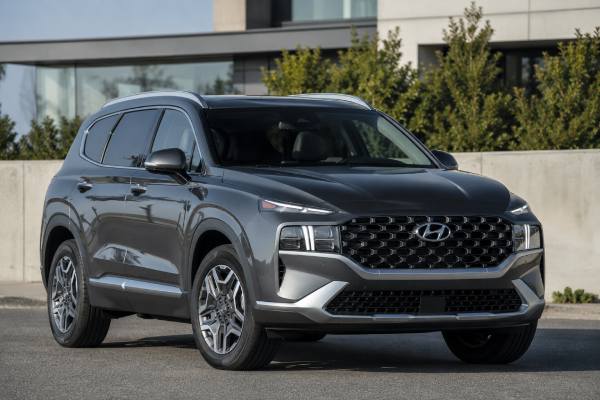

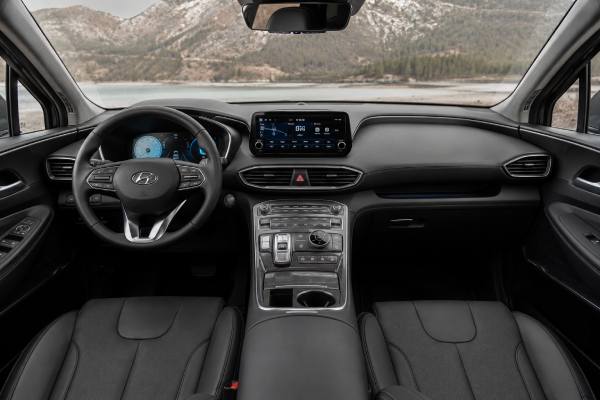
The facelifted TM-generation Hyundai Santa Fe Hybrid is one of the more practical large family SUVs from the early-2020s: seven-seat packaging in many markets, a conventional automatic gearbox, useful electric assistance, and available 4WD without moving into plug-in charging or diesel ownership. The 1.6 T-GDi HEV version is not a pure off-roader and not a performance SUV, but it does a good job of combining everyday refinement, respectable towing capacity, and lower urban fuel use than the older diesel in many driving patterns.
The key detail is scope. This page focuses on the 2021–2023 facelift Hyundai Santa Fe TM 4WD Hybrid with the 1.6-litre turbocharged petrol-electric system rated at 230 PS, paired with a 6-speed automatic transmission and active on-demand 4WD. Equipment, fluids, emissions figures, safety ratings, and service intervals can vary by country, trim, wheel size, seating layout, and VIN.
Quick Specs and Notes
- The 230 PS hybrid system gives smooth low-speed response, a quoted 0–62 mph time of about 9.1 seconds for the 4WD HEV, and a 116 mph top speed.
- Strong advantages include seven-seat versatility in many markets, a comfortable ride, good ADAS availability, and a conventional 6-speed automatic rather than a dual-clutch unit.
- Ownership caveats include brake-disc corrosion from light regen-heavy use, 12 V battery sensitivity on short trips, and the need to verify recall completion by VIN.
- Normal maintenance should be based on the official schedule; some markets list engine oil and filter service every 8,000 km or 6 months, while others use longer intervals.
- Spark plugs are commonly scheduled around 80,000 km, and the HEV inverter coolant may be listed for first replacement at 200,000 km or 120 months, then every 40,000 km or 24 months.
Table of Contents
- Santa Fe TM 4WD HEV Context
- Santa Fe TM Hybrid Technical Data
- Santa Fe TM Trim and Safety
- Reliability Issues and Service Actions
- Maintenance and Used Buyer Checks
- Driving Performance and Efficiency
- Rival Comparison and Verdict
Santa Fe TM 4WD HEV Context
The 2021–2023 Santa Fe Hybrid sits within the facelifted fourth-generation Santa Fe, known by the TM platform code. The facelift was more than a light styling update: the front structure, interior electronics, powertrain range, and driver-assistance equipment were substantially revised for many markets. In Europe and the UK, the 1.6 T-GDi Hybrid replaced much of the earlier diesel-led appeal for buyers who wanted a large SUV with automatic transmission, family space, and lower urban fuel use.
The version covered here is the full hybrid, not the plug-in hybrid. It uses a 1.6-litre turbocharged direct-injection petrol engine, a transmission-mounted electric motor, a small lithium-ion polymer traction battery, and a 6-speed automatic gearbox. The combined output is listed at 230 PS, roughly 227 hp or 169 kW, with combined torque of 350 Nm. Unlike the PHEV, it has no external charging port and no meaningful EV-only range claim. It can move under electric power at low speed and during light-load cruising, but the system is designed mainly to reduce fuel use and smooth the petrol engine’s workload.
The 4WD wording is important. This Santa Fe does not have a low-range transfer case or locking differentials. It uses an active on-demand all-wheel-drive system that sends torque rearward when traction, acceleration, cornering, or drive-mode logic requires it. For wet roads, snow, gravel tracks, campsites, and mild towing use, it is useful. For repeated deep mud, rocks, or heavy off-road work, it is still a road-biased crossover.
Its appeal is strongest for buyers who want a comfortable family SUV with hybrid efficiency but do not want plug-in charging habits. The cabin is roomy, the driving position is relaxed, and many versions include seven seats. The third row is best for children or occasional adult use, but the Santa Fe’s overall packaging is generous for its length.
The main trade-offs are weight and complexity. The hybrid hardware adds useful torque but also adds diagnostic systems, cooling circuits, high-voltage components, and battery-specific checks. A well-maintained example can be a sensible used buy, but service history and recall verification matter more than on a simpler petrol SUV.
Santa Fe TM Hybrid Technical Data
The figures below reflect the facelift TM Santa Fe 1.6 T-GDi HEV 4WD, using European/UK data where possible and owner-manual specifications where they clarify fluids and service capacities. Some numbers vary by market, wheel package, seating configuration, and homologation method.
| Category | Specification |
|---|---|
| Model | Hyundai Santa Fe TM facelift |
| Years covered | 2021–2023 |
| Body style | 5-door midsize SUV, typically 5 or 7 seats depending on market |
| Powertrain | Petrol-electric full hybrid |
| Engine code/family | Smartstream G1.6 T-GDi HEV, commonly G4FT |
| Engine layout | Transverse inline-4, DOHC, 16 valves, 4 valves/cylinder |
| Bore × stroke | 75.6 × 89.0 mm (2.98 × 3.50 in) |
| Displacement | 1.6 L, 1,598 cc |
| Induction | Turbocharged |
| Fuel system | T-GDi direct injection |
| Compression ratio | 10.5:1 |
| Timing drive | Chain |
| Petrol engine output | 180 PS / 132 kW at 5,500 rpm |
| Petrol engine torque | 265 Nm (195 lb-ft) from 1,500–4,500 rpm |
| Electric motor | PMSM, transmission-mounted electric device |
| Motor output | 60.1 PS / 44.2 kW |
| Motor torque | 264 Nm (194 lb-ft) |
| Battery | Lithium-ion polymer, 1.49 kWh, 270 V |
| Combined output | 230 PS / 169.2 kW at 5,500 rpm |
| Combined torque | 350 Nm (258 lb-ft) from about 1,500–4,500 rpm |
| Rated efficiency, 4WD HEV | About 7.0–7.4 L/100 km WLTP, trim dependent; about 40.4–38.2 mpg UK / 33.6–31.8 mpg US |
| Real highway at 120 km/h | Commonly about 8.0–9.5 L/100 km, depending on tyres, load, weather, and terrain |
| Transmission and driveline | Specification |
|---|---|
| Transmission | 6-speed automatic, Smartstream 6AT |
| Drive type | Active on-demand 4WD/AWD |
| Low range | No |
| Differential/lockers | Open differentials; electronic traction and stability control support |
| Final drive | Market-dependent; UK/Australia data commonly lists 3.51 |
| Towing system | Trailer Stability Assist fitted in many markets |
| Chassis and dimensions | Specification |
|---|---|
| Front suspension | MacPherson strut |
| Rear suspension | Multi-link |
| Steering | Motor-driven power steering; around 2.6 turns lock-to-lock |
| Turning circle | About 11.4 m (37.4 ft) kerb-to-kerb in UK data |
| Front brakes | 325 mm ventilated discs |
| Rear brakes | 325 mm ventilated discs |
| Common tyres | 235/65 R17 on some Premium HEV versions; 235/55 R19 on many 4WD/Ultimate versions |
| Length | 4,785 mm (188.4 in) |
| Width | 1,900 mm (74.8 in), excluding mirrors |
| Height | About 1,710 mm (67.3 in) with roof rails in many EU/UK specifications |
| Wheelbase | 2,765 mm (108.9 in) |
| Ground clearance | Market-dependent; commonly around 176–208 mm (6.9–8.2 in) depending on measuring method and load |
| Kerb weight, 4WD HEV | About 1,842–1,980 kg (4,061–4,365 lb) in UK data |
| GVWR | About 2,630 kg (5,798 lb) in UK data; some manuals list different market values |
| Fuel tank | 67 L (17.7 US gal / 14.7 UK gal) |
| Cargo volume | UK VDA: 571 L seats up / 1,649 L seats down; 5-seat SAE markets may list higher behind-row figures |
| Performance and capability | Specification |
|---|---|
| 0–62 mph / 0–100 km/h | About 9.1 seconds for 4WD HEV |
| Top speed | 187 km/h / 116 mph |
| Braked towing capacity | 1,650 kg (3,638 lb) in UK HEV 4WD data |
| Unbraked towing capacity | 750 kg (1,653 lb) |
| Nose weight | 100 kg (220 lb) in UK data |
| Payload | About 650–788 kg depending on trim, market, and kerb-weight basis |
| 100–0 km/h braking distance | Not consistently published by Hyundai; independent results usually depend heavily on tyre fitment, surface, and load |
| Fluids and service capacities | Specification |
|---|---|
| Engine oil | SAE 0W-20, API SN PLUS/SP or ILSAC GF-6; about 4.8 L (5.1 US qt) drain and refill |
| Coolant | Phosphate-based ethylene glycol coolant for aluminium radiator; about 7.31 L (7.72 US qt) in some owner-manual data |
| HEV inverter coolant | About 1.71 L (1.8 US qt) in some owner-manual data |
| Coolant mix | Commonly 50:50 water/antifreeze for protection to about -35°C (-31°F), unless local documentation specifies otherwise |
| Automatic transmission fluid | Hyundai Genuine ATF SP4M-1 or equivalent; about 6.0 L (6.3 US qt) |
| Rear differential oil, AWD | API GL-5 SAE 75W/85; about 0.53–0.63 L (0.56–0.67 US qt) |
| Transfer case oil, AWD | API GL-5 SAE 75W/85; about 0.53–0.63 L (0.56–0.67 US qt) |
| Brake fluid | DOT-4 LV / ISO 4925 Class 6 |
| A/C refrigerant | R1234yf; HEV front system about 625 g, front + rear about 800 g |
| A/C compressor oil | POE; about 150 g front or 230 g front + rear |
| Key torque value | Wheel lug nuts: 107–127 Nm (79–94 lb-ft) |
Santa Fe TM Trim and Safety
In the UK launch range, the Santa Fe Hybrid was offered mainly as Premium and Ultimate, with 2WD and 4WD choices for the HEV and 4WD only for the PHEV. Other European markets used different grade names, and North American trims such as SEL, Limited, and Calligraphy do not map perfectly to UK equipment. The safest way to compare used cars is to check the VIN, original build sheet, wheel size, headlight type, seat layout, and driver-assistance menu.
Premium HEV versions were already well equipped. Typical features included leather seat facings, heated front and outer rear seats, dual-zone climate control, adaptive cruise control with stop/go, full LED lighting, navigation, Bluelink connected services, wireless phone charging, front and rear parking sensors, rear camera, and 7-seat configuration in many UK cars. Ultimate added more luxury and assistance features, including items such as ventilated front seats, memory driver’s seat, panoramic sunroof, head-up display, surround-view monitor, Blind Spot View Monitor, Highway Drive Assist, Remote Smart Parking Assist, and rear cross-traffic collision avoidance depending on market.
Mechanical differences are modest. The core engine, hybrid motor, battery, and 6-speed automatic are the same across the HEV trim range. The larger functional differences are drivetrain, wheel size, kerb weight, towing paperwork, and tyres. A 4WD Ultimate on 19-inch wheels feels more planted and better equipped, but a Premium on 17-inch wheels can ride more softly and may cost less to replace tyres.
Safety equipment is one of this Santa Fe’s strengths. Many versions include:
- Front, front-side, and curtain airbags.
- ABS, ESC, hill-start assist, downhill brake control, and trailer stability assist.
- Forward Collision-Avoidance Assist for cars, pedestrians, cyclists, and junction turning in many markets.
- Lane keeping assistance, driver attention warning, intelligent speed limit warning, eCall, and adaptive cruise control.
- Blind-spot collision assistance and rear cross-traffic systems, with more advanced camera-based displays on higher trims.
- ISOFIX points on the front passenger seat and second-row outer seats in some European specifications.
Euro NCAP rated the Santa Fe at five stars under the 2018 protocol, with 94% adult occupant, 88% child occupant, 67% vulnerable road user, and 76% safety assist scores. The test vehicle was a diesel TM Santa Fe, so the result is best treated as a platform-level safety reference rather than a direct test of every HEV 4WD trim. The rating is also marked as expired, which means it should not be compared directly with newer Euro NCAP protocols.
In the US, IIHS results for the 2021–2023 Santa Fe are strongly headlight-dependent. Crashworthiness ratings were generally strong, but lower headlight specifications could receive poorer headlight scores, while higher projector LED systems performed better. That distinction matters when buying used: two Santa Fe Hybrids that look similar can differ meaningfully at night.
ADAS calibration is a practical ownership point. Windscreen replacement, front bumper repair, radar replacement, suspension changes, wheel alignment, or steering-angle faults can require camera or radar calibration. A repaired car that tracks poorly, gives false alerts, or loses lane-centering confidence should be inspected with the correct diagnostic equipment.
Reliability Issues and Service Actions
The Santa Fe 1.6 T-GDi HEV is still a relatively modern hybrid system, so long-term 200,000-mile patterns are less established than for older Toyota-style hybrids or Hyundai’s earlier non-hybrid petrol engines. Even so, the main ownership risks are clear enough to check carefully.
| Issue area | Prevalence | Severity | Symptoms | Likely remedy |
|---|---|---|---|---|
| 12 V battery weakness | Occasional | Low–medium | No-start, warning messages, intermittent electronics | Battery test, charge, replacement, software check |
| Rear brake corrosion | Common in low-use cars | Low–medium | Grinding, pulsing, rusty rear discs | Regular friction-brake use, clean/service brakes, replace discs if pitted |
| Rough shifts or hesitation | Occasional | Medium | Delayed engagement, flare, harsh 2–3 or 3–4 shifts | TCU update, adaptation reset, fluid check, dealer diagnosis |
| Hybrid warning messages | Rare–occasional | Medium–high | “Check hybrid system,” limp mode, cooling warnings | Diagnostic scan, BMS/inverter checks, coolant and connector inspection |
| Coolant level loss | Occasional | Medium | Low coolant warning, smell, overheating risk | Pressure test, hose/radiator/inverter loop inspection |
| Direct-injection deposits | Mileage-dependent | Medium | Rough idle, misfire, poor fuel economy | Intake inspection, approved cleaning method, fuel-quality habits |
| AWD driveline noise | Occasional | Medium | Whine, clunk, vibration under load | Rear diff/transfer case inspection, fluid service, mount and shaft checks |
| ADAS sensor faults | Occasional after repairs | Medium | Disabled cruise/lane assist, false warnings | Calibration, sensor alignment, bumper/windscreen repair verification |
The hybrid battery itself is not usually the first concern on a properly maintained car. The 1.49 kWh pack is small, actively managed, and used within a controlled state-of-charge window. Normal ageing may reduce assist slightly over time, but sudden hybrid faults are more likely to involve sensors, wiring, cooling, contactors, relays, or control logic than simple “battery worn out” failure. A scan tool that can read hybrid battery data is useful for a pre-purchase inspection.
The petrol engine deserves normal turbo-GDI care. Use the specified oil, keep intervals conservative if the car does short trips, and avoid ignoring low oil level. Direct injection can leave intake-valve deposits over high mileage because fuel does not wash the back of the valves. The engine uses a timing chain, so there is no scheduled timing-belt replacement, but chain rattle, timing-correlation codes, poor oil history, or cam-phaser faults should be investigated rather than dismissed.
The 6-speed automatic is a positive point compared with some heavier dual-clutch applications. It suits the hybrid’s torque delivery and is generally smoother in parking manoeuvres and towing. Still, it is not maintenance-free in a used-car sense. Harsh shifts, delayed engagement, or repeated hunting on hills can come from software, adaptation, fluid condition, mounts, or internal wear.
Service actions and recalls are market-specific. Public campaigns in different regions have involved items such as seat-belt pretensioner components, accessory tow-hitch harness moisture/fire risk, rear-view camera display failure, and earlier TM panoramic-roof side-curtain airbag concerns. Not every campaign applies to every VIN, and some apply only to dealer-installed accessories or specific production windows. Ask for dealer printouts showing open and completed campaigns, then verify the VIN through the relevant national Hyundai or safety-regulator lookup.
Pre-purchase inspection should include a cold start, a full diagnostic scan, hybrid-system data, all recall records, evidence of oil services, brake condition, tyre match, underbody corrosion, coolant level, rear differential/transfer case leaks, and confirmation that all ADAS systems operate without warning lights.
Maintenance and Used Buyer Checks
Maintenance planning should start with the book for the exact market, because Hyundai schedules vary. Canadian owner-manual data for 2023 HEV/PHEV, for example, shows frequent oil-service intervals, spark plugs at 80,000 km, automatic transmission fluid at 96,000 km, and long initial coolant intervals. Other markets may state different mileage or time limits. For a used purchase, a conservative schedule is often wiser than stretching the interval, especially for short-trip hybrid use.
| Item | Practical interval to verify |
|---|---|
| Engine oil and filter | Follow the oil-life system and market schedule; severe use often justifies shorter intervals |
| Engine air filter | Inspect regularly; replace at scheduled intervals or sooner in dust |
| Cabin air filter | Often annual or every second service, depending on climate and pollution |
| Spark plugs | Commonly around 80,000 km on this 1.6 T-GDi HEV schedule |
| Brake fluid | Test regularly; many schedules replace about every 48,000 km or 36 months |
| Engine coolant | Some schedules list first replacement at 200,000 km or 120 months, then every 40,000 km or 24 months |
| HEV inverter coolant | Some HEV schedules mirror the long initial coolant interval; verify by VIN |
| Automatic transmission fluid | Some schedules list replacement at 96,000 km; earlier service can be sensible for towing or heat |
| Rear differential/transfer case oil | Inspect for leaks; consider periodic replacement on 4WD cars even when not emphasized |
| HSG belt | Inspect frequently; replace according to market schedule or if cracked, noisy, oil-soaked, or worn |
| Tyre rotation | Every service or about 8,000–10,000 km helps protect AWD balance |
| Alignment | Check after tyre wear, suspension work, pothole impacts, or steering pull |
| 12 V battery | Test from year 3 onward, especially if the car sits unused |
| Brake discs and pads | Inspect for corrosion and uneven wear; hybrids can use rear friction brakes lightly |
| ADAS calibration | Check after windscreen, bumper, radar, camera, suspension, or alignment work |
A good used Santa Fe HEV should feel calm from cold. The petrol engine may start and stop frequently, but it should not shake hard, clatter for long, or produce persistent misfire. The transition between electric assistance and engine power should be smooth. On a test drive, use normal, Eco, Sport, and 4WD/terrain modes where fitted. Listen for driveline thumps, rear differential whine, steering knocks, and brake scraping.
Interior checks matter because high-spec Santa Fes have a lot of equipment. Test every seat adjustment, ventilation fan, heated seat, rear climate function, panoramic roof, tailgate, camera view, radar cruise, lane support, blind-spot system, parking sensors, and infotainment function. A weak battery can cause odd electronic symptoms, but repeated warnings should not be waved away without a scan.
For buyers, the best versions are usually the ones with complete Hyundai service history, matched tyres, clean recall records, and no accident-related ADAS uncertainty. Ultimate-type trims are attractive for equipment, but they add more expensive features to repair. A Premium with smaller wheels may be the better long-term comfort and cost choice if luxury items are less important.
Avoid cars with unresolved hybrid warnings, low coolant with no explanation, missing service records, mismatched tyres on the AWD system, signs of poor body repair around sensors, or a tow-hitch harness campaign that has not been verified. The Santa Fe HEV can be durable, but it rewards owners who treat it as a hybrid system with petrol-engine maintenance needs, not as a simple low-maintenance appliance.
Driving Performance and Efficiency
On the road, the Santa Fe 4WD HEV feels more relaxed than sporty. The electric motor fills in the low-speed torque that a small turbo petrol engine would otherwise lack in a heavy SUV, so city pull-away is smooth and easy. The 6-speed automatic gives stepped shifts rather than the elastic feel of an e-CVT, which many drivers prefer. At light throttle, the system often moves away quietly, starts the engine gently, and blends regenerative braking with friction braking without much fuss.
Performance is adequate rather than brisk. The quoted 0–62 mph time of around 9.1 seconds for the 4WD HEV is enough for family use, motorway merging, and moderate towing, but the car’s weight is always present. The hybrid system gives its best response from low to medium speeds. At higher motorway speeds, the petrol engine does more of the work, and acceleration becomes more conventional.
Ride quality is one of the model’s strongest points. On 17-inch wheels, the Santa Fe has a rounded, settled feel over broken urban roads. On 19-inch wheels, body control improves slightly and the car looks sharper, but sharp-edged impacts are more noticeable. Steering is light and predictable rather than communicative, which suits the vehicle’s role. It tracks securely on the motorway and feels stable in crosswinds, although it is still a tall SUV.
The braking feel is generally consistent for a hybrid, but regen blending can make very low-speed stops feel slightly less natural than in a purely hydraulic setup. Cars used gently in towns can suffer rusty discs because regenerative braking reduces friction-brake use. A few firm stops from moderate speed, when safe, help keep the discs clean.
Real-world fuel use depends heavily on speed and trip pattern. In town and suburban driving, the hybrid system can deliver useful savings because it recovers energy and shuts the engine off often. On fast motorway runs, the benefit narrows because the engine must push a large SUV through the air.
Typical real-world expectations are:
- City and suburban: about 6.5–8.0 L/100 km, or 36–29 mpg US / 43–35 mpg UK.
- Mixed driving: about 7.0–8.5 L/100 km, or 34–28 mpg US / 40–33 mpg UK.
- Highway at 100–120 km/h: about 7.8–9.5 L/100 km, or 30–25 mpg US / 36–30 mpg UK.
- Cold weather, roof boxes, winter tyres, short trips, and heavy loads can add roughly 10–25%.
The 4WD system is best understood as confidence technology. It improves traction when pulling away on wet roads, climbing snowy driveways, or towing on grass. It does not turn the Santa Fe into a ladder-frame off-roader, and tyre choice has a bigger effect than drive mode in winter. With a braked towing limit around 1,650 kg in UK HEV 4WD form, it can tow small to medium caravans, but fuel use rises quickly and long uphill grades should be driven with mechanical sympathy.
Rival Comparison and Verdict
The closest rival is the Kia Sorento HEV, which shares broad powertrain thinking and family-SUV positioning. The Sorento often feels slightly more squared-off and practical, with a particularly strong third-row and boot layout. The Santa Fe counters with a softer, more comfort-led character and, depending on market, strong equipment value.
The Toyota Highlander Hybrid is larger, smoother, and very efficient for its size, with a well-proven hybrid reputation. It is also more expensive in many used markets and less compact on narrow roads. The Santa Fe feels easier to place and can be better value, but Toyota’s hybrid durability record is a major advantage for high-mileage buyers.
The Nissan X-Trail e-Power and Honda CR-V Hybrid offer different hybrid approaches. The Nissan’s series-hybrid feel is very smooth in urban use, while the Honda is efficient and practical. Neither has quite the same Santa Fe blend of towing rating, cabin equipment, and seven-seat availability in every market. The Mitsubishi Outlander PHEV is appealing if home charging is available, but the Santa Fe HEV is simpler for drivers who cannot plug in.
Against diesel SUVs, the Santa Fe HEV is quieter in town and usually cleaner-feeling in short-trip use. Against a diesel at steady high motorway speed or under heavy towing, it may not be as economical. Buyers replacing an older diesel should be honest about their use: the hybrid suits town, suburbs, school runs, mixed family journeys, and occasional long trips better than repeated high-speed towing.
Its best advantages are clear: strong equipment, comfortable road manners, useful 4WD traction, good safety technology, a roomy cabin, and a conventional automatic gearbox. Its drawbacks are also clear: real motorway economy is not miraculous, the hybrid system adds diagnostic complexity, some service intervals vary by market, and used examples need careful checks for recalls, ADAS calibration, brake corrosion, and battery health.
For the right buyer, the 2021–2023 Hyundai Santa Fe 1.6 T-GDi HEV 4WD is a sensible and appealing used family SUV. Choose a clean, fully documented car, verify its VIN history, avoid neglected examples, and budget for proper hybrid-aware servicing. Treated that way, it offers a balanced mix of comfort, practicality, efficiency, and all-weather confidence.
References
- New SANTA FE – pricing spec and tech 2021 (Manufacturer Specifications) ([Hyundai News][1])
- 2. Vehicle Information and Reporting Safety Defects 2023 (Owner’s Manual)
- 9. Maintenance 2023 (Owner’s Manual)
- Euro NCAP | Hyundai SANTA FE 2018 (Safety Rating) ([Euro NCAP][2])
- 2021 Hyundai Santa Fe 2021 (Safety Rating) ([IIHS Crash Testing][3])
Disclaimer
This content is for informational purposes only and is not a substitute for professional diagnosis, repair advice, or official service procedures. Specifications, torque values, service intervals, fluids, recalls, safety equipment, and procedures can vary by VIN, market, production date, trim, and installed equipment. Always verify details against the official owner’s manual, workshop information, dealer records, and the relevant Hyundai or government VIN recall database before servicing or buying a vehicle.
If this helped, please consider sharing it on Facebook, X/Twitter, or another platform to support our work.