
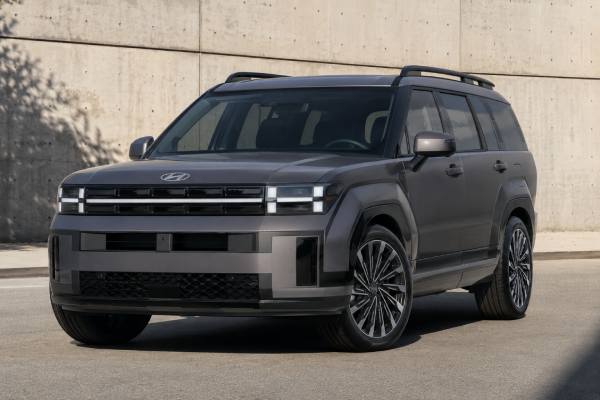
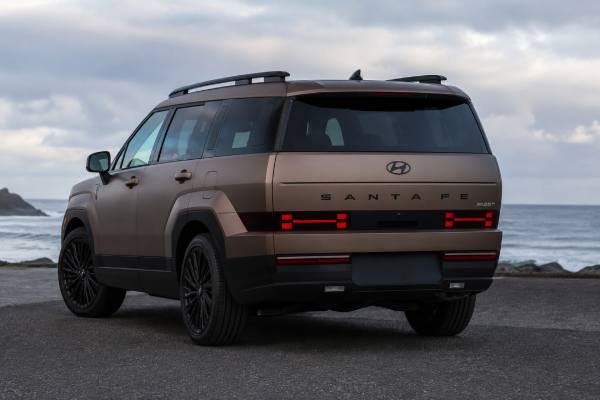
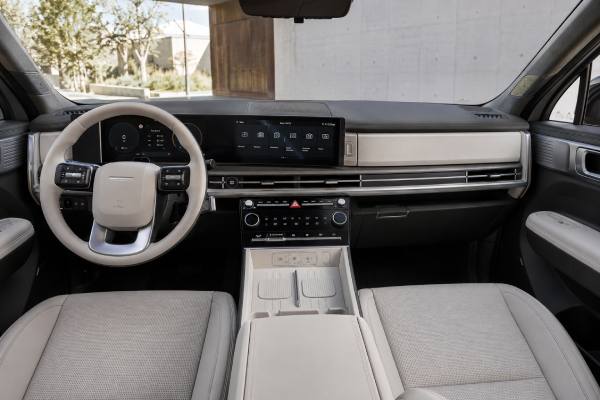
The fifth-generation Hyundai Santa Fe takes a very different approach from the softer, rounded models that came before it. In MX5 form, it is larger, more upright, more family-focused, and much more obviously shaped around space, technology, and electrified drivability. The 1.6 T-GDi plug-in hybrid 4WD version sits near the practical high end of the range: it combines a turbocharged petrol engine, a sizeable hybrid battery, electric-only driving for shorter trips, and all-wheel-drive traction for poor weather or light outdoor use.
This is not a performance SUV in the traditional sense. Its appeal is the mix of seven-seat usability, low-emission urban driving when charged, strong equipment levels, and a calmer long-distance character than its boxy styling might suggest. The main caveat is that the Santa Fe PHEV is complex, heavy, and market-dependent in specification, so careful attention to service history, software updates, recall completion, and charging habits matters more than it would on a simpler petrol SUV.
Quick Overview
- Strong advantages include a roomy 5-door SUV body, 4WD traction, a smooth 6-speed automatic, and up to 54.2 km WLTP electric driving range.
- The 13.8 kWh lithium-ion battery and 3.3–3.6 kW onboard charger suit home charging rather than rapid public charging.
- Official launch-calibration output is 253 PS, with 0–100 km/h in about 9.3 seconds and a 180 km/h top speed.
- Ownership caveats include early-model software/recall checks, hybrid cooling-system care, and brake corrosion checks because regenerative braking reduces friction-brake use.
- Normal maintenance for the Smartstream 1.6 T-GDi is commonly listed at 10,000 km or 12 months for oil and filter, with severe use shortening oil service to about 5,000 km.
Table of Contents
- Hyundai Santa Fe MX5 PHEV Profile
- Hyundai Santa Fe MX5 Technical Specs
- Hyundai Santa Fe MX5 Trims And Safety
- Reliability And Service Actions
- Maintenance And Buyer Checks
- Driving Performance And Efficiency
- Rivals And Buying Alternatives
Hyundai Santa Fe MX5 PHEV Profile
The Hyundai Santa Fe MX5 PHEV is a mid-size, three-row plug-in hybrid SUV built around a transverse front-mounted 1.6-litre turbocharged petrol engine, an integrated electric motor, a 6-speed automatic transmission, and 4WD. In European launch specification, the plug-in hybrid was listed at 253 PS, with the PHEV offered only with 4WD in the main technical data. It is a 5-door SUV with 5-, 6-, or 7-seat layouts depending on market and trim, although many right-hand-drive retail configurations focus on seven seats as standard, with a six-seat captain’s-chair option on higher trims.
The MX5 generation is visibly more practical and upright than the previous TM Santa Fe. Its square tailgate, long roofline, and broad cabin are not just styling choices; they help cargo access, third-row packaging, and headroom. The trade-off is bulk. At 4,830 mm long and 1,900 mm wide, this Santa Fe needs more space than a compact SUV, and the turning circle is noticeable in tight city parking.
The PHEV version is best understood as a family SUV for drivers who can charge regularly. Used properly, it can cover commuting, school runs, and local errands on electric power more often than a conventional hybrid. Once the battery is depleted, it behaves like a heavy petrol hybrid rather than an EV, so fuel economy becomes more dependent on speed, terrain, temperature, and load. For motorway drivers who rarely plug in, the self-charging hybrid may be simpler and lighter; for owners with home charging and daily short trips, the plug-in version makes far more sense.
The 4WD system is intended for traction and stability rather than serious off-road use. Snow, mud, and sand modes can help the vehicle manage throttle response and traction control on loose or slippery surfaces, but the Santa Fe’s long body, road-biased tyres, and modest ground clearance keep it in the light-adventure category. It is suitable for wet roads, gravel tracks, campsites, and winter conditions, not rock crawling or deep-rut trails.
As a used or nearly new buy, the main attraction is breadth of ability. The Santa Fe PHEV offers quiet low-speed running, flexible seating, good safety equipment, and strong equipment levels. The main checks are whether the car has been charged and serviced correctly, whether all recalls and software campaigns are complete, and whether the buyer understands that real-world economy depends heavily on plugging in.
Hyundai Santa Fe MX5 Technical Specs
The following data reflects the 1.6 T-GDi PHEV 4WD launch specification used in European/UK context where the 253 PS plug-in hybrid is offered. Figures can vary by market, model year, trim, seating layout, wheels, and homologation update.
| Item | Hyundai Santa Fe MX5 1.6 T-GDi PHEV 4WD |
|---|---|
| Engine code | Smartstream G1.6 T-GDi family, commonly listed as G4FT/G4F-family depending on market documentation; verify by VIN |
| Engine layout | Transverse inline-4, DOHC, 4 valves per cylinder, 16 valves total |
| Bore × stroke | 75.6 × 89.0 mm, 2.98 × 3.50 in |
| Displacement | 1.6 L, 1,598 cc |
| Induction and fuel system | Turbocharged, petrol direct injection, Euro 6e-market dependent |
| Compression ratio | 10.5:1 |
| Timing drive | Timing chain |
| Electric motor | Permanent magnet synchronous motor, single traction motor integrated with the front powertrain; mechanical 4WD to rear axle |
| Motor output | 72 kW and 304 Nm |
| System voltage | 360 V |
| Battery | 13.8 kWh lithium-ion polymer pack; exact cell chemistry should be confirmed by battery label or VIN data |
| Maximum power | 253 PS, about 249 hp, about 186 kW; market documents may round or format kW differently |
| Maximum torque | Hyundai-listed 367 Nm, 271 lb-ft, at 1,000–5,100 rpm for the PHEV system data; petrol engine torque is commonly listed separately around 265 Nm |
| Rated efficiency | WLTP weighted combined around 38 g/km CO2; charge-sustaining petrol consumption listed around 7.6 L/100 km, about 30.9 mpg US or 37.2 mpg UK |
| Electric range | Up to 54.2 km WLTP, about 33.7 miles |
| Real-world highway at 120 km/h | Not an official fixed rating; expect roughly 8.0–9.5 L/100 km, about 29–24.8 mpg US or 35–29.7 mpg UK, once the battery is in charge-sustaining mode |
| Item | Specification |
|---|---|
| Transmission | 6-speed automatic transmission; 1st 4.639, 2nd 2.826, 3rd 1.841, 4th 1.386, 5th 1.000, 6th 0.772, reverse 3.385, final drive 3.648 |
| Drive type | 4WD/AWD; open differentials, electronically managed traction and stability control, terrain modes on equipped models |
| Suspension | Front MacPherson struts, rear multi-link |
| Steering | Rack-mounted electric power steering, 2.53 turns lock-to-lock; ratio not published in main EU technical sheet |
| Brakes | Ventilated discs front and rear, 325 mm, 12.8 in, with ABS and electronic brake-force distribution |
| Popular wheel and tyre size | 255/45 R20 on 8.5J × 20 in wheels; some non-PHEV or market variants use 18 in wheels |
| Ground clearance | 177 mm, 7.0 in |
| Length / width / height | 4,830 / 1,900 / 1,720–1,770 mm, 190.2 / 74.8 / 67.7–69.7 in, depending on roof rails |
| Wheelbase | 2,815 mm, 110.8 in |
| Turning circle | 11.6 m kerb-to-kerb, 38.1 ft, based on 5.8 m turning radius |
| Kerb weight | About 2,035–2,145 kg, 4,486–4,729 lb, depending on trim and seating |
| GVWR | 2,670–2,740 kg, 5,886–6,041 lb, depending on seating |
| Fuel tank | 47 L, 12.4 US gal, 10.3 UK gal |
| Cargo volume | VDA: 704 L seats up for 5-seat PHEV, 621 L for 6/7-seat PHEV; up to 2,025 L or 1,942 L seats down respectively |
| Item | Specification or guidance |
|---|---|
| 0–100 km/h | 9.3 seconds |
| Top speed | 180 km/h, 112 mph |
| 100–0 km/h braking | Not published as a factory specification; tyre condition, load, and surface matter more than a fixed quoted number |
| Towing capacity | 1,010 kg braked, 2,227 lb; 750 kg unbraked, 1,653 lb, for the 253 PS launch PHEV data |
| Payload | About 580–660 kg, 1,279–1,455 lb, depending on seating and trim |
| Engine oil | SAE 0W-20, API SN PLUS/SP or ILSAC GF-7 where specified; drain and refill about 4.8 L, 5.1 US qt |
| Coolant | Ethylene-glycol coolant for aluminium radiator, mixed with distilled water; about 8.5 L, 9.0 US qt, for Smartstream G1.6 T-GDi documents |
| Automatic transmission fluid | Hyundai Genuine ATF SP-IV or equivalent listed SP-IV fluid; about 6.5 L, 6.9 US qt |
| Rear differential oil | API GL-5 SAE 75W/85 hypoid gear oil; about 0.4–0.5 L, 0.42–0.53 US qt |
| Transfer case oil | API GL-5 SAE 75W/85 hypoid gear oil; about 0.62–0.68 L, 0.66–0.72 US qt |
| Brake fluid | DOT 4 |
| A/C refrigerant and oil | R-1234yf and electric-compressor POE oil on hybrid/PHEV applications; exact charge must be read from the under-bonnet label |
| Key torque values | Oil drain plug commonly listed around 39 Nm, 29 lb-ft; wheel nuts and high-voltage fasteners must be verified by official service data for the VIN |
For safety data, Euro NCAP lists the Santa Fe with 84% adult occupant, 88% child occupant, 70% vulnerable road user, and 69% safety assist scores for the standard-equipment rating. The same model can achieve a higher star outcome with the relevant safety pack in applicable markets. IIHS testing for the 2024 Santa Fe records Top Safety Pick status in the United States, with Good small-overlap and updated-side results, Acceptable headlights, and Good front-crash-prevention ratings; U.S. IIHS results may not map exactly to a European PHEV trim.
Hyundai Santa Fe MX5 Trims And Safety
Trim names vary by country, but the launch pattern in the UK and parts of Europe centred on well-equipped grades such as Premium, Ultimate, and Calligraphy. The PHEV 4WD powertrain was positioned above the regular hybrid in price and complexity, with the main mechanical package remaining broadly consistent across trims: 1.6 T-GDi plug-in hybrid system, 6-speed automatic, 4WD, 20-inch wheels in many retail specifications, and three-row seating.
The main differences are usually equipment rather than core drivetrain hardware. Higher grades tend to add comfort, visibility, parking, and driver-assistance features rather than more power. Depending on market and model year, look for:
- Larger digital displays and navigation-linked connected services.
- Dual wireless phone charging, additional USB-C ports, and upgraded cabin trim.
- BOSE premium audio on higher trims.
- Relaxation front seats and, where offered, second-row captain’s chairs.
- Surround View Monitor, Blind-Spot View Monitor, Digital Centre Mirror, and Remote Smart Parking Assist on upper grades or option packs.
- More complete ADAS equipment through safety packs in countries where the base car is not supplied with every system.
Quick identifiers are straightforward. PHEV models normally carry plug-in hybrid badging, have an external charge port, display EV/hybrid energy information in the instrument cluster, and use a 13.8 kWh battery pack. A 7-seat cabin has a second-row bench and third-row access folding; a 6-seat configuration has individual second-row captain’s chairs. Calligraphy-style trims usually have the richest upholstery, more exterior detailing, and the broadest technology equipment.
Safety equipment is one of the MX5 Santa Fe’s strengths, but availability should still be checked by trim and market. The structure uses more advanced high-strength steel than the previous generation, and many versions have 10 airbags, including a centre side airbag, driver knee airbag, second-row side airbags, and curtain coverage extending to the third row. ISOFIX/LATCH child-seat points are fitted in the rear rows depending on seating layout and market, with the third row specifically supported in some European specifications.
Driver-assistance systems can include Forward Collision-Avoidance Assist with vehicle, pedestrian, and cyclist detection; lane keeping and lane following assistance; adaptive cruise control; speed limit assistance; blind-spot monitoring; rear cross-traffic collision-avoidance; Safe Exit Assist; and Highway Driving Assist 2 where fitted. These systems are useful but calibration-sensitive. After windscreen replacement, front bumper work, suspension alignment, steering-angle sensor work, or camera/radar replacement, proper ADAS calibration is not optional. A car that pulls gently in lane support, brakes late in AEB demonstrations, or shows camera/radar warnings may simply need calibration or software, but it should be checked before purchase.
The safest buying approach is to compare the actual build sheet against the market’s safety rating conditions. A Santa Fe with the full safety pack is preferable if Euro NCAP star outcome is a priority, while U.S. IIHS data should be treated as useful but not identical evidence for European PHEV trims.
Reliability And Service Actions
The MX5 Santa Fe PHEV is still a young model, so long-term reliability patterns are not as mature as they are for the earlier TM generation. That does not mean it should be treated as risky by default, but it does mean early ownership quality, recall completion, and software history matter. A plug-in hybrid combines petrol-engine, automatic-transmission, high-voltage, charging, cooling, and ADAS systems; most serious issues are more likely to come from neglected updates or poor diagnosis than from routine wear alone.
| Area | Prevalence | Severity/cost tier | Symptoms | Likely remedy |
|---|---|---|---|---|
| Software, infotainment, connectivity | Occasional | Low to medium | Black screen, Bluelink dropout, camera messages, OTA update prompts | Dealer software update, infotainment reset, module check |
| ADAS sensor calibration | Occasional after repair | Medium | Lane support warnings, radar blocked messages, uneven lane centring | Camera/radar calibration and alignment check |
| Regen-brake corrosion | Common in wet/salty climates | Low to medium | Grooved discs, brake noise, pulsing, rust lip on rotors | Regular friction-brake use, inspection, pad/rotor replacement if needed |
| 12 V battery weakness | Occasional | Low to medium | No-start condition, warnings, sleeping electronics, remote-service issues | Battery test, parasitic draw check, software update, battery replacement |
| High-voltage battery degradation | Rare so far | High | Reduced EV range, charging fault, abnormal state-of-charge swings | Dealer diagnostic scan, battery state-of-health report, cooling-system checks |
| Charging hardware | Occasional | Medium to high | AC charge interruption, charge-port lock fault, onboard charger warning | Inspect cable, wallbox, charge port, OBC software and hardware |
For the petrol engine, the Smartstream 1.6 T-GDi uses a timing chain rather than a scheduled timing belt. That reduces routine belt-service cost, but it does not make the timing system maintenance-free. On a used example, listen for chain rattle on cold start, check for cam/crank correlation fault codes, and avoid cars with poor oil-change history. Turbocharged direct-injection engines are sensitive to oil quality, heat cycles, and short-trip operation. Occasional hard starts, misfires, or rough idle can come from plugs, coils, injectors, fuel quality, or intake deposits, so diagnosis should be data-led rather than guesswork.
The 6-speed automatic is a plus compared with more complicated dual-clutch behaviour in some non-hybrid petrol SUVs. It should shift smoothly, without flare, harsh engagement, or repeated hunting. Because the electric motor is integrated into the hybrid powertrain, transitions between EV and petrol running should be nearly seamless during gentle driving. Jerks, clunks, or repeated warning lights need a hybrid-system scan, not just a generic OBD check.
Electrified-specific checks include the battery coolant circuit, inverter and hybrid power-control unit, DC–DC converter, contactors, charge port, onboard charger, and reduction/gear oil service where specified. A pre-purchase inspection should include a high-voltage battery state-of-health report where the dealer tool allows it. It should also confirm that the car charges correctly from a known good AC supply and that charge scheduling, preconditioning, and remote app functions work.
Known service actions and recalls vary by country and VIN. Certain MX5 Santa Fe and Santa Fe Hybrid vehicles have been subject to wiring-harness recalls or checks related to the rear-seat/floor harness area, with possible airbag implications if damaged. Some markets have also had rear-view-camera or software-related campaigns on Santa Fe-family vehicles. The exact PHEV applicability is VIN-specific, so the correct process is to run the VIN through Hyundai’s official recall portal and ask the dealer for a printed campaign completion record.
Maintenance And Buyer Checks
The Santa Fe PHEV rewards conservative maintenance. It may use less petrol on short trips, but the engine still cold-starts, shuts down, restarts, and sometimes runs under load when the vehicle is already moving. That is demanding in its own way. Regular oil changes, correct coolant, proper ATF, and clean software records are the foundation of long-term durability.
| Interval | Work to prioritise |
|---|---|
| Every month | Check tyre pressures, lights, washer fluid, coolant level when cold, visible leaks, charge-port condition, and brake-disc surface condition |
| Every 10,000 km or 12 months | Replace engine oil and filter; inspect brakes, suspension, steering, tyres, cooling hoses, driveshaft boots, hybrid warning history, and software updates |
| Severe use, about every 5,000 km | Short trips, heavy traffic, dusty roads, mountain driving, towing, very cold climates, or repeated high-load use justify shorter oil intervals |
| Every 20,000–40,000 km | Replace cabin air filter as needed; inspect or replace engine air filter; inspect brake fluid condition; check alignment and tyre wear |
| Every 70,000 km | Replace spark plugs on schedules that specify this interval for Smartstream 1.6 T-GDi |
| Every 100,000 km under severe use | Replace automatic transmission fluid where the severe-use schedule calls for it |
| Every 120,000 km under severe use | Replace transfer case and rear differential oil where specified; inspect propeller shaft and AWD components |
| First 200,000 km or 120 months | Replace engine coolant where the long-life coolant schedule applies, then replace at shorter follow-up intervals |
| Every 3–5 years | Test the 12 V battery; replacement timing depends on climate, accessory load, and usage |
Use only fluids that match the official specification. The engine oil requirement is low-viscosity full-synthetic 0W-20 with the correct API/ILSAC rating. The automatic transmission requires SP-IV-type ATF, not a universal fluid chosen only by viscosity. The rear differential and transfer case require GL-5 75W/85 hypoid gear oil. Brake fluid is DOT 4. Coolant must be compatible with Hyundai aluminium-engine and hybrid cooling requirements. The A/C system on the PHEV uses an electric compressor, so compressor oil choice is important; the under-bonnet label and service manual must be followed.
A buyer’s inspection should start with documents. Ask for the service book or digital records, invoices showing oil grade and mileage, recall completion printout, warranty status, and any battery or charging-system work. Then inspect the vehicle cold. Listen for chain rattle, check idle quality when the petrol engine starts, look for coolant staining, inspect underbody panels for damage, and make sure the charging cable and port are undamaged.
During the road test, check that the vehicle can drive in EV mode, switch smoothly to hybrid operation, accelerate without hesitation, and brake cleanly without scraping or pulsation. Test reverse camera, 360-degree camera if fitted, blind-spot displays, adaptive cruise, lane support, parking sensors, heated/ventilated seats, all USB ports, rear climate controls, and the power tailgate. On 6- or 7-seat cars, fold every row and inspect the harness areas under and behind the rear seats for signs of interference or previous repair.
Recommended versions are usually the better-equipped trims with complete ADAS and camera systems, provided the price is sensible and service history is clean. Avoid cars with missing charging cables, incomplete recalls, persistent warning lights, mismatched tyres, unexplained coolant loss, or vague statements about hybrid battery health. The long-term durability outlook is positive if the vehicle is maintained correctly, but neglect will be expensive because powertrain, charging, and ADAS systems overlap.
Driving Performance And Efficiency
The Santa Fe PHEV drives with a comfort-first personality. The body is tall and square, but the chassis is not loose or old-fashioned. Straight-line stability is good, the ride is composed on main roads, and the suspension deals well with family use, luggage, and uneven surfaces. The 20-inch tyre package can introduce more firmness over sharp edges than an 18-inch setup would, but the PHEV’s weight also helps it feel settled.
Steering is light to medium in effort, with enough accuracy for a large family SUV but limited feedback. In corners, the Santa Fe feels secure rather than eager. It will tolerate brisk driving, but it does not encourage it. The front end is predictable, the rear stays planted, and stability control is tuned for safety. The main reminder of size is not body roll so much as width and turning circle. In town, the camera systems and parking sensors are worth having.
Power delivery is smooth when the battery has charge. The electric motor fills low-speed response, so the Santa Fe moves away cleanly and quietly. In gentle use, the transition from EV to petrol running is usually subtle. When stronger acceleration is requested, the 1.6-litre turbo engine works harder and can sound more strained than a larger-displacement engine would, but the 6-speed automatic avoids the rubber-band feel of some hybrid CVT systems. Kickdown is measured rather than aggressive, which fits the vehicle’s character.
Performance is adequate for a fully loaded family SUV. The 9.3-second 0–100 km/h figure is not quick by modern EV standards, but it is enough for motorway merging and normal overtaking. Passing performance depends heavily on battery state, drive mode, incline, and load. With the battery depleted, the car still has hybrid assistance, but it feels less effortless than it does immediately after charging.
Real-world economy is highly usage-dependent. In daily use with regular charging, many owners can complete short urban trips using little or no petrol. In mixed driving, a realistic result may range from very low fuel use over short charged trips to conventional-hybrid-like figures once the battery is depleted. In charge-sustaining mode, expect roughly 7.0–8.5 L/100 km in moderate mixed use, about 33.6–27.7 mpg US or 40.4–33.2 mpg UK. At 120 km/h, the boxy shape and weight make 8.0–9.5 L/100 km a more realistic planning range.
Electric range also changes with weather. The WLTP figure of 54.2 km is achievable only in favourable conditions and gentle use. Cold weather, wet roads, high cabin-heat demand, roof loads, winter tyres, and motorway speed can reduce electric range noticeably. A practical winter expectation is often 20–35% less than mild-weather range.
Charging is simple but not fast. The onboard AC charger is rated around 3.3–3.6 kW depending on supply voltage. A 10–80% charge can take roughly 2–2.5 hours under good AC conditions, while a near-empty to full charge is typically an overnight or several-hour home-wallbox task. There is no DC rapid charging, which is normal for many PHEVs of this type.
For towing, the 253 PS launch PHEV’s 1,010 kg braked rating is modest for such a large SUV. It can manage small trailers, light leisure loads, or compact camping gear, but buyers wanting to tow a heavy caravan should verify later model-year ratings or consider a rival with a higher certified tow limit. With a trailer or full cabin, expect fuel consumption to rise substantially and EV range to fall quickly.
Rivals And Buying Alternatives
The Santa Fe PHEV sits in a crowded but uneven field. Its strongest selling point is the combination of plug-in hybrid ability and generous family packaging. Many PHEV SUVs offer five seats, while many three-row SUVs are conventional hybrids or petrol models. That makes the Hyundai attractive for families who need occasional third-row use but still want electric commuting.
The Kia Sorento PHEV is the closest mechanical and conceptual rival. It offers similar plug-in hybrid logic, family space, and warranty appeal, with a slightly different cabin and brand positioning. The Sorento may feel a little less visually adventurous, which some buyers will prefer. The Santa Fe counters with bolder styling, a more modern-feeling cabin in MX5 form, and excellent cargo access.
The Toyota RAV4 Plug-in Hybrid is stronger for performance and efficiency, and Toyota’s hybrid reputation remains a major advantage. However, the RAV4 is a smaller five-seat SUV, so it cannot match the Santa Fe’s three-row practicality. Buyers choosing between them should decide whether space or powertrain efficiency matters more.
The Mazda CX-90 PHEV, where sold, offers a more premium-feeling longitudinal platform and stronger towing credentials in some markets. It is also larger and can be more expensive to buy and run. Its plug-in hybrid system has a different character, and Mazda’s cabin quality may appeal to drivers who want a more driver-focused SUV.
The Volvo XC90 Recharge is a more expensive, premium alternative. It has more power, a luxury image, and a long-standing three-row format, but purchase price, repair costs, tyres, and insurance can all be higher. A used XC90 may look tempting next to a new Santa Fe, but maintenance exposure is very different.
The Skoda Kodiaq, Peugeot 5008, and similar European three-row SUVs are worth considering for buyers who care more about space and running costs than plug-in performance. Some are not true PHEV alternatives in all markets, but they can be cheaper and simpler.
The Santa Fe PHEV makes the most sense when three conditions are true: charging is easy, third-row or large-cargo flexibility matters, and the buyer wants a highly equipped SUV without moving fully into premium-brand pricing. It is less compelling for high-mileage motorway drivers who rarely charge, for heavy towing, or for buyers who want sporty handling. As a practical family plug-in hybrid, though, it is one of the more complete large-SUV choices in its class.
References
- Hyundai SANTA FE | Technical Data | Updated: August 2024 2024 (Manufacturer Technical Data)
- Normal Maintenance Schedule (Smartstream 1.6 T-GDi) 2025 (Owner’s Manual)
- Recommended lubricants and capacities 2025 (Owner’s Manual)
- Hyundai SANTA FE 2024 (Safety Rating)
- 2024 Hyundai Santa Fe 2024 (Safety Rating)
Disclaimer
This article is for informational purposes only and is not a substitute for professional diagnosis, repair, or official service documentation. Specifications, torque values, service intervals, fluids, procedures, safety equipment, and recall applicability can vary by VIN, market, model year, trim, and equipment. Always verify the exact data for the vehicle against Hyundai’s official owner’s manual, workshop information, recall database, and dealer records.
If you found this useful, please consider sharing it on Facebook, X/Twitter, or your preferred platform to support our work.