
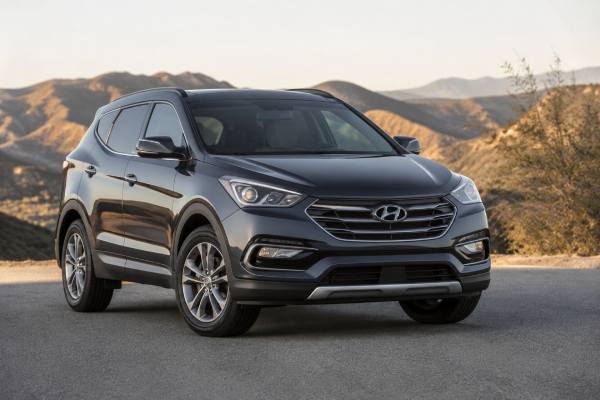
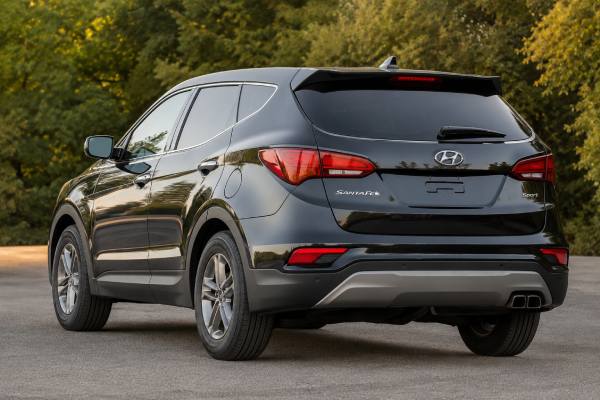
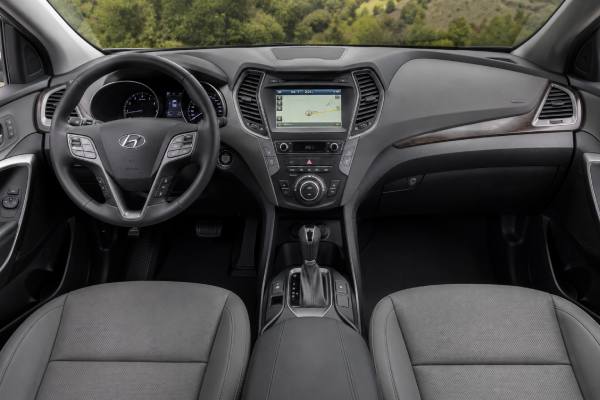
The facelifted 2017–2018 Hyundai Santa Fe Sport FWD with the 2.4-liter GDI engine is the simpler, naturally aspirated version of Hyundai’s two-row DM-generation crossover. It sits between compact family SUVs and larger midsize models: roomier than many rivals in the back seat and cargo area, but still easier to park than a three-row Santa Fe.
For used buyers, its appeal is straightforward. It offers good cabin space, a comfortable ride, useful equipment, and a conventional six-speed automatic transmission. The main caution is the Theta II 2.4 GDI engine family, which requires careful service history checks, recall verification, and close attention to oil level, engine noise, and Hyundai campaign status.
Quick Overview
- Spacious two-row cabin, large cargo area, and a comfortable highway ride make it a practical family SUV.
- The 185 hp 2.4 GDI engine is smooth enough for daily use, but not quick when fully loaded.
- Fuel economy is reasonable rather than class-leading: officially about 9.8 L/100 km combined, or 24 mpg US.
- Engine-related campaigns, oil consumption, and rod-bearing concerns make service history especially important.
- Normal oil service is commonly every 7,500 miles or 12 months; severe-use service is often shortened to 3,750 miles or 6 months.
Table of Contents
- Santa Fe Sport DM Used Overview
- Santa Fe Sport DM Technical Specs
- Santa Fe Sport DM Trims and Safety
- Reliability and Known Service Actions
- Maintenance Schedule and Buyer Checks
- Driving Feel and Real Performance
- Santa Fe Sport Versus Rivals
Santa Fe Sport DM Used Overview
The 2017–2018 Santa Fe Sport is the five-seat, short-wheelbase version of the third-generation Santa Fe platform. In North America, “Sport” identified the two-row model, while the longer Santa Fe handled three-row duty. The 2017 facelift brought sharper exterior lighting, revised bumpers, updated infotainment availability, and more advanced safety equipment on upper trims.
This specific model is the front-wheel-drive 2.4 GDI version. It uses Hyundai’s Theta II 2.4-liter naturally aspirated direct-injection four-cylinder engine, rated at 185 hp and 178 lb-ft. Power goes through a six-speed torque-converter automatic with SHIFTRONIC manual selection. There is no turbocharger, no hybrid hardware, no dual-clutch transmission, and no transfer case on the FWD model.
That mechanical simplicity is one of its advantages. Compared with the 2.0T AWD versions, the 2.4 FWD has fewer driveline components, lower tire and brake demands, and generally lower purchase prices. It is also less mechanically stressed than the turbocharged model. The trade-off is performance. The 2.4 is adequate for commuting, school runs, and moderate highway use, but it needs revs for passing and feels slower with passengers, cargo, or steep grades.
The Santa Fe Sport’s main strengths are space, comfort, and value. The rear seat is generous, the cargo area is square and useful, and the cabin feels more substantial than many compact SUVs from the same period. The suspension favors comfort over sharp handling, which suits the vehicle’s family role.
The main ownership risk is engine history. The 2.4 GDI belongs to an engine family that has had significant Hyundai service campaigns, warranty extensions, and diagnostic updates related to bearing wear and knock detection. Not every vehicle will fail, and many run high mileages with clean oil and completed campaigns, but this is not a model to buy without records. A quiet cold start, clean oil-change history, completed recalls, and a Hyundai VIN check matter more than cosmetic condition.
Overall, the Santa Fe Sport 2.4 FWD works best for buyers who want a roomy, comfortable, value-focused crossover and are willing to inspect it carefully before purchase. It is less ideal for drivers who tow often, climb mountain roads fully loaded, or expect compact-SUV fuel economy with midsize-SUV space.
Santa Fe Sport DM Technical Specs
The following specifications focus on the North American 2017–2018 Hyundai Santa Fe Sport FWD 2.4 GDI. Some figures vary by market, trim, wheel package, equipment, and VIN, so service work should always be checked against the exact vehicle.
| Item | Hyundai Santa Fe Sport FWD 2.4 GDI |
|---|---|
| Engine code / family | Theta II 2.4 GDI, commonly G4KJ family |
| Layout | Inline-4, DOHC, 16 valves, 4 valves/cylinder |
| Bore × stroke | 88.0 × 97.0 mm (3.46 × 3.82 in) |
| Displacement | 2.4 L, about 2,359 cc |
| Induction | Naturally aspirated |
| Fuel system | Gasoline direct injection |
| Compression ratio | 11.3:1 |
| Maximum power | 185 hp (138 kW) @ 6,000 rpm |
| Maximum torque | 241 Nm (178 lb-ft) @ 4,000 rpm |
| Timing drive | Chain |
| Official efficiency | 11.2 / 8.7 / 9.8 L/100 km city/highway/combined; 21 / 27 / 24 mpg US; 25.2 / 32.4 / 28.8 mpg UK |
| Real-world highway at 120 km/h | Typically about 9.0–10.5 L/100 km, depending on wind, tires, load, and temperature |
| Item | Specification |
|---|---|
| Transmission | 6-speed electronic automatic, A6MF2-family, SHIFTRONIC manual mode |
| Drive type | Front-wheel drive |
| Final drive | 3.510:1 on the base 2.4 FWD media specification |
| Differential | Open front differential with electronic traction and stability control |
| Item | Specification |
|---|---|
| Front suspension | MacPherson strut with gas-filled dampers and stabilizer bar |
| Rear suspension | Multi-link with gas shock absorbers and stabilizer bar |
| Steering | Motor-driven power steering; 15.01:1 ratio; 2.95 turns lock-to-lock |
| Brakes | Front ventilated discs 320 mm (12.6 in); rear solid discs 302 mm (11.9 in) |
| Popular tire size | P235/65 R17 on 17 × 7.0J alloy wheels |
| Length / width / height | 4,699 / 1,880 / 1,679 mm (185.0 / 74.0 / 66.1 in); 1,689 mm (66.5 in) with roof rack |
| Wheelbase | 2,700 mm (106.3 in) |
| Turning circle | 10.9 m (35.8 ft), curb-to-curb |
| Curb weight | About 1,644 kg (3,624 lb) |
| GVWR | About 2,210 kg (4,872 lb) |
| Payload estimate | About 566 kg (1,248 lb), depending on equipment |
| Fuel tank | 65.9 L (17.4 US gal / 14.5 UK gal) |
| Cargo volume | 1,002 L (35.4 ft³) behind second row; 2,025 L (71.5 ft³) behind front seats, SAE method |
| Item | Figure or Note |
|---|---|
| 0–100 km/h | Typically about 9.8–10.5 seconds in independent-use conditions |
| Top speed | Not a major published U.S. figure; comparable markets are generally around 185–190 km/h (115–118 mph) |
| 100–0 km/h braking | Often around 38–41 m (125–135 ft) in independent testing, tire and surface dependent |
| Towing capacity | 907 kg (2,000 lb) braked; 748 kg (1,650 lb) unbraked in U.S. media specifications |
| Engine oil | SAE 5W-30 preferred in many manuals; API SM / ILSAC GF-4 or later-compatible specification; 4.8 L (5.1 US qt) with filter |
| Coolant | Ethylene-glycol coolant for aluminum engines, normally mixed 50/50 with distilled water; full capacity must be verified by VIN and service manual |
| Automatic transmission fluid | Hyundai/Kia ATF SP-IV type; total fill commonly about 7.1 L (7.5 US qt), service exchange amount varies |
| FWD differential / transfer case | No separate rear differential or transfer case on FWD models |
| A/C refrigerant | Usually R-134a on North American 2017–2018 vehicles; market and label verification required |
| A/C charge range | Typically about 600 g (21.2 oz) without rear evaporator in DM data; verify under-hood label |
| Key torque values | Wheel nuts commonly around 108–127 Nm (80–94 lb-ft); oil drain plug often around 39 Nm (29 lb-ft); verify before service |
For safety, the North American Santa Fe Sport received strong IIHS results for the 2017–2018 structure, including Good ratings in several core crashworthiness categories. Passenger-side small overlap was rated Acceptable. The 2018 Top Safety Pick+ award applied only to vehicles with optional front crash prevention and specific headlights built after June 2017. NHTSA listed a five-star overall rating for the model family, with rollover typically rated four stars. Euro NCAP does not provide a directly equivalent rating for this exact U.S.-market Santa Fe Sport FWD DM configuration.
Santa Fe Sport DM Trims and Safety
For 2017–2018, the Santa Fe Sport lineup centered on three main U.S. grades: the 2.4 base model, 2.0T, and 2.0T Ultimate. This article’s vehicle is the 2.4 FWD, but many used listings include option packages that can make two base 2.4 models feel very different.
The standard 2.4 model included the 185 hp engine, six-speed automatic, front-wheel drive, 17-inch alloy wheels, rearview camera, Bluetooth, steering-wheel controls, air conditioning, and a 40/20/40 split-folding second-row seat. AWD was optional when new, but the FWD model is mechanically simpler and lighter.
The 2018 Value Package is worth looking for because it made the base 2.4 feel much more modern. It added features such as 7-inch display audio, Android Auto, Apple CarPlay, dual-zone automatic climate control, Blue Link, proximity key, push-button start, power driver seat, heated front seats, LED daytime running lights, fog lights, and roof rails. The Premium Package added leather seating, blind-spot detection, rear cross-traffic alert, lane-change assist, a hands-free liftgate, power passenger seat, sliding second-row seats, auto-dimming mirror, and upgraded interior trim. The Tech Package added luxury and parking features such as panoramic sunroof, navigation, multi-view camera, Infinity audio, memory settings, heated steering wheel, heated rear seats, ventilated front seats, and rear parking sensors.
| Feature | What It Usually Indicates |
|---|---|
| 17-inch wheels, cloth seats, 5-inch screen | Base 2.4 with few options |
| 7-inch screen, push-button start, heated front seats | 2.4 Value Package |
| Leather, blind-spot detection, smart liftgate | 2.4 Premium Package |
| Panoramic roof, 8-inch navigation, 360-degree camera | 2.4 Tech Package |
| 2.0T badge, 18- or 19-inch wheels | Turbo model, outside this exact 2.4 FWD scope |
Safety equipment includes front airbags, front side-impact airbags, side curtain airbags, ABS, electronic brake-force distribution, brake assist, stability control, traction control, tire-pressure monitoring, and LATCH child-seat anchors. Blind-spot detection and rear cross-traffic alert were optional on the 2.4 and standard on higher turbo trims. Lane departure warning, smart cruise control, automatic emergency braking with pedestrian detection, high-beam assist, and advanced headlight equipment were concentrated in upper packages, especially the Ultimate Tech Package on 2.0T Ultimate.
On used examples, do not assume a Santa Fe Sport has AEB or adaptive cruise simply because it is a facelift model. Check the steering-wheel buttons, instrument cluster menus, front radar area, windshield camera area, and original window sticker. If the windshield, front bumper, grille, radar sensor, steering angle sensor, or alignment has been serviced, calibration records are important for ADAS-equipped vehicles.
Reliability and Known Service Actions
The Santa Fe Sport 2.4 FWD can be a durable vehicle, but its reliability profile is dominated by the Theta II GDI engine family. The most serious concern is connecting-rod bearing wear, which can lead to knocking, reduced power, warning lights, limp mode, stalling, or engine replacement. Hyundai issued engine-related recalls, product improvement campaigns, knock-sensor software updates, and warranty extensions for affected Theta II GDI vehicles. Coverage depends on VIN, market, campaign completion, maintenance evidence, and the exact failure pattern.
A common warning sign is diagnostic trouble code P1326 after the Knock Sensor Detection System detects vibration consistent with bearing distress. Some vehicles receive an ECU update; others require inspection and, if criteria are met, engine replacement. A buyer should ask for proof that the applicable engine monitoring campaign has been completed and should verify the VIN with Hyundai, not only with a generic vehicle-history report.
| Issue | Prevalence | Cost Tier | Typical Clues | Best Response |
|---|---|---|---|---|
| Theta II bearing wear / P1326 | Known concern | High | Metallic knock, limp mode, flashing check-engine light, low oil pressure light | Stop driving, tow to Hyundai dealer, verify campaign and warranty coverage |
| Oil consumption | Occasional | Medium to high | Oil level drops between services, smoke, fouled plugs, catalyst stress | Document consumption test, inspect PCV system, cylinders, and service history |
| GDI carbon buildup | Occasional with short trips | Medium | Rough idle, misfire, hesitation, intake deposits | Diagnosis first; intake cleaning if confirmed |
| VCM / intake manifold faults | Occasional | Low to medium | Check-engine light, intake runner codes, poor response | Inspect actuator and lever; repair kit may avoid full manifold replacement |
| Six-speed automatic shift harshness | Occasional | Medium | Delayed engagement, flare, harsh downshift | Check fluid condition, scan TCM, apply updates, service with correct ATF |
| Suspension wear | Common with age | Low to medium | Clunks, wandering, uneven tire wear | Inspect sway-bar links, struts, bushings, ball joints, alignment |
| ABS module fire-risk recall | VIN-dependent | Recall repair | May have no symptom before recall notice | Verify completion; follow park-outside guidance if unrepaired |
The 2018 model is especially important to check for ABS-related recall work. Hyundai and NHTSA identified affected Santa Fe Sport vehicles in which the ABS module could malfunction internally and create an electrical short, raising engine-compartment fire risk. The remedy involved dealer recall work, including fuse-related repair. A completed recall should appear in Hyundai dealer records.
The automatic transmission is generally less troublesome than the engine, especially compared with some later dual-clutch Hyundai units. Still, old fluid, overheating, neglected service, or software issues can produce shift flare or harsh engagement. A healthy gearbox should engage Drive and Reverse promptly, shift without slipping, and downshift cleanly during a road test.
Chassis wear is ordinary for the class. Expect struts, sway-bar links, control-arm bushings, brake rotors, wheel bearings, and engine mounts to need attention as mileage rises. Salt-belt vehicles should be inspected underneath for corrosion around subframes, brake lines, suspension mounting points, rear wheel arches, and door seams.
The best pre-purchase inspection includes a cold start, scan for stored and pending codes, oil-level check, underbody inspection, highway road test, transmission behavior check, recall verification, and dealer service-history review. A cheap Santa Fe Sport with uncertain engine history can become expensive quickly.
Maintenance Schedule and Buyer Checks
The 2.4 GDI engine rewards conservative maintenance. Direct injection, timing-chain hardware, and the Theta II bearing history all make clean oil more important than stretching intervals. For normal use, many manuals list oil and filter service around 7,500 miles or 12 months. For severe service, such as short trips, cold starts, dusty roads, stop-and-go driving, hot climates, mountain use, or frequent roof-load/tow use, 3,750 miles or 6 months is the safer rhythm.
| Interval | Service Items |
|---|---|
| Every fuel stop to monthly | Check engine oil level, coolant level, tire pressure, lights, washer fluid, and visible leaks |
| 3,750–7,500 miles / 6–12 months | Replace engine oil and filter; rotate tires; inspect brakes, steering, suspension, belts, hoses, and underbody |
| 15,000 miles / 12 months | Replace cabin air filter; inspect battery, brake lines, parking brake, exhaust, CV boots, and cooling system |
| 30,000 miles / 24 months | Replace engine air filter; replace brake fluid if due or contaminated; inspect alignment, tires, and suspension wear |
| 60,000 miles | Service automatic transmission fluid under severe use; inspect drive belt, hoses, mounts, fuel system, and evaporative-emissions system |
| 105,000 miles / about 84 months | Replace spark plugs on the 2.4 GDI if not already done; inspect coils and plug wells |
| 120,000 miles / 10 years, then about every 30,000 miles / 24 months | Replace engine coolant according to the correct manual and coolant specification |
| Every 3–5 years | Test or replace 12 V battery; weak batteries can trigger electronic and starting complaints |
The timing chain is not a routine replacement item like a belt, but it is not maintenance-free in the practical sense. Listen for start-up rattle, check for cam/crank correlation codes, and inspect guides, tensioner function, and oil-service history if noise appears. Chain work should be based on diagnosis, not mileage alone.
For a used purchase, service records should show consistent oil changes with the correct viscosity and quality. Receipts are better than verbal claims. A vehicle that has gone 10,000–15,000 miles between oil changes, especially on short-trip city use, is a higher-risk buy.
The inspection checklist should include:
- Cold-start engine noise before the seller warms the vehicle.
- Oil level, oil color, and evidence of sludge under the filler cap.
- Stored and pending diagnostic codes, including misfire, catalyst, knock-sensor, and transmission codes.
- Smooth idle after warm-up and clean acceleration under moderate load.
- Transmission engagement from Park to Drive and Reverse.
- Brake pulsation, wheel-bearing hum, suspension clunks, and steering pull.
- Rust on subframes, brake lines, exhaust fasteners, lower door edges, and rear suspension mounts.
- Water leaks around the panoramic sunroof, if equipped.
- Working rearview camera, parking sensors, blind-spot monitoring, and infotainment functions.
- Recall completion proof from Hyundai dealer records.
The most desirable 2.4 FWD examples are usually well-documented 2018 cars with Value, Premium, or Tech equipment, completed recalls, clean underbodies, and conservative oil service. Avoid vehicles with unexplained engine noise, low oil, repeated P1326 history without documentation, unresolved ABS recall status, heavy corrosion, or transmission slipping.
Long term, a properly maintained Santa Fe Sport can be a comfortable and practical SUV. The key is not to treat it as a bargain blindly. Buy the records and condition, not just the mileage and price.
Driving Feel and Real Performance
The Santa Fe Sport 2.4 FWD drives like a comfort-oriented family crossover. The steering is light, the ride is settled on the standard 17-inch tire package, and the cabin feels calm at city speeds. It is not sporty in the handling sense, despite the name, but it feels stable and predictable.
The 2.4 GDI engine has smooth manners when maintained well. Around town, throttle response is acceptable, and the six-speed automatic usually keeps the engine in a relaxed range. The engine’s torque peak arrives at 4,000 rpm, so stronger acceleration requires revs. This is most noticeable when merging onto a fast highway, climbing grades, or passing with passengers and luggage.
Compared with the 2.0T, the 2.4 is slower but simpler. There is no turbo lag because there is no turbo, but there is also no strong midrange surge. The automatic transmission is generally smooth in normal driving, although it may downshift more often than some rivals because the engine does not have abundant low-rpm torque. Eco mode softens response, Sport mode makes the transmission hold gears longer, and Normal is the most natural setting for daily use.
Ride quality is one of the model’s better traits. On 17-inch wheels, the Santa Fe Sport handles broken pavement well and avoids the brittle feel some larger-wheel SUVs develop. Body roll is present in quicker corners, but it is controlled enough for family driving. The brake pedal is easy to modulate, though used examples should be checked for rotor pulsation and caliper slide-pin condition.
Real-world fuel use depends heavily on trip type. In dense city driving, 11.5–13.5 L/100 km is realistic. Mixed driving usually lands around 9.8–11.2 L/100 km. A steady highway cruise at 100–110 km/h can return around 8.3–9.3 L/100 km, while 120 km/h often moves closer to 9.0–10.5 L/100 km. Cold weather, winter tires, roof racks, short trips, and underinflated tires can worsen consumption by 10–20 percent.
The FWD model has adequate traction on dry and wet pavement with good tires. In snow, tire quality matters more than the badge. The AWD Santa Fe Sport is better for steep snowy roads, but a FWD model on proper winter tires is often more secure than an AWD model on worn all-seasons. Stability control intervenes early enough to keep behavior tidy.
Towing is possible but should be modest. The 2.4 FWD is rated at 2,000 lb braked in U.S. specifications, but the engine and brakes feel more comfortable with light utility trailers than with tall, heavy loads. Expect fuel consumption to rise sharply when towing or carrying a full load, and leave more space for braking on long descents.
Santa Fe Sport Versus Rivals
The Santa Fe Sport 2.4 FWD competes with used SUVs such as the Toyota RAV4, Honda CR-V, Subaru Forester, Nissan Rogue, Ford Edge, Kia Sorento, and Mazda CX-5. Its position is slightly unusual because it is roomier and heavier than many compact SUVs, but not as large as a true three-row midsize crossover.
Against the Toyota RAV4, the Hyundai usually offers more cabin width and a more substantial highway feel for the money. The RAV4 counters with stronger resale value, simpler long-term reputation, and often lower ownership anxiety. Buyers who prioritize durability records often lean Toyota; buyers who want more features per dollar may prefer the Hyundai.
Against the Honda CR-V, the Santa Fe Sport feels broader and quieter, with a more traditional automatic transmission rather than the Honda’s CVT in many years. The CR-V is more efficient and more agile in tight urban use. The Hyundai has the advantage in value and, depending on trim, comfort equipment.
The Subaru Forester offers standard AWD, excellent outward visibility, and better rough-weather confidence. The Santa Fe Sport FWD has a smoother conventional automatic feel and a more insulated cabin, but cannot match Subaru’s traction on poor roads unless equipped with excellent winter tires.
The Nissan Rogue is usually efficient and comfortable, but its CVT is a concern for some used buyers. The Hyundai’s six-speed automatic is a more conventional and often more reassuring driveline component. The Rogue may return better fuel economy, while the Santa Fe Sport feels sturdier and more spacious.
The Mazda CX-5 is the sharper driver’s SUV. It has better steering feel, a more athletic chassis, and a more premium-feeling cockpit in some trims. The Hyundai is more relaxed, roomier, and often cheaper in similar model years. For drivers who enjoy handling, the Mazda wins. For family comfort and cargo space, the Hyundai remains competitive.
The Kia Sorento is closely related in market position, but many Sorento versions add a third row or different engine choices. A two-row Santa Fe Sport is simpler if five seats are enough. The Sorento may be more flexible for occasional extra passengers, but the Santa Fe Sport is easier to understand as a practical two-row family vehicle.
The Santa Fe Sport’s biggest advantage is value for space and equipment. Its biggest disadvantage is engine-risk perception. A documented, recall-complete, well-maintained example can be a strong used buy. A neglected one is not worth the discount.
References
- 2018 HYUNDAI SANTA FE SPORT SPECIFICATIONS 2018 (Manufacturer Specifications)
- 2018 HYUNDAI SANTA FE SPORT FEATURES & OPTIONS 2018 (Manufacturer Equipment Guide)
- 2018 Hyundai Santa Fe Sport 2018 (Safety Rating)
- Gas Mileage of 2018 Hyundai Santa Fe 2018 (Fuel Economy)
- Consumer Alert: Important Hyundai Recall for Fire Risk 2022 (Recall Database)
Disclaimer
This article is for informational purposes only and is not a substitute for professional diagnosis, repair advice, or official service procedures. Specifications, torque values, service intervals, fluids, campaign eligibility, and repair methods can vary by VIN, market, production date, and installed equipment. Always verify critical information against the official owner’s manual, service manual, under-hood labels, Hyundai dealer records, and current recall data for the exact vehicle.
If this article helped you, please consider sharing it on Facebook, X/Twitter, or your preferred social platform to support our work.