
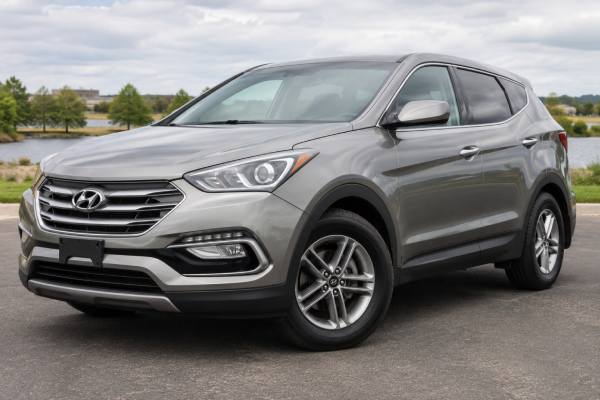
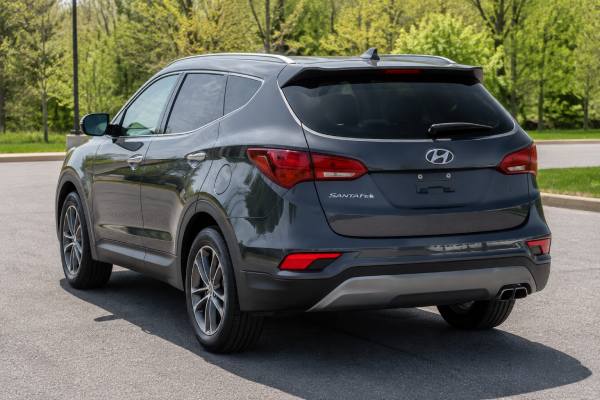
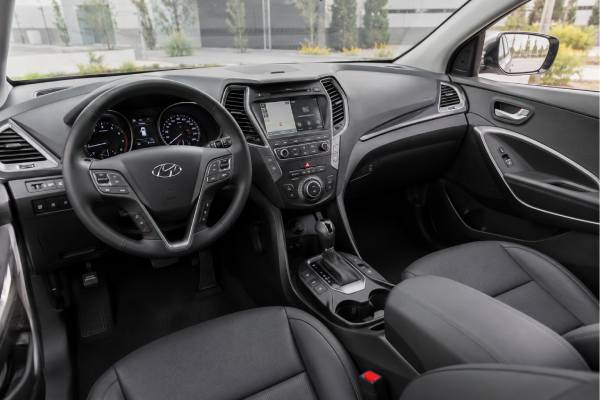
The facelifted 2017–2018 Hyundai Santa Fe Sport FWD with the 2.0 T-GDi engine is the stronger, more upscale version of Hyundai’s two-row DM-generation crossover. It sits between compact family SUVs and larger three-row models, with useful cargo space, a comfortable cabin, a turbocharged engine, and a conventional six-speed automatic transmission rather than a CVT.
The main attraction is simple: it gives the Santa Fe Sport the torque and refinement that the base 2.4-liter engine can lack, especially with passengers, hills, or highway merging. The trade-off is that the Theta II turbo engine demands careful maintenance history, recall verification, and a more serious pre-purchase inspection than a basic naturally aspirated SUV.
Key Takeaways
- The 2.0 T-GDi produces 240 hp and 260 lb-ft, giving the FWD Santa Fe Sport strong mid-range passing power for its class.
- Practicality is a major strength: cargo space is about 35.4 cu ft with the rear seats up and 71.5 cu ft with them folded.
- Braked towing is rated up to 3,500 lb when properly equipped, but cooling, brakes, tires, and transmission service history matter.
- The main ownership caveat is the Theta II turbo engine family, so check oil service records, knock-sensor software completion, recalls, and bearing-noise history.
- A typical normal-service oil interval for the 2.0T is about 5,000 miles or 6 months after the initial early service; severe use calls for shorter intervals.
Table of Contents
- Santa Fe Sport DM Buyer View
- Santa Fe Sport DM Technical Specs
- Santa Fe Sport DM Trims Safety
- Reliability Issues and Service Actions
- Maintenance Schedule and Buying Checks
- Driving Feel and Real Efficiency
- Santa Fe Sport Against Rivals
Santa Fe Sport DM Buyer View
The 2017–2018 Hyundai Santa Fe Sport FWD 2.0T is a five-passenger crossover from the facelifted DM generation. In North America, the “Sport” name identifies the shorter two-row model, while the larger Santa Fe was the three-row version. The vehicle covered here is the front-wheel-drive 2.0T model, not the base 2.4 GDI, not the AWD version, and not the later 2019 redesign.
Its 2.0-liter turbocharged gasoline direct-injection engine is the reason to choose this version. With 240 hp and 260 lb-ft of torque, it feels much more relaxed than the naturally aspirated 2.4 when the cabin is loaded or when quick highway passing is needed. The torque arrives low in the rev range, so the SUV does not need to be driven hard to feel responsive. The six-speed automatic is also familiar and generally smooth when healthy.
The Santa Fe Sport’s size is one of its biggest real-world advantages. It is easier to park than many midsize three-row SUVs, but it still has a wide rear seat, a large cargo hold, and a useful towing rating. Families who do not need a third row often find this layout more practical than a smaller compact crossover, especially for child seats, luggage, pets, and road-trip cargo.
The facelift brought updated exterior styling, interior equipment improvements, and broader availability of driver-assistance features. Even so, safety equipment varies sharply by trim and package. A 2.0T Ultimate with the right Technology package can be much better equipped than a regular 2.0T. Headlight performance also depends on build date and equipment, which matters because the IIHS rating picture is not identical for every version.
As a used vehicle, this Hyundai is best judged by condition and history rather than mileage alone. A well-maintained 2.0T with documented oil changes, completed recalls, clean cooling-system behavior, and smooth transmission operation can be a comfortable and capable family SUV. A neglected one can become expensive, especially if there are early signs of engine knock, oil consumption, turbo issues, overheating, or poor prior repair work.
The ideal buyer is someone who values space, comfort, equipment, and stronger acceleration, but is willing to inspect the car carefully. This is not the most fuel-efficient choice in the class, and it is not the lowest-risk engine family. It is, however, a well-packaged crossover when bought with evidence rather than optimism.
Santa Fe Sport DM Technical Specs
The 2017–2018 Santa Fe Sport 2.0T FWD uses Hyundai’s turbocharged Theta II gasoline direct-injection four-cylinder engine paired with a six-speed automatic transmission. Public specification sheets cover the core dimensions and performance-related data well, but some workshop values vary by market, VIN, production date, and service procedure. For fluid quantities and torque values, the service manual and under-hood labels should always take priority.
| Item | 2017–2018 Santa Fe Sport FWD 2.0T |
|---|---|
| Engine code | Theta II 2.0 T-GDi family; commonly cataloged as G4KH, verify by VIN and engine label |
| Engine layout | Inline-4, DOHC, 16 valves, 4 valves per cylinder |
| Bore × stroke | 86.0 × 86.0 mm, 3.39 × 3.39 in |
| Displacement | 2.0 L, 1,998 cc |
| Induction | Turbocharged |
| Fuel system | Gasoline direct injection |
| Compression ratio | 10.0:1 |
| Maximum power | 240 hp, 179 kW, at 6,000 rpm |
| Maximum torque | 353 Nm, 260 lb-ft, from 1,450–3,500 rpm |
| Timing drive | Timing chain |
| EPA economy, 2.0T FWD | 20 city / 28 highway / 23 combined mpg US; about 11.8 / 8.4 / 10.2 L/100 km |
| EPA economy, 2.0T Ultimate FWD | 20 city / 27 highway / 23 combined mpg US; about 11.8 / 8.7 / 10.2 L/100 km |
| Real-world highway at 120 km/h | Typically about 8.8–10.2 L/100 km, or 23–27 mpg US, depending on tires, load, wind, and terrain |
| Item | Specification |
|---|---|
| Transmission | Six-speed electronically controlled automatic; commonly listed as A6LF2 for 2.0T applications |
| Drive type | Front-wheel drive |
| Differential | Open front differential |
| Front suspension | MacPherson strut with stabilizer bar |
| Rear suspension | Multi-link independent rear suspension |
| Steering | Motor-driven power steering, 15.01:1 ratio, 2.95 turns lock-to-lock |
| Turning circle | 10.9 m, 35.8 ft |
| Front brakes | Ventilated discs, about 320 × 28 mm, 12.6 × 1.1 in |
| Rear brakes | Solid discs, about 302 × 11 mm, 11.9 × 0.4 in |
| Popular tire sizes | P235/60R18 on 2.0T; P235/55R19 on 2.0T Ultimate |
| Ground clearance | About 185 mm, 7.3 in |
| Length / width / height | 4,699 / 1,880 / about 1,679 mm; 185.0 / 74.0 / about 66.1 in |
| Wheelbase | 2,700 mm, 106.3 in |
| Curb weight | About 1,696–1,791 kg, 3,739–3,949 lb, depending on trim and equipment |
| GVWR | About 2,270 kg, 5,004 lb |
| Estimated payload | About 479–574 kg, 1,055–1,265 lb, depending on curb weight |
| Fuel tank | 65.9 L, 17.4 US gal, 14.5 UK gal |
| Cargo volume | About 1,003 L, 35.4 cu ft, seats up; about 2,025 L, 71.5 cu ft, seats folded, SAE method |
| Towing capacity | Up to 1,588 kg, 3,500 lb, braked; about 748 kg, 1,650 lb, unbraked |
| System | Specification or capacity |
|---|---|
| Engine oil | Typically 5W-30 full synthetic meeting the correct Hyundai/API/ACEA specification; about 4.8 L, 5.1 US qt, with filter |
| Automatic transmission fluid | Hyundai/Kia ATF SP-IV; total dry capacity commonly cataloged around 7.8 L, 8.2 US qt, but service fill is lower and level must be set by procedure |
| Coolant | Ethylene-glycol coolant suitable for aluminum engines, usually mixed 50/50 with deionized water; exact capacity must be verified by VIN and drain method |
| Brake fluid | DOT 3 or DOT 4 brake fluid, flush based on moisture content and time |
| Transfer case / rear differential | Not applicable to the FWD model |
| A/C refrigerant | Use the under-hood label for refrigerant type and charge weight; recharge only by measured weight |
| Key torque examples | Oil drain plug commonly about 39 Nm, 29 lb-ft; wheel nuts commonly about 88–107 Nm, 65–79 lb-ft; verify by official service data |
Performance figures depend heavily on trim weight, tires, fuel quality, temperature, and test method. A healthy FWD 2.0T is generally in the roughly eight-second range for 0–100 km/h, quick enough to feel confident in normal family use. Official top-speed and braking-distance numbers were not central to Hyundai’s public U.S. specification material, so these should not be treated as fixed factory claims.
Santa Fe Sport DM Trims Safety
For 2017–2018, the 2.0T FWD version was positioned above the base Santa Fe Sport 2.4. The most relevant trims are the regular 2.0T and the 2.0T Ultimate. Both use the same turbocharged engine and front-wheel-drive layout, but equipment can differ enough to change the ownership experience.
The regular 2.0T is usually the value pick. It commonly includes 18-inch alloy wheels, leather seating, dual-zone automatic climate control, heated front seats, a power driver’s seat, proximity key, smart liftgate availability, blind-spot detection, rear cross-traffic alert, and a touchscreen audio system with smartphone integration. It feels meaningfully more premium than the base model without carrying all of the Ultimate trim’s complexity.
The 2.0T Ultimate is the feature-rich version. It typically adds 19-inch wheels, upgraded exterior lighting, panoramic roof availability, navigation, a premium audio system, multi-view camera equipment, heated rear seats, ventilated front seats, a heated steering wheel, rear parking assistance, and more upscale cabin trim. Some of these features are attractive, but they also create more items to inspect on a used vehicle: sunroof operation, camera image quality, parking sensors, seat ventilation, navigation screen function, and electronic parking brake behavior where fitted.
The most valuable safety-related package is the one that adds advanced driver assistance. Depending on year, build date, and trim, equipment may include automatic emergency braking with pedestrian detection, smart cruise control, lane departure warning, high beam assist, dynamic bending lights, and related features. These systems should not be assumed from the badge alone. The window sticker, build sheet, dashboard controls, camera/radar hardware, and VIN-specific equipment report are more reliable than a seller’s description.
| Area | What to check |
|---|---|
| VIN and build year | The 10th VIN character identifies model year; H generally indicates 2017 and J generally indicates 2018 |
| 2.0T identification | Look for 2.0T badging, turbo engine layout under the hood, correct VIN/build data, and matching emissions label |
| Wheel package | 18-inch wheels are common on 2.0T; 19-inch wheels are typical on 2.0T Ultimate |
| Ultimate clues | Navigation, panoramic roof, premium audio, ventilated front seats, heated rear seats, and upgraded lighting are useful identifiers |
| ADAS hardware | Check for front radar, camera equipment, steering-wheel controls, instrument-cluster menus, and warning lights |
Crash-test results are generally strong for this generation, but the details matter. NHTSA rated the FWD Santa Fe Sport highly overall, with rollover performance typically lower than frontal and side-impact scores, as is common for SUVs. IIHS ratings were also strong in the core crash structure categories, but headlight ratings and front crash prevention depended on trim, optional equipment, and build date. In particular, later 2018 vehicles with the correct lighting and optional front crash prevention performed better in IIHS evaluations than earlier or lower-equipped versions.
Standard passive safety equipment includes multiple airbags, side-curtain airbags with rollover sensors, stability control, traction control, anti-lock brakes, electronic brake-force distribution, brake assist, hill-start assist, downhill brake control, tire-pressure monitoring, and rear child-seat anchors. For families, the rear seat is one of the Santa Fe Sport’s strong points because it offers useful width and easier child-seat accommodation than smaller compact SUVs.
After windshield replacement, collision repair, bumper work, suspension alignment, steering-angle sensor replacement, or camera/radar removal, driver-assistance systems may require calibration. A used example with warning lights disabled, mismatched bumper parts, or poorly repaired front-end damage should be treated cautiously.
Reliability Issues and Service Actions
The Santa Fe Sport 2.0T’s reliability picture is mixed rather than simple. The body, cabin, suspension layout, and conventional automatic transmission can age well with normal care, but the Theta II turbo engine family has enough known history that a careful inspection is essential. A cheap purchase price does not offset the risk of an unhealthy engine.
The highest-severity concern is internal engine wear, especially rod-bearing-related noise or damage in affected Theta II engines. Symptoms can include a metallic knock from the lower engine, oil-pressure warnings, flashing check-engine light, limp-home behavior, rough running, or stored diagnostic codes associated with knock detection. The recommended response is not to keep driving and “see what happens.” The vehicle needs prompt diagnosis, oil-level verification, code scanning, and VIN-specific campaign or warranty review.
Knock Sensor Detection System software is an important part of the ownership history. Hyundai issued service actions for affected vehicles to improve detection of bearing-related knock and to place the vehicle into a protective reduced-power mode if a serious condition is detected. Coverage, warranty extension terms, and settlement eligibility vary by VIN, software completion, market, and vehicle history, so documentation matters. A seller who cannot show dealer records should not be treated the same as one with clear campaign completion proof.
| System | Prevalence | Severity | Symptoms | Best response |
|---|---|---|---|---|
| Engine bearings / knock detection | Occasional but important | High | Knocking noise, flashing MIL, limp mode, metal in oil, oil-pressure warning | Stop driving, scan codes, verify campaigns, request dealer diagnosis and warranty review |
| Oil consumption or leaks | Occasional | Medium to high | Low oil between services, smoke, burnt-oil smell, seepage around turbo or covers | Perform consumption test, inspect PCV and leaks, shorten oil intervals |
| Direct-injection carbon buildup | Occasional with age | Medium | Rough idle, hesitation, misfires, poor cold running | Diagnose ignition and fueling first; clean intake valves if confirmed |
| Turbo and boost control | Occasional | Medium | Whine, underboost, overboost, oil residue, sluggish acceleration | Inspect hoses, wastegate control, intercooler plumbing, oil feed and return lines |
| Six-speed automatic | Usually durable, but condition-dependent | Medium | Delayed engagement, harsh shifts, flare, shudder under load | Check fluid condition, scan TCM data, verify updates, service with correct ATF |
| Suspension and wheel bearings | Common with mileage | Low to medium | Clunks, humming, uneven tire wear, vibration | Inspect bushings, links, struts, bearings, tires, and alignment |
| Electronics and cameras | Occasional | Low to medium | Intermittent camera image, sensor warnings, infotainment glitches | Check battery health, software level, connectors, water intrusion, and calibration status |
Recalls and service campaigns should be checked by VIN, not by model year alone. Important items for this era can include ABS module fire-risk recalls, hood-latch cable issues on certain vehicles, seat-belt anchor bolt concerns, steering-wheel assembly recalls on some 2018 vehicles, fuel-pipe inspections after engine replacement on affected vehicles, and anti-theft software updates for certain non-immobilizer configurations. The correct remedy may be a fuse kit, part replacement, inspection, software update, or dealer-installed campaign part depending on the recall.
A strong pre-purchase inspection should include a cold start, warm idle, hard acceleration, deceleration, extended idle, highway cruise, and a scan of all modules. Ask specifically for service history, oil-change intervals, recall proof, KSDS completion records, transmission-fluid service evidence, coolant service records, and any engine replacement paperwork. If the engine was replaced, the fuel pipe, software status, and warranty documentation become even more important.
Maintenance Schedule and Buying Checks
This 2.0T rewards conservative maintenance. Turbocharging, direct injection, heat, short trips, and city driving all make oil quality more important than on a simple low-output engine. The safest approach is to follow the official schedule for the exact VIN and market, then shorten intervals when the vehicle sees severe use such as short trips, high heat, freezing starts, dusty roads, towing, repeated idling, or heavy traffic.
| Item | Typical interval or guidance |
|---|---|
| Engine oil and filter | About every 5,000 miles or 6 months in normal use after initial early service; about every 3,000 miles or 3 months in severe use |
| Engine air filter | Inspect at routine services; replace commonly around 15,000–30,000 miles depending on dust and condition |
| Cabin air filter | Usually every 12 months or 15,000 miles, sooner in dusty or high-pollen areas |
| Spark plugs | Turbo GDI engines need correct plugs and gap; replacement is commonly around 45,000 miles, but verify by manual and plug type |
| Fuel system cleaner | Use only products and intervals allowed by Hyundai guidance; not a substitute for diagnosing misfires or fuel-system faults |
| Timing chain | No routine belt replacement; inspect if there is rattle, timing-correlation code, guide wear, tensioner fault, or oil-neglect evidence |
| Serpentine belt and hoses | Inspect at every service; replace for cracking, glazing, swelling, seepage, noise, or age-related hardening |
| Automatic transmission fluid | Often treated as long-life in normal use, but 50,000–60,000-mile service is sensible for city use, towing, heat, or unknown history |
| Coolant | Follow official time and mileage schedule; many used buyers service it immediately if age, history, or coolant type is uncertain |
| Brake fluid | Test regularly and replace about every 2–3 years, or sooner if moisture content is high |
| Brake pads and rotors | Inspect at tire rotations; check rear caliper slide pins, parking brake function, rotor corrosion, and pedal feel |
| Tires and alignment | Rotate about every 5,000–7,500 miles; check alignment if wear is uneven, steering is off-center, or suspension parts were replaced |
| 12 V battery | Load-test annually after about 3 years; replacement commonly falls around 4–6 years depending on climate |
A buyer’s inspection should start underneath. Look for engine-oil leaks, turbo oil residue, coolant staining, damaged plastic undertrays, rusty brake lines, exhaust corrosion, suspension bushing cracks, strut seepage, and impact damage around the front subframe. The FWD model avoids transfer-case and rear-differential service, but the front axle shafts, CV boots, wheel bearings, and automatic transmission still need attention.
During the test drive, the engine should start quietly from cold, settle into a stable idle, pull cleanly under boost, and show no smoke after idling or acceleration. The transmission should engage Drive and Reverse without a long delay, shift smoothly when cold and hot, and downshift without harsh banging. A mild downshift delay is not unusual, but flares, shudders, or repeated hunting under steady throttle deserve diagnosis.
Inside, test every electrical feature. Pay close attention to the panoramic sunroof, rear camera, blind-spot warnings, parking sensors, climate control, heated and ventilated seats, navigation screen, Bluetooth, steering-wheel controls, tailgate, and all window switches. Water leaks around the roof, tailgate, or windshield can create electrical symptoms that look unrelated at first.
The most desirable examples are usually clean 2.0T or 2.0T Ultimate models with complete records, matching tires, no warning lights, no engine noise, documented recall completion, and evidence of frequent oil changes. Avoid cars with unexplained low oil, fresh engine-bay cleaning, incomplete campaign history, overheating signs, misfire codes, heavy sludge under the oil cap, rough turbo boost, or a seller who discourages a full inspection.
Long-term durability is very dependent on care. The Santa Fe Sport 2.0T can be a comfortable, useful SUV past higher mileage, but it should be bought with a reserve for maintenance and age-related repairs. It is not the model to buy blindly because the price looks attractive.
Driving Feel and Real Efficiency
The Santa Fe Sport 2.0T drives like a comfort-focused family crossover with a useful extra layer of torque. It is not sporty in the sharp-handling sense, but it feels secure, stable, and easy to place on the road. The ride is generally compliant on 18-inch tires, while 19-inch Ultimate models can feel firmer over broken pavement and expansion joints.
The engine’s best trait is its mid-range response. With 260 lb-ft available low in the rev range, the 2.0T does not need constant high-rpm operation to merge, climb grades, or pass slower traffic. There can be a small pause while the turbo builds boost and the transmission chooses the right gear, but once moving, the power delivery is much stronger than the base 2.4. The engine can sound coarse when worked hard, though it is usually quiet enough in normal driving.
The six-speed automatic suits the vehicle’s character. It is smoother and more familiar than many CVTs, and it generally avoids unnecessary drama. Under light throttle, it shifts early for economy. Under stronger throttle, it can kick down firmly, especially when the turbo engine is asked for a quick pass. Any flare, clunk, delayed engagement, or shudder should be treated as a condition issue, not as normal Santa Fe behavior.
FWD traction is adequate in dry conditions, but the 2.0T’s torque can overwhelm the front tires on wet pavement, worn tires, or cold all-season rubber. Wheelspin and mild torque steer are possible if the driver asks for full boost from low speed. Good tires make a major difference. Buyers who live in snowbelt areas may prefer the AWD version, but AWD adds its own driveline service and inspection needs.
Real-world economy is reasonable rather than impressive. In city use, expect about 11.5–13.5 L/100 km, or 17–20 mpg US, depending on trip length and traffic. Mixed driving often falls around 10.0–11.5 L/100 km, or 20–24 mpg US. Steady highway travel at 100–120 km/h can return about 8.8–10.2 L/100 km, or 23–27 mpg US, when the vehicle is healthy and not heavily loaded. Cold starts, winter tires, roof boxes, short trips, and aggressive boost use can raise consumption noticeably.
Braking feel is predictable when the system is fresh. The Santa Fe Sport is not a lightweight vehicle, so tires, pads, rotors, brake fluid, and rear caliper condition matter. A long pedal, steering shimmy under braking, or rusty rear rotors should be fixed before towing or long mountain trips.
With a trailer, the 3,500-lb braked rating is useful, but it should not be confused with heavy-duty towing ability. A moderate trailer can raise fuel consumption by 30–50 percent or more depending on speed, frontal area, wind, and terrain. Transmission temperature, brake condition, tire load rating, hitch setup, and tongue weight all become more important than the engine’s peak horsepower.
Santa Fe Sport Against Rivals
The Santa Fe Sport 2.0T sits in an interesting space because it is roomier and stronger than many compact SUVs, but smaller and easier to manage than most three-row midsize crossovers. Its closest rivals are not always identical in size or mission, so the right comparison depends on what matters most: economy, reliability reputation, power, towing, cabin space, or equipment.
| Rival | Where it may be better | Where the Santa Fe Sport 2.0T stands out |
|---|---|---|
| Honda CR-V 1.5T | Fuel economy, packaging efficiency, resale strength | More traditional midsize feel, higher tow rating, stronger conventional automatic character |
| Toyota RAV4 2.5 | Simple powertrain reputation, ownership predictability, fuel economy | More torque, more upscale available equipment, larger-feeling cabin |
| Ford Edge 2.0 EcoBoost | Refinement, broad cabin, composed highway ride | Often better value used, useful equipment, slightly smaller footprint |
| Kia Sorento 2.0T | Available larger body and, in some versions, extra seating flexibility | Shorter two-row practicality, simpler passenger layout, similar turbo performance |
| Mazda CX-5 2.5 | Handling, interior polish, fuel economy, reliability perception | More cargo space and stronger turbocharged torque in this Hyundai version |
| Nissan Murano V6 | Smooth V6 power, comfort-oriented ride, quiet cruising | More conventional cargo shape, turbo torque feel, no CVT-specific buyer concern |
Against the CR-V and RAV4, the Hyundai feels more substantial and more powerful, especially with passengers. The trade-off is fuel economy and engine-risk perception. A buyer focused mainly on low running costs and long-term simplicity may prefer the Toyota. A buyer who wants a roomier, stronger, better-equipped used SUV for the money may find the Hyundai more appealing, provided the maintenance history is strong.
Against the Ford Edge and Nissan Murano, the Santa Fe Sport is a little more compact and often easier to park. The Edge can feel more refined on the highway, and the Murano’s V6 is smoother, but both rivals have their own aging and drivetrain considerations. The Hyundai’s advantage is value and a practical two-row layout.
The closest corporate rival is the Kia Sorento 2.0T. It shares some engineering themes and powertrain considerations, so it should not be treated as a risk-free alternative. The Kia may offer different seating and packaging, while the Hyundai Sport feels more focused as a two-row crossover.
The final verdict depends on inspection quality. The Santa Fe Sport 2.0T FWD is worth considering when it has documented oil service, completed recalls, clean diagnostics, no engine noise, smooth transmission behavior, and the right equipment. It is less attractive when the history is vague, the engine shows warning signs, or the price is only slightly lower than a cleaner, simpler rival.
References
- 2018 HYUNDAI SANTA FE SPORT SPECIFICATIONS 2018 (Specifications)
- 2018 HYUNDAI SANTA FE SPORT FEATURES & OPTIONS 2018 (Features & Options)
- Gas Mileage of 2017 Hyundai Santa Fe 2017 (EPA Fuel Economy)
- Gas Mileage of 2018 Hyundai Santa Fe 2018 (EPA Fuel Economy)
- 2018 Hyundai Santa Fe Sport 2018 (Safety Rating)
Disclaimer
This information is for informational purposes only and is not a substitute for professional diagnosis, repair, inspection, or factory service procedures. Specifications, torque values, service intervals, fluids, capacities, recalls, and repair methods can vary by VIN, market, production date, equipment, and prior service history. Always verify details against the official owner’s manual, factory service information, under-hood labels, dealer records, and VIN-specific recall data before making maintenance or purchase decisions.
If this was useful, please consider sharing it on Facebook, X/Twitter, or your preferred automotive community to support our work.