
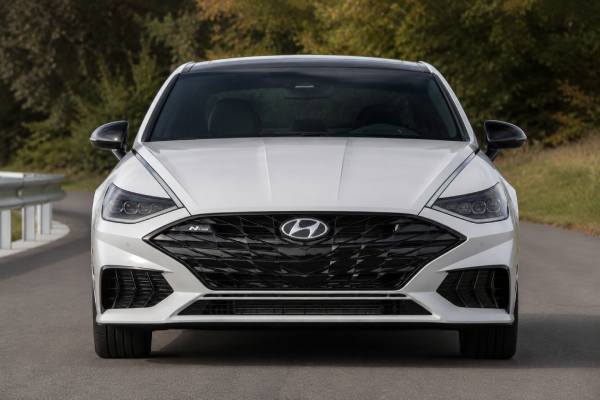
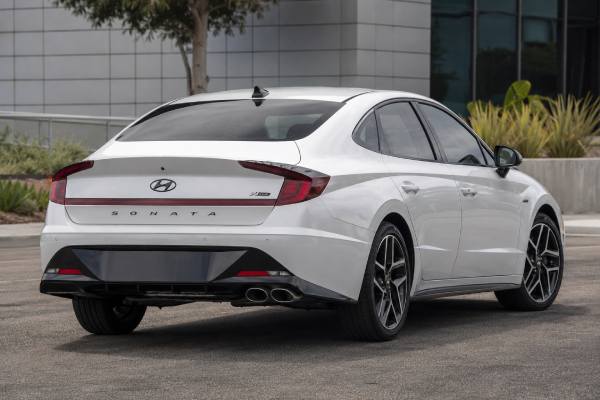
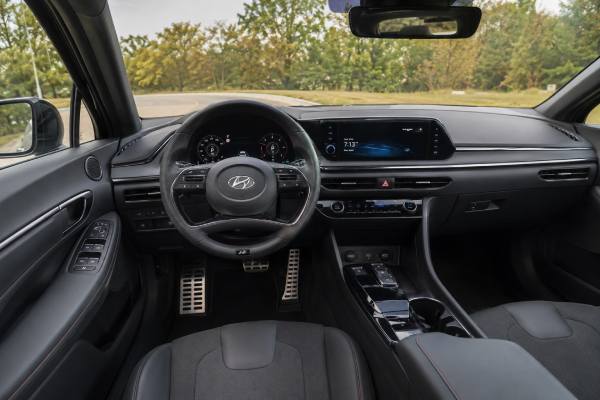
The 2021–2023 Hyundai SONATA N Line is the performance-focused version of the DN8-generation Sonata, using Hyundai’s Smartstream G2.5 T-GDi 2.5-liter turbocharged four-cylinder engine, an 8-speed wet dual-clutch transmission, and front-wheel drive. It was designed as a faster, sharper, better-equipped midsize sedan rather than a full N performance car.
For used buyers, the appeal is clear: near-sport-sedan acceleration, a spacious cabin, strong safety equipment, and lower used prices than many similarly quick sedans. The important ownership questions are different from a normal Sonata, though. The N Line’s turbo engine, wet DCT, 19-inch tires, and higher brake load make service history, recall completion, tire condition, and transmission behavior especially important.
Final Verdict
The 2021–2023 Hyundai Sonata N Line is a strong choice for buyers who want a roomy, comfortable midsize sedan with genuinely quick 290-hp performance and distinctive styling, without moving into a German sport sedan or a less practical compact performance car. It suits commuters who enjoy strong passing power, families who still want a large trunk and rear seat, and enthusiasts who accept front-wheel-drive limits. The main tradeoff is ownership sensitivity: the wet dual-clutch transmission, turbo engine, 19-inch tires, and recall history make service records and a clean pre-purchase inspection essential. Buy one only after confirming recall completion and smooth DCT operation.
| Pros | Cons |
|---|---|
| 290-hp 2.5T gives very strong midsize-sedan acceleration | Front-wheel drive struggles to deploy full torque cleanly |
| 8-speed wet DCT shifts quickly and suits spirited driving | DCT recall history makes software completion very important |
| Large cabin and 16.0 cu ft trunk remain family-friendly | 19-inch tires raise replacement cost and pothole vulnerability |
| Good standard safety and driver-assistance equipment | No AWD, limited-slip differential, or full N chassis hardware |
| Used prices often undercut comparably quick sport sedans | Fuel economy trails regular Sonata and hybrid versions |
Table of Contents
- Sonata N Line DN8 Overview
- Specifications and Technical Data
- Trims, Options, Safety and ADAS
- Reliability, Common Issues and Service Actions
- Maintenance and Buying Guide
- Driving and Performance
- Sonata N Line vs Rivals
Sonata N Line DN8 Overview
The 2021–2023 Sonata N Line is best understood as a high-output grand-touring version of the DN8 Sonata, not a track-focused Hyundai N model. It combines the regular Sonata’s space, safety tech, and daily comfort with a much stronger engine, sportier suspension tuning, larger wheels, and N Line styling.
The DN8 Sonata arrived with a dramatic low-roof sedan shape, a long wheelbase, and a cabin that feels closer to a large sedan than many older midsize cars. The N Line built on that with a unique front and rear fascia, quad exhaust outlets, sport seats, red contrast stitching, a digital instrument cluster on many markets, paddle shifters, and 19-inch wheels. In North America, the N Line sat near the top of the Sonata range and was the only version with the 2.5-liter turbocharged engine.
The key difference is the powertrain. The Smartstream G2.5 T-GDi engine produces 290 hp and 311 lb-ft of torque, far above the regular 2.5-liter naturally aspirated Sonata and the 1.6-liter turbo versions. It also uses both gasoline direct injection and multi-point injection, which helps output, response, emissions control, and long-term intake cleanliness compared with a pure direct-injection layout.
The 8-speed wet dual-clutch transmission is another major distinction. A wet DCT uses oil-cooled clutches, which are better suited to high torque than the dry-clutch units used in some economy-focused cars. It gives the Sonata N Line a sharper, more immediate feel than a conventional torque-converter automatic, especially during hard acceleration. The tradeoff is that a DCT can feel less smooth in parking-lot creeping and heavy stop-start traffic, and it needs correct software, fluid, and diagnostic attention.
The Sonata N Line is front-wheel drive only. That keeps weight and cost down, but it also defines the car’s limits. With 311 lb-ft arriving low in the rev range, full-throttle launches can bring wheelspin, torque steer, and traction-control intervention, especially on worn tires or wet roads. Once moving, the car is much more composed and feels impressively quick for a practical sedan.
For used buyers, the 2021–2023 years are attractive because they cover the pre-facelift DN8 N Line before the later styling update. Equipment is strong, availability is reasonable, and depreciation can make the N Line look like a bargain. The best examples are one-owner cars with documented oil changes, completed recalls, unmodified engine software, matching high-quality tires, and no repeated DCT complaints.
Specifications and Technical Data
The Sonata N Line uses a transverse 2.5-liter turbocharged inline-four, an 8-speed wet dual-clutch transmission, and front-wheel drive. The package is performance-oriented, but it remains a five-seat midsize sedan with a large trunk, regular unleaded fuel compatibility in the U.S. market, and a practical 15.9-gallon fuel tank.
| Item | 2021–2023 Sonata N Line 2.5T |
|---|---|
| Engine family | Smartstream G2.5 T-GDi |
| Configuration | Turbocharged inline-four, DOHC, 16 valves |
| Displacement | 2.5 L / 2,497 cc |
| Fuel system | Gasoline direct injection plus multi-point injection |
| Maximum power | 290 hp / 216 kW at 5,800 rpm |
| Maximum torque | 422 Nm / 311 lb-ft from 1,650–4,000 rpm |
| Compression ratio | 10.5:1 |
| Recommended fuel | Regular unleaded in U.S. specification |
| EPA fuel economy | 10.2 / 7.1 / 8.7 L/100 km city/highway/combined; 23 / 33 / 27 mpg US |
| Item | Specification |
|---|---|
| Transmission | 8-speed N wet dual-clutch transmission |
| Transmission family | D8LF1 / Smartstream 8DCT in related technical literature |
| Drive type | Front-wheel drive |
| Paddle shifters | Standard |
| Clutch type | Oil-cooled wet twin clutch |
| Limited-slip differential | Not fitted |
| Item | Value |
|---|---|
| Body style | Four-door midsize sedan |
| Seats | Five |
| Length | 4,900 mm / 192.9 in |
| Width | 1,860 mm / 73.2 in |
| Height | 1,445 mm / 56.9 in |
| Wheelbase | 2,840 mm / 111.8 in |
| Passenger volume | 104.4 cu ft / 2,956 L |
| Trunk volume | 16.0 cu ft / 453 L |
| Fuel tank | 60.2 L / 15.9 gal US |
| Common tire size | 245/40R19 |
| Item | Useful value |
|---|---|
| 0–60 mph | About 5.0–5.3 seconds in instrumented testing |
| Top speed | Electronically limited or estimated around 155 mph in some tests |
| Engine oil | Use the VIN-specific owner’s manual; 0W-30 full synthetic is commonly specified for the 2.5T |
| Engine oil capacity | About 6.3–6.7 qt with filter depending on reference and market |
| Timing drive | Timing chain; inspect if noise, correlation faults, or oil neglect are present |
| Wheel-nut torque | Typically 79–94 lb-ft / 107–127 Nm; verify by VIN service data |
Trims, Options, Safety and ADAS
For 2021–2023, the N Line was a specific performance trim rather than a simple appearance package. The quick identifier is the 2.5T engine, N Line exterior trim, quad exhaust outlets, 19-inch wheels, sport seats, paddle shifters, and the 8-speed wet DCT.
In the U.S. market, the regular Sonata range included SE, SEL, SEL Plus, Limited, Hybrid, and N Line variants depending on model year. The N Line stood apart because it did not merely add sporty bumpers to the regular engine. It brought the 290-hp engine, N 8-speed wet DCT, sport-tuned suspension, larger brakes than the mainstream trims, 245-section tires, and unique interior trim.
The 2022 model year also brought the limited-production N Line Night Edition. It was mostly an appearance package, not a mechanical upgrade. It added matte-black 19-inch wheels, dark chrome badging, red brake calipers, carbon-fiber-reinforced exterior accents, and limited color choices. Mechanically, buyers should treat it like a standard N Line and inspect it with the same focus on transmission behavior, tires, recalls, and maintenance history.
Equipment and quick identifiers
Useful N Line identifiers include:
- Exterior: N Line grille and bumpers, side-sill treatment, quad exhaust outlets, 19-inch wheels, N Line badging.
- Interior: sport front seats, red stitching, N-style steering wheel details, paddle shifters, sportier trim materials.
- Powertrain: 2.5T engine on the build sticker or VIN records, not the 1.6T or 2.5 naturally aspirated engine.
- Transmission: 8-speed wet DCT with push-button shift controls in many markets.
- Night Edition: black exterior accents, black wheels, red calipers, and limited-production visual trim.
Avoid relying only on badges when buying used. Confirm the engine and trim through the VIN, window sticker, build sheet, or dealer service records. Some regular Sonatas may have aftermarket black wheels or N Line-style cosmetic parts, while true N Line cars have the 2.5T powertrain.
Safety ratings and structure
The DN8 Sonata performed well in major safety testing. IIHS ratings for the 2020–2023 body structure were strong, with Good results in several major crashworthiness categories and Superior-rated front crash prevention in the original vehicle-to-vehicle and daytime pedestrian tests for applicable years. Later IIHS testing became tougher, especially for side-impact evaluation, so check the exact test version when comparing results across model years.
NHTSA 5-Star Safety Ratings have generally been favorable for the DN8 Sonata generation, but ratings can vary by model year and test availability. Used buyers should also remember that crash ratings apply to a properly repaired, structurally sound vehicle. A repaired salvage car, poorly replaced airbag, non-OEM windshield, or badly calibrated ADAS system can be much less safe than its rating suggests.
Driver assistance and calibration
Typical safety and driver-assistance features include forward collision-avoidance assist, lane keeping or lane following assistance, blind-spot monitoring, rear cross-traffic alert, stability control, anti-lock brakes, multiple airbags, LATCH child-seat anchors, and a rearview camera. Availability can vary by market and model year, but the N Line was generally well equipped.
ADAS inspection matters after windshield replacement, front-end repair, suspension work, wheel alignment, or accident repair. Camera and radar systems need proper calibration to work as designed. During a test drive, confirm that no warning lights are present and that lane support, adaptive cruise if fitted, blind-spot alerts, parking sensors, and rear camera functions behave normally.
Reliability, Common Issues and Service Actions
The Sonata N Line can be reliable when maintained correctly, but it is more maintenance-sensitive than a regular Sonata. The most important used-car checks are recall completion, smooth DCT operation, no fuel-system smell, no tune-related abuse, and proof of regular synthetic oil changes.
| Area | Prevalence | Severity | Typical symptoms | Best remedy |
|---|---|---|---|---|
| 8-speed wet DCT recall/software | Occasional, affected VINs | High | Harsh shifts, hesitation, loss of motive power, warning light | Confirm TCU update; replace DCT if required by DTCs |
| High-pressure fuel pipe recall | Rare, affected 2021–2022 VINs | High | Fuel smell, leak risk near fuel rail | Dealer inspection, tightening, or pipe replacement |
| DCT electric oil pump faults | Occasional | Medium to high | DTCs, limp mode, shift issues | Diagnostic scan, wiring check, EOP or DCT replacement |
| 19-inch wheel and tire wear | Common | Low to medium | Noise, vibration, bent wheel, rapid shoulder wear | Quality tires, alignment, wheel inspection |
| Brake wear and vibration | Occasional | Low to medium | Pulsation, squeal, steering shake under braking | Inspect pads, rotors, slide pins, and torque procedure |
| Infotainment and sensor glitches | Occasional | Low | Screen lag, Bluetooth issues, ADAS warnings | Software update and sensor calibration check |
The major service-action item is the 8-speed wet DCT recall affecting certain 2021–2022 Sonata N Line vehicles. The concern involved possible drivability symptoms and loss of motive power. The remedy focused on a transmission control unit software update, with transmission replacement required in certain cases where specific diagnostic trouble codes were present. For a used buyer, “recall completed” is necessary but not always enough; the car should still shift smoothly during cold operation, low-speed maneuvering, moderate acceleration, and highway kickdown.
The high-pressure fuel pipe recall also matters for certain 2021–2022 2.5T Sonatas. The concern involved the pipe between the high-pressure fuel pump and fuel rail, with a possible leak risk if the pipe or installation did not meet specification. Any fuel smell, wetness near the fuel rail, or incomplete recall record should stop the purchase until a Hyundai dealer verifies the remedy.
The Smartstream 2.5T itself does not have the same reputation pattern as older Hyundai/Kia Theta II engine issues, but it still needs correct oil, clean oil, and regular level checks. Turbocharged direct-injected engines run hotter and put more stress on oil than base engines. Avoid cars with extended oil-change gaps, heavy modifications, piggyback tuners, repeated overheating, or unexplained misfire history.
The wet DCT is the most expensive system to get wrong. Low-speed clutch behavior should feel controlled, not jerky or slipping. A small amount of DCT character is normal, especially when creeping, but repeated clunks, delayed engagement, shudder, warning lights, or “transmission hot” behavior are not normal. Request a full scan of all modules, not just a generic engine-code check.
Chassis durability is generally good, but the N Line’s 19-inch wheels and low-profile tires make it more vulnerable to pothole damage. Inspect inner wheel lips, tire sidewalls, alignment wear, wheel bearings, and suspension links. On cars from snowy climates, look closely at subframes, brake lines, exhaust hardware, suspension fasteners, and lower door seams.
Maintenance and Buying Guide
A good Sonata N Line should have evidence of regular oil changes, completed recalls, proper tires, and no unresolved DCT complaints. Because this is a turbocharged performance trim, a neglected cheap example can become more expensive than a cleaner car with a higher asking price.
| Interval | Service items |
|---|---|
| Every 8,000 miles / 13,000 km or 12 months | Engine oil and filter, tire rotation, brake inspection, fluid level check, visual leak inspection |
| Every 5,000 miles / 8,000 km in severe use | Shorter oil interval for heavy traffic, short trips, hot climates, cold starts, or spirited driving |
| Every 16,000 miles / 26,000 km | Cabin filter inspection or replacement, brake and suspension inspection, alignment check if tire wear appears |
| Every 24,000–32,000 miles / 39,000–52,000 km | Engine air filter as needed, DCT inspection, coolant hoses, drive belt, battery test |
| Every 48,000–60,000 miles / 78,000–96,000 km | Brake fluid, coolant inspection, DCT fluid service consideration for severe use, deeper chassis inspection |
| Around 96,000 miles / 156,000 km | Spark plugs, full cooling-system review, timing-chain noise and cam-correlation scan if symptoms exist |
For fluids, use only VIN-correct Hyundai specifications. The 2.5T commonly calls for full-synthetic low-viscosity oil, often 0W-30 depending on market and manual version. The wet DCT is especially fluid-sensitive; do not substitute generic ATF, ordinary manual-transmission oil, or friction-modified additives. If the transmission has been serviced, the invoice should show the correct Hyundai DCT fluid and procedure.
Brake fluid is often ignored on newer cars, but it matters on a fast sedan. Replace it by the time-based interval in the official schedule, and sooner if the pedal feels soft or the car sees mountain driving. Pads and rotors should be inspected for taper wear, heat spots, pulsation, and seized slide pins. Tire rotation and alignment are also important because a powerful front-drive car can wear front tires quickly.
Pre-purchase inspection checklist
Before buying, request or perform the following checks:
- Verify all open recalls and service campaigns by VIN.
- Confirm DCT recall completion where applicable.
- Scan engine, transmission, ABS, ADAS, and body modules.
- Test cold start, idle quality, low-speed DCT engagement, and full-throttle upshifts.
- Check for fuel smell, oil leaks, coolant crust, and turbo plumbing leaks.
- Inspect tire brand, size, date codes, tread depth, and matching sets.
- Check 19-inch wheels for bends, cracks, curb impact, and vibration.
- Inspect brake rotor condition and pad thickness.
- Confirm ADAS functions after any windshield or bumper repair.
- Review oil-change invoices, not just dashboard reminders.
The best years to seek are not simply the newest ones. A 2021 with complete recall work and excellent records can be better than a 2023 with hard use, poor tires, and no documentation. That said, later 2022 builds and 2023 cars may have fewer early-production concerns, so long as the inspection is clean.
Avoid cars with engine tunes unless you are prepared for warranty and durability risk. Also be cautious with cars showing mismatched budget tires, repeated transmission complaints, accident history involving the front structure, warning lights, or missing service records. The N Line is quick enough that previous-owner behavior matters.
Long-term durability should be good for buyers who treat the car as a fast daily driver rather than a drag-strip toy. The engine has strong output, but regular oil service, warm-up discipline, good fuel, and cooling-system attention are important. The DCT can last well, but it dislikes neglect, overheating, incorrect fluid, and unresolved software or pump faults.
Driving and Performance
The Sonata N Line feels much quicker than a regular midsize sedan, especially from 30–80 mph. Its strength is effortless passing power and fast real-world acceleration, while its weakness is putting all that torque through the front tires from a stop.
Around town, the 2.5T has strong low-rpm torque and does not need high revs to feel quick. Throttle response is calm in normal modes and sharper in sportier settings. Turbo lag is present but modest; the bigger issue is traction. In dry conditions with good tires, the car launches hard but may still tug at the steering wheel. In wet or cold conditions, full throttle in first or second gear can bring obvious wheelspin.
The wet DCT gives the N Line much of its character. At speed, it shifts quickly and makes the car feel more alert than a conventional automatic. During parking maneuvers or slow creeping, it can feel less fluid than a torque-converter transmission. That is normal to a degree, but harsh engagement, repeated shuddering, or delayed drive selection should be inspected.
Ride comfort is firmer than a regular Sonata but still livable for daily use. The long wheelbase helps highway stability, and the cabin remains reasonably quiet for a sedan with 19-inch tires. Rough pavement can produce more tire impact noise than in the standard trims, and worn or cheap tires make the car feel much less refined.
Handling is secure and predictable. The steering is accurate enough, body control is tighter than the regular Sonata, and the chassis feels confident in fast sweeping bends. It is not as sharp as a true sport compact or rear-drive sedan, and the lack of a limited-slip differential is noticeable during aggressive corner exits. The car is at its best when driven smoothly and quickly rather than forced into tight, traction-limited corners.
Real-world fuel economy depends heavily on driving style. In mixed use, many owners should expect roughly 8.7–10.5 L/100 km, or about 22–27 mpg US. Highway driving at steady speeds can approach the official 33 mpg US rating, while short trips, winter temperatures, traffic, and spirited acceleration can pull economy into the low 20s. Compared with the Sonata Hybrid, the N Line uses much more fuel, but that is the expected tradeoff for nearly 300 hp.
Braking performance is strong for road use, especially with quality tires. Repeated hard stops will still reveal that this is a sporty midsize sedan, not a track car. If you plan mountain driving or repeated high-speed braking, prioritize high-quality pads, fresh fluid, and premium tires over cosmetic modifications.
Sonata N Line vs Rivals
The Sonata N Line’s closest rivals are the Kia K5 GT, Honda Accord 2.0T, Toyota Camry TRD or V6, Nissan Altima SR VC-Turbo, and used sport sedans such as the Acura TLX or Volkswagen Arteon. The Hyundai’s main advantage is its mix of power, space, equipment, and used-market value.
The Kia K5 GT is mechanically very close, using a similar 2.5T and 8-speed wet DCT. The K5 GT feels slightly more aggressive in image and is often cross-shopped directly. Buying decisions between them usually come down to styling, equipment, warranty status, condition, and price. The same DCT recall awareness applies.
The Honda Accord 2.0T is one of the strongest alternatives. It has less peak horsepower but an excellent 10-speed automatic, strong refinement, and a reputation for broad reliability. The Accord feels more mature and may be easier to live with in traffic, while the Sonata N Line feels more dramatic and often costs less used.
The Toyota Camry TRD and Camry V6 offer naturally aspirated smoothness and Toyota durability appeal. The Camry’s V6 is strong and simpler in feel than the Hyundai turbo-DCT setup, but the interior and transmission character are less sporty. The Camry TRD also sacrifices some comfort and rear-seat flexibility for chassis tuning and styling.
The Nissan Altima SR VC-Turbo is less compelling as a performance rival. It offers interesting variable-compression engine technology, but its CVT and overall driving feel do not match the Sonata N Line’s urgency. It may suit buyers who value comfort and efficiency more than sharp response.
The best reason to choose the Sonata N Line is that it delivers near-sport-sedan pace in a practical, well-equipped, affordable package. The best reason to choose something else is if you want AWD traction, a smoother conventional automatic, a limited-slip differential, or a simpler long-term ownership profile. For the right buyer, a clean Sonata N Line is one of the most interesting used midsize sedans of its era.
References
- 2023 Sonata Product Guide 2022 (Manufacturer Specifications) ([Hyundai News][1])
- Gas Mileage of 2023 Hyundai Sonata 2023 (Fuel Economy) ([Fuel Economy][2])
- 2021 Hyundai Sonata 2021 (Safety Rating) ([IIHS Crash Testing][3])
- Part 573 Safety Recall Report 21V-524 2021 (Recall Database)
- HMA Recall 236: 8 Speed Wet DCT TCU Update 2022 (Recall/Service Action)
Disclaimer
This article is for informational purposes only and is not a substitute for professional diagnosis, repair, or inspection. Specifications, torque values, service intervals, recall applicability, fluid requirements, and procedures can vary by VIN, market, production date, and equipment. Always verify maintenance and repair information against the official owner’s manual, Hyundai service documentation, dealer records, and VIN-specific recall checks.
If you found this guide helpful, please consider sharing it on Facebook, X/Twitter, or another platform to support our work.