
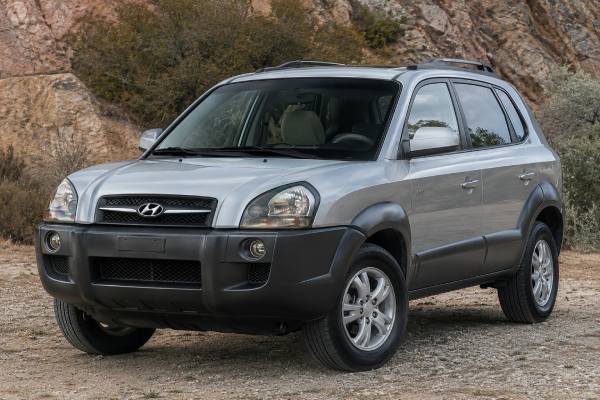
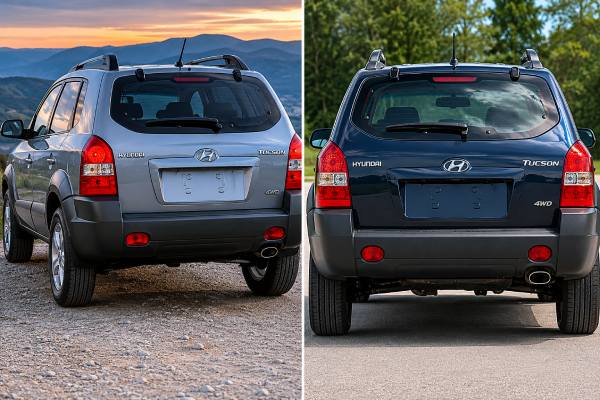
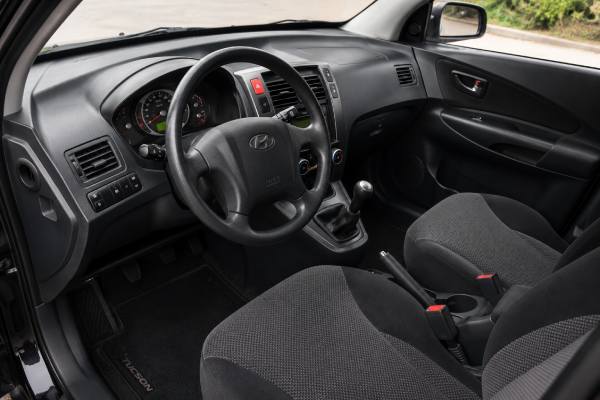
The Hyundai Tucson 4WD (JM) with the Delta 2.7 V6 is the stronger, smoother petrol version of Hyundai’s first-generation compact SUV. Sold during the mid-2000s, it offered a simple naturally aspirated V6, a conventional automatic transmission, five-seat practicality, and an on-demand four-wheel-drive system aimed at bad weather rather than serious off-roading.
For used buyers today, the appeal is clear: this Tucson is inexpensive, roomy for its size, and mechanically less complex than many newer turbocharged SUVs. The main question is whether age, fuel use, corrosion, and timing-belt maintenance make it a smart buy.
Final Verdict
The 2005–2009 Hyundai Tucson 4WD 2.7 V6 is a good choice if you want a cheap, straightforward compact SUV with stronger performance than the four-cylinder version and useful all-weather traction. It suits buyers who value simplicity, visibility, winter usability, and low purchase price more than fuel economy or modern cabin refinement. The tradeoff is running cost: the V6 drinks noticeably more fuel than newer crossovers, and neglected timing-belt or cooling-system maintenance can turn a bargain into an expensive repair. Buy only one with proof of belt service, clean fluids, solid underbody condition, and no open recalls.
| Pros | Cons |
|---|---|
| Smooth Delta V6 gives better passing power than four-cylinder Tucsons | Fuel economy is weak by modern compact SUV standards |
| Simple automatic and naturally aspirated engine reduce complexity | Timing belt, water pump, and seals must be kept current |
| On-demand 4WD is useful for snow, rain, and gravel roads | Not a true low-range off-road 4×4 system |
| Compact body still offers practical cargo and rear-seat space | Cabin noise and ride quality feel dated on highways |
| Standard stability control and six airbags were strong for the era | No modern ADAS such as AEB, ACC, or lane support |
| Parts availability is generally good through Hyundai/Kia sharing | Rust, suspension wear, and tired driveline fluids are common now |
Table of Contents
- JM Tucson V6 Overview
- Tucson 2.7 V6 Specifications
- Trims, Safety, and Driver Assistance
- Reliability, Common Issues, and Service Actions
- Maintenance and Buying Guide
- Driving, Performance, and Efficiency
- How the Tucson V6 Compares
JM Tucson V6 Overview
The JM Tucson 2.7 V6 is best understood as a durable, old-school compact SUV with extra engine smoothness rather than a sporty crossover. Its strongest point is its simple mechanical layout: a transverse petrol V6, a four-speed automatic, and an electronically controlled 4WD system.
The first-generation Tucson shared much of its platform thinking with the Kia Sportage of the same era. It was shorter than many family SUVs but taller and more upright than a hatchback, giving it easy entry, good outward visibility, and a useful tailgate opening. The V6 version was aimed at buyers who wanted more relaxed acceleration, automatic convenience, and all-weather traction.
The engine is Hyundai’s Delta-family 2.7-liter V6, commonly identified as G6BA. In many markets it was listed around 175 PS, while U.S. figures are usually 173 hp SAE and 178 lb-ft of torque. The difference is mostly rating method and market wording, not a meaningful mechanical difference.
This Tucson is not a refined modern SUV. It has a dated four-speed automatic, fairly high fuel consumption, and cabin materials that feel simple today. It also lacks modern driver-assistance systems. But those same traits make it easier to understand and maintain than many later direct-injection, turbocharged, dual-clutch, or hybrid SUVs.
The best examples are the boring ones: stock suspension, matching tires, clean coolant, smooth automatic shifts, no warning lights, no accident history, and documented timing-belt work. A cheap Tucson with no history can still be usable, but the risk rises quickly once rust, overheating, belt neglect, or transmission neglect enter the picture.
Tucson 2.7 V6 Specifications
The 2.7 V6 Tucson uses a naturally aspirated multi-point-injection engine and a conventional four-speed automatic. The 4WD system is an on-demand setup that normally behaves like a front-drive SUV, then sends torque rearward when needed.
Powertrain and efficiency
| Item | Hyundai Tucson 4WD 2.7 V6 |
|---|---|
| Engine family | Hyundai Delta V6, commonly G6BA |
| Layout | Transverse 60-degree V6, DOHC, 24 valves |
| Displacement | 2,656 cc / 2.7 liters |
| Induction and fuel system | Naturally aspirated, multi-point fuel injection |
| Power | 129 kW / 173 hp SAE; often listed as 175 PS |
| Torque | 241 Nm / 178 lb-ft at about 4,000 rpm |
| Bore x stroke | 86.7 mm x 75.0 mm |
| Compression ratio | About 10.0–10.1:1 |
| Timing drive | Timing belt |
| Fuel | Regular unleaded petrol; 87 AKI / 91 RON minimum |
| Item | Specification |
|---|---|
| Transmission | Four-speed automatic with SHIFTRONIC manual mode |
| Drive type | On-demand electronic 4WD / AWD |
| Normal torque bias | Primarily front-wheel drive in steady cruising |
| Rear torque transfer | Up to about 50 percent rearward when slip or demand requires it |
| Lock function | Manual 50:50 lock for low-speed slippery conditions |
| Low-range gearing | Not fitted |
Dimensions, chassis, and capacities
| Item | Value |
|---|---|
| Body style | Five-door compact SUV |
| Seating | Five seats |
| Length | 4,325 mm / 170.3 in |
| Width | About 1,795–1,830 mm / 70.7–72.1 in by market measurement |
| Height | About 1,680–1,730 mm / 66.1–68.1 in by market measurement |
| Wheelbase | 2,630 mm / 103.5 in |
| Ground clearance | About 186–195 mm / 7.3–7.7 in |
| Turning circle | About 10.8 m / 35.4 ft |
| Fuel tank | 65 liters / 17.2 US gal |
| Curb weight | About 1,568–1,609 kg / 3,457–3,548 lb |
| Item | Value |
|---|---|
| Front suspension | MacPherson struts with stabilizer bar |
| Rear suspension | Independent multi-link with stabilizer bar |
| Steering | Hydraulic power-assisted rack and pinion |
| Common tire size | 235/60 R16 on many V6 4WD versions |
| Cargo volume | 22.7 cu ft behind rear seat; 65.5 cu ft maximum in U.S. measurement |
| Towing rating | Up to 907 kg / 2,000 lb in the U.S.; up to 1,500 kg braked in some markets |
Performance and quick service data
| Item | Typical value |
|---|---|
| 0–100 km/h | About 10.5 seconds |
| Top speed | About 180 km/h / 112 mph |
| EPA fuel economy, 2005 V6 4WD | 17 city / 23 highway / 19 combined mpg US |
| EPA fuel economy, 2009 V6 4WD | 18 city / 23 highway / 20 combined mpg US |
| Engine oil service fill | About 4.5 liters / 4.8 US qt with filter |
| Common oil viscosity | 5W-20, 5W-30, or 5W-40 depending market and climate |
| Timing belt interval | Commonly 96,000 km / 60,000 miles or time-based interval |
| Wheel nut torque | About 88–108 Nm / 65–80 lb-ft |
Trims, Safety, and Driver Assistance
The V6 4WD Tucson was usually positioned above the basic four-cylinder models. Equipment varies by country, but the V6 4WD versions are the ones most likely to have larger tires, alloy wheels, fog lights, roof rails, heated seats, leather, and higher-grade audio.
Trims and equipment identifiers
In the U.S., early V6 Tucsons were commonly sold as GLS and LX, while later versions used SE and Limited naming. Other markets used different names, including CDX, Elite, SX, or locally specific trim labels.
Useful identifiers include:
- A 2.7 V6 engine callout in the listing, service record, or emissions label.
- Four-speed automatic selector with SHIFTRONIC manual gate.
- 4WD lock switch on the dashboard or console area.
- Rear differential, rear driveshaft, and transfer case visible underneath.
- 235/60 R16 tires on many higher-grade V6 versions.
- Leather trim and sunroof on many Limited/LX-type versions.
- Heated front seats and windshield wiper de-icer on some cold-weather 4WD trims.
For 2009, Hyundai updated the Tucson with a bolder grille, revised alloy wheels, new interior accents, added audio/navigation availability, and some trim equipment changes. The 2009 SE 4WD gained standard heated front seats and a windshield wiper de-icer in the U.S. market, making it one of the more desirable practical versions.
The trim to buy depends more on condition than badge. A clean SE with full maintenance history is better than a neglected Limited with leather, sunroof leaks, old tires, and no belt record.
Safety ratings and crash protection
For its era, the JM Tucson had a strong safety equipment list. U.S.-market models were notable for standard electronic stability control, traction control, ABS, six airbags, and active front head restraints when many rivals still made some of that equipment optional.
IIHS ratings for the 2005–2009 Tucson were mixed but respectable for the time. The moderate overlap front test was rated Acceptable, the side test was rated Acceptable, and the roof-strength rating was Poor. That roof rating matters today because small SUVs from this era generally do not match the rollover and roof-strength standards of later vehicles.
Hyundai’s 2009 model information also stated that the Tucson earned NHTSA five-star ratings for front and side impacts under the test system used at that time. That does not equal a modern five-star overall rating, because NHTSA later changed its testing and scoring.
Safety systems and ADAS
Standard or commonly fitted safety equipment included:
- Dual front airbags.
- Front seat-mounted side airbags.
- Side-curtain airbags for front and rear outboard occupants.
- ABS with electronic brake-force distribution.
- Brake Assist on many versions.
- Electronic Stability Control.
- Traction control.
- Three-point belts for all five seating positions.
- LATCH/ISOFIX-style child-seat anchors for rear outboard seats.
- Tire-pressure monitoring on later U.S.-market models.
Modern ADAS is basically absent. Do not expect automatic emergency braking, adaptive cruise control, blind-spot monitoring, lane-keeping assist, rear cross-traffic alert, or surround-view cameras. After collision repairs, the key calibration checks are mechanical and safety related: steering angle sensor, ABS/yaw sensor function, wheel alignment, airbag/SRS codes, and seat-belt pretensioner status.
Reliability, Common Issues, and Service Actions
The Tucson 2.7 V6 can be reliable when maintained, but age now matters more than mileage. The biggest risks are timing-belt neglect, cooling-system deterioration, oil leaks, rust, worn suspension, and ignored automatic or 4WD fluid service.
| Issue | Prevalence | Cost tier | Typical clue |
|---|---|---|---|
| Timing belt overdue | Common | High | No receipt, belt noise, unknown service history |
| Valve-cover or cam/crank seal leaks | Common | Medium | Burning oil smell, oil down engine front |
| Misfires from plugs, wires, coils, or oil in plug wells | Common | Low–medium | Flashing check-engine light, rough idle, wet-weather stumble |
| Cooling-system wear | Occasional | Medium | Coolant smell, temperature creep, pink/green crusts |
| Automatic shift harshness or flare | Occasional | Medium–high | Delayed engagement, harsh 2–3 shift, dark ATF |
| Rust on subframes, sills, lines, and rear arches | Common in salty climates | Medium–high | Flaking metal, swollen seams, brake-line corrosion |
Engine and cooling system
The Delta 2.7 V6 is generally stout, but it is not forgiving of skipped belt service. The timing belt should be treated as a major service item, usually done with the water pump, tensioner, idlers, accessory belts, and front seals. If the belt fails, valve damage is a real possibility.
Oil leaks are common with age. Valve-cover gaskets, spark-plug tube seals, camshaft seals, crankshaft seal, and oil-pan sealing areas should all be checked. A small seep is normal on an older vehicle, but oil dripping onto exhaust parts or the alternator needs attention.
Misfires often come from old spark plugs, tired plug wires, coil issues, vacuum leaks, or oil in the plug wells. A rough idle after rain or a flashing check-engine light under load should not be ignored because unburned fuel can damage the catalytic converters.
Cooling-system checks are critical. Look for radiator tank seepage, brittle hoses, weak thermostat behavior, water-pump leakage, and cooling fans that do not cycle correctly. Any sign of overheating should lower the purchase value sharply.
Transmission, 4WD, and chassis
The four-speed automatic is not sophisticated, but it usually works well if the fluid has not been cooked or ignored. The test drive should include cold engagement, light throttle shifts, firm acceleration, highway cruising, and a full stop-to-reverse check. Harsh engagement, delayed drive, slipping, or burnt ATF means you should budget for diagnosis or walk away.
The 4WD system needs matching tires. Different tire sizes or uneven tread depths can stress the coupling and driveline. On inspection, look for leaks at the transfer case and rear differential, clunks from worn mounts or driveshaft joints, and binding during tight turns.
Suspension wear is normal at this age. Front lower control-arm bushings, ball joints, sway-bar links, struts, rear links, wheel bearings, and engine/transmission mounts are common reconditioning items. A Tucson that wanders, knocks, or eats tires usually needs more than a simple alignment.
Recalls and service actions
Important campaigns and recall areas to verify by VIN include:
- 2005 Electronic Stability Program recall involving yaw-rate sensor sensitivity and HECU reprogramming.
- 2005 parking brake lever/pawl recall on certain vehicles.
- 2005–2007 driver airbag inflator-related campaigns on some vehicles.
- 2005–2009 stop lamp switch-related recalls or campaigns, depending year and market.
- Hyundai service campaigns that may not appear the same way in every country.
Always check both the national recall database and Hyundai’s VIN recall tool. A seller saying “there are no recalls” is not enough; ask for a VIN printout or dealer record.
Maintenance and Buying Guide
The best maintenance strategy for this Tucson is preventive rather than reactive. Because most examples are now old, time-based service matters as much as mileage-based service.
Practical maintenance schedule
| Interval | Service item |
|---|---|
| Every 8,000–10,000 km / 5,000–6,000 miles | Engine oil and filter; inspect leaks, belts, hoses, brakes, tires |
| Every 12 months | Cabin filter, brake inspection, underbody rust inspection, battery test |
| Every 24–36 months | Brake fluid flush, coolant condition check, alignment check |
| Every 48,000 km / 30,000 miles | Engine air filter, fuel filter where serviceable, full driveline inspection |
| Every 60,000 miles / 96,000 km or time limit | Timing belt, water pump, idlers, tensioner, accessory belts |
| Every 60,000–100,000 km in older use | Automatic transmission fluid, transfer case oil, rear differential oil |
| By 150,000–160,000 km / about 95,000 miles | Spark plugs if not already replaced; inspect coils and plug wires |
Do not stretch the timing belt because the vehicle is cheap. On a low-value SUV, a broken belt can exceed the value of the vehicle. A proper timing-belt job should also include the water pump and front-of-engine inspection, because labor overlap is significant.
For fluids, use Hyundai-compatible ATF for the automatic, correct gear oils for the transfer case and rear differential, and the coolant specification recommended for the market. Mixing universal fluids without checking compatibility is a false economy.
Pre-purchase inspection checklist
Before buying, check:
- Cold start: smooth idle, no heavy ticking, no smoke.
- Timing belt proof: receipt with mileage/date, not just a seller claim.
- Coolant: clean level, no oil contamination, no overheating history.
- ATF: clean red or amber color, no burnt smell, smooth shifts.
- 4WD hardware: rear diff present, no leaks, no tire mismatch.
- Rust: rear subframe, front subframe, sills, brake lines, fuel lines, rear arches, liftgate seam.
- Suspension: clunks, uneven tire wear, loose ball joints, worn bushings.
- Brakes: seized calipers, pulsing rotors, corroded lines.
- Electronics: locks, windows, blower speeds, sunroof, airbag light, ABS/ESC light.
- Exhaust: leaks near flex pipe, catalytic converter efficiency codes.
- Air conditioning: compressor engagement, condenser leaks, fan operation.
- Paperwork: recalls completed, service records, clean title, no odometer concerns.
Which versions to seek or avoid
The best Tucson V6 4WD is the one with the cleanest body and best records. A later 2008–2009 SE or Limited can be attractive because of improved equipment and availability of heated seats, updated audio, and revised trim, but condition still wins.
Avoid vehicles with heavy rust, overheating history, slipping automatic transmission, mismatched tires on the 4WD system, persistent airbag/ABS lights, or no timing-belt documentation. A cheap purchase price does not matter if the first month requires belt service, tires, brakes, suspension arms, ATF service, and rust repair.
Long-term durability is decent when maintained. The engine itself is not the weak link; neglected age-related systems are. A well-kept Tucson can still serve as a winter beater, student car, rural runabout, or inexpensive second SUV. It is less appealing as a high-mileage commuter if fuel cost matters.
Driving, Performance, and Efficiency
The Tucson 2.7 V6 drives like a compact SUV from the early crossover era: easy, upright, reasonably stable, but not especially quiet or sharp. Its main dynamic advantage over the four-cylinder model is smoother acceleration and less effort when loaded.
Powertrain character
The V6 has a broad, relaxed feel. It does not make huge torque at very low rpm, but it is smoother and more willing than the 2.0-liter four-cylinder, especially when merging, climbing hills, or carrying passengers. Throttle response is natural because there is no turbocharger and no complex hybrid blending.
The four-speed automatic is the limiting factor. Around town it is simple and predictable, but the wide gear spacing can make it kick down noticeably during passing or hill climbs. At highway speed, it does not have the relaxed low-rpm cruising of a newer six-, seven-, or eight-speed automatic.
Ride, handling, and noise
Ride quality is acceptable on smaller wheels and good tires, but sharp bumps can feel busy. The Tucson is tall and short, so it leans more than a modern low-roof crossover if pushed through corners. Steering is light and easy in parking lots, with modest feedback on open roads.
Braking feel is generally straightforward when the system is healthy. A spongy pedal usually means old brake fluid, worn pads, seized caliper slides, or corroded rear hardware rather than a design problem.
Noise is one of the clear age markers. Wind and road noise rise at highway speeds, and the V6 becomes more audible when the automatic downshifts. Good tires, intact door seals, fresh engine mounts, and a tight exhaust help, but this will never feel like a modern Tucson.
Real-world fuel economy
Official U.S. EPA figures for the V6 4WD automatic range from 17–18 mpg city, 23 mpg highway, and 19–20 mpg combined depending model year. In metric terms, that is roughly 13.8–13.1 L/100 km city, 10.2 L/100 km highway, and 12.4–11.8 L/100 km combined.
Real-world use often lands around:
- City driving: 13–16 L/100 km, or about 15–18 mpg US.
- Highway cruising: 9.5–11.5 L/100 km, or about 20–25 mpg US.
- Mixed driving: 11.5–13.5 L/100 km, or about 17–20 mpg US.
Cold weather, short trips, roof racks, old oxygen sensors, dragging brakes, underinflated tires, and aggressive driving can make it worse. Anyone expecting modern hybrid SUV economy will be disappointed.
Traction, towing, and load use
The 4WD system is useful in snow, wet grass, gravel driveways, and loose surfaces. It is not designed for rock crawling, deep mud, or sustained off-road abuse. The lock function helps at low speeds, but it automatically disengages as speed rises.
For light towing, the V6 is better than the four-cylinder, but the Tucson remains a compact SUV with modest brakes, a short wheelbase, and a four-speed automatic. Stay within the rating for your market, service the transmission and cooling system, and avoid heavy towing on long hot grades. Expect fuel consumption to rise sharply with a trailer.
How the Tucson V6 Compares
The Tucson 2.7 V6 sits between basic compact SUVs and larger V6 family crossovers. It is cheaper and simpler than many rivals, but it is not the most efficient, most refined, or most spacious choice.
| Rival | How it compares |
|---|---|
| Kia Sportage V6 | Very similar platform and mechanical feel; condition matters more than badge |
| Honda CR-V 2.4 | More efficient and better resale; less V6 smoothness and torque |
| Toyota RAV4 V6 | Much quicker and more refined; usually costs more to buy |
| Ford Escape / Mazda Tribute V6 | Similar old-school feel; rust and transmission condition are key concerns |
| Nissan X-Trail / Rogue | Often more efficient; CVT-equipped models need careful transmission checks |
| Jeep Patriot / Compass | More rugged image; Tucson is usually smoother and better equipped |
Against the Honda CR-V, the Tucson V6 feels stronger in a straight line but uses more fuel and has weaker resale value. Against the Toyota RAV4 V6, the Hyundai is cheaper but much less powerful. Against the Ford Escape V6, the Tucson offers a similar practical formula, though both need serious rust checks in cold climates.
The Kia Sportage is the closest match. A buyer should shop both and choose based on service history, body condition, tires, and price. Shared mechanical parts can make ownership easier, but neither vehicle should be bought without an underbody inspection.
The Tucson V6 makes the most sense when it is significantly cheaper than a comparable CR-V or RAV4 and has better maintenance records. It makes the least sense when priced close to cleaner, newer, more efficient crossovers.
References
- Hyundai Owners manuals | Hyundai Motor UK 2026 (Owner’s Manual)
- TUCSON BOASTS EVEN BETTER FUEL ECONOMY FOR 2009 2008 (Manufacturer Release)
- Gas Mileage of 2009 Hyundai Tucson 2009 (Fuel Economy)
- 2005 Hyundai Tucson 2005 (Safety Rating)
- Hyundai – Recalls 2026 (Recall Database)
Disclaimer
This article is for informational purposes only and is not a substitute for professional diagnosis, inspection, or repair. Specifications, torque values, fluid requirements, maintenance intervals, towing limits, safety equipment, and repair procedures can vary by VIN, market, trim, production date, and installed equipment. Always verify details against official service documentation and qualified workshop guidance before buying, servicing, towing with, or repairing a vehicle.
If this guide helped you, consider sharing it on Facebook, X/Twitter, or your preferred car community to support our work.