
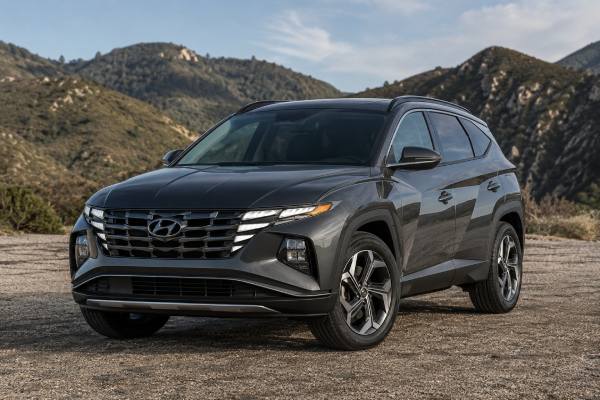
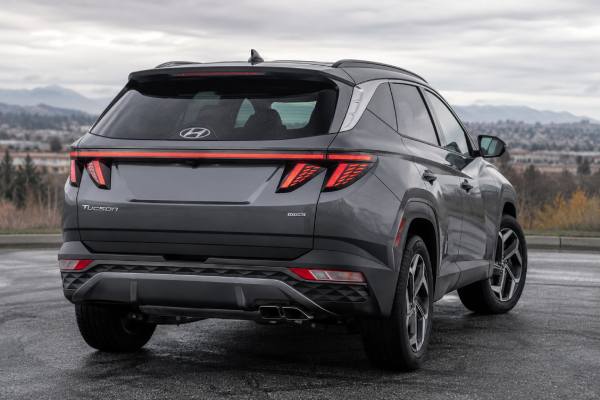
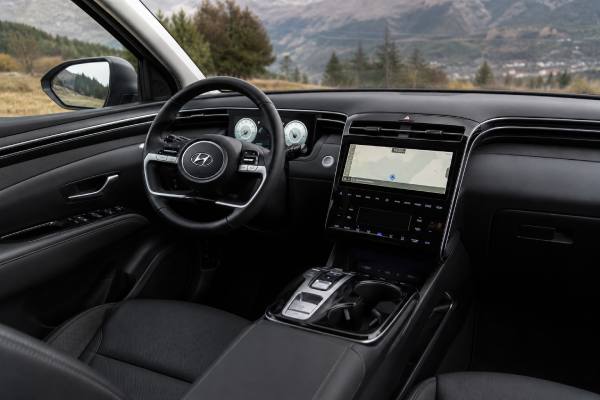
The 2021–2024 Hyundai Tucson NX4 with the Smartstream 1.6 T-GDi 150 hp petrol engine and HTRAC all-wheel drive is a practical compact SUV for buyers who want more traction than a front-drive crossover without moving into a bigger, thirstier vehicle. It combines a roomy cabin, a large boot, strong safety equipment, and a modern turbocharged engine with a conventional six-speed manual gearbox in many European-market versions.
This exact version is not the fastest Tucson NX4, and it is not the most economical. Its appeal is balance: enough torque for daily driving, useful AWD security in rain or snow, sensible running costs, and a cabin that feels more family-sized than many compact SUV rivals.
Final Verdict
The Hyundai Tucson NX4 HTRAC AWD with the 150 hp Smartstream 1.6 T-GDi is a good choice for drivers who want a spacious, safe, modern petrol SUV with extra traction, but do not need hybrid complexity or high performance. Its strongest appeal is everyday usability: generous cabin space, a big boot, good safety credentials, and a smooth turbo engine with useful mid-range torque. The main tradeoff is fuel economy, because AWD and the SUV body make it thirstier than front-drive or hybrid Tucsons. Buy one only with clear service history, completed recall checks, correct 0W-20 oil use, and evidence that the AWD driveline has not been neglected.
| Pros | Cons |
|---|---|
| HTRAC AWD adds useful wet-road and winter traction | Heavier and thirstier than the front-drive 150 hp Tucson |
| 250 Nm turbo torque suits daily driving well | Acceleration is adequate rather than genuinely quick |
| Large boot and roomy rear seats for family use | Large wheels can make the ride firmer and tyres costlier |
| Strong Euro NCAP result and broad safety equipment | ADAS features vary noticeably by trim and market |
| Six-speed manual avoids dual-clutch repair concerns | Clutch wear matters on city-driven or towing-used cars |
| Good used availability in many European markets | VIN-specific recall and campaign checks are essential |
Table of Contents
- Tucson NX4 AWD Overview
- Tucson 1.6 T-GDi Specifications
- Trims, Safety and Driver Assistance
- Reliability, Issues and Service Actions
- Maintenance and Used Buying Guide
- Driving, Performance and Fuel Economy
- Tucson AWD Compared With Rivals
Tucson NX4 AWD Overview
The NX4 Tucson is one of Hyundai’s most practical compact SUVs, and the 150 hp HTRAC version is best understood as the traction-focused petrol model rather than the performance model. It suits families, commuters in colder climates, and buyers who want a conventional petrol SUV with AWD instead of a hybrid.
The NX4 generation arrived with a much sharper design than the previous Tucson, but the important changes are underneath and inside. The body is wider, the wheelbase is generous for the class, and the boot is large enough to make the Tucson feel closer to the bigger end of the compact SUV segment. For buyers moving from an older Tucson, ix35, Qashqai, Sportage, Tiguan, or Kuga, the jump in cabin technology and rear-seat space is noticeable.
The Smartstream 1.6 T-GDi is a turbocharged direct-injection petrol engine. In this 150 hp tune, it makes its best case through mid-range torque rather than outright speed. The engine’s 250 Nm torque band starts low enough to make normal driving easy, especially with the six-speed manual gearbox. It is not a heavy towing specialist and it is not as relaxed as the hybrid under hard acceleration, but it feels flexible in ordinary traffic.
HTRAC is Hyundai’s electronically controlled all-wheel-drive system. In normal light driving, the Tucson behaves mainly like a front-drive SUV. When slip is detected, or when the control system predicts that rear-axle help is useful, torque can be sent to the rear wheels through a coupling. There is no low-range transfer case, so this is not an off-road 4×4 in the traditional sense. Its real value is in slippery roads, wet roundabouts, snow-covered lanes, gravel tracks, steep driveways, and light towing stability.
For used buyers, the key point is market variation. The 150 hp AWD petrol was offered in some European markets, while other regions paired AWD mainly with more powerful mild-hybrid, hybrid, plug-in hybrid, diesel, or 2.5-litre petrol versions. Trim names also vary by country. Always decode the VIN or check the original registration data before assuming that a Tucson advertised as “1.6 T-GDi” has HTRAC.
The 2021–2024 period covers the pre-facelift NX4 shape. Hyundai updated the Tucson for the 2025 model year in several markets, with revised engines, screens, controls, and equipment. The pre-facelift 150 hp HTRAC remains attractive because it offers the room and safety of the NX4 with a simpler petrol/manual layout than many electrified versions.
Tucson 1.6 T-GDi Specifications
This Tucson uses Hyundai’s Smartstream G1.6 T-GDi petrol engine mounted transversely in the front, paired with a six-speed manual gearbox and an electronically controlled AWD system. The most important ownership facts are the turbocharged direct-injection layout, the 250 Nm torque output, the 54-litre fuel tank, and the need for correct low-viscosity oil.
| Item | Hyundai Tucson NX4 1.6 T-GDi HTRAC AWD |
|---|---|
| Model years covered | 2021–2024 pre-facelift NX4 |
| Engine family | Smartstream G1.6 T-GDi |
| Engine code | G4FP |
| Displacement | 1,598 cc, 1.6 litres |
| Configuration | Inline-four, 16-valve DOHC |
| Induction | Turbocharged, intercooled |
| Fuel system | Petrol direct injection |
| Maximum power | 150 hp, 110 kW at 5,500 rpm |
| Maximum torque | 250 Nm, 184 lb-ft from 1,500–4,000 rpm |
| Bore × stroke | 75.6 × 89.0 mm |
| Compression ratio | 10.5:1 |
| Timing drive | Timing chain |
| Fuel recommendation | Unleaded petrol; 95 RON recommended in Europe |
| Item | Specification |
|---|---|
| Transmission | Six-speed manual |
| Drive system | HTRAC all-wheel drive, market-dependent naming |
| AWD layout | Front-biased with rear axle engaged by coupling |
| Front suspension | MacPherson struts with anti-roll bar |
| Rear suspension | Independent multi-link with stabiliser |
| Steering | Electric power-assisted rack-and-pinion |
| Front brakes | Ventilated discs, 291 mm |
| Rear brakes | Solid discs, 302 mm |
| Common tyre sizes | 215/65 R17, 235/55 R18, 235/50 R19 |
| Wheel lug nut torque | 107–127 Nm, 79–94 lb-ft |
| Item | Measurement |
|---|---|
| Body style | Five-door SUV |
| Seats | Five |
| Length | 4,500 mm, 177.2 in |
| Width | 1,865 mm, 73.4 in |
| Width with mirrors | 2,130 mm, 83.9 in |
| Height | 1,651 mm, 65.0 in |
| Wheelbase | 2,680 mm, 105.5 in |
| Ground clearance | 170 mm, 6.7 in |
| Turning circle | 10.92 m, 35.8 ft |
| Boot volume | 620–1,799 litres, 21.9–63.5 cu ft |
| Fuel tank | 54 litres, 14.3 US gal |
| Maximum roof load | 100 kg, 220 lb |
| Item | Value |
|---|---|
| 0–100 km/h | 10.6 seconds |
| 0–60 mph | About 10.1 seconds |
| Top speed | 189 km/h, 117 mph |
| Engine oil capacity | 4.8 litres, 5.07 US qt |
| Typical engine oil grade | SAE 0W-20, API SN PLUS/SP or ILSAC GF-6 |
| Coolant capacity | About 7.9 litres, 8.35 US qt |
| Brake fluid | DOT-4 LV type |
| Rear differential oil | API GL-5 SAE 75W/85, about 0.53–0.63 litres |
| Transfer case oil | API GL-5 SAE 75W/85, about 0.62–0.68 litres |
Trims, Safety and Driver Assistance
Trim names differ by market, so the safest way to shop is by equipment rather than badge alone. The same 1.6 T-GDi Tucson may appear as Comfort, Style, Premium, Ultimate, N Line, SE Connect, or another local grade depending on country and year.
Trims, options and identifiers
Most mechanical differences are tied to powertrain, gearbox, AWD availability, wheel size, and suspension options rather than trim badge alone. A basic 150 hp manual AWD car can feel more comfortable on 17- or 18-inch wheels, while high-spec N Line or Ultimate-style cars often bring larger wheels, more driver assistance, a bigger infotainment package, and a firmer feel.
Useful equipment to look for includes:
- LED headlights, not only LED daytime running lights.
- Heated front seats and heated steering wheel for winter use.
- Front and rear parking sensors with a rear-view camera.
- Larger digital driver display and 10.25-inch infotainment screen.
- Krell premium audio on higher trims in some markets.
- Smart electric tailgate on upper trims.
- Around-view camera, Blind-spot View Monitor, and electronically controlled suspension where available.
- Roof rails and towbar preparation if the car will carry bikes, roof boxes, or a small trailer.
Quick identifiers help avoid buying the wrong version. HTRAC or AWD badging may appear at the rear, but badges can be removed, added, or missing after repairs. Look underneath for the rear differential and driveshaft, check the registration document, and confirm the VIN build data. Inside, a manual 150 hp car has a conventional gear lever and clutch pedal, while hybrid and DCT versions use different controls and instrument displays.
Year-to-year changes before the facelift were mostly equipment and trim adjustments, not a fundamental change to the 150 hp petrol AWD formula. The big change came with the facelift that arrived around the 2025 model year in several regions, so a late-2024 registered car may need careful checking to see whether it is pre-facelift stock or a facelifted model.
Safety ratings
The NX4 Tucson achieved a five-star Euro NCAP rating in 2021. The rating applied across a broad range of Tucson variants, including 1.6 T-GDi 4×4 versions, and the headline scores were strong for a family SUV: 86% adult occupant protection, 87% child occupant protection, 66% vulnerable road user protection, and 70% safety assist.
Those numbers tell a useful story. Occupant protection is a strength, child protection is very good, and the safety assist score is respectable for the period. Vulnerable road user protection is not poor, but it is the weaker area, mainly because SUV front-end shape and stiff windscreen-pillar areas remain hard to manage in pedestrian impacts.
Safety systems and ADAS
A typical NX4 Tucson safety package includes multiple airbags, including a front-centre airbag on many versions, electronic stability control, anti-lock brakes, emergency stop signalling, tyre-pressure monitoring, ISOFIX child-seat mounting points, autonomous emergency braking, lane assistance, and driver attention warning. Higher trims may add blind-spot collision avoidance, rear cross-traffic collision avoidance, Highway Driving Assist, adaptive cruise control, and camera-based blind-spot display.
ADAS availability depends heavily on gearbox and trim. Some systems that work best in stop-and-go traffic are more common on DCT, hybrid, or automatic variants than on a manual 150 hp car. For used buyers, do not rely on the brochure name alone. Test the actual car, scroll through the driver-assistance menus, and check that no warning lights appear after startup.
Calibration matters after repairs. A windscreen replacement, bumper repair, steering alignment, radar bracket repair, or camera fault can affect AEB, lane keeping, adaptive cruise, and sign recognition. A used Tucson with recent front-end damage should have invoices showing correct sensor calibration, not just cosmetic repair.
Reliability, Issues and Service Actions
The 150 hp Smartstream Tucson is generally a sensible ownership proposition, but it rewards correct oil, regular servicing, and proper AWD fluid checks. Most problems are small electrical, brake, trim, battery, or wear-related issues, while the expensive risks are rare but worth screening before purchase.
| Issue area | Prevalence | Cost tier | Typical signs | Best response |
|---|---|---|---|---|
| 12 V battery and stop-start | Common | Low to medium | Stop-start unavailable, weak starts, random warnings | Test battery health before replacing parts |
| Brake corrosion or noise | Common | Low to medium | Squeal, vibration, rusty rear discs | Inspect pads, sliders and rear discs |
| Infotainment or camera glitches | Occasional | Low to medium | Black screen, lag, Bluetooth dropouts | Check software updates and connectors |
| Ignition or fuel-system misfire | Occasional | Medium | Rough idle, hesitation, check-engine light | Scan codes, check plugs, coils and injectors |
| Clutch wear | Occasional | Medium | High biting point, slip, judder | Road-test uphill and inspect service use |
| AWD coupling or oil neglect | Occasional | Medium to high | Binding, vibration, driveline noise | Inspect transfer case and rear differential service |
| Timing chain or CVVD faults | Rare | High | Cold rattle, correlation codes, poor running | Diagnose promptly; do not ignore chain noise |
| Turbo or boost-control faults | Rare | High | Loss of power, smoke, boost codes | Check oil history, hoses and actuator control |
Engine and emissions checks
The G4FP engine’s biggest need is clean, correct oil. The turbocharger, timing chain, cam phasers, and Hyundai’s variable-valve hardware all depend on oil quality and pressure. A Tucson that has missed services, used the wrong oil grade, or spent years doing very short trips is a higher-risk buy than one with boring but complete records.
Listen for a brief cold-start rattle, uneven idle, or a sharp tapping noise that does not settle. A small amount of direct-injection noise is normal, but persistent chain rattle, cam correlation fault codes, or misfire codes need diagnosis. Spark plugs are not a lifetime item, and old plugs can stress ignition coils on turbo petrol engines.
Direct-injection engines can build carbon deposits on intake valves over time because fuel does not wash over the back of the valve. This is usually a long-term issue rather than an early failure point. Symptoms include rough idle, hesitation, and reduced performance. Good oil, decent fuel, proper warm-up, and regular longer journeys help.
Many European petrol models use a gasoline particulate filter. Short urban trips can make soot management less effective. A car that only does school runs may need occasional longer drives to keep the system healthy. Warning lights, repeated failed regeneration attempts, or exhaust-sensor faults should be scanned before purchase.
Driveline, suspension and body
The manual gearbox is usually straightforward, but the clutch is the wear item to watch. Test for slip in a higher gear at low rpm, listen for dual-mass flywheel chatter, and check for judder when pulling away. Cars used for steep driveways, towing, heavy city traffic, or inexperienced drivers can wear clutches sooner than mileage suggests.
HTRAC adds transfer-case, prop shaft, rear differential, coupling, and rear driveshaft components. These are not usually troublesome when maintained, but they dislike mismatched tyres, neglected oil checks, impact damage, and water submersion. All four tyres should be the same size, similar brand and tread depth, and correctly inflated.
Suspension wear is usually predictable: front drop links, bushes, ball joints, and wheel bearings are worth checking on rough-road cars. Large wheels increase road shock and can make bent rims or tyre sidewall damage more likely. Inspect the rear suspension and underbody carefully in regions that use road salt.
Recalls and service actions
Recall exposure depends on market, build plant, model year, trim, and VIN. Known NX4-era Tucson campaigns in some markets have included lighting software updates, roof molding inspections, tyre placard corrections, electric oil-pump-related actions on certain automatic or ISG-equipped models, and tow-hitch wiring harness inspections or repairs. Not every campaign applies to this exact 150 hp manual AWD version.
Before buying, request:
- A printed dealer campaign report for the VIN.
- Proof that any safety recalls were completed.
- Service invoices showing oil grade and mileage.
- Evidence of brake fluid replacement.
- Records for transfer case and rear differential inspections.
- Any infotainment, ADAS, or ECU software updates.
A clean recall check is not the same as a good service history. Recalls address safety defects; they do not prove that the owner changed oil, brake fluid, coolant, or AWD lubricants on time.
Maintenance and Used Buying Guide
The best Tucson 1.6 T-GDi HTRAC is the one with regular oil changes, clean tyres, smooth clutch action, no warning lights, and documented AWD inspection. A cheaper car with missing records can quickly cost more than a well-maintained example.
| Interval | What to service or inspect |
|---|---|
| Every 10,000 km or 12 months | Engine oil and filter; tyre rotation; general inspection |
| Every service | Check oil level, coolant, brakes, tyres, lights, leaks and battery condition |
| Every 30,000 km or 24 months | Brake fluid; cabin air filter |
| Every 40,000 km | Replace engine air filter under normal schedule |
| Every 60,000 km or 48 months | Inspect transfer case oil, rear differential oil and AWD driveline |
| Every 70,000 km | Replace spark plugs |
| Every 90,000 km or 72 months | Inspect valve clearance if noisy or vibration is present |
| First 200,000 km or 120 months | Replace engine coolant, then repeat every 40,000 km or 24 months |
| After water submersion | Change transfer case and rear differential oil immediately |
The official normal schedule is a starting point. Use shorter oil intervals if the car does mostly short trips, heavy traffic, cold starts, mountain driving, dusty roads, towing, or long high-speed motorway work. Turbo petrol engines are not the place to save money by stretching oil changes.
The fuel filter is generally treated as maintenance-free, but fuel quality matters. If the car shows hard starting, hesitation, fuel starvation, surging, or repeated lean codes, fuel delivery should be checked rather than ignored.
The timing chain has no routine replacement interval like a timing belt. That does not mean it can never fail. It should be inspected when symptoms appear: cold-start chain rattle, camshaft/crankshaft correlation fault codes, rough running, poor starting, or oil-pressure-related warnings. Chain, guides, tensioner, and cam timing hardware should be replaced when out of specification.
| System | Useful reference |
|---|---|
| Engine oil | 4.8 litres; SAE 0W-20, API SN PLUS/SP or ILSAC GF-6 |
| Coolant | Ethylene-glycol coolant suitable for aluminium engines |
| Brake fluid | DOT-4 LV, replaced every 30,000 km or 24 months |
| Rear differential oil | API GL-5 SAE 75W/85, inspect every 60,000 km |
| Transfer case oil | API GL-5 SAE 75W/85, inspect every 60,000 km |
| Wheel nuts | 107–127 Nm, retorque after wheel removal |
| 12 V battery | Test yearly after three years; many need replacement around 4–6 years |
Used inspection checklist
A good pre-purchase inspection should include more than a short test drive. Focus on the items that tell you how the car was used:
- Cold start: listen for chain rattle, turbo noise, misfire, exhaust leaks, and rough idle.
- Clutch and gearbox: check bite point, slip, reverse engagement, and vibration.
- AWD system: check for matching tyres, driveline binding, oil leaks, and rear differential noise.
- Brakes: inspect rear-disc corrosion, pad wear, caliper sliders, and brake-fluid age.
- Suspension: listen for knocks over small bumps and inspect bushes and ball joints.
- Electronics: test cameras, parking sensors, infotainment, climate control, keyless entry, and all ADAS warnings.
- Body: inspect roof moldings, door seals, tailgate alignment, panoramic roof drains if fitted, and underbody corrosion.
- Cooling system: look for coolant smell, stained hoses, low coolant, and radiator damage.
- Service documents: confirm oil grade, date-based servicing, recall completion, and mileage consistency.
The most desirable examples are usually mid-to-high trims with useful comfort and safety equipment, but not necessarily the largest wheels. A well-kept car on sensible tyres is often a better long-term choice than a high-spec car with cheap mismatched tyres, missing services, and a tired clutch.
Avoid cars with unresolved warning lights, unknown remaps, towbar wiring installed without documentation, major front-end repairs without ADAS calibration proof, or a history of skipped oil changes. The Tucson is durable when maintained, but it is still a modern turbocharged AWD SUV with expensive components if neglected.
Driving, Performance and Fuel Economy
The 150 hp Tucson HTRAC feels calm and easy rather than sporty. Its strength is secure, predictable everyday driving, while its weaknesses are modest acceleration and higher fuel use than front-drive or hybrid alternatives.
The engine pulls cleanly from low revs once the turbo is awake. There can be a slight pause if you ask for full acceleration from very low rpm, but the wide 1,500–4,000 rpm torque band means you do not need constant gear changes in normal use. The six-speed manual has a practical spread of ratios. It is not an enthusiast gearbox, but it is easy to live with and avoids the low-speed hesitation some drivers dislike in dual-clutch automatics.
In town, the Tucson feels bigger than a hatchback but not difficult. The steering is light, the driving position is high, and visibility is helped by cameras and sensors on better-equipped cars. The ride depends heavily on wheels. On 17- or 18-inch tyres, it is comfortable for daily driving. On 19-inch wheels, the body still feels composed, but sharp potholes and broken tarmac are more obvious.
On motorways, the Tucson is stable and quiet enough for long family trips. Wind noise is moderate, tyre noise depends on tyre brand and wheel size, and the engine settles down well at a cruise. It does not have the effortless high-speed response of the hybrid or more powerful 180 hp versions, so planned overtaking is best. Loaded with passengers and luggage, you will use the gearbox more often on hills.
HTRAC improves confidence in poor weather. It cannot overcome bad tyres, but with good all-season or winter tyres it makes the Tucson feel more secure pulling away on slippery surfaces and climbing wet or snowy roads. Stability control is generally well judged, stepping in early enough to keep the car tidy without making normal driving feel clumsy.
Real-world fuel economy is the main compromise. Expect roughly:
- City and short trips: 8.5–10.5 L/100 km, about 22–28 mpg US or 27–33 mpg UK.
- Highway at 100–120 km/h: 6.8–8.0 L/100 km, about 29–35 mpg US or 35–42 mpg UK.
- Mixed use: 7.5–9.0 L/100 km, about 26–31 mpg US or 31–38 mpg UK.
Cold weather, winter tyres, roof boxes, short journeys, heavy traffic, and mountain roads can add a noticeable penalty. A front-drive 150 hp Tucson will usually be slightly more economical, and the hybrid can be much better in city use. The HTRAC version earns its keep when traction matters, not when maximum fuel economy is the priority.
For towing, check the exact rating on the registration document and VIN plate. In general, this powertrain is better suited to small trailers, light camping equipment, bike racks, or occasional utility use than regular heavy towing. AWD helps traction, but the 150 hp engine, manual clutch, and compact-SUV brakes still have limits. If towing is central to your use, inspect the clutch, cooling system, rear suspension, towbar wiring, and rear tyres carefully.
Tucson AWD Compared With Rivals
The Tucson 1.6 T-GDi HTRAC is most appealing when judged as a roomy, well-equipped, traction-focused family SUV. It is less convincing if judged only by fuel economy, acceleration, or premium cabin feel.
Against the Kia Sportage, the Tucson is closely related under the skin. The Sportage often offers similar engines, similar safety technology, and similar space, so the better buy usually comes down to price, warranty, trim, condition, and which cabin layout you prefer. The Kia’s dashboard design may suit some drivers better, while the Hyundai often feels slightly cleaner and more restrained.
Against the Volkswagen Tiguan, the Hyundai usually wins on equipment value and warranty appeal in many markets. The Tiguan can feel more mature at motorway speeds and may have a more conservative interior that ages well. The Tucson counters with bolder styling, a large boot, and strong safety features. Used Tiguan 4Motion petrols can cost more and often involve DSG servicing considerations.
Against the Mazda CX-5 AWD, the Hyundai offers a more modern cabin layout and often more rear-seat space. The Mazda usually has better steering feel and a more natural driving position for keen drivers. If you enjoy driving on country roads, the Mazda may feel more satisfying. If you want screens, space, safety equipment, and a newer-generation cabin, the Tucson has the edge.
Against the Toyota RAV4 Hybrid AWD, the Toyota is usually more economical and has a strong reputation for hybrid durability. The Tucson fights back with a lower used price in some markets, a conventional manual petrol setup, and a more European-feeling turbo torque delivery. The RAV4 is the smarter efficiency choice; the Tucson is the more conventional petrol SUV choice.
Against the Ford Kuga, the Tucson feels roomier and more distinctive inside, while the Ford often has sharper steering and a more engaging chassis. The Kuga’s engine and hybrid choices vary widely, so comparison depends on the exact version. For buyers who care most about rear-seat room, boot shape, and dashboard tech, the Hyundai is usually easier to recommend.
The most important internal rivals are other Tucsons. The 150 hp front-drive version is cheaper to run and simpler if you do not need AWD. The 180 hp mild-hybrid AWD is quicker and often automatic, but more complex. The full hybrid is smoother and more efficient, especially in town, but costs more to buy and has hybrid-system inspection needs. The plug-in hybrid can be excellent for short commutes with home charging, but it is the wrong choice if you rarely charge it.
For most used buyers, the 150 hp HTRAC makes sense when the car’s condition, service history, equipment, and price are right. Do not pay a large premium for AWD unless you will use it. Do pay a premium for a clean car with correct services, matching tyres, completed campaigns, and no clutch or driveline warning signs.
References
- Hyundai Tucson IV 1.6 T-GDI (150 Hp) 4×4 | Technical specs, data, fuel consumption, Dimensions 2020–2024 (Specifications)
- Normal Maintenance Schedule (Smartstream 1.6 T-GDi) 2025 (Owner’s Manual)
- Recommended lubricants and capacities | 2025 Hyundai Tucson 2025 (Owner’s Manual)
- Euro NCAP | Hyundai TUCSON 2021 (Safety Rating)
- Check for Recalls: Vehicle, Car Seat, Tire, Equipment 2026 (Recall Database)
Disclaimer
This article is for informational purposes only and is not a substitute for professional diagnosis, repair, inspection, or official Hyundai service guidance. Specifications, torque values, service intervals, fluids, procedures, safety equipment, recall status, and towing limits can vary by VIN, market, model year, trim, and factory equipment. Always verify critical information against the official service documentation for the specific vehicle and consult a qualified technician before repairs or purchase decisions.
If this guide helped you, please consider sharing it on Facebook, X/Twitter, or with another Hyundai Tucson buyer to support our work.